This study investigates the critical question of why the Iranian Parliament has not adopted and institutionalizing established mechanisms for public participation in its legislative process.
Employing a qualitative inductive research design, this study conducted 23 semi-structured, in-depth interviews with key stakeholders directly involved in the legislative process. The data collected was subjected to a rigorous qualitative content analysis to identify emergent themes and patterns.
The analysis uncovered a complex typology of legislative inaction, which can be categorized into five themes: (1) Calculated inaction, driven by a desire to preserve legislative power and the perception that lawmaking is too technically complex for public input; (2) Ideological inaction, stemming from a paternalistic governance ethos and a commitment to safeguarding revolutionary values from perceived deviation; (3) Imposed inaction, where external factors such as restrictive parliamentary regulations and influential media narratives enforce exclusivity; (4) Reluctant inaction, arising from systemic deficiencies including a lack of public demand, weak institutional incentives, and infrastructural constraints; and (5) Inadvertent inaction, sustained by cognitive biases, risk aversion, and unconscious institutional habits among legislators.
This research proposes a comprehensive framework for understanding the phenomenon of legislative inaction in public participation. With Iran’s unique political-ideological landscape, characterized by the principle of Velayat-e Faqih (Guardianship of the Islamic Jurist), the study contributes to debates on participatory democracy and offers evidence-based insights for designing context-sensitive parliamentary reforms.
Introduction
In recent years, there appears to be a growing perception that knowledge is not exclusive to specialists but is distributed among all actors (Ranchordás and Voermans, 2017). It is no longer sufficient to rely solely on the thoughts and opinions of experts for policymaking and legislation; the points of view of the public should also be used. Because the lives of expert policymakers and legislators rarely mirror those of ordinary people, attention to the public is particularly valuable: citizens have experiential knowledge of situations that elites rarely encounter (Dean, 2017). This epistemological shift challenges traditional models of policymaking and legislation, which have historically relied on expert judgment. Accordingly, there is growing consensus that effective governance must also incorporate the experiential knowledge of citizens, who possess direct understanding of policy impacts that elites often lack (Danaeefard et al., 2024a). Furthermore, with increasing levels of education and access to information, we are witnessing the emergence of the “critical citizens”. These citizens are more critical of the decisions made by those in power and are more inclined to criticize the state based on their individual preferences and life circumstances (Leston-Bandeira and Siefken, 2023). Hence, today many citizens no longer rely solely on representative democracy; they seek a more active role in governance (Voermans et al., 2015). When citizens withdraw from the political space, it is often not because they are disinterested or indifferent to public affairs, but as their needs have been ignored (Hoppe, 2010). In a public discourse shaped by narratives of voter indifference and mistrust of politicians — and where parliaments are blamed for many politics’ ills — parliaments would be expected to attract public participation (Leston-Bandeira, 2014; Danaeefard et al., 2024a).
Public participation is therefore often seen as an important way to restore trust and strengthen the legitimacy of parliaments; this can be achieved by providing multiple access points to legislatures, ensuring transparent information, and enabling meaningful participation in policymaking. Legislators sit at the center of issues that require extensive discussion and enrichment beyond existing political and expert circles (Acosta et al., 2024). Accordingly, parliaments hope that by expanding their participatory role they will create new channels for communicating with citizens and better link the national political system to them (Su Seo and Raunio, 2017). They also aim to rekindle citizens’ attachment to the institution of parliament and to the democratic system as a whole (Matthieu et al., 2020). All this occurs while parliaments, by their nature, have traditionally been closed institutions that often rely on confidential consultations for power negotiations, decision-making, compromise, and conflict resolution (Danaeefard et al., 2024a). Furthermore, their centralized physical location and distance from many citizens pose additional challenges for public participation (Griffith and Leston-Bandeira, 2012). Nevertheless, given the global trend toward opening parliamentary doors to the public, the emphasis in higher-level documents on public participation, and Iran’s “People’s Parliament” plan, parliamentarians should have taken practical and effective steps to design and use public-participation tools in legislation. Because of this lack of action, analyzing the causes of inaction is the central problem of this article. The article therefore aims to explain and analyze the reasons, challenges, and considerations behind that inaction. By clarifying the mechanisms that reproduce non-adoption, the study contributes to both debates on institutionalizing participation in legislatures and to policy discussions about feasible, context-sensitive reforms that can channel citizen knowledge into legislative decision-making without undermining constitutional and security constraints.
Theoretical foundation and conceptual framework
What and why public participation
Since the 1960s, a global “participatory turn” has placed participatory discourses and techniques at the center of decision-making across policy domains and sectors (Bherer et al., 2018). Originally, these mechanisms were devised to channel citizens’ views into political and bureaucratic processes, to hold elected officials accountable, and to empower people through sustained involvement (Kabingesi, 2021, p. 16). In this regard, representative, vote-centric systems restrict citizens’ formal role to periodic elections: between ballots, elected officials exercise delegated authority with limited direct input from the public (Mukuna and Mbao, 2014). In practice, however, citizens increasingly demand a voice in law-making and policy selection so that policies echo lived experience rather than only expert judgment (Bishop and Davis, 2002). Greater, direct citizen participation can strengthen the legitimacy and effectiveness of legislation, improve the fit between problem and policy, enhance the quality of policymaking, and support implementation and compliance (Voermans et al., 2015). Hence, this demand for participation sits alongside growing public distrust of core political institutions — notably parliaments — which has prompted legislatures to broaden and diversify their outreach and engagement efforts (Prior and Leston-Bandeira, 2022). Equally important is the disposition of officials themselves: the willingness of national and government actors to participate of the public is a crucial attitudinal determinant of participatory success (Migchelbrink and Van de Walle, 2022).
Accordingly, scholars have advanced several reasons for incorporating citizens directly into the legislative and policy process. Dewey’s (1981, cited in Fung, 2006, p. 68) aphorism “the man who wears the shoe, not the shoemaker, knows best where it pinches” captures the core idea that those affected by a policy often possess the most relevant practical knowledge. Contemporary research elaborates this claim with multiple, complementary rationales: the rising technical complexity of public problems and policy designs (Howlett and Mukherjee, 2018); different ways that people identify and reason about problems (Danaeefard et al., 2024a); the value of end-user perspectives when defining problems and solutions (Howlett and Mukherjee, 2018); uncertainty in policy outcomes (Pluchinotta et al., 2020); and gaps in decision-makers’ knowledge of everyday life and practice (Fung, 2006; Dean, 2017). Empirical needs — access to accurate local information and statistics — also motivate participation (Restrepo and Christiaans, 2004). Normative and political reasons matter too: participation can respond to a felt collective need to be involved (Serra-Silva, 2023), reduce distance between citizens and their representatives (Niessen and Reuchamps, 2022), rebuild public trust (Bishop and Davis, 2002; Leston-Bandeira, 2012), and make it easier to achieve policy objectives by aligning policy goals with public preferences and capacities (Tamano, 2021). However, understanding the intellectual developments in the field of politicization and how they affect legislative institutions can provide important insights for analyzing barriers to public participation, as research trends are moving toward examining the consequences of politicization on institutional legitimacy and accountability (Danaeefard et al., 2025).
Tools used in different countries
Over the past decade, parliaments have introduced a wide range of tools to expand citizen participation in legislative process. These include traditional mechanisms such as petitions and public hearings, alongside digital innovations like e-petitions, online consultations, crowdsourcing initiatives, e-participation platforms and structured e-forums (Danaeefard et al., 2024a). While many countries experiment with multiple instruments, petitions, hearings, and digital participation platforms remain the most widespread. The United Kingdom and Brazil, in particular, have been at the forefront of testing and institutionalizing such mechanisms.
The UK experience illustrates both the opportunities and limits of digital participation. The e-petition system launched in 2015 generated tens of thousands of petitions and millions of signatures, offering citizens new ways to link with institutions and shape public debate (Bochel, 2013, 2016; Leston-Bandeira, 2019). Yet, research shows that most petitions are rejected, and few translate into legislative change. Parliamentary experiments with public readings and online comments also attracted significant engagement but had little influence on amendments or debates, reflecting MPs’ skepticism about the value of such participation (Leston-Bandeira and Thompson, 2017; Matthews, 2021). These findings highlight a broader tension between institutional openness and the reluctance of representatives to share legislative authority.
In Brazil, efforts to foster engagement have taken a more multifaceted form. The Chamber of Deputies has embraced digital hearings, social media channels, and a dedicated e-democracy portal, which together enhance transparency and offer citizens spaces for deliberation (de Barros et al., 2016; Faria and Rehbein, 2016). Additional innovations such as Collective Mandates, where groups of citizen’s campaign for legislative seats collectively, aim to reconfigure representation, though they raise concerns about legal ambiguities and populist risks (Secchi et al., 2024). Beyond Brazil and the UK, initiatives such as France’s Parliament & Citoyens and Greece’s crowdsourced parliamentary data project show how technology can facilitate public dialogue and improve transparency, even if their role often supplements rather than replaces representative structures (Defacqz and Dupuy, 2021; Fitsilis and Mikros, 2024).
A more recent frontier in participatory governance involves institutionalizing deliberation. The German-speaking Community of Belgium has pioneered a model combining a permanent citizens’ council with recurring deliberative assemblies directly linked to parliamentary process (Niessen and Reuchamps, 2022). This approach responds to public dissatisfaction with representative democracy, yet studies caution that elites may instrumentalize such innovations to reinforce existing power structures rather than democratize them (Macq and Jacquet, 2023).
While these international examples illustrate a spectrum of participatory tools, their application must be understood within specific national contexts. In Iran, the legislative process formally mirrors common models, typically divided into stages: (1) agenda-setting/issue identification, (2) drafting/preliminary text, (3) committee scrutiny (evidence and amendment), (4) plenary debate and vote, and (5) post-enactment review/vetting. Our data indicates that most interviewees identified the primary inaction in stages 1-3: public inputs are often not solicited at the drafting stage, and committees do not systematically integrate citizen submissions into amendment processes. In addition, Iran’s legislative environment is uniquely structured by the principle of Velayat-e Faqih (Guardianship of the Islamic Jurist) and the oversight of the Guardian Council. This creates a system where centralized authority and revolutionary ideology necessitate that any participatory tools be reconciled with compliance to Islamic and constitutional principles. While initiatives such as crowdsourcing bills and a Virtual Parliament platform demonstrate sporadic engagement, these efforts remain ad-hoc and have failed to become systematic. This is due to institutional barriers including legal gatekeeping, concentrated agenda-setting power, and political incentives that favor local clientelism over national participatory reform, resulting in a form of structural inaction that hinders the institutionalization of public participation.
Taken together, these cases reveal a consistent pattern: while participatory tools expand opportunities for transparency, dialogue, and symbolic empowerment, their real impact on legislation depends on institutional design and political will. Without dedicated committees, clear procedures, and parliamentary commitment, public input risks remaining consultative at best. At the same time, uneven engagement, risks of populist capture, and representative skepticism limit the transformative potential of these tools. The challenge for the future is to embed participation more deeply into legislative routines, ensuring that citizen voices influence not only debate but also decision-making.
Methodology
Content analysis is a method that may be used with qualitative or quantitative data. In addition, it may be used inductively or deductively. Which one of these items is used is determined according to the purpose of the study. If there is insufficient prior knowledge about the phenomenon or if this knowledge is fragmented, an inductive approach is recommended (Danaeefard et al., 2024b). Therefore, considering that there was not enough previous knowledge about the issue of inaction in public participation, an inductive approach was adopted in this research.
Research design
As this study aims at identifying and analyzing the reasons for inaction in the application and use of public participation tools in the legislation of the Iranian Parliament, it adopted the qualitative research approach. This approach is particularly suitable for exploring complex and context-dependent phenomena, enabling an in-depth examination of the factors contributing to this issue. This research sought to capture the nuanced perspectives of key stakeholders and uncover underlying causes of inaction.
Participants
The participants in this research included a diverse group of individuals with expertise and experience related to the subject. Specifically, the sample comprised members of the Iranian Parliament, experts and managers from the Iranian Parliamentary Research Center (PRC), and selected public policy scholars. To ensure that the participants were well-suited to provide rich and relevant insights, purposive sampling was employed.
Data collection
Data collection was conducted through semi-structured interviews, a method suitable for qualitative research due to its flexibility and depthness. The interview protocol was carefully designed to address the research objectives while allowing participants to freely express their thoughts and experiences. A total of 23 interviews, including 11 members of parliament, 7 experts and directors of the PRC, and 5 scholars in the field of parliamentary studies, were conducted in winter 2024, with the process continuing until theoretical saturation was reached. This saturation indicates that no new themes were emerging from the data. The interviews were recorded, transcribed verbatim, and stored securely to ensure data integrity and confidentiality.
Data analysis
Data was analyzed by using qualitative content analysis method (Graneheim and Lundman, 2004). The process began with a review of all interview transcripts to identify units of meaning, which were assigned preliminary codes. To ensure reliability, two coders independently coded the transcripts; they then reconciled discrepancies through discussion and consensus, ultimately recoding all transcripts against a finalized, agreed-upon codebook. An iterative process of constant comparison was adopted to examine the codes for similarities and differences. This allowed the grouping of similar codes into distinct subcategories, which were then further synthesized into broader main categories. Finally, through a careful review of these main categories, the overarching themes that form the core findings of the study are identified.
Findings
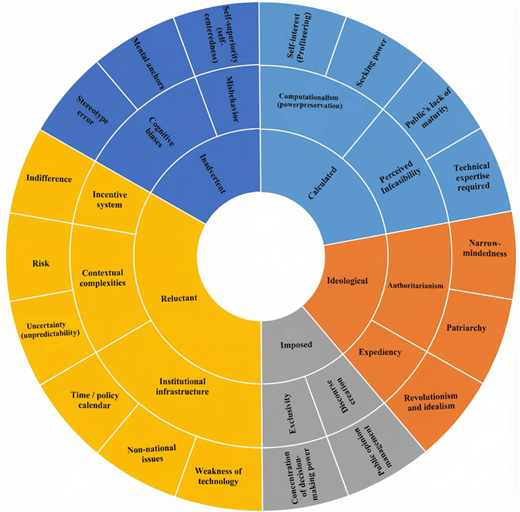
This study has identified five interrelated types of inaction: (1) calculated or deliberate inaction, the deliberate withholding of participatory mechanisms to preserve power or protect vested interests; (2) ideological or normative inaction, value-based resistance rooted in paternalistic or revolutionary norms; (3) imposed or forced inaction, external constraints that limit participation; (4) reluctant or involuntary inaction, passive non-adoption stemming from systemic deficiencies and resource gaps; and (5) inadvertent or unconscious inaction, unintentional non-action driven by cognitive biases and institutional habits. As indicated in Figure 1, these themes are extracted from categories and subcategories.
Themes 1: Calculated inaction
Calculated (or intentional) inaction refers to times when the legislator and policymaker does not act on an issue or problem deliberately and on purpose, and assumes a passive attitude.
Category 1: Perceived infeasibility
According to some interviewees, legislative language is a complex and technical language and the public does not have a detailed and specialized understanding of this field. In other words, the being specialized of legislation and the design of many complex and multi-dimensional issues requires the presence of people with different expertise, and naturally the public cannot give expert opinion. Another point is that even if the people can give an expert opinion, is there a possibility of infrastructure in the country or not? Although in the literature of democracy, we are faced with the systems of representative democracy, direct democracy and semi-direct democracy, but for the sake of possibility, usually the tendency of parliamentary systems of countries is towards representative democracy; Because in direct democracy, there is little opportunity for individual citizens to express their opinion on many governance issues; For this reason, the public elects a small number of representatives to express their opinions on important public issues and send them to the parliaments. The necessity of representation in democratic systems has created the idea or illusion in some representatives that the people lack social and citizenship maturity to participate in the legislative process and the representatives are more knowledgeable, correct and sympathetic to the good of the society and the country than other people. This is the reason why these representatives give priority to the education and empowerment of the people, and after that they advise to use the potential of the people to participate in the affairs of the country.
Category 2: Computationalism (power preservation)
The interviewees believed that some representatives considered the right to legislate as part of their power and did not believe in opening the area of legislation to the public and other sovereign and non-sovereign stakeholders. In fact, by seeking power, they tend to make legislation as a factor of authority exclusive to themselves and do not involve the public in it; Because the redistribution of power leads to an increase in the scope of inclusion and the presence of the public in the area of decision-making. Also, the existence of certain privileges and special interests in some legislations has created tendencies that keep legislation in a closed and dark space so that those privileges are not revealed through public participation. Hence, one of the factors of inaction should be considered the self-interest or profiteering of some representatives in directing some interests to themselves, which has a more deliberate and calculated nature.
Theme 2: Ideological inaction
The second theme is ideological inaction. This type of inaction is the result of cultural factors and basic values, arising from cultural origins, social norms and beliefs, and the value system of a society, and cannot necessarily be proven with scientific evidence.
Category 1: Expediency
One of the ideological reasons for inaction in participation can be a form of revolutionism and idealism. Some of the interviewees believe that people's participation in the legislative process provides the possibility of deviating the direction of governance from the ideals and values of the society, so to avoid this negative outcome, they go towards non-participatory legislation. Therefore, the existence of such risks and the effect that public participation can have on the preservation of the values and ideals of the revolution has blocked the tendency to participate.
Category 2: Authoritarianism
According to the interviewees, some of the existing theories and ideologies basically consider legislation to be an elite practice that should be confined to the level of scientific-executive elites. In other words, according to these theories, people who are lawyers and representatives of the people took this responsibility on behalf of the people to make decisions on their behalf, and this issue itself has become the basis for non-participation. Perhaps this patriarchal approach has created this image among the representatives that they consider themselves the guardians of the people.
Another reason that can be raised here for not asking people to participate is the elimination of points of view that are against the narrow-minded point of view. Participatory legislation leads to the fact that people with different points of view start expressing their opinions, which will lead to pluralism and sometimes theoretical and practical confusion. For this reason, the preference of legislation is to be able to prevent the submission of others' opinions by closing the collaborative space.
Theme 3: Imposed inaction
The third type of inaction is the imposed inaction, which refers to the conditions when external influencing factors (whether outside the parliament or outside the country) impose this type of behavior, i.e., the lack of participation from the public, on the representatives.
Category 1: Exclusivity
In the following, the interviewees mentioned the powers of the Presidium of the Parliament. Referring to the review of the Parliament's internal regulations in the previous period (the 11th period), they believe that the Presidium of the Parliament has many powers to interfere in the legislative process, which negates public participation and even the participation of representatives. Of 23 interviewees, 9 voiced concerns about Presidium power. In other words, these powers have resulted in the total weight of the representatives being much less than the Presidium of the Parliament, and in practice, the Board of Governors determines and imposes the rules of the game. In other words, it can be claimed that this issue has caused a form of concentration of decision-making power in the Presidium of the Parliament, and as a result, inaction is imposed on the representatives in some matters, because it has created a kind of exclusivity among a limited number of representatives. It is worth mentioning that, while the internal regulations of the parliament have incorporated the traces of political participation and opinion polling from the elites, they are silent about public participation.
Category 2: Discourse creation
On the other hand, lobbyists and interest groups in the process of bargaining with representatives, warn them from public participation. They introduce themselves as representatives of the people and public affairs, but in practice they impose their personal opinions on the representatives under the umbrella of public interest and lead to the lack of public participation. Therefore, some representatives are afraid of public participation due to the fear of confusing people’s opinion with pressure or interest groups, and wanting to formulate their interests under the cover of public demands.
Another factor that the interviewees proposed in the imposed inaction is the effect of the negative media flow on public opinion. Considering the abuses that the opposition media may have on the quality of the people's demands in various legislative areas, the representatives act more cautiously in pursuit of the realization of this matter. However, the media can often exploit the public interest through media techniques.
Theme 4: Reluctant inaction
The fourth type of inaction is reluctant inaction. In some cases, it has been seen that policymakers take or do not take a series of decisions out of necessity and reluctance.
Category 1: Incentive system
The interviewees believe that the lack of public will is a key factor in the inaction of representatives in public participation. In their view, many representatives remain passive in this matter because they perceive no public demand for public participation in the legislative process. This stems from their role: as representatives responsible for conveying the opinions, thoughts and wishes of the people, they argue that the people themselves have not clearly requested such involvement. Another reason is the lack of proper evaluation system and incentive system. Considering that in some parliaments around the world, the name of the designer is attached to every plan presented to the representatives — so to speak, his or her name is tied to the plan — and in the future, the strengths and weaknesses of the plan will be attributed to that person, this accountability makes it possible for the people to evaluate the performance of that represenatation. It also gives specific motivation for the person to work toward improving society’s conditions along with the approval of the plan. Since this is not possible in the Iranian parliament, representatives lack a particular motivation to advance within the legislative system and tend to suffer from indifference in this area. As a result, they often prefer to deal with everyday, low-margin, and low-risk affairs.
Category 2: Institutional infrastructure
Another reason that the interviewees acknowledged was the lack of opportunity and time of the representatives. Some representatives, while believing in the effectiveness of public participation, consider the lack of enough time to realize the public participation process as a factor for reluctant inaction. In fact, the limitations of the time / policy calendar and the pressures caused by the lack of time prevent the representatives from engaging the public in the legislation. In addition, the representation of the constituency is also influential. Parliamentarians are in a position to focus on the issues of the constituency, which may make them free from national issues, and therefore the possibility of thinking about improving the legislative process is likely to be denied to them. In other words, due to the existence of a parliament in Iran's political system, and the withdrawal mechanism from the government, which is within the powers of the parliamentarians, it is possible for the representatives to get more funds and facilities from the government for their constituencies. For this reason, much of their time is spent on non-national issues. Anyway, a number of people consider their representatives as their refuge and the representatives inevitably take necessary measures to satisfy their legitimate/illegitimate demands. Also, lack of technological infrastructure and weakness of technology, especially for the residents of other cities who face restrictions on participation in the legislation, are other factors of the representatives' inaction in attracting public participation in the legislation.
Category 3: Contextual complexities
In some of the interviews, there were two views regarding the effectiveness of public participation in the legislative process. First, according to some interviewees, we are facing unknown possibilities and unpredictable results regarding public participation in the legislative process. In other words, there is no accurate probability and predictable results from the application of these methods, which means uncertainty. In other words, uncertainty is the presence of unknown possibilities and unpredictable results. Uncertainty is difficult to quantify or assess due to lack of information, whereas risk can be objectively quantified and assessed. Therefore, the interviewees, referring to extensive social changes at the community level and technological acceleration, argued that the randomness of the results of public participation cannot even be expressed in terms of specific probabilities, and thus related the parliament’s inaction in public participation to this concept.
But some representatives had a more balanced and realistic opinion about the effectiveness of public participation in the legislative process. According to them, because the real and unintended consequences of using these tools have not yet been accurately and clearly defined, they will not go towards using these tools, which somehow implies risk. Risk includes known and measurable probabilities, therefore, since the advantages and disadvantages of public participation, as well as the possible functions and malfunctions of these tools, have not yet been clearly defined, it makes policymakers cautious. Interviewees claim that legislators prefer to rely on their mental shortcuts and thumb calculations to overcome the risk and simplify the issue, which is why they don't need to ask the public for their opinion. In sum, it can be said that uncertainty and risk are two concepts that, according to the opinions of the interviewees, are among the inaction factors in public participation in the legislative process in the Iranian parliament, and we placed these two subcategories under the category of contextual complexities.
Theme 5: Inadvertent inaction
The fifth type of inaction refers to inadvertent matters. In some cases, it has been seen that the policymakers make or do not make decisions by mistake. In fact, they sometimes refrain from doing an action due to reasons such as cognitive biases, mental errors and negligence.
Category 1: Misbehavior
According to the interviewees, some representatives do not feel the need for public participation in legislative matters. This claim refers to the sense of self-superiority and self-confidence of some representatives, who in some way regard the elite class and properties against the common class. They consider dealing with complicated and difficult specialized matters to be within their scope. Therefore, in a way, they have become self-superiority or self-centeredness in decision-making and do not feel the need to involve the people and ask the public's opinion in the matter of legislation, and as a result, they do not take any action in this direction.
Category 2: Cognitive biases
The interviewees believed that the root of many inactions is avoiding blame. In fact, in some cultures and societies, politicians prefer to do nothing and preserve the status quo because they are spared blame. Therefore, they adopt a risk-averse approach, and this issue will be the cause of passing public opinion polls because they consider new measures as risky; 13 of them described risk aversion as an obstacle. Of course, this issue is also in line with the issue of fear of the unknown. Some representatives have inadvertently failed to take action in this area due to their lack of respect for the results of public participation in the legislation, predicting some possible losses and avoiding the possible losses resulting from it. Also, some representatives have a position on the issue of participation and are involved in a political and policy taboo in this connection. Because this type of intervention and entry of people in Iran's governing structures had not been directly established until now, they think that there is a taboo, and they will not go towards breaking it. All these reasons are based on the existence of mental anchors among some representatives, which leads them to cognitive biases.
One of the cognitive errors of legislators is that they think that whatever they enact will be implemented. In other words, there is a common notion in the minds of some policymakers and legislators who believe that the legislation will be guaranteed to be implemented in order to support coercive power. Therefore, they do not see the need for public participation, while one of the reasons for the favorable implementation of the law is public participation in the legislative process, which with the participation of the public and stakeholders can greatly reduce possible risks in the implementation phase. On the other hand, among some legislative representatives, it is perceived as an individual task. Because the legislation in the Iranian parliament is mostly individual, drafts are not written as a team, both because of the dangers of presenting opposing opinions, and the idea that he considers himself an authority among others, they practically limit the circle of legislation to themselves. And it limits and removes any comment. Also, due to the responsibility of the person who will be directed to the designer, he/she prefers to play a role exclusively in this process. All these cases indicate the existence of some kind of stereotypical error among some representatives and legislators, therefore they do not see a reason to interfere with the people and ask the public's opinion in the legislation, and as a result, they do not take any action in this direction.
Conclusion
This study elucidates the multifaceted barriers to public participation in Iran’s legislative process, structured around five interlocking themes: calculated, ideological, imposed, reluctant, and inadvertent inaction. Calculated inaction reflects deliberate resistance rooted in power preservation and perceived legislative complexity, while ideological constraints stem from paternalistic governance and a commitment to safeguarding revolutionary values. Externally imposed factors, such as rigid parliamentary regulations and media narratives, further entrench exclusivity. Reluctant inaction arises from systemic gaps, including the absence of public demand and evaluative incentives, and inadvertent inaction underscores cognitive biases and risk aversion that stifle innovation.
A critical structural barrier lies in the unicameral parliamentary system, which exacerbates the dual accountability of representatives to local constituencies and national priorities, often sidelining broader legislative coherence. Compounding this is the paradox of modern democratic engagement: despite technological advancements enabling greater access to parliamentary process, public alienation persists. This disconnect highlights the inadequacy of procedural solutions alone; fostering meaningful participation requires cultivating a motivated citizenry that perceives its input as consequential.
To address these challenges, the study advocates for institutional reforms that prioritize culturally adapted participatory technologies, transparent incentive structures, and resource allocation to empower marginalized groups. Rebuilding trust necessitates dismantling systemic exclusivity through legislative technologies that bridge the gap between public input and policy outcomes. Crucially, the Iranian parliament must transcend traditional representative models by institutionalizing public voices, thereby enhancing governance legitimacy and accountability. Future efforts should focus on comparative analyses to identify context-sensitive strategies, ensuring participatory mechanisms evolve dynamically with societal needs. Ultimately, transforming legislative inaction into proactive engagement demands a holistic reimagining of governance — one that harmonizes Iran’s unique political ethos with the imperatives of inclusive democracy.
Finally, this paper proposes the following. This proposal packages a set of complementary, practical recommendations to open selected stages of the legislative process to meaningful public input while protecting constitutional and security boundaries. Key measures are: (1) a formal “public reading” stage for eligible bills (a 14-day public consultation on the parliamentary portal with a PRC synthesis of submissions); (2) piloting a culturally adapted e-petition and comment platform with tiered validation; (3) creation of a Parliamentary Participation Unit (PPU) inside the PRC to manage platforms, produce syntheses and transparency reports, and train MPs and staff; (4) targeted digital inclusion measures (mobile-first design and offline kiosks for remote constituencies); and (5) pilots of citizens’ juries for select policy areas. A staged rollout (short, medium and long term) reduces risk, builds capacity and creates measurable performance targets.