


This paper aims to analyze young Indonesian voters’ perceptions of money politics, particularly in the context leading up to the 2024 general election.
The study adopts a quantitative approach with data collection from a Gen Z survey conducted in Surabaya City, one of Indonesia’s central cities. The analysis technique employed to test the proposed model is Partial Least Square-Structural Equation Modelling (PLS-SEM).
The results show that attitudes are the dominant factor influencing the intention to engage in money politics among Gen Z voters. Unsatisfactory environmental conditions, driven by constraints and social pressures, also play a significant role. The salience of money politics behavior can change perceptions. Awareness of such practices is important for preventing their normalization among young voters. Notably, knowledge, perceived norms, and personal agency are not significant factors driving political intentions.
This study highlights the complex relationship between the dominance of attitudes, the influence of the social environment, and the prevalence of money practices on the decisions of young voters in the general election. It demonstrates that knowledge alone is insufficient to influence the intention to engage in money politics, and enhances the understanding of the factors that shape political behavior.
Introduction
Democracy involves active citizen participation in the establishment of governmental power. Civic education fueled strong democracy, which emphasizes governance by people to achieve shared goals. As Fernandez and Olmedo (2013) highlighted, democratic principles focus on governance that is both by and for people (Fernandez and Olmedo, 2013). Citizen involvement in politics is crucial but must be informed and driven by awareness. Indonesia, adhering to democratic principles in line with Pancasila, successfully conducted its general election in February 2024 to elect the President, Vice-President, and legislative representatives. The campaigns were intense, with three pairs of candidates competing. Although not as intense as the 2019 election, Indonesia’s 2024 general election has significant global and regional consequences. As Southeast Asia’s largest democracy, the outcome may impact regional stability, neighboring countries’ interests, bilateral cooperation, trade agreements, and global economic dynamics (Risnanto et al., 2023). Indonesia’s role as a member of the G20 and the 16th largest economy accentuates its influence on international markets, investments, and diplomacy (Sjoraida et al., 2023).
Public participation in the 2024 election is crucial for Indonesia’s democratic success, ensuring the legitimacy of governmental power. Following democratic principles, election must be conducted directly, publicly, freely, secretly, and fairly (Warganegara et al., 2019). Young voters, who participated for the first time, play a pivotal role in influencing election and acting as agents of change for integrity (Masduki et al., 2020). Despite their susceptibility to politicization, this tech-savvy generation is determined to prevent political fraud. With a distinct perspective, they prioritize information access over material temptations and scrutinize potential leaders diligently.
Money politics is a significant issue in Indonesian election, involving the use of money or material rewards to sway outcomes. This undermines democracy’s integrity, diverting attention from crucial issues. Candidates use substantial sums to secure support, buy votes, and influence voters. In the 2019 election, 19.4 percent to 33.1 percent of voters were involved in money politics, ranking Indonesia third globally (Kustati et al., 2020). This prevalence hampers political access equality, diminishes public participation, and erodes the quality of representation. Indonesia’s experience with money politics is of global significance both academically and administratively. Adlin et al. (2022), in their study of money politics using an integrative approach of interviews, observations, and document analysis, provide a nuanced understanding of grassroots-level money politics (Adlin et al., 2022). Academically, these studies reveal systemic issues such as weak monitoring, judicial inefficiencies, and high poverty rates (Virananda et al., 2021). Administratively, Indonesia’s decentralized fiscal system encourages favoritism and patronage, perpetuating money politics (Gonschorek, 2024). The re-emergence of political corruption in the post-Reformasi era further underscores its entrenched nature within democratic institutions (Choi, 2004).
Some researchers have examined the literature on election, both presidential, senate, and national and international parliaments. Moreover, in 2024, 40 countries will hold general election and have been studied as predictive of pre-election politics, such as the United States (Walker, 2023), Mexico (Paarlberg, 2023), Germany (Ackermann et al., 2023), Italy (Pasquino and Valbruzzi, 2023), Turkey (Şahin, 2023), and South Africa (Farole and Sari-Genc, 2023). Some of the literature above focuses on electoral policy, the domino effect of law security, economic implications, social impacts, public participation, e-voting, and voter rights. However, while considerable research has been conducted on electoral fraud, including money politics, more investigation is needed into the specific perceptions of young voters and their behavior in the context of money politics in Indonesia. This gap has attracted the attention of researchers seeking to further examine the perspectives of young voters in Indonesia. There is one research question that arises: What are the factors influencing young voters’ perceptions of money politics in Indonesia’s 2024 general election? This study analyzes the factors shaping young Indonesian voters’ perceptions of money politics in the context of the 2024 concurrent general election.
Literature review
Money politics from a legal and political perspective
The practice of ‘money politics’ becomes more prominent in every election, whether legislative or regional. The concept of money politics, which refers to the use of financial resources to influence political outcomes, needs to be conceptually redefined. This term is often narrowly interpreted as merely giving money or other incentives to voters to establish a patron-client relationship (Trivellato, 2022). Money politics refers to the use of financial resources to influence political processes, including election, public policy, and political decision-making (Kirshner, 2010). Widespread in Indonesia, this practice encompasses activities such as bribery, campaign donations, and misuse of public funds (Adlin et al., 2022). It undermines democratic principles by promoting political inequality and encouraging leaders to prioritize personal gain over public welfare. This negatively impacts political participation and governance and contributes to corruption for first-time voters (Aspinall and Rohman, 2017). Often called the ‘mother of corruption’, money politics fosters fraudulent practices in post-election governance (Nurmandi and Mutiarin, 2021).
Hypothesis development
The intention to engage in money-oriented political practices, such as bribery and corruption, is influenced by psychological, social, and structural factors (Tjahjoko, 2020). This study applies the Integrated Behavioral Model to analyze political behavior through predisposing, situational, and skill factors (Zhang et al., 2021). This model effectively examines political participation, shaped by social norms, motivation, and control factors such as voting accessibility, offering insights for predicting and influencing political behavior (Baber, 2020).
In politics, attitudes shape engagement and participation (Agarwal et al., 2023) and influence perceptions of fraud (Schmidthuber et al., 2019). Apathy or skepticism can increase vulnerability to fraud due to weak monitoring, while critical attitudes promote accountability and transparency (Bussi et al., 2022). Political and moral attitudes also affect responses to scandals, including unethical campaign practices (Algara and Hale, 2023). Additionally, youth attitudes toward political issues, dissatisfaction, and beliefs can drive political violence or extremism (Guzmán Grassi et al., 2023). This study examines young Indonesian voters’ attitudes toward unethical political behavior involving money, exploring their role in shaping political integrity and accountability.
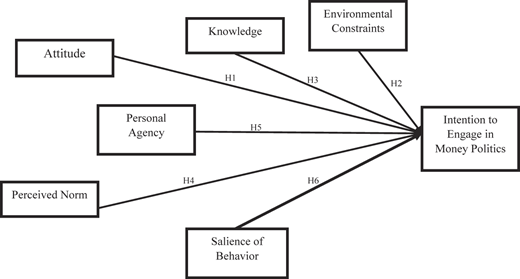
Attitude has a significantly positive effect on the intention to engage in money politics.
Environmental constraints in the context of political intention are factors in the environment that can limit or influence an individual’s intention to engage in political activity (Bae et al., 2022). Social injustice, political tensions, and limited resources can fuel public frustration, prompting some to engage in unethical behaviors such as profit-driven political actions, neglecting long-term national interests (Sahide, 2022). A study of Latino electoral participation in America found that minority pressure from one candidate affects perceived compromise intentions to derail presidential candidates (Toma, 2022). The researchers assume that environmental influence can constrain young voters’ intention to engage in money politics.
Environmental constraints have a significantly positive effect on the intention to engage in money politics.
Political knowledge refers to the information and understanding individuals or groups have about political systems, citizen rights, public policy, and participation (Xu et al., 2016). It plays a crucial role in preventing fraud and manipulation in politics by helping people identify false rhetoric or corrupt practices. Nobert and Wen (2022) emphasize that a knowledge society consists of politically informed citizens. Educating students on political matters enhances their critical thinking and decision-making abilities (Nobert and Wen, 2022). Alfa and Marangos (2016) highlight that regions with weak electoral knowledge are more vulnerable to election fraud, as seen in Nigeria (Alfa and Marangos, 2016). Conversely, Look (2020) found that humorous campaigns in Belarus effectively increased public awareness and election participation (Look, 2020). Overall, political knowledge empowers citizens to engage in democracy, recognize fraud, and make informed political choices. Researchers are encouraged to test whether the political knowledge possessed by young Indonesian voters can encourage the intention of money politics to perform in the 2024 general election.
Knowledge has a significantly positive effect on the intention to engage in money politics.
Perceived norms in politics shape political decisions, as individuals tend to conform to widely accepted views (Landry et al., 2021). Research shows that black campaigning and covert gift-giving can increase voter support for certain candidates. Reiter and Matthes (2022) found that when communities see clientelistic bargaining as normal, they are more likely to vote for such politicians (Reiter and Matthes, 2022). Similarly, Farooq et al. (2024) found that habitual reliance on paper vote collectors fosters resistance to e-voting (Farooq et al., 2024). These findings highlight how perceived norms influence electoral behavior, reinforcing political practices that may either support or hinder democratic integrity. With the study above, the researchers determine the perceived norm of young Indonesian voters’ intention of political behavior in the 2024 general election.
The perceived norm has a significantly positive effect on the intention to engage in money politics.
Personal agency in politics is concerned with the extent to which individuals feel they have control over the political process and the decisions taken (Liang et al., 2023). When individuals feel a strong sense of personal agency, they tend to be more motivated to engage in political processes, such as voting, participating in campaigns, or voicing their opinions. However, in the context of political fraud, personal agency can also play a role. When a person feels that a political system is corrupt or unfair, and their belief in their influence in changing it is low, they may tend to feel hopeless or less motivated to engage in legitimate political processes (Pickard, 2022). This can increase the intention to engage in unethical or fraudulent acts because such individuals feel they have no control over or significant changes in the political system. Researchers are encouraged to test whether the personal agency felt by young Indonesian voters can encourage the intention of money politics to perform in the 2024 general election.
Personal agency has a significantly positive effect on the intention to engage in money politics.
The salience of behavior refers to how striking or compelling a stimulus, information, or event is in a given situation (Kalhan et al., 2021). It plays a key role in how individuals process information, make decisions, and respond to their environment. This concept is relevant to political fraud, as salience influences how society reacts to political information (Aytaç and Çarkoğlu, 2021). When an issue is highly noticeable, it can be used to divert attention from political fraud (Braun and Popa, 2018). For instance, raising sensitive topics can distract the public from unethical actions. Additionally, salience can be manipulated to conceal hidden facts (Vestergaard, 2021). By emphasizing certain issues, fraudulent activities can remain unnoticed behind more visible concerns. Researchers are encouraged to examine whether the perceived salience of behavior among young Indonesian voters influences their intention to engage in money politics during the 2024 general election.
Salience of behavior has a significant positive effect on the intention to engage in money politics.
The research model with the hypotheses of the study is shown in Figure 1.
Methodology
Research design
This study chooses a quantitative approach to predict the determinants of the money politics behavior of young voters or the younger generation leading up to and during the legislative general election and the president-vice presidential pair of the Republic of Indonesia in 2024. This study involved young voters among colleges in Surabaya. The selection of this region is based on the fact that Surabaya City is one of the ‘power’ cities of the Millennial-Gen Z population and has become a political contest for the legislature at the central level and even the candidate-president-vice presidential pair in every general election (Haddad, 2022).
The student status selection process is based on intellectual maturity and has received sufficient political education from the General Election Commission as well as from the democratic process of college. With the quantitative research design of this survey, the results of the study are able to provide important insights regarding the potential behavior of money politics that arises from young Indonesian voters, especially during the 2024 general election. In this study, convenience sampling was chosen because it can access several young voters within a limited timeframe. This technique allows for the efficient collection of data from easily reachable participants, providing relevant insights into their perceptions of money politics in Indonesia’s 2024 general election. The minimum sample size was determined using G*Power software, set to “linear multiple regression: Fixed model, R2 deviation from zero” with an effect size of 0.15 (medium), an alpha error probability of 0.05, and a power of 0.95. The calculation indicates that a minimum sample of 89 respondents is required. The data collection process was conducted online using Google Forms, supplemented by field visits for dissemination. This event occurred during December 2023, coinciding with the campaign period for legislative candidates and the president-vice presidential candidate coalition. Initially, we received a total of 350 responses; however, due to the screening process that eliminated incomplete questionnaires and those outside the criteria, 297 valid respondents were selected for analysis.
Measurement
The study developed a questionnaire with nine sections, informed by previous research and validated through mini focus group discussions (FGDs). Section A collects respondents’ demographic data relevant to the research. Sections B to H form the core of the questionnaire, addressing key variables related to the intention to engage in money politics. Section B examines attitudes toward money politics using six items that assess the affective, cognitive, and conative dimensions of unethical political behavior (Agarwal et al., 2023; Waeterloos et al., 2023). Section C explores environmental constraints with three items focusing on external influences such as social pressures, political instability, and resource limitations (Bae et al., 2022; McDowell et al., 2018). Section D evaluates political knowledge through three items measuring respondents’ understanding of political systems, public policies, and electoral processes (Nobert and Wen, 2022; Singh, 2022). Section E investigates perceived norms on money politics with seven items assessing societal acceptance of unethical practices such as black campaigning and covert gift-giving (Landry et al., 2021). Section F measures personal agency with four items exploring respondents’ perceived ability to influence political processes (Liang et al., 2023). Section G assesses behavioral salience using four items that evaluate how political issues and stimuli shape respondents’ decisions (Aytaç and Çarkoğlu, 2021; Kalhan et al., 2021). Finally, Section H measures intentions to participate in money politics through four items capturing the likelihood of engaging in such practices (Aytaç and Çarkoğlu, 2021; Kalhan et al., 2021). This comprehensive approach provides insights into the factors shaping attitudes and behaviors regarding money politics. Each section of the questionnaire employs a five-point Likert scale for response evaluation, where a rating of 1 indicates strong disagreement and a rating of 5 indicates strong agreement. The questionnaire is designed to take approximately 15 minutes to complete, ensuring an efficient and comprehensive data collection process.
Data analysis
PLS-SEM analysis offers a unique advantage by enhancing the research accuracy and providing significant benefits. It excels in analyzing complex models with small or non-normal datasets, allowing the use of latent variables, estimating intricate causal relationships, and emphasizing prediction and explanation (Becker et al., 2023). Its flexibility accommodates new theoretical concepts without stringent data distribution requirements, making it suitable for testing new theories, accelerating analysis through bootstrapping, and facilitating inclusive model development with intuitive interpretations (Sarstedt et al., 2022).
Results
Measurement Outer Test
In the early stages, factor loadings should be evaluated to assess item variable validity. As shown in Table 1, all items had an excellent loading factor (>0.70) (Sarstedt et al., 2022). To strengthen validity, the AVE was measured to determine the extent to which the variables were similar. An AVE value (>0.50) of all variables between 0.580 and 0.798 confirms the feasibility of AVE (Hair et al., 2018). Reliability was assessed using CR and Cronbach’s alpha. Table 3 shows that the CA and CR of all variables are within the appropriate range (>0.70), reinforcing the measurement reliability. The discriminant validity test considers the Heterotrait-Monotrait (HTMT) ratio, with the results in Table 2 showing that all values are below 0.90 (Roemer et al., 2021), indicating that there is no issue with discriminant validity.
Convergent Validity and Reliability Testing
| Variable | Item | Factor Loadings | AVE | CR | CA |
|---|---|---|---|---|---|
| Attitude | ATD1 | 0.785 | 0.645 | 0.916 | 0.889 |
| ATD2 | 0.772 | ||||
| ATD3 | 0.816 | ||||
| ATD4 | 0.844 | ||||
| ATD5 | 0.863 | ||||
| ATD6 | 0.732 | ||||
| Personal Agency | PA1 | 0.862 | 0.765 | 0.907 | 0.846 |
| PA2 | 0.873 | ||||
| PA3 | 0.887 | ||||
| Perceived Norm | PN1 | 0.785 | 0.580 | 0.904 | 0.875 |
| PN2 | 0.741 | ||||
| PN3 | 0.824 | ||||
| PN4 | 0.886 | ||||
| PN5 | 0.826 | ||||
| PN6 | 0.779 | ||||
| PN7 | 0.827 | ||||
| Knowledge | KLD1 | 0.886 | 0.771 | 0.910 | 0.852 |
| KLD2 | 0.872 | ||||
| KLD3 | 0.874 | ||||
| Salience of Behavior | SOB1 | 0.872 | 0.798 | 0.922 | 0.873 |
| SOB2 | 0.866 | ||||
| SOB3 | 0.940 | ||||
| Environmental Constraints | ETC1 | 0.802 | 0.725 | 0.888 | 0.810 |
| ETC2 | 0.879 | ||||
| ETC3 | 0.871 | ||||
| Intention to Perform (Participant) | PIU1 | 0.885 | 0.787 | 0.917 | 0.864 |
| PIU2 | 0.902 | ||||
| PIU3 | 0.873 |
Notes: n = 297. AVE, average variance extracted; CR, composite reliability; CA, cronbach’s alpha
Source: By authors
Heterotrait-Monotrait Testing (HTMT)
| ATD | ETC | PIU | KLD | PN | PA | SOB | |
|---|---|---|---|---|---|---|---|
| ATD | |||||||
| ETC | 0,889 | ||||||
| PIU | 0,828 | 0,878 | |||||
| KLD | 0,795 | 0,805 | 0,777 | ||||
| PN | 0,811 | 0,880 | 0,801 | 0,869 | |||
| PA | 0,881 | 0,896 | 0,827 | 0,886 | 0,891 | ||
| SOB | 0,721 | 0,807 | 0,808 | 0,865 | 0,846 | 0,802 |
Notes: ATD, Attitude; ETC, Environmental Constraints; PIU, Intention to Perform; KLD, Knowledge; PN, Perceived Norm; PA, Personal Agency; SOB Salience of Behavior.
Source: By authors
Structural Model Result
| Relationship | Path Coefficient | t-test | p-value | Decision | R-Square |
|---|---|---|---|---|---|
| ATD→PIU | 0.280 | 2,617 | 0.005 | Supported | 0.755 |
| ETC→PIU | 0.198 | 1,739 | 0.041 | Supported | |
| KLD→PIU | 0.014 | 0,161 | 0.436 | Not Supported | |
| PN→PIU | 0.032 | 0,279 | 0.390 | Not Supported | |
| PA→PIU | 0.143 | 1,582 | 0.057 | Not Supported | |
| SOB→PIU | 0.243 | 2,695 | 0.004 | Supported |
Notes: ATD, Attitude; ETC, Environmental Constraints; PIU, Intention to Perform; KLD, Knowledge; PN, Perceived Norm; PA, Personal Agency; SOB Salience of Behavior. (One-Tailed)
Source: By authors
Structural Inner Test
Structural inner testing was carried out after the outer model was successfully checked for validity and reliability. A structural inner analysis was performed to determine the strength of the model and test the hypothesis. The structural inner process used a bootstrapping method with 5000 resampling, and the results are shown in Table 3. A hypothesis is accepted if the significance level of the t-test is >1.96 or the p-value <0.05 (Kock, 2018).
The findings showed that attitude (β = 0.280, t = 2.617, p-value = 0.005), environmental constraints (β = 0.198, t = 1.739, p-value = 0.041), and salience of behavior (β = 0.243, t = 2.695, p-value = 0.004) had a significant relationship with intention to to engage in money politics. However, the results of the coefficient test showed that knowledge, perceived norms, and personal agency were not significantly related to the intention to engage in money politics.
Testing the coefficient of determination needs to be studied to measure how much the independent variables in the model can explain the variability of the dependent variable. According to Fan et al. (2016), the R-Square criteria are divided into three categories: >0.67 strong categories, 0.67-0.33 moderate category, and <0.33 weak category (Fan et al., 2016). The results of the coefficient of determination (r-square) test show that the intention to engage in money politics can be explained by a concurrent independent variable of 75.5 percent or a strong category.
Discussion and implications
Based on these results, the attitude variable has the most dominant influence on the intention to use political money. This trend can be seen from the highest coefficient compared to other variables (0.280), which is compatible with previous studies (Schmidthuber et al., 2019; Waeterloos et al., 2023). Individuals’ attitudes significantly impact their intention to use political money, with positive attitudes correlating with a higher intention. Despite other variables exerting influence, the attitude variable was the most dominant, especially among young voters or Gen Z. Those with positive attitudes were more inclined to use political money, whereas those with negative attitudes were less likely to do so due to perceptions of corruption or ethical concerns.
The effect of environmental constraints on the intention to engage in money politics agrees with previous studies (Sahide, 2022). Environmental constraints, such as dissatisfaction with the government or political system, can influence young voters or Gen Z to use money politics. Distrust of the system can make them feel that money politics is the only way to influence the outcome of election. When the political environment feels unfair or corrupt, young voters tend to opt for quick means, such as accepting money or rewards, to support a particular candidate. This becomes an alternative when it is difficult to make changes through conventional political participation. Young voters or Gen Z are also more vulnerable to social pressure from friends and family. If their social environment supports the use of political money, they are also more inclined to use political money.
Knowledge alone is insufficient to influence Gen Z voters regarding money politics in election. The findings challenge previous research (Jha, 2021; Singh, 2022) and highlight the complexity of voter behavior. While young voters may understand the negative impact of money politics, their decisions are often shaped more by emotional influences, social environments, and pressure from admired figures or groups. For example, despite the awareness of the harmful effects of money politics, young voters may be swayed by a candidate’s emotional appeal or peer expectations. Persuasive communication from candidates and social dynamics can override informed decision-making, leading voters to prioritize emotions and social pressures over political awareness. This reveals a crucial gap between awareness and action. Interestingly, knowledge may even increase the likelihood of engaging in money politics. Some voters may rationalize it as a pragmatic or unavoidable aspect of election. This underscores the limitations of knowledge-based interventions and emphasizes the need to address emotional, social, and psychological factors. By understanding these influences, voter education strategies can be more effective in curbing money politics among young voters.
Young voters and Gen Z challenge assumptions about the societal norms influencing their participation in money politics during election. While previous research emphasized the power of widely accepted norms (Landry et al., 2021), this study suggests that these norms may be less influential than expected. Although young voters recognize the general disapproval of money politics, their decisions are shaped more by localized social pressures than by broader societal expectations. The ambiguity surrounding the election norms complicates the issue. Uncertainty about whether money politics is truly rejected or tacitly accepted within certain circles creates discrepancies between stated norms and actual behavior. Public figures who engage in or endorse money politics contribute to this uncertainty, weakening the deterrent effect of societal disapproval. Additionally, the environment plays a crucial role. Rather than dismissing non-significant results as anomalies, these findings indicate that established norms do not uniformly influence behavior across all contexts. Immediate social circles, situational ambiguity, and environmental factors often override the impact of perceived norms. This challenges the notion that broad societal expectations alone dictate behavior, highlighting the importance of localized and situational influences in shaping electoral decisions.
The findings also reveal that personal agency is not sufficient to influence young voters’ decisions about money politics, in stark contrast to previous studies (Liang et al., 2023; Pickard, 2022). Political parties and candidates who hold great political power wield considerable influence on voters. Young voters or Gen Z who come from underprivileged families or who have less knowledge about politics and law are more susceptible to influence by these political forces. Young voters tend to be influenced by various factors, such as the social environment, information from social media, and direct experience with politics. Although personal agency is important in decision-making, the surrounding environment may exert more dominant pressure in influencing their political stance. If the environment or culture around them encourages the practice of money politics, personal agency may not be strong enough to oppose that influence. Therefore, although personal agency plays an important role in decision-making, in a political context, environmental influences and external factors often have a greater impact on shaping young voters’ political attitudes and behaviors regarding the use of money politics.
In the context of young voters or Gen Z in the 2024 Indonesian general election, the salience of behavior can influence the intention to engage in money politics. These results agree with previous studies that revealed flagrant political fraud in political decisions (Azpuru, 2010). Money politics behavior that often appears in the environment of young voters or Gen Z, such as on social media, television, or the surrounding environment, can increase the salience of behavior toward this behavior. This can cause young voters or Gen Z to become more accustomed to political behavior involving money and see it as normal. In addition, the salience of behavior can also affect the perception of young voters or Gen Z toward money political behavior. As a result, young or Gen Z voters may view the use of money politics as part of the prevalent political process, increasing their likelihood of considering or even using the practice in election. With high salience, money-oriented political behavior can become the norm that influences young voters’ intentions in the electoral process.
This study provides theoretical and managerial implications for understanding and mitigating money politics among young voters, particularly Gen Z, in the 2024 general election. Theoretically, it highlights the dominant role of individual attitudes, the social environment, and money politics in shaping young voters’ decisions. Pressure from peers or family and exposure to such practices, especially via social media, can normalize money politics. The study also underscores that knowledge alone is insufficient to deter such behavior, emphasizing the need for better political literacy.
Managerially, the study urges the General Election Commissions (GECs) in democratic countries to focus on educational campaigns that influence young voters’ attitudes by promoting ethical political values and exposing the negative consequences of money politics. Collaboration with legal institutions to strengthen regulations and enforce penalties for violations is essential. Moreover, governments must address dissatisfaction with governance by ensuring transparency and fairness in the political process to rebuild trust. Engagement with communities, schools, and families should also be undertaken by GECs to foster norms opposing money politics and to reduce its visibility on social media. A holistic approach integrating education, regulation, and public awareness is vital to reduce reliance on money politics and empower young voters to make informed decisions.
Conclusion
This study identified three significant psychological predictors of money politics among Gen Z voters: attitude, dissatisfaction with the political environment, and social pressure. Attitude emerged as the dominant factor, with young voters perceiving money politics as a viable means of influencing election outcomes due to distrust in the political system. Their intentions were shaped by social pressure from peers and family, alongside the influence exerted by the visible presence of money politics in their communities. These findings underscore the need to address the normalization of money politics to prevent it from becoming a widely accepted practice among young voters.
The study has limitations as its focus on urban colleges in Surabaya may not represent the broader national population. Future research should include diverse youth groups, such as rural and non-university students, and expand the scope to encompass national and international comparisons. Additionally, socioeconomic factors, social media influence, political ideology, and the role of political education should be investigated to provide a more comprehensive understanding. Enhanced research methods, such as mixed methodologies or longitudinal studies, are recommended to capture changes in attitudes over time and further illuminate the complexities of money politics among young voters.

