


The COVID‑19 pandemic accelerated the adoption of work‑from‑home (WFH) arrangements in Hong Kong to minimise the risk of cross-infections, reshaping a work culture previously dominated by office‑based routines. This study examines how organisational trust influences employees’ WFH experience, specifically job effectiveness and well‑being, and how these factors subsequently affect engagement and job satisfaction.
An instrument was developed to measure the constructs relevant to this study. Following an expert review and pilot testing, the instrument was administered in a formal online survey with 455 valid responses. Structural equation modelling (SEM) and confirmatory factor analysis (CFA) were utilised to evaluate the reliability, validity, and causal relationships among constructs.
The research reveals that organisational trust, which encompasses trust in the supervisor and trust in the institution, significantly affects employee engagement both directly and indirectly. The indirect effect is mediated solely through employee well-being. Specifically, trust in a supervisor has a stronger influence on employee well-being, while trust in institution more strongly predicts engagement. Employee engagement directly enhances job satisfaction for all workers.
The study addresses a gap in understanding remote work in Hong Kong. It contributes to theory by linking organisational trust with WFH experiences, employee engagement, and satisfaction. Furthermore, the study introduces validated instruments for assessing trust and WFH readiness for future research and practice.
Introduction
The COVID-19 pandemic prompted widespread adoption of WFH arrangements in Hong Kong, where office-based work had long been the norm. Before the pandemic, 85 percent of employees worked on-site daily, and only a minority of high-tech professionals engaged in hybrid work (Leung and Zhang, 2016). Surveys show that WFH is now widely preferred due to reduced commuting time, lower stress, and improved well-being (JLL, 2020). However, organisational readiness has lagged, with fewer than half of local organisations providing adequate remote-work support (Wong and Cheung, 2020).
The Hong Kong SAR Government implemented phased WFH arrangements to maintain essential services while reducing infection risks (Hong Kong Civil Service Bureau, 2020). Support measures included secure ICT access and digital communication tools (Hong Kong Information Services Department, 2020), complemented by public health interventions (Hong Kong Department of Health, 2022).
As WFH becomes more established, organisations must address challenges such as professional isolation, uneven managerial capability, and inconsistent support. Understanding how organisational trust shapes employees’ WFH experiences and work outcomes is therefore essential. This study examines these relationships among high-tech employees in Hong Kong, contributing evidence to a deeper insight of the relational and organisational factors that underpin effective remote work in a rapidly evolving labour landscape.
Literature review and theoretical framework
Organisational trust
Organisational trust is a multidimensional construct encompassing institutional trust, supervisor trust, and mutual trust (Shockley-Zalabak, 2000). Trust is fundamentally relational, involving a trustor and a trustee, and plays a critical role in shaping employee behaviour, particularly in remote work environments where physical distance heightens uncertainty. Institutional trust reflects confidence in organisational systems and fairness (Ellonen et al., 2008), while supervisor trust is interpersonal and shaped by day-to-day interactions. Reduced visibility in remote work makes trust essential for autonomy, cooperation, and engagement (Offstein et al., 2010). Mutual trust reinforces reciprocal support and commitment (Doz et al., 2002). Perceived autonomy mediates the relationship between trust and positive outcomes (Kossek and Ozeki, 1998). Organisational trust therefore becomes a central mechanism for sustaining cooperation, reducing ambiguity, and maintaining engagement that enhances job satisfaction in remote work operations.
Work-from-home (WFH) experience
WFH is often conceptualised as a psychological mediator that enhances employees’ sense of autonomy and control over their work, thereby improving job effectiveness and well-being (Bentleigh et al., 2016). This study focuses on job effectiveness and well-being as core aspects of the WFH experience.
Teleworking may increase productivity due to increased autonomy, fewer workplace distractions, and greater flexibility (Dutcher, 2012). Employees often demonstrate stronger commitment when they perceive greater control over their work and commitment (Morganson et al., 2010). Nevertheless, research suggests that longer working hours and heightened supervisory control may undermine these benefits (Noonan and Glass, 2012). Well-being reflects the intrinsic qualities that contribute to a positive quality of life and is influenced by autonomy, workload, social support, and stress (Crisp, 2017). Well-being may also generate feelings of guilt or pressure to overwork, particularly when employees perceive flexibility as a privilege (Maitland and Thomson, 2014). Subsequently, the WFH experience is likely to influence engagement and job satisfaction.
Work outcomes
Remote work has been consistently associated with a range of positive organisational outcomes, including enhanced employee engagement, improved performance, higher job satisfaction, reduced absenteeism, and increased autonomy (Mache et al., 2020).
Employee engagement, which conceptualised as vigour, dedication, and absorption (Schaufeli et al., 2002), is strongly linked to performance and lower turnover. Engaged employees typically exhibit higher productivity, reduced stress, and greater organisational commitment (Harter et al., 2002). Drawing on Social Exchange Theory, employees reciprocate organisational support, recognition, and trust with positive attitudes and behaviours (Homans, 1961; Cropanzano and Mitchell, 2005). Trust therefore emerges as a critical antecedent of engagement, shaping employees’ willingness to invest effort and remain committed (Fay and Kline, 2011).
Job satisfaction is similarly shaped by autonomy, organisational support, and work-life balance. Teleworkers often report higher job satisfaction due to reduced commuting, fewer workplace distractions, and increased flexibility (Wheatley, 2012). Empirical studies consistently demonstrate a positive association between WFH and job satisfaction, driven by enhanced autonomy, perceived competence, and supportive organisational climates (Petcu et al., 2021).
Taken together, the literature indicates that organisational trust, WFH experiences, engagement, and job satisfaction are closely interconnected. Understanding these relationships is essential for developing effective and sustainable remote-work strategies in high-tech environments where flexibility and autonomy are central to performance and innovation.
Research gap
Despite the rapid proliferation of WFH arrangements during the COVID-19 pandemic, empirical research on remote work in high-density Asian cities such as Hong Kong remains limited. Existing studies tend to focus on general telework satisfaction or productivity, with relatively little attention to the role of organisational trust in shaping WFH experiences and outcomes. Moreover, even fewer studies distinguish between supervisor trust and institutional trust, despite evidence that these dimensions operate differently and may influence employees through distinct psychological pathways.
Another gap concerns the mechanisms linking trust to work outcomes. Although trust is recognised as an antecedent of engagement and job satisfaction, the specific mediating role of WFH experience, particularly job effectiveness and well-being, remains underexplored in Hong Kong. The unique characteristics of Hong Kong’s workforce, including long working hours, dense living environments, and strong hierarchical norms, suggest that trust may play a crucial role in enabling successful remote work. However, empirical evidence on these relationships is limited.
Methodologically, current literature lacks validated instruments tailored to the WFH context in Hong Kong. Most existing measures of engagement, trust, and well-being were developed for traditional office environments and may not adequately capture the complexities of remote work. There is also limited use of structural equation modelling (SEM) to test integrated models linking trust, WFH experience, engagement, and job satisfaction.
This study addresses these gaps in four ways. First, it offers one of the few empirical examinations of WFH experiences in Hong Kong, providing context-specific insights into the influence of trust on remote work outcomes in a high-density urban environment. Second, it differentiates between supervisor trust and institutional trust, demonstrating their distinct effects on job effectiveness, well-being, and engagement. Third, it introduces validated instruments, including the WFH Engagement Survey and the Organisational Trust Checklist, for assessing WFH readiness and performance. Finally, the study employs SEM to test a theoretically grounded model linking organisational trust, WFH experience, engagement, and job satisfaction, thereby contributing to both theory and practice.
Introduction to hypotheses
Grounded in Social Exchange Theory, organisational trust is expected to shape employees’ WFH experiences and subsequent work outcomes. Higher trust in supervisors and institutions should enhance job effectiveness and well-being, which in turn are anticipated to strengthen engagement. Trust is also expected to exert a direct influence on engagement, while engagement is predicted to positively affect job satisfaction. Drawing on the theoretical foundations and identified research gaps, the study proposes the following hypotheses:
Hypotheses
Organisational trust is positively associated with employees’ WFH experience.
Institutional trust is positively associated with perceived job effectiveness.
Institutional trust is positively associated with perceived well-being.
Supervisor trust is positively associated with perceived job effectiveness.
Supervisor trust is positively associated with perceived well-being.
WFH experience is positively associated with employee engagement.
Perceived job effectiveness is positively associated with engagement.
Perceived well-being is positively associated with engagement.
Organisational trust is positively associated with employee engagement.
Institutional trust is positively associated with engagement.
Supervisor trust is positively associated with engagement.
Employee engagement is positively associated with job satisfaction.
To clarify the theoretical foundations of the proposed model, Table 1 summarises the key studies supporting each hypothesis and outlines the rationale linking organisational trust, WFH experience, engagement, and job satisfaction.
Summary of hypotheses, supporting literature, and rationale
| Hypothesis | Supporting Literature | Theoretical Logic / Rationale | Link to Current Study |
|---|---|---|---|
| H1: Organisational trust → WFH experience | Shockley-Zalabak (2000); Ellonen et al. (2008); Offstein et al. (2010); Eddleston and Mulki (2017) | Trust reduces uncertainty in remote work, enabling autonomy, smoother communication, and better WFH experiences. | Explains why institutional and supervisor trust influence job effectiveness and well-being. |
| H1a: Institutional trust → job effectiveness | Ellonen et al. (2008); Morganson et al. (2010); Dutcher (2012) | Institutional trust signals reliable systems and policies, enabling employees to perform effectively from home. | |
| H1b: Institutional trust → well-being | Crisp (2017); Kelliher and Anderson (2010) | Trust in organisational systems reduces stress and supports work–life integration. | |
| H1c: Supervisor trust → job effectiveness | Skogstad et al. (2014); Offstein et al. (2010) | Supervisory trust empowers employees, increasing autonomy and productivity in remote settings. | |
| H1d: Supervisor trust → well-being | Bernstrøm and Svare (2017); Maitland and Thomson (2014) | Supportive supervisors reduce anxiety and guilt associated with WFH, improving well-being. | |
| H2: WFH experience → engagement | Kahn (1990); Kelliher and Anderson (2010) | Positive WFH experiences enhance psychological availability, a precursor to engagement. | Justifies the link between WFH experience and engagement. |
| H2a: Job effectiveness → engagement | Morganson et al. (2010); Dutcher (2012) | Feeling effective reinforces motivation and encourages greater engagement. | |
| H2b: Well-being → engagement | Schaufeli et al. (2002); Harter et al. (2002) | Well-being increases vigour, dedication, and absorption — core dimensions of engagement. | |
| H3: Organisational trust → engagement | Cropanzano and Mitchell (2005) | Trust fosters reciprocity, commitment, and engagement under Social Exchange Theory. | Supports the direct effect of trust on engagement. |
| H3a: Institutional trust → engagement | Ellonen et al. (2008); Fay and Kline (2011) | Transparent, fair organisational systems enhance employees’ willingness to invest effort. | |
| H3b: Supervisor trust → engagement | Bernstrøm and Svare (2017); Offstein et al. (2010) | Trusting supervisors create psychological safety, increasing engagement. | |
| H4: Engagement → job satisfaction | Wheatley (2012); Petcu et al. (2021) | Engaged employees experience higher satisfaction due to autonomy, motivation, and positive affect. | Explains why engagement predicts job satisfaction. |
Research methodology
Research design
This study adopted a quantitative, cross-sectional design to examine the relationships among Organisational trust, WFH experience, engagement, and job satisfaction among high-tech employees in Hong Kong. SEM was employed to test the hypothesised model, given its suitability for analysing latent constructs and multivariate relationships (Anderson and Gerbing, 1988). A minimum sample size of 400 was targeted based on Soper’s SEM sample size calculator, assuming six latent variables, 33 indicators, an effect size of 0.20, and α = 0.05.
Population and sampling
The target population comprised high-tech employees in Hong Kong who had engaged in WFH within the previous three years. Industries represented included software development, telecommunications, cybersecurity, fintech, artificial intelligence, data analytics, and IT operations. A convenience sample was drawn from 1,149 organisations listed in the Hong Kong Science and Technology Park (HKSTP) Innovator Directory. A total of 455 valid responses were collected. Although convenience sampling has limitations, the study mitigated population validity concerns by securing a large and heterogeneous sample across job roles, seniority levels, and functional areas.
Instrument development
The survey instrument was developed through a multi-stage process:
- 1)
Construct identification:
A review of 91 empirical studies informed the selection and adaptation of validated scales for supervisor trust, institutional trust, job effectiveness, well-being, engagement, and job satisfaction.
- 2)
Expert review:
Twelve industry experts, including data scientists, engineers, project managers, and analysts, reviewed the draft instrument for clarity, relevance, and technical accuracy. Their feedback informed revisions to the item wording, sequencing, and readability.
- 3)
Pilot testing:
A pilot test with 52 participants assessed the instrument’s clarity and preliminary reliability. Feedback led to minor refinements before full deployment. Pilot data were excluded from the final analysis.
The final questionnaire consisted of 33 items across four sections as well as a list of demographic questions. All items used a 5-point Likert scale (1 = strongly disagree; 5 = strongly agree).
Data collection
The online survey was administered using Google Forms and distributed through the human resources departments of 1,149 participating organisations. A consent statement was provided before the distribution of the questionnaire, detailing confidentiality and voluntary participation. Data collection occurred over two months in late 2021.
A total of 489 responses were received, resulting in a 53 percent response rate. After excluding incomplete or invalid entries, 455 valid responses remained, corresponding to a 51 percent usable rate. All data were encrypted and securely stored in compliance with university ethical guidelines.
Data analysis
Data were analysed adopting a two-step SEM approach (Anderson and Gerbing, 1988):
- 1)
Measurement model
Confirmatory factor analysis (CFA) assessed the reliability, validity, and causal relationships of each construct. Model fit was evaluated using established thresholds:
CFI ≥ 0.90
RMSEA ≤ 0.07
SRMR ≤ 0.08
χ2/df ≈ 3:1
These criteria align with recommendations for models with >30 observed variables and sample sizes <250 per group. The analysis was conducted assuming a multivariate normal distribution of the observed variables, along with a valid hypothesised model (Byrne, 2001). The measurement scales were tested for their sufficient psychometric properties through goodness-of-fit indexes (GFI) (Hair et al., 2010). Tables 2–5 present the factor loadings, composite reliability, and variance extracted for these variables.
CFA of Organisational Trust and WFH Experience
| Item No. | Item | Factor Loadings | Composite Reliability | Variance Extracted |
|---|---|---|---|---|
| Organisational Trust (9 items) | ||||
| Supervisor Trust (4 items) | 0.883 | 0.655 | ||
| OT 1. | My supervisor trusts me to be able to do my job at home. | 0.865 | ||
| OT 2. | My supervisor believes that I can perform my work effectively at home. | 0.839 | ||
| OT 3. | My supervisor understands that I know how to complete my work during WFH. | 0.773 | ||
| OT 4. | My supervisor never has to wonder if I will keep my word, even when doing WFH. | 0.756 | ||
| Institutional Trust (5 items) | 0.655 | 0.502 | ||
| OT 5. | Top management keeps its commitments to employees. | 0.7 | ||
| OT 6 | My organisation encourages differences of opinion. | 0.756 | ||
| OT 7. | Top management is sincere in its efforts to communicate with employees. | 0.805 | ||
| OT 8. | In our organisation, we openly share all the relevant Information, nothing is held back. | 0.582 | ||
| OT 9. | My top management avoids retaliation when mistakes have been made | 0.681 | ||
| WFH - Job Effectiveness (4 items) | 0.867 | 0.629 | ||
| WFH 1 | When doing WFH I can concentrate better on my work. | 0.809 | ||
| WFH 2 | WFH makes me more effective in delivering my work. | 0.931 | ||
| WFH 3 | My overall job productivity has increased due to WFH. | 0.855 | ||
| WFH 4 | I have adapted to WFH by developing suitable skills and behaviours | 0.515 | ||
| WFH - Well-Being (3 items) | 0.748 | 0.498 | ||
| WFH 5 | WFH is so flexible that I can easily take time off if I want to. | 0.72 | ||
| WFH 6 | With flexible hours due to WFH, I can integrate my work and non-work life. | 0.691 | ||
| WFH 7 | I can easily switch off from work for a while to rest during WFH. | 0.705 | ||
CFA results: Chi-squared test χ2 = 262, CFI = 0.95, RMSEA = 0.06, SRMR = 0.05
Average Variance Extracted of Organisational Trust and WFH Experience
| Supervisor Trust | Institutional trust | Effectiveness | Well-being | |
|---|---|---|---|---|
| Supervisor Trust | 0.809 | |||
| Institutional Trust | 0.473 | 0.708 | ||
| Effectiveness | 0.476 | 0.224 | 0.793 | |
| Well-being | 0.562 | 0.39 | 0.674 | 0.705 |
CFA Employee Engagement and Job Satisfaction
| Item No. | Item | Factor Loadings | Composite Reliability | Variance Extracted |
|---|---|---|---|---|
| Employee Engagement | 0.868 | 0.525 | ||
| EE 1 | At my job, I feel strong and vigorous | 0.643 | ||
| EE 2 | I am enthusiastic about my job | 0.731 | ||
| EE 3 | My job inspires me | 0.794 | ||
| EE 4 | I am proud of the work that I do | 0.853 | ||
| EE 5 | I am immersed in my work | 0.676 | ||
| EE 6 | I get carried away when I am working | 0.624 | ||
| Job Satisfaction | 0.855 | 0.663 | ||
| JS 1 | All in all, I am satisfied with my work in the company | 0.734 | ||
| JS 2 | In general, I like my job | 0.849 | ||
| JS 3 | In general, I like working here | 0.854 | ||
CFA results: Chi-squared test χ2 = 123, CFI = 0.95, RMSEA = 0.09. SRMR = 0.04
Average Variance Extracted of Work Outcomes
| Engagement | Satisfaction | |
|---|---|---|
| Engagement | 0.725 | |
| Satisfaction | 0.726 | 0.814 |
- 2)
Structural model
SEM with maximum likelihood estimation tested the hypothesised relationships among latent variables. Maximum likelihood (ML) was selected for its robustness to moderate deviations from normality. Comparative Fit Index (CFI) was applied to test the model fit and determine whether the structural model adequately represented the observed covariance matrix. Figure 1 presents the hypothesised model of exogenous and endogenous variables.
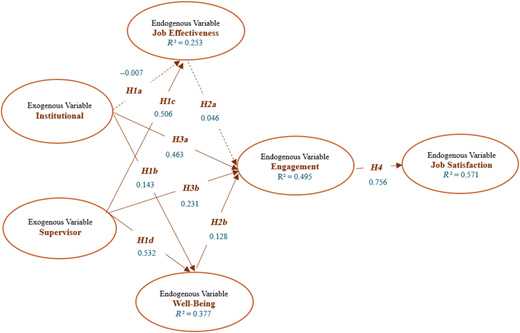
Hypothesised model of exogenous and endogenous variables. Note: The dashed lines indicate insignificant path coefficients at the 0.05 level Fit Statistics: χ2 = 797, df = 265, p < 0.001. Standardised RMR = 0.072. RMSEA = 0.066. CFI = 0.913. Source: By author
Hypothesised model of exogenous and endogenous variables. Note: The dashed lines indicate insignificant path coefficients at the 0.05 level Fit Statistics: χ2 = 797, df = 265, p < 0.001. Standardised RMR = 0.072. RMSEA = 0.066. CFI = 0.913. Source: By author
For each endogenous variable, a squared multiple correlation (R2) is displayed underneath each variable name. The value shows the amount of variance in the endogenous variable accounted for by the exogenous variables.
Validity and reliability
Construct validity was supported through:
- 1)
Convergent validity: factor loadings > 0.50 and AVE > 0.50
- 2)
Discriminant validity: square root of AVE exceeding inter-construct correlations (Byrne, 2001; Hair et al., 2010).
- 3)
Internal consistency: Cronbach’s alpha and composite reliability > 0.70
Threats to internal validity (e.g., Type I/II errors) were mitigated through instrument refinement, expert review, pilot testing, and the use of an adequate sample size with validated scales. External validity was strengthened by sampling across diverse high-tech organisations and job roles.
Findings
Sample characteristics
A total of 455 valid responses were analysed. The sample represented a broad cross-section of Hong Kong’s high-tech workforce, including software engineers, data analysts, cybersecurity specialists, project managers, and IT operations professionals. Approximately 62 percent of respondents were male and 38 percent female. Most participants were between 25 and 44 years old, and 87 percent had engaged in WFH for more than one year. Over half held mid-level professional roles, while 28 percent occupied senior or managerial positions. This demographic profile aligns with the composition of Hong Kong’s innovation and technology sector and supports the generalisability of the findings.
CFA and SEM indicated a good overall model fit, demonstrating that the measurement model adequately captured the relationships among organisational trust, WFH experience, engagement, and job satisfaction.
The findings indicated that organisational trust, which comprised both supervisor trust and institutional trust, exerted significant direct and indirect effects on employee engagement. Notably, the indirect effect operated exclusively through employee well-being. Specifically, supervisor trust demonstrated a stronger influence on well-being, whereas institutional trust exerted a greater impact on employee engagement. In parallel, employee engagement directly contributed to job satisfaction in both teleworking and office-based contexts. Collectively, these results provided robust empirical support for the hypothesised pathways, as summarised below:
Effects of organisational trust on WFH experience
H1: Organisational trust is positively associated with employees’ WFH experience.
Both dimensions of organisational trust, including supervisor trust and institutional trust, were positively associated with employees’ WFH experience.
H1a: Institutional trust is positively associated with perceived job effectiveness.
H1b: Institutional trust is positively associated with perceived well-being.
Institutional trust was more closely associated with perceived job effectiveness. Items such as “Top management keeps its commitments to employees” loaded strongly on the institutional trust factor, suggesting that employees who view organisational systems as reliable and fair feel more capable and effective when working remotely.
H1c: Supervisor trust is positively associated with perceived job effectiveness.
H1d: Supervisor trust is positively associated with perceived well-being.
Supervisor trust exerted the strongest influence on employee well-being, reflecting the interpersonal nature of supervisory relationships in remote settings. This is consistent with the high factor loading of items such as “My supervisor trusts me to be able to do my job at home” (0.865), which indicates strong perceptions of interpersonal trust.
Effects of WFH experience on engagement
H2: WFH experience is positively associated with employee engagement.
Both components of the WFH experience, consisting of job effectiveness and well-being, were positively associated with employee engagement.
H2a: Perceived job effectiveness is positively associated with engagement.
H2b: Perceived well-being is positively associated with engagement.
Employees who reported higher job effectiveness (e.g., “WFH makes me more effective in delivering my work”, loading 0.931) also reported higher levels of vigour, dedication, and absorption. Well-being similarly contributed to engagement, supporting the view that flexible work arrangements enhance psychological resources that ground sustained motivation.
Direct effects of organisational trust on engagement
H3: Organisational trust is positively associated with employee engagement.
Organisational trust also demonstrated a significant direct effect on engagement, independent of WFH experience.
H3a: Institutional trust is positively associated with engagement.
H3b: Supervisor trust is positively associated with engagement.
Institutional trust showed a stronger direct association with engagement than supervisor trust, suggesting that transparent communication, fairness, and organisational reliability are essential for maintaining engagement during remote work.
Effect of engagement on job satisfaction
H4: Employee engagement is positively associated with job satisfaction.
Employee engagement was positively associated with job satisfaction, confirming H4. Items such as “In general, I like my job” (loading 0.849) and “In general, I like working here” (loading 0.854) indicate that engaged employees experienced higher levels of satisfaction, consistent with Social Exchange Theory.
This is the summary of key findings:
- 1)
Supervisor trust → strongest predictor of well-being
- 2)
Institutional trust → strongest predictor of engagement
- 3)
Job effectiveness and well-being → both enhance engagement
- 4)
Engagement → directly increases job satisfaction
Discussion
The findings of this study provide strong empirical support for the proposed model linking organisational trust, WFH experience, engagement, and job satisfaction among high-tech employees in Hong Kong. Consistent with Social Exchange Theory, trust emerged as a central mechanism influencing well-being, engagement, and job satisfaction during WFH. The results underscore the importance of distinguishing between interpersonal and system-based trust when examining remote-work dynamics.
Supervisor trust and well-being
Supervisor trust exerted the strongest influence on employee well-being. This highlights the importance of supportive, empathetic, and communicative leadership in remote settings. When employees feel trusted by their supervisors, they experience reduced anxiety, greater autonomy, and enhanced psychological well-being. This finding aligns with prior research emphasising the importance of supportive supervisory relationships in distributed work environments.
Institutional trust as a driver of engagement
Institutional trust demonstrated a more pronounced effect on engagement, suggesting that employees’ confidence in organisational systems, communication, and fairness is critical for sustaining motivation during WFH. Even when supervisors are supportive, engagement may falter if organisational systems are inconsistent or inadequate. Conversely, strong institutional trust that is cultivated through transparent policies, reliable ICT support, and consistent organisational practices, which appear to strengthen employees’ willingness to invest effort and remain committed to their work.
The mediating role of WFH experience
The study confirms that WFH experience, operationalised through job effectiveness and well-being, serves as a meaningful channel through which trust influences engagement. Notably, well-being emerged as the sole mediator between trust and engagement, indicating that psychological and emotional resources are central to sustaining motivation in remote settings. Employees may feel productive but still experience stress, fatigue, or disconnection that undermines engagement, despite perceived effectiveness. This extends existing literature by demonstrating the importance of well-being in Hong Kong’s dense urban context, where living conditions and work pressures may intensify remote-work challenges.
Engagement as a pathway to job satisfaction
The strong positive relationship between engagement and job satisfaction reinforces established literature. This relationship is particularly relevant for organisations seeking to maintain morale and performance in hybrid or remote-work arrangements. The results also show that engagement directly enhances job satisfaction, reinforcing the view that engaged employees exhibit more positive work attitudes and outcomes. This suggests that interventions aimed at strengthening trust and well-being may have downstream benefits for job satisfaction, retention, and organisational commitment.
Contributions to theory and practice
This study contributed to the literature in several ways. First, it provides context-specific evidence on how trust shapes WFH experiences in Hong Kong, a work mode characterised by long working hours, compact living conditions, and hierarchical organisational norms. Second, it demonstrates the distinct roles of supervisor and institutional trust while offering deeper insight into trust dynamics in remote-work environments. Third, it introduces validated instruments, including the WFH Engagement Survey and the Organisational Trust Checklist, that support future research and organisational assessments.
Implications for policymakers and practitioners
The findings suggest that strengthening institutional trust through transparent communication and supportive policies may enhance engagement, while cultivating supervisory trust can improve employee well-being. Together, these efforts can help organisations design more effective and sustainable WFH arrangements. For policymakers, the results highlight the need for clear guidelines, digital infrastructure support, and incentives that encourage organisations to invest in trust-building and well-being initiatives. The following section elaborates further on this aspect.
Practical implications
The findings of this study offer several practical implications for policymakers, organisational leaders, and educators seeking to strengthen the effectiveness and sustainability of WFH arrangements in Hong Kong.
Implications for policymakers
The distinct roles of supervisor trust and institutional trust highlight the need for a coherent policy framework that supports trust-based remote work practices. The HKSAR Government may consider:
- 1)
Developing a territory-wide WFH policy framework that provides clear guidelines on eligibility, performance expectations, communication standards, and data security requirements across government departments.
- 2)
Reviewing Employees’ Compensation Insurance and occupational safety regulations to ensure adequate protection for home-based workers.
- 3)
Encouraging the use of validated assessment tools, such as the WFH Engagement Survey and the Organisational Trust Checklist, to monitor workforce readiness, trust levels, and employee well-being.
- 4)
Offering tax incentives or subsidies to organisations that invest in ICT infrastructure, cybersecurity, and remote-work training to support sustainable WFH adoption.
- 5)
Exploring opportunities for public-private partnerships to strengthen the overall remote-work readiness across sectors.
Implications for organisational leaders
The results underscore the importance of cultivating both supervisor and institutional trust to enhance employee well-being and engagement. Organisations can:
- 1)
Strengthen supervisory trust by training managers in remote leadership, communication, and trust-building behaviours.
- 2)
Reinforce institutional trust through transparent policies and decision-making processes related to remote work expectations, performance standards, consistent communication, and visible support for employee well-being.
- 3)
Adopt the validated instruments developed in this study to diagnose trust levels, identify gaps, and design targeted interventions for WFH readiness.
- 4)
Support work-life integration by setting realistic expectations, monitoring workload, redesigning workflows to support distributed teams, and encouraging healthy boundaries during WFH.
Implications for educators and training bodies
Educational institutions and professional training providers can:
- 1)
Integrate trust-building and remote leadership competencies into management, public administration, and professional development curricula.
- 2)
Use the measurement tools introduced in this study for teaching, assessment, and leadership development programmes to equip future managers with skills to lead distributed teams effectively.
- 3)
Support public sector capacity-building by offering training on hybrid work management, digital communication, and employee well-being.
These implications collectively highlight the importance of trust-based governance and leadership in sustaining effective WFH arrangements in Hong Kong.
Limitations and future research
While the study provides valuable insights into the role of organisational trust in shaping WFH experiences and work outcomes, several limitations should be acknowledged.
Cross-sectional design
The study employed a cross-sectional survey, which limits causal inference. Although SEM provides evidence of directional relationships, longitudinal designs would encourage future research to examine how trust, well-being, and engagement evolve as hybrid work becomes the norm.
Self-reported measures and potential bias
As a self-administered online survey in which all variables were measured using self-reported data, the study may introduce common method variance and perceptual bias. Nonetheless, the large and diverse sample, combined with validated instruments, helps mitigate these concerns. Future studies could incorporate multi-source data, such as supervisor ratings, performance metrics, or digital trace data, to reduce bias and strengthen validity.
Convenience sampling and generalisability
The sample was drawn adopting convenience sampling from high-tech organisations listed in the HKSTP directory. Although the final sample was large and heterogeneous (455 valid responses), the findings may not generalise to other sectors or to employees with limited digital literacy. Future research could employ probability sampling across industries, including public sector organisations, to enhance external validity.
Evolving nature of remote work
WFH practices continue to evolve post-pandemic globally. Future studies could examine hybrid-work models, the role of the AI-enabled monitoring tools, or the impact of employment policies such as “right to disconnect” legislation on trust and well-being.
Conclusion
This study examined the role of organisational trust in shaping employees’ WFH experiences and work outcomes within Hong Kong’s high-tech sector. Drawing on Social Exchange Theory and using structural equation modelling, the research provides empirical evidence that both institutional and supervisory trust play central roles in influencing well-being, engagement, and job satisfaction during remote work. The findings highlight the importance of relational and structural dimensions of trust, revealing that supervisor trust significantly enhances well-being, while institutional trust is the strongest predictor of engagement.
A key contribution of this study is the identification of well-being as the primary psychological mechanism linking organisational trust to engagement. Contrary to expectations, job effectiveness did not significantly influence engagement, suggesting that emotional and relational factors may be more salient than productivity perceptions in Hong Kong’s remote-work context. This insight underscores the need for organisations to prioritise well-being and supportive leadership practices when designing sustainable WFH strategies.
The study also contributes methodologically by validating instruments tailored to Hong Kong’s WFH environment and by applying SEM to test an integrated model of trust, WFH experience, engagement, and job satisfaction. These tools and findings provide a foundation for future research on remote work in high-density Asian cities, where cultural norms, living conditions, and organisational structures differ from Western contexts.
To summarise, this study addressed a research gap by offering new insights into WFH dynamics in Hong Kong’s high-tech sector. The findings suggest that successful remote-work depends on more than technological readiness or productivity gains. It requires a holistic approach that strengthens supervisor capability, builds institutional trust, and places employee well-being at the centre of organisational strategy. As WFH becomes an enduring feature of Hong Kong’s work landscape, organisations that invest in trust-building, supportive systems, and well-being-focused policies will be better positioned to enhance engagement, sustain job satisfaction, and remain competitive in a rapidly evolving labour market.

