Clinical practice provides teacher candidates with opportunities to link teaching and learning theory to practice in a supported environment with strong mentorship through their initial phases of teaching. Teacher candidates wait in anticipation for the opportunity to get into classrooms to work alongside veteran teachers to promote student learning and achievement. This article presents one educator preparation program’s (EPP’s) innovative program that spans the boundaries of the USA to provide teacher candidates with a two-week intensive full-time clinical placement in schools located in the Cotswold Region of England.
Highlighted in this piece is the program’s partnership history, design, structure, connection to the nine essentials, assessment of program goals, and a synthesis of the literature on global education and its value in educator preparation.
Highlighted in this piece is the program’s partnership history, design, structure, connection to the nine essentials, assessment of program goals and a synthesis of the literature on global education and its value in educator preparation.
This article highlights one university’s innovation that places teacher candidates in the classroom for a two-week full-time immersive clinical experience in various schools in England. As early as their sophomore year, teacher candidates can participate in this study abroad program and do so while developing their own cultural competence and global citizenship.
Introduction
For most teacher candidates, a highlight of their education and training is a robust clinical experience. Required hours for clinical experiences vary by state and are codified into their individual regulations or code. Compliant universities set these codes into practice through local P-12 partnerships. Innovative universities use them as a minimum standard, and seek out opportunities for their teacher candidates to expand their practices in ways they had not imagined. This article highlights one university’s innovation that places teacher candidates in the classroom for a two-week full-time immersive clinical experience in various schools in England. As early as their sophomore year, teacher candidates can participate in this study abroad program and do so while developing their own cultural competence and global citizenship.
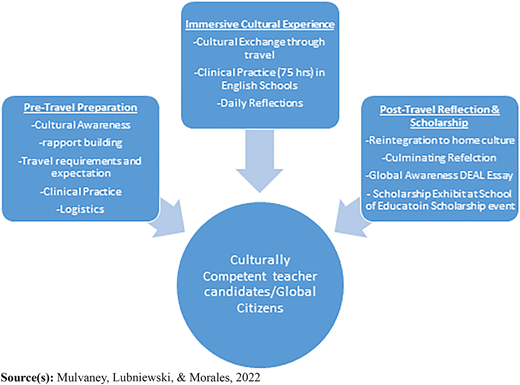
The Education and Culture program is part of a three-credit course (ED 300) that counts toward the general education requirement of Culture Diversity and Global Understanding at Monmouth University. Teacher candidates who enroll in the course experience a unique three phase program different from any other they will receive in the field. This clinical experience innovation (NAPDS Essential 4) includes pre-travel preparation, an immersive (international) cultural experience and post-travel reflection and scholarship which are illustrated in Figure 1. The ultimate goal is to provide candidates with immersive clinical experiences (NAPDS Essential 2) that will help them develop a higher level of global citizenship, while practicing and improving their own cultural competence through a rigorous field experience abroad (NAPDS Essential 8).
Each part of the framework will be further explored in the program design section of this piece. Additionally, the program history, goals and connection to the PDS nine essentials will be presented. First, literature on the benefits of study abroad programs and immersive cultural experiences are given through a synthesized literature review.
Synthesis of the literature
Studying abroad has numerous proven benefits. Between 1950-1999, the Institute for International Education of Students analyzed survey data from over 3,400 alumni of study abroad programs and found a positive impact on the following: personal growth, intercultural development, academic commitment and career development (Dwyer & Peters, 2004). Ungar (2016) claimed that the solution to Americans understanding others in today’s global society is to, “massively increase the number of U.S. college and university students who go abroad for some part of their education and bring home essential knowledge and new perspectives'' (p. 112). This sentiment was shared by the National Association of Foreign Student Advisers (NAFSA) who also stated students who study abroad are, “better prepared for the demands of the twenty-first century” and develop skills that improve US foreign policy, as well as national and economic security (NAFSA, 2021).
Although study abroad programs take place over different time bands (semesters, quarters, intersessions and academic years), all prove to be valuable experiences for students. Smith and Mitry (2008) asserted that even short-term programs, “enhance students’ cross-cultural skills and global understanding” (p. 240). The literature confirms that engaging in study abroad experiences improves students’ cognitive processes related to creative thinking (Lee, Therriault, & Linderholm, 2012). Even though the benefits are well documented, an overwhelming majority of students do not participate in study abroad programs.
The Commission on the Abraham Lincoln Study Abroad Fellowship Program, formed in 2004, established a goal that one million American students would participate in a study abroad program by the 2016-17 academic year. The commission argued that students who studied overseas, “enhanced their interest in academic work, helped them acquire important career skill sets,’ and continued for decades to influence their perspective on world events” (p. vi). Unfortunately, the commission did not reach its goal. According to the Institute of International Education (IIE), only 341,751 of the nation’s students participated in study abroad programs in the 2017-18 academic year. While this number reflected a 2.7% increase from the year before, it does not come close to the goal set by the commission in 2004 (IIE, 2019). So what does this mean for those looking to study abroad in a teacher preparation program?
The logical question is, does a clinical experience abroad enhance a teacher candidate's teaching skills? Fortunately, there are multiple studies providing support that participating in study abroad is especially important to students in teacher preparation programs. Due to the globalized nature of society, teachers must prepare their students to succeed in an increasingly connected, culturally diverse society. Teacher candidates who include clinical experiences through study abroad as part of their program are prepared at a high level to accomplish this. In 2018, the Program for International Student Assessment (PISA) assessed global competence for the first time since its inaugural implementation in 2000. Global Competence, as defined by the Organisation for Economic Co-operation and Development (OECD), touts globally competent individuals as those who can, “examine local, global and intercultural issues … understand and appreciate different perspectives and worldviews and interact successfully and respectfully with others … [and] take responsible action toward sustainability and collective well-being” (2020). The USA did not participate in the 2018 assessment, however numerous world-renowned organizations such as UNESCO, Asia Society, and the Longview Foundation call for an increased focus on global education in all grade levels and subject areas (Morales, 2020).
Unfortunately, with few opportunities for in-service teachers to develop their own global competence (Morales, 2020), the responsibility predominantly falls on postsecondary educator preparation programs (EPPs). The lack of global studies in teacher education was pointed out in 1992 by Merryfield and Harris. They provided recommendations for how to increase teacher candidates’ global perspectives including creating “cross-campus ties” that “internationalize the campus.” (Merryfield & Harris, 1992, pp. 60-61). Kahn, Lindstrom, and Murray (2014) argued that EPPs must increase their students’ cultural competence by providing them with multicultural education courses, as well as opportunities to work with diverse groups of students and participate in a variety of field experiences to increase their cultural competence. This can be effectively done through study abroad programs that include a field based experience. Poole and Russell (2015) found a “significant positive relationship” between pre-service teachers' global perspectives and their exposure to “global content courses and co-curricular cross-cultural experiences” (p. 50). This finding further illustrates the importance of study abroad programming for teacher candidates.
Increased resources have been allocated by institutes of higher education for the purpose of increasing their preservice teachers’ global competence through different types of structured international experiences. Many positive outcomes have been identified as a result of preparation in these programs. DeVillar and Jiang (2012) found a significant positive impact an international student teaching experience had on preservice teachers’ self-efficacy. Participants not only were able to successfully transfer instructional techniques and pedagogy they learned in their US university classrooms, but they found tremendous value in the cultural and language experiences provided by their host classrooms. Similarly, Chao et al. (2019) discovered an increase in preservice teachers’ critical awareness and cross-cultural understanding after studying abroad. These valuable competencies were naturally integrated into the participants’ pedagogical practices when they returned to the USA and began their classroom teaching.
Cushner (2007) stressed that one valuable way to develop preservice teachers’ global perspectives is through experiential learning:
Experiential learning, which engages both the right and left hemispheres of the brain, links an experience with cognition. The international immersion experience plays a major role in the success of this effort—there is just no substitute for the real thing (p. 35).
While national organizations dedicated to teacher preparation and practice do not mandate or even encourage that experiential learning must take place abroad, their expectations reveal their belief that preservice teachers should engage in more than the traditional student teacher experience.
Further, professional teaching organizations provide rationale through their own standards that teacher candidates would benefit from clinical experiences abroad. The Council for the Accreditation of Educator Preparation (CAEP) stated in its 2022 standards that partnerships and clinical practices should offer candidates experiences in, “different settings and modalities, as well as with diverse P-12 students, schools, families, and communities” (Standard 2). Furthermore, the National Board for Professional Teaching Standards (NBPTS) stresses the value of teachers building a global learning community and developing an “understanding of multiculturalism” (p. 39) These expectations solidify the claim that teachers and their students benefit greatly from exposure to diverse settings and people. Study abroad programs with clinical experiences that promote teacher candidates’ cultural competence, global citizenship and practice clearly benefit their subsequent instruction in US schools.
Background of the program and partnership
Approximately 30 years ago two men, passionate about bridging education in England and the USA, designed a program that has expanded to multiple P-12 sites in England and to two US Universities. The first man, Alan, was a teacher in London who happened to cross paths with a professor in the Midwest USA, Jim, who was visiting. The impact of this meeting developed into something that they could not have foreseen.
Through their conversation, they determined that given their interests in helping students understand teaching within a different culture, they would work together to develop a program with exactly that goal. Through collaboration, they designed a study abroad course where Jim would take the university teacher candidates to London and Alan would pair them with teachers in schools in England. Following the university process for new course development, Jim formalized the program that grew to impact countless students and teacher candidates on both sides of the partnership. Alan’s role on site in London was to meet teachers and screen them to find the most qualified candidates to match them with. For the American students, he set up their accommodation and cultural exploration activities to engage candidates when they were not in schools. The program was originally for three weeks during the winter term when the university teacher candidates served as instructional assistants to their mentor teachers in London.
In 2009, the second author of this article, Kathryn, began working at the same Midwest university with Jim. The two initially met as they were both alumni of the same university. Through their initial conversation they found they had a common passion for college students studying abroad. Since Jim was retiring, he transitioned the course/program to Kathryn who began working as the lead professor. She continued the work through Alan and they improved the program. When Kathryn left to Midwestern university to teach at Monmouth University, she brought her passion and the program with her. Currently, the program is run by both institutions in opposite years. Presently, two other study abroad programs of similar design have been approved to run in the Bahamas and Hong Kong. No matter which country hosts the ED 300 students, the program goals remain the same. Each goal is clearly articulated and aligns directly to three of the nine PDS essentials.
Program goals and their relationship to the nine essentials
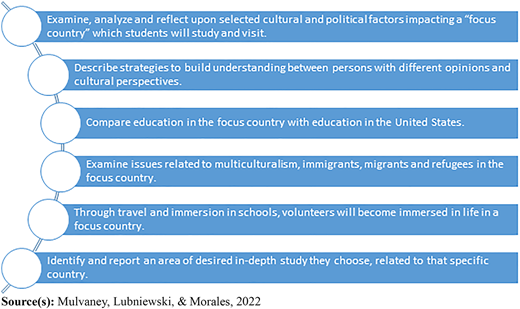
The primary objective of the education and culture program is to develop teacher candidate cultural competence through an immersive international clinical experience. A second objective is to enhance global citizenship through experiential learning in a country outside their own. To achieve this the program has six articulated goals which are presented in Figure 2. These goals are not taught in isolation, rather are integrated throughout the three-phase framework which takes place over an entire academic year. The comprehensive nature of these goals include concepts that teacher candidates learn about (pre-travel preparation), live (immersive cultural experience), and reflect upon (post-travel reflection and scholarship).
In addition, the program goals align directly with three of the PDS nine essentials (NAPDS, 2021): clinical preparation, reflection and innovation and boundary spanning roles.
Essential 2: clinical preparation
Clinical preparation is at the heart of this experience. Although teacher candidates are engaged in numerous activities before and after the immersive cultural experience, they spend approximately 70 hours in various English schools. During this time, they support the host teacher in providing instruction to students. This essential ties directly into the first three goals listed above that relate to learning about cultural and political factors in the host country, build an understanding of differing cultural perspectives, all while giving them the ability to compare their educational system with that of the host country. It also aligns directly with the fifth goal of the program which seeks to immerse students in daily life in the host country.
Essential 4: reflection and innovation
This essential highlights reflective practice, responsive innovation, and generative knowledge. First, the program requires students to use reflective skills through intentionally designed activities from their first seminar through their post-travel reflection and scholarship. Focused reflection is a key to providing an enriched experience for the teacher candidates. These reflections become a part of the experience they can reference in their future careers or educational experiences. In respect to responsive innovation, the Education and Culture program by design is directly aligned to goals 4 and 5. Students look at historical and multicultural issues related to immigration and refugee groups. They are able to do this through not only the immersive classroom experiences, but through the tours in culturally significant regions.
Essential 8: boundary-spanning roles
This essential focuses on expanding the boundaries of the institutions and is infused in all standards. The teacher candidates learn about teaching and learning theory in their university classrooms. They further this by learning about the focus country through seminars, then travel to the focus country to not only experience the culture, but to teach within it. While doing so, they visit historical landmarks, learn about the history and political structures, and they experience daily life. Every one of the program goals ties back to this essential in some meaningful way. For example, goal #6 asks students to identify an area of in-depth study related to that country. Students are able to identify the area prior to travel, but really explore within the context of that country. They don’t have to read about the role of the monarchy in the UK, rather they can visit and tour the palaces that are active to this day. They can see the changing of the guards and learn about the countries that participate in the daily ceremony. They are able to walk down the streets in which kings and queens have strolled. Then, they can speak about it once they return to the USA with the students in their subsequent clinical experiences.
Program design
The program design consists of the three-phase framework illustrated in Figure 1: Pre-travel preparation, immersive cultural experience, and post travel reflection and scholarship. In brief, during the Fall semester, students participate in pre-travel seminars that include topics such as: host country culture, educational systems in the host country and travel preparation. Over the winter break, students are immersed in the host country and travel for 17 days through London and various regions of England while interning for 10 full days in P-12 schools. During their travels they engage in seminars and complete reflections based on specific prompts. Upon return, students engage in post-travel reflection and scholarship during the Spring semester while being enrolled in the actual ED 300 course. They participate in more seminars, complete their required paper, submit their reflections, and present their experiences using posters at the School of Education’s Scholarship Night. This timeline maximizes the experience by providing students with extensive preparation activities, cultural immersion, and reflection and scholarship opportunities.
Ongoing seminars
Seminars are held throughout all three phases of the program. During the pre-travel phase, teacher candidates participate in four formal seminars. These seminars are conducted at the university in the USA throughout the Fall semester. The purpose of the pre-travel seminars includes building rapport between and among faculty and students, creating a supportive community within the group, and learning about the host culture. The teacher candidates learn about the host country's culture, cultural norms, and their own potential unconscious biases. Additionally, an in-depth examination is conducted of the host country's educational system, thus allowing teacher candidates to draw similarities and differences between their own educational experience and that of the host country. Another critical topic that is addressed during these seminars is supporting the student to travel internationally. Teacher candidates are led through the completion of specific travel documents, learning about international travel, and are given expectations while traveling.
During the immersive cultural experience in England, candidates participate in seven seminars. These seminars are focused on sharing their experiences, learning from each other, guides and other invited guest speakers who share and build on the cultural experience of the candidates within the country, town and schools. Each seminar is guided by faculty members to include key ideas, misconceptions, experiences and goals discussed in their daily journal reflections (discussed below).
Once travel is complete, candidates participate in post travel reflections and scholarship activities outlined in the final three seminars. During these seminars, the teacher candidates are given the opportunity to debrief on their experiences upon their return. They discuss the impact the experiences have had in their teacher preparation and within the context of the stated goals of the program.
Focused reflection
Throughout all three phases of the program, teacher candidates are required to reflect in individual journals that are only viewed by faculty teaching the course. Prompts are given for each entry to guide their writing and build upon each other as the course continues. During the pre-travel phase, candidates have specific prompts. During the immersive cultural experience phase, candidates have a menu of prompts they can select from that relate to events they resonate with that day. During the post-travel phase, they have specific prompts to address relating to the experience and its impact as a whole. Sample prompts given during each phase are provided in Table 1.
All prompts are selected to match the phase they are in at the time that allows them to develop their cultural journey. The choice of prompts during the immersive travel phase allows for candidates to change based on the events of their day, their feelings and other factors. The focused reflections are critical in all phases of the program. Perhaps the most revealing of their cultural induction are those written in their immersive clinical experience.
Immersive clinical experience
The premier feature of this program is the immersive two-week clinical experience provided to American teacher candidates in various schools in the Cotswold Region of England. Teachers are matched with candidates through a process involving the partnership. On the teacher side, the tour organizer, Alan, selects teacher participants through interviews to evaluate and identify teachers that have the skill and ability to mentor teacher candidates from the USA. On the US teacher candidate side, candidates complete questionnaires to identify content areas and grade preferences during the initial preparation phase. They identify three choices of settings, and have options for specific schools in England that focus on working with students with disabilities. Then Alan and the faculty from the USA work together to partner the teachers from England with the teacher candidate from the USA.
Teacher candidates begin their immersive clinical experience on the first day the English schools are back from winter break. The faculty members escort the teacher candidates on the first day and arrive a little bit earlier than the mentor teacher arrives. Some of the placements set up a scheduled meeting for the teacher candidates to learn about the school, while others just work individually with the mentor teacher. The teacher candidate is prepared to enter this setting because of the ongoing seminars and support. The first day for the teacher candidate is typically doing a lot of observing and asking questions to become familiar in the classroom; however, observations are not encouraged to last too many days because the goal of the program is to gain as much hands-on-experience as possible.
Within the second or third day, the teacher candidates are encouraged to support the teacher as much as possible. Some responsibilities include walking around while the teacher is teaching and answering questions, making copies, creating bulletin boards, or working with students one-on-one or in small groups. As the two-week experience builds, the teacher candidate should become more involved in the classroom by co-teaching with the cooperating teacher and eventually teaching one or more lessons.
One of the assignments that is built into the immersive experience during the first week is for the teacher candidates to identify key stakeholders (within the school) that their mentor teacher communicates with on a daily basis and then conduct an interview with them. The purpose of this activity is to gain insight on education in England. During their interview they ask a set of specific questions like, “What is your role in the school?”, “Why did you become a teacher?” and, “What are the benefits of working at this school?.” They are also required to add in at least two additional questions that they created on their own based on their understanding and experiences. As they review the responses, teacher candidates are asked to write a reflection tying what they learned in the interview to their ideas about the experience. Examples of the questions they use for reflection include, “What is something you have been looking forward to doing at this placement?,”, “What is something you have been nervous about doing at this placement?,” and, “Describe your plans to collaborate to improve student learning.”
During this immersive experience the teacher candidate and mentor teacher are encouraged to have a university faculty member observe the teaching duo in the classroom. Open communication between all stakeholders is critical to the success of the program.
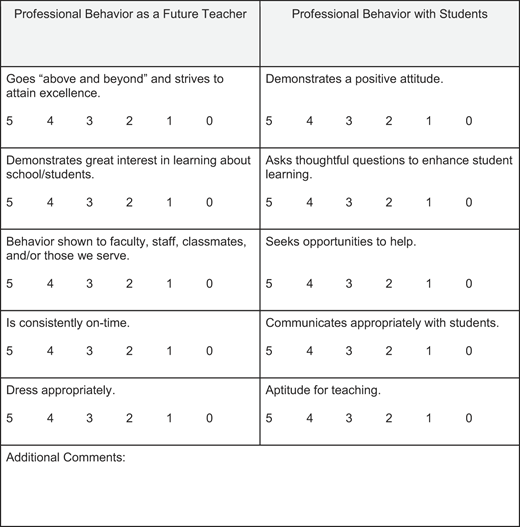
Upon completion of the experience, the mentor teacher is asked to formally evaluate the teacher candidate based on their performance using a 0 (needs improvement) to 5 (exceptional) likert scale (see Appendix). The mentor teacher is requested to put this in a sealed envelope and return it to the faculty member, teacher candidate or to mail it back to the USA to maintain the authenticity of the evaluation.
Assessment
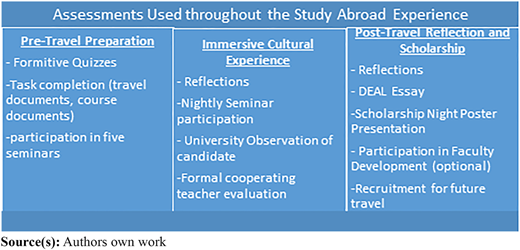
Program assessment is conducted throughout all phases of the program. Figure 3 identifies key assessment strategies employed through each of the three phases. In the pre-travel preparation phase, teacher candidates participate in formative quizzes focused on the information provided in the seminars. A checklist assessment is completed on travel task completion and includes travel document and course document completion. They are also graded on their participation and attendance in the five seminars. During the immersive cultural experience phase, candidates complete their daily reflection and nightly seminar participation. The reflections are uploaded to the course management system and graded by assigned faculty using a rubric. Further, the mentor teacher provides the university faculty with an observation assessment of the teacher candidate’s performance during this phase (see Appendix). That observation is done concurrent to the faculty observation of the student.
Finally, teacher candidates are assessed using multiple measures in the post-travel reflection and scholarship phase. They continue with two final reflections and a DEAL essay. The acronym DEAL stands for description, elaboration, articulate learning and learning outcomes met (Ash, Clayton, & Moses, 2009). This three-point rubric assigns values specific criteria and can total up to 15 points with the addition of formatting criteria. The DEAL essay assignment is built on the premise that we can better appreciate and comprehend the host culture’s educational practices by understanding the interconnectedness and interdependence of the two cultures, furthering each candidate’s world view. This essay also helps inform the second key assignment, the professional poster presentation.
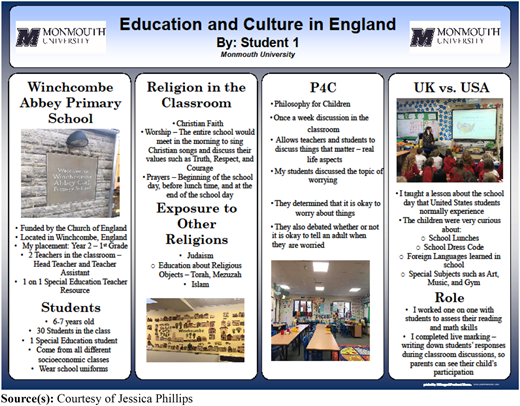
To further student scholarship, teacher candidates provide poster presentations to the research community during the university’s research exhibition in the Spring. The poster presentation includes; a reflection on the site (context), description of the students, their specific assignments/role, what the teacher candidate learned through the experience, and a reflection. In the reflection, the teacher candidate addresses the strengths and problems in education facing developing countries, solutions, obstacles, ethics, the personal relevance of the issues, and how these issues shape global phenomena, and the impact on globalization. They also include how they influenced the site based on knowing this information. Their posters are expected to be of professional scholarly quality and they provide talking points when they present them at the annual scholarship week event. Their posters and presentations are graded using a rubric. A sample poster is provided in Figure 4. Teacher candidates present alongside faculty, graduate students and doctoral student researchers. Both activities require a high level of academic skill including reflecting, researching, poster production and presenting it to an audience of administrators, professors and students at the university.
Other optional activities that teacher candidates engage in upon return include teaching academic lessons about the host country to their US students, presenting to university faculty on their journey how it enriched their college experience, and speaking to potential ED 300 candidates to assist in recruiting more interest. Finally, as part of ongoing personal development, the faculty who hosted the trip also organize activities outside of the university classroom where the group can get together to reconnect and continue to build their relationships. The shared experience unites the cohort of candidates together in a unique way that they are not likely to forget. Some examples of this could be going to a park, meeting for ice cream or lunch, or meeting at an on-campus activity. It is important that teacher candidates realize that the relationships that they created with each other and the faculty can last a lifetime.
Conclusion
The Monmouth University ED 300 Education and Cultures class and program, offers teacher candidates and students a unique opportunity to explore culture through an immersive clinical experience. This innovation directly aligns to NAPDS essentials 2, 4 and 8 as described in the text. Many university students avoid study abroad programs because they typically last a full semester. This course has an immersive experience that places candidates in classrooms for two full weeks. Most candidates in the program have never traveled internationally and therefore this significantly abbreviated experience is attractive to them. Working directly with English tour guides and educators allows for the most holistic immersive experience possible. Given the longevity of the program across both universities, interest in the program continues to grow. As candidates matriculate through the course and the experience, they grow to be more culturally competent and develop a worldview that they would not have otherwise gained. This translates into their own practice throughout their pre-service and in-service careers.
With the benefit of this program being evident, other members of faculty have since sought out other countries in which to replicate the experience. Presently, the university has developed partnerships with schools in Hong Kong and the Bahamas. Although the Hong Kong study abroad was scheduled for January of 2020, due to the nation’s political unrest, the students were re-directed to China where they were not permitted to interact with students in schools because it was during their national testing week. The Bahamas program is set to run for the first time in the 2024-2025 school year. The university faculty is committed to explore opportunities to provide unique international clinical experiences to teacher candidates and will continue to improve the program offerings to further meet the NAPDS essentials.
This article was accepted under the current editorial team.
The following Nine Essentials are highlighted in this article:
Essential 2: Clinical Preparation
Essential 4: Reflection and Innovation
Essential 8: Boundary-Spanning Roles
References
Further reading
Appendix Evaluation of performance (to be completed by cooperating teacher or professional)
The following evaluation and information should be completed by a Certified Teacher or Licensed Professional, who supervised this field experience. Please circle the number that best applies (5 = exceptional to 0 = needs major improvement).