


Law enforcement personnel are often exposed to critical incidents and are at risk of post-traumatic psychopathologies. The purpose of this systematic review is to synthesize and evaluate recent empirical research about primary and secondary prevention strategies designed to reduce the risk of law enforcement officers developing post-traumatic disorders.
The study used a systematic review approach guided by the Institute of Medicine’s Standards for Systematic Reviews and Preferred Reporting Items for Systematic Reviews and Meta-Analyses.
In total, 13 articles were deemed relevant to the question of evidence for prevention programs intended to reduce the development of post-traumatic psychopathologies in law enforcement officers. Our review found these indicated a lack of evidence for the efficacy of prevention programs. Seven of the articles included in this review focused on Critical Incident Stress Debriefing (CISD), providing no evidence to support CISD as a secondary prevention strategy for law enforcement officers. The remaining six studies focused on diverse prevention approaches including resilience training, imagery and psychosocial support, with limited evidence available.
Interestingly, despite a plethora of literature in this area, our review indicates a lack of high-quality studies investigating effective prevention approaches for law enforcement personnel. Given the potentially significant impact of post-traumatic stress disorder and other conditions associated with work-related trauma for law enforcement organizations, there is a clear need to undertake high-quality research into preventative measures in this area.
Introduction
Police and corrections officers are routinely exposed to traumatic situations on-duty. Though estimates vary across study samples, data suggest that between 84 and 100% of police officers report having experienced a work-related trauma or “critical incident” (CI), with 46–85% reporting such situations within a one-year period (Inslicht et al., 2011; Maia et al., 2015; Martin et al., 2009 ). The kinds of CIs reported vary as well, but most police officers across studies report exposure to dead bodies, abused or sexually assaulted children, and severely assaulted adult victims (Hartley et al., 2013; Violanti and Gehrke, 2004; Yuan et al., 2011). In corrections, CI exposures are also common, with up to 100% of employees reporting previous exposure to a situation involving risk of violence, injury, or death (Spinaris et al., 2012). American corrections officers are subject to approximately 36-fold higher rates of nonfatal injuries and violent acts than workers in the general population (Konda et al., 2013), with many such incidents involving inmate-fashioned weapons (Lincoln et al., 2006).
Prevalence estimates of Post-Traumatic Stress Disorder (PTSD) and other post-traumatic psychopathologies such as Acute Stress Disorder (ASD), Major Depressive Disorder (MDD), and Anxiety Disorder (AD), tend to be lower in police samples compared to corrections, despite a similar rate of exposure. However, prevalence of PTSD in police samples ranges substantially from 0 to 40% (Carlier et al., 2000; Hodgins et al., 2001; Lee et al., 2016; Regehr et al., 2019, 2021; Violanti and Gehrke, 2004; Wagner et al., 2020), while PTSD in North American correctional samples have been observed at rates as high as 27% (Spinaris et al., 2012), which is considerably higher than the 6.8% prevalence observed in the general population of North America (Kessler et al., 2005). Boudoukha et al. (2013) used the Impact of Events Scale (IES) to measure symptoms of PTSD in a sample of 240 French correctional officers and found that the mean score across the sample exceeded the cut-off for detecting significant symptoms of acute stress.
Regardless of prevalence, prevention strategies to ensure the psychological wellbeing of workers in these fields are highly important given the cumulative frequency of traumatic exposure and the responsibilities associated with protecting the safety of civilians, inmates, and the officers themselves. The present systematic review examines the literature on workplace prevention programs intended to reduce the development of symptoms of post-traumatic psychopathologies including PTSD/ASD, MDD, and AD in law enforcement populations.
PTSD and/or job stress are the focus of most current prevention programs in law enforcement. Prevention programs can be broadly divided into two categories based on the timing of administration, namely whether prevention programs are undertaken in response to a specific CI exposure, or in a more “inoculative” manner (e.g. during job training or outside the context of a specific exposure). For the purposes of the present review, we categorize the secondary programs undertaken in response to exposure as “incident-specific prevention” strategies, and the primary programs as “inoculative prevention” strategies. Due to the definition of secondary incident-specific prevention, the boundary between preventative techniques and treatment intervention programs can be at times unclear. Di Nota et al. (2021) highlight this issue as well in a systematic review of workplace mental health interventions for public service personnel, drawing a valuable distinction between “true” inoculative prevention and “proactive mitigation.” We classified prevention studies as those studies employing programs with the aim of reducing either the likelihood of developing trauma-related symptoms where none currently exist, or to prevent worsening of extant symptoms following exposure. Interventions, on the other hand, concern reducing the severity or eliminating (i.e. mitigating) already-present symptoms.
Inoculative prevention is relatively less commonly employed and fewer empirically validated strategies have been established for this purpose compared to incident-specific prevention strategies. However, in both police and corrections samples as well as other public service personnel groups, job stress and PTSD risk have been linked more strongly to organizational strain than to trauma-specific factors (Edgelow et al., 2022; Carlier et al., 1997; Maguen et al., 2009). Burnout, a syndrome defined as work-related emotional exhaustion and depersonalization (Maslach, 1993), has been linked with PTSD symptoms following work-related trauma in police and other high-risk first responder groups (Alexander and Klein, 2001; Carlier et al., 1997; Gallagher and McGilloway, 2009; Katsavouni et al., 2016), although it is unknown at present whether burnout is a risk factor for or a consequence of PTSD. Nonetheless, Finney et al. (2013) reported that burnout also demonstrates consistent associations with organizational strain in a systematic review (see also Dowden and Tellier, 2004). Given these findings, more inoculative prevention programs that address issues such as job dissatisfaction and other organizational risk factors may be of importance in reducing rates of PTSD in law enforcement populations (Carlier et al., 1997).
As mentioned, incident-specific prevention strategies are relatively more common. The most well-studied of these programs is Critical Incident Stress Debriefing (CISD), originally developed by Mitchell and Bray (1990) to serve as a therapist-guided group intervention following trauma. CISD involves components of psychoeducation, social support, and re-experiencing through group discussion. The optimal timing of CISD administration following trauma is debated, with its creators intending for CISD to be offered within 48–72 h of a CI (Mitchell and Bray, 1990) and other authors suggesting that no evidence exists for any enhanced efficacy of immediate intervention compared to intervention in the first weeks to three months following trauma (Agorastos et al., 2011). Several reviews indicate insufficient evidence for the general efficacy of CISD in emergency service fields, a majority of studies reporting no effects, and several reporting iatrogenic worsening of symptoms, possibly because of the re-experiencing component (Bledsoe, 2003; Regehr, 2001; Roberts et al., 2009). Issues complicating the evaluation of CISD efficacy include individual-difference factors in PTSD risk, self-selection into receiving CISD based on current symptoms (Regehr, 2001), and potential confounds arising from perceptions of increased organizational support and stigma reduction conferred by protocols which all personnel are required to attend (Becker et al., 2009).
There have been several other incident-specific prevention programs studied in police beyond CISD. In a systematic review of psychosocial interventions intended to prevent the development of PTSD, depression, and anxiety in law enforcement officers (i.e. police officers and military police), Peñalba et al. (2008) examined 10 randomized and quasi-randomized control trials across intervention types. Only one of these studies employed an inoculative strategy (mental imagery training), which was effective in reducing symptoms of depression at the study’s endpoint but not at the 18-month follow-up; however, the non-treated control group demonstrated a significant advantage in coping and there were no differences between groups for physical symptoms or burnout. The remaining nine studies included in the review used varied incident-specific strategies, including problem-solving skills training, group counseling, stress management training, and exercise-based therapies. Of these, most showed modest benefits at end-of-study, but no retention of benefits at follow-up (Peñalba et al., 2008). The authors conclude that law enforcement officers may benefit from such prevention programs, but that given the low number of studies and methodological variance, more data are needed.
Current study
The current study is part of a larger systematic review of trauma-related psychopathologies in personnel at high risk of CI exposure on a day-to-day basis, including ambulance personnel, police, firefighters, corrections, emergency dispatch, and public transportation workers (Wagner et al., 2023). This review reports on law enforcement workers, including police and corrections personnel, as a combined group in the present review due to the exceedingly small number of eligible studies on organizational prevention strategies in these related occupational groups. Peñalba et al. (2008) also grouped law enforcement professions including police officers and military police. The present systematic review evaluates the literature on both inoculative and incident-specific prevention programs intended to reduce rates of PTSD/ASD, MDD, and AD in law enforcement personnel.
Methods
An international research team of experts in traumatic stress and occupational health provided input for procedures, search terms, inclusion and exclusion criteria, data extraction, quality assessment, and data interpretation throughout the entire process. The team met in person twice, once at the beginning of the project and once toward the end of the project. Teleconference, videoconference, and email were used throughout the project for communication and meetings. The Preferred Reporting Items for Systematic Reviews and Meta-Analyses (PRISMA) statement (Moher et al., 2009) and the Institute of Medicine’s Standards for Systematic Reviews (IOM, 2011) guided the systematic review. All search terms, screening materials and project data are publicly available via project registration on the Open Science Framework (DOI: 10.17605/OSF.IO/SFRHE).
Search strategy
The team worked with a research librarian to develop the search language and vetted the strategies. The initial search in Medline OVID was peer-reviewed by another librarian utilizing the Peer Review of Electronic Search Strategies criteria (McGowan et al., 2016) and subsequently adjusted according to review feedback. This adjusted search was replicated in the following databases: Evidence Based Medicine Reviews (OVID), PsycINFO (EBSCO), Cumulative Index to Nursing and Allied Health Literature (EBSCO), PILOTS (ProQuest) and Web of Science (Institute for Scientific Information). The search strategies were originally limited to articles published between 1980 and 2017 and included all study designs and languages. More recently a full updated search for articles from 2017 to December 2024 was conducted resulting in three additional articles relevant to prevention programs for law enforcement personnel. All search results were exported into DistillerSR following removal of duplicates, and the search was registered in PROSPERO International Register of Systematic reviews (Registration No: CRD42018085689).
The review phase of the project began with screening of titles and abstracts by two team members done independently. Following manual screening of approximately 5,000 records, a DistillerSR algorithm-assisted screening procedure was used to complete title/abstract screening with one team member manually checking all algorithm-assisted screening decisions; no further algorithm-assisted screening was conducted following title/abstract review. Potential papers were then read in full by two content experts to determine inclusion or exclusion. Reviewers were encouraged to resolve discrepancies through discussion, but a third reviewer was brought into the discussion to make a final decision if needed. Throughout the full paper review process a research team member or a faculty colleague translated non-English language articles if fluent in that language. If this was not an option, articles were translated in consultation with a fluent volunteer faculty member at the University of Northern British Columbia, or via professional translation or Google translate as needed. It is acknowledged that Google translate has limitations, but this is outweighed by the limitation of not including a significant publication in the review (Balk et al., 2013). Following the initial systematic search and review processes, a secondary manual search was conducted from the reference lists of eligible articles. The review process for this search was the same as the review process for articles identified in the first search.
Data extraction
The research team developed a data extraction form and customized it to extract information specific to the prevention initiative. During the initial in-person team meeting, the researchers pilot tested the data extraction form to ensure that it would pull relevant and meaningful data. As with all levels of review, two team members conducted the data extraction for each article to confirm that important information was completely and correctly extracted.
Quality assessment
Munn’s Prevalence Critical Appraisal Instrument (Munn et al., 2014) was revised for assessing prevention initiatives specifically. In addition to the 10 items of Munn’s instrument, the research team appended two additional questions to evaluate the empirical rigor of prevention programs. The additional questions asked whether the implementation of the prevention was sufficiently described and whether the preventative intervention was appropriate for the intended outcomes. While there are quality assessment metrics that have been validated for intervention protocols more specifically, most of these instruments concern evaluation of randomized control trials (RCTs), and there are few RCTs in this literature, so this modified Munn’s prevalence instrument was utilized. Similar to the data extraction form, the research team provided input on the revisions to the quality assessment form and subsequently tested it for usability and reliability. The 12-item quality assessment form evaluated an article’s sample, recruitment, analysis, measurement, prevention initiative, and bias. The questions were answered with yes, no, unclear, or N/A, and were given one point for every yes answer. Once the article’s quality score out of 12 was calculated, it was categorized as high quality (10–12), medium quality (6–9), or low quality (5 and below) in line with an adapted version of the categorical groupings used in the Health Evidence Quality Assessment tool (healthevidence.org). The final stage of review included a subjective analysis of the strength of the study design (high, moderate, or low) and level of contribution it would make to the research question (definite, moderate, low, or no contribution). The subjective perception questions were included as a part of the systematic review process based on the experience of the research team. It was noted that at times, a quality assessment ranked an article as high quality despite it making a minimal contribution to the present research question.
Results
Our comprehensive review of law enforcement and mental disorders resulted in 10,883 original citations. After exclusions based on title and abstract reviews, there were 116 full-text articles assessed for eligibility, with a further 82 articles excluded with reasons at this stage, leaving 34 articles for qualitative synthesis and abstraction. Thirteen of these articles were directly relevant to the question of evidence for prevention programs intended to reduce the development of post-traumatic psychopathologies such as PTSD/ASD, MDD, and AD in law enforcement populations (see Figure 1: PRISMA flow diagram).
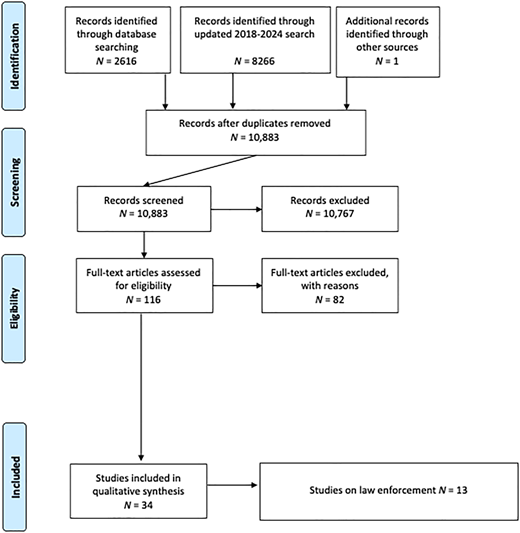
PRISMA flow diagram of study inclusion for systematic review. Note that full-text articles were only excluded if full-text review revealed that the study did not include a population or mental health outcome of interest. Source: Authors’ own work
PRISMA flow diagram of study inclusion for systematic review. Note that full-text articles were only excluded if full-text review revealed that the study did not include a population or mental health outcome of interest. Source: Authors’ own work
Quality scores ranged from six to nine out of 12, all within the medium quality group. Subjective quality assessments varied with none of the articles rated as high, 12 rated as medium, and one as low. Of the 13 articles, 11 were focused on police and two on corrections officers. The level of contribution to addressing the research question was assessed as definite for three of the articles, moderate for eight articles and weak for the remaining two articles. Seven of the articles focused on CISD or variations thereof. The remaining six studies utilized other prevention strategies, including Trauma Risk Management (TRiM), resilience training, imagery, and officer led psychosocial support groups. See Table 1 for an overview of the 13 articles included in this review.
Summary of evidence for studies examining impact of prevention following exposure to work-related trauma for law enforcement personnel
| Article | Quality rating | Contribution | Population | Design | Sample size | Measures | Prevention type | Results PTSD | Results depression | Results anxiety |
|---|---|---|---|---|---|---|---|---|---|---|
| Carlier et al. (1998) | Medium | Definite | Dutch police officers who responded to same fatal plane crash | Post-test only study with control group | 105 (46 with CISD; 59 without CISD) | Structured interview for PTSD (SI-PTSD) | Critical Incident Stress Debriefing (CISD) | No difference between groups 8 months post disaster. No significant difference in PTSD diagnosis after 18 months, but significantly more hyperarousal symptoms in CISD group | ||
| Carlier et al. (2000) | Medium | Definite | Traumatized Dutch police officers | Non-randomized pre-test post-test study with 2 control groups | 243 (86 received CISD; 82 refused CISD = internal control group; 75 historical control who did not receive CISD) | Spielberger State-Trait Anxiety Inventory (STAI); Anxiety Disorders Schedule-Revised (ADIS-R); Self-Rating Scale for PTSD (SRS-PTSD); Impact of Events Scale (IES); Peritraumatic Dissociative Experiences Questionnaire (PDEQ-R) | Critical Incident Stress Debriefing (CISD) | No differences at pre-test, 24 h and 6 months, but 1 week intervention group displayed significantly more PTSD symptomatology | No differences on STAI 24 h post trauma | |
| Leonard and Alison (1999) | Medium | Moderate | Australian police officers | Case control design with matched sample | 60 (30 received CISD and 30 control) | Coping Scale; State-Trait Anger Expression Inventory | Critical Incident Stress Debriefing (CISD) | No significant difference on Coping Scale after CISD; Significantly lower state and trait anger after CISD | ||
| Stephens (1997) | Medium | Moderate | New Zealand police officers | Retrospective cohort study | 527 (121 debriefed and 404 non-debriefed) | Civilian Mississippi PTSD scale (M-PTSD); traumatic stress schedule; 2 social support scales; ease of talking about trauma at work scale; and attitudes of expressing emotion at work scale | CISD | No difference on M-PTSD scores within debriefed group for those with more traumatic events. Participants with higher PTSD scores significantly more likely to report less social support, less positive attitudes to expressing emotion, and less ease in talking about trauma at work | ||
| Young (2012) | Medium | Moderate | US police officers | Pre-test post-test study with control group | 37 (20 debriefed; 17 control group) | Impact of Event Scale – Revised (IES-R); Beck Depression Inventory (BDI) | Critical Incident Stress Management (adaptation of CISD for cumulative stress with social support) | No statistically different changes in post-traumatic stress | No statistically different changes in depression | |
| Bär et al. (2004) | Medium | Weak | German police officers | Post-test only study | 649 | ICD-10 | Secondary preventative intervention after traumatic event incl. defusing, structured discussions and debriefings | 2.9% developed PTSD and 14.5% had another stress reaction. Impact of prevention activity unclear | 9.4% had a different psychological illness | |
| Ruck et al. (2013) | Medium | Moderate | UK prison staff who experienced traumatic experiences | Pre-test post-test design with self-selected control group | 91 at time 2 (55 debriefed and 36 non-debriefed) | Impact of Events Scale Extended (IESE); Generalized Anxiety and Depression Scale (GAD) | 7 stage Mitchell debriefing process delivered by trained facilitators | Debriefed group had higher IESE scores prior to debrief and significantly lower scores at T2 | No differences on GAD | No differences on GAD |
| Watson and Andrews (2018) | Medium | Definite | UK police officers | Cross-sectional survey | N = 693 intervention group N = 166 control group | PCL-C, no cut-off or scoring method reported Stigma and Barriers to Care Questionnaire Military Stigma Scale | Trauma Risk Management (TRiM) program in the workplace | Compared to controls, the TRiM group scored significantly lower on the PCL-C Controlling for PTSD symptoms, the TRiM group also showed significantly lower public stigma and barriers to help-seeking | ||
| Ramey et al. (2016) | Medium | Moderate | US police officers | Experimental wait listed control design | 38 (Pilot A 20 immediate intervention and Pilot B 18 delayed intervention 3 months) | Anger and Resentment subscale of Personal and Organizational Quality Assessment-R; IES; Perceived Stress Scale | Resilience training | Younger officers had a significant benefit from the resilience training on several measures of psychological stress (e.g. critical incident stress). Older officers had a non-significant opposite effect. Overall: Significant benefit | Younger officers had a significant benefit from resilience training on several measures of psychological stress (e.g. emotional vitality). Older officers had a non-significant opposite effect. Overall: unclear effect | |
| Arble et al. (2017) | Low | Moderate | US police academy recruits from Detroit | Pre-training (recruits) post-training 12 months later) study without control group | 22 | Anonymous survey; 28-item Brief Coping Orientation to Problems Experienced; 10-item Sources of Support scale; 17-item PTSD Checklist; Hospital Anxiety and Depression Scale; Karolinska Institute Sleep Questionnaire; Alcohol Use Disorder Identification Test | Imagery-based program (incl Relaxation, imaginal traumatic incidents and group discussion) | PTSD symptoms did not increase 12 months post program, which is not typical of new police officers. Maintained pre-deployment sleep quality, which is also not usual | Reduced alcohol consumption (non- significant) | Overall anxiety significantly decreased 1 year after training |
| Becker et al. (2009) | Medium | Weak | US law enforcement officers (including students, cadets and officers) | Traumatic scenario followed by list of intervention options for participants to choose from | 379 (including 99 criminal justice students; 108 police cadets; 156 law enforcement officers) | Modified Credibility Scale (CS); Posttraumatic Stress Diagnostic Scale (PDS) | Cognitive Processing Therapy; Pharmacological; EMDR and psychodynamic treatment; Brief eclectic psychotherapies; + questions about CISD | Participants (with and without PTSD) preferred Cognitive Processing Therapy. Overall 2nd preference was exposure therapy, but not for those with PTSD who preferred psychodynamic treatment as 2nd choice | ||
| Bademci et al. (2016) | Medium | Moderate | Correctional officers in Turkey | Quasi-experimental pre-test post-test design no control group | 42 | Qualitative interviews; Minnesota Job Satisfaction Inventory (MJSI), Maslach Burnout Inventory (MBI), Positive and Negative Affect Scale (PANAS), Beck Anxiety Inventory (BAI), Beck Depression Inventory (BDI) | Psychosocial support group to help officers to deal with feelings of insecurity and helplessness | Burnout, negative feelings and depression scores significantly decreased Job satisfaction and positive feelings increased | Anxiety scores significantly decreased | |
| Ramey et al. (2017) | Medium | Moderate | Police academy recruits | Experimental with randomized group assignment; testing at baseline, post-intervention, and 2-month follow-up | N = 34 | Impact of Events Scale | Resilience training | No significant change in IES scores within- or between-groups |
Source(s): Authors’ own work
CISD police articles
The six CISD incident-specific prevention for police articles are organized according to level of contribution.
Carlier et al. (1998) conducted a post-test-only study to compare post-traumatic stress outcomes between Dutch police officers who received CISD (n = 46) and officers who did not receive CISD (n = 59) after responding to the same fatal airplane crash. Debriefing was delivered as soon after the traumatic exposure as possible, and follow-up clinical interviews, using the structured interview for PTSD, took place eight- and 18-months post-debriefing. No statistical difference in PTSD diagnosis was found between groups at either follow-up. However, officers who received CISD were more likely to report disaster-related hyperarousal symptoms (7%) than the control participants (0%).
Carlier et al. (2000) conducted a non-randomized pre-test post-test study of multisession CISD for post-traumatic stress, other psychological distress, and sick leave. Dutch police officers who experienced a traumatic event received CISD 24-h, one month, and three months post-trauma, or did not receive CISD by their own choice. Eighty-six officers received CISD and 82 refused. An additional historical control of 75 officers was also included who were unable to receive CISD at the time. Officers were interviewed by group-blinded research psychologists pre-CISD, and 24 h, one week, and six months post-trauma. The CISD and control groups did not differ in anxiety symptoms at 24-h post-trauma. One-week post-trauma, the CISD group reported greater symptoms of re-experiencing (44% experiencing one or more symptoms vs 26%) and the avoidance symptom of “loss of recall” (12 vs 2%) than the control group who declined CISD (p < 0.01 each). However, this difference was non-significant at six-month follow-up. Most officers in each group returned to work immediately after the incident, with no group differences in sick leave.
Stephens (1997) examined the impact of social support and CISD on police officers in New Zealand in a retrospective cohort study. 527 police officers filled out various surveys that were sent out by mail, including the Civilian Mississippi PTSD scale (M-PTSD), the traumatic stress schedule, two social support scales, an ease of talking about trauma at work scale, and attitudes of expressing emotion at work scale, and a question of whether they attended debriefing at work or not. There was no significant difference between the scores of participants who attended a debriefing with scores of participants who did not attend a debriefing. Furthermore, Stephens (1997) outlines that participants with higher PTSD scores were more likely to report having less social support than those with lower PTSD scores. Overall, this study which is based on a large sample size compared to other studies in this review outlines the ineffectiveness of debriefing, and the importance of social support in reducing PTSD symptoms. Similar results were found in a smaller Australian case-control study conducted by Leonard and Alison (1999). However, this study noted that the 30 police officers who received CISD had lower levels of self-reported State-Trait anger and angry temprament than the 30 officers who did not receive CISD.
Young (2012) conducted a controlled pre-test post-test study investigating the effect of an eight-week, eight-session cumulative stress debriefing intervention (adapted from CISD) among American police officers in preventing symptoms of PTSD and depression. A total of 37 police officers either voluntarily participated in the debriefings (n = 20) or refused (n = 17, control group), and completed both the pre-intervention and post-intervention study measures. Most participants were male (86.5%) and had an average of 12.61 years of policing experience. After the eight weeks of debriefing, and controlling for role (patrol or investigator), no statistically differences in PTSD symptoms (IES-Revised), or depression (Beck Depression Inventory (BDI)), were found between the intervention and control participants. However, all debriefing participants found the intervention useful, with most indicating that they perceived the debriefings to relieve some of their stress.
Bär et al. (2004) conducted a post-test only study of 649 German police officers who had experienced a traumatic event and received one or more secondary intervention immediately following one of 250 documented CIs to prevent the onset of psychological illness, including defusing (n = 425), debriefing (n = 278), and structured discussion (n = 183). All participants also received other support, such as legal advice. All interventions were provided by emergency response teams of police doctors and senior police officers. There was no comparison group, and the findings were not separated according to interventions. The implications for the efficacy of prevention are unclear given the limited description of interventions and unclear timing of initial and follow-up conversations, but the authors attributed the low rates of diagnosed PTSD and psychological illness to the preventative interventions provided by the emergency response teams. Based on the interpretation of the German-speaking first author of this paper (CR), the Bär et al. study aligns with acute defusing and debriefing and was therefore grouped with the CISD studies.
CISD moderate contribution corrections article
Ruck et al. (2013) conducted a study to evaluate the benefits of participating in trauma debriefing with prison staff in the UK. Following traumatic incidents within the prison, staff were invited to participate in a debriefing program that followed the seven-stage Mitchell debriefing process. Participants self-selected to be in either the debriefing group or the non-debriefing group. The Impact of Events Scale Extended (IESE) and the Generalized Anxiety and Depression (GAD) Scale were used as outcome measures. Results revealed that the debriefed group had significantly higher IESE scores than the non-debriefed group at time 1, prior to the debriefing. Following the debriefing, at time 2, the debriefed group had a significant reduction in IESE symptom scores with an effect size of 0.59, whereas the non-debriefed group did not experience a significant difference between time 1 and time 2. While it appears that the debriefing contributed to a reduction in symptoms, the two conditions were not initially matched for comparison as participants who were experiencing more stress symptoms were more likely to attend the debriefing.
Inoculative prevention police articles
Five inoculative prevention police articles are organized according to level of contribution.
Watson and Andrews (2018) evaluated symptoms of PTSD as well as help-seeking and stigma in police officers in the UK, using an observational approach to compare a group of officers already receiving the peer-support-based occupational program TRiM through their department, and a control group receiving no such department-based programming. Outcomes were evaluated using the PTSD Checklist Civilian version (PCL-C) for PTSD, the Stigma and Barriers to Care Questionnaire and the Military Stigma Scale. The groups were statistically equivalent on demographic variables including gender, years of service, race/ethnicity, and rank, and no differences were observed in the reported rates of previous occupation-related or other lifetime traumatic exposure. PCL-C scores were significantly lower for the TRiM group (n = 693) compared to the control group (n = 166), as were scores on measures of help-seeking and stigma, in accordance with the authors’ hypotheses that TRiM would be associated with fewer barriers to help-seeking, less stigma, and fewer PTSD symptoms. The authors highlight that while TRiM is not directly intended to address psychological distress, it shows promise as a prevention tool due to its focus on reducing barriers to help-seeking and stigma-related attitudes.
Ramey et al. (2016) conducted an evaluation of a resilience training intervention among American police officers to improve both physiological and psychological outcomes. The resilience training included two moderated sessions (one session moderated by one of the researchers and the other moderated by mental health professionals, including psychologists), and covered topics related to stress (physiology, triggers, awareness, etc.) Participants were taught biofeedback techniques and were encouraged to practice these techniques for three months after completion of the sessions. Post-intervention, a marginally significant reduction of scores on the Anger and Resentment subscale of the Personal and Organizational Quality Assessment-R was observed (Mdiff = −2.3 ± 0.7, p = 0.08). Across all other included psychological measures (IES, Perceived Stress Scale, Response to Stressful Experiences Scale, and the remaining subscales of the Personal and Organizational Quality Assessment-R), mean changes were non-significant in the detrimental direction. Only for the Avoidance subscale of the IES (M = 2.4 ± 8.0, p = 0.09) was this detrimental effect of marginal significance. It should be noted that a significant effect of age (p < 0.05) was found across most scales and subscales, including the Avoidance subscale, with younger officers benefiting from the resilience training as indicated by decreasing stress scores on the IES and the older officers apparently experiencing the opposite effect. Of those officers who provided feedback regarding the intervention, most provided positive feedback and noted that they were more aware of the stress they were experiencing, and that the biofeedback helped them relax. The researchers postulated that this increased awareness of the stress these officers were experiencing may have led to the self-reported scoring of greater stress effects after the intervention, such as the increased Avoidance scores. In a similar RCT of resilience training efficacy for preventing the onset of trauma-related symptoms in new police academy recruits, Ramey et al. (2017) found no significant effects of resilience training on IES scores at two-month follow-up; no further follow-up assessments were conducted.
Arble et al. (2017) conducted a study to test the efficacy of an imagery-based program designed to prevent traumatic stress and improve coping in police officers. The prevention strategy was adapted from the Swedish version to fit the needs of American police officers. A train the trainer approach was used for this study and senior officers were involved in designing the program to ensure that the scenarios were suitable and to increase acceptance of the prevention initiative. Twenty-two police recruits from the Detroit Police Academy participated in the initial study and again one year later for follow up, when they became active-duty police officers. The imagery-based program is done over five sessions and includes various stages within each session. Each session contains relaxation, imaginal traumatic incidents, and group discussion. The outcome measures used pre-training and at follow-up revealed no significant change in PTSD symptoms, a significant reduction of anxiety symptoms, and a marginally significant increase in depression scores. Arble et al. (2017) suggest that the participants in this study did not experience an increase in PTSD symptoms, which is not typical of new police officers. Additionally, the senior officers involved in the development of this prevention initiative stated that the program is important and useful. While this study offers support for the efficacy of the initiative there was no control group which means the changes may be due to factors other than the prevention initiative.
Becker et al. (2009) sought to investigate the prevention and treatment preferences of law enforcement officers. While this study met our screening criteria, no formal prevention protocol was conducted, as the focus was on preference for and perceived credibility of different mental health prevention and treatment strategies; it is included here for comprehensiveness. The sample consisted of 379 participants, including 99 criminal justice students, 108 police cadets, and 156 law enforcement officers in the US. To assess prevention and treatment preferences, the authors used a modified version of the Credibility Scale. Becker et al. (2009) found that 77% of participants thought that participation in CISD should be required to reduce the onset of PTSD. Interestingly, fewer than 20% of participants believed that CISD would reduce PTSD symptoms. The authors speculate that this discrepancy between beliefs that CISD should be mandatory and the expected efficacy of CISD may be related to a perceived reduction in mental health stigma and increased organizational support in relation to protocols that all personnel are required to attend.
Inoculative prevention moderate contribution corrections article
Bademci et al. (2016) conducted a quasi-experimental pre-test post-test designed study to determine the efficacy of a psychosocial support group for correctional officers in Turkey. Participants were assessed on various measures, including anxiety and depression, both before and after the 11-week psychosocial support group. The support meetings were intended to provide the correctional officers who were experiencing a sense of insecurity and helplessness with an opportunity to discuss their feelings with other correctional officers. From pre-to post-intervention, there was a significant reduction in scores on both the Beck Anxiety Inventory (t(40) = 3.72, p = 0.001) and the BDI (t(40) = 3.52, p = 0.001) following the psychosocial support meetings. Bademci et al. (2016) concluded that the psychosocial support meetings reduced the distress levels in the correctional officers.
Discussion
Our goal was to critically review literature on prevention approaches to dealing with work-related trauma in police and correctional officers. The results of our systematic review indicate a lack of high-quality studies investigating this important area. Indeed, we could only find nine studies of moderate quality and one of low quality that focused on police officers and two of moderate quality that addressed correctional officers. All eligible studies concerned person-level interventions, despite a growing body of literature regarding the psychological impacts of organizational strain in public service personnel (Edgelow et al., 2022) and a recognized need for systems-level interventions to support resilience (Shaw et al., 2016). It is also notable that only three of these studies were viewed by the research team as “definitely” contributing to the research question, all of which focused on police officers. Given the potentially significant impact of PTSD and other conditions associated with work-related trauma for law enforcement organizations, there is a clear need to undertake high-quality research into preventative measures in this area. Considerably more research is needed to responsibly inform practical recommendations, ideally conducted in partnership with police organizations to identify personnel support needs via a participatory action framework. Gottfredson et al. (2015) provide excellent recommendations for standards of evidence and efficacy in the design of research in this important area.
A variety of interventions have been used to prevent and manage PTSD and its associated symptoms. These include CISD, resilience training, imagery, psychosocial support, and eclectic approaches using a combination of therapies. Of the 13 studies in our review, 58% (n = 7: police = 6, correctional officers = 1) used CISD as the prevention strategy. Consistent with previous studies (e.g. Bledsoe, 2003; Regehr, 2001; Roberts et al., 2009) little evidence was found to support CISD. Our review obtained variable findings, which ranged from some benefit to no impact or a negative impact on symptoms when compared to a comparison or control group. Stephens (1997) found that CISD had no impact on PTSD scores in a large sample of New Zealand police officers and that social support was more strongly associated with lower symptom levels, supporting the speculation of Becker et al. (2009) that workplace programs targeting all personnel may be associated with reduced mental health stigma and higher perceived organizational support. Leonard and Alison (1999) reported similar findings in an Australian sample but did find that CISD recipients compared to non-CISD recipients had lower levels of trait and state anger and angry temperament. In an American sample of police officers, Young (2012) found participants reported that debriefing was useful in relieving their stress. However, there were no statistical changes in post-traumatic stress or depression using standardized scales. Two non-randomized studies of Dutch police officers (Carlier et al., 1998; Carlier et al., 2000) found no differences between a CISD intervention and non-intervention comparison groups six to 18 months post-trauma. It was notable in the 2000 study that the CISD group reported greater symptoms of re-experiencing and the avoidance symptom of “loss of recall” than the internal control group within the first week, although these effects receded over time, and in the 1998 study the officers who received CISD were more likely to report disaster-related hyperarousal symptoms than the control participants, which did persist over time. Bär et al. (2004) suggest some benefit from defusing, debriefing and/or structured discussions, but being unable to discern the prevention protocols utilized makes it difficult to draw further conclusions.
The one study investigating CISD with correctional officers (Ruck et al., 2013) found that the debriefing group had a significant reduction in scores on the IES Extended (IESE) scale. However, the results of this study are significantly compromised by the fact that there was no matching or randomized allocation of participants in the two groups. Participants self-selected into the debriefing and non-debriefing groups, with officers experiencing higher stress levels more likely to attend the debriefing group. Overall, there is scant evidence to support CISD as an intervention with either police or correctional officers. At best our findings indicate that CISD may have some “subjective” benefit to participants, who self-selected into debriefing, in terms of their reported capacity to manage their stress, and one study found lower scores for the debriefed group related to trait and state anger. We reiterate previous work and current best-practice guidelines (e.g. Cochrane Methods Equity, 2025) in concluding that evidence does not support the mandatory use of CISD following occupational traumatic exposure. However, recent meta-analytic work concludes that widespread shortcomings in study methodology and reporting in relation to quantifying the efficacy of psychological debriefing for prevention of trauma-related symptoms promote conducting further, high-quality research on debriefing to gain more clarity on the capacity of post-incident debriefing to support high-risk personnel (Stileman and Jones, 2023).
The remaining six studies included in this review represented a range of prevention approaches. Given the moderate quality and insufficient number of these studies it is difficult to reach any definitive conclusions about the efficacy of these interventions in relation to preventing and managing work-related trauma. Resilience training may be an intervention that has some merit, although the results from the two studies reviewed are somewhat ambiguous. Ramey et al. (2016) found that building resilience through information provision and biofeedback led to significant decreases in anger and resentment but no significant change for relational tension and a significant increase in avoidance overall. However, these findings were age-contingent, wherein younger officers benefited from the training while older officers did not. Furthermore, feedback indicated that most officers reported benefiting from the biofeedback, but their heightened awareness of stress consequently led to greater stress reporting on the relevant subscales. In a RCT of resilience training for new police academy recruits, Ramey et al. (2017) found no effects on IES scores at two-month post-training; however, this follow-up window may be too short for new recruits to fully experience the potential benefits of inoculative resilience training. Further longitudinal work is required.
Somewhat related to resilience training, imagery-based programs involving relaxation, imagining traumatic incidents and group discussion led to new police recruits not experiencing the usual increase in PTSD symptoms and senior officers commenting positively on the program (Arble et al., 2017). However, the design of this study was weak with no control group, a small unrepresentative sample and lack of baseline measures, thereby precluding any firm conclusions. In terms of correctional officers, a Turkish study (Bademci et al., 2016) lent support to the impact of a psychosocial support intervention on anxiety and depression. Again, the study design was weak, being a quasi-experimental pre-test, post-test design.
Limitations of the current review include the use of quality scores which all fell into the medium range for the current study. This was somewhat offset by the expertise of the international research team including subjective quality and contribution ratings. These subjective ratings provided a more nuanced hierarchy of evidence across the larger systematic review of trauma-related psychopathologies in personnel at high risk of CI exposure, which this paper is drawn from. The contribution rating was potentially affected by how “relevance” was interpreted. For the current paper, relevance is about the extent to which the reviewed papers address the specific question of how effective prevention programs are in reducing the rates of PTSD/ASD, MDD, and AD in law enforcement personnel.
Another limitation of the current review as well as the current literature is that all included studies focused on person-level interventions for trauma-related mental health symptoms. Given documented associations between organizational factors in relation to workers’ mental health (e.g. Edgelow et al., 2022), organization-level interventions which focus on modifying negative aspects of workplace culture may hold promise for mental health prevention. However, at present, the available literature which met our screening criteria did not include any such interventions, leaving this question open for future work.
Conclusion
In summary it is evident that there is a dearth of high-quality studies investigating strategies to prevent PTSD and associated symptomatology. Most studies focus on CISD, which is largely discredited as an effective approach. Other strategies, including resilience training, imagery, psychosocial support, and eclectic approaches using a combination of therapies, may have value but require further examination. Future work in designing novel prevention strategies should involve law enforcement personnel to identify emerging research priorities and increase efficiency in the development of urgently needed solutions to support personnel in the workplace.
Funding: The present study was funded by WorkSafeBC grant SR2016-SR04 to Shannon Wagner.

