This article examines the role of servitized business model innovation (SBMI) in facilitating the transition to circular economy (CE) performance within the real estate sector, with a specific emphasis on the South African built environment. It analyses how moving from asset ownership to service provision can advance sustainability, resource efficiency and decarbonisation objectives.
This study used a qualitative research approach through semi-structured interviews with stakeholders from public and private property development organisations. Participants were purposefully selected to represent different management levels: strategic, tactical and operational, to provide an overall view of SBMI throughout the real estate value chain.
The research identifies that SBMI supports circular real estate practices, including building lifecycle extension, shared-use models and regenerative resource strategies. In the South African context, servitized approaches such as energy-as-a-service, space-as-a-service and circular retrofitting are described as potential methods to separate value from material consumption. Transition management is discussed as a governance framework to address systemic barriers, coordinate stakeholders and facilitate CE implementation.
The study proposes a framework to assist property developers, urban planners and policymakers in developing circular-ready business models and addressing sector changes related to sustainable, net-zero real estate in South Africa.
This article introduces a novel integration of SBMI and transition management as a dual lens for transforming traditional, linear property systems. It addresses a critical research gap in CE transitions in the Global South.
1. Introduction
The built environment plays a central role in addressing global sustainability challenges, as it is responsible for approximately 37% of energy- and process-related carbon dioxide (CO2) emissions and 34% of global energy demand (UNEP, 2022). Real estate and construction activities also contribute significantly to material consumption, waste generation and land degradation, making the sector a critical target for decarbonisation and resource efficiency interventions (Olanrewaju, 2025).
The circular economy (CE) has emerged as a transformative paradigm for mitigating the environmental impacts of the built environment by promoting regenerative systems, minimising waste and extending the life cycle of materials and assets (Ellen MacArthur Foundation, 2021; Pomponi and Moncaster, 2017). Within the context of real estate, CE principles are increasingly applied to promote adaptive reuse, flexible space management and shared asset models, thereby aligning built assets with broader sustainability goals and the United Nations Sustainable Development Goals (SDGs) (Owojori and Okoro, 2022; Lundgren, 2023).
Although there is increasing acknowledgement of the CE's significance, its practical use within the real estate industry is still constrained, especially regarding implementation techniques that extend beyond materials and design (Rahla et al., 2021a, b). A substantial gap exists in integrating CE principles with innovative business models capable of sustaining these practices over the long term. In this context, servitized business model innovation (SBMI), which transforms value delivery from product ownership to service providing, presents a compelling yet underexamined avenue for integrating CE into real estate delivery and management systems. Servitization facilitates the separation of asset ownership from utilisation, hence permitting performance-based models such as space-as-a-service, energy-as-a-service and circular retrofitting (Tukker, 2015; Ingelsson and Mellgren, 2020).
Nonetheless, the institutional inertia and fragmented value chains within the real estate market appear to obstruct the extensive implementation of such models. The absence of systemic transition frameworks, particularly for existing business models, has intensified these issues, hindering stakeholders from effectively integrating services into the industry's historically product-centric offerings. While some authors have focused on the challenges of institutional inertia and fragmented value chains in the real estate sector (Ghafoor et al., 2025; Nyoni et al., 2023), there is a scarcity of research aimed at creating a comprehensive framework for managing transitions to product-service systems (El Hafiane et al., 2025).
A transition management approach can provide structured pathways for integrating SBMI with CE objectives, especially in contexts like South Africa, where urban inequality, informality and infrastructure deficits converge with global sustainability mandates (Swilling et al., 2016). Accordingly, this article explores the potential of SBMI to accelerate circular built environment transitions within the real estate sector, employing transition management theory to develop practical strategies for business model transformation.
2. Literature review
2.1 Circular economy in the built environment
The transition to a CE has become imperative within the built environment due to the sector's substantial environmental footprint. Buildings and construction account for a significant portion of global energy consumption, greenhouse gas emissions and material waste, prompting scholars to explore CE principles as a means of achieving sustainability (Ghaffar et al., 2018). The application of CE principles in the built environment is defined by techniques including material circularity, lifecycle extension, adaptive reuse and design for disassembly, all intended to eradicate waste and diminish reliance on virgin materials (Pomponi and Moncaster, 2017; Foster, 2020; Rahla et al., 2021a, b).
Although CE-oriented frameworks have become widespread, their implementation in real estate and construction sectors is inconsistent. El Hafiane et al. (2025) contend that despite the theoretical foundation of lifecycle thinking and material reuse, a disparity exists in their systemic application owing to fragmented value chains and insufficient collaboration throughout the supply chain. Recently, Gasparri et al. (2023) and Reynolds (2025) further highlight the misalignment between CE rhetoric and actual practice, noting that many built environment actors adopt superficial “circular” strategies without fully integrating circular design or operational principles. In Global South contexts such as South Africa, additional challenges such as urban informality, infrastructure deficits and financial constraints further complicate the realisation of CE in property development and housing sectors (Godfrey et al., 2021; Mensah et al., 2024).
In other instances, the adaptive reuse strategies in Amsterdam's De Ceuvel project (Hussein and Alhebsi, 2025) and the implementation of space-as-a-service models in the UK's City of London Office buildings (Tsolacos et al., 2023) offer instructive examples of how circularity can be embedded in real estate practices. These international case studies provide useful benchmarks for South Africa's property sector, revealing parallels in challenges related to regulation, stakeholder alignment, and digitalisation. Integrating learnings from such practices highlights the need for flexible, localised strategies that draw from global innovation while remaining sensitive to domestic socio-economic and institutional realities.
These innovations, however, require new business models and governance approaches to become scalable and commercially viable. This highlights the need for integrated models that embed CE principles not only into design and technology but also into the foundational logics of value creation, delivery and capture within the real estate industry.
2.2 Servitization and business model innovation
Servitization refers to the strategic shift from product-based to service-oriented business models, wherein firms provide value through the functionality and performance of assets rather than their ownership (Tukker, 2015). In the context of the built environment, servitized business models (SBMs) enable real estate assets to be delivered “as a service” (Chua and Wang, 2021). Such service could take the following forms energy-as-a-service, space-as-a-service or performance-based retrofitting agreements. These models decouple asset ownership from use, promoting more sustainable consumption patterns and enabling circular practices such as lifecycle management and resource sharing (Bocken et al., 2016; Scheel et al., 2020; Giovanardi, 2023).
The concept of business model innovation (BMI) has attracted significant academic and practical attention, highlighting the necessity for organisations to modify their value creation and capture strategies in reaction to evolving market and environmental circumstances (Aagaard, 2024; Zott et al., 2024). BMI is generally defined as the intentional modification, diversification or reconfiguration of current business models to address both internal and external catalysts for change (Foss and Saebi, 2018; Geissdoerfer et al., 2018). In this paradigm, business models (BMs) serve as both structures for arranging economic transactions and tools for fostering innovation (Zott et al., 2024; Abdulkader et al., 2020). They can function as either facilitators of new product or service development or as independent drivers of competitive difference, where the business model's structure itself represents a strategic innovation (Boons and Lüdeke-Freund, 2013).
As sustainability issues escalate, BMI has been intricately linked with environmental and social imperatives. An increasing volume of research highlights the incorporation of triple bottom line (TBL) thinking, which involves balancing economic, environmental and social value, as fundamental to modern innovation strategies (Bocken et al., 2014; Tate and Bals, 2018; Nogueira et al., 2025). This linkage has advanced the development of sustainable business model innovation (SBMI), prompting firms to pursue value propositions that promote environmental stewardship and inclusive growth. Evans et al. (2017) contend that sustainability-oriented BMI necessitates enterprises to restructure both their offerings and their operational systems, as well as their stakeholder connections.
The rise of sustainability issues has prompted the development of thematic sub-streams within the broader BMI debate, each focussing on sector-specific and technology factors. This encompasses innovation for the CE, servitization and digitalisation, each necessitating distinct strategic orientations, competencies and governance structures (Foss and Saebi, 2018). Collectively, these advancements represent a fundamental shift in organisational perceptions of innovation, viewing it not solely as product enhancement but as a systemic revolution integrated into the very design of business models.
The adoption of servitization into BMI has garnered considerable academic attention, especially about its capacity to facilitate CE transformations. Antikainen and Valkokari (2016) and Du (2025) emphasise that CE-compatible business models must transcend incremental enhancements and adopt systemic innovation in value propositions and delivery methods. For real estate professionals, this may entail transitioning from singular sales or rents to enduring service agreements centred on performance, durability and flexibility.
Recent investigations delineate the facilitative function of digitalisation in bolstering SBMs. Du (2025) notes that smart building technologies, the Internet of Things (IoT) and predictive maintenance systems can support performance-based models that correspond with CE objectives. Nevertheless, despite their promise, the implementation of SBMs in real estate is still constrained (Nissinen, 2024). Literature indicates that obstacles comprise risk aversion, entrenched asset-ownership cultures and insufficient transition support frameworks. In South Africa, these issues are exacerbated by legislative deficiencies, financial limitations and insufficient stakeholder knowledge, necessitating an exploration of how servitized innovation might be institutionalised within a comprehensive transformation framework.
2.3 Transition management theory
Transition management theory (TMT) offers an organised approach for comprehending and directing intricate socio-technical changes, exemplified by the implementation of CE principles in the real estate sector. TMT, which is based on systems thinking, perceives sustainability transitions as long-term, multi-phase processes that entail interactions between actors, technologies, institutions and cultural norms (Loorbach et al., 2016). It is especially pertinent for tackling organisational resistance and habits that obstruct the dissemination of innovative business models, such as SBMI, in traditional sectors like real estate.
Loorbach (2010) introduced a governance-focused Transition Management framework that includes the steps of identifying the problem, creating a vision, setting the agenda and experimenting with solutions. This method allows stakeholders recognise their mistakes and work together to establish paths to the future states they want. In the context of circular real estate, TMT can facilitate the alignment of governmental tools, institutional logics and actor strategies to foster the development of SBMs. Markard et al. (2012) suggest that successful transitions need coordinated efforts at different levels, including small-scale innovations, existing systems (or regimes) and broader external forces. This approach is especially important in developing countries, where institutional strength and capacity can vary widely.
Köhler et al. (2019) highlight the significance of interdisciplinary and participative strategies in facilitating transitions. They propose that effective transitions should be inclusive, contextually aware and attuned to local dynamics. In South Africa, where the built environment blends with inequality, informality and infrastructural deficits, TMT provides a crucial perspective to address socio-political complexities and promote inclusive, circular innovation. By integrating TMT with SBMI, stakeholders can develop adaptable, service-oriented solutions that are environmentally sustainable as well as socially and economically acceptable.
3. Research method
This study employed a qualitative research methodology to investigate how SBMI can facilitate circular transitions in the real estate sector. A qualitative approach was considered suitable due to the exploratory nature of the research, the complex nature of the transition processes being examined and the necessity to collect varied viewpoints across managerial divisions (Creswell and Poth, 2018).
3.1 Research design
The research followed a multiple-case study strategy, focusing on public and private property development organisations operating within South Africa's property development or real estate sector. Case study research is particularly effective for analysing contemporary phenomena within real-world situations, especially when the distinctions between the phenomenon and context are ambiguous (Yin, 2018). This approach enabled a rich, contextual understanding of how SBMI is conceptualised, implemented, and governed in relation to CE goals.
3.2 Sampling and data collection
Purposive sampling was used to identify key informants with in-depth knowledge of BMI, circular strategies and real estate operations. The study employed semi-structured interviews with key participants from both public and private property development organisations across various management levels (strategic, tactical and operational). The sample included six case studies, consisting of two public property developers, two private non-listed property developers, and two private listed property developer's organisations. Each case study consisted of 9 participants comprising of 3 participants from each management level, culminating in 54 participants in total for this study. Each interview lasted between 30 and 45 min and was audio-recorded with participant consent. The semi-structured format allowed for flexibility while ensuring consistency in thematic coverage.
3.3 Data analysis
All interviews were transcribed verbatim and analysed thematically, focusing on key themes: understanding CE in property development/real estate, utility of the SBM and managing the transition to SBMI. A hybrid coding approach was used, combining deductive codes based on the conceptual framework (SBMI, CE principles and transition management processes) with inductive codes emerging from the data (Fereday and Muir-Cochrane, 2006). This enabled the identification of patterns, relationships and contextual insights relevant to the research questions.
3.4 Trustworthiness and ethical considerations
To ensure the trustworthiness and ethical integrity of the study, measures were taken to enhance the credibility, truthfulness and consistency of the research process. The study adhered to accepted ethical norms, and all individuals provided informed consent prior to their involvement. To protect the identities and personal information of the people who took part in the research, anonymity and secrecy were strictly upheld.
4. Findings and discussion
4.1 Key drivers, enablers and barriers to SBMI in real estate
4.1.1 Drivers
In all six case studies, participants identified increasing environmental, market and policy challenges as primary drivers for the shift to SBMs in the South African real estate sector. Numerous organisations indicated that they are integrating their business strategies with national and international sustainability frameworks, including the requirements set by the Green Building Council of South Africa and the UN Sustainable Development Goals (SDGs). Higher investor assessment and ESG (environmental, social and governance) reporting mandates were identified as catalysts for investigating alternatives to linear, asset-intensive development frameworks (Bocken et al., 2016; Gasparri et al., 2023).
Alongside these macro-level constraints, some businesses saw a transformation in user expectations and tenant behaviour as a significant market driver for the use of SBMI. The increasing need for flexible, on-demand space solutions, fuelled by the post-COVID-19 hybrid work culture, has undermined the feasibility of fixed-use developments and long-term lease structures. Participants noted that clients prioritise functionality, digital integration and service quality over conventional indicators such as living space or location alone. This behavioural change is prompting developers to investigate space-as-a-service and retrofitting-as-a-service models that provide agility, cost-effectiveness and sustainability. Additionally, younger and socially aware tenants are pursuing properties that align with their environmental and social principles, rendering sustainability-focused business models not merely a compliance matter but also a competitive advantage in a changing market climate.
Moreover, deductions from the engagements highlighted the urgency of addressing climate vulnerability, infrastructure backlogs and socio-economic inequality, which further strengthens the case for SBMI. Participants referenced increasing pressure from municipalities and national departments such as the Department of Human Settlements and the Department of Public Works and Infrastructure to demonstrate sustainable development outcomes. The country's Transition Framework and National Development Plan (NDP 2030) have both emphasised inclusive, low-carbon urban development as a national priority. In this context, SBMI is seen as a potential enabler of resource-efficient, service-based models that align with public mandates for affordable, adaptive and environmentally sustainable urban infrastructure. This positions SBMs not merely as corporate innovations, but as mechanisms for addressing broader systemic challenges facing South African communities.
4.1.2 Enablers
Digitalisation has become a significant facilitator in the execution of SBMs, especially those dependent on performance metrics and real-time monitoring. Participants from both public and private sector organisations highlighted the growing integration of technologies, including Internet of Things (IoT) devices, Building Information Modelling (BIM), digital twins and smart energy systems, as critical infrastructure for shifting from product-ownership models to service-based offerings (Suppatvech, 2020; Du, 2025). These technologies facilitate value delivery via functionality and outcomes, such as energy conservation or better space utilisation, rather than through the tangible ownership of an asset. Through the collection and analysis of data regarding energy consumption, occupancy trends and equipment efficiency, companies can customise service provisions, anticipate maintenance requirements, prolong building longevity and minimise operational expenses (Rosa et al., 2019).
Alongside technology infrastructure, numerous participants emphasise the facilitative function of organisational innovation and internal change leadership. Companies that exhibited adaptability in reorganising their operations around service delivery models, such as creating integrated facilities management units or forging strategic alliances with technology suppliers, were more effective in incorporating circularity into their business framework. This indicates a change from isolated processes to more collaborative and systems-oriented methods of value generation, a crucial prerequisite for circular and servitized transformations.
Furthermore, external enablers such as green finance instruments, energy performance contracting and ESG-aligned procurement frameworks were cited as mechanisms that will enable easier pilot or scale SBMI initiatives. Access to blended finance or sustainability-linked loans was seen as particularly important for de-risking investment in long-term service models that may require upfront capital for retrofitting or digital upgrades. In this regard, some firms noted emerging opportunities for alignment with South Africa's national climate finance strategies and just transition frameworks, although more proactive policy guidance and clarity were deemed necessary. These enabling factors highlight that SBMI adoption is not simply a technological upgrade, but it requires a confluence of digital capacity, organisational learning, financial innovation and supportive institutional ecosystems.
4.1.3 Barriers
In parallel, significant and multi-layered barriers continue to inhibit the widespread adoption of SBMs in the real estate sector. The most frequently cited constraint among participants was the industry's entrenched preference for ownership-based value models, which remain dominant across both private and public property development organisations.
This ownership-focused paradigm is deeply embedded in financial reporting systems, investment evaluation frameworks, and client anticipations, all of which emphasise asset accumulation, resale value and short-term profits at the expense of long-term service performance or lifetime impact. Consequently, SBMI strategies like leasing, pay-per-use agreements and service-oriented energy models are frequently regarded as marginal, experimental or financially precarious, especially in industries characterised by conservative capital investment practices, as noted by researchers (Gasparri et al., 2023; Bocken et al., 2016).
Regulatory and policy-related limitations also surfaced as significant impediments. Participants articulated dissatisfaction with antiquated zoning regulations, procurement policies and municipal infrastructure funding frameworks that inadequately facilitate circular or service-oriented development models. Developers seeking to implement shared infrastructure systems, off-grid energy services or modular co-living solutions may encounter regulatory obstacles, such as misaligned land-use classifications or restrictions on non-traditional tenancy arrangements. Furthermore, public procurement regimes were often characterised as inflexible and focused on compliance, prioritising initial capital cost reduction over lifecycle value or sustainability performance. This legislative misalignment limits experimentation and deters both public and commercial stakeholders from engaging in SBMI solutions (Calisto Friant et al., 2020).
A significant obstacle was the lack of measurement instruments and performance metrics for assessing the effectiveness of SBMI in facilitating circular results. In the absence of explicit benchmarks, case studies or industry norms, organisations find it challenging to construct a business case for servitized services, especially when these models require substantial initial investment and yield returns only over prolonged periods. This uncertainty diminishes investor confidence and restricts access to long-term, low-cost financing options, which are crucial for the commercial feasibility of performance-based contracts and retrofitting-as-a-service models (Geissdoerfer et al., 2018). In the absence of dependable data and frameworks, decision-makers frequently resort to familiar, linear methodologies that correspond with traditional success measurements.
Lastly, cultural resistance and constrained internal capacity for change emerged as consistent themes throughout all case studies. Despite leadership's interest in sustainability and innovation, middle management frequently lacked the necessary incentives, training or operational autonomy to execute servitized solutions. Participants indicated an imbalance between sustainability discourse and implementable strategy, with several SBMI initiatives limited to pilot projects or corporate social responsibility frameworks. This disconnection is intensified by hierarchical structures and isolated departments, which impede cross-functional collaboration and hinder the organisational learning processes essential for systemic innovation (Loorbach, 2010; Köhler et al., 2019). As a consequence, some participants believe that the institutionalisation of SBMI is still an aspirational objective rather than a fundamental practice in most real estate firms, especially in developing countries such as South Africa.
4.2 Real estate CE performance outcomes enabled through SBMI
SBMI, characterised by the shift from conventional product ownership to service-oriented value provision, serves as a potent instrument for implementing CE concepts within the real estate sector (Han et al., 2020; Mark-Herbert et al., 2025). The empirical results of this study indicate that SBMI not only improves organisational adaptability but also facilitates quantifiable CE performance outcomes throughout building lifecycles, asset utilisation patterns and resource efficiency areas.
A significant effect highlighted in case studies was the prolongation of building lifespans via service-oriented retrofitting and maintenance agreements. Through the use of performance-based strategies like energy-as-a-service and integrated facilities management-as-a-service, developers successfully minimised material waste, decreased energy consumption and circumvented superfluous demolition or reconstruction. These outputs embody fundamental CE objectives, including lifecycle extension, dissociating value from material throughput and regenerating constructed assets, as emphasised by Munir et al. (2024).
Furthermore, SBMI empowers developers to provide adaptable spatial goods that may be modified and re-leased according to changing user requirements. Space-as-a-service platforms, modular co-working spaces and flexible leasing models facilitated increased occupancy rates and reduced vacancy periods, while also minimising embedded carbon and construction waste. These approaches advance not just CE objectives but also resilience and economic circularity by promoting the sharing economy and minimising unused asset capacity (Tukker, 2015; Ghaffar et al., 2018).
SBMI serves as a governance strategy, offering structure and accountability for circular transitions in organisational processes. The incorporation of real-time data systems, digital twins and intelligent sensors enabled property firms to assess asset performance and undertake predictive maintenance and data-driven retrofitting. These capabilities create feedback loops essential for continuous improvement, aligning with CE's emphasis on system optimisation and transition theory's focus on reflexive learning (Loorbach, 2010; Markard et al., 2012).
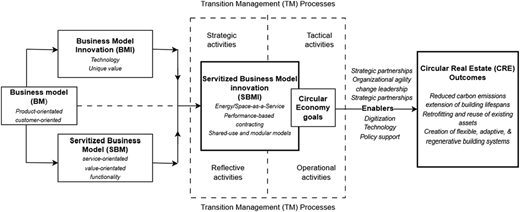
The findings suggest that SBMI fits squarely at the intersection of CE and transition management frameworks (see Figure 1). As illustrated, CE offers the overarching sustainability goals (e.g. net zero, regenerative design, material reuse), while transition management provides a multi-actor governance structure and strategic pathway for systemic change. SBMI operationalises both: it enables CE outcomes while serving as a mechanism for stakeholder coordination, experimentation and the redefinition of value delivery. In this dual role, SBMI supports long-term systemic transitions by embedding CE practices into mainstream real estate operations, thus transforming not just how buildings are made and used, but how they are conceptualised and governed.
The findings from this study also stress that SBMI offers a viable and scalable strategy for achieving CE performance outcomes such as reduced environmental footprint, asset resilience and circularity in building use. When framed within a transition management perspective, it also becomes a catalyst for institutional, behavioural and policy change, making it indispensable to future-ready, net-zero real estate systems.
4.3 The role of governance and multi-level actors
A recurring theme across all interviews was the importance of multi-level coordination in enabling the transition toward SBMI. Participants recognised that isolated organisational efforts were insufficient to drive sector-wide transformation. The successful implementation of servitized models depends on the alignment among developers, local governments, financial institutions and service providers. This supports the claims of Markard et al. (2012), who emphasise the necessity for systemic, multi-actor interventions in sustainability transitions.
Participants emphasised the pivotal role of municipalities in establishing development approval standards, zoning regulations and infrastructural incentives at the local government level. They expressed dissatisfaction with redundant policy frameworks that do not support CE approaches, such shared infrastructure, decentralised utilities or long-term leasing arrangements. This governance gap highlights the necessity for intentional institutional innovation, as proposed by Köhler et al. (2019).
The findings emphasise the significance of strategic niche management (SNM) in facilitating the adoption of early-stage SBMI from a transition management viewpoint. Participants often mentioned establishing collaborative partnerships, including public–private partnerships and industry alliances, to implement service-based models in mixed-use developments. These specialised operations establish a “safe space” for innovation, enabling participants to learn, adapt and progressively impact mainstream practices, in accordance with the transition pathways model posited by Loorbach et al. (2016).
In the South African context, resolving fragmented responsibilities among departments (e.g. human settlements, infrastructure, finance) was identified as crucial for enhancing SBMI. In the absence of coordinated governance, even technically proficient models faced difficulties in achieving traction. Consequently, the incorporation of transition management tools, including actor-network alignment, long-term visioning and co-creation platforms, is essential for institutionalising SBMI and achieving CE objectives on a large scale.
4.4 Key lessons across case studies: commonalities and differences
Across the six cases, commonalities emerged around a shared awareness of sustainability imperatives and a gradual recognition of servitization as a strategic necessity. All participating organisations acknowledged the increasing relevance of sustainability reporting, carbon neutrality targets and market shifts favouring lifecycle performance and social value creation. This aligns with broader trends in the built environment, where firms are compelled to reimagine value delivery within a CE context (Geissdoerfer et al., 2018; Lundgren et al., 2025).
However, notable differences were observed in the pace and depth of SBMI adoption. Public-sector organisations tended to focus on compliance-driven motivations, aligning their activities with national policy directives such as the National Infrastructure Plan (NIP 2050) and local government procurement reform frameworks. In contrast, private-listed firms articulated more proactive motivations, particularly in response to ESG-linked investment criteria and global green building benchmarks (e.g. GRESB, LEED). These firms viewed servitization as an opportunity to capture new revenue streams through service diversification, such as leasing, asset monitoring and energy-as-a-service models, thereby gaining a competitive edge.
Organisational capacity emerged as a key differentiator. Firms with existing digital infrastructure, in-house innovation units and cross-functional governance structures reported smoother transitions toward SBMI. In these settings, the ability to collect real-time asset data, evaluate performance contracts and engage stakeholders across silos enabled more agile experimentation with new service-oriented models. On the other hand, entities with traditional hierarchical structures, fragmented departments and limited digital literacy exhibited greater resistance to change. This finding reinforces earlier literature that highlights the importance of organisational ambidexterity and dynamic capabilities in enabling BMI (Bocken et al., 2016; Farzaneh et al., 2022).
Cultural readiness and leadership orientation also varied significantly. Some firms benefitted from visionary leadership willing to champion systemic innovation, even in the absence of clear regulatory incentives. Others exhibited more risk-averse cultures where short-term cost considerations overshadowed long-term sustainability potential. For example, while some respondents embraced circular design principles and shared ownership, others expressed concern over customer uptake, contractual complexity and uncertain ROI.
Contextual factors such as geography, procurement regimes and stakeholder maturity further shaped the degree of SBMI institutionalisation. Urban municipalities with stronger local green economy strategies and access to pilot funding displayed greater experimentation. In contrast, rural or under-resourced areas reported constraints linked to outdated infrastructure, limited private-sector engagement and fragmented value chains.
In summary, while the overarching shift toward sustainability and servitization is gaining traction, the transition pathways diverge significantly across actor types, institutional arrangements and resource configurations. These findings highlight the need for multi-level and multi-actor transition strategies that can accommodate context-specific enablers and barriers while steering systemic transformation across the real estate sector.
5. The study's implications
This study's findings have significant implications for both practice and policy in the transition to a circular real estate industry facilitated by SBMI.
The study reveals that SBMI may generate value beyond conventional ownership and sales models, enabling developers and property managers to capitalise on services such as space utilisation, energy efficiency and retrofitting. These models promote circular outcomes such as lifecycle extension, reduced vacancy rates and energy efficiency at the same time enhancing financial resilience. Practitioners must invest in the digital infrastructure required to assess performance and provide value-as-a-service. This encompasses building management systems, IoT-integrated assets and analytical platforms that provide performance contracts and predictive maintenance.
Organisations should develop interdisciplinary teams capable of integrating the technological, financial and operational dimensions of circular service delivery. Incorporating CE ideas into fundamental operations necessitates enhancing skills across many roles and activities, and the establishment of new key performance indicators to monitor circular performance over time (Ciechan-Kujawa et al., 2024). The real estate sector must shift from short-term investment cycles to long-term service contracts and value propositions that prioritise sustainability and user-centred design.
The study indicates that the implementation of SBMI is presently hindered by redundant and outdated regulatory frameworks and distorted interests. National and municipal authorities ought to reassess building rules, zoning restrictions and procurement policies to facilitate flexibility, adaptive reuse and service-oriented development models. Municipalities could use regulatory instruments such as CE building certification programs, incentives for shared infrastructure and tax refunds for energy-as-a-service initiatives (Calisto Friant et al., 2020).
Interdepartmental collaboration is crucial at the management level. Transitioning to circular real estate models necessitates the integration of portfolios such as urban planning, housing, energy and finance. The formation of cross-sectoral transition platforms that include developers, policymakers, financiers and community representatives may promote experimentation, learning and collaborative policy development (Geissdoerfer et al., 2017). South Africa, in particular, stands to benefit from institutionalising such platforms in municipal development strategies, given the country's high levels of urban inequality, informal development and infrastructure backlogs.
Importantly, the study highlights the need for transition governance approaches that go beyond compliance and support long-term visioning, experimentation and feedback loops. Transition management tools such as scenario planning, living labs and pilot zones can help embed SBMI into broader sustainable development goals and promote legitimacy for emerging models (Loorbach et al., 2017). However, this transition will require deliberate multi-actor collaboration, policy innovation and a redefinition of how value is created and measured in the built environment.
6. Conclusion and recommendations
6.1 Conclusion
This study has examined the transformative potential of SBMI as a strategic and operational mechanism for enabling circular transitions in the real estate sector, with a focus on the South African context. Drawing from six case studies across public and private property development organisations, the findings reveal that SBMI holds promise for decoupling asset ownership from use, reducing lifecycle environmental impacts and aligning value creation with long-term sustainability goals. When situated at the intersection of CE principles and transition management theory, SBMI offers a dual function: it acts as a business innovation pathway and a governance tool capable of structuring stakeholder coordination, visioning processes and institutional change.
However, the diffusion of SBMI is constrained by entrenched ownership logics, misaligned regulatory frameworks, capacity gaps and a lack of systemic support for innovation. While enabling technologies such as IoT and digital twins provide the technical infrastructure for performance-based models, institutional inertia and fragmented governance structures limit their scalability. Therefore, realising the full potential of SBMI requires a holistic approach, integrating digital, organisational, financial and policy innovations, anchored within a broader transition management strategy.
Ultimately, the research emphasises that SBMI can contribute meaningfully to net-zero, adaptive and regenerative real estate systems. Its success depends not only on technological adoption but on the willingness of institutions to rethink how value is defined, delivered and sustained in the built environment.
6.2 Recommendations
6.2.1 For real estate practitioners and developers
Property developers and asset managers should actively reconfigure their value propositions around performance-based services rather than traditional asset ownership. Adopting models such as space-as-a-service and energy-as-a-service allows for greater alignment with CE goals while responding to user demands for flexibility, efficiency and customisation.
Investing in digital infrastructure is essential for enabling these models. Tools such as IoT, digital twins and building management systems facilitate monitoring, predictive maintenance and data-driven optimisation, key capabilities for delivering consistent value over time.
Firms should also establish cross-functional innovation teams that bring together sustainability officers, financial analysts and operational managers. These teams can drive internal learning and ensure that SBMs are embedded into strategic and operational decision-making.
Lastly, organisations should prioritise experimentation and pilot projects, using demonstration sites to test, validate and scale new models. This creates an internal culture of innovation and generates external legitimacy, accelerating industry adoption.
6.2.2 For policymakers and regulators
There is an urgent need to reform zoning regulations, building codes and procurement frameworks to accommodate non-traditional development models. Regulations should support shared infrastructure, adaptive reuse and long-term service contracts.
Governments should offer financial and non-financial incentives for SBMI adoption, such as tax relief for circular projects, subsidies for retrofitting-as-a-service and green public procurement standards that favour service performance over capital cost.
Creating public-private transition platforms would support coordinated action across sectors. These platforms can facilitate stakeholder alignment, policy co-creation and resource mobilisation for circular and servitized innovations in the built environment.
National infrastructure and climate strategies must explicitly integrate circular and service-based business models as pathways to achieve sustainable development goals and just transitions in urban systems.
6.2.3 For financial institutions and investors
The financial sector must broaden its risk frameworks and valuation methods to accommodate long-term, service-oriented returns. Lifecycle performance, flexibility and regenerative asset use should be embedded in underwriting, lending and investment models.
Blended finance instruments, sustainability-linked bonds and outcome-based contracts can lower the entry barrier for SBMI, especially in retrofit-heavy markets like South Africa.
Moreover, ESG frameworks should include indicators for servitized and circular performance, enabling investors to benchmark sustainability outcomes across portfolios and incentivise innovation at scale.
6.2.4 Future research directions
This study opens several avenues for future research. First, the proposed SBMI transition model can be empirically validated across a broader range of urban contexts in South Africa and internationally. Second, longitudinal studies can explore how real estate firms institutionalise servitization over time, particularly in relation to governance innovation and user engagement. Third, future research can integrate quantitative performance metrics such as circularity indicators, lifecycle carbon impact or ESG-linked returns to complement the qualitative insights provided here. Lastly, cross-disciplinary work with fields like digital systems, urban planning and finance can help build integrated frameworks for advancing circular real estate.
The authors acknowledge the use of OpenAI's, a large language model, to assist with the refinement of academic writing, grammar and clarity during manuscript preparation. All conceptual contributions, empirical analysis, interpretation of findings and original arguments presented in the manuscript were developed solely by the authors.