The purpose of this paper is to examine the interrelationship of marketing, accounting and auditing with corporate social responsibility (CSR) to determine the benefit of CSR marketing, the responsibility of Board of Directors (BODs) with CSR accounting and the duty of external auditors with CSR that has influence on corporate sector.
This paper uses exploratory and qualitative data obtained from multiple research methods, to investigate benefit of CSR marketing, the responsibility of BODs with CSR accounting and the duty of external auditors with CSR and of its practices by companies’ websites, google search, annual reports and CSR reports from all listed companies in the Muscat Securities Market, Oman. The data are used to critically examine and revise a previously published explanatory framework that identifies interrelationship of CSR marketing, accounting with CSR and auditing with CSR.
Results indicate that CSR marketing, CSR accounting and CSR auditing are closely interrelated for accepting and implementing CSR requirements by corporates. This finding suggests that the benefit of CSR marketing, the responsibility of BODs with CSR accounting and the duty of external auditors with CSR has positively influence on corporate sector. The finding helps to build good image by corporates.
Organizations from developing countries such as Oman should be aware of CSR marketing, CSR accounting and CSR auditing that affects decisions with CSR adoption and implementation by organizations that could also lead to competitive advantage when it operates in developed countries. Though, organizations in developed countries are also equip for higher expectations by applying innovative CSR initiatives.
To the best of the author’s knowledge, this is the first academic literature review on interrelationship of marketing, accounting and auditing with CSR based on evidence from an Oman context. The paper contributes by exploring the benefit of CSR marketing, the responsibility of BODs with CSR accounting and the duty of external auditors with CSR which influence on corporate sector.
1. Introduction
Corporate social responsibility (CSR) of a company has become vital, as it is expected to fulfil certain required obligations to the society wherein which it functions (Mehedi and Jalaludin, 2020). Operations of CSR in any business strives to meet ethical, commercial, social, legal and other stakeholders’ expectations (Welbeck et al., 2020). As part of CSR, corporates have undertaken various development programs to build schools, colleges and hospitals, initiating rural development program to provide the needs of society (Kim and Ferguson, 2019). CSR is significantly important because it is a win-win situation for the community, as well as for the business (Silva and Verschoore, 2020; Al-Malkawi and Javaid, 2018). CSR encourages employees’ participation to build company’s loyalty and increasing productivity (Koch et al., 2019). Firms can ensure improvement of employee performance via implementing transformational leadership which will motivate employees to involve in social activities (Hongdao et al., 2019). It is observed that the company which contributes its portion of profit to the society’s development try to support and giving value to the business and its product (Ajina et al., 2020). Successful implementation of CSR ultimately aims to makes its customers happy, increases target market, investment and ensures sustainable employee retention. Thus, CSR enhances company reputation (Welbeck et al., 2020).
It is believed that adopting CSR is costly because it involves additional costs to the company by providing fund for CSR activities (Zeng, 2020). Most of the small and medium enterprises (SMEs) that employ less than 200 employees believe that they cannot afford to deal CSR initiatives (Elhajjar and Ouaida, 2020). Another concern is that the CSR strategies hinder financially by companies as it cannot give attention to other investment opportunities (Gangi et al., 2019). CSR implementation cost is another major problem facing by many of organizations (Bux et al., 2020). It is the responsibility of an auditor to audit CSR fund provision and its spending as per the companies act (Musallam, 2018).
Oman is an Islamic emerging economy always guides social interactions, especially during the religious period of Ramadan (Harun et al., 2020). As for Oman as a context of the current study, based on recent literature and other available data, the companies in Oman lacks knowledge of CSR marketing is one of the challenges facing by various large, medium and small companies. Lack of awareness of CSR is another main constrains (Sundström et al., 2020). Most of the business has not much encouragement to implement CSR (Almatrooshi et al., 2018). Jusoor is the first pioneer social foundation in the Sultanate of Oman, established since 2012, aiming to serve the Omani society in accordance with the latest practices of the CSR principles1. Oman Chamber of Commerce and Industry (OCCI) giving undivided attention to encourage CSR since the launch of its first award in the field in 2014. Lack of knowledge about CSR in turn lacks interest of local organizations in participating and contributing to CSR activities. Successful implementation of CSR will accelerate improving businesses, drive development, build a sustainable economy in Oman. Hence, it is required that there should get an in-depth knowledge about the interrelation of marketing, accounting and auditing with CSR that will help to solve problems faced by Omani companies to adopt CSR which require attention and intervention by researchers and scholars.
The set of needs, challenges and problems stated above represents a call for researchers to study to examine the interrelationship of marketing, accounting and auditing on CSR to determine the benefit of CSR marketing, the responsibility of Board of Directors (BODs) with CSR accounting and the duty of external auditors with CSR that has influence on corporate sector.
2. Theoretical background
2.1 Interrelationship of marketing, accounting and auditing with corporate social responsibility
Better implementation of Marketing, accounting and auditing functions are most important for any successful business (Chen and Yang, 2019). Advertising CSR activities is one of the marketing activities (Guo et al., 2019). Cost of CSR should properly record and reported (Garcia‐Torea et al., 2020). The recorded CSR cost should properly audit by an external auditor (Fauzyyah and Rachmawati, 2018). Thus, there is a relationship between marketing, accounting and auditing on CSR.
2.2 Benefits of corporate social responsibility marketing
Some companies take advantage of CSR strategies for marketing their products. The communication of the companies CSR strategical plan will improve company’s image, strengthen its brand, enliven morale and even raise the value of its stock. Companies such as Coca- Cola, Marlboro and Dettol were touch billions of people across the world by using CSR in their marketing approach (Natarajan et al., 2018; Alhouti and D’Souza, 2018). The consumer perceptions on CSR had been studied by (Alfakhri et al., 2020). Direct and indirect effect of CSR influences on behavior of citizenship were analyzed by (Ahmed et al., 2020b). Saudi Arabia. Systematic and deliberate CSR initiatives provide improvement of customer engagement, through different forms of positive word of mouth (Chang and Lee, 2020). Moliner et al. (2019) analyzed the role of managers’ perceptions of CSR in CSR marketing outcomes. Companies’ increasing social awareness has led to the development of a CSR orientation, whose implementation impacts on their overall marketing communication, both at its strategic and operational levels (Zatwarnicka-Madura et al., 2019). Customer-perceived community worth of the strategic CSR initiative to the proposed beneficiary of the activity was found to be an effective antecedent of customer engagement (Chomvilailuk and Butcher, 2018). CSR have a marked influence on customers’ perceptions of CSR, which again have a notable impact on customer satisfaction, customer trust, customer engagement and customer loyalty (Moliner et al., 2019). It is appropriate for expanding the conception of CSR from Islamic point of view (Nurunnabi et al., 2020). Proposed method to building advertising and marketing communication around CSR and justifiable orientation makes the advertising marketing statement consistent and vibrant to the audience (Zatwarnicka-Madura et al., 2019).
2.3 Responsibility of Board of Directors with corporate social responsibility accounting
Generally chief environmental officer, human resource manager or any person such other person who deals and responsible with CSR fund generation and its spending. Certain countries company law provides to keep a statutory provision for CSR fund looking at the legal forms of the company. Other companies voluntarily contribute a portion of the profit to CSR activities. CSR committee consists of BODs responsible for accounting for CSR initiatives, such as set aside required CSR fund from profit and spending of such fund for the said purpose (Alshbili et al., 2019; Alabdullah et al., 2019). The structure of corporate governance helps to CSR reporting practices both in developing and developed countries (Alshbili et al., 2019). Lack of knowledge of applicable International Accounting Standard (IAS) on environmental disclosures by accountant may end up with what it describes as a “greenwashing” effect (Kurpierz and Smith, 2020). Kim and Jung (2020) examine the relationship between CSR activities and accounting transparency. Companies committed to CSR should ensure that their managers possess the appropriate competencies to effectively manage the CSR adaptation process (Osagie et al., 2019). Foreign BOD, board independence and institutional ownership, are found to be significant on the CSR disclosure (Qa’dan and Suwaidan, 2019). The influence of organizational-level factors with CSR is highly dependent on the institutional context where companies operate (El-Bassiouny and El-Bassiouny, 2019). From the perspective of accounting, CSR is known to have a strong relationship with management sustainability (Kim and Jung, 2020). Intensive role of the BOD strengthened the effect support of economy and social commitment-based investment to enhance the corporate values (STIE AUB et al., 2019). CSR managers’ job roles, indeed, influenced the importance of particular CSR-related competencies (Osagie et al., 2019).
2.4 Duty of external auditors with corporate social responsibility
Listed companies accounts should audit by external auditors as per applicable accounting standards. Other companies may also go for auditing to ensure that the financial statements are prepared fairly without any errors. Set aside fund of CSR should be audited by a certified auditor to ensure the reliability of related accounting. The auditor should address these matters with shareholders through audit report. Boiral et al. (2019) aims to observe the nature and extent of auditors’ involvement in CSR assurance. Audit report with CSR engagements can build trust and reputational capital in the marketplace (Mahrani and Soewarno, 2018). Firms of audit that involve in CSR increase the magnitude of their client base, on an average, compared with firms of audit that do not involve in CSR (Riguen et al., 2019). The Big 4 accounting firms are encouraging the importance of CSR adopted financial statements (Kwakye et al., 2018). Gillet-Monjarret (2018) made study on the evolution of assurance contents of the companies reports. They recommend that internal audit function could provide independent assurance with CSR reports. Obviously, the fair adoption of CSR in financial statements provides fair information that can provide to shareholders and other stakeholders around the world. A variation in the content of assurance reports is required for regulatory of sustainability auditing (Gillet-Monjarret, 2018). Musallam (2018) found substantial relationship of audit committee financial expertise and audit committee meeting with CSR disclosure over the existence of risk management. Orazalin (2019) suggest that companies invested in the capital of foreign companies’ disclosures should more extensive and transparent information with CSR activities than local companies and government-owned organizations. Hickman and Cote (2019) suggest that managerial encouragement is fostered by the weakness of reporting standards and the absence of agreement concerning the over-arching needs of CSR reports.
3. Methodology
This paper uses exploratory and qualitative data obtained from multiple research methods, to investigate benefit of CSR marketing, the responsibility of BODs with CSR accounting and the duty of external auditors with CSR. The data were taken from companies’ websites, annal reports and CSR reports and considered all listed companies (as on 9 September 2020) in the Muscat Securities Market (MSM), Oman. The data are used to critically examine and revise a previously published explanatory framework that identifies interrelationship of CSR marketing, accounting with CSR and auditing with CSR.
For the exploratory and qualitative study, the content analysis technique was used for the current study. Neuman (2003, p. 219) explains content analysis as “a technique for gathering and analyzing the content of text. The content refers to words, meanings, pictures, symbols, ideas, themes, or any message that can be communicated.” Though the content analysis technique is descriptive in nature, it gives an idea of emerging themes and trend (Henderson, 1991).
Content analysis allows data can be collected by observing and analyzing from web sites, official documents, advertisements, press releases, television programs, television programs and so on (Zikmund et al., 2009). It is the methodical observation and quantitative description of the obvious content of messages outlines in the content (e.g. audited financial statements, website of company, government decrees and CSR reports) that organizations publicize are identified and described. There is no right or wrong way of undertaking content analysis (Finn et al., 2000; Miles and Huberman, 2002). The purpose of research study allows to apply quantitative and or qualitative forms of method Neuman (2003).
The study has engaged content analysis to interpret contents of the text data with directed content analysis was used to identify main themes in the literature (Hsieh and Shannon, 2005). Accordingly, following criteria were adopted:
Three step search process: benefit of CSR marketing, the responsibility of BODs with CSR accounting and the duty of external auditors.
Published global peer-reviewed articles in academic journals.
Date of publication in the period 2018–2020.
Website of the listed companies in muscat securities market.
Year of audited financial statements 2019.
The search was undertaken using company website of listed companies in Muscat Securities Market, Oman commercial company law, website of capital market authority and other CSR related official website in Oman.
There are total of 117 listed companies (as on 9–9-2020) are there in muscat securities market website ( Appendix) are taken consideration for the current study. Hence this study has considered 100% listed companies in Oman. Interestingly, there are 78 out of 117 were showing CSR activities in their financial statements (as per 2019 annual report).
All 117 companies were selected for the study with the help of content analysis bordered to determine the benefit of CSR marketing, the responsibility of BODs with CSR accounting and the duty of external auditors with CSR that has influence on corporate sector, the selection criteria being included to the keywords “CSR” within interrelationship of marketing, accounting and auditing with CSR.
To achieve the purposes of this study, details of CSR marketing was obtained from official web site of the company, google search and CSR accounting and CSR auditing details was obtained from annual reports of companies registered under muscat securities market. The weighting was based on the presence or the absence of each item in the official website/annual report of the company. If the item is disclosed, then the company will receive a weight of one (Yes), otherwise, zero (No) and if there is no data available has put weight of two (NA). To obtain the CSR percentage on profit, the percentage was calculated by dividing CSR contribution on adding CSR contribution with profit after tax.
4. Findings
Following are the important types of frames that has registered by scholars anticipate the benefit of CSR marketing, the responsibility of BODs with CSR accounting and the duty of external auditors with CSR that has influence on corporate sector are presented.
4.1 Benefits of corporate social responsibility marketing
The first group in the current study to investigate how the corporates are benefitting with advertising and marketing their CSR activities. There are number of benefits for the corporates while engages in advertising their CSR activities. The studies, (Stefańska and Bilińska-Reformat, 2020; Carlini et al., 2019; Puncheva-Michelotti et al., 2018; Ahmed et al., 2019), were taken the importance and advantages of advertising/marketing with CSR which has effect on employer branding. Increased corporate reputation is another benefit of marketing with CSR (Ajayi ans Mmutle, 2020; Bruna and Nicolò, 2020; Kelley et al., 2019; Caruana et al., 2018). Some studies focused on increase of firm financial performance on advertising CSR activities (Yumei et al., 2021; Vu et al., 2020; Maqbool and Hurrah, 2020; Gangi et al., 2019; Aslam et al., 2018) and others talks about potential customers (Aljarah and Alrawashdeh, 2020; Shah and Khan, 2019; Hafez, 2018).
4.2 Responsibility of board of directors with corporate social responsibility accounting
In a similar manner the second group of the current study addressed the responsibility of BOD with CSR accounting such as its calculation on which the provision to be made on profit, the percentage of reserve to be created, its spending, tax benefit of such fund and so on. This can be ensuring the exact amount of provision with CSR fund and its fair spending (Harun et al., 2020; Welbeck et al., 2020; Tasnia et al., 2020; Fahad and Nidheesh, 2020; Biswas et al., 2019; Ahmed et al., 2020a) Johnson et al., 2018). Certain companies might establish CSR committee to look after CSR activities (Fu et al., 2020; Alshbili et al., 2019; Adnan et al., 2018). Globally, CSR is the voluntary effort of Corporates to operate in an economic, social and environmentally sustainable manner. Hence owners, manager or any authorized person shall decide about CSR fund and its accounting (Kumala and Siregar, 2020).
4.3 Duty of external auditors with corporate social responsibility
The third group of the current study, auditing CSR fund, follows CSR accounting which has described above. Certain countries such as Sweden, Norway, The Netherlands, Denmark, France, Australia, India are mandated CSR for corporates (Chhatrola, 2020; Ioannou and Serafeim, 2019; Kurian and Suresh, 2018). Hence the companies should set aside and spend certain prescribed amount of CSR fund from their annual profit. The provision implements by amending companies act of that country. CSR audit is an assessment of the company's performance with CSR objectives (Delalieux and Moquet, 2020; Jackson et al., 2020). CSR audit may include CSR spend (Welbeck et al., 2020), CSR non-spend (Bhatia et al., 2020), CSR underspend (Acharyya and Agarwala, 2020), CSR overspend (Muhammad et al., 2019). The responsibility of the auditors requires that any transaction that is under spend, overspend or non-spend has to be qualified by the auditors in the Audit Report (Maso et al., 2020). An auditor is responsible towards the stakeholders (Malik et al., 2020), these issues in CSR are considered a deviance and by making a qualification (Godos-Díez et al., 2020), it ensures that the attention of the shareholders is drawn to the fact that there has been a deviation in the accounting of CSR (Chantziaras et al., 2020).
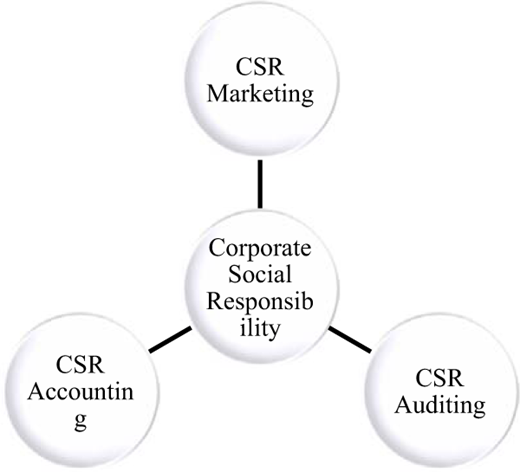
Based on the above, the analytical framework is presented highlighting interrelationship of CSR marketing, CSR accounting and CSR auditing are assumed to be vital for the success of practice and implementation of efficient CSR agenda (Figure 1).
5. Discussion and conclusion
Below our findings are discussed in terms of main findings, limitations and implications.
5.1 Main findings
Arguing that the way scholars conceptualize interrelationship of CSR marketing, CSR accounting and CSR auditing may lead to gaining and/or losing better practice and implementation of CSR, this study examined how CSR marketing, CSR accounting and CSR auditing are interrelated and extrapolated in CSR-related literature. The study highlighted which interrelationship of CSR marketing, CSR accounting and CSR auditing are assumed to be most effective when bridging stakeholders’ perceptions of corporate CSR agenda.
To gain wide-range view of interrelationship of marketing, accounting and auditing with CSR literature, a systematic review was conducted resulting in the following. Addressed from previous literature, it was found that the most important types interrelated variables of CSR (marketing, accounting and auditing) articulated in the three types of studies were related to the following:
Increases brand image and firm’s profitability through proper marketing with CSR.
Fixing a standardized provision on profit for CSR and its spending through proper accounting.
Statutory reporting to stakeholders about CSR to ensure fair financial statements through auditing by competent and independent professionals.
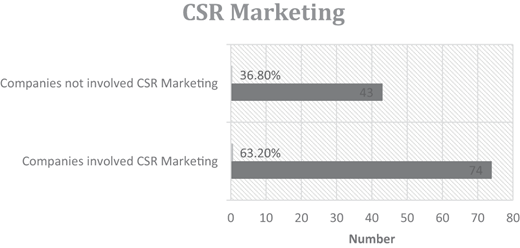
Based on Table 1, Figure 2, it was found that there are 74 companies out of 117 (63.2%) were actively engaged in CSR marketing via various social media. Remaining 43 companies were not actively engaged in CSR marketing.
Our findings confirmed previous research articulating CSR marketing increases brand image and firm’s profitability (Rhou and Singal, 2020; Srivastava, 2019; Ronald et al., 2019). 74 companies, 63.2% (Table 1), were actively engaged and supported with CSR Marketing. One of the companies (C1) opined that:
[…] Its consistent focus on community welfare through a very active CSR program has also earned the organization countless awards and invaluable recognitions. With such solid foundation and having secured over 10% of market share and acquired a solid customer-base of over quarter a million customers; it was time for the bank to leap into the next stage of development and further boost its contributions to Oman’s overall development by redefining banking and introducing a new era for the brand.
But on the other hand, still 43 companies, 36.8% (Table 1) were not actively engaged in CSR marketing. As per conventional view, it argues that CSR is costly because it incurs additional expenses for socially responsible activities including investment in employee benefit plan, donations to charitable institutions, societal services, contribution to pollution reduction and so on (Chazireni and Kader, 2019).
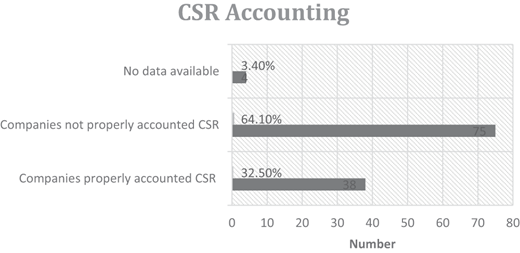
Table 2 and Figure 3 show that there are only 38 companies out of 117 (32.5%) were properly accounted CSR accounting. A total of 75 companies out of 117 (64.1%) did not show CSR accounting, and remaining 4 companies’ current statements were not available.
Our findings confirmed previous research articulating CSR accounting. Fixing a standardized provision on profit for CSR and its spending through proper accounting increases brand image and firm’s profitability (Maso et al., 2020; Bharadwaj, 2020; Kim and Jung, 2020; Pavel, 2018; Thottoli, 2020a; Thottoli, 2020b). Companies were set aside a separate percentage as CSR provision on current year profit for future CSR spending (Bala and Verma, 2019). CSR provision, its calculation, spending, disclosures and related accounting increases the brand image of any company (Ehsan et al., 2018).
In Oman, surprisingly 38 (32.5%), Table 2, companies only were recorded CSR accounting whereas it shows that 74 (63.2%), as shown in Table 1, companies were engaged in CSR marketing. The provisions for CSR funding were to get approved by the shareholder in their annual meeting. The responsibility of CSR accounting and its spending lies by BODs.
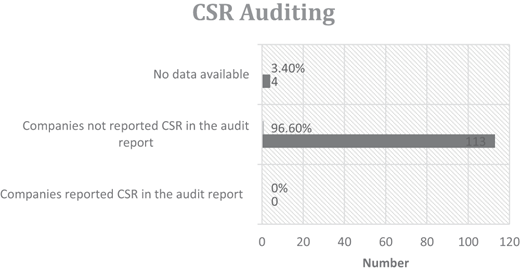
Based on Table 3 and Figure 4, it was found that there are 113 companies out of 117 (96.6%) were not specifically mentioned about CSR in their audit report. It has mentioned either in the companies report or in corporate governance report. Remaining 4 companies’ current financial statements were not available.
Our findings confirmed previous research articulating about CSR auditing. Statutory reporting to stakeholders about CSR to ensure fair financial statements through auditing by competent and independent professionals (Delalieux and Moquet, 2020; Gunn et al., 2019; Niyommaneerat et al., 2018). Information communication technology is a new trend to accounting and auditing even for CSR (Thottoli et al., 2019a; Thottoli et al., 2019b; Thottoli et al., 2019c; Thottoli and Thomas, 2020).
One of the companies (C2) disclosed that:
[…] “a fraudulent activity by some of its employees amounting to OMR […]. In a statement issued to Muscat Securities Market, it is said that the fraudulent activity was reported in respect of the expired products that has already been accounted for, there will not be any further impact on the company’s income statement. According to the statement, the company launched an immediate investigation and on detailed scrutiny, found some employees of the company have committed fraud to the extent of approximately OMR […]. The company has revamped its system and processes and brought additional measures of internal control. We are in the process of filing the case in the court with the help of our independent legal accountant consultant and the company’s lawyer”.
In Oman, as per the authors knowledge, Oman has not made mandatory CSR reporting requirements for the companies. The above companies’ incidents lead to add a separate disclosure in the audit report about CSR to ensure fair financial statements through auditing by competent and independent professionals.
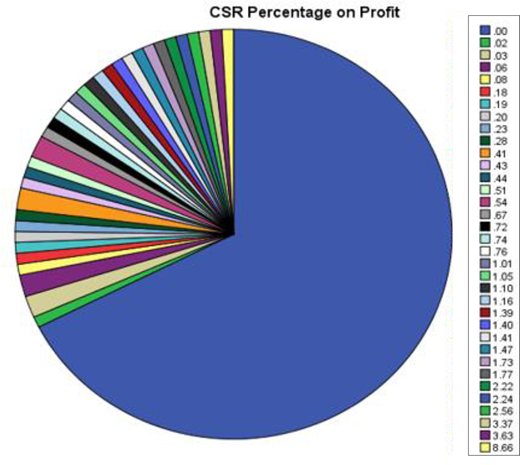
Below Table 4, Figure 5, shows that there are 79 companies out of 117 (67.5%) were not spent any amount for CSR activities in the year 2019. Even if there is no compulsion to spend with CSR, the remaining 38 (32.5%) companies set aside a provision for CSR activities in Oman. It has observed that most of the financial/banking sectors organizations are regularly contributing/spending money for various CSR activities.
One of the companies in their sustainability report mentioned 0.75% on profit after tax has ensured in each year.
Further, it can conclude that there is a significant interrelationship between CSR marketing, CSR accounting and CSR auditing between companies registered in securities market. Results indicate that CSR marketing, CSR accounting and CSR auditing are closely interrelated for accepting and implementing CSR requirements by corporates. This finding suggests that the benefit of CSR marketing, the responsibility of BODs with CSR accounting and the duty of external auditors with CSR has positively influenced on corporate sector. The finding helps to build good image by corporates.
6. Implications for future research
CSR marketing, CSR accounting and CSR auditing are an emerging field that helps to expand our understanding of their interrelationship for strategic management, government, scholars and practicing accounting or audit firms. As shown in our review, the CSR marketing, CSR accounting and CSR auditing are addressed as a slender discipline, interrelationship of these three CSR gears may increase businesses’ brand image and the attitudes and beliefs of their stakeholders through CSR marketing, CSR accounting and CSR auditing BODs and professional auditors. However, CSR marketing, CSR accounting and CSR auditing as a broad strategic discipline implementation of these three CSR components make sense for the law-making bodies. The broad approach to CSR marketing, CSR accounting and CSR auditing is slowly emerging in step with new political global agendas, and it is now more of a societal trend that has appeared through the bridging of corporate societal/environmental responsibilities (Grayson and Hodges, 2017) and through an increasing eagerness to CSR contribution by companies in Oman as a possible framework for future growth and for businesses in society.
7. Conclusion
On the basis of this, this study believe that the three interconnected component of CSR, CSR marketing, CSR accounting and CSR auditing could take proper implementation and disclosures with CSR research a step forward: studies that link CSR marketing, CSR accounting and CSR auditing to a broader and more holistic concept of CSR fields (such as, corporate branding, stakeholder interaction, societal relations, etc.); empirical studies that provide more in-depth insights into the stakeholder benefits; fixing a standardized provision on profit for CSR and its spending through proper accounting and statutory reporting to stakeholders about CSR to ensure fair financial statements through auditing by competent and independent professionals. Moreover, we believe that linking company-specific studies to the above three focus areas could increase our understanding of interrelationship of CSR marketing, CSR accounting and CSR auditing as national and international issue.
From a practical perspective, our findings indicate that organizations could benefit from developing through interconnecting CSR marketing, CSR accounting and CSR auditing in collaboration with local government if their aim is to implement statutory regulations with CSR. It might, for example, be a good decision for organizations which are engage with CSR marketing – via available social media advertising – to do and ensure proper accounting with CSR by BODs after consultation with shareholders and applicable regulations that might leads to ensure fair financial statements by auditing professional auditors.
Finally, organizations in Oman could increase their opportunities to compete with global market by achieving global branding by implementing systematic CSR policies and disclosures that processes to cope with global CSR issues and allow the organizations to participate more proactively in joint CSR projects and solutions with the aim of enhancing the role of business in society.
8. Limitations
The research has several potential shortcomings restricting its validity. First, our review of CSR marketing, CSR accounting and CSR auditing is based on a limited sample of research articles published. Second, we have set keywords “Corporates Social Responsibility (CSR)” within interrelationship of marketing, accounting and auditing for our search, focusing with CSR marketing, accounting and auditing which may be excluded publications that are more marginal in terms of dealing with CSR marketing, CSR accounting and CSR auditing. Third, that the measurement of the dependent variables (Corporate Social Disclosure) could not be able to include since there are no disclosure regulations for companies registered in muscat securities market.