


The purpose of this paper is to study the uneven geographies of corruption on the African continent. Corruption is an entrenched part of African political culture. However, the degree and impacts of corruption vary widely across the continent, ranging from failed states such as Somalia to the region’s bright spot Botswana. This paper first defines corruption and discusses its causes and effects. It then delves into the specifics of African corruption, including its causes and effects such as patrimonial political cultures, clientelism and the role of natural resource exports.
The study uses data from Transparency International to assess African corruption empirically and geographically, and links its levels of severity using correlations to gross domestic product per capita, literacy, income inequality and freedom of the media.
The major findings are that while the vast majority of the continent’s one billion people live under very corrupt regimes, the impacts of corruption on economic growth are questionable. Few geographic studies of corruption exist.
The paper’s novelty stems in part from being the first to explore African corruption from a spatial perspective, illustrating its widely varying contexts and consequences.
Corruption is a highly visible aspect of African politics, with a number of high-profile scandals standing out. For example, Mobutu Sese Seko, long-time tyrant of Zaire (now Democratic Republic of the Congo), amassed a fortune of US$5bn, equal to the country’s entire external debt, before he was ousted in 1997 (Thomas, 2001; Svensson, 2005). The widespread corruption overseen by Kenya’s Daniel arap Moi is seen in the millions of dollars lost in “massive cash subsidies for fictitious exports of gold and diamonds” in the Goldenberg scandal (Vasagar, 2006). Nigeria’s Sani Abacha (Pallister and Capella, 2000) and South Africa’s Jackie Selebi (Schwella, 2013) are also among public officials implicated in major corruption scandals. More recently, opposition to corruption in Africa was manifest in the events of the Arab Spring. Tunisia and Egypt were among the earliest and the most visible of these revolutions (Anderson, 2011), while Occupy Nigeria arose later to protest removal of an oil subsidy that undergirded an uneasy peace between parts of Nigerian society and the corrupt state (Agbedo, 2012). Kofele-Kale (2006, p. 697) summarizes the dismal state of African corruption succinctly:
Corruption is a punishable offense under the laws of nearly every African state, and it is expressly prohibited in several of their constitutions and in various regional and pan-African anti-corruption instruments. In fact, Africa’s leadership is so concerned about the problem of corruption that hardly a day goes by without some government entity criticizing corruption and its cancerous effects on African society. Yet, for all the bombast about eradicating corruption, Africa has made little progress on this front.
Corruption is almost universal across the planet but varies widely in severity, type and consequences. Although corruption is not unique to Africa, African corruption remains pervasive and among the world’s most severe (Lawson, 2009). For example, data from Transparency International (about which more later) indicate that six African countries are rated as “extremely corrupt” (scores under 20) and another 35 are considered “very corrupt” (scores 20-39); only Botswana emerges as a member of the “slightly corrupt” group, and no African country is among the “least corrupt” group which includes most of the economically advanced world. Ninety per cent of Africa’s population – roughly one billion people of 1.2 billion – thus live under very or extremely corrupt governments, a rate that exceeds most of the rest of the world.
Corruption is one of the several factors that have hindered African economic development, a governance issue with a wide variety of deleterious social and political consequences. Unfortunately, geographical analyses of this phenomenon have been highly limited and have been mostly confined to a few case studies of India (Robbins, 2000; Corbridge and Kumar, 2002; Jeffrey, 2002), and a critique of anti-corruption campaigns (Brown and Cloke, 2004). Bracking (2009) offers a rare exception concerning Africa, noting that corruption in Zimbabwe is not an exception to neoliberal rule but an integral part of it. Yet, there are virtually no other works on the spatiality of corruption in Africa.
Although it is arguably the most corrupt continent on the planet, corruption in Africa has been largely neglected by geographers. This paper seeks to fill this void; its aim is to disclose the uneven geography of corruption there and the causes of differences in the level of severity found among its various countries, noting that causes, severity and effects vary across the continent. Its primary focus is on the roles of the “resource curse” and globalization as two predominant forces that have facilitated and constrained corruption, respectively. It opens with an overview of the definitions of corruption, its causes and its consequences. Next, it turns to the specifics of corruption on the African continent, noting the roles played by colonial borders, patrimonial politics, foreign aid and the “resource curse”. The third part briefly summarizes the data used in the empirical analysis; the fourth correlates corruption scores with gross domestic product (GDP) levels and growth, income inequality, literacy, export intensity, reliance on raw materials exports, media freedom and government effectiveness in combatting corruption. The conclusion emphasizes the uneven spatial nature of corruption, its cultural and institutional embeddedness and the uncertain role of anti-corruption campaigns.
The causes and consequences of corruption
In its broadest sense, corruption may be defined as the use of public office and funds for private gains (Bardhan, 1997, 2006). Within this umbrella fall a large number of illicit, illegal and immoral behaviors, including graft, bribes, extortion, embezzlement, inflated payrolls in which the designated payees do not receive funds (“ghost salaries”), over-invoicing, theft of foreign aid, a blind eye toward smuggling, the purchase and sale of legislative votes, nepotistic hiring practices and selling of government contracts, licenses and land concessions, to name but a few. Petty corruption may be practiced on a small scale by few individuals, such as police or customs officials, while grand corruption may be institutionalized as wholesale, well-organized kleptocracies designed to enrich a small elite at the expense of the public. Both types are found in Africa; whereas the former is essentially ubiquitous, the latter varies geographically, depending on several factors such as colonial legacies, the structure of exports and associated revenues and the degree to which international agencies [e.g. the International Monetary Fund (IMF), non-governmental organizations (NGOs)] have intervened in particular states.
Corruption occurs when the expected benefits exceed the costs, and it is thus a form of rent-seeking behavior (Klitgaard, 1988). Benefits are not limited to monetary gains but include acquiring political office, power and prestige. The likelihood of corruption must be measured against the probability of being caught or exposed and the associated penalties. In large part, these reflect the transparency of government actions and the degree of administrative oversight and accountability involved.
Several factors either exacerbate or inhibit corruption. Poor countries tend to have the highest levels (Warf, 2016), and the poor, who rely the most heavily on public services, often face demands for bribes to obtain them. Corruption flourishes in secretive environments in which deals and decisions are made out of view of the public (Jain, 2001). Democratic societies tend to have lower levels of corruption because they create mechanisms for accountability and the enforcement of laws (Moreno, 2002). Indeed, many of the most notoriously corrupt governments at present are profoundly anti-democratic (Treisman, 2000; Billger and Goel, 2009); examples include North Korea, China, Iran and Eritrea. Low literacy rates also contribute: uninformed populations cannot be made easily aware of the extent of government malfeasance. Unsurprisingly, corruption is the most severe in countries without an effective independent media, which serves as a watchdog and a whistle blower (Brunetti and Weder, 2003). Low salaries of public employees are a common cause (van Rijckeghent and Weder, 2001).
Globalization may have several effects on corruption, although the relations between the two are contingent and complex. Foreign investors, for example, may prefer relatively non-corruption environments in which the costs of doing business are low. Lalountas et al. (2011), using cross-section data for 127 countries, found that globalization [in the forms of foreign direct investment (FDI) and import penetration] mitigated corruption in relatively developed countries but had little impact in poorer ones. Corrupt practices such as smuggling or black market money exchanges flourish when government policies are overly restrictive, unduly complicated, irrational, rigid or unrealistic (such as setting official exchange rates too high). Corrupt countries tend to have porous borders through which drugs, weapons or slaves may be moved easily.
Finally, corruption is often associated with the “resource curse”. Economists have noted the “paradox of plenty”, in which resource-dependent economies often perform worse than those lacking in such wealth (Bulte et al., 2005; Humphreys et al., 2007). Raw materials usually command low prices on the world market, and their revenue streams may be easily diverted by well-connected elites. Resource-rich countries may be also more inhospitable to democratic institutions (Jensen and Wantchekon, 2004), particularly when potential public revenues from the exports of oil, copper or diamonds are minimized by poorly enforced taxation policies.
Corruption also reflects cultural norms, which vary widely among societies. Where it is widespread and endemic, it is often accepted simply as another part of doing business. Bribery may be viewed simply as a means to get the bureaucratic machinery to move forward, and enriching oneself at public expense may not be seen as particularly loathsome. As Bardhan (1997, p. 1330) puts it, “What is regarded in one culture as corrupt may be considered a part of routine transaction in another”. Masculinist cultures tend to exhibit more corruption than do societies in which women hold larger shares of public office (Goetz, 2000; Swamy et al., 2001). Parboteeah et al. (2014) suggest that varying ethical climates, including the teaching of ethics in corporate and public sector human resources departments, help to explain the geography of African corruption.
Corruption has numerous corrosive effects on an economy and society. In societies in which it is deeply entrenched, it lowers public morale and creates cynicism and distrust of the state. In Mali, for example, the overthrow of President Moussa Traoré in 1991 led to the burning of customs and tax offices, traditional centers of high-level corruption and embezzlement (Harsh, 1993). Corruption also inhibits the efficiency and effectiveness of government policies, including the appropriate delivery of public monies to their intended ends. Corrupt construction contractors may erect buildings that are shoddy and unsafe, or use public funds to build luxury homes for wealthy politicians. In South Africa, corrupt elites captured the public utilities, awarding themselves with subsidized water, while the poor pay higher prices charged by private firms (Auriol and Blanc, 2009). Nepotistic hiring short-circuits meritocratic hiring systems and fills public offices with unqualified, underqualified or incompetent staff. Corruption can also undermine the quality of education and retard progress in eliminating illiteracy (Reinikka and Svensson, 2005).
Numerous economists have studied corruption’s influences on markets (Mauro, 1995; Bardhan, 1997; Aidt, 2003; Rose-Ackerman, 2006). High levels of corruption are associated with reduced FDI (Wei, 2000; Habib and Zurawicki, 2002). By raising transactions costs, it increases the cost of doing business, notably production and transportation costs, and reduces profits. Corruption raises the barriers to entry for non-privileged groups, notably those lacking in political connections (Fisman, 2001) and funds for bribes and kickbacks. Corruption also increases inequality (Gupta et al., 2002), typically imposing its greatest costs on the poor.
The extent and nature of African corruption
Compared to many parts of the world, African states are particularly prone to severe corruption, with low average incomes, low literacy levels and numerous repressive governments. Nigeria, for example, has been widely cited as a state enveloped by a withering scourge of corruption (Fagbadebo, 2007; Smith, 2007; Ologbenla, 2008; Agbiboa, 2012), which has deeply destabilized the government, led to inadequate provision of services such as electricity, hampered foreign investment and helped to fuel insurgencies such as Boko Haram. Similar conditions apply to the Democratic Republic of the Congo (Matti, 2010), Uganda (Tangri and Mwenda, 2006), Ethiopia (Plummer, 2012) and Kenya (Mwangi, 2008). Gettleman (2015, p. 10) notes that:
In Kenya, police corruption starts even before officers are hired. Analysts say it is so stubbornly ingrained that it begins with young men raising money from their villages, usually around $2,000, to bribe recruitment officials just to get the job. The young officers, who make only $200 a month, then have a stiff debt to repay. Hapless motorists and passers-by then become their quarry. Superiors in the police department are widely believed to demand a cut, sustaining a system in which countless men and women in uniform are on the take.
In Somalia, which has effectively lacked a functional government for two decades, the government consists essentially of spoils obtained in a Darwinian struggle for power and survival (Menkhaus, 2007). Sudan and South Sudan are governed by militarized kleptocracies in which patronage systems leave few funds for social services (Ismail, 2011, de Waal, 2014). Similarly, prolonged conflict in Angola over its oil and diamond wealth, including tribal wars waged by contending factions of the elite class, has rendered the state unable to contain systemic and widespread corruption (Malaquias, 2001). Kristof (2015) notes of Angola, which has the world’s highest infant mortality rate, “Under the corrupt and autocratic president, José Eduardo dos Santos, who has ruled for 35 years, billions of dollars flow to a small elite — as kids starve”. Eritrea, obsessed with security since its independence from Ethiopia in 1993, is so corrupt that there is severely inadequate funding for public bureaucracies and minimal provision of services by civil servants hampered by low salaries and morale (Habtom, 2014, Tronvoll and Mekonnen, 2014).
Not surprisingly, Africans are concerned about corruption. As a survey of selected countries in 2014 by the Pew Charitable Trust reveals (Table I), large majorities of people in diverse countries rate it as a “very serious problem”. In some countries, only crime was rated as a worse concern. Roughly 22 per cent of Africans acknowledge having paid a bribe within the past year (The Economist, 2015). For example, police officers in Kenya often stop motorists, and in lieu of citations, which require a court appearance, ask for “fees”.
Percentage reporting corruption is a “very serious problem” in 2014
| Country | (%) |
|---|---|
| Egypt | 39 |
| Ghana | 85 |
| Kenya | 77 |
| Nigeria | 86 |
| Senegal | 66 |
| South Africa | 70 |
| Tanzania | 90 |
| Tunisia | 89 |
| Uganda | 87 |
Similarly, large numbers of Africans report taking bribes. Transparency International (2015a, 2015b, 2015c) estimated that roughly 75 million people in Africa paid bribes in the past year. The percentage who did so varied widely among countries (Table II), ranging from a very low 1 per cent in Benin and Mauritius to as high as 69 per cent in Liberia. The majority (58 per cent) felt that corruption had increased over the past year. The police were ranked as the most corrupt institution, followed by business executives and government officials.
Frequency of bribery in Africa, 2014
| Country | % saying they had paid a bribe in the past year |
|---|---|
| Benin | 26 |
| Botswana | 1 |
| Burkina Faso | 11 |
| Burundi | 14 |
| Cameroon | 48 |
| Cape Verde | 2 |
| Cote d’Ivoire | 34 |
| Ghana | 36 |
| Guinea | 35 |
| Kenya | 37 |
| Lesotho | 5 |
| Liberia | 69 |
| Madagascar | 16 |
| Malawi | 13 |
| Mali | 18 |
| Mauritius | 1 |
| Namibia | 7 |
| Niger | 10 |
| Nigeria | 43 |
| Senegal | 8 |
| Sierra Leone | 41 |
| South Africa | 7 |
| Swaziland | 9 |
| Tanzania | 25 |
| Togo | 26 |
| Uganda | 38 |
| Zambia | 17 |
| Zimbabwe | 22 |
Several factors conspire to create high levels of corruption in Africa. Corruption in Africa in no small part reflects its long and tragic history of colonialism (Acemoglu et al., 2001), and by its occurrence within “a very specific historical, material, and moral global framework involving a variety of actors – as opposed to the standard image of a single despot siphoning off vast quantities of funds” (Scher, 2005, p. 18). Pre-independence territorial boundaries have been largely preserved intact, an entrenched political geography that reinforces tribal conflicts and fratricidal civil wars, undermining the growth of healthy civil society (Jackson and Rosberg, 1982). Post-independence political conditions did not help in reducing corruption. For example, although foreign aid undoubtedly plays a role in facilitating growth (Hansen and Tarp, 2000), aid to Africa is often misappropriated, resulting in outright theft (Thomas, 2001), retarded rates of development (Gyimah-Brempong, 2002), the consolidation of power among corrupt elites (Tangri and Mwenda, 2006) or the ossification of emerging patterns of social organization and related identities (e.g. among refugees; Duffield, 2002).
Moreover, neoliberal structural adjustment policies foisted on Africa by the IMF and World Bank impoverished millions, reduced government resources (e.g. to pay competitive public salaries) and amplified anti-democratic political factions that took advantage of unrest and uncertainty to enrich themselves. Neoliberal reforms that sought to downsize the size of the state and its monopolistic powers often only generated new opportunities for corruption instead. Pressure by international financial institutions and other states to adopt particular institutional forms, among other impacts, led to an institutional framework that facilitated Egypt’s Hosni Mubarak’s movement of vast wealth around the world (Fadel, 2011).
De Sardan (1999) locates the phenomenon within a normalized “corruption complex” that includes the absence of effective sanctions, widespread gift giving, predatory forms of public authority and redistributive regimes of accumulation. The majority of Africa’s states are characterized by weak public institutions, anemic private sectors, high degrees of dependence on foreign aid and a history of restructuring guided by international institutions such as the IMF and World Bank (Gyimah-Brempong, 2002). Development in the African context is particularly vulnerable to corruption, while clientelism, patronage and patrimonialism are seemingly indelible. African politics tend to exhibit high degrees of neopatrimonialism, a blend between personal rule, patrimonial politics and bureaucratic forms of domination (Médard, 2001; Erdmann and Engel, 2007; Bach and Gazibo, 2013). Public office is often treated as a route to personal gain by elites and the public, and research on corruption often defines away the overlap between the private and public sectors that can inhibit efforts to combat it (Adebanwi and Obadare, 2011). Despite challenges to the concept’s utility (Di John, 2010), it remains influential, as does Bratton and van de Walle’s (1994) claim that neopatrimonialism is a core feature of African politics, although it is certainly not confined to Africa. Because it centralizes power among secretive and well-connected political elites, corruption tends to undermine fragile democracies and encourage the growth of despots, almost always at the expense of the poor, as the case of the Democratic Republic of the Congo amply demonstrates (Matti, 2010). As Chabal and Daloz (1999) note in their volume Africa Works, rigorously structured political systems may work to the disadvantage of entrenched elites, which often prefer to conduct the business of running the state informally, contributing to an environment in which corruption thrives. In this reading, patrimonial structures and tribal conflicts all help to mitigate against a democratic and efficient state. However, as Bayart (2009) argues, in this respect, Africa is hardly an unusual exception, and despite its unique historical context, overemphasis on the particularities of the region serves to demonize the African state unfairly.
Still, African nations vary in considerable ways, and “African corruption” is not a straightforward or homogeneous problem. While neopatrimonialism is a useful heuristic for analysis of the politics of the region, Bratton and van de Walle (1994) presented a typology of regimes into which African states could be sorted, and it has long been recognized that neopatrimonialism arises in different ways in different geographic contexts (Allen, 1995). Indeed, even Africa’s participation in the Arab Spring – widely perceived as a series of revolutions linked by a common struggle – was carried out by different types of actors with different motivations – beyond a general concern with corruption – in vastly different institutional contexts. Tunisia’s Jasmine Revolution, which lit the fuse, started in rural areas in an apparently technocratic nation (Anderson, 2011); Egypt’s protests against daily lives characterized by corruption at every level were driven in large part by educated youths who had earlier been identified as more likely to draw attention to corruption (National Integrity System Study, Transparency International, 2009). Further, Egypt’s comparatively peaceful protests were counterposed to Libya’s destructive civil war (Anderson, 2011; Fadel, 2011).
Africa’s abundance of natural resources also contributes to its corruption. One poignant example is the Niger Delta in Nigeria, where revenues from petroleum exports have left the vast majority of residents impoverished (Watts, 2004). Arezki and Gylfason (2013) found a strong relationship between resource exports and corruption in Africa; rents from resources may also be used to quell public dissent. Indeed, part of the “resource curse” of many African states seems to be corrupt, indifferent and ineffective governments (McFerson, 2009).
The presence or absence of natural resources is beyond a state’s control, and even a deterministic understanding of the impact of natural resources on a country would therefore see reason for substantial differences within Africa, specifically between nations with and without such resources. A concentration of FDI in resource extraction can lead to a reduction in the benefits it is expected to produce (Asiedu, 2006), which may depend on a more functional institutional context and more open trade policies (Asiedu, 2004). While the link between natural resources, civil war and authoritarian governance is not unquestioned (Di John, 2007), a concentration of investment by multinational corporations in resource extraction can destabilize local institutions and spur conflict (Montague, 2002; McFerson, 2009). Moreover, resource-rich states are not always affected in the same way. Natural resources comprise the vast majority of Botswana’s exports (McFerson, 2009), for example, yet Botswana is considered the least corrupt nation in the continent.
Although it varies in type and severity, there can be no doubt that the lives of hundreds of millions of Africans are negatively impeded by the corruption in their states. One example is health care. Transparency International (2015b) identified a report by Audit Service Sierra Leone (ASSL) (2015) as the only audit to date of local efforts to combat the 2014 Ebola outbreak within hard-hit West African nations. The ASSL (2015) report found that allocation of these funds was inadequately documented and that as much as one-third may have been used improperly. The misuse of funds slated for public health and other social services can be a particularly damaging form of corruption (Thomas, 2001; Svensson, 2005), and this problem is rampant in Africa: an earlier Transparency International (2006) Report describes pervasive bribery, sales of counterfeit drugs, misuse of funds for other purposes and diversion of resources, among other abuses. Although African nations are not alone in their struggles with corruption in health care, the lack of oversight in a closely watched emergency situation reflects the severity of corruption in this case.
Corruption also enters into African wildlife management efforts. For example, it hinders attempts to preserve East Africa’s dwindling stocks of herbivores (Jones, 2006), often tolerating if not exacerbating poaching, such as the recent massacres of elephant populations in Uganda, Kenya and Somalia. In the same vein, widespread bribery has reduced the utility of fishing management in South Africa (Sundström, 2013). Similarly, corruption often accelerates rates of illegal deforestation, as the case of Benin sadly demonstrates (Siebert and Elwert, 2004). Corruption may also enhance environmental damage when it fails to curtail illegal logging or similar forms of resource abuse.
Botswana, Africa’s least corrupt country, is a regional leader in infrastructure, education and public services and has a history of comparatively strong democratic institutions (Manga Fombad, 1999; McFerson, 2009; Di John, 2010). While anti-corruption efforts and attempts to repatriate stolen funds have enjoyed varying levels of success (and failure; see Scher, 2005; Lawson, 2009; National Integrity System Study, Transparency International, 2009; Adebanwi and Obadare, 2011), Botswana’s anti-corruption efforts exist in a context that permits no comparison. Although the nation’s Directorate on Corruption and Economic Crime (DCEC) was founded in response to a series of corruption scandals in the early 1990s, Botswana already had relatively low levels of corruption; further, the nation benefited from a number of inputs that make its situation unique: a relatively healthy economy, available funds for public services, a small (and relatively ethnically homogeneous) population, a lack of bloody conflicts and no history of significant political power wielded by the military (Theobald and Williams, 1999; McFerson, 2009). Further, the DCEC was based on, and initially staffed by veterans of, Hong Kong’s Independent Commission Against Corruption (Theobald and Williams, 1999). Manga Fombad (1999) cites the DCEC as an example of what a multi-pronged approach to corruption emphasizing prevention and reinforcing the rule of law can be, even in Africa, although in other African nations, such an agency would be tasked with combating greater corruption with fewer resources (Theobald and Williams, 1999). Botswana’s background and successes highlight the variation between African nations and reinforce the need to consider their historical, political and economic situations.
Data
Data on the relative levels of African government corruption in 2014 were obtained from Transparency International (2015a, 2015b, 2015c), a global NGO that monitors corruption and offers tactics to reduce it. The group exposes egregious cases of corruption, offers advice to companies to minimize extortion and bribery and develops tools such as Integrity Pacts to combat it.
Transparency International’s most famous product is its annual Corrupt Perceptions Index (CPI) of government malfeasance, issued annually since 1995 as part of a global corruption report. The world’s most widely used measure of corruption, the CPI, is a composite indicator based on surveys and interviews with public and private sector officials in individual countries and expert assessments by 13 sources, including the World Bank, Transparency International’s Bribe Payers Survey, the African Development Bank, the World Justice Project, the Bertelsmann Foundation, Freedom House, Political Risk Services International and The Economist Intelligence Unit. A minimum of three of these units contributed to the assessment of corruption in each country; most were evaluated on the basis of seven to eight sources. Importantly, the index assesses the extent of corruption in a country, not its impacts. CPI scores were normalized on an ordinal scale of zero (most corrupt) to 100 (least corrupt).
Obviously, any quantitative measure of a phenomenon as elusive as corruption cannot be reduced to a single number. The CPI, therefore, should not be regarded as a precise, absolute measure, but judged in relative or qualitative terms. As a broad indication of the level of severity of government malfeasance, it is the best available measure. More nuanced approaches use several indices, including risk assessments. In this analysis, grouping countries into categories of severity of corruption helps to avoid giving the impression of an undue level of precision; rather, these groupings serve to paint a broad picture of the degree to which the public sector is compromised.
Data for independent variables were collected from a variety of sources. The World Bank provided data on exports as a percentage of GDP, raw materials as a percentage of export revenues and its governance index. Finally, a variable assessing government attempts to reign in corruption, the World Bank’s Indicator for Control of Corruption in 2014, which ranges between −2.5 and 2.5. It combines information from several diverse sources, including surveys and expert opinions. The working hypothesis is that countries with strong and effective controls over corruption should have lower levels.
The analysis also invoked the widely used Freedom House index of political freedom (www.freedomhouse.org). An NGO, Freedom House, assesses countries on the basis of electoral freedoms, political pluralism and civil liberties, including the number of political parties, degree of corruption, human rights abuses, autonomy of minorities, media censorship and tolerance of political discussion. This measure has scores ranging between 1 and 7 (1 = most open).
Results
Table III displays the distribution of Africa’s population by the level of severity of corruption. The results are disturbing. Not one country falls into the “least corrupt” category with Transparency International scores exceeding 80. Botswana, Africa’s least corrupt country, with a score of 63, is in a class by itself, but comprises a minuscule 0.245 per cent of the continent’s population. Moderately corrupt countries with scores between 40 and 59 comprise an additional 10.7 per cent. By far the largest category is “very corrupt” (scores 20 to 39) which subsumes roughly 909 million people, or 82 per cent of the region. Finally, 79 million people live in “extremely corrupt” states with scores below 20. Such figures point to the degree to which African corruption is widespread, entrenched and normalized to a high degree.
African corruption by level of severity, 2014
| Corruption severity | Corruption index | Population (millions) | % of population |
|---|---|---|---|
| Least corrupt | ≥80 | 0 | 0 |
| Slightly corrupt | 60-79 | 2.1 | 0.2 |
| Moderately corrupt | 40-59 | 118.5 | 10.7 |
| Very corrupt | 20-39 | 909.0 | 82.0 |
| Extremely corrupt | ≤20 | 79.3 | 7.2 |
| Total | 1,108.9 | 100.0 |
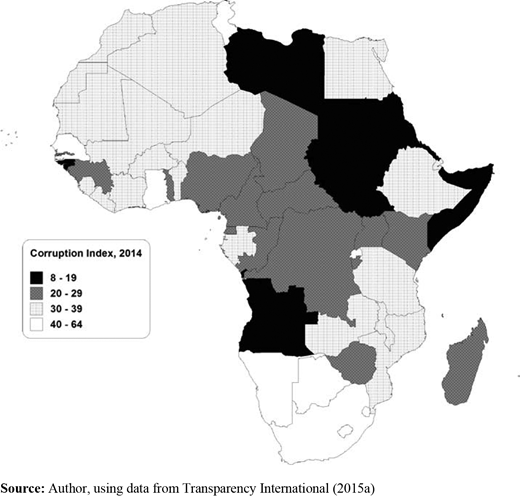
Figure 1 displays these results cartographically. In broad terms, the highest levels of corruption may be observed in states such as Sudan, South Sudan, Eritrea and Somalia, which are marginally functional and often unable to provide minimal government services. Libya, too, falls in this category, given the disintegration of the state there following the fall of Qaddafi. Angola emerges as an extremely corrupt petro-state in this context. The next-highest levels of corruption are found in a broad swath of states, including Chad, Nigeria, Congo, the Democratic Republic of Congo and Kenya, as well as Zimbabwe to the south. Moderately corrupt states are located largely in the northern and western portions of the continent, such as Niger, Mali and Algeria, and Maghreb countries such as Morocco, as well as Ethiopia and several East African nations such as Tanzania, Zambia and Mozambique. Africa’s least corrupt states are found in the south, notably Botswana and to a lesser extent South Africa and Namibia, although Tunisia and Ghana also fall into this group.
Corruption indices were correlated against several variables hypothesized to be causally related (Table IV). The Transparency International score was positively correlated with GDP per capita, indicating that national wealth tends to reduce the severity of corruption, a pattern common across the world. Typically, relatively more prosperous societies tend to have a large middle class, which often advocates for civil liberties and freedom of the press, and serves as a watchdog for corruption (Mauro, 1995). Surprisingly, corruption was not significantly correlated with change in GDP in 2014: several very corrupt economies nonetheless grew quite rapidly, including Angola (5.6 per cent), Guinea Bissau (3.5 per cent), Zimbabwe (3.2 per cent), Congo (5.8 per cent) and Nigeria (6.2 per cent). This result may reflect the high prices of certain minerals (e.g. copper, uranium, gold, coltan) and petroleum that form the mainstay of several African economies.
Transparency international corruption score correlations
| GDP per capitaa | 0.30* |
| % change GDP 2014 | 0.12 |
| Fuels and ores % GDP | −0.20 |
| Exports % GPD | 0.23 |
| FDI % of GDP 2014 | −0.07 |
| Gini coefficient | 0.24 |
| Literacy rate | 0.27* |
| Freedom House score | −0.55* |
| World Bank indexb | 0.93* |
Notes:
Purchasing power parity;
World Bank control of corruption index;
Indicates significant at 0.95 confidence level
Neither was corruption significantly correlated with the Gini measure of inequality, indicating that it was, statistically, equally widespread among those with even and unevenly distributed national incomes. This observation appears to contradict the claim that wealth mitigates corruption, but it refers to the distribution of income rather than its level. It may be that the very pervasiveness of corruption in African countries, both within those with egalitarian distributions of income and those without, defies any clear connection between corruption and inequality. Literacy, not surprisingly, was significantly correlated with the corruption score: the more literate African countries become, the lower is their level of corruption.
To assess the “resource curse” hypothesis, the analysis included fuels and ores/minerals as a percentage of total export revenues in 2014, data for which were obtained from the World Bank (http://wdi.worldbank.org/table/4.4). On average, 60 per cent of the foreign revenues of African countries originates from sales of these products. However, they comprise as little as less than 1 per cent for small, tourist-oriented states (e.g. Mauritius) to as much as 88 or 96 per cent in oil-rich Nigeria and Algeria, respectively. The result of the resource curse hypothesis was rather surprising: the correlation coefficient, −0.20, was negative but not statistically significant. Apparently, dependence on exports of raw materials does not explain the severity of corruption, in part because some countries, such as Botswana, defy the easy explanation of the resource curse. This finding stands in stark contrast to arguments such as that of Arezki and Gylfason (2013), who found that exports of raw materials and corruption were significantly related.
Two variables were included to assess the relations between corruption and globalization. The first, exports as a per cent of GDP, serves as a proxy for a country’s reliance on the global economy for revenues. On average, roughly 29 per cent of the exports of African countries consist of exports, although this ranges from as little as 6 per cent (Sudan) to more than 95 per cent (Equatorial Guinea). Data for the second, FDI as a percentage of GDP in 2014, were obtained from the World Bank (2015a, 2015b). FDI varies markedly in its significance to African states, ranging from a low of −5.3 per cent in Sudan (net capital outflow) to as high as 38.8 per cent in the Republic of the Congo. The results for the two globalization variables were disappointing. Exports as percentage of GDP had a modest relation to corruption (0.23), as might be expected, but the correlation was statistically insignificant. Similarly, FDI as a percentage of GDP was indeed negatively correlated with the CPI, but at a statistically meaningless level (−0.07). Such findings indicate that economic forces may not be as influential in driving or curtailing corruption as has been widely presumed. If raw material resources, the relative size of exports and foreign investment do not explain corruption, what does? The answer may lie in variables that reflect the political environment of different countries.
Corruption was also inversely and significantly correlated with the Freedom House index of political freedom. The significant, inverse correlation with corruption indicates that it is the most severe in politically repressive environments, notably those without an independent media, one of the prime guarantors of honest governance. Such a finding is not unique to Africa; many repressive governments around the world are highly corrupt (Warf, 2016), a reflection of the concentration of power and lack of institutional oversight on parties that divert public funds for private uses.
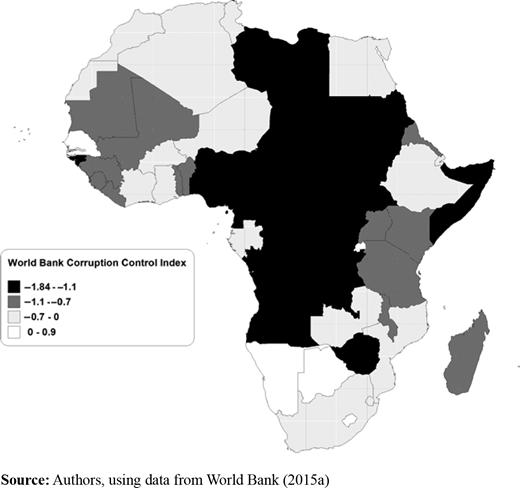
A map of the World Bank control of corruption index (Figure 2) indicates that only a handful states, mostly in southern Africa as well as Senegal, have scores above zero, indicating that corruption has been brought to moderate levels. A wide swath of states stretching from Libya to Congo to Angola, as well as Zimbabwe, have scores below −1.84, indicating that government attempts to limit corruption there have been ineffectual, some to the point of non-existences. The World Bank corruption control index was very strongly correlated with the CPI, indicating that countries with strong government policies to combat corruption have lower rates of it, although this relationship may reflect the influence of wealth and political openness as much as anything else.
Concluding thoughts
Corruption is, unfortunately, a pronounced feature on the African political and economic landscape. Many of the world’s most corrupt governments are found in Africa (as indicated by Transparency International scores). The prevalence and severity of African corruption reflect several enabling forces, including poverty and illiteracy, patrimonial political cultures, a high degree of dependence on natural resource exports, poorly developed civil societies and the lack of an independent media that could expose corrupt practices. Corruption has a wide array of poisonous effects, encourages nepotism and incompetence, gives rise to widespread cynicism and distrust of the state, distorts the allocation of public services, minimizes the beneficial effects of foreign aid and discourages foreign investment.
The empirical analysis was surprising. Variables such as standards of living (GDP per capita) and literacy were very important, indicating that relatively wealthy, well-informed publics were less likely to tolerate massive corruption. Macroeconomic variables enjoyed less success, including the annual growth rate of GDP, likely because many booming economies had corrupt governments. Unexpectedly, two variables that measured the resource curse and globalization, the primary hypothesized causes, proved to be insignificant. It may well be that widespread corruption occurs in both growing and declining economies, and that the resource curse has been exaggerated as a cause. Moreover, foreign investors may find corruption more tolerable than political instability. Rather, measures of the political environments of African states were more meaningful, including the Freedom House index of political freedoms and the World Bank’s index of the control of corruption. More tolerant governments with a relatively free media, and those that have actively sought to control corruption, exhibit lower levels than those in which political freedoms were minimized. The African experience, it would seem, points to the inverse relations between corruption and democracy.
Some of the complexity of the empirical findings may reflect the likelihood that the factors that give rise to corruption in African countries do not have the same effects across the continent. Corruption must be understood contextually and geographically, as the conjunctions of circumstances that enable, or constrain, it vary markedly among countries. In some places, the resource curse is largely to blame (e.g. Nigeria); in others, the colonial legacy of borders and tribal conflicts (e.g. Kenya, Sudan); in yet others, foreign policies, including support for dictators and neoliberal structural adjustment lie at the root (e.g. Democratic Republic of the Congo, Egypt). The most severe cases of corruption in Africa occur in “failed states” wracked by civil wars and tribal conflicts, such as Sudan, South Sudan, Libya, Somalia and the Democratic Republic of the Congo. At the other end of the spectrum, Botswana stands as a model of minimal corruption, with an active watchdog agency that monitors and controls malfeasance.
Like many parts of the world, African countries often engage in periodic anti-corruption campaigns (Riley, 1998; Asongu, 2013). Kenya and Tanzania, for example, applied the traditional method of inhibiting cattle raiding, armed sungusungu vigilantes, to clean up their notoriously corrupt judicial systems and provide security (Abrahams, 1987; Heald, 2007). Often anti-corruption campaigns are sponsored by foreign donors, who are concerned about misuse of their funds (Michael, 2004). Unfortunately, such programs generally have limited success. Given how deeply embedded corruption is in social relations, these attempts often amount to little more than window dressing, and at worse, opportunistic attacks on political opponents of established regimes. For example, the African Peer Review Mechanism (APRM), erected by the New Partnership for Africa’s Development (Nepad), includes 30 volunteer countries of the African Union and is designed to monitor political and economic governance in its member states; however, it has achieved little by way of substantive results. Indeed, it includes some of the continent’s most corrupt states, such as Nigeria, Kenya and Angola, and was at one point chaired by the notoriously corrupt prime minister of Ethiopia, Meles Zenawi. For these reasons, Bond (2009) excoriates it as an anti-democratic, neoliberal hypocrisy. More meaningful steps to curb corruption include reforming existing laws and institutions (Mbaku, 2008), the growth of literacy, political stability, higher salaries for civil servants, a vibrant and independent watchdog media free of censorship, protections for whistle-blowers and closer controls over foreign aid and the revenues derived from resource exports.

