


This paper aims to apply an integrated data envelopment analysis (DEA) and analytic hierarchy process (AHP) approach to a multi-hierarchy grey relational analysis (GRA) model. Consistent with the most real-life applications, the authors focus on a two-level hierarchy in which the attributes of similar characteristics can be grouped into categories. Nevertheless, the proposed approach can be easily extended to a three-level hierarchy in which attributes might also belong to different sub-categories and further be linked to categories.
The procedure of incorporating the DEA and AHP methods in a two-level GRA may be broken down into a series of steps. The first three steps are under the heading of attributes and the latter three steps are under the heading of categories as follows: computing the grey relational coefficients of attributes for each alternative using the basic GRA model which further provides the required (output) data for an additive DEA model; computing the priority weights of attributes and categories using the AHP method which provides a priori information on the adjustments of attributes and categories in additive DEA models; computing the grey relational grades of attributes in each category for alternatives using an additive DEA model; converting the grey relational grades of attributes to the grey relational coefficients of categories; computing the grey relational grades of categories for alternatives using an additive DEA model; computing the dissimilarity grades of categories for the tied alternatives using an additive DEA exclusion model.
The proposed approach provides a more reasonable and encompassing measure of performance in a hierarchy GRA, based on which the overall ranking position of alternatives is obtained. A case study of a wastewater treatment technology selection verifies the effectiveness of this approach.
This research is a step forward to overcome the current shortcomings in a hierarchy GRA by extracting the benefits from both the objective and subjective weighting methods.
1. Introduction
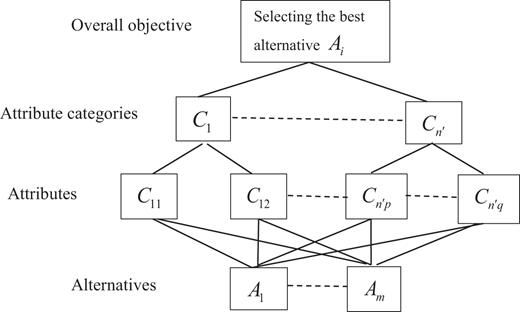
Grey relational analysis (GRA) is a multi-attribute decision-making (MADM) tool that provides a single measure of performance for each alternative with respect to a set of incommensurate attributes. Nevertheless, the traditional GRA is only limited to the situations with a single level of attributes, which might not entirely satisfy the need for increasingly complex MADM problems. In real-world applications, there are a great number of MADM activities which not only need to be represented by a set of attributes, but these attributes might also belong to different categories constituting a hierarchical structure. Figure 1 illustrates a complex MADM problem into a system of hierarchies in which a set of alternatives lies at the lowest level, and attributes, categories and the overall objective of the decision are on the higher levels of this hierarchy, respectively. For example, the problems of selecting wastewater treatment plants (Zeng et al., 2007), renewable electricity generation technologies (Sarucan et al., 2011), natural gas pipeline operation schemes (Jia et al., 2011), coal-fired power plants (Xu et al., 2011), biomass briquette fuel system schemes (Wang et al., 2015), weapon equipment systems (Guoqing and Lin, 2015), call center sites (Birgun and Gungor, 2014), firms demanding commercial credits (Ertuğ and Girginer, 2015), advertising spokesmen (Hsu and Su, 2008) and stock investments (Li et al., 2010).
These studies use the analytic hierarchy process (AHP) in a multi-level GRA, known as hierarchy GRA. AHP is a subjective data-oriented procedure that determines the relative priorities of attributes based on the formal expressions of decision makers’ preferences (Saaty, 1987). The application of AHP not only overcomes the drawback of assigning uniform weights to each attribute by GRA, but also incorporates the effects of attribute (sub) categories in the performance of alternatives. However, since the introduction of AHP in 1980, it has been a target of criticism due to its subjective nature of producing weights (Swim, 2001; Dyer, 1990). Therefore, hierarchy GRA may not result in the best ranking position for each alternative in comparison to all the other alternatives. This flaw can be corrected by integrating data envelopment analysis (DEA) in hierarchy GRA. DEA is an objective data-oriented approach that allows each alternative (known as a decision-making unit in the DEA terminology) to choose its own favorable system of weights to optimize its relative performance (Cooper et al., 2011). This flexibility in selecting the weights, on the other hand, may be undesirable for some decision makers because it may place an alternative in the best ranking position for unlikely weight combinations. By noting the problematic contradiction between objective weights in DEA and subjective weights in AHP, this research is intended to develop an integrated DEA and AHP approach in a multi-level GRA framework. Therefore, it can provide more reasonable and encompassing results for ranking alternatives in GRA. The integration of both the DEA and AHP methods in a single-level GRA can be found in Pakkar (2016a, 2016b). Pakkar (2016a) explores the tradeoff relationship between the objective weights obtained by DEA and the subjective weights obtained by AHP in a GRA methodology. This may result in various ranking positions for each alternative in comparison to the other alternatives. Pakkar (2016b) applies a pair of additive DEA models in a fuzzy multi-attribute GRA methodology to assess the overall performance of alternatives from both the optimistic and pessimistic perspectives. In this approach, the attribute weights obtained by additive DEA models are bounded by AHP. Nonetheless, as mentioned earlier, none of the proposed models consider the hierarchical structures of attributes. Simply treating all the attributes to be at the same level obviously ignores the hierarchical information and further leads up to invalid and unstable measures of performance assessment for alternatives. Therefore, the approach proposed in this research is a step forward to overcome the current shortcomings in a hierarchy GRA by extracting the benefits from both the objective and subjective weighting methods.
2. The proposed approach
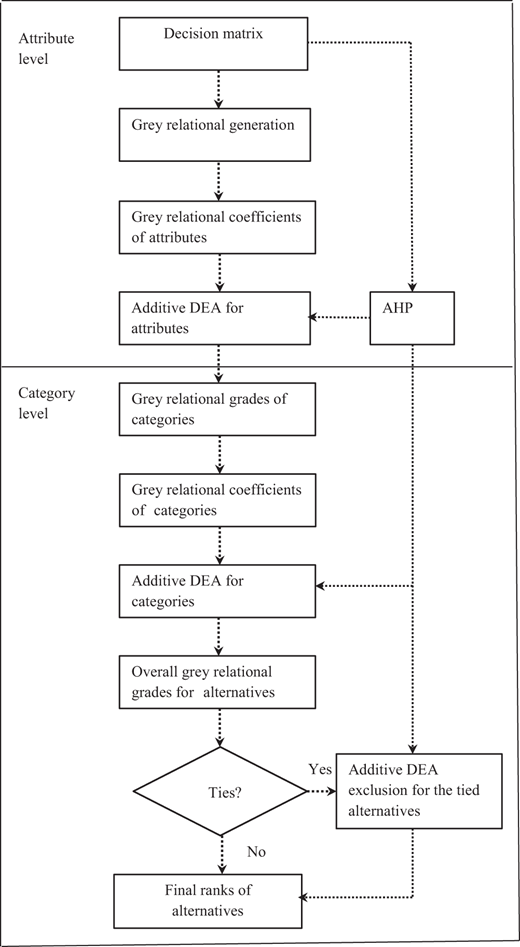
As mentioned earlier, we focus on those MADM problems in which the attributes of similar characteristics can be grouped into different categories to construct a two-level hierarchy. The procedure of incorporating DEA and AHP in a two-level GRA may be broken down into the following steps (Figure 2).
2.1 Step 1: Computations at the level of attributes
Computing the grey relational coefficients of attributes for each alternative using the basic GRA model which further provides the required (output) data for an additive DEA model;
Computing the priority weights of attributes and categories using the AHP method which provides a priori information on the adjustments of attributes and categories in additive DEA models; and
Computing the grey relational grades of attributes in each category for alternatives using an additive DEA model.
2.2 Step 2: Computations at the category level
Converting the grey relational grades of attributes to the grey relational coefficients of categories;
Computing the grey relational grades of categories for alternatives using an additive DEA model; and
Computing the dissimilarity grades of categories for the tied alternatives using an additive DEA exclusion model.
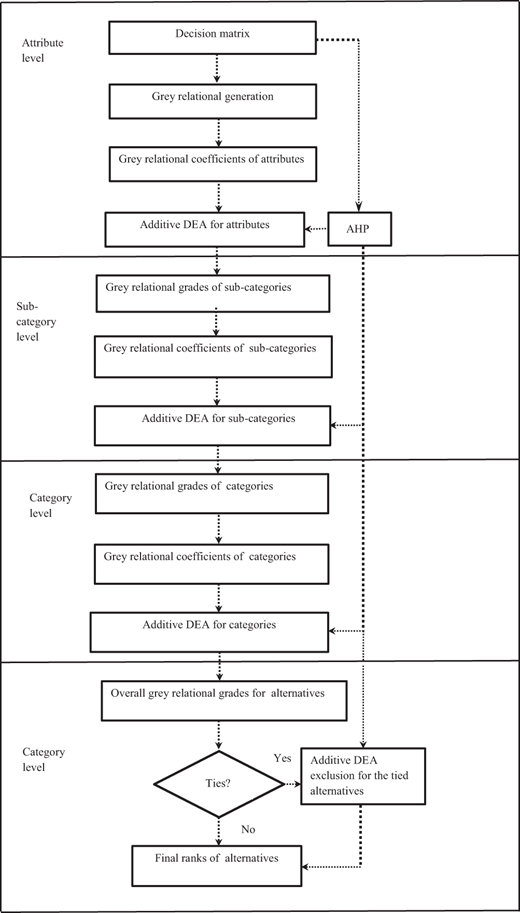
Note that the idea of the two-level hierarchy is consistent with the most real-world applications. Nevertheless, the proposed approach can be easily extended to a three-level hierarchy in which attributes might also belong to different sub-categories and further be linked to categories ( Appendix 1).
2.3 Basic grey relational analysis
Let yik be the value of attribute Ck (k = 1, 2, …, n) for alternative Ai (i = 1, 2, …, m) in an MADM problem. The term yik can be translated into the comparability value rik by using the following equations:
where yk(max) = max{y1k, y2k, …, ymk} and yk(min) = min{y1k, y2k, …, ymk}. Note that desirable attributes satisfy the property of “the larger the better” and undesirable attributes satisfy the property of “the smaller the better”. To eliminate the scale differences between all attributes, and moreover, ensure that all of them are in the same direction of change, equations (1) and (2) are used. Now, let u0k be the reference value for an ideal alternative, A0, as follows:
Then the ideal alternative, A0, can be defined as a virtual alternative which is characterized by a reference sequence of the maximum values of all attributes. To measure the degree of similarity of alternative Ai to the ideal alternative A0, with respect to each attribute, the grey relational coefficient, ξik (a distance function), can be calculated as follows:
where |u0k − rik| represents the absolute deviation of each alternative from the ideal alternative with respect to a particular attribute. Obviously, ξik decreases when |u0k − rik| increases and ξik increases when |u0k − rik| decreases. mini mink |u0k − rik| and maxi maxk |u0k − rik| are the minimum and maximum absolute deviations among all alternatives with respect to all attributes. ρ ∈ [0, 1] is the distinguishing coefficient, which adjusts the range of the grey relational coefficient. The smaller the ρ is, the greater is its distinguishing power. Generally it is taken as 0.5. To find an aggregated measure of similarity of alternative Ai to the ideal alternative A0, over all the attributes, the grey relational grade, Гi, can be computed as follows:
Where wk is the weight of attribute Ck and . In practice, expert judgments using AHP are often used to obtain the weights of attributes. When such information is unavailable, equal weights seem to be a norm. In the next section, we show how the hierarchical structures of attributes can be incorporated in a traditional GRA method to constitute a two-level hierarchy in GRA.
2.4 Two-level grey relational analysis
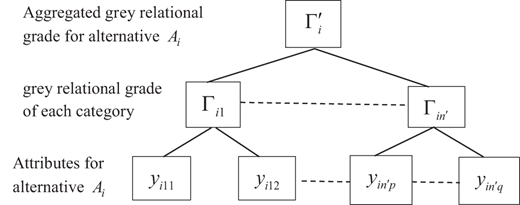
The computational structure of a two-level GRA is illustrated in Figure 3. Suppose yijk is the value of attribute Cjk (k = p, p + 1,…, q) in category C′j(j = 1,2,…,n′) for alternative Ai (i = 1, 2, …, m) while 1 ≤ p ≤ q ≤ n. Using equations (1)-(5), the grey relational grade of attributes in category C′ j for alternative Ai, denoted as Гij, can be computed as follows:
where ξijk and wjk are the grey relational coefficient and the weight of attribute Cjk in category C′j for alternative Ai. Again, using equations 3-(5) on Гij, the grey relational grade of categories for alternative Ai, denoted as Γ′i, is obtained as follows:
2.5 The analytic hierarchy process
The AHP procedure for computing the priority weights of attributes and their categories may be broken down into the following steps:
Step 1: A decision maker makes a pairwise comparison matrix of different attributes of each category, denoted by B with the entries of bjkk′ (k = k′ = p, p + 1, …, q) while 1 ≤ p ≤ q ≤ n. The comparative importance of attributes is provided by the decision maker using a rating scale. Saaty (1987) recommends using a 1-9 scale. In a similar way, a pairwise comparison matrix can be made to compare the importance of each category. This matrix is denoted by D with the entries of djj′ (j = j′ = 1, 2, …, n′).
Step 2: The AHP method obtains the priority weights of attributes of each category by computing the eigenvector of matrix B (equation 8), Wj = (wjp, wjp+1, …, wjq)T, which is related to the largest eigenvalue, γmax:
In a similar way, the priority weights of each category are obtained by computing the eigenvector of matrix D (equation 9), W = (w1, w2,…, wn′)T, which is related to the largest eigenvalue, γmax:
To determine whether the inconsistency in a comparison matrix is reasonable, the random consistency ratio, C.R, can be computed by the following equation:
where R.I is the average random consistency index and N is the size of a comparison matrix.
2.6 Additive DEA models
To compute the grey relational grade of attributes in a particular category for each alternative, an additive DEA model can be developed in which all the grey relational coefficients, ξijk, are treated as outputs. This model is similar to the additive model in Cooper et al. (1999) without explicit inputs as follows:
while 0 ≤ Poj ≤ 1, and 1 − Poj indicates the grey relational grade, Гoj (o = 1,2,…, m, j = 1, 2, …, n′), of attributes in category C′ j for alternative under assessment Ao (known as a decision-making unit in the DEA terminology). Sjk is the slack variable of attribute Cjk (k = p, p + 1,…, q) in category C′ j, expressing the difference between the performance of a composite alternative and the performance of the assessed alternative with respect to each attribute. In other words, Sjk identifies a shortfall in the attribute value of Cjk of category C′ j for alternative Ao. Obviously, when Poj = 0, alternative Ao is considered as the best alternative in comparison with all the other alternatives in category C′ j. wjk is the priority weight of attribute Cjk of category C′ j which is defined out of the internal mechanism of DEA using AHP, and λij is the weight of alternative Ai (i = 1, 2, …, m) in category C′ j. The convexity constraint in Model (11) meets the assumption of variable returns-to-scale frontier for an additive model. Similarly, we can develop a model to obtain the grey relational grade of categories for each alternative as follows:
while 0 ≤ Po ≤ 1 and 1 − Po indicates the grey relational grade, Γ′o(o = 1,2,…,m), of categories for alternative under assessment Ao Sj is the slack variable of category C′j. wj is the priority weight of category C′j, obtained by AHP, and λi is the weight of alternative Ai (i = 1, 2, …, m). One should notice that the additive DEA models bounded by AHP does not necessarily yield results that are different from those obtained from the original additive DEA models (Charnes et al., 1985). In particular, it does not increase the power of discrimination between the considerable number of alternatives which form the best practice-frontier. The alternatives on this frontier are usually ranked in the first place by obtaining the grey relational grades of 1. To eliminate the ties that occur for the best alternatives, we propose model (13) that is similar to the additive DEA exclusion (or super-efficiency) model in Du et al (2010) without explicit inputs:
After removing alternative Ao from the best practice frontier of model (12), we need to decrease the grey relational coefficients of categories for alternative Ao to reach the frontier constructed by the remaining alternatives. Note that the value of objective function, αo, can be considered as a dissimilarity grade between alternative Ao and the remaining alternatives. tj is a slack variable representing a decrease in the grey relational coefficient of category C′ j for alternative Ao to reach the frontier.
3. Case study
In this section, we present the application of the proposed approach to assess the performance of four wastewater treatment technology alternatives: anaerobic/anoxic/oxic (A1), triple oxidation ditch (A2), anaerobic single oxidation ditch (A3) and sequencing batch reactor (A4) with respect to eight attributes which are grouped into three attribute categories. Table I presents the required data as adopted from Zeng et al. (2007). Note that some attributes are provided by the numerical values and some are by the quantification of the linguistic values of experienced decision makers based on Table II (Zeng et al., 2007). Capital cost, operation and maintenance (O & M) cost and land area are undesirable attributes while the other attributes are desirable. These data are turned into the comparability sequence by using equations (2) and (3) as presented in Table III. Using Equation (4), all grey relational coefficients for attributes are computed to provide the required (output) data for the additive DEA model (11) as shown in Table IV.
Data for wastewater treatment technology selection
| Alternatives | ||||||
|---|---|---|---|---|---|---|
| Goal | Categories | Attributes | 1 | 2 | 3 | 4 |
| C′1 economic category | C11 capital cost (×104 RMB) | 13,762 | 12,080 | 12,375 | 11,870 | |
| C12 O&M cost (×104 RMB) | 7,612 | 8,747 | 8,126 | 8,233 | ||
| C13 land area (×104 m2) | 9.88 | 11.78 | 11.93 | 9 | ||
| Wastewater treatment technology selection | C′2 technical category | C24 removal efficiency of nitrous and phosphorous pollutants | G (0.7) | M (0.5) | E (0.9) | M (0.5) |
| C25 sludge disposal effect | P (0.3) | G (0.7) | G (0.7) | P (0.3) | ||
| C26 stability of plant operation | G (0.7) | E (0.9) | E (0.9) | G (0.7) | ||
| C27 maturity of technology | E (0.9) | G (0.7) | G (0.7) | P (0.3) | ||
| C′3 administrative category | C38 professional skills required for operation and maintenance | M (0.5) | E (0.9) | G (0.7) | M (0.5) | |
Linguistic values scale
| Linguistic values | Quantity |
|---|---|
| Excellent (E) | 0.9 |
| Good (G) | 0.7 |
| Moderate (M) | 0.5 |
| Poor (P) | 0.3 |
| Very Poor (VP) | 0.1 |
Results of grey relational generation for wastewater treatment technology selection
| Categories | Attributes | Alternative technologies | ||||
|---|---|---|---|---|---|---|
| A0 | A1 | A2 | A3 | A4 | ||
| C′1 | C11 | 1 | 0.86 | 0.98 | 0.96 | 1 |
| C12 | 1 | 1 | 0.87 | 0.94 | 0.93 | |
| C13 | 1 | 0.91 | 0.76 | 0.75 | 1 | |
| C′2 | C24 | 1 | 0.78 | 0.56 | 1 | 0.56 |
| C25 | 1 | 0.43 | 1 | 1 | 0.43 | |
| C26 | 1 | 0.78 | 1 | 1 | 0.78 | |
| C27 | 1 | 1 | 0.78 | 0.78 | 0.33 | |
| C′3 | C38 | 1 | 0.56 | 1 | 0.78 | 0.56 |
Results of grey relational coefficients for attributes
| Categories | Attributes | Alternative technologies | |||
|---|---|---|---|---|---|
| A1 | A2 | A3 | A4 | ||
| C′1 | C11 | 0.705 | 0.944 | 0.893 | 1 |
| C12 | 1 | 0.72 | 0.848 | 0.827 | |
| C13 | 0.788 | 0.583 | 0.573 | 1 | |
| C′2 | C24 | 0.604 | 0.432 | 1 | 0.432 |
| C25 | 0.37 | 1 | 1 | 0.37 | |
| C26 | 0.604 | 1 | 1 | 0.604 | |
| C27 | 1 | 0.604 | 0.604 | 0.333 | |
| C′3 | C38 | 0.432 | 1 | 0.604 | 0.432 |
Note that grey relational coefficients depend on the distinguishing coefficient ρ, which here is 0.50. Table V depicts the hierarchical structure of attributes for wastewater treatment technologies and the corresponding priority weights in the AHP model as constructed by Zeng et al. (2007).
The priority weights of attributes and categories obtained by AHP
| Goal | Categories | Weights | Attributes | Weights |
|---|---|---|---|---|
| C′1 economic category | 0.6371 | C11 capital cost | 0.6371 | |
| Prioritizing attributes and categories | C12 O&M cost | 0.1052 | ||
| C13 land area | 0.2581 | |||
| C′2 technical category | 0.2581 | C24 removal efficiency of nitrous and phosphorous pollutants | 0.2271 | |
| C25 sludge disposal effect | 0.1904 | |||
| C26 stability of plant operation | 0.2483 | |||
| C27 maturity of technology | 0.3345 | |||
| C′3 administrative category | 0.1052 | C38 professional skills required for operation and maintenance | 1 |
For the attributes and categories shown in Table V, four comparison matrices need to be elicited from the decision maker–three for computing the weights of attributes with respect to each category and one for estimating the priority weights of categories with respect to the problem goal. Table VI shows the results of the pairwise comparison matrix at the category level with respect to the goal which further are used in the additive DEA model (12) and the additive DEA exclusion model (13).
Pairwise comparison matrix at category level
| Categories | C′1 | C′2 | C′3 | Weights |
|---|---|---|---|---|
| C′1 | 1 | 3 | 5 | 0.6371 |
| C′2 | 1/3 | 1 | 3 | 0.2581 |
| C′3 | 1/5 | 1/3 | 1 | 0.1052 |
Notes:
γmax = 3.0379; C.R = 0.0327
Obtaining the results of grey relational coefficients and the priority weights of attributes, the additive DEA model (11) can be run. Table VII shows the results of running model (11) that computes the grey relational grade of attributes in each category for the alternative under assessment.
Grey relational grades with respect to each category
| Categories | Alternative technologies | ||||
|---|---|---|---|---|---|
| A0 | A1 | A2 | A3 | A4 | |
| C′1 | 1 | 1 | 0.845 | 0.851 | 1 |
| C′2 | 1 | 1 | 0.871 | 1 | 0.562 |
| C′3 | 1 | 0.432 | 1 | 0.604 | 0.432 |
Again, using equation (4), the grey relational grades of each category are turned into the grey relational coefficients for that category as shown in Table VIII.
Grey relational coefficients with respect to each category
| Categories | Alternative technologies | ||||
|---|---|---|---|---|---|
| A1 | A2 | A3 | A4 | ||
| C′1 | 1.000 | 0.648 | 0.656 | 1.000 | |
| C′2 | 1.000 | 0.688 | 1.000 | 0.393 | |
| C′3 | 0.333 | 1.000 | 0.418 | 0.333 | |
The overall grey relational grade for the alternative under assessment is obtained from the additive DEA model (12) as shown in Table IX. Since alternatives A1, A2 and A3 are placed in the best ranking positions, the additive DEA exclusion model (13) is run to create a unique rank order among these alternatives. As indicated in Table X, the three alternatives A1, A2 and A3 are ranked 2, 3 and 1, based on the minimum grade of dissimilarity, respectively. Therefore, the anaerobic single oxidation ditch (A3) is selected as the optimal alternative for the studied municipal wastewater treatment technologies.
4. Conclusions
In many MADM cases, it makes sense to group attributes hierarchically, while different weights may be assigned to different attributes and their own categories to reflect their relative priorities. The standard GRA model is not able to reflect such hierarchical structures, as they assume that all the attributes use the same weights. To cope with this problem, scholars have adopted the application of AHP in GRA, known as hierarchy GRA, where attributes are constructed hierarchically and different weights can be used at different levels. However, the subjective process of producing weights in AHP may not place each alternative in its best light in comparison with all the other alternatives. To overcome this issue, we integrate the two variants of DEA models in hierarchy GRA. Since we use both the DEA and AHP methods in a multi-level GRA framework, more reasonable and encompassing results can be provided for assessing the performance of alternatives. Finally, the usefulness of the proposed approach is demonstrated using a real case study of the hierarchy system of wastewater treatment technology selection.
References
Appendix 1
Appendix 2. The glossary of modeling symbols
yjk is the value of attribute Ck (k = 1,2, …, n) for alternative Ai (i = 1, 2, …, m).
rik is the comparability value of attribute Ck for alternative Ai.
yk(max) is the maximum value of attribute Ck.
yk(min) is the minimum value of attribute Ck in a basic GRA model.
uok is the reference value for a virtual ideal alternative, Ao.
ξik is the grey relational coefficient of attribute Ck for alternative Ai.
ρ is the distinguishing coefficient.
Гi is the grey relational grade for alternative Ai in a basic GRA model.
wk is the weight of attribute Ck in a basic GRA model.
yijk is the value of attribute Cjk (k = p, p + 1, … q) in category C′j(j = 1,2,…,n′) for alternative Ai while 1 ≤ p ≤ q ≤ n.
ξijk is the grey relational coefficient of attribute Cjk in category C′j for alternative Ai.
wjk is the weight of attribute Cjk in category C′j, obtained by AHP.
Гij is the grey relational grade of attributes in category C′j for alternative Ai.
ξij is the grey relational coefficient of category C′j for alternative Ai.
wj is the weight of category C′j obtained by AHP.
Γ′i is the grey relational grade of categories for alternative Ai.
bjkk′ is the k − k′ (k = k′ = p, p + 1,…q) element of the pairwise comparison matrix for attributes, denoted by B, with respect to category C′j.
djj′ is the j − j′ (j = j′ = 1, 2, …, n′) element of the pairwise comparison matrix for categories, denoted by D, with respect to the problem goal.
γmax is the largest eigenvalue.
R.I is the average random consistency index.
N is the size of a comparison matrix.
C.R is the random consistency ratio.
1 − Poj is the grey relational grade, Гoj (o = 1, 2, …, m, j = 1, 2, …, n′), of attributes in category C′ j for alternative under assessment Ao.
Sjk is the slack variable of attribute Cjk (k = p, p + 1, … q) in category C′ j.
λij is the weight of alternative Ai in category C′j.
1 − Po is the grey relational grade, Γ′o(o = 1,2,…,m), of categories for alternative under assessment Ao.
Sj is the slack variable of category C′j.
λi is the weight of alternative Ai (i = 1, 2, …, m).
αo is a dissimilarity grade between alternative Ao and the remaining alternatives in the additive DEA exclusion (or super-efficiency) model.
tj is a slack variable of category C′j in the additive DEA exclusion model.

