


This paper aims to explore the Google Arts and Culture platform in terms of parameters used for categorizing the digital collections by it; the total number of items and their types; top contributing artists; top ten historical events and figures; and the top ten countries having maximum artworks.
An online method was used to collect the relevant data for achieving the objectives of the study. Data were harvested from the official website of Google Arts and Culture (https://artsandculture.google.com/) during the period of 15 May to 31 May 2018, and the same was tabulated in MS Excel for analysis and interpretation.
The findings revealed that Google Arts and Culture includes a total of 6,272 artists, 228 media and 121 art movements. Moreover, there are a total of 641 historical movements; 6,250 historical figures; 9,692 places; 3,226 museum views; 1,702 zoom views; 39,607 featured videos; and 5,528 featured stories; 122 items organized by color and 954 organized by time.
The present study is first of its kind that focuses on exploration of diverse arts and cultural heritages of different countries and by diverse artists made visible by Google Arts and Culture initiative. It will significantly reinforce the art and cultural heritage lovers to acquire the knowledge pertinent to various types of arts and cultures that prevailed in antiquity across the globe and also make aware the conservators about how to use digital technologies for efficient preservation and visibility of unique artworks, artists and the places whom they belong.
Introduction
In the course of human evolution, certain changes have occurred in their lifestyle that includes advancement in their living standards and means of communication they adopted. The consistent progress in the communication has simplified the knowledge spreading of masses. In the present era, digital technologies have shaped the social setup, economic well-being and living luxuries of people in all walks. The communication has also achieved its highest standard in the form of Information and Communication (ICT). The ICT consists of a huge number of wireless networks, satellite telecommunications and broadcasting networks and applications such as internet, multimedia tools, database management systems (DBMS). ICT comprises a variety of technological tools. Due to the intervention of ICT in each and every field, digitization has gained a wide momentum (Krubu and Osawaru, 2011).
Before the digital age or emergence of ICT, handwritten or typed letters were the only real way of communication. While it meant waiting for days and even weeks to hear a response, they were used to convey all sorts of information from the mundane to the life-changing. Here, we look at a handful of letters from artists, writers and historical figures to get a sense of who they were and what they were going through at the time. A large part of the vast amount of information produced in the world is born digital and comes in a wide variety of formats: text, database, audio, film and image. For cultural institutions traditionally entrusted with collecting and preserving cultural heritage, the question has become extremely pressing as to which of these materials should be preserved for future generations, and how to go about selecting and preserving them. This enormous trove of digital information produced today in practically all areas of human activity and designed to be accessed on computers may well be lost unless specific techniques and policies are developed to conserve it (Conway, 1994). Preserving valuable scientific information, research data, media output, digital art, to name but a few areas, poses new problems. If such material is to be accessed in its original form, technical equipment – original or compatible hardware and software – must be maintained alongside the digital files that make up the data concerned. In many cases, the multimedia components of websites, including internet links, represent additional difficulty in terms of copyright and geography, and sometimes making it difficult to determine which country a website belongs to. Traditional preservation methods, such as the “legal deposit” used by national libraries to ensure that copies of all printed materials are kept, cannot be applied as such to digital material for a variety of reasons, notably because Web “publications” often draw on data stored on servers in different parts of the world. The sheer volume of data concerned also poses a problem. It is estimated that the internet features one billion pages whose average lifespan is extremely short, estimated at 44 days to two years. Considered as the most democratic publishing medium ever, some argue that the ever-growing internet deserves to be preserved as a whole, as its pages and discussion forums can be considered a priceless mirror of society (Vohra and Aarti, 2011). The preservation of valuable manuscripts and documents is the need of the hour. Several such attempts have been made; for instance, World Digital Library is a venture with such efforts. Google Art and Culture is also one of them, and it is fully concerned with the development and preservation of art and culture dating back to centuries. The present study rotates around it and provides a full introduction regarding it.
Historical overview of Google Art and Culture
The project was initially launched on 1 February 2011 by Google, in cooperation with 17 international museums, including the Tate Gallery, London; the Metropolitan Museum of Art, NY City; and the Uffizi, Florence. In 2002, a major extension to Art Project was announced, and an agreement of partnership was signed with 151 museums from 40 countries. At present, the platform features more than 32,000 artworks from 46 museums. It includes works from institutions like the Art Gallery of Ontario; the White House; the Australian Rock Art Gallery at Griffith University; the Museum of Islamic Art, Doha; and the Hong Kong Museum of Art. The main intention for launching this project was to provide a second-generation platform and to be a resource without boundaries. Later in the year 2013, Google Cultural Institute joined the venture. This initiative is fully supporting the venture (Google Art and Project, 2018).
The glimpse of Google Arts and Culture
It is an online platform where the general public can access the high-resolution images of artworks housed in the initiative’s partner museums. The main Components of Google Arts and Culture are as follows:
Virtual gallery tour: This feature allows the virtual visit to the gallery of each partner museum by using the options Google Street View or clicking the floor plan of the gallery. This feature is helpful in exploring the site.
Artwork view: This feature helps to zoom in on a particular artwork and helps to analyze it in a greater detail. While analyzing the image, the user may also get information pertaining to the physical characteristics of the image (which includes size, material and artist). However, some of the other options include viewing notes, history of the artwork and information of the artist. The Google includes external links for the ease of its users to explore additional information about a particular artwork.
Create an artwork collection: A Google account login can help users to create a collection of their own so that users can compile many images from the partner museum and save and create a gallery of their own.
Review of literature
The sustainability of art and culture within the sustainable developmental agendas has become an increasing priority, depicted as a fourth pillar, equal to social, economic and environmental concerns (Loach et al., 2017). The preservation of art and culture through new multimedia technologies is one of the key ideas to retain the sustainability of art and culture across the world. New-media technologies can help to disseminate cultural heritage between people, making them uniformly available, irrespective of spatial locations. It is believed that virtual heritage propagated through new-media have strong potentiality to create cultural awareness among people about our absconding cultural heritage (Cameron and Kenderdine, 2007). Similarly, the meaningful application of new-media into virtual heritage conservation should retain the cultural presence to fulfill the pedagogic aim of conservation – knowledge dissemination and awareness generation (Pujol and Champion, 2012).
One of the great initiatives taken to preserve the traditional art and culture is “Google Art and Culture” project which is a:
Scrupulous documentation of museum exhibits, which includes many Indian art museums. The projects cater to larger target audiences enabling them a virtual walkthrough of these museums. Being available to all internet users the project deploys the benefit of new-media by adopting a tool to disseminate knowledge irrespective of spatial boundaries (Kolay, 2016).
The Google Art and Culture Project (GACP) launched in 2011 is still a young initiative. As a result, there has been meager scholarly work published on the project. Beil’s “Seeing Syntax: Google Art Project and The Twenty-First-Century Period Eye” is one of the only academic pieces of writing published on GACP. Beil situates GAP in the history of art reproductions and explores the way representations shape how spectators look at art: Even as photographs – and especially reproductive photographs – claim to represent the visual world with a rigorous objectivity, they make use of pictorial conventions that must be decoded by their viewers. When these conventions are familiar to viewers, they imagine that they can see right through the reproduction to the original that it represents. However, when conventions become outdated, it is the process itself that becomes most visible, rendering the reproduction an opaque representation rather than a transparent window on the original (Beil, 2013). Beil’s paper opens up academic discussion about GACP, but as a result of its short length, its scope is limited. While the paper provides valuable insight into the practice of looking at online images of artworks, the paper never discusses the “street view” functionality, the integration of social media platforms, the “user galleries” or the Google brand. In her thesis titled “A Rembrandt in Virtually Everyone’s Living Room?”, Ioanna Panagiotopoulou argues that GACP represents a new era of user-generated content where online interactive tools encourage users to more actively engage with online content. Panagiotopoulou primarily explores whether GACP is a more democratic method of art consumption. She approaches this central research question through a series of user interviews and surveys. These interviews and surveys include discussion of various topics including the aura of art objects in a virtual museum, the museum’s role as an educator and the prevalence of edutainment in initiatives like GACP. Panagiotopoulou also briefly examines the museum’s social role in helping to either reaffirm or challenge power structures that privilege some members of the public over others. While there are small critiques woven throughout her thesis, including a small paragraph on the Project’s Western bias. Panagiotopoulou largely characterizes GAP as an audience-driven project and praises its democratic potential. GACP and similar initiatives are suggested as potential solutions to help narrow the “‘semantic gap’ between everyday experience and the knowledge of the general public when it concerns high art” (Panagiotopoulou, 2010). In the Language of New Media, Manovich (2009) examines the politics of code: In cultural communication, a code is simply a neutral transport mechanism; usually it affects the messages transmitted with its help code may also provide its own model of the world, its own logical system, or ideology; subsequent cultural messages or whole languages created with this code will be limited by its accompanying model, system, or ideology. Manovich’s (2013) paper “Database as Symbolic Form” looks at the relationship between database and narratives. Manovich explores databases including some of the first “virtual museums” housed on CD-ROMs. He argues that over time, we have projected “the ontology of the computer onto culture itself.” CD-ROMs, Video Games and Web pages contain their own narrative flow determined by the database model that is used. Although his analysis of virtual museums housed on CD-ROMs may be outdated now, much of the same broader theory can be applied to a narrower case study of a website like GACP and can be synthesized with other digital heritage scholars. In the twentieth century, curatorial practices moved towards being much more universal and standardized between museums. The introduction of the computer seemed to impose a more violent structure onto the museum and its collections: “the computer-enabled systematization of documentation in the 1970s was a rationalizing discourse, aiming to bring order to the bricolage of earlier twentieth-century curatorial practices”. Hooper-Greenhill (2013) describes the “mythological art museum” and its reputation as a rigid, tightly controlled environment for the educated and influential to bask in the presence of high art. This myth is certainly not universal in reality, as many museums struggle with underfunding or little public recognition. Stallabrass (2010) quite fiercely argues that while many museums and galleries may face a reality that is quite different from this mythological vision of the gallery, “both museums and galleries are committed to the mystification of the objects that they display, holding to the fiction of a distinct realm of high art that stands above the bureaucratized world of work and the complementary vulgar blandishments of mass culture”. If the art gallery and the museum are associated with a mythological rigidity, the online gallery is often linked to something quite the opposite. Häyrinen (2012), while debating whether Google is a massive online museum, concludes that Google is a gigantic voting, re-contextualization and marketing machine that connects information and materials without caring about academic degrees, institutional status or proper context. Google is a Wikipedia on a larger scale, with unlimited perspectives and without any publishing policy. Museums are not in the position to define the rules for this particular kind of museum. The only thing they can define is whether they will be part of it. The revolution of heritage authority has already taken place. There is a large-scale crowdsourcing is coming into being, where people are creating, commenting and manipulating digital heritage. Museums may give their support to it or they may ignore it, but they cannot prevent it from happening. The Virtual Museum of the Pacific (VMP) is a model for online community interaction with the Pacific Island collection of the Australian Museum, which operates within an understanding of objects and their meanings as dynamic, contested and negotiable. The VMP is a digital environment for exploring and defining the relationships among a selection of the 60,000 objects in the Pacific collection of the Australian Museum. Stuedahl (2011) attempts to understand how Web 2.0 and social media might open new possibilities for museums to collaborate with communities and lay professionals in cultural heritage knowledge creation. Digital technologies provide tools that in many ways overcome challenges of physical collaboration between museums and amateurs. But technologies also bring in new aspects of ordering, categorizing and systematizing knowledge that illuminates the different institutional and professional frameworks that writing local historical knowledge into digital forms. In a nutshell, GACP is an ambitious project from the internet giant which has opened a new debate in the literature of preserving and providing access to worldwide cultural artifacts.
Objectives
The main objectives of the study include:
to explore various parameters on the basis of which the digital collection are categorized in Google Arts and Culture;
to gauge the total number of items available in it as per their types;
to identify the contribution of top ten artists, the medium of items and art movements that contribute the highest number of items in Google Arts and Culture collection; and
to evaluate the contribution of top ten historical events and historical figures and the contribution of top ten leading countries having the maximum number of artworks.
Methodology
The study used an online search method for the collection of data to achieve the laid objectives. In a systematical manner, the official website of Google Arts and Culture was accessed via link (https://artsandculture.google.com/), during the period of 15 May to 31 May 2018, to harvest the required data. The website was browsed through the various options, reflected at the left side of its homepage, enlisting various searching options like artists, mediums, art movements, historical events, historical figures and places. All the relevant data as per each browsed option were collected and then tabulated in a MS Excel worksheet for further analysis and interpretation. Accordingly, the objectives of the study were successfully achieved, and findings were depicted in tables and figures along with discussions.
Data analysis and interpretation
Total collection of Google Arts and Culture
Google Arts and Culture (formerly known as Google Art Project) is a large database of worldwide culture and art. It explores the items of artwork, museums, libraries, archives, historical events and figures, artists and organizations that are in cooperation with Google Cultural Institute. It also provides various important features: a person can zoom any artwork with high resolution; create and share their own build collection; watch relevant videos about the artwork; and virtually walk around the museums, libraries and historic sites. Google Art and Culture is now available in 18 different languages including English, Japanese, Indonesian, French, Italian, Polish and Portuguese. As on 31 May 2018, Google Arts and Culture includes a total of 6,272 of artists, 228 media and 121 art movements. Moreover, there are a total number of 641 historical movements; 6,250 historical figures; 9,692 places; 3,226 museum views; 1,702 zoom views; 39,607 featured videos; 5,528 featured stories; and 122 items organized by color and 954 organized by time (Table I).
Total collection of Google Arts and Culture
| S.no. | Total collection | Total no. of items |
|---|---|---|
| 1 | Artists | 6,272 |
| 2 | Mediums | 228 |
| 3 | Art movements | 121 |
| 4 | Historical events | 641 |
| 5 | Historical figures | 6,250 |
| 6 | Places | 9,692 |
| 7 | Museums views | 3,226 |
| 8 | Zoom views | 1,702 |
| 9 | Featured videos | 39,607 |
| 10 | Featured stories | 5,528 |
| 11 | Organized by color | 122 |
| 12 | Organized by time | 954 |
Google Arts and Culture website interface and browsing options
Google Arts and Culture website is user-friendly, as its search interface increases the visibility of its contents for the users. The Google continuously update the platform’s search capabilities so that users can feel the ease of access to find artworks. Its main aim is to enrich the virtual experience for its online users. Users can find art by filtering their search into several categories including the artists, museums, type of work, art movements, place, historical figures and events. The filtered results are then displayed on the screen. This enables the users to search across numerous collections to find artworks that are useful for them and meets their area of interest. Figure 1 gives the glimpses of the same.
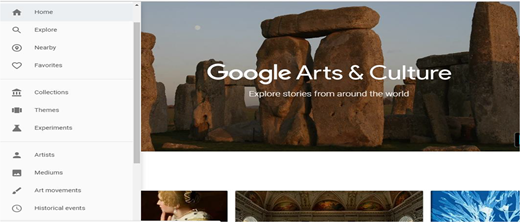
Arts and experiments of Google Art and Culture
Google Cultural Institute is a non-profit initiative that partners with cultural organizations to bring the world’s beautiful cultural heritage online. They build various tools and technologies for the cultural sector to showcase and share their gems, make them more widely accessible to a global audience. They are using state-of-the-art system for capturing paintings at ultra-high resolution. The different experiments are carried out at the crossroads of art and technology, created by artists and creative coders with the collection from Google arts and culture. Since its beginning, these coders have created an amazing experiment using Android, AI, Chrome and Voice Experiments. They are showcasing various projects in experiments along with useful tools and resources to inspire others to create the new experiment. Table II depicts a nascent view.
Arts and experiments of Google Art and Culture
| Arts and culture experiments | Features |
|---|---|
| AI experiments | Explore machine learning in simple, hand on ways |
| Android experiments | Related to Creativity and Code on Android |
| AR experiments | Features work by coders who are experimenting with augmented reality |
| Web VR experiments | Explore virtual reality on the Web for everyone |
| Chrome experiments | Showcase the work of coders who are pushing the boundaries of Web technology, creating beautiful ,unique web experience |
| Voice experiments | Explore voice interaction in fun new ways |
Top ten artists of Google Art and Culture
Google Arts and Culture collections map shows that Americans and Europeans are dominant in most aspects and in all sections of the collections. It is evident from the option “Latest news” that the project is making a serious effort to display the diverse artworks of artists. The recent topics include the Raja Ravi Varma Heritage Foundation in Bangalore and Peranakan clothing of China without un-raveling centuries of bias. In the artist's section of Google Arts and Culture, the total number of artworks created by a particular artist is displayed. It also provides the detailed description about the artists like the date of birth and death; his/her notable works; and the medium of artwork and importance of artists in art history. This section also helps to discover the other similar type of works along with the physical description. The list of top ten artists with their highest contribution is compiled. For observing the list, see Table III.
Top ten artists of Google Art and Culture
| S. no. | Name of the artists | No. of contributing items |
|---|---|---|
| 1 | Alfred Eisenstaedt | 192,332 |
| 2 | Carl Mydans | 115,756 |
| 3 | George Silk | 96,921 |
| 4 | Margaret Bourke-White | 44,286 |
| 5 | David Scherman | 30,131 |
| 6 | Gordon Parks | 11,493 |
| 7 | George Rodger | 5,490 |
| 8 | George Hendrik Breitner | 2,804 |
| 9 | Jacques Callot | 2,373 |
| 10 | James Abbott McNeill Whistler | 2,333 |
Top ten mediums of Google Art and Culture
The Google Art and Culture hosts millions of artifacts and artwork of leading artists around the world ranging from prehistory to the modern history. In art, the medium is simply a material used by artists to create their artwork. It provides historical details about the type of item along with its uses from prehistoric times. This sections also provide the links of similar other artwork of the same type of medium and total number of artwork created from the particular medium. In Google project, the maximum number of type of type of medium is etching, followed by paper and engraving. The least number of artifacts is made on textiles. For clear understanding, see Table IV.
Top ten art movements of Google Art and Culture
In Google Arts and Culture, users can zoom any artwork of his/her interest along with the item details also. It provides the physical characteristics detail about the item like type, size, material, artist, country of origin, location, period and subject category. Under zoom view of any artwork, it also provides the scholarly and conceptual information order to enhance the understanding of the work. Any museum, library or achieve is allowed to include as many materials as they wanted to contribute, and the level of information varies by museum, artwork or artists. Google Arts and Culture includes various art movements on the list, some of the top ten art movements and their number of items included in their movement. The highest number of items included in Baroque (21,926) followed by Modern Art(10,484) and the least number of items was in Northern Renaissance (2,843) items as shown in Table V.
Top ten historical events of Google Art and Culture
Google Arts and Culture was launched on 1 February 2011 by Google, in cooperation with 17 international museums, including the Tate Gallery, London; the Metropolitan Museum of Art, NY City; and the Uffizi, Florence. It is an effort to make important cultural material available and accessible to everyone and to digitally preserve it to educate and inspire future generations. The main contribution to Google’s platforms allows for interlinking with other institution’s collection, enables greater global accessibility. It provides a detailed history of the event and time when the event has started and till which year it ends. This section also shows the similar like historical events along with other details also. Table VI gives a clear view.
Top ten historical events of Google Art and Culture
| S. no. | Historical events | No. of items |
|---|---|---|
| 1 | World War II | 32,094 |
| 2 | The Holocaust | 16,925 |
| 3 | Cold War | 14,570 |
| 4 | World War I | 4,392 |
| 5 | Protests of 1968 | 3,811 |
| 6 | May 1968 events in France | 3,792 |
| 7 | Pacific War | 2,290 |
| 8 | Korean War | 2,678 |
| 9 | Cuban Missile Crisis | 2,115 |
| 10 | First Indochina War | 2,058 |
Top ten historical figures of Google Art and Culture
Google Arts and Culture provides access to the notable amount of information about the included artwork in the collection. In addition to standard metadata, there is another physical description of every artwork and additional links to the related content also. The works of the artists are also relatively diverse, representing the historical sites and figures in many countries around the world and the content ranging from street art fashion to valuable paintings and sculptures. In historical figures, they provide a list of historical figures which are popular in respective fields. See Table VII for brief understanding.
Top ten historical figures of Google Art and Culture
| S. no. | Historical figures | No. of items |
|---|---|---|
| 1 | Richard Nixon | 17,919 |
| 2 | Lyndon B. Johnson | 14,492 |
| 3 | John F. Kennedy | 14,154 |
| 4 | Nikita Khrushchev | 11,108 |
| 5 | Dwight D. Eisenhower | 9,820 |
| 6 | Harry S. Truman | 6,821 |
| 7 | Robert F. Kennedy | 5.550 |
| 8 | Franklin D. Roosevelt | 4,756 |
| 9 | Charles de Gaulle | 4,091 |
| 10 | Jacqueline Kennedy Onassis | 3,017 |
Top ten places of Google Art and Culture
Google Art and Culture in collaboration with art museums, heritage sites, archives and other cultural institutions around the world makes global art and culture visible to the rest of the world. This project allows the users to explore paintings, sculpture, prints, drawing, photographs, decorative arts and other objects in this collection. The artwork contributed to the Google art represents many areas from the museum's comprehensive collection, from second millennium BCE to the twentieth century from the Europe, America, Asia, North Africa and the Mediterranean. Place wise, the artwork is categorized according to the country of origin. It provides the historical detail of every artwork in a particular country. Table VIII offers a lucid picture.
Top ten museum view countries of Google Art and Culture
For centuries, cultural institutions like libraries, museums, archives and organizations all over the world have collected and safeguarded the history and heritage. Powerful technologies can amplify this mission while preserving these artifacts for the worldwide audience today and tomorrow. In country-wise search option, it displays the overall history of the particular country along with other information like the number of states and districts and union territories. The collection of a particular country is shown along with the physical description of the artwork. This section also shows the similar stories of artwork and the total number of items available in Google Art and Culture from a particular country. For clear view, see Table IX.
Limitations and direction for future research
Google Art and Project has a digital collection of painting, photographs, historical events, notable figures, prints and sculptures of thousands of resources from almost all the countries of the world. Keeping in the view the time constraints in consideration, the contributions of only top ten artists, art movement and type of item, historical events, historical figures and countries are explored and analyzed for the study. The study suggests that future researches can be conducted on the other aspects which are not covered in the present study.
Conclusions
The study tried to show that digital technologies are having the significant impact on the preservation of world-wide art and culture. Within this framework, when it comes to promoting and protecting the diversity of world culture and art in a new environment, the progress made by some countries could be extremely useful for others. Indeed, many of the initiatives in relation to access, creativity and cultural industries for increasing the visibility of world culture and art. The present study is an effort to explore Google Art and Culture. This platform gives users to explore world-renowned artifacts, artwork, museums, archives and organizations that are in cooperation with Google Cultural Institute. It not only provides this but also realizes the virtual experiences of worldwide art and culture sitting at home. It provides users with significant features like any user can zoom into their views into high-resolution images with specifications; can create their own collection; and is able to watch, share and virtually walk around the museums and historical sites. Users can also browse the collection by sorting options by color, time, theme and popularity.
The authors are very thankful to all the friends and colleagues who provided a helpful support during the preparation of this research report. The study is not funded by any agency or organization. It is our own effort to make this paper successfully completed with a purpose to disseminate valuable knowledge to the users of this paper.

