


New developments in cold pad batch dyeing
New developments in cold pad batch dyeing
Keywords: Dyes, Colour technology, Garment industry
Jürgen Süss-Leonhardt, DyStar Textilfarben GmbH & Co. KG, Derek McKelvey, Marks & Spencer plc, Bernd Pesch, Küsters GmbH.
The classic cold pad batch (cpb) dyeing process has undergone significant changes since its development during the early sixties and is a culmination of good co-operation between dyestuff producer, dyehouse and machine manufacturer. In addition, leading retailers such as Marks & Spencer have provided challenges in respect of new fabric constructions, emerised fabrics and fastness requirements which have given impetus regarding this specific dyeing technology. In this review we will demonstrate the importance of reactive dyestuff diffusion and its significance in producing a superior fabric with better wash and wear fastness performance on both non- surface finished and emerised material.
The global market demands are supported by the use of the cpb processing. The key factors are continued pressure on cost, improved quality (both appearance and fastness) and reduced lead times in the global textile supply chain. These requirements combined with shorter production runs – due to reduced lead time or multi-phased fashion seasons – means the dyehouse must be capable of excellent lab to bulk transferability. These market needs are combined with new fabric constructions and fibre blends which can be dyed by the cpb process(Table I).
Today's cpb process could not have been successfully developed further without the combined approach of many participants in this technology. DyStar as a leading textile solutions provider is working together with the market-leading machine manufacturers, e.g. Küsters, to provide optimised conditions for dyestuff application and control with one target: to achieve controlled pad batch technology. Key developments in cpb technology were started in 1957 and is still ongoing:
development of dosing pumps (Hoechst);
introduction of sodium silicate as a fixing alkali (Hoechst);
development of microwave and oven lab fixation method (Hoechst);
mathematical determination of pad liquor stability under practical conditions (Hoechst) ! Optidye CR (DyStar); and
development of silicate free alkali systems (DyStar).
In addition to machinery and control developments the research and development of new reactive dye chromophores and anchor systems have continued to be innovation targets to provide better pad liquor stability including under different climate conditions, higher fixation yield and optimised compatibility in ternary combinations. The development of the Levafix CA dye range has set the benchmark in new dyestuff chemistry with a number of Color Confidence®and Controlled Coloration® benefits for dyehouses.
Importance of temperature control
No light without shade! The cpb process – which can appear to be a simple application process – must be consistent. Figure 1 shows the importance of temperature control and its influence on a given yellow/red/blue ternary combination. This 3-color-combination is excellent up to 20°C but with all temperature influencing parameters the pad liquor temperature can easily increase to 28-30°C. The performance is then inferior –resulting in repeatability problems, tailing and costly reworks.
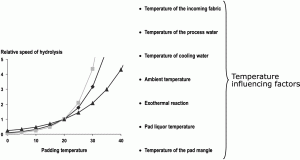
Figure 1 Influence of temperature control on a combination dyeing
Importance of reactive dye diffusion
The quality of a finished fabric suitable for shirting, workwear or chinos is to a large extent dependent on dye diffusion, the capability of dyestuff to penetrate into the interstices of the yarn and material and to remain fully diffused throughout the entire process. The effect from poor diffusion and penetration after ten domestic wash cycles using a modern activated bleach detergent will be washdown (Figure 2) and white crease marks (Figure 3).
 Figure 2Washdown after ten domestic wash cycles with activated bleach detergents
 Figure 3White crease marks after ten domestic wash cycles with activated bleach detergents
Examination under higher magnification by moving from the surface of the dyed material into the single fibre, we see clearly the reason for the above described problems and can easily detect the difference of good dye and poor dye penetrations (Figure 4).
 Figure 4Diffusion of a dyeing under the microscope
Full diffusion of the yarn is not only important for the appearance of a garment but also for the fastness properties. Evaluations using different dyes have given dramatic differences in the fastness properties. A comparison of fastness properties against the degree of diffusion of a navy based on the important but oxidative bleach sensitive Reactive Black 5 and a grey based on the high fastness performance Levafix CA dyes is shown in Table II.
The figures are self explanatory: light and multiple wash fastness of Reactive
Table IGlobal trends for CPB application of reactive dyes Black 5 are reduced by 1.5 grades entirely due to poor diffusion.
| Fibretrend | cpvtrend | |
|---|---|---|
| Woven fabrics,cotton | Stable | Stable |
| Woven fabrics,regenerated celluloseincl. Lyocell | Smallgrowth | Smallgrowth |
| Woven fabric,cotton – elastomericblends | Significantgrowth | Significantgrowth |
| Knit goods | Positivegrowth | Positivegrowth |
It will be observed that the Levafix CA dyes are suitable for the M&S C10A test, but are reduced significantly in light fastness, combined with a strong decrease in multiple wash fastness if the dyes are poorly diffused. Reduced fastness properties of the dyes selected for high performance are directly related to the risk of customer complaints.
Preconditions for good diffusion
The basis for optimised diffusion starts with pre-treatment. It has to be ensured that the wetability of the material is excellent and the pH value is slightly acid to neutral and is distributed evenly throughout the whole batch of material. Good wetability is self explanatory, but even a slightly alkaline pH value can increase dramatically the substantivity of the dyestuffs which consequently reduces their opportunity for diffusion. The drying process must be controlled to guarantee a uniform moisture content. The usual practice is to overdry the material, but this results in poor wetability combined with poor lab-to-bulk reproducibility. Nowadays a moisture control system is strongly recommended.
Good diffusion does not end with good pre-treatment and drying processes. The correct alkali system has to be used, especially if dyeing tightly woven material. “Soft” alkali systems control the rate of fixation and allows the diffusion into the cellulose structure of the dyes which should be selected according to their molecular structure and of course according to the required fastness properties. Influencing parameters on the degree of diffusion are:
wetability;
uniformity;
pH value;
moisture content;
overdrying;
“soft” alkali systems; and
molecular structure of the dyes.
To meet the above criteria DyStar's dyestuff recommendations are shown in Table III. The “soft” alkali recommendation especially developed for Levafix CA dyes to promote diffusion of reactive dye before fixation is shown in Table IV. Silicate free alkali systems can offer some more advantages such as easier clean down of the whole cpb unit, no hardening of the rollers, easier wash off of the fabrics combined with softer handle. Using the OptidyeqCR computer program for the accurate calculation of pad liquor stabilities and batching times under any circumstances assist the dyer in controlling and optimising the whole dyeing process.
Emerised fabrics
Emerised fabrics for leisurewear, women's wear, smart casual trousers, etc. are one of the important fashion trends. The emerising process (also known as sanding, sueding, brushing) has been developed to include standard grade emery paper, diamond shaped emery paper and carbon coated PA- bristles to produce different effects and handles but which results in different dyeing properties in terms of face-back colour uniformity. In addition to the normal difficulties a cpb dyehouse faces further fastness challenges for emerised material which are not easy to achieve:
high light fastness C9: 4 on-tone fading;
high multiple-wash fastness C10A: 3-4 on-tone shade change;
high wet light fastness C9A;
perspiration fastness C7;
NOX-stable, fastness to ozone;
non photochromism; and
good wash and wear properties.
The above mentioned C fastness tests are M&S specific tests which can differ from ISO and/or AATCC fastness test.
These requirements can be challenging in terms of dyestuff selection in respect of repeatability, face-back colour uniformity and diffusion properties.
Padding configurations
The padding technologies shown in Figure 5 are used for around 90 per cent of all production and lab dyeings. The U-shaft and Mini MFLO technologies (both from Küsters) and comparable systems are mostly used in production, whilst the nip dyeing is mainly used in the lab, and is only suitable for a few articles (e.g. shirting) for production. However, the dyeing results differ significantly between these two technologies which is highly apparent on emerised material (Figure 6). The difficulties start in the lab. Even if the face-back uniformity is commercially acceptable on a lab dyeing –significant shade differences between trough and nip dyeing are possible when transferring to production. With appropriate dyestuff selection this shade difference can be minimised (Figure 7).
 Figure 5Padding configurations
 Figure 6Shade differences dyeing emerised material
 Figure 7Shade differences between lab and bulk
Dyeing properties are not only dependent on the padding configuration technology but also on the speed used which can create reproducibility problems from different dyestuff combinations (Figure 8).
 Figure 8Shade differences due to process speed
The importance of lab reproducibility cannot be underestimated. Each lab has to determine the right correlation between the lab equipment, process and production. Speeds of between 30 and 60 m min-1 are not possible for the lab; consequently a correlation between the two has to be found. The latest development from the machine manufacturer Küsters (Padmaster) is a helpful tool for correlating lab and bulk procedures.
Table IIFastness comparison vs different degrees of diffusion
| Medium navy shade based on C.I. Reactive Black 5 | Grey shade based on Levafix CA | |||
|---|---|---|---|---|
| Optimum diffusion | Poor diffusion | Optimum diffusion | Poor diffusion | |
| C10A | 2-3 | 1-2 | 4-5 | 4 |
| Light fastness | 4 | 2-3 | 5 | 3-4 |
| 103C4A, 508C | 3-4 | 2 | 4 | 3 |
| NOx | 3 R | 2-3 R | 3-4 | 3 |
Table IIIDye recommendation for cpb
| For pale ternaries | Pale to medium ternaries for highest performance | For dark ternaries | |
|---|---|---|---|
| Levafix | Levafix | Levafix | Remazol |
| Yellow E-3RL | Br. Yellow CA | FastRed CA | UltraYellow RGB |
| Brown E-2R | Yellow CA | Red CA | UltraRed RGB |
| Br. Blue E-B | Amber CA | Rubine CA | Orange RGB |
| Orange CA | Blue CA | DeepRed RGB | |
| Scarlet CA | Navy CA | Blue RGB | |
| Olive CA 100 | Navy RGB | ||
| Deep Black RGB | |||
Table IV “Soft” alkali recommendation
| Dyestuffgl21 | , 5 | 5-9 | 10 | 15 | 20 | 30 | 40 | 50 | 60 | 80 | 100 |
| Soda ashgl21 | 20 | 20 | 18 | 18 | 17 | 15 | 15 | 15 | 15 | 15 | 15 |
| NaOH 50 per centmll21 | 0.4 | 0.6 | 1.2 | 1.8 | 2.3 | 3.4 | 5.0 | 7.2 | 8.5 | 11.8 | 12.0 |
The decision process for new orders depends in many cases on lab dyeings in terms of fabric appearance, fastness properties and shade uniformity. Bearing in mind that most lab dyeings are produced by the nip thread-up, the fastness properties (especially the light fastness) can be inferior in bulk if produced by trough thread-up. In the following table the effect on light fastness is illustrated. It will be observed that the pad dyeing configuration is critical but also that careful dye selection can mitigate the differences in certain shade areas Table V.
Table V
Effect on fastness of different thread-ups
The correct dyestuff selection is essential in addition to all the other discussed issues when dyeing emerised material. DyStar has developed recommendations to meet all performance requirements in controlled pad batch including the appropriate “soft” alkali system for best diffusion and the correct dyestuff selection with Levafix CA and Remazol RGB, the correct speed for best reproducibility and the correlated machine set-up for optimum lab to bulk transferability.
Based on many lab and production trials the optimised dyestuff selection for the difficult earth tone shades on emerised woven fabrics is:
Levafix Amber CA – non photochromic, high light fastness.
Levafix FastRed CA – high light fastness.
Levafix Blue CA – high light fastness.
Levafix Olive CA100 – homogeneous, non photochromic combined with high light fastness.
All Levafix CA dyes show extremely high colour build-up and highest robustness in production. Ternary combinations based on the above demonstrate good lab to bulk transferability and bulk-to- bulk repeatability, highest fastness performance and excellent face-back uniformity. Production trials have to be made to test the lab to bulk transferability but also to be aware of material differences due to emerising. The bulk processing conditions have to be imitated in the lab. There has to be a correlation between the different process conditions.
Conclusion
The expertise involved in controlled pad batch technology provides the basis for better quality, higher productivity, higher differentiation and reduced production risk. The cpb process continues to develop further improvements for optimising diffusion and reproducibility through both dye innovation,application and parameter control. This can only be achievable by close co-operation between global retailer, innovative dyestuff producer and leading machinery manufacturer to develop optimised solutions for new fastness performance requirements to meet increased customer expectations on the latest fabric developments whilst minimising non-conformance material.
DyStar as a leading textile solutions provider offers optimised dye selection and application technology to meet the highest performance requirements. As a partner for the whole textile chain DyStar provides Color Confidence®to fulfil all requirements of the world's leading retailers and Controlled Coloration® to offer textile mills cost- effective dyes and right first time technology for any requirement. Investments in R&D and co-operations with major retailers, brands and world's leading textile machine and fibre manufacturers help DyStar to stay at the forefront of the industry.

