This paper aims to examine the role of technology in the transition towards appropriate care in long-term care settings for older adults.
A rapid review was conducted based on the Cochrane guidelines on Rapid Reviews. Three databases were searched. Studies conducted after 1999 that examined technology in long-term care settings in relation to the concept of appropriate care (defined as a need for health care transformation due to the increasing demand for long-term care and the shortage of long-term care staff) were included.
Six studies were included and examined a wide range of technologies in long-term care. Findings highlight the importance of technology implementation and stakeholder involvement. Studies used the transition towards appropriate care as justification for research on technology but failed to connect their findings back to the transition towards appropriate care.
Technology has not yet in been studied in the context of the transition towards appropriate long-term care for older adults.
Introduction
The population worldwide is aging. In 2020, 1 billion people were aged 60 and above and it is expected to double by 2050 (World Health Organization, 2021). An increase in age-related disease and associated care is expected. For example, the number of people living with dementia is expected to increase to 150 million people with a prevalence of 0.5% (Nichols et al., 2022), and the rate of frailty among older adults has been increasing over the past decades (Hoogendijk et al., 2021). Older adults are likely to have more than one disease which is associated with higher health care utilization (Zhong et al., 2023). They need health care services to treat or support them to live with these conditions (Atella et al., 2019).
The rise in care utilization demands an increase in capacity and additional funding to support the growing demand for care. Globally, health care and long-term care costs have increased significantly. The amount of money spent on health care across European Union (EU) countries has increased by 24.1% since 2014 (European Union, 2024). In 2020, countries in the EU spent on average 10.9% of their GDP towards health care (European Union, 2024). To illustrate, Dutch health care costs have risen by 500% in the past 30 years, 13.4% of their GDP is spent towards health care, and 27 million euros is spent towards long-term care yearly (CPB Netherlands Bureau For Economic Policy Analysis, 2024).
In addition to health care costs, staff shortage is a frequent problem considering the increasing demand for long-term care. Already there is a shortage of staff to provide long-term care (Heiks and Sabine, 2022). Many people who work in long-term care leave the health care sector due to high work pressure, reduced autonomy and lack of supervisor support (Woodhead et al., 2014; Van Aerschot et al., 2022). The staff shortage is expected to worsen due to changing demographics, as the ratio of workforce capacity to older adults needing care will decline (Statistics Netherlands, 2024).
The current organization of long-term care is unsustainable with the expected demand for health care services due to the aging population. To promote future delivery and provision of care in the Netherlands, there has been transition towards person-centered and sustainable care considering decreasing resources in terms of money and staff. The term “appropriate care” has been introduced by the Dutch Government to describe and guide this transition process (Care Institute Netherlands, 2022). The concept of appropriate care revolves around the following four core principles; care is based on value and shared-decision making, happens at the right time at the right place and centers around health instead of disease.
In practice, many initiatives in the Dutch long-term care sector are used to transition towards appropriate care. An example is the “circle of care” (van Elst, 2022). This model proposes five subsequent steps to guide the allocation of resources: what can the older adult do himself? How can the informal caregiver (often spouse) support? How can technology help? How can the social network help and how can the health care professional help?
The use of technology in long-term care has been well documented and took a flight during the COVID-19 pandemic (Su et al., 2020; Wang et al., 2023). For older adults it can improve safety, well-being and social connectedness (Carros et al., 2020; Kim et al., 2018). For staff it can reduce administrative burden and support decision-making (Akbar et al., 2021). Many studies have evaluated technology in terms of its effectiveness and acceptance (Krick et al., 2019). However, the role of technology in long-term care has rarely been considered in the context of appropriate care. Therefore, this rapid review will examine the role of technology in the transition towards appropriate care (defined as a need for health care transformation due to the increasing demand for long-term care for older adults and the shortage of long-term care staff) in long-term care settings. These findings can support the use of the technology in the transition towards appropriate care.
Methods
A rapid review was conducted based on the Cochrane guidelines on Rapid Reviews (Garritty et al., 2021). A rapid review is a form of knowledge synthesis that accelerates the process of conducting a traditional systematic review through streamlining or omitting various methods to produce evidence for stakeholders in a resource-efficient manner (Hamel et al., 2021). The choice for a rapid review was based on the timeline of the project.
A search strategy was developed based on the PCC (population, context, concept) framework and discussed with a library information specialist (Aromataris et al., 2024). The search consisted of the following concepts: Older Adults, Long-term Care, Technology and Health care transformation. The search string combined MeSH terms, free text words and equivalent index terms. The search was conducted in Pubmed, Psychinfo and CINAHL and duplicates were removed in Endnote.
Table 1 provides in and exclusion criteria. Scientific articles were included if they were published after 1999, written in English, covered the topics of technology in long-term care for older adults and referenced the technology to the increasing demand for long-term care or availability of long-term care staff. There was no restriction on the type of technology. Conference proceedings, protocol articles and articles investigating technology effects on outcomes directly related to the older adult’s well-being (such as quality of life, mood etc.) were excluded. We excluded articles investigating technology as way to improve person-centered care or when technology was a minor part of a new way of working. Instead, the authors opted for a broader approach on the transformation towards appropriate care for the purpose of doing a rapid review.
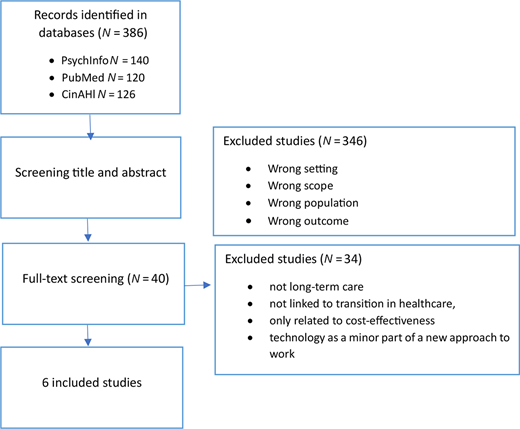
The software platform Rayyan was used for systematic documentation of the screening process of title and abstract. Twenty percent of abstracts were screened by the authors MH and MJ and conflicting views were discussed and resolved. MH screened the remaining abstracts whereby MJ double checked 50 excluded abstracts and those abstracts that warranted further examination. In line with the Cochrane guidelines on Rapid Reviews, full-text screening of forty articles was conducted by the first author (Garritty et al., 2021). To verify the full-text screening, MJ read those full texts that MH deemed eligible for inclusion or those that remained unclear after screening. The concept of “appropriate care” was operationalized as a need for health care transformation due to the increasing demand for long-term care for older adults and the shortage of long-term care staff. Figure 1 depicts the screening process.
MH extracted data in Excel (study characteristics, type of technology, aim and target audience). MH performed a narrative synthesis in Atlast.i to summarize the knowledge on the topic. This is a recommended type of analysis for rapid reviews (Garritty et al., 2021). Data relating to the technology and the transition towards appropriate care (ability of technology to support employees in long-term care or support the expected increase in demand for long-term care) and other relevant aspects were coded. Preliminary findings were discussed with co-authors.
Results
We included six studies (Table 2). The studies were conducted in Singapore (n = 1), Norway, (n = 1), Germany (n = 1), the United States (US) (n = 2) and the United Kingdom (UK) (n = 1). The studies used a variety of research approaches (quantitative, qualitative and mixed methods) and examined a wide range of technologies.
Technology in long-term care
There was a wide variety in the types of technology (ambient assisted living technologies, monitoring technologies and digital health technologies). Some studies described the technological system and its setup in detail. Aloulou et al. (2013) described that their technological system consisted of sensors, interaction devices and a central machine. Others provided little details on the technology under investigation. Barisch-Fritz et al. (2023) for example mentioned “apps and other software applications as well as complete digital devices”.
Technology supporting the transition towards appropriate care
All studies recognized the need to alter current provision of long-term care due the ageing population and (expected increase in) staff shortage. They all posed technology as a solution to promote the transition towards appropriate care. Technology was promoted as delaying or obliviating the need for long-term care, increasing quality of care and supporting recruitment and retention of long-term care workforce.
Two studies investigated the use of technology in long-term care settings. Holmes et al. (2007) investigated a nocturnal system to support resident safety and well-being and decrease staff burden. They expected that a monitoring system could alleviate staff burden associated with frequent night checkups on residents. However, they did not observe an effect on staff burden. Aloulou et al. (2013) developed and tested a technological system in a nursing home that would alert staff in resident activity and safety (wandering at night, showering too long, leaving washing room tap on and toilet fall detection) and identified important human and technological requirements that support the development and implementation.
Anker-Hansen et al. (2022), Curtis and Brooks (2020), Dorsten et al. (2009) and Barisch-Fritz et al. (2023) deposited the potential role of technology in the transition towards appropriate care to strengthen their argument on why (research into) technology was important. They were concerned with collecting views and experiences with technology that could support further development of technology and its use and implementation in long-term care. These studies did not link back their findings to the transition towards appropriate care.
Considerations of implementing technology
Implementation of technology is crucial to successfully aid the transition towards appropriate long-term care. Ethical challenges are important to consider when implementing technology. Holmes et al. (2007) examined the ethical and legal challenges from the perspective of residents, informal caregivers and different types of employees (nurses, administrators and maintenance) and observed that privacy, dignity, cost and autonomy were important in evaluating ethical concerns for all stakeholders. Curtis and Brooks (2020) identified consideration of privacy and data security as important to support successful implementation of digital health technology.
To further expand on technology acceptance of nursing home employees, Barisch-Fritz et al. (2023) studied their affinity for technology as it supports successful development and implementation. Their results showed a high affinity for technology overall whereby nursing home employees (nursing operations) scored higher on their technology enthusiasm, competence and positive technical consequence compared to nursing home managers. Curtis and Brooks (2020) addressed considerations of implementation of digital health technology and explored how it could potentially aid time-management, decrease reliance on time-consuming paper records and thereby improve communication.
The properties of a technological system could aid implementation when there was a clear benefit and when the system was easy to use for employees (Aloulou et al., 2013). There are technological challenges to overcome (flexibility to adapt to individual residents, battery life and reconfiguration) to aid adoption in long-term care settings (Aloulou et al., 2013). When employees refuse to take ownership of the technological system, it can negatively impact implementation and adoption (Holmes et al., 2007). Nurses considered availability of technical support from the supplier important (Curtis and Brooks, 2020).
Despite technology benefits that support the transition towards appropriate care, concerns and critical views on the use of technology were expressed. Anker-Hansen et al. (2022) strongly posed that technology is only valuable if residents can successfully use it and that technology on its own cannot solve future staff shortages or replace human care.
Involving multiple stakeholders
All studies but Anker-Hansen et al. (2022) involved more than one type of stakeholder. The perspectives of the nursing home employees played a crucial role in the use, adoption and implementation of technology. Professional caregivers, nursing home managers, nurses or administrators each have different roles, responsibilities and views regarding technology that can contribute to the successful use of technology. Curtis and Brooks (2020) examined the perspectives of nursing home managers and residents and their relatives and nurses. On an overarching level, the same topics emerged. They were also able to capture the nuances in perspectives, residents and relatives had few concerns about data-safety whereas nurses considered it very important in relation to their professional responsibility to maintain confidentiality.
Nursing home residents participated in three studies (Aloulou et al., 2013; Curtis and Brooks, 2020; Dorsten et al., 2009). Aloulou et al. (2013) observed residents with dementia during the pre-deployment phase. This input coupled with input from professional caregivers helped determine the type of assistive technology that needed to be developed and deployed. Curtis and Brooks (2020) included residents and their families in co-creating a model to support effective implementation of digital health technology. Dorsten et al. (2009) conducted focus groups on the ethical perspective on technology with residents and professional caregivers. They observed that residents are more concerned about privacy and dignity in relation technology compared to professional caregivers.
The study of Anker-Hansen et al. (2022) investigated perspectives of informal caregivers and observed that their views can contribute to the successful design and implementation of technology for residents in nursing homes. These informal caregivers also identified benefits for themselves as technology can support communication with nursing home staff.
Discussion
This study examined the role of technology in long-term care for older adults in the transition towards appropriate care. Findings highlight involvement of different stakeholders in development and implementation of technology as important to support the transition towards appropriate care. The transition towards appropriate long-term care was indicated as a reason to study technology as it was expected to support the long-term workforce, improve quality of care and increase efficiency. Two studies investigated these benefits, but did not relate their findings to the transition towards appropriate care in long-term care settings for older adults (Holmes et al., 2007; Aloulou et al., 2013). The remaining studies collected views and experiences with technology to support technology development and use. Future studies should specify how their findings support the transition towards appropriate long-term care.
Results highlighted technology implementation as important to support the transition towards appropriate care. In our rapid review, technology affinity and safety emerged as important components of implementation (Curtis and Brooks, 2020; Barisch-Fritz et al., 2023). Other studies have concluded that teamwork, training and education of staff members and communication and the perceived benefits can also support the implementation of technology in long-term care settings (Schoville, 2017; Ko et al., 2018).
There is currently a gap between technology development and its implementation by long-term care facilities reinforcing the need to include stakeholders in technology development and implementation (Feenstra et al., 2023). This rapid review underpins the importance of involving multiple stakeholders (residents, informal caregivers, nurses, managers) as they each fulfill a different role in technology development and implementation in long-term care settings. Van Hoof et al. (2014) observed that stakeholders can hold conflicting views on the need for technology and at the same time use different wording to refer to the same concept. In addition, the authors reinforce the notion that it is beneficial to include residents in all stages of the development and implementation of technology. Caution should be taken with using resident proxy observations or experiences based on formal or informal caregivers. Older adults hold different care preferences, experiences and priorities compared to their informal caregivers, this might extend to their wishes and needs regarding technological innovations (Hevink et al., 2023; Linden et al., 2023).
Strengths and limitations
This rapid review is to the best of our knowledge the first that studied the role of technology in the context of appropriate care. Appropriate care is a relatively new concept in Dutch Government policy (Care Institute Netherlands, 2022) and technology is only one way to achieve this. Other examples include a greater reliance on informal caregivers in a long-term care setting whereby they provide assistance with self-care needs that are typically addressed by nursing home employees (Coe and Werner, 2022).
Of our six studies, half were published before 2015, and the rest were published after 2020. The authors purposefully opted for a broad range in publication year as it is not recommended to shorten the publication date year for the purpose of rapid reviews (Garritty et al., 2021). The authors recognize recent developments of technology in long-term care such as artificial intelligence might not have been included (Lukkien et al., 2023). This rapid review focused on the transition towards appropriate care, studies that failed to include any reference to the transition towards appropriate care in their abstract were therefore excluded at the abstract screening stage. However, findings from the current study emphasize ongoing challenges related to the implementation of technology and stakeholder involvement continues to remain relevant to more recent technological developments. The implementation gap of technology is widely recognized in health care and long-term care settings (McGough and Thompson, 2024). It therefore remains a critical area for consideration. Future studies could examine how technology in long-term care settings for older adults evolves over time and how these impact the provision of appropriate care.
The methodology of a rapid review can pose risks in terms of missing evidence or inadequate synthesis of results (Tricco et al., 2022). In our study, the number of included studies was small, potentially relevant articles could have been missed in the screening process. In addition, the scope of our rapid review did not study how technology affects each individual component of appropriate care (care is based on value and shared decision-making, happens at the right time at the right place and centers around health instead of disease). For example, technology can aid appropriate care through development and use of patient-decision aids to support shared-decision making (Butler et al., 2014). Our rapid review took a broader approach with a focus on health care transformation and its staff. It is therefore important to keep in mind this rapid review does not provide a comprehensive overview of how technology can support the transition towards appropriate long-term care for older adults.
Conclusion
Implementation and stakeholder engagement are important for technology to support the movement towards appropriate long-term care. Future studies should pay more attention to how their findings support futureproof long-term care.