This study aims to examine how multicultural experiences shape university students’ intention to participate in international internship programs. Drawing on social cognitive theory, the study conceptualises multicultural experiences as environmental stimuli that foster students’ psychological readiness for global learning and career opportunities through cultural intelligence and openness to experience.
Data were collected from a convenience sample of university students in Vietnam using a two-wave, time-separated survey design to reduce the risk of common method bias. The first wave measured multicultural experiences and cultural intelligence, while the second wave measured openness to experience and international internship intention. A total of 291 valid responses were analysed using partial least squares structural equation modelling.
The findings show that multicultural experiences have a positive direct effect on students’ intention to participate in international internship programs. The results further reveal that cultural intelligence and openness to experience serve as parallel mediating mechanisms, explaining how exposure to multicultural environments is translated into stronger international engagement intention.
This study contributes to quality education and international higher education literature by clarifying the psychological pathways through which multicultural experiences support students’ access to global learning opportunities, particularly in the context of an emerging economy.
Introduction
The internationalisation of higher education has expanded beyond student exchange and cross-border academic cooperation to include experiential learning opportunities that prepare students for culturally diverse labour markets. Among these opportunities, international internships are particularly valuable because they combine academic learning, professional practice and sustained exposure to unfamiliar cultural and organisational environments (Jackson, 2018; Pinto and Pereira, 2019). However, the availability of international internship programs does not necessarily lead to student participation. Such programs require students to confront cultural ambiguity, professional expectations, unfamiliar social norms and perceived personal risk. Consequently, understanding why students intend to participate in international internships is important for universities seeking to translate internationalisation strategies into meaningful student engagement.
Multicultural experiences (MCE) may constitute an important antecedent of this intention. These experiences arise through interaction with culturally diverse people, ideas, practices and social environments and can broaden individuals’ cognitive perspectives, enhance adaptability and reduce psychological distance from unfamiliar cultural contexts (Leung et al., 2008; Maddux and Galinsky, 2009). Students with richer MCE may therefore be more willing to consider an international internship as a feasible and valuable opportunity. Nevertheless, existing research provides an incomplete explanation of this relationship.
Firstly, prior studies have mainly examined the consequences of MCE for outcomes such as creativity, intercultural competence, cultural adaptability and general international orientation (Leung et al., 2008; Maddux and Galinsky, 2009; Ng et al., 2009). Comparatively less attention has been given to international internship intention, which differs from general international mobility because it requires students to adapt simultaneously to culturally unfamiliar and performance-oriented workplace environments. Thus, evidence that MCE generate positive intercultural outcomes does not fully explain whether students will intend to undertake an international professional placement.
Secondly, the psychological mechanisms through which MCE are translated into international internship intention remain insufficiently understood. Exposure to cultural diversity may create learning opportunities, but exposure alone does not ensure that students develop the capability or motivation to act on those opportunities. Cultural intelligence and openness to experience may explain two distinct aspects of this process. Cultural intelligence represents a learnable capability to understand and function effectively in culturally diverse situations (Earley and Ang, 2003; Ang et al., 2007). It may enable students to perceive themselves as capable of managing the interpersonal and cultural demands of an international internship. Openness to experience, by contrast, reflects receptiveness to novelty, ambiguity and unfamiliar ideas (McCrae and Costa, 1997). It may influence whether students view an unfamiliar international environment as attractive rather than threatening. Although both constructs have been associated with cross-cultural engagement, their simultaneous mediating roles have rarely been examined within a unified model of international internship intention.
Thirdly, existing research has not sufficiently differentiated between capability-based and dispositional pathways linking environmental exposure to international engagement. This distinction is theoretically important because students may intend to participate in an international internship for different psychological reasons: they may believe that they are capable of functioning effectively across cultures, they may be motivated by novelty and unfamiliar experiences or both. Treating these mechanisms as interchangeable may obscure how MCE shape international career-related decisions.
Social cognitive theory (SCT) provides an appropriate framework for addressing these gaps. SCT proposes that behaviour and behavioural intentions emerge through the reciprocal relationship between environmental conditions and personal factors rather than as automatic responses to external opportunities (Bandura, 1986, 2001). From this perspective, MCE constitute an environmental influence, whereas cultural intelligence and openness to experience represent personal mechanisms through which students interpret the feasibility and desirability of international internships. Applying SCT therefore enables the study to explain not only whether MCE influence internship intention, but also how this influence occurs.
Accordingly, this study examines the relationship between MCE and university students’ intention to participate in international internship programs, with cultural intelligence and openness to experience modelled as parallel mediators. More specifically, it addresses the following overarching question:
How do multicultural experiences shape students’ international internship intention through capability-based and dispositional psychological mechanisms?
The model is tested using two-wave survey data collected from university students in Vietnam.
This study makes three contributions. Firstly, it extends research on MCE by examining a specific future-oriented professional decision, international internship participation intention, rather than broader intercultural or mobility outcomes. Secondly, it clarifies the underlying process by distinguishing cultural intelligence as a capability-based mechanism from openness to experience as a novelty-oriented dispositional mechanism and by testing both pathways simultaneously. Thirdly, it extends the application of SCT to international internship decision-making by providing a differentiated account of how an environmental experience is translated into behavioural intention through complementary personal mechanisms. In doing so, the study offers a more precise explanation of students’ psychological readiness to pursue international professional experiences and provides evidence from an emerging-economy higher education context.
Literature review
Theoretical backgrounds
Social cognitive theory and students’ international engagement behaviour.
SCT, proposed by Bandura (1986), provides a foundational theoretical framework for explaining human behaviour in complex contexts, where decisions are shaped not only by external conditions but also by how individuals interpret, evaluate and internalise their experiences. Unlike traditional behaviourist approaches, SCT emphasises the principle of triadic reciprocal determinism among environmental factors, personal resources and behaviour, arguing that behaviour is not a direct reaction to environmental stimuli but rather the outcome of mediating cognitive and motivational processes (Bandura, 1986; Bandura, 1997).
In subsequent developments, Bandura (2001) further extended SCT by clarifying the role of cognitive resources and personal beliefs in the formation of behavioural intentions, particularly in contexts characterised by uncertainty and change. From this perspective, environmental experiences influence behaviour only when individuals develop the psychological capabilities necessary to interpret those experiences as meaningful and attainable. This theoretical approach is especially relevant for explaining voluntary and future-oriented decisions, such as individuals’ intentions to engage in international activities.
Within the context of higher education, SCT has been widely applied to explain students’ participation in international learning and mobility. Prior studies indicate that the mere availability of international opportunities, such as exchange programmes or overseas internships, does not automatically translate into participation. Instead, these opportunities must be mediated by individual psychological resources, including adaptive capabilities, self-beliefs and motivational factors (Lent et al., 1994; Ng et al., 2009). From this standpoint, SCT enables researchers to move beyond direct-effect models and focus on the psychological mechanisms through which environmental experiences are transformed into specific behavioural intentions.
Applying SCT to the present study, MCE are conceptualised as a central environmental factor capable of stimulating the development of individual psychological resources. Cultural intelligence and openness to experience, from a social cognitive perspective, represent key capabilities and dispositional tendencies that enable students to interpret, evaluate and respond effectively to culturally novel situations (Ang et al., 2007; McCrae and Costa, 1997). Accordingly, students’ intentions to participate in international internships are viewed as the outcome of an internalisation process in which MCE are translated into behavioural intentions through these psychological mechanisms, consistent with SCT’s core proposition regarding the interrelationship between environment, person and behavioural intention.
Environmental–personal–intention mechanisms in the context of international internships
A central tenet of SCT is that the influence of environmental factors on human behaviour is rarely direct, but is instead mediated by individuals’ cognitive and motivational processes (Bandura, 1986; Bandura, 2001). From this perspective, environments do not determine behaviour per se; rather, they create experiential conditions through which individuals develop the psychological resources necessary to form behavioural intentions. Consequently, SCT is particularly well suited to explaining future-oriented decisions that involve uncertainty and personal agency, such as decisions to engage in international learning and work-related activities.
Empirical applications of SCT in education and career development research suggest that environmental experiences affect individuals’ choices and intentions only when they foster the cognitive capabilities and beliefs required to evaluate these options as both feasible and worthwhile (Lent et al., 1994; Lent and Brown, 2013). In higher education contexts, international opportunities – such as study abroad or overseas internships – are often characterised by elevated levels of uncertainty and perceived risk. As a result, students must possess sufficient psychological readiness to translate these opportunities into concrete intentions to participate.
This challenge is particularly salient in the case of international internships, which involve a higher degree of complexity than short-term academic exchanges. International internships require students to simultaneously adapt to professional expectations, organisational norms and culturally unfamiliar work environments (Jackson, 2018). In such contexts, prior exposure to multicultural environments may facilitate students’ engagement; however, only when these experiences are internalised as individual psychological resources can they effectively shape intentions to participate in international internships. This reasoning aligns with SCT’s assertion that environmental influences on behaviour are contingent upon mediating personal factors.
In the present study, cultural intelligence and openness to experience are conceptualised as two key individual psychological resources that reflect the cognitive and dispositional processes emphasised by SCT. Cultural intelligence represents individuals’ capabilities to understand, interpret and adapt their behaviour in culturally diverse settings (Earley and Ang, 2003; Ang et al., 2007), whereas openness to experience reflects a dispositional tendency to embrace novelty and tolerate ambiguity (McCrae and Costa, 1997). These resources play a critical role in enabling students to perceive the challenges associated with international internships as manageable and developmentally beneficial, rather than as insurmountable barriers.
From a social cognitive perspective, incorporating multiple mediating mechanisms within a single analytical framework allows for a more comprehensive explanation of how environmental experiences are transformed into behavioural intentions (Bandura, 2001; Ng et al., 2009). Accordingly, the proposed research model – wherein MCE influence students’ intentions to participate in international internships through cultural intelligence and openness to experience – faithfully reflects the core principles of SCT and provides a theoretically coherent foundation for testing the study’s hypotheses.
Although the present study is situated in international higher education, broader research across tourism, organisational behaviour, development and international economic contexts also indicates that participation and engagement outcomes are rarely determined by the availability of an opportunity alone. Rather, individuals’ perceptions, motivational mechanisms, contextual constraints and evaluations of expected outcomes influence whether opportunities are translated into behavioural engagement. For example, studies of metaverse tourism show that experience-related perceptions and evaluations play an important role in shaping tourists’ behavioural intentions and engagement with technology-mediated travel environments (Jafar et al., 2025; Wang et al., 2026). Similarly, Khan et al. (2024) highlight the role of environmental passion as a motivational psychological mechanism linking antecedent conditions with employee green engagement. Research on tea tourism further illustrates that engagement with an experience depends partly on how the opportunity is structured, communicated and positioned within a particular context (Chen et al., 2017).
Evidence from other emerging-economy settings likewise suggests that access to an opportunity does not necessarily generate uniform participation or outcomes. Institutional constraints and policy conditions shape international market engagement in the agricultural sector (Jafar et al., 2015), while participation in microcredit programmes produces heterogeneous welfare outcomes and may be affected by selection-related conditions (Latif et al., 2020). Although these studies address different substantive domains, they collectively reinforce the broader need to examine the mechanisms and contextual conditions through which environmental opportunities are translated into behavioural or participation outcomes.
To clarify how the present study is positioned within the existing literature, Table 1 summarises representative studies related to MCE, cultural intelligence, openness to experience, international engagement and behavioural intention.
As shown in Table 1, prior research has established important relationships between multicultural or international experience and outcomes such as creativity, cultural intelligence, intercultural effectiveness, career readiness and perceived employability. Research has also begun to examine factors associated with students’ overseas internship and career-related intentions. However, limited attention has been given to whether and how MCE shape students’ intention to participate in international internships. In particular, previous studies have not simultaneously examined cultural intelligence as a capability-based mechanism and openness to experience as a dispositional mechanism within a unified model. The present study addresses this gap by testing both mediators in parallel within an SCT framework.
Hypothesis development
Multicultural experiences as an environmental antecedent of international internship intention
Within SCT, environmental factors influence behavioural intentions not by direct causation, but by shaping the cognitive frames through which individuals evaluate action possibilities (Bandura, 1986, 2001). MCE, in this sense, represent a qualitatively rich form of environmental exposure that challenges individuals’ existing cultural assumptions and expands their interpretive repertoires. Unlike generic international exposure, MCE involves sustained interaction with cultural difference, requiring individuals to actively interpret, negotiate and reconcile divergent norms and practices.
Prior research suggests that such experiences foster greater cognitive flexibility and reduce psychological distance towards unfamiliar contexts (Leung et al., 2008; Maddux and Galinsky, 2009). In higher education settings, this cognitive reorientation is particularly relevant for decisions involving international professional engagement. International internships, unlike short-term academic mobility, require students to anticipate prolonged immersion in culturally unfamiliar and performance-oriented environments. Consequently, students with richer MCE are more likely to perceive international internships as attainable and developmentally meaningful, rather than excessively risky or disruptive.
From a social cognitive perspective, this altered evaluation of opportunity constitutes a critical precursor to behavioural intention formation. Therefore, MCE are expected to exert a direct positive influence on students’ intentions to participate in international internship programmes:
Multicultural experiences are positively associated with students’ intentions to participate in international internship programmes.
Multicultural experiences and the development of cultural intelligence
SCT conceptualises capability development as a product of experiential learning, whereby individuals acquire and refine skills through observation, reflection and behavioural adjustment in response to environmental demands (Bandura, 1986). Cultural intelligence (CQ), defined as the capability to function effectively in culturally diverse contexts (Earley and Ang, 2003), aligns closely with this conception of learned competence.
MCE provide repeated opportunities for individuals to engage in cross-cultural sense-making, interpret ambiguous social cues and test adaptive behavioural strategies. Empirical studies indicate that such experiences are instrumental in developing the metacognitive, motivational and behavioural components of CQ (Ng et al., 2009; Ang et al., 2007). Importantly, CQ does not emerge from exposure alone, but from the active processing of culturally diverse interactions – an assumption that resonates strongly with SCT’s emphasis on cognitive mediation.
In the context of higher education, students’ engagement in multicultural environments – whether through intercultural coursework, interaction with international peers or prior international exposure – can therefore be expected to enhance their cultural intelligence. Accordingly, MCE are posited as a critical antecedent of CQ:
Multicultural experiences are positively associated with students’ cultural intelligence.
Cultural intelligence and international internship intention
Within SCT, behavioural intentions are shaped by individuals’ perceived capability to perform successfully in a given context (Bandura, 2001). Cultural intelligence represents a domain-specific capability that directly informs individuals’ confidence in navigating culturally complex environments. Students with higher levels of CQ are better equipped to anticipate, interpret and manage the interpersonal and organisational challenges inherent in international work settings.
Empirical evidence suggests that individuals with high CQ experience lower levels of intercultural anxiety and greater perceived control when operating across cultures (Ang et al., 2007). In the context of international internships, such perceptions are crucial, as students must evaluate not only their technical competence but also their ability to adapt socially and culturally. From a social cognitive perspective, CQ enhances students’ outcome expectations and self-regulatory confidence, thereby strengthening their intentions to engage in international internships.
Thus, cultural intelligence is expected to exert a direct positive influence on international internship intention:
Cultural intelligence is positively associated with students’ intentions to participate in international internship programmes.
Cultural intelligence as a capability-based mediator
A defining proposition of SCT is that environmental influences on behaviour are transmitted through personal capabilities that enable individuals to translate experience into action (Bandura, 1986). In this study, cultural intelligence is conceptualised as a capability-based mediator that transforms MCE into international internship intention.
MCE alone may increase awareness of cultural diversity, but without the development of adaptive capabilities, such experiences may remain cognitively distant from behavioural decision-making. Cultural intelligence provides the mechanism through which experiential exposure is internalised as actionable competence, allowing students to perceive international internships as manageable rather than overwhelming. This mediating role is consistent with prior research demonstrating that experiential antecedents influence international engagement outcomes indirectly via capability development (Ng et al., 2009).
Accordingly, cultural intelligence is expected to mediate the relationship between MCE and international internship intention:
Cultural intelligence mediates the relationship between multicultural experiences and students’ intentions to participate in international internship programmes.
Multicultural experiences and openness to experience as a dispositional orientation
In contrast to capability-based mechanisms, SCT also recognises the role of dispositional orientations in shaping how individuals interpret environmental stimuli (Bandura, 2001). Openness to experience, a core dimension of the Big Five personality framework, reflects individuals’ tendency to seek novelty, tolerate ambiguity and embrace unfamiliar experiences (McCrae and Costa, 1997).
Although openness is relatively stable, research indicates that contextual exposure – particularly to culturally diverse environments – can amplify the expression of this trait (Leung et al., 2008). MCE confront individuals with difference and uncertainty, potentially recalibrating their attitudinal orientation towards novelty. From a social cognitive standpoint, such experiences may not fundamentally alter personality structure, but can strengthen dispositional readiness to engage with unfamiliar contexts.
Therefore, MCE are expected to be positively associated with openness to experience:
Multicultural experiences are positively associated with students’ openness to experience.
Openness to experience and international internship intention
Unlike cultural intelligence, which facilitates adaptation through competence, openness to experience shapes behavioural intentions by influencing individuals’ motivational orientation towards novelty and uncertainty. Students high in openness are more likely to interpret unfamiliar situations as opportunities for exploration rather than sources of threat.
International internships inherently involve ambiguity, cultural difference and unpredictable social dynamics. From a social cognitive perspective, openness to experience affects how students cognitively frame these characteristics, thereby influencing their willingness to engage. Prior research suggests that openness is positively associated with international mobility intentions and exploratory career behaviours (Leung et al., 2008).
Accordingly, openness to experience is expected to directly enhance students’ intentions to participate in international internship programmes:
Openness to experience is positively associated with students’ intentions to participate in international internship programmes.
Openness to experience as a mediator
Beyond its direct effect, openness to experience may also function as a dispositional mediator linking MCE to international internship intention. While MCE expose students to cultural difference, openness determines the extent to which such exposure is interpreted as attractive and worth pursuing further.
From the SCT perspective, this pathway represents a motivational–interpretive mechanism distinct from capability-based mediation. Whereas cultural intelligence enables students to feel capable of acting, openness to experience predisposes them to want to act. By strengthening students’ positive orientation towards novelty and uncertainty, MCE may indirectly increase international internship intention through enhanced openness.
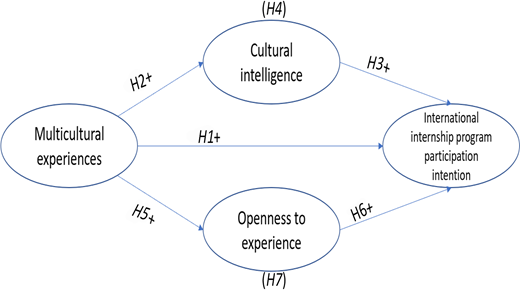
Thus, openness to experience is expected to mediate the relationship between MCE and international internship intention. Therefore, the following hypothesis was proposed and the research model was drawn as Figure 1 below:
Openness to experience mediates the relationship between multicultural experiences and students’ intentions to participate in international internship programmes.
Research method
Research design
This study used a quantitative, two-wave, time-separated survey design to examine the relationships among MCE, cultural intelligence, openness to experience and students’ intention to participate in international internship programs. Although all variables were measured through self-reported questionnaires, temporal separation was introduced between the predictor and criterion-related measures to reduce respondents’ ability to infer the full structure of the proposed model and to mitigate potential common method bias.
In the first wave, participants reported their MCE and cultural intelligence. Three weeks later, the same participants completed measures of openness to experience and international internship participation intention. The two-wave design does not establish causality, but it provides stronger temporal separation than a single-wave cross-sectional survey and reduces the likelihood that all observed associations are attributable to a single measurement occasion.
The proposed model was grounded in SCT and examined both direct and indirect relationships. MCE were conceptualised as an environmental antecedent, cultural intelligence and openness to experience as parallel personal mechanisms and international internship intention as the focal behavioural intention. Although the sociocultural context may influence how these mechanisms are expressed, SCT proposes that its core agentic processes operate across cultural settings (Bandura, 2002).
Participants and sampling
The target population of this study consisted of undergraduate students enrolled in universities in Vietnam. A convenience sampling approach was used because the study required voluntary participation across two survey waves and access to students through university-related communication channels. The online questionnaire was distributed through personal email invitations, university student groups and other university-related online communication channels.
Participants were informed that their involvement was voluntary and that their responses would remain confidential and de-identified. A matching code was used to link responses across the two waves without collecting personally identifying information. After the two data sets were matched, incomplete questionnaires and responses that could not be reliably linked across both waves were excluded. The final analytical sample consisted of 291 students who completed both survey waves. Sample adequacy was assessed according to the statistical requirements of PLS-SEM using the inverse square root method proposed by Kock and Hadaya (2018). At a significance level of 0.05 and statistical power of 0.80, the final sample of 291 respondents was sufficient to detect standardised path coefficients of approximately 0.146 or greater. Therefore, the sample was considered adequate for estimating the proposed structural relationships.
The use of convenience sampling should be considered when interpreting the generalisability of the findings. Nevertheless, the achieved sample provided an adequate basis for estimating the proposed PLS-SEM model, which included four latent constructs, multiple direct relationships and two parallel indirect pathways. The demographic details of the participants are presented in Table 2.
Measures
All constructs were measured using established scales adapted from prior studies. Minor wording adjustments were made to enhance clarity and contextual relevance for university students, while preserving the original conceptual meaning of each scale.
Multicultural experiences.
MCE were measured using ten items adapted from the scale developed by Nguyen et al. (2025). The scale captures both the frequency of exposure to multicultural contexts and the frequency of interaction with individuals from different cultural backgrounds. Respondents were asked to indicate how often they engaged in various multicultural activities using a five-point Likert scale ranging from 1 = Never to 5 = Always. Higher scores indicate greater levels of multicultural experience. A sample item is: “How often do you read books about foreigners?”
Cultural intelligence.
Cultural intelligence was measured using nine items adapted from Wei et al. (2022), based on the conceptual framework proposed by Earley and Ang (2003). Although shortened for survey feasibility, the adapted scale retained the four core dimensions of cultural intelligence
Metacognitive CQ (2 items), reflecting awareness and regulation of cultural knowledge. Cognitive CQ (3 items), capturing knowledge of cultural norms, values and practices. Motivational CQ (2 items), indicating interest and confidence in cross-cultural interactions. Behavioural CQ (2 items), reflecting the ability to adapt verbal and non-verbal behaviour in intercultural situations. An example item of the scale is: “I enjoy interacting with people from different cultures.” This approach ensured that the multidimensional nature of cultural intelligence was preserved while maintaining measurement efficiency.
Openness to experience.
Openness to experience was assessed using a 10-item scale adapted from Hee (2014). This scale captures individuals’ curiosity, imagination and receptiveness to novel ideas and experiences. Participants rated their agreement with each statement on a five-point Likert scale ranging from 1 = Strongly disagree to 5 = Strongly agree. A sample item is: “I am curious about many things.” Negatively worded items were reverse-coded prior to analysis so that higher scores reflect higher levels of openness to experience.
International internship program participation intention.
Students’ intention to participate in international internship programs was measured using four items adapted from Chen et al. (2022). The items assess respondents’ willingness and planned efforts to engage in international internship opportunities in the future. Higher scores indicate stronger intentions to participate in international internships. A sample item is: “I intend to apply for an international internship program if I have the opportunity.”
Procedure
Although the measurement scales were adapted from established studies, a pilot test was conducted to ensure clarity, reliability and contextual appropriateness. A sample of 30 university students with characteristics similar to those of the main sample was invited to complete the questionnaire. The pilot data were used to assess internal consistency using Cronbach’s alpha, as well as corrected item-total correlations.
The pilot results indicated satisfactory internal consistency, with all Cronbach’s alpha values exceeding the recommended threshold of 0.70. Participant feedback also suggested that the questionnaire items were clear and easy to understand; therefore, no substantial revisions were required prior to the main survey.
To reduce the potential risk of common method bias, the main survey was administered online in two waves separated by three weeks. In the first wave, participants completed the measures of MCE and cultural intelligence. Three weeks later, the same participants received the second online questionnaire, which measured openness to experience and international internship program participation intention. The survey links were distributed through personal emails, university student groups and other university-related online communication channels.
Before accessing the online questionnaire, participants were provided with information about the purpose of the study, the voluntary nature of participation, their right to withdraw and the confidentiality of their responses. Informed consent was obtained electronically. Participants generated a matching code that was used to link their responses across the two waves without collecting directly identifying information.
Data analysis
Data analysis was conducted using SPSS and SmartPLS. Preliminary analyses including descriptive statistics, assessment of missing data and Harman’s single-factor test were performed using SPSS to evaluate potential common method bias. The measurement and structural models were subsequently assessed using PLS-SEM in SmartPLS following established reporting recommendations (Hair et al., 2019).
Measurement model evaluation focused on indicator reliability, internal consistency reliability, convergent validity and discriminant validity. Structural model assessment included examination of path coefficients, explained variance (R2), effect sizes and mediation effects using bootstrapping procedures.
Findings
Common method bias and descriptive statistics
Given that the data for this study were collected from a single source using a self-reported questionnaire, potential common method variance (CMV) was examined prior to hypothesis testing. Following the procedural recommendations of Podsakoff et al. (2003), Harman’s single-factor test was conducted to assess whether a single latent factor accounted for the majority of the covariance among the measurement items.
The results of the test indicated that the largest unrotated factor explained 36.53% of the total variance, which is below the commonly accepted threshold of 50%. This finding suggests that no single factor dominated the variance structure of the data, thereby reducing concerns regarding common method bias. Although Harman’s single-factor test cannot fully rule out the presence of CMV, the results provide preliminary evidence that CMV is unlikely to pose a serious threat to the validity of the study’s findings.
In addition to CMV assessment, descriptive statistics were examined to provide an overview of the main constructs included in the study. Table 3 presents the means and standard deviations for MCE, cultural intelligence, openness to experience and international internship program participation intention. The mean values ranged from 2.959 to 3.015, while standard deviations ranged from 0.998 to 1.180, indicating adequate variability across constructs.
Overall, the descriptive statistics suggest that the data are suitable for subsequent PLS-SEM analysis, with no indications of extreme skewness or restricted variance that could compromise the robustness of the structural model estimation.
Measurement model evaluation
Prior to testing the structural relationships, the measurement model was evaluated to assess indicator reliability, internal consistency reliability, convergent validity and discriminant validity, following established guidelines for PLS-SEM (Hair et al., 2011).
Indicator reliability was examined by inspecting the outer loadings of each item on its corresponding construct. As shown in Table 4, most indicators exhibited loadings above the recommended threshold of 0.70, indicating satisfactory reliability.
Internal consistency reliability was assessed using Cronbach’s alpha, rho_A and composite reliability (CR). As reported in Table 4, Cronbach’s alpha values ranged from 0.854 to 0.941, exceeding the recommended minimum value of 0.70. Similarly, rho_A values ranged from 0.855 to 0.944 and CR values ranged from 0.901 to 0.950, all of which surpassed the threshold of 0.70. These results indicate adequate internal consistency for all constructs.
Convergent validity was evaluated using the average variance extracted (AVE). As shown in Table 4, the AVE values for all constructs exceeded the recommended threshold of 0.50, ranging from 0.577 to 0.695. This suggests that each construct explains more than half of the variance of its indicators, thereby demonstrating satisfactory convergent validity.
Discriminant validity was assessed using the Fornell–Larcker criterion and the heterotrait–monotrait ratio (HTMT), following Fornell and Larcker (1981) and Henseler et al. (2015). As shown in Table 5, the square root of the AVE for each construct was greater than its correlations with the other constructs, thereby satisfying the Fornell–Larcker criterion. In addition, as reported in Table 6, all HTMT values were below the conservative threshold of 0.90, providing further evidence that the constructs were empirically distinct from one another.
Structural model evaluation
Lateral collinearity assessment
Prior to evaluating the structural model, inner variance inflation factor (VIF) values were assessed to identify any potential multicollinearity among the predictor constructs. Following the guideline suggested by Hair et al. (2011), VIF values below 5.0 indicate that collinearity is unlikely to bias the path estimates. In the present study, inner VIF values ranged from 1.00 to 1.596, which are well within the acceptable threshold. These results indicate that lateral collinearity is not a concern and the structural relationships can be interpreted with confidence.
Direct hypothesis testing
Following the validation of the measurement model, the structural model was evaluated to test the proposed hypotheses. The assessment focused on path coefficients, explained variance (R2) and mediation effects, using a bootstrapping procedure with 1,000 resamples.
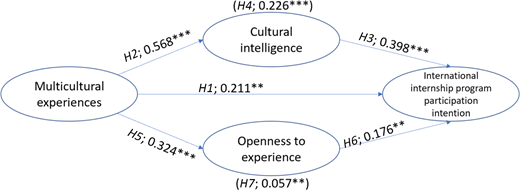
The standardised path coefficients and their corresponding significance levels are summarised in Table 7. MCE exhibited a positive and significant effect on students’ intention to participate in international internship programs (β = 0.211, p < 0.01), supporting H1.
MCE were also found to have a significant positive effect on cultural intelligence (β = 0.568, p < 0.001), providing support for H2. In turn, cultural intelligence positively influenced international internship intention (β = 0.398, p < 0.001), supporting H3.
Similarly, MCE were positively associated with openness to experience (β = 0.324, p < 0.001) and openness to experience exerted a significant positive effect on international internship intention (β = 0.176, p < 0.01), thus supporting H5 and H6, respectively.
Mediation analysis
To examine the mediating roles of cultural intelligence and openness to experience, indirect effects were tested using bootstrapping procedures.
The bootstrapping results supported both proposed indirect effects. MCE had a significant indirect effect on international internship intention through cultural intelligence (β = 0.226, p < 0.001), supporting H4. The indirect effect through openness to experience was also positive and significant (β = 0.057, p < 0.01), supporting H7.
Because the direct effect of MCE on international internship intention remained positive and significant after the two mediators were included in the model (β = 0.211, p < 0.01), the results indicate complementary partial mediation rather than full mediation. Thus, MCE appear to influence international internship intention through three concurrent routes: a direct route, an indirect capability-based route through cultural intelligence and an indirect dispositional route through openness to experience.
The estimated indirect effect through cultural intelligence was larger in magnitude than the indirect effect through openness to experience. This pattern suggests that the development of cross-cultural capability constitutes a more prominent transmission mechanism than dispositional receptiveness to novelty within the proposed model.
Explanatory power, effect sizes and predictive relevance
As presented in Table 8, the model explained 37.8% of the variance in international internship participation intention (R2 = 0.378), indicating that MCE, cultural intelligence and openness to experience jointly provided meaningful explanatory power. The f2 statistic assesses the incremental contribution of an exogenous construct to the explained variance of an endogenous construct by examining the change in R2 when the predictor is omitted from the model. Following Cohen’s (1988) guidelines, f2 values of 0.02, 0.15 and 0.35 indicate small, medium and large effects, respectively. Among the three predictors, cultural intelligence made the largest incremental contribution to explaining international internship intention (f2 = 0.173), corresponding to a medium effect. MCE (f2 = 0.045) and openness to experience (f2 = 0.044) each produced a small effect.
Predictive relevance was assessed using Q2. This statistic evaluates whether the model can reproduce the observed values of an endogenous construct better than a benchmark that relies only on the construct’s mean. A Q2 value greater than zero therefore indicates that the model has predictive relevance for the relevant endogenous construct. Table 9 shows that all Q2 values were positive, including cultural intelligence (Q2 = 0.200), openness to experience (Q2 = 0.067) and international internship participation intention (Q2 = 0.253). These results indicate predictive relevance for all three endogenous constructs, with the strongest predictive relevance observed for international internship participation intention. The structural model with standardised path coefficients is presented in Figure 2.
Discussion and conclusion
Discussion
This study examined how MCE shape university students’ intention to participate in international internship programs through cultural intelligence and openness to experience. Taken together, the findings reveal a dual-pathway process in which MCE influence international internship intention both directly and indirectly through two distinct personal mechanisms. Cultural intelligence represents a capability-based pathway that helps students function effectively in culturally unfamiliar environments, whereas openness to experience represents a dispositional pathway that increases receptiveness to novelty and uncertainty. This pattern is consistent with SCT, which proposes that environmental influences are translated into behavioural intentions through personal cognitive and motivational processes (Bandura, 1986, 2001).
The first overall finding is that MCE have a significant direct relationship with international internship intention. Exposure to culturally diverse people, ideas and practices may reduce the psychological distance associated with international placements and make such opportunities appear more familiar, attainable and valuable. This result is consistent with previous research showing that multicultural exposure can broaden cognitive frameworks, facilitate flexible thinking and encourage positive engagement with unfamiliar cultural contexts (Leung et al., 2008; Maddux and Galinsky, 2009). It also complements evidence that intercultural and international experiences can support students’ global career readiness and willingness to engage in international learning and work-related opportunities (Jackson, 2018; Pinto and Pereira, 2019).
The present finding nevertheless extends earlier research in an important way. Previous studies have mainly linked MCE to creativity, intercultural competence, cultural adaptation or general international orientation (Leung et al., 2008; Maddux and Galinsky, 2009; Ng et al., 2009). By focusing on international internship intention, this study demonstrates that multicultural exposure is also associated with a specific future-oriented professional decision. This distinction is important because international internships require students to manage both cultural unfamiliarity and workplace performance demands (Jackson, 2018; Pinto and Pereira, 2019). The persistence of the direct effect after both mediators were included further suggests that cultural intelligence and openness do not fully explain the relationship. Other processes, such as international self-efficacy, perceived employability, intercultural anxiety, perceived risk and favourable outcome expectations, may also contribute to students’ intention formation, as suggested by social cognitive approaches to educational and career decision-making (Lent et al., 1994; Lent and Brown, 2013).
The second and most prominent finding concerns cultural intelligence. MCE were strongly associated with cultural intelligence, which is consistent with the view that CQ develops through experiential learning and repeated exposure to culturally diverse situations (Ang et al., 2007; Ng et al., 2009). Similar relationships have been reported in educational contexts, where MCE were associated with higher cultural intelligence among teachers and other education-related samples (Wei et al., 2022; Nguyen et al., 2025). Repeated cross-cultural interaction may allow students to observe unfamiliar norms, revise cultural assumptions, regulate their motivation and practise culturally appropriate behaviour. The present findings therefore provide additional support for the conceptualisation of CQ as a learnable capability rather than a simple outcome of passive cultural exposure.
Cultural intelligence was also the strongest predictor of international internship intention among the antecedents included in the model. This result is aligned with prior evidence that CQ facilitates cultural judgment, adaptation, behavioural adjustment and effective performance in culturally diverse settings (Ang et al., 2007). It also supports Ng et al. (2009) argument that international experience produces more meaningful outcomes when individuals possess the capability to interpret and learn from culturally unfamiliar situations. The present study extends these findings from adaptation and performance outcomes to a pre-participation decision. Students with higher CQ may be more willing to pursue an international internship because they feel more capable of interpreting cultural cues, regulating their motivation and adjusting their behaviour in an unfamiliar workplace.
Cultural intelligence also carried the largest estimated indirect effect between MCE and international internship intention. This finding integrates two relationships that have often been examined separately: multicultural experience as an antecedent of CQ and CQ as a predictor of cross-cultural effectiveness (Ang et al., 2007; Ng et al., 2009; Wei et al., 2022). The results show that MCE become more behaviourally relevant when students transform exposure into adaptive intercultural capability. This mechanism is particularly important in international internships because students must meet professional expectations while adapting to unfamiliar organisational norms and interpersonal practices (Jackson, 2018; Pinto and Pereira, 2019). In such settings, interest in cultural novelty may be insufficient unless students also believe that they can manage the cultural demands of the experience.
The third major finding is that openness to experience also functions as a significant mediating mechanism. MCE were positively associated with openness and openness subsequently predicted international internship intention. This finding is broadly consistent with research showing that meaningful exposure to cultural difference can encourage cognitive flexibility, receptiveness to alternative perspectives and greater tolerance for unfamiliarity (Leung et al., 2008; Maddux and Galinsky, 2009). It also accords with the conceptualisation of openness as a disposition characterised by curiosity, imagination and willingness to engage with new ideas and experiences (McCrae and Costa, 1997). Students who are more open to experience may therefore interpret international internships as opportunities for exploration and development rather than as sources of uncertainty or threat.
However, openness is generally regarded as a relatively stable personality disposition (McCrae and Costa, 1997). The positive relationship between MCE and openness should therefore not be interpreted as definitive evidence that multicultural exposure fundamentally changes students’ personality. A more cautious interpretation is that MCE may activate or strengthen the expression of openness in relation to culturally unfamiliar opportunities. This interpretation is compatible with prior research showing that the effects of multicultural experience depend not only on exposure itself but also on how individuals process and respond to cultural difference (Leung et al., 2008; Maddux and Galinsky, 2009).
The smaller estimated contribution of openness relative to cultural intelligence highlights an important distinction between willingness and capability. Openness may encourage students to approach unfamiliar experiences, but it does not necessarily provide the culturally specific knowledge and behavioural skills required for effective adaptation. Cultural intelligence, by contrast, directly reflects the capability to understand and operate effectively across cultures (Earley and Ang, 2003; Ang et al., 2007). The two mechanisms are therefore complementary rather than interchangeable. Openness may make international opportunities more attractive, while cultural intelligence may make their demands appear more manageable. This dual-pathway interpretation extends previous research that has typically examined personality orientation and intercultural capability separately.
The simultaneous significance of the direct and indirect effects indicates complementary partial mediation. MCE appear to shape international internship intention through a direct familiarity-based route, a capability-based route through cultural intelligence and a dispositional route through openness to experience. This pattern provides a more differentiated application of SCT. Rather than treating personal factors as a single broad category, the findings show that environmental experiences may be translated into behavioural intention through personal mechanisms with different psychological functions (Bandura, 1986, 2001). Cultural intelligence concerns students’ capability to act effectively, whereas openness concerns their orientation to approach and value unfamiliar experiences.
The explanatory and predictive results provide additional support for the usefulness of the proposed model. The model explained 37.8% of the variance in international internship intention, indicating that MCE, cultural intelligence and openness jointly account for a meaningful proportion of students’ intention formation. Cultural intelligence produced the largest effect size, while MCE and openness made smaller independent contributions. These results are compatible with previous international internship research showing that participation decisions are influenced not only by the availability of opportunities but also by students’ perceptions, capabilities and expected benefits (Chen et al., 2022; Pinto and Pereira, 2019). In addition, the positive Q2 values indicate predictive relevance for all endogenous constructs, although these values should be interpreted as evidence of model-based predictive relevance rather than proof of actual internship participation.
Overall, the findings are broadly aligned with prior research demonstrating that multicultural exposure supports cognitive flexibility, intercultural learning, cultural intelligence, adaptation and engagement with unfamiliar environments (Ang et al., 2007; Leung et al., 2008; Maddux and Galinsky, 2009; Ng et al., 2009; Wei et al., 2022; Nguyen et al., 2025). At the same time, the present study extends this literature by integrating these relationships into a parallel mediation model focused on international internship intention. The findings therefore shift attention from the provision of international opportunities alone to the psychological processes through which students become prepared to pursue international professional experiences.
Conclusion
This study investigated the influence of MCE on students’ intention to participate in international internship programs, focusing on the mediating roles of cultural intelligence and openness to experience. Using a PLS-SEM approach, the findings reveal that MCE not only exert a direct effect on international internship intention but also influence intention indirectly through both cultural intelligence and openness to experience.
By empirically testing and providing support for a parallel mediation model grounded in SCT, the study contributes to the literature on international education and intercultural learning. The results suggest that fostering meaningful MCE is essential for enhancing students’ psychological readiness and motivation to engage in international internships, thereby supporting sustainable internationalisation efforts in higher education. In particular, the findings indicate that cultural intelligence showed the larger estimated indirect effect, although openness to experience also plays a meaningful complementary role.
The positive Q2 values indicate that the model has predictive relevance for the endogenous constructs, particularly international internship intention. However, these values should be interpreted as model-based predictive relevance rather than evidence of actual future participation or out-of-sample predictive performance.
Theoretical implications
This study makes several theoretical contributions to research on international education, MCE and students’ international engagement.
Firstly, the findings provide a more differentiated application of SCT to international internship intention. SCT proposes that environmental influences shape behaviour through personal cognitive and motivational processes. However, personal factors are often treated as a broad and relatively undifferentiated category. The present study distinguishes between two psychologically different personal mechanisms. Cultural intelligence represents a capability-based mechanism that enables students to understand and respond effectively to culturally diverse situations, whereas openness to experience represents a dispositional mechanism that increases receptiveness to novelty, ambiguity and unfamiliar experiences. By testing both mechanisms simultaneously, the study provides a more precise explanation of how environmental exposure is translated into behavioural intention.
Secondly, the study extends the multicultural experience literature by examining a specific future-oriented professional decision. Previous research has commonly linked MCE to outcomes such as creativity, intercultural competence, cognitive flexibility and adaptation (Leung et al., 2008; Maddux and Galinsky, 2009; Ng et al., 2009). The present findings show that MCE are also relevant to students’ intention to enter an unfamiliar international workplace. This extends the explanatory scope of multicultural experience research from general psychological and intercultural outcomes to a concrete form of international career-related engagement.
Thirdly, the study contributes to cultural intelligence research by positioning CQ as a transmission mechanism rather than only as a consequence of cross-cultural exposure or a predictor of adaptation. The significant indirect effect through CQ indicates that MCE become more influential when students convert exposure into culturally relevant knowledge, motivation, metacognitive awareness and behavioural adaptability. This finding is consistent with the view of cultural intelligence as a learnable capability that transforms experience into effective functioning in culturally diverse contexts (Ang et al., 2007; Ng et al., 2009).
Fourthly, the findings clarify the relationship between capability-based and dispositional explanations of international engagement. Cultural intelligence and openness to experience both mediated the relationship between MCE and international internship intention, but the estimated effect through cultural intelligence was larger. This pattern suggests that willingness to approach novelty and perceived capability to manage cultural demands are complementary rather than interchangeable. Openness may make unfamiliar opportunities more attractive, whereas cultural intelligence may make them appear more manageable. The study therefore advances a dual-pathway explanation of international internship intention in which motivational receptiveness and adaptive capability perform distinct functions.
Finally, the persistence of a significant direct effect of MCE after both mediators were included indicates that the two proposed mechanisms do not fully explain the relationship. This finding refines the proposed SCT model by suggesting that other personal processes, such as international self-efficacy, expected career benefits, perceived employability, intercultural anxiety or perceived risk, may also transmit the influence of MCE. The partial mediation pattern therefore provides a foundation for future research to develop a broader account of how students form intentions to participate in international internships.
Practical implications
The findings provide several practical implications for universities, international internship program designers and higher education policymakers.
Firstly, universities should not assume that exposure to cultural diversity automatically prepares students for international internships. Although MCE had a positive direct relationship with participation intention, cultural intelligence was the strongest direct predictor of international internship intention among the predictors included in the model. Universities should therefore combine multicultural exposure with structured activities that help students interpret and respond to intercultural situations. Appropriate initiatives may include intercultural simulations, culturally diverse team projects, case-based problem solving, guided reflection and training in culturally appropriate communication and conflict management.
Secondly, institutions should distinguish between activities that build willingness and those that build capability. Activities aimed at stimulating openness to experience may include short-term intercultural events, internationalised classroom content, interaction with international students, virtual exchanges and exposure to unfamiliar viewpoints. These activities can reduce students’ reluctance towards novelty and ambiguity. However, because openness showed a smaller effect than cultural intelligence, such exposure should be followed by capability-building activities that give students practical confidence in managing cultural and professional challenges.
Thirdly, universities could adopt a staged preparation model. At the initial stage, students may be offered low-risk MCE within their home institution, such as collaborative projects with international peers or culturally diverse community engagement. At the second stage, students could receive structured CQ training and participate in simulated international workplace scenarios. At the final stage, students could be offered mentoring, pre-departure preparation and targeted international internship opportunities. This staged approach may gradually convert multicultural exposure into both psychological readiness and concrete participation intention.
Fourthly, program designers should identify students who have limited multicultural exposure or low confidence in intercultural settings. Rather than viewing low intention as a lack of interest, institutions should assess whether students perceive international internships as culturally difficult, professionally risky or beyond their adaptive capabilities. Diagnostic surveys, advising sessions and readiness assessments may help identify students who require additional support. Interventions can then be tailored to students’ specific needs, including cultural orientation, language preparation, mentoring or confidence-building activities.
Fifthly, communication strategies should emphasise both the developmental value and the manageability of international internships. Promotional materials should not focus only on travel, novelty or employability benefits. They should also provide realistic information about cultural challenges, available institutional support, mentoring arrangements, accommodation, workplace expectations and coping resources. This may strengthen positive outcome expectations while reducing perceived uncertainty.
Finally, policymakers and higher education leaders should view international internship participation as a psychological preparation issue as well as an opportunity-provision issue. Expanding the number of overseas placements may have limited impact if students do not possess sufficient cultural capability or willingness to engage with unfamiliar environments. Funding and quality assurance frameworks should therefore support pre-departure training, intercultural competence development, mentoring and post-internship reflection, rather than focusing exclusively on the number of placements offered.
Limitations and suggestions for further study
Despite its contributions, this study has several limitations. Firstly, although the study used a two-wave, time-separated survey design, its observational nature and the absence of repeated measurement of all constructs limit causal inference. Future research could use longitudinal or experimental designs to examine changes in MCE, cultural intelligence, openness to experience and internship participation over time.
Secondly, the data relied on self-reported measures, which may be subject to social desirability and common method bias. Although procedural and statistical remedies were applied, future studies could incorporate multi-source or behavioural data to enhance robustness.
Thirdly, the study used convenience sampling, which may limit the representativeness of the sample and introduce selection bias. Students who chose to participate may have had greater interest in MCE, international education or overseas career opportunities than students who did not participate. Therefore, the findings should not be generalised to the broader population of university students without caution. Future research should use probability-based or stratified sampling across different universities, disciplines and regions to improve sample representativeness and assess the robustness of the proposed relationships.
Fourthly, the study was conducted within a single national context, which may limit the generalisability of the findings. Future research could replicate the model across different cultural and institutional settings to examine potential contextual variations.
Finally, future studies could explore additional mediating or moderating variables such as self-efficacy, perceived risk or institutional support to further enrich understanding of students’ international internship participation intentions.