This study aims to propose a structured didactic design for teaching majāz (figurative language) to non-native Arabic secondary learners by utilizing Chevallard’s Anthropological Theory of the Didactic. It specifically addresses the “didactic gap” between complex rhetorical tasks and the cognitive scaffolding provided in learning materials.
The study employs a qualitative, interpretive document analysis of a purposive corpus of Arabic textbooks designed for non-native secondary learners. Using a theory-driven praxeological framework (T, τ, θ, Θ). The analytical focus is placed on the didactic transposition of majāz concepts. To ensure validity and trustworthiness, the study utilizes theoretical and analyst triangulation.
The analysis uncovers a critical praxeological misalignment: highly demanding identification tasks (T) are presented without explicit cognitive techniques (τ), relying instead on abstract classical definitions (θ). To bridge this gap, this study proposes a reformed instructional design featuring a “Three-Step Semantic Decoding Algorithm” (detecting semantic anomalies, mapping conceptual domains, and reconstructing figurative meaning).
Practically, the findings offer an operational guide for curriculum developers and textbook authors to design scaffolded rhetorical tasks and visual aids. For educators, it provides concrete classroom activities (e.g., “The Semantic Detective”).
This study represents one of the few early attempts to systematically apply didactic praxeology to L2 Arabic rhetorical pedagogy (Balāghah), offering a novel approach to analyzing and reconstructing figurative language instruction.
Introduction
Arabic language instruction for non-speakers at the high school level requires an approach that is not only oriented towards communicative skills (Almelhes, 2024), but also on mastering the rhetorical aspects that shape the beauty of linguistic expression (Qpilat and Salam, 2023; Al-Rohili, 2024; AlQbailat, et al., 2025). However, although Arabic is a language with a long scholarly tradition, knowledge about the rhetorical and linguistic features of contemporary Arabic prose is still relatively limited (Moreh, 1968; Alharbi and Swales, 2011). One of the main elements of Arabic rhetoric is majāz (metaphor and figurative expression) (Abdul et al., 2016), which serves to sharpen linguistic sensitivity (Sardaraz and Naz, 2019), expand vocabulary (Wu and Graban, 2022), and enrich the appreciation of classical and contemporary Arabic texts (Khalfallah, 2024).
The language and style of the Qur’an and Arabic have attracted considerable work from Western scholars (Shah, 2013). However, two areas remain neglected: Arabic rhetoric and certain aspects of Qur’anic style (Haleem, 2020). Therefore, the role of non-speaker learning through rhetorical instruction is considered crucial. In the context of non-speaker learning, the presentation of majāz poses a unique challenge because it involves cognitive, cultural, and aesthetic dimensions that are not always easily understood without proper pedagogical instruction (El-Mouloudi, 1986; Sokip et al., 2023).
Arabic language textbooks used in secondary schools are often the primary medium for transferring knowledge of rhetoric, including majāz (Amien et al., 2023). However, the material presented tends to be normative, emphasizing definitions and textual examples without linking them to contextual communicative practices (Kataw, 2016). As a result, students are directed more towards memorizing concepts rather than in-depth understanding and application of majāz in real situations (Wegner et al., 2020). This indicates a gap between the rhetorical theory presented in textbooks and the instructional needs of non-native Arabic students, who demand more meaningful learning. In reality, Arabic argumentation is often described as relying on repetition and coordination, in contrast to Western argumentation, which emphasizes syllogism, proof, and dialectic (Al-Sharafi et al., 2025). Therefore, the role of rhetorical use is relied upon in this phenomenon.
Previous studies have focused more on linguistic analysis (Owens, 2013; Al-Qatawneh et al., 2021) or focused on the broader area of rhetoric through the study of the theoretical perspectives of classical Arabic scholars and writers (İnce, 2019; Atabik, 2021), research on the evaluation of textbook content in general (Ritonga et al., 2021), and research on rhetoric in magazines using concepts and terminology related to al-balāghah, or eloquence, which are alternately accurate, controversial, and innovative (Fontana, 2024). While research that highlights the instructional dimension of majāz through the framework of praxeology is relatively absent, similar research has been conducted (Syihabuddin et al., 2024) that uses praxeology as a tool for analyzing Arabic textbooks but focuses on nominal gender agreement rather than majāz. In his research findings, praxeology involves two main components: practical exercises (praxis) and theoretical explanations (Logos) (Syihabuddin et al., 2024). This approach ensures that students not only practice language tasks but also understand the underlying linguistic theory.
This is based on the fact that textbooks designed for non-native speakers often contain exercises that categorize words and explain grammatical rules, such as gender agreement, which are crucial for understanding Arabic syntax (Shamsuddin and Ahmad, 2019). Finally, the content sequence and complexity of textbooks can hinder learning if not structured appropriately (Motaghizadeh et al., 2025). For example, first-year secondary school textbooks require careful content organization to facilitate comprehension. Thus, this analysis is important to assess the extent to which textbooks are able to connect theoretical aspects of Arabic rhetoric with applicable learning practices for non-native speakers. This background emphasizes the urgency of instructional research on majāz through a review of praxeology in high school Arabic textbooks.
Research has shown significant differences in the use of linguistic features across secondary school levels (Ghani et al., 2021). For example, the use of complex sentences is higher in certain grades, which can impact comprehension for non-native speakers (Alduais, 2012). As a result, this research is expected to not only provide a critical evaluation of existing textbooks but also contribute to the development of a more contextual, communicative, and relevant balāghah instructional model that meets the needs of non-native students in the era of global education.
Several studies have evaluated Arabic textbooks from various dimensions, such as comprehension analysis (Wahba and Chaker, 2013), word frequency evaluation (Moser, 2021), quantitative approaches (Al-haddad, 2023), and more recently, through the lens of the CEFR framework (Arkan, 2026). Although prior research in Arabic rhetorical pedagogy has predominantly focused on descriptive evaluations of textbook content such as examining thematic distribution or linguistic accuracy, these studies often stop at identifying textbook deficiencies without offering systematic pedagogical solutions. This study addresses this critical gap by integrating Chevallard’s (2015) Anthropological Theory of the Didactic (ATD), specifically the praxeology framework, with the development of concrete instructional designs for teaching majāz (figurative language) to intermediate non-native learners. Consequently, this research moves beyond mere text-based evaluation. It systematically analyzes the “didactic transposition” of rhetorical concepts and translates these insights into a theoretically grounded, concrete instructional framework that can be directly applied in classroom settings and future textbook development.
Literature review
To establish a robust foundation for reforming the instructional design of majāz (figurative language) for non-native Arabic learners, this literature review synthesizes three interconnected scholarly domains. First, it critiques current pedagogical approaches and challenges in teaching Arabic rhetoric (Balāghah) to non-native speakers. Second, it evaluates existing literature on Arabic as a Foreign Language (AFL) textbook analysis, highlighting the limitations of purely descriptive and structuralist evaluative methods. Finally, it introduces Chevallard’s (2015) ATD and its praxeological framework comprising the practical block, or know-how (T = type of task, dan τ = technique), and blok logos (θ = technology/justification, dan Θ = theory) as both an analytical tool and a generative engine for instructional design. By synthesizing these domains, this section delineates a critical research gap: the lack of a theoretically grounded, praxeological model for the didactic transposition of metaphorical concepts in secondary AFL textbooks.
Pedagogical challenges of majāz (balāghah) for non-native learners
The bulk of contemporary literature remains disproportionately focused on the memorization of classical theoretical definitions (Balāghah) rather than on communicative and contextual competence. Scholarly consensus indicates that historically, the pedagogy of Balāghah (Arabic rhetoric) has been deeply rooted in a classical paradigm, prioritizing rigid taxonomic classifications and rote memorization of definitions (e.g., distinguishing between majāz ‘aqlī and majāz mursal) over cognitive and communicative comprehension (Sardaraz and Naz, 2019; Rashwan et al., 2025; Mellati et al., 2026). Critics argue that this structuralist approach fails to facilitate the cognitive transition from literal (haqīqī) to figurative (majāzī) comprehension for second-language learners, who frequently lack the socio-cultural and linguistic intuition of native speakers. Although several empirical studies have identified this pedagogical gap, they often stop at diagnosing learners’ difficulties, thereby leaving a critical void regarding how textbooks can systematically support the decoding process specifically in identifying semantic connections (ʿalāqah) and contextual clues (qarīnah).
Current landscape of Arabic textbook analysis: Limits of descriptive evaluations
Prior research has narrowly focused on textbook content (e.g., word frequency and thematic distribution) while neglecting how such knowledge is didactically organized (didactic transposition). Although Arabic textbook evaluation has gained considerable attention in recent decades, existing studies exhibit significant methodological and conceptual limitations. The dominant trend in AFL textbook analysis heavily relies on descriptive or evaluative criteria, such as examining textbook alignment with national curricula, lexical density, or cultural representation (Nasban, 1991; Oweini and El-Far, 2025). While valuable for administrative quality control, these evaluations remain superficial; they rarely examine the internal cognitive logic of instructional tasks or pedagogical progression. In other words, they analyze what content is present in the textbook but fail to investigate how that content is didactically transposed to facilitate learning. Consequently, there is a conspicuous dearth of studies employing a systematic epistemological framework to examine how complex rhetorical concepts are transformed from scholarly knowledge (savoir savant) into teachable knowledge (savoir enseigné) within AFL instructional materials.
Didactic praxeology (ATD) as an analytical and constructive framework
To bridge the gap between static textbook evaluation and dynamic instructional design, this study employs Yves Chevallard’s ATD, specifically the concept of didactic praxeology (Chevallard et al., 2015). ATD conceptualizes every human cognitive activity as a praxeology, which is modeled by a fourfold structure (, , , ). Within an educational context, this structure is bifurcated into two blocks: the practical block (praxis), comprising the type of tasks (T) and technique (τ) utilized to solve them; and the knowledge or theoretical block (logos), consisting of the technology (θ) that explains the technique and the theory (Θ) that justifies the technology.
Applying this framework to the study of majāz provides an unprecedented level of analytical rigor. Rather than merely noting whether majāz is included in a textbook, a praxeological analysis maps out whether the textbook provides a coherent practical-theoretical loop, that is, whether the task (T) of identifying metaphorical expressions is supported by explicit cognitive techniques (τ) and justified by accessible rhetorical technologies (θ). Consequently, ATD serves not only as an evaluative lens but also acts as a constructive mechanism for redesigning the didactic transposition, transforming complex classical Arabic rhetorical theory into a scaffolded, structured instructional pathway for non-native learners.
Within Chevallard’s ATD framework, a clear distinction is made between the technology (θ) and the theory (Θ). The technology (θ) serves as the immediate “discourse” or technical explanation that rationalizes and justifies the practical technique (τ). In teaching majāz, this corresponds to specific pedagogical rules, such as identifying the contextual clue (qarīnah) or the semantic connection (ʿalāqah). In contrast, the theory (Θ) represents the broader, overarching epistemological system that validates the technology itself. In this study, the theory (Θ) is rooted in the classic tenets of ʿIlm al-Bayān (the science of eloquence) and Cognitive Metaphor Theory, which philosophically explain how human cognition maps meaning across literal and figurative domains.
Synthesis and research gap
By synthesizing these three domains of literature, a distinct research gap emerges, as illustrated in the visual mapping below:
Prior Balāghah pedagogical studies: Identify learners’ difficulties with majāz but lack a systematic model for curricular reconstruction;
Prior Arabic textbook analyses: Evaluate content descriptively but fail to analyze the cognitive and didactic progression of instructional tasks; and
Prior ATD/praxeological studies: Widely applied in mathematics and science education, yet severely underutilized in foreign language acquisition, particularly in Arabic rhetoric.
This study directly addresses this three-dimensional gap. By integrating the linguistic-rhetorical precision of Balāghah with the structural rigor of Didactic Praxeology, this paper is the first to systematically analyze the didactic transposition of majāz in intermediate secondary Arabic as a second language textbook and propose a concrete, theoretically validated instructional design.
Glossary of key terms
Balāghah (Arabic rhetoric): The science of Arabic eloquence and rhetoric, which studies how to cohere and adapt speech according to the psychological state of the listener and the situational context;
Bayān (science of eloquence/clarity): A sub-branch of Balāghah that deals with expressing a single meaning in various ways with varying degrees of clarity, primarily focusing on simile (tashbīh), metaphor (majāz), and metonymy (kināyah);
Majāz (Figurative language/metaphorical tropes): The use of a word or phrase in a non-literal or secondary meaning due to a specific connection (ʿalāqah) between the literal and figurative sense, accompanied by a contextual clue (qarīnah) that prevents the literal meaning;
Haqīqī (literal meaning): The original, conventional linguistic meaning for which a word was originally coined;
Majāzī (figurative/metaphorical meaning): The derived or transferred meaning of a word when used in a figurative context; and
Qarīnah (contextual clue/indicator): The textual, situational, or logical clue that prevents the word from being understood in its literal (haqīqī) sense and directs the reader to the figurative (majāzī) interpretation.
Method
Design
This research is based on an interpretive paradigm (Gichuru, 2017) with the aim of deeply understanding how instructional figures of speech are constructed in high school Arabic textbooks for non-native Arabic students. This paradigm was chosen because it is appropriate for uncovering the meaning behind instructional practices, rather than simply measuring effectiveness quantitatively (Thanh and Thanh, 2015). The design of this study is an interpretive qualitative document analysis focusing on text-based curriculum materials. The primary objective is to evaluate and reconstruct the didactic transposition of majāz within the selected textbooks through the theoretical lens of Chevallard’s ATD.
The approach used was qualitative with a praxeological study research design (Brondani, 2023). This design was chosen to describe the relationship between the dimensions of theory, technique, instructional technology, and didactic objectives that shape the presentation of figurative language in textbooks. Praxeological analysis allows for an examination of how rhetorical knowledge (theory) is integrated with learning activities (practice) and directed toward pedagogical functions (didactic purposes).
Data source
The data source was a high school Arabic textbook widely used in Indonesian schools in the 2024/2025 academic year, published by the Indonesian Ministry of Religious Affairs: “Buku Ajar bahasa Arab (Balaghah) Madrasah Aliyah Peminatan Keagaman.” The sample books were selected using a purposive sampling technique, considering the criteria for official use in schools and containing material on majāz (figurative language). The analysis focuses on special chapters on rhetoric (Balāghah), which present material on majāz mursal.
Research procedure
Data analysis techniques refer to Chevallard’s (2015) praxeology framework, which includes four main components: (1) type of task, namely identifying the form of task given related to majāz; (2) techniques, namely how to complete the task; (3) technologies, namely explanations or justifications for the techniques used; and (4) theories, namely the underlying linguistic or rhetorical concepts. All data were analyzed thematically to reveal the coherence between theoretical aspects and instructional practices in the presentation of majāz. Data validity was maintained through source triangulation.
This review of research steps highlights the importance of using praxeology to evaluate and improve Arabic textbooks for high school students, especially non-native speakers. By combining practical exercises with theoretical knowledge and ensuring well-structured and relevant content, educators can enhance the learning experience and effectiveness of these teaching materials.
To ensure the trustworthiness, validity, and rigor of the qualitative findings, this study employs two forms of triangulation:
Theoretical triangulation: The analysis is validated by cross-referencing and bridging two distinct theoretical frameworks: classical Arabic rhetorical theory (specifically ʿIlm al-Bayān and its rules regarding qarīnah and ʿalāqah) and modern Western didactics (specifically Chevallard’s praxeological model). This dual-framework approach ensures that the interpretation of majāz tasks is both linguistically accurate and pedagogically precise.
Analyst triangulation: The qualitative coding and praxeological classification of the textbook content were conducted independently by multiple researchers (analysts). Discrepancies in the coding process, such as determining whether a technique () is explicitly present or implicitly assumed, were resolved through iterative peer discussions and consensus meetings until a high level of inter-rater agreement was achieved.”
Result and discussion
Empirical textual data and praxeological analysis
Model 1
Arabic text: “(يجعلون أصابعهم في آذانهمِ” (سورة البقرة: 1)
Transliteration: yajʿalūna aṣābiʿahum fī ādhānihim (Sūrah Albaqarah: 19)
Translation: They put their fingers into their ears (QS. AlBaqarah: 19)
Model 2
Arabi text: إِذَا سَقَطَ السَّمَاءُ بِأَرْضِ قَوْمٍ ۞ رَعَيْنَاهُ وَإِنْ كَانُوا غِضَابًا
Transliteration: idhā saqaṭati al-samāʾu bi-arḍi qawmin, raʾaynāhu wa-in kānū ghiḍāban
Translation: If the sky (rain) falls upon the land of a people, we graze our cattle therein, even if they are angry.
Components of praxeological analysis
Type of task (Task - ): Students are required to identify words containing majāzī (non-literal) meanings within the text and determine their specific type of istiʿārah (metaphor).
Technique (): Findings analysis: The analyzed textbook fails to provide a step-by-step cognitive algorithm to guide students in deciphering how “darkness” (aẓ-ẓulumāt) denotes misguidance and “light” (an-nūr) denotes guidance. Instead, students are directly presented with the final answer, bypassing the explicit cognitive technique or reasoning process.
Technology (θ): Findings analysis: The theoretical explanations in the textbook are confined to rigid definitions, such as "Istiʿārah Taṣrīḥiyyah is a metaphor where the borrowed-from term (musyabbah bih) is explicitly stated while the borrowed term (musyabbah) is omitted.” This explanation remains excessively abstract for non-native (L2) learners because it fails to operationally clarify the semantic connection (ʿalāqah) and the contextual clue (qarīnah).
Theory (): Findings analysis: The overarching theory is anchored in the classical epistemology of traditional ʿIlm al-Bayān treatises, which implicitly presupposes that learners already possess a well-developed native linguistic intuition (badīhah) in Arabic.
Analysis of praxis and logos
Integrating sustainability criteria, including social and intellectual-scientific development, can increase the relevance and effectiveness of textbooks (Esmaili and Rahmani, 2025). To begin this, researchers analyzed Arabic text fragments in Arabic language textbooks for high schools using a praxeology approach according to Yves Chevallard’s ATD (Bosch and Gascón, 2014). Praxeology consists of two main components: praxis (practice), which includes types of tasks and techniques (methods or procedures for completing tasks). Second, logos (knowledge), which includes technologies (explanations or justifications of techniques) and theories (more general theoretical frameworks) (Chevallard, 2007).
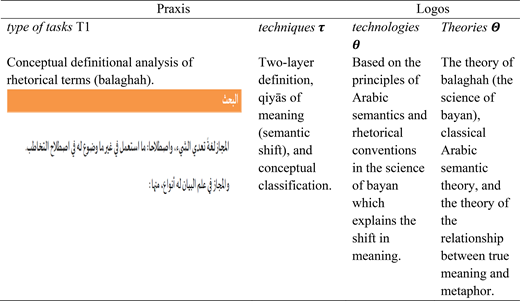
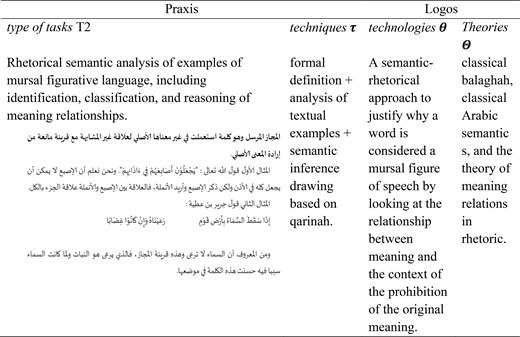
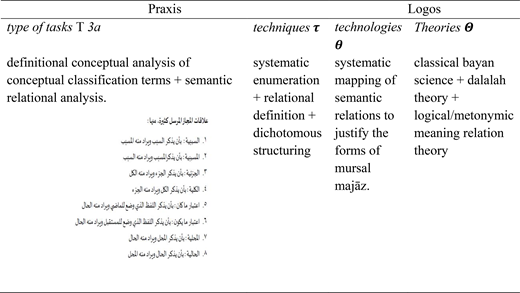
Analysis of praxis and logos for Majāz material is depicted in Figures 1–3 and Tables 1 and 2.
Task 1 in this text is to explain the meaning of majāz linguistically and terminologically (conceptually). The cognitive task is to identify and differentiate between the lughawi (language) meaning and the termi (scientific terminology). The semiotic task: to understand the use of the word “majāz” in the context of the science of balaghah (the science of bayan).
The technique used to complete this task is a two-layer definition: describing the meaning linguistically (ta‘rīf lughawī) and terminologically (ta‘rīf iṣṭilāḥī). First, the use of qiyās (meaningful interpretation) interprets “تعدي الشيء” (transcending something) as the basis of metaphorical meaning, namely the transition of meaning from the original to another meaning. Second, the classification of types in the next sentence, the authors open the structure of the further explanation with “وله أنواع منها” (the science of bayan), demonstrating the classification technique in the study of bayan science.
From a theoretical perspective, the explanation or justification for the above technique is based on the classical Arabic principle that every scientific term needs to be defined in a lughawi and terminological manner (Ali, 2013; Elmgrab, 2016). The semantic rule of majāz, namely the transfer of meaning from the original meaning to another meaning due to a relationship (Alasbli, 2020). The scientific convention in bayan science distinguishes majāz from essence through the context of use (isti‘māl fī ghayri mawḍū‘ihi) (Ab Rahman et al., 2013). The theory underlying all of these explanations is the classical balāghah theory (علم البيان) (Larcher, 2013), which examines how to convey meaning through shifts in language forms (essence and majāz).
Task 2 in this section is to define the concept of majāz mursal, namely the use of words not in their original meaning but because of the presence of ‘alāqah ghayr al-musyābahah (non-simile relationship) (Belqes and Saidi, 2019). Identify examples of majāz mursal from the Qur’an and classical Arabic poetry. Explain the linguistic logic why the examples are majāz mursal (through an analysis of the relationship between meaning and the presence of qarinah).
The techniques used to complete the above task include conceptual definitions by mentioning the main elements of majāz mursal: shifts in meaning, non-similarity relationships (ʿalāqah ghayr mushābahah) and the presence of qarinah. Examples are provided (tahlīl miṡālī); the first example (a verse of the Qur’an) is analyzed to demonstrate the relationship of parts to the whole (الإصبع–الأذن). The second example (verse) shows a causal relationship (السماء–المطر). The linguistic justification is given by mentioning “السماء لا تُرى” as a qarīnah (linguistic indication) that what is meant is not the literal sky, but rain.
Scientific explanations underlying the above technique include the concept of qarinah in balaghah, a linguistic marker that hinders the understanding of literal meaning (Rahman et al., 2019), and the theory of meaning relations (العلاقة بين المعنيين) (Abdelkarim and Alhaj, 2023). The tahlīl bayānī method analyzes text based on the function of meaning in communication, not solely grammatical. The theory underlying this entire practice is the theory of Ilmu al-Bayān (Balāghah), which regulates the transfer of meaning from essence to majāz based on certain relationships.
This section explains the types of semantic relationships (العلاقات) that form the basis for the formation of mursal figurative language. Thus, the focus is no longer on definitions or examples but rather on the classification system of semantic relationships between the original meaning and the figurative language.
The tasks in this section include identifying and classifying semantic relationships in mursal figurative language, analyzing the relational principles between literal meaning and figurative language, and interpreting logical-linguistic relationships such as cause-effect, part-whole, place-content, time, event, and so on. The techniques used in this section are enumeration, which is to mention one by one the types of mursal majāz relationships systematically from points 1–8, for example, a brief definitional explanation for each point accompanied by a relationship formula, for example, السببية: أن يُذكر السبب ويُراد منه المسبّب and الجزئية: أن يُذكر الجزء ويُراد منه الكل, which is a semi-formal technique typical of balaghah science, and logical symmetry, where almost every pair of relationships is written in opposites (for example, cause–effect, part–whole, and place–content). This demonstrates a semantic dichotomy-based teaching technique.
The knowledge that underpins this technique includes the concept of semantic relations (العلاقة بين المعنيين) in majāz theory, where every shift in meaning has an identifiable logical basis. The linguistic qarinah principle distinguishes whether the relationship is causal, partial, temporal, or locative. The scientific classification method (تصنيف العلاقات) is how balaghah scholars organize meaning relationships so they can be taught and tested in the context of rhetorical learning.
The underlying theory is the Balāghah theory (Ilmu al-Bayān), which explains the general principles of non-literal meaning shifts (Almjlad, 2025). Second, the Dalālah theory (Classical Arabic Semantics) (Birnstiel, 2019), which states that meaning relationships can occur through several logical relationships. And finally, the Cognitive Theory of Meaning Relations, although it has not been codified classically, in a modern context it can be linked to conceptual metaphor theory (Zibin et al., 2024) or metonymic relations (Al-Sharafi, 2004), where the mursal figure of speech functions as a metonymy.
Based on the praxeological analysis above, a profound didactic gap was identified between the complex tasks (T) and the techniques (τ) provided by current textbooks. To bridge this gap, our proposed pedagogical design reconstructs both the Practical Block (Praxis) and the Theoretical Block (Logos) through a scaffolded approach. We reformulate the task-solving technique (θ) not as an act of rote memorization, but as a systematic three-step cognitive procedure tailored for non-native learners:
identify the semantic anomaly (the verbal clue or qarīnah);
determine the semantic tension between the literal (haqīqī) and figurative (majāzī) domains; and
establish the underlying logical connection (ʿalāqah).
By transforming the implicit knowledge of classical Arabic rhetoric into explicit cognitive steps, the new instructional design directly addresses the textbook deficiencies identified in our empirical analysis.
Elaboration of understanding of figurative language in teaching materials.
It should be emphasized first that materials for non-native speakers often include structured, step-by-step instruction tailored to varying levels of proficiency. This approach emphasizes controlled activities and basic language skills, such as vocabulary and basic sentence structure (Altakhaineh and Zibin, 2017; Shaikha and Hamzeh, 2023; Al-Omari, 2016). In comparison, textbooks for native speakers may focus more on complex linguistic features and advanced language use, including a higher frequency of complex sentences and abstract words (Ghani et al., 2021).
Based on three previous praxeological studies (the definition of majāz with examples and the types of relationships between majāz and mursal), the researcher then elaborated. This elaboration serves as a pedagogical bridge: how the concept of majāz is not only understood theoretically but also transformed into applicable learning competencies in Arabic language learning, particularly the science of al-bayān (rhetoric).
The initial understanding that needs to be instilled in the teaching materials is that majāz is not merely a style of language (uslūb bayānī), but rather a mechanism of linguistic thinking that demonstrates how Arabic expresses meaning through shifts from original meaning (ma‘nā aṣlī) to new meanings (ma‘nā majāzī).
In a didactic context, understanding majāz (figurative language) can be explained through four main components of praxeology: types of tasks, techniques, technologies, and theories. In the practical realm, students are guided to analyze texts with tasks such as identifying words used in figurative language, distinguishing between literal and figurative meanings, and explaining the semantic reasons behind these shifts in meaning. This process is carried out through techniques such as defining the concept of majāz in both linguistic and iṣṭilāḥi terms, identifying qarīnah (literary expressions) that hinder literal understanding, and classifying meaning relationships based on their type, such as cause-effect, part-whole, place-content, or time-event.
The choice of these techniques is based on epistemic foundations (technologies) in the form of the principle of semantic relations in the science of al-bayān and the principle of dalālah (the principle of logical reasoning), which explains the logical relationship between literal and non-literal meanings. This approach requires students to analyze the linguistic context and communicative meaning of a text, not just interpret it grammatically. From a theoretical perspective, the study of majāz is rooted in the classical balāghah and dalālah theories developed in the Arabic rhetorical tradition but can also be enriched with modern semantic approaches such as metonymy and conceptual metaphor theories, which highlight the cognitive processes behind the shift in meaning.
Through this learning process, students are expected to understand majāz in three cognitive domains: declarative, procedural, and conceptual. At the declarative stage, they understand the definition and elements of majāz; at the procedural stage, they are able to identify and explain the types and their meaning relationships; while at the conceptual stage, they understand the reasons why shifts in meaning are used as a means of enhancing and deepening meaning in Arabic.
The didactic implications of this study emphasize that learning majāz should be conducted analytically and contextually through authentic texts, such as verses from the Quran, hadith, or classical poetry. A discovery-based approach (Janssen et al., 2014) can be used to enable students to discover for themselves the forms of majāz and the reasons for their use.
Through this elaboration, understanding figurative language in teaching materials becomes a holistic interpretive skill: the ability to interpret shifts in meaning based on semantic relationships and communicative context. This approach fosters not only linguistic sensitivity but also an appreciation for the beauty and depth of Arabic expression in religious texts and literary works.
Design of material for non-native high school students.
Based on the analysis of the praxeology study above, a material design scheme for non-native high school students can be formulated. This design positions the teacher as a facilitator, helping students move from literal understanding to an appreciation of figurative meaning. By combining communicative, contextual, and aesthetic approaches, this didactic design not only teaches majāz as a linguistic concept but also as a window into Arabic thought and feeling. The primary goal is for students to understand the concept of majāz not simply as a linguistic phenomenon but also as an expression of beauty and profound meaning in Arabic texts, particularly the Quran and classical Arabic literature.
Literary texts, such as those used in teaching majāz, are inherently complex and often not designed for educational purposes. Non-native speakers find these texts particularly difficult due to their use of abbreviations, metaphors, and omissions, which hinder overall comprehension and understanding (Qpilat and Salam, 2023). A curriculum tailored to the needs of non-native Arabic learners is needed. Current textbooks may not be able to address the unique challenges faced by these learners, such as integrating cultural components and accommodating diverse learners (Almelhes, 2024). Teachers often lack implicit and explicit knowledge of pragmatics, which is crucial in teaching praxeology. This gap in teacher training results in a lack of emphasis on pragmatics in the classroom, further complicating student learning (Tan and Farashaiyan, 2016).
The design of figurative language (majāz) teaching materials for non-Arabic-speaking high school students needs to be adaptive, contextual, and semiotically communicative so that students can understand figurative meaning without being burdened by complex rhetorical terms. The primary focus of learning is not on classical rhetorical theory but rather on the ability to recognize, interpret, and use figurative language (majāz) expressions in real-life contexts.
The design of the materials begins with an introduction to the concepts of literal meaning (haqīqī) and figurative meaning (majāzī) through simple examples relevant to students’ lives. Teachers can present sentence pairs such as those (see Table 1). This approach helps students understand that Arabic has layers of meaning that extend beyond lexical meaning.
The second stage is the exploration of figurative language forms in a communicative context, not based on theoretical classifications such as mursal or isti’arah. For example, students are shown light texts such as modern Arabic poetry, proverbs, or verses containing figurative meaning. The teacher guides them to discover shifts in meaning with provocative questions such as “Does Allah really have hands?” (QS. Al-Fath: 10) “What does the sentence ‘قلبه أبيض’ mean? Is his heart really white?” Questions like these open up discussion of symbolic, ethical, and aesthetic meanings in Arabic.
The third stage is contextual and cross-cultural interpretation. The teacher invites students to compare Arabic figurative language expressions with their Indonesian equivalents, such as Arabic: “نور العلم” (light of knowledge). Indonesian: “light of life.” This activity helps students understand the function of figurative language as a universal means of expression and enhances their intercultural competence.
The next stage focuses on creative production. Students are asked to write sentences or short texts containing elements of figurative language based on a specific theme (e.g., friendship, nature, or honesty). This activity can be developed into mini-projects such as creating posters of figurative language, simple Arabic poetry, or vlogs with their own figurative language narratives.
In this design, the teacher’s role is that of a facilitator of meaning, not a definer. The teacher helps students connect the meaning of language to their emotional and social experiences. Evaluation is conducted authentically, for example, through portfolios, reflective journals, or performative assessments, not just multiple-choice tests.
Didactically, this design is based on three main principles: first, constructivism of meaning: students construct their understanding of figurative language through personal experience and interpretation. Second, cultural contextualization: figurative language is presented in discourse relevant to Arabic cultural values and students’ lives. Understanding the cultural context of metaphor is crucial, as it helps students grasp the deeper meaning and use of figurative language in Arabic (Jaradat and Al-Khawaldeh, 2015). Third, linguistic aesthetics: figurative language is understood as a bridge between logic and feeling, between words and meaning.
In general, the authors delineate the findings regarding the current state of textbooks through the lens of the ATD praxeological components in the following Table 2.
The findings of this study demonstrate that current Arabic textbooks continue to suffer from a profound “didactic gap,” wherein complex tasks (T) are presented without adequate cognitive techniques. Consequently, curriculum developers and next-generation textbook authors must undertake a structural overhaul based on the following recommendations:
Provision of explicit cognitive algorithms: Textbooks must move away from merely presenting abstract definitions (logos block) and immediately jumping to exercises without step-by-step guidance. The authors should integrate dedicated sections, such as “Thinking Steps” or “Semantic Decoding Guides,” to visually and gradually guide non-native students through separating literal (haqīqī) and figurative (majāzī) meanings (see Table 3).
Gradual didactic transposition: The introduction of majāz concepts must follow a pedagogical trajectory progressing from the most concrete to the most abstract. The structural presentation of instructional materials should shift from rigid, classical taxonomic classifications (e.g., immediately distinguishing dozens of majāz mursal sub-types) toward a functional introduction rooted in conceptual metaphors that resonate with students’ everyday experiences.
Optimization of visual scaffolding: Textbooks should utilize conceptual mapping or flowcharts illustrating meaning transfer from the source domain to the target domain. Furthermore, typographical cues such as bolding or distinct color-coding should be applied to words acting as contextual clues (qarīnah), thereby minimizing the cognitive load of foreign language learners.
Conclusion
In conclusion, this study has successfully demonstrated that while current Arabic textbooks often present majāz as a rigid, declarative taxonomy, its teaching can be systematically reconstructed into an actionable cognitive process. By analyzing the textbook corpus through the lens of didactic praxeology, we identified key “didactic gaps” where complex tasks lacked explicit techniques. Rather than viewing these limitations as insurmountable barriers, this research has provided a robust empirical foundation to bridge these gaps. Through the proposed three-step semantic decoding algorithm and structured visual scaffolding, majāz instruction can be transformed from passive memorization into active linguistic competence for non-native secondary learners.
Author contributions
HM and AS wrote this paper; TT prepared the table. AA and ZG reviewed the table. All the authors reviewed the paper.
Data availability
The data analyzed in this study consist of publicly available Arabic textbooks. All relevant textual excerpts, transliterations, and analytical praxeological matrices are fully presented and documented within the manuscript. No human subjects were involved, and no external datasets were generated.
Disclosure
AS received funding from Kementerian Riset, Teknologi dan Pendidikan Tinggi.