


The political consequences of economic globalization has lately been fiercely debated across Europe and the United States, including the role of labor immigration. In this paper we study the party choices of voters facing labor market competition from immigration. To identify the effect of labor market competition we introduce the national skill cell approach, which is designed to isolate a direct partial effect of immigrant competition. By access to detailed, population-wide, administrative data, we get precise measures of Norwegian voters’ exposure to competition, and we relate this measure to voting behavior in five national elections. We find a polarizing effect of immigration among voters experiencing negative wage effects of immigration. The polarization points to the existence of a protectionist and a compensatory response, and we propose that predetermined ideological convictions determine the response.
Many advanced industrialized economies have over the last years experienced an increase in political polarization and in support for parties at the left and the right wing of the political landscape.1 In the popular press, the rise of Donald Trump, Bernie Sanders, and Jeremy Corbyn, as well as Brexit, has frequently been interpreted as signs of political polarization. The role of globalization, in particular trade and immigration, have gained center stage in the discussions of why this development takes place (Autor et al., 2016; Halla et al., Forthcoming). In this paper, we study the role of immigration, in particular its labor market consequences. Does immigration affect natives’ voting behavior by changing the level of labor market competition faced by individual workers? And, if so, in which direction do party preferences move as a result of such influence?
Immigration into and within Europe has increased rapidly over the last 25 years. Norway is no exception. Over the period we analyze (1993-2009), the immigrant share of the population increased from 5% to 10% and by 2016 it has reached 16%. The share of immigrants from low-income countries in Asia and Africa and from the new EU member countries has increased. A similar development has taken place in many West-European countries. This influx of immigrants, mostly in their prime age, has increased labor supply and labor market competition. However, the increase in labor supply has not been evenly distributed across labor markets in the receiving countries. At the same time, a heterogenous set of anti-immigration parties on the right has increased their vote shares or consolidated their positions in national parliaments. On the left, immigration has led to concerns about social dumping, social protection, and calls for better regulation of the labor market.
In this paper, we study the importance of immigration-induced pressure on natives’ wages and employment conditions for party vote shares. The key empirical challenge is to identify the degree of labor market competition experienced by voters. The previous empirical literature may be classified according to how they define the relevant labor market when identifying who competes with immigrants. One popular approach is to deduce the competition effect from the spatial correlation between the proportion of immigrants and vote shares (e.g., Halla et al., Forthcoming; Harmon, 2014; S0rensen, 2015). Other studies observe labor market penetration of immigrants along occupational and/or sectorial divisions within the same country (Burgoon et al., 2012; Dancygier and Donnelly, 2013). These approaches suffer from similar selection problems. Within the national labor market, immigrants select themselves into the thriving parts and natives may react to the influx of immigrants by moving out of more affected areas, occupations, or industries (Friedberg, 2001; Peri and Sparber, 2009). Due to such endogenous mobility, wage and employment effects of immigration are difficult to identify in labor markets which are defined according to such lines. The main cause of this problem is that borders between areas, occupations, and industries are relatively easy to cross within the same country. Another part of the literature identifies the degree of competition by coarse, indirect, measures of exposure to immigrant workers in the national labor market, typically binary indicators of whether the worker has a high or a low level of education (e.g., Hainmueller and Hiscox, 2007; Mayda, 2006; Scheve and Slaughter, 2001). A main criticism against these studies is that the measure of immigrant competition is based on a division of the national labor markets which is too rough to capture any significant change in the labor supply.
We propose instead to divide the national labor market according to the “national skill cell approach” introduced in Borjas (2003). In this approach, workers are classified into different skill cells in the national labor market defined by combinations of their educational level and the length of labor market experience. These skill cells are more fine-tuned than measures based purely on levels of education, a fine-tuning which we illustrate below is important in order to capture who is competing with immigrants in the labor market. One main argument, to promote this national approach over the spatial/occupational/sectorial approach, is that the national borders and the “borders” between these skill cells are more difficult to cross than the “borders” of spatial/occupational/industrial labor markets.
We apply the skill cell approach on high quality population-wide administrative data from Norway, and find negative effects of immigration on natives’ wages (see also Bratsberg et al., 2014). One intuitive expectation is that the anti-immigration party in Norway, FrP (The Progress Party), will become more attractive as voters more exposed to competition will demand restriction on immigration, a response we label as the protectionist response. We further highlight a potential leftist, compensatory response where demand for income redistribution and regulation of the labor market increases. This compensatory response has been largely ignored by the previous literature (but see Burgoon et al., 2012; Finseraas, 2008). Finally, we outline how the two responses can operate simultaneously and thereby make voter polarization a plausible political consequence of immigration.
We would like to stress that our emphasis on the relationship between changes in competition and voting behavior does not imply that we disregard that noneconomic/cultural factors may affect the relationship between immigration and political preferences. That economic considerations play a part by no means excludes cultural factors from playing its own independent role. However, we try to isolate the effect of immigration induced changes in competition on voting behavior. By exploiting the variation in immigrant share within skill cells, defined by education and experience, we control for the impact of cultural factors along age and education groups.
Our analysis of the vote shares provides evidence for the protectionist response (see also Halla et al., Forthcoming; Harmon, 2014; S∅rensen, 2015).2 A standard deviation increase in the share of immigrants within the skill cell is associated with a two percentage points increase in FrP’s vote share, and decreasing vote shares for FrP’s main competitors on the left (Ap, Labor) as well as on the right (H, the Conservative Party). But, consistent with the compensatory response, we also find a positive relationship between immigration and the vote share of SV (the Socialist Left Party). SV is the leftmost party on immigration, economic redistribution, and labor market regulation in the Norwegian parliament. Thus, we find clear signs of a polarizing effect of immigration. These findings contradict Hainmueller and Hopkins’ (2014) conclusion that labor market competition is irrelevant for voter behavior.
In a final analysis, we use individual level panel data and find suggestive evidence that ideological predispositions prior to the immigration shock are important for how individuals respond to competition.3 Those reporting opposition to liberal immigration policies in a previous survey are particularly likely to vote FrP when competing with immigrants, while those holding leftist predispositions on both immigration and redistribution are more likely to vote for SV when competition is high. Thus, voters’ choice between the two political options they have — protection or compensation — is determined by their ideological predispositions. In the conclusion, we elaborate on the theoretical and empirical implications of this result.
Labor Market Competition with Immigrants, Wages, and Voting
We begin by discussing the labor market effects of immigration. We discuss this literature first because it validates the skill cell approach that we use, and because the labor market consequences of immigration determine our theoretical expectations.
In the standard neoclassical labor market model there are roughly two kinds of relationships between categories of labor (skill): substitutes or complements. Those who can replace each other relatively easily in the production process are substitutes and competitors in the labor market. If a certain amount of two types of labor are necessary for each to work well, they are complementary and partners in the labor market. Given the other factors of production, the marginal product of all categories of labor is decreasing in the amount used. The marginal product of each type of labor increases when complementary factors are used more intensively in the production process. In a competitive market, wages are determined by the marginal product of labor. For the labor market to absorb a rise in supply caused by higher immigration, the wage must decrease for workers who hold relatively similar, and thus competing, types of labor. The effect is the opposite for workers with skills that are different from the types of labor which becomes more abundant. Thus, to measure the increase in competition experienced by native workers with the same skill, it is crucial to allocate the immigrants to labor market clusters where they represent close substitutes. If immigrants are assumed to compete in very broad groups of natives, such as all low skilled natives, one is unlikely to capture the effects of immigration, because the positive effects on the labor market situation of workers who are complements to the immigrants may neutralize the negative effects for the workers who are substitutes.
The Norwegian labor market with centralized and coordinated wage setting differs from this model which assumes flexible wage formation. However, the model still identifies some basic mechanisms with regard to how immigration affects competition and the direction of the underlying wage pressure in different skill groups. In the case of inflexible wage levels, immigration may increase the unemployment risk of native workers with similar skills as immigrants. Native workers in both permanent and temporary positions may experience that outside options deteriorate. This may reduce the power of employees in bargaining and, thus, their relative wage level in the longer term.
The early empirical literature on wage and employment effects of immigration was dominated by what is often referred to as the area (or spatial) approach. This approach explores geographical variation in immigration within the country to estimate effects on labor market outcomes (Altonji and Card, 1991). The wage effects of immigration in this literature are small and often insignificant (see Okkerse, 2008, for a review). As mentioned in the introduction, one major concern in area studies is the endogenous sorting of immigrants and natives according to the characteristics of the local labor market. When workers in both groups move in the direction of better employment conditions, wage effects of immigration which are identified by such geographical variation may be upward biased, and labor markets in all regions of the country are affected.4
The skill cell approach was developed as a response to these drawbacks of the area approach. The main idea is to define relatively closed skill cells across the national labor market in which natives and immigrants are close substitutes. Borjas (2003), inspired by the seminal works of Becker (1975) and Mincer (1974), suggests that workers who are educated at the same level of education, but with different lengths of experience represent diverse types of labor. That is, they are not perfect substitutes and, thus, they cannot replace each other without costs. He, accordingly, allocates individuals to 32 groups defined by their combination of educational attainment and length of potential work experience. Since education needs investment of time and money, and potential experience is defined by age, these 32 skill cells may be characterized as fairly closed in the short run. Borjas (2003) next argues that the wage effect of immigration may be empirically identified by the correlation between the immigrant shares and the mean wage of natives within skill cells, over time. To control for other factors that affect wages over time, he includes year, education, and experience fixed effects, as well as the interaction terms of these variables. We describe the empirical approach in detail below.
One important question is whether immigrants within these cells represent the same type of labor as natives do and, thus, compete for the same jobs. A set of papers analyzing US data conclude that there is a high level of substitution between natives and immigrants within these groups (Aydemir and Borjas, 2007; Borjas, 2003; Borjas et al., 2010; Jaeger, 1996), while others find indications of more imperfect substitution (Manacorda et al., 2012; Ottaviano and Peri, 2008, 2012). Analyzing Norwegian data, Bratsberg et al. (2014, p. 379ff) find a high degree of substitutability between natives and immigrants within these skill cells in the Norwegian labor market.
Ottaviano and Peri (2008) point out that the skill cell approach identifies the short-term direct partial wage effect of immigration. This is the wage impact from immigration of competing workers, given all other types of labor supply and physical capital. In the Online Appendix, we give a formal presentation of this wage effect and how it is deduced from a simple version of the structural economic model that motivates Borjas’ (2003) empirical approach. The direct partial effect is not an expression of the wage effect from total immigration to the country or the aggregated effect of immigration of competing workers. These comprehensive effects cannot be uncovered using the national skill cell approach. Even though the direct partial effect only picks up one part of the wage effect experienced by individuals, it is clearly relevant in our context, since it identifies a variation in immigration induced labor market competition that may be linked to voting behavior.
Negative effects on wages (and perhaps employment prospects) imply that competition with immigrants might have effects also on party choice. Immigration and public transfer policies are important dimensions of Norwegian electoral politics in the period we study, making it plausible that labor market competition with immigrants will have electoral consequences. Most intuitively, we should expect demand for liberal immigration policies to be affected. Unless workers were fully aware of the effects of immigration before they immigrate, we should expect support for immigration of similar skill-type workers to change in a more restrictive direction when the detrimental effects manifest. We can think of this as a protectionist (insider) response: Voters respond to the negative effects of immigration by demanding restrictions on entry of competitors. The main anti-immigration party in Norway is the Progress Party (FrP), thus we expect FrP to benefit from the protectionist response.5
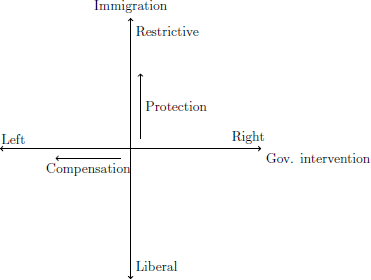
The competition effects might also influence support for public transfers and labor market regulations, in what we might label a compensatory or regulatory response. Standard political economy models predict that support for income redistribution will increase if wages fall and risk of unemployment increases (see Meltzer and Richard, 1981, and Cusack et al., 2006 for empirical evidence). Support for social insurance programs might also change, but here the effect is less straightforward. For a given risk of unemployment, a drop in wage income will lead to lower support for social insurance because workers become more concerned with current consumption and less willing to pay taxes to insure their income (Barth et al., 2015; Markussen, 2008; Moene and Wallerstein, 2001). However, an increase in the risk of unemployment will increase support for social insurance to smooth consumption between periods with and without employment (Iversen and Soskice, 2001; Moene and Wallerstein, 2001; Rehm, 2011). Thus, if wages drop and risk increases simultaneously, the net effect of immigration on support for social insurance transfers is ambiguous.6 Stricter regulations of labor contracts, workplace safety arrangements, and tougher controls of employers are other compensatory responses to competition that are likely to increase in demand. The most leftwing party in the Norwegian parliament, the Socialist Left Party (SV), is likely to be the main beneficiary from the compensatory response. Figure 1 illustrates the two responses.
Since there are two possible responses to the shock, uniform effects across voters on the two dimensions might be unrealistic. Instead, one might envision that different groups of voters choose different responses. One might think of voter positions on immigration and government intervention as being determined by two components: a deep, time-invariant or slowly changing normative belief about the benefits of immigration/intervention7; and a time-varying component, reflecting the current cost/benefits of immigration/intervention (the “price” of immigration/intervention). Immigrant share in the skill cell influences the time-varying component, that is, it changes the price of immigration/intervention for voters exposed to competition.
We propose that whether a voter demand protection or compensation depends on his deep-held normative convictions; normative views decide which policy dimension is being “triggered” by the economic shock. The reasoning is in line with Petersen et al. (2010) who find that on issues where parties propose clear alternatives–as Norwegian parties do on immigration and redistribution-the parties “signal to citizens what political values are at stake, and hence enable citizens to take the side most consistent with their deeper values” (Petersen et al., 2010, p. 531. See also Dinesen et al., Forthcoming; Johnston et al., Forthcoming). Moreover, recent research on political responses to job loss during the Great Recession finds that the response to the shock depends on ideological predispositions (Margalit, 2013). A similar mechanism can be in play for immigrant supply shocks, making a polarized response within skill cells a plausible expectation.
Empirical Strategy
We follow Borjas (2003) and classify individuals into four education groups, which correspond to less than high school, high school graduate but no college diploma, short college/university, and long college/university education. Potential labor market experience is measured as years since leaving school, with school-leaving age computed as six plus statutory years of the individual attainment (so-called “Mincer experience”). Then individuals with 1-40 years of potential experience are allocated into eight 5-year experience intervals. The combination of the 4 education groups and 8 experience groups constitutes the 32 different skill cells. These skill cells are the units of analysis in the main part of the paper.
Our independent variable is the proportion of immigrants in each skill group. The construction of this variable is made possible by access to information from several administrative registers that cover all residents of Norway during the period 1992–2010.8 Even though we have top quality data, there are potentially important sources of measurement error. First, data on immigrants’ educational attainment typically stems from Norwegian educational institutions, supplemented with decennial surveys of the immigrant population. Therefore, educational attainment is often missing for newly arrived immigrants. For immigrants with missing education records, we follow previous research (Bratsberg et al., 2014) and assume that their schooling distribution is similar to that of immigrants with the same gender, age, and origin (see the Online Appendix for additional information). Second, a sizeable portion of the immigrant workers have been hired by foreign contractors, especially after the expansion of the European Union in 2004. They work in Norway, but are employed by foreign firms and contractors (D∅lvik and Eldring, 2008), implying that their labor supply is not registered in our data. Moreover, immigrants may work “off the books,” which is a source of measurement error that may have increased over the period of analyses.9 These sources of measurement error will probably lead to an understatement of the actual immigrant share in the Norwegian labor market.
There is no administrative data of election results broken down by skill cells. Thus, we have to rely on survey data to get estimates of vote shares in the different skill cells. This is challenging because a typical survey data set contains relatively few observations from each skill cell, in particular for the most unusual skill cells (like the combination of few years of labor market experience and no education beyond compulsory schooling). The implication is that we need to combine data from a large amount of surveys to be sure that we get a reasonable estimate of the distribution of votes for each election for all skill cells. In order to achieve this we combine information from more than 70 surveys which contain the necessary information to identify each voter’s skill cell as well as a question on what party s/he voted for in the previous national election.10,11
Next we pool the survey data sets and derive the vote shares for each skill cell in the five elections over the 1993–2009 period. In the main specification we weight the skill cells by the number of observations behind the aggregated vote shares to account for varying degrees of uncertainty in the estimate of the vote shares (Borjas, 2003).12 The number of observations behind each skill cell aggregate ranges from 54 to 1934, the mean/median is 654/515 observations.13
In our main analysis, we study the aggregate vote shares in each skill cell in the five national (Storting) elections (1993, 1997, 2001, 2005, 2009) for which we have data on the proportion immigrants in each skill cell. Let y be the vote share of the particular party for voters with education i, experience j, at election t. Following Borjas (2003) we estimate WLS/OLS regressions14 of the following form:
where Iijt refers to the share of immigrants, αi to fixed effects (FE) for levels of education, γj to FE for levels of experience, and μt to FE for election years.15 As in Borjas (2003) we also add interactions between the fixed effects. The inclusion of these fixed effects implies that we identify the effect of immigration from changes within skill cells which are independent of education and experience specific trends. This is a powerful design, in particular because we have a rigid control for time trends through the inclusion of year fixed effects and the interactions between the fixed effects. These controls account for general shifts, in for example, the relationship between education and party choice.16 Moreover, the controls account for education and experience (age) specific trends in noneconomic/cultural factors. Standard errors are clustered at the skill cell level, since the variation we base our identification on varies across skill cells.17
As mentioned, we weight the skill cells by the number of observations behind the aggregated vote share. The purpose of the weighting is to improve precision of the estimates, but it will be a red flag with regard to bias from omitted variables if estimates vary substantively depending on whether weights are applied (Solon et al., 2013). We therefore report results where we do not use weights.
We aggregate the data to the skill cell level because our key independent variable varies at this level. In such instances, aggregation ensures accurate variance estimates (Green and Vavreck, 2008). All conclusions below remain, however, if we instead estimate Equation (1) on the individual level, including if we control for truly exogenous variables such as gender and age (see below and the Online Appendix).
The β coefficient will be unbiased as long as the error term in Equation (1) is orthogonal to Iijt (conditional on the fixed effects). The identifying assumption is that there are no skill-group specific residual change in voting behavior that is correlated with the immigrant share. One threat to this assumption is the existence of external factors affecting both voting behavior and inflow of immigrants within skill cells. For example, we know that business cycles affect migrant flows; immigration increases when labor demand is high, and decreases when labor demand is low. If vote shares are also systematically affected by business cycles, our estimates of the immigration effect on voting behavior will be biased. In a robustness check we construct an instrument for observed immigrant share based on a push-model of immigration to directly tackle the possibility that thriving skill cells attract more immigrants. We describe the construction of this instrument below.
In standard spatial models of voting, a voter’s utility of supporting a party depends on the distance between the party’s position and one’s own position on particular policy issues. Parties put forward the same platform for all skill cells, so the inclusion of year fixed effects in Equation (1) implies that we estimate the effect of immigrant share net of changes in party positions. Positive (negative) immigrant share estimates based on Equation (1) imply that the platform of the party has become relatively well-aligned (less well-aligned) with voter positions in skill cells with increasing immigrant shares.
Empirical Results
We begin the empirical analysis by re-examining the relationship between immigration and wages, since the analysis in Bratsberg et al. (2014) does not cover all the election years in our analysis. The wage analysis is important since the wage effect is the key mechanism behind the expected effects on the vote shares. To study the impact of immigration on wages we use the empirical set-up as described in Equation (1), with the outcome variable being the log of annual earnings, covering the years 1993–2009. By studying annual earnings we capture the combined effect on hourly wage, work hours per week, and days worked. Remember, the unit of analysis is the 32 skill cells, which are followed over 17 years.
The results for earnings are presented in Table 1. Each row represents the results from separate empirical models. We restrict the presentation to the immigrant share coefficient βIijt, but all models include the full set of fixed effects as specified in Equation (1). We find a negative and significant relationship between the immigrant share and log of annual labor earnings. According to the estimates in row 1, a one percentage point increase in immigrant share is associated with a 0.7% reduction in annual earnings. The overall mean immigrant share is 10%. This implies that — measured from the mean — a 10 per cent change in the immigrant share leads to a 0.7% reduction in annual earnings. We consider this to be a moderate effect. The negative wage effects are in line with Bratsberg et al. (2014), but their estimates are somewhat more negative.18 Rows 2 and 3 show, respectively, that the estimate is similar without weights or if we measure the supply shock as the proportion of the work force. Rows 6-9 show that immigration is associated with slightly lower employment rates and higher up-takes of welfare benefits among natives, but a small and insignificant association with unemployment rates.19 These results suggest that some of those facing competition worked fewer hours, and some entered active labor market programs or health-related insurance programs.
Regression results for labor market outcomes. N=544.
| βIijt | |
| 1.Earnings | −0.70 (0.17) |
| 2.Earnings: unweighted regression | −0.66 (0.16) |
| 3.Earnings: work force | −0.74 (0.18) |
| 4.Earnings: new EU immigrants | −1.47 (0.66) |
| 5.Earnings: nonwestern immigrants | −0.75 (0.16) |
| 6.Unemployment | 0.03 (0.05) |
| 7.Employment | −0.53 (0.14) |
| 8.Full-time employment | −0.57 (0.12) |
| 9.Welfare benefits | 0.48 (0.12) |
Note: Robust standard errors adjusted for clustering on skillcell in parentheses. All regressions include education group FE, experience group FE, year FE, and interactions between these FE, see Equation (1). All regressions except in row 2 are weighted by skill-cell size.
In rows 4 and 5 we replace the total immigrant share with the share from new EU countries and from nonwestern countries, respectively. The negative wage effect is substantively larger for share of immigrants from the new EU countries, while we find a similarly sized coefficient for nonwestern immigrants as for total immigrant share. These results indicate that labor migrants from the new EU member countries are closer substitutes to native Norwegians in the labor market than immigrants from culturally and geographically more distant countries. From a competition perspective, we should thus expect labor immigration from new EU countries to be more strongly associated with shifts in vote shares than nonwestern immigration.
In the rest of the paper, we analyze the relationship between immigrant shares and vote shares. We first analyze the relationship for the antiimmigration party FrP. Figure 2 presents the descriptive relationships between the immigrant shares and the FrP vote shares in the different skill cells. The figure suggests that immigrant share and FrP vote share have a common trend in most skill cells, although to a lesser degree in the top skill cells (those with high education). When we regress immigration share and FrP vote share against the year trend for each skill cell, we find a positive and significant correlation between the trend in immigrant share and the trend in FrP’s vote share (β = 0.57, SE = 0.22, p = 0.01).
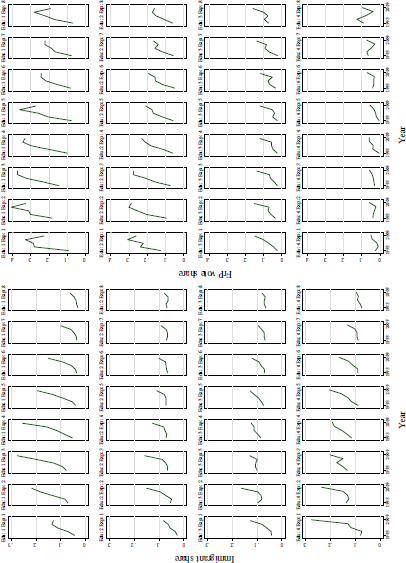
Immigrant share and FrP vote share by skill-cell groups.
Note: The figure shows the immigrant share (left) and Frp’s vote share (right) from 1993 to 2009 for each skill cell. Edu 1, less than high school; Edu 2, high school graduate but no college diploma; Edu 3, short college/university education; Edu 4, long college/university education. Exp 1, 1–5 years of potential experience; Exp 2, 6–10 years of potential experience; Exp 3, 11–15 years of potential experience; Exp 4, 16–20 years of potential experience; Exp 5, 21–25 years of potential experience; Exp 6, 26–30 years of potential experience; Exp 7, 31–35 years of potential experience; Exp 8, 36–40 years of potential experience.
Immigrant share and FrP vote share by skill-cell groups.
Note: The figure shows the immigrant share (left) and Frp’s vote share (right) from 1993 to 2009 for each skill cell. Edu 1, less than high school; Edu 2, high school graduate but no college diploma; Edu 3, short college/university education; Edu 4, long college/university education. Exp 1, 1–5 years of potential experience; Exp 2, 6–10 years of potential experience; Exp 3, 11–15 years of potential experience; Exp 4, 16–20 years of potential experience; Exp 5, 21–25 years of potential experience; Exp 6, 26–30 years of potential experience; Exp 7, 31–35 years of potential experience; Exp 8, 36–40 years of potential experience.
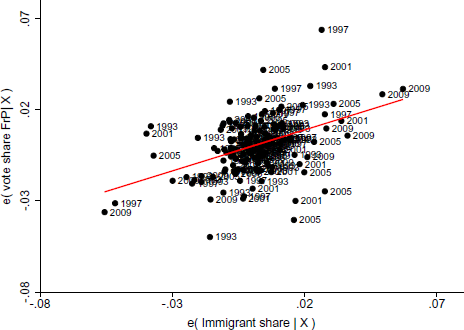
Our first set of regression results is presented in Table 2. The table is organized in the same manner as Table 1, that is, each row present the immigrant share estimate βIijt for separate regressions, following the setup in Equation (1). Remember that the specification in equation (1) includes rigid controls for the trend between immigration and vote shares. The βIijt estimates provide strong evidence that support for FrP increases in those skill cells where the immigrant share increases. According to the estimate in the top row, a one standard deviation increase in a skill cell’s immigrant share increases support for FrP by an average of about two percentage points, which has to be considered as a politically important effect. Figure 3 illustrates this result using a partial regression plot. This figure shows the variation in immigrant share which produces the regression coefficient in the top row of Table 2.
The estimate is slightly larger if we do not weight the data (second row), but the similarity of the estimates with and without weights are reassuring with regard to potential misspecification problems (Solon et al., 2013). Table 2 further shows that results are robust to measuring the immigration supply shock as the proportion of the work force (row 3).
Regression results. The dependent variable is FrP vote share. N=160.
| βIijt | |
| 1. Main specification | 0.45 (0.11) |
| 2. Unweighted regression | 0.49 (0.10) |
| 3. Work force | 0.46 (0.12) |
| 4. New EU immigrants | 0.87 (0.35) |
| 5. Nonwestern immigrants | 0.52 (0.17) |
Note: Robust standard errors adjusted for clustering on skillcell in parentheses. All regressions include education group FE, experience group FE, year FE, and interactions between these FE, see Equation (1).
As in Borjas’ (2003) analysis of wage effects, the immigration effect is mainly driven by the changes in immigrant share net of the education and experience trends. This is evident in Figure A-1, which shows that there is no relationship between the immigrant share and FrP’s vote share if we leave out the interactions between the education and experience fixed effects. This is not surprising in light of the growth of FrP’s vote share since the early 1990s. Since the beginning of the 1990s, FrP has grown relatively faster among those with high education, since very few of those with high education voted FrP when FrP was a small party. Those with high education tend to be in skill cells with a smaller growth in immigrant share, thus, this underlying trend conceal the impact of labor market competition from immigration. That said, this underlying trend clearly points to factors unrelated to labor market competition as important factors behind the support for FrP.
Our earlier analysis shows that wage effects for this period are stronger for western than for nonwestern immigrants, leading us to expect a stronger correlation between FrP’s vote share and share of Western immigrants. Immigrants from the new EU countries are mainly relatively low-skilled labor immigrants. Since the 2004 expansion of the European Union, there has been a massive increase in immigration from this group. Nonwestern immigrants are typically refugees and asylum seekers of which there has been a steady growth over the period (see Brochmann and Hagelund (2012) for an overview of immigration to Norway over this period). Our analysis of labor market outcomes (Table 1) indicates that the immigrants from EU are closer substitutes to natives than those coming from non-western counties. If labor market competition matters we, accordingly, expect that immigration from the new EU countries have a stronger impact on voting than the immigration from non-western countries. In contrast, if immigration drives FrP voting due to noneconomic, cultural concerns (Hainmueller and Hopkins, 2014) we should see larger impact of nonwestern immigration. This is so since we should expect the culturally based reaction to be stronger against individuals from geographically and culturally distant countries.
Rows 4 and 5 show the results when we replace the immigrant share variable with the share of immigrants from the new EU countries and share of nonwestern immigrants. In line with the expectation from competition theory, the results show a much larger coefficient for new EU immigration. We find results in the same direction if we estimate the coefficients simultaneously. When estimating them simultaneously we find a coefficient for nonwestern immigrant of 0.39 (cluster SE = 0.16) compared to 0.65 (cluster SE = 0.36) for new EU immigration, however, since the latter coefficient is somewhat imprecisely estimated we cannot reject a null hypothesis of equal coefficients.
We conduct a set of additional robustness checks. One concern regarding the estimates in Table 2 is that immigration to Norway might be targeted to skill cells with a positive wage development. If so, the earnings estimates will be upward biased (Borjas 2003). Immigrant targeting of skill cells with a positive wage development might also impact the vote share estimates if vote shares are systematically affected by business cycles. We propose an Instrumental Variable approach to address this issue (see the Online Appendix for additional information). Inspired by Llull (2015), we set up a regression model predicting the number of immigrants from sending countries in each skill cell, using a set of exogenous “migration-push” factors (see the note to Table 3 for a list of variables). We then use the predicted immigrant shares from these regressions as an instrument for the actual shares in a 2sls setup.
The second stage results from the 2sls-models in Table 3 are slightly larger, but close in size to the OLS-results in Table 2. When we use the 2sls-approach on the earnings-equation we find that, if anything, the OLS estimate is slightly biased downward. In support of the validity of the IV-approach, we get very high F -values in the first-stage, and the instrument is strongly related to FrP vote shares in the reduced form. The reduced form estimate suggests that a one standard deviation shift in the instrument increases the FrP vote share by about 2.1 percentage points. Thus, we conclude that there is not much selection bias in the OLS-estimates on vote shares due to potential skill-cell targeting of immigration.
Regression results. Voting. N = 160.
| Frp second stage | Frp reduced form | Im. share first stage | Earnings second stage | Earnings reduced form | Im. share first stage | |
|---|---|---|---|---|---|---|
| Immigrant share | 0.56 (0.11) | −0.53 (0.14) | ||||
| Instrument | 1.58 (0.33) | 2.83 (0.33) | −1.59 (0.59) | 2.98 (0.24) | ||
| Kleibergen-Paap F-value | 73.77 | 148.7 | ||||
| Observations | 160 | 160 | 160 | 544 | 544 | 544 |
Note: Robust standard errors adjusted for clustering on skill cell in parentheses. All regressions include education group FE, experience group FE, year FE, and interactions between these FE. Weights are applied. Variables used to construct predicted immigrant share are log(GDP), log(population size), the freedom of assembly and association index (Cingranelli and Richards, 2010), the political terror scale (Giavazzi et al., 2014), log of years of civil war 1800–2007, log of years of interstate wars 1800–2007, number of battle deaths, log of the employment rate, and log of distance to Oslo.
In Table A-1 in the Online Appendix, we further show that the correlation between immigrant share and FrP’s vote share is robust to a control for the number of natives in the skill cell, to rule out that the main results for immigrant share are driven by a change in the number of natives in the cell. Next, we find a similar immigrant share coefficient if we lag the immigrant share by one year. Finally, OLS estimation on bounded dependent variables like ours is potentially problematic, so it is often recommended to transform the dependent variable to logit form to convert it to an unbounded variable (e.g., Tomz et al., 2002, p. 68). When doing so we get similar conclusions, but a slightly less precise estimate (t = 1.85).20 Finally, Table A-3 presents individual level results. The results are similar to those in the aggregated models; a one standard deviation differences in immigrant share is associated with 1.33 percentage points higher support for FrP. Perhaps more interesting, when we split the sample by gender, we find a slightly larger coefficient for males, suggesting that there are more male than female voters at the margin of voting FrP. The difference between these estimates are, however, insignificant.
Regression results. Voting. N = 160.
| Vote share FrP | Vote share Ap | Vote share H | Vote share SV | |
|---|---|---|---|---|
| Main specification | 0.45 (0.11) | −0.58 (0.21) | −0.34 (0.14) | 0.44 (0.16) |
| Unweighted regressions | 0.49 (0.10) | −0.51 (0.16) | −0.35 (0.16) | 0.37 (0.15) |
| IV: Second stage | 0.56 (0.11) | −0.49 (0.28) | −0.56 (0.19) | 0.64 (0.17) |
| New EU immigrants | 0.87 (0.35) | −1.19 (0.63) | −0.73 (0.27) | 0.48 (0.31) |
| Non western immigrants | 0.52 (0.17) | −0.58 (0.31) | −0.42 (0.23) | 0.64 (0.21) |
Note: Robust standard errors adjusted for clustering on skill cell in parentheses. All regressions include education group FE, experience group FE, year FE, and interactions between these FE, see Equation (1).
Next we examine how immigrant share influences the vote share of other parties. The results for the three most relevant parties are presented in Table 4, where for we comparison include the results for FrP. These parties are Arbei-derpartiet (Ap, Labor), H∅yre (H, The conservative party), and Sosialistisk Venstreparti (SV, the Socialist Left Party). Ap is a social democratic party which appeals to voter groups with similar characteristics as FrP’s core voters, H is a secular conservative party and FrP’s main competitor on the right, while SV is a New Left party diametrically opposed to FrP on many dimensions, in particular on immigration. The results for the other parties represented in the Norwegian Storting are presented in the Online Appendix Table A-2, where we also present estimates for incumbent parties and voter turnout. These estimates are insignificant.
The results in Table 4 show that the increase in FrP’s vote share is partly on expense of Ap, for which we consistently find negative and significant effects. This result is unsurprising since there is competition between these two parties for the votes of the low pay, low educated segments of the electorate (see e.g., Finseraas and Vernby, 2014). Immigration is also negatively related to the vote share of H, thus voters competing with immigrants appear to abandon the main party both on the right and on the left. For both Ap and H, the coefficients are larger for labor immigration, pointing to competition as an important mechanism.
The results for SV points to the limits of the protectionist response as the sole operating response to labor market competition with immigrants. SV is the most immigration-friendly party in the Norwegian Storting, but like FrP, they appear to gain in skill cells with an increasing share of immigrants. The IV-results show that we get a larger point estimate for SV (and H) when we instrument immigrant share, and a smaller one for Ap.21 For SV, the nonwestern immigration coefficient is the largest, while the new EU immigrants coefficient is similar to the overall share coefficient.22 This finding suggests that noneconomic policy concerns are more important for SV’s vote share than for the vote share of FrP, Ap, and H. Importantly, the results point to the existence of two political responses to competition with immigrants, and to immigration as a driver of voter polarization rather than causing uniform shifts in one partisan direction.
To dig deeper into the polarizing effect of labor market competition, we return to the theoretical framework, which posits that workers can react to competition by demanding less immigration or more public intervention. The former links competition to FrP voting, the latter links competition to SV voting. Based on the results of polarization within skill cells, we return to the expectation that voters’ choice of response depends on her deep held values on these issues: Those who hold leftist ideological predispositions will become more likely to vote SV when facing labor market competition from immigrants, those without a normative commitment to the left are more likely to turn to FrP. One way to think about this in the theoretical framework above is that the choice of response is determined by the normative, time-invariant views on immigration and public intervention. While the economic shock moves the time-varying components in the same direction for all voters, the normative views determine to what degree the two different dimensions are triggered when circumstances change. For those holding leftist ideological predispositions, the immigration induced economic shock mainly triggers the social transfers and regulation dimension, while the immigration dimension is triggered for those holding rightist predispositions.
We are unable to provide a rigorous test of this claim, but we employ the panel feature of the Norwegian election studies to shed some light on this proposition. The panel feature is a rotating panel where a subset of the respondents in each election is re-interviewed in the subsequent election (four years later). We pool the subset of respondents who are interviewed for the second time in the 1993–2009 elections and add the information about these respondents from the first interview four years earlier. Specifically we add information about their views on immigration and income redistribution. Next, we estimate regression models identical to those discussed earlier (i.e., with the same set of fixed effects), but on individual level data, and add interaction terms between previously stated political preferences and current exposure to labor market competition with immigrants. The key interest is on the interaction terms, which tells us whether the impact of immigrant share depends on views on immigrants/redistribution in the previous election. When interpreting the immigration share coefficients, one should keep in mind that mean immigrant share in this sample is 0.06 and the SD = 0.03.
Regression results. Voting.
| Voting FrP | Voting SV | |
|---|---|---|
| Immigrant shareXRestrictivet−1 | 0.45 (0.71) | −1.46 (0.53) |
| Immigrant shareXRedistributiont−1 | 0.10 (0.54) | 1.17 (0.38) |
| Immigrant share | 0.44 (0.80) | −0.73 (0.64) |
| Restrictive immigration policyt−1 | 0.23 (0.05) | −0.10 (0.04) |
| More redistributiont−1 | −0.03 (0.03) | 0.05 (0.02) |
| Observations | 2,494 | 2,494 |
Note: Robust standard errors adjusted for clustering on skill cell in parentheses. All regressions include education group FE, experience group FE, year FE, and interactions between these FE.
Views on immigration policy is measured using a question where voters are asked to express their view on immigration on a scale from 0 to 10, where 0 equals “easier for immigrants to get access to Norway” while 10 equals “even more restrictions on immigration to Norway”.23 We recode this variable to the 0-1 range. We measure views on income redistribution using the question on whether they agree that “we have come far enough in reducing economic inequalities.” Respondents are asked to state their view using Liekert-scale answer categories which we recode to a 0–1 scale.
The results are presented in Table 5. Two important results emerge. First, immigrant share is positively related to FrP voting irrespective of ideological predisposition, however, the effect is much larger among those holding restrictive views on immigration prior to the immigrant shock. The effect is doubled if we go from the most liberal (Restrictivet−1 =0) to the most restrictive (Restrictivet−1 = 1). Second, immigrant share is negatively related to SV voting for most voters; however, there is a positive correlation for those initially holding very liberal immigration views and egalitarian views on redistribution. This group score 0 on Immigrant shareXRestrictivet−1, thus the marginal effect of immigrant share is positive since 1.17 — 0.73 > 0.24 We hasten to add, however, that the small sample size causes imprecise and insignificant estimates, so results should only be considered as suggestive.25
Finally, we study the relationship between immigrant share and the probability of voting for FrP and SV among voters who voted for Ap, H or did not vote in the previous election. These estimates are presented in Table A-5 in the Online Appendix and show that the immigration shock made H voters more likely to vote FrP, while SV mobilizes voters who did not vote in the previous election. Although these estimates are based on a small sample size, they suggest that voter transitions are more complex than what the estimates in Table 4 suggests.
Conclusion
The canonical model for studying the impact of immigration says that an expansion in the supply of a certain type of labor will cause a downward pressure on the wage of native labor of the same type. We demonstrate such negative wage effects in Norway, and propose that workers have two political responses to immigration-induced negative wage shocks: Voters can demand more restrictive immigration policies, or they can demand more public intervention in the form of social transfers and regulations of the labor market.
To our knowledge, we are the first to study the political responses to immigration which utilizes Borjas’ (2003) skill cell approach to identify the relative degree of labor market competition native workers are exposed to from immigration. The approach is particularly useful in our context as it better identifies voters competing with immigrants on the labor market than the approaches which are typically used in political science. We find robust evidence that voters respond to personal economic consequences of immigration. We find that Norway’s most right-wing party on immigration and the most left-wing party on public interventions gain support among voters who are more exposed to labor market competition from immigrants.
Previous research on electoral consequences of immigration has mainly been concerned with the protectionist response to immigration (see discussions in, e.g., Arzheimer, 2009; Golder, 2003), which we show is unfortunate. Our approach and results highlight the need to closely identify the group of voters affected by immigration in order to track the electoral consequences. Failure to do so might explain e.g., the mixed empirical results on the relationship between unemployment and support for far-right parties (Arzheimer and Carter, 2006; Golder, 2003). Importantly, our results show that the political consequences of immigration are not only due to cultural concerns or concerns about the fiscal burden of immigration, and they question the status of labor market competition theory as a “zombie theory” (Hainmueller and Hopkins 2014) in immigration research. In our view, too much of the literature on the political consequences of immigration have been concerned about the relative importance of ideology and self-interest (Sides and Citrin 2007). Our results suggest instead that understanding the interaction between ideology and economic consequences is a useful direction of research.
A polarized response among voters might have important implications for how immigration will influence public policy. If vote shares shift in one direction, we are likely to observe strong policy shifts as a consequence of immigration. However, if polarization occurs, status quo bias might be the outcome. The latter is consistent with claims about the limited policy impact of the anti-immigration parties in Europe (Mudde, 2013). Moreover, polarization will make collective action within the group of affected voters more difficult, and they will strive to reach a common consensus on policy proposals to counterweight the negative wage effects they experience. Further theoretical and empirical studies of the polarizing effect of labor market competition with immigrants appear to us as an important direction of research, in particular in light of the current public debates about the political consequences of globalization.
See Kriesi and Pappas (2015) for an overview of European populism since the Great Recession.
See Feigenbaum and Hall (2015) for a related protectionist response to globalization. They find that legislators from areas exposed to competition from China vote for more protectionist trade policy.
See Margalit (2013) for previous results on how ideological predispositions condition the effect of economic shocks. There is also a resemblance between our results and recent findings in the political psychology literature on immigration (Dinesen et al., Forthcoming; Johnston et al., Forthcoming; Petersen et al., 2010).
Instrumental variable approaches that exploit historic settlement patterns, have often been the tool to adjust for the reversed causality in the area studies, that is, that immigrants move in the direction of thriving regions. This approach is vulnerable to the existence of persistent economic shocks.
FrP is strongly opposed to liberal asylum and refugee policies, but their position on labor immigration is less clear. Unlike many anti-immigration parties in Europe, they are not an anti-EU party, but there is a debate within the party on whether they should call for re-negotiation of Norway’s main agreement with the European Union. Those demanding renegotiation points to exports of welfare benefits due to labor immigration as one important reason for why Norway should renegotiate the agreement. Moreover, during the debate prior to the liberalization of EU labor immigration in 2004, they criticized the government for the lack of concern about the consequences of labor immigration for the stability of the labor market (Norwegian newspaper articles available upon request). The party’s labor immigration scepticism has historical traces, as they supported strict “Swiss style” labor immigration quotas in the 1980s (Jupskås, 2015, p. 84).
Personal labor market consequences of immigration have been found to push support for redistribution in a leftist direction (Burgoon et al., 2012; Finseraas, 2008). We are not aware of any empirical studies of how immigration affects support for social insurance. If immigration in addition influences aggregate unemployment rates, this will be an additional channel for immigration to influence support for social insurance (see e.g. Markussen 2008).
This is analogous to consumers’ preferences for different consumption goods in microeconomics. Dinesen et al. (Forthcoming) find that immigration attitudes are strongly correlated with personality traits, suggesting that deep, time-invariant beliefs are important.
The data consists of merged administrative registers, encrypted to prevent identification of individuals and made available by Statistics Norway for research purposes. The starting point is a public demographic register with information on all residents in Norway, linked to information on employment, earnings, education, immigration status, country of origin, and more.
In a survey of Polish Building and construction workers, 35% responded (in 2006) that they did not pay taxes (Friberg and Eldring, 2011).
There is a list of the included surveys in the Online Appendix.
We include some measurement error by using between election year surveys, since we assume that voters belonged to the same skill cell in the election year as in the year of the survey. This will be inaccurate for those completing education between the election year and the time of the survey. Since we know voters’ year of birth there is no bias in labor market experience. Moreover, misreporting might increase with the number of years since the prior election. Measurement error in the dependent variable will usually not bias coefficient estimates, only increase the standard errors (Wooldridge, 2003, p. 302).
One alternative approach is to use post-stratification techniques to get estimates of votes shares in each skill cell (Lax and Phillips, 2009). We prefer the transparent approach of aggregating the raw survey data.
Nine skill cells have less than 100 observations. The mean across election years is lowest for the 2001 election (476). In general, the number of observations is lowest in the skill cells combining low level of education and few years of labor market experience.
An alternative is to estimate the vote shares jointly in a seemingly unrelated regressions (SUR)-framework (Tomz et al., 2002). However, since we include the same covariates in all regressions, SUR and OLS will yield identical coefficient estimates.
∈ijt is the error term, assumed to be normally distributed.
Berglund (2007) argues that socio-economic characteristics have become less important for party choice over the period we study.
All results go through if we instead rely on standard errors which only adjust for heteroscedasticity.
Bratsberg et al. (2014) restrict their analysis to men, while we include both genders.
Unemployment is defined as the share receiving unemployment benefits during the year. Employment is defined as the share having annual labor earnings above two times the basic amount in the Norwegian social security system. Full-time employment is defined as the share having annual labor earnings above four times the basic amount in the Norwegian social security system, while welfare benefits is defined as the average share of total income the individuals in the skill cell receive in the form of public transfers.
In the Online Appendix Table A-6 we also show that we get significant coefficients for immigrant share when excluding single election years in a rotating fashion. The coefficient is also quite stable across these regressions. The coefficient is, however, larger when we exclude the 2009 election, that is, data from the 2009 election pushes the immigrant share coefficient downwards. Thus, skill cells which experienced an increase in its immigrant share from 2005 to 2009 responded to a lesser degree than immigrant supply shocks between the other election years. We suspect that this could be related to the financial crisis, even though Norway was not heavily hit by the crisis. In line with this interpretation, the immigrant share estimate when excluding the 2009 election becomes more similar to the others if we control for skill cell unemployment.
In the Online Appendix we further show that the SV effect is larger for female than male voters (Table A-4). In the data we analyze in Table 5, women are significantly more likely to have pro-redistribution and pro-immigration preferences, which is consistent with a larger SV effect for female voters.
When we include them together the coefficient in the nonwestern model is 0.61 (0.23) while the coefficient in the new EU immigrants model drops to 0.14 (0.34).
The asymmetry in the scale was present in all years.
These results might be interpreted as consistent with an alternative “Contact Theory” (Allport, 1954) interpretation, where ideological (or authoritarian) predisposition determines how one reacts to cultural contact with immigrants. Although we cannot rule out that such an mechanism might be in play, we do not believe that this is the most likely explanation for our results. First, the results suggest that it is those with the specific combination of pro-immigration and pro-redistribution preferences that becomes more likely to vote for SV when facing competition. This result is consistent with our framework, while redistribution preferences play no role in contact theory. Second, we rely on a national approach, that is, voters and immigrants in the same skill cell are spatially dispersed across Norway. If one wants to test contact theory one should rely on a research design explicitly tailored to contact theory (see, e.g., Finseraas and Kotsadam, Forthcoming). Such tailoring is particularly important also because contact theory specifies a set of quite restrictive assumptions regarding in what contexts it is supposed to apply (for instance equal status), assumptions which do not hold in the empirical setup we rely on here.
Unfortunately, the IV-strategy does not work on this model because the instrumentation of the interaction terms results in a weak first stage.

