Abstract:
Although the importance of learner motivation for successful Web-based instruction (WBI) has been recognized, substantial theories and strategies for the design of motivating WBI have not been developed. The main purpose of this paper is to suggest research issues of motivation in WBI. First, motivational features of WBI are discussed. Second, a definition of motivation in WBI (based on Keller’s ARCS Model) is proposed. Third, three types of motivation (motivation to initiate, motivation to persist, and motivation to continue) are conceptualized, with motivational problems related to each type of motivation. Finally, seven categories of research issues of motivation are suggested.
Introduction
The World Wide Web has rapidly become an important platform of instruction. However, we have not accumulated substantial theories or principles to use in the design and development of effective, efficient, and appealing Web-based instruction (WBI). Further, because few systematic discussions of learner motivation associated with WBI are found in the literature, there is a need to explore motivational issues and suggest critical areas of research on motivation in WBI.
Motivational Features of Wbi
WBI may be defined as a type of distance instruction that utilizes the diverse resources of the Internet. This implies that WBI is a derivative of both traditional distance education and stand-alone computer-assisted instruction. Therefore, it may have the same motivational features that have been encountered by distance educators and computer-assisted multimedia instruction designers. For example, teachers and learners are separated in time and space. This means that learners may feel isolated, resulting in high dropout rates. The use of fancy multimedia effects will disappear as learners become more familiar with computers and the Internet.
However, WBI has one unique feature that both distance education and stand-alone computer-assisted instruction do not have; WBI allows instructors and students to interact synchronously or asynchronously through computerized networks. This implies that WBI may not have the same problems that faced distance educators or stand-alone CAI designers. We need to study how to utilize this feature to design more motivating WBI.
Definition of Motivation in WBI
Researchers have emphasized the importance of learners’ motivation for successful WBI (Duchastel, 1997). However, just emphasizing the importance does not ensure motivating WBI. What instructional designers need is a practical definition that will guide them in designing motivating WBI. In the literature of educational psychology, there have been many definitions suggested by different psychological perspectives (Stipek, 1993). But psychologists do not provide a practical definition to be used by instructional designers. They tend to contribute to the understanding of the nature of motivation, not to provide a prescriptive definition that will guide instructional design of motivating WBI.
In this sense, Keller’s approach is unique and valuable in that his ARCS model is practical enough to be used by instructional designers (Keller, 1983). The ARCS model is a comprehensive model that helps us understand motivation more concretely. In the ARCS model, Keller defines motivation as the “direction and intensity of behavior” which is influenced by four categories—attention, relevance, confidence, and satisfaction. With this conceptualization, instructional designers do not need to worry about the complexity of the construct of motivation because the four categories give a neat understanding of motivation to designers. Consequently, the designers may use that understanding when they design WBI. In fact, in the ARCS model, the definition of motivation is practically used in two ways: first, it guides the systematic process of motivational design and, second, it suggests motivational strategies for each of the four components—attention, relevance, confidence, and satisfaction.
Now, if we use the ARCS model for the designing of motivating WBI, we may define motivation to learn as “direction and magnitude of effort to learn through WBI, which can be explained in terms of attention, relevance, confidence, and satisfaction.”
Types and Problems of Motivation in WBI
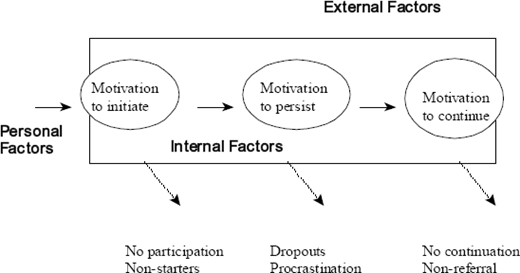
Identifying research issues of motivation in WBI requires us to systematically analyze the process learners employ with WBI. Imagine learners who enter WBI; they will first need to decide whether they will participate in WBI or not. The motivation to influence this decision may be called “motivation to initiate.” Once they have started WBI, they need to decide continually on whether or not they will persist in the instruction; the motivation to influence this decision may be called “motivation to persist.” When they finish WBI, they will need to decide whether to continue studying the same or similar subject through WBI; the motivation behind this decision would be called “motivation to continue” (see Figure 1).
Based on the ARCS model, these three types of motivation can be defined as the following:
Motivation to initiate: direction and magnitude of effort to learn by participating in WBI, which can be explained in terms of attention, relevance, confidence, and satisfaction.
Motivation to persist: direction and magnitude of effort to learn by persisting in WBI, which can be explained in terms of attention, relevance, confidence, and satisfaction.
Motivation to continue: direction and magnitude of effort to continue learning the same or similar subject through WBI, which can be explained in terms of attention, relevance, confidence, and satisfaction.
There are two reasons to conceptualize these three types of motivation. One is that motivation tends to change through instruction (Coldeway, 1991; Song & Keller, 1999). The other is that reasons for participation may be different from those for dropping out and continuation (Wilkes & Burnham, 1991). That is, factors (personal factors, internal WBI factors, or external WBI factors) influencing learners to participate, persist, and continue would be different. Therefore, with this conceptualization, instructional designers can be better prepared to address motivational problems at each stage of learning process. Belawati (1998) suggested two goal commitments of learners in distance education: one is initial goal commitment, the other is modified goal commitment.
Motivation to participate is related to initial goal commitment, while the other two types of motivation are more related to modified goal commitment.
Major motivational problems of WBI can be explained in relation to these three types of motivation. When learners do not have proper motivation to participate, they will not participate or become nonstarters (Coldeway, 1991). In distance education, nonstarters are the ones who register for the course but never start their learning.
When learners do not have proper motivation to persist, they will drop the course or they will procrastinate. Dropping out from lack of motivation to persist is different from that of nonstarters. If learners who are not nonstarters drop out, the quality of WBI should be questioned. That is, WBI is not motivating. Perhaps the interactions (instructors-learners, contentlearners, learners-learners interaction) provided to learners are not motivating. Procrastination is another problem. WBI instructors should be responsive to indicators of procrastination.
When learners do not have proper motivation to continue, they will go away or they will not recommend WBI to others. Continuing motivation (Maehr, 1976) is basically intrinsic motivation. Learners having intrinsic motivation study hard because they like the learning itself and they tend to study more about the same or similar topics. Instructional designers should consider how the WBI they design can increase learners’ continuing motivation. Otherwise, they will encounter the problem of nonreferral by learners.
Conclusion: Research Issues of Motivation in WBI
What are the research issues of motivation in WBI? There are seven categories of motivational issues that need to be further studied. The listings are not intended to be exclusive. However, research on these issues will provide building blocks for designing a motivating WBI.
Category 1: What influences motivation to initiate?
Who prefers WBI?
What types of WBI are preferred?
What are the barriers to registration (participation)?
How to measure motivation to initiate?
Category 2: Nonstarters
What percentage of enrolled students become nonstarters?
What are indicators of nonstarters?
How to deal with nonstarters?
Category 3: Dropout rates, procrastination
What is the model to explain dropouts on WBI?
What are indicators of procrastination?
How to measure motivation to persist?
How to increase motivation to persist?
Category 4: Interaction
What motivational strategies should be provided for each type of interaction (instructors-learners, content-learners, learners-learners interaction)?
What combination of interaction types should be provided?
Category 5: Web features and motivation
Which individual differences (learning style etc.) are more appropriate to WBI digital environment?
Should we provide more multimedia or less?
Category 6: Motivation to continue
How to measure motivation to continue?
How to increase motivation to continue?
What is the relationship between motivation to continue and the other two types of motivation?
Category 7: Need for comprehensive model
What is the model to describe motivation in WBI?
What is the model to prescribe motivation in WBI?
How to integrate the Instructional Systems Design model and Motivational Design Model (such as ARCS model) for designing WBI?