Abstract:
Asynchronous distance education provides an opportunity for meaningful learning beyond the capacity of the traditional classroom if learning communities are created which encourage knowledge-building through information exchange and social reinforcement. This article describes the development of learning communities within the context of asynchronous distance education.
To examine the argument that the community effects learning achievement, we studied 12 graduate students enrolled in a graduate level asynchronous distance education class. The semester-long class, conducted using Internet-based conferencing software, worked on solving four different case studies. The students were arbitrarily assigned to one of three four-person teams. The course was constructed as a regular class and not an “experiment.” This plan, although sacrificing some research integrity, was felt to better capture the reality of this type of interpersonal interaction.
All the student messages were saved for later analysis. The results of both the messages and case studies were compared, showing a significant pattern emerging, indicating the importance of community. The preliminary results indicate a relationship between learning achievement and strength of the community. While, due to a small sample population, no statistical significance can be attached to these findings, the data do provide a foundation for a rich discussion. The empirical data are triangulated by qualitative analysis collected through interviews and student journals. The qualitative data support the empirical results and explain why the community may have had its impact by identifying factors that led to the communities’ cohesion.
Literature Review
Learning and Distance
Asynchronous distance education, as a learning tool, has evolved to a point where it is technologically feasible and socially acceptable. With concerns over its effectiveness largely resolved, asynchronous distance education (ADE) offers two potentially distinct advantages over face-to-face instruction: the ability to deliver instruction anytime and any place, thus increasing access for learners who could otherwise not be served and, second, for creating an environment that allows for knowledge-building based on collaborative and reflective learning (Barry & Runyan, 1995; Moller, 1998; Moore & Kearsley, 1996). However, for distance education to reach its potential for knowledge-building, existing pedagogy and the accompanying instructional strategies that include fostering community development must be expanded to exploit the capabilities presented by the technology. One key factor that can inhibit the potential effectiveness of asynchronous distance education is the strategic development of a learning community (Jonassen, Davidson, Collins, Campell, & Haag, 1995; Moller, 1998).
The Role of Community
When the goal of asynchronous distance education is to attain knowledge-building levels, learners must have membership in a community dedicated to learning topic-specific information. According to Wilson and Ryder (1996), “groups become communities when they interact with each other and stay together long enough to form a set of habits and conventions and when they come to depend upon each other for the accomplishment of certain ends.” This description is consistent with Shaffer and Anundsen (1993), who wrote that communities can be defined as a dynamic whole that emerges when a group of people share common practices, are interdependent, make decisions jointly, identify themselves with something larger than the sum of their individual relationships, and make long-term commitments to the general group’s well-being.
The two basic functions of a learning community are to provide social reinforcement and intellectual exchange (Moller, 1998). A learning community, by providing social reinforcement, creates an opportunity to satisfy a human need for self-esteem, that encourages one of the internal conditions necessary for a learner to be ready and able to learn (Maslow, 1954). McIsaac and Gunawardena (1996) stated that social presence, the degree to which the person feels, or is seen by others as, “real” is a significant factor that affects satisfaction and achievement. Social reinforcement is a natural and positive outcome resulting from others in a community who contribute a sense of identity through shared values, norms and preferences (Cathcart, Samovar, & Henman, 1996). According to Cathcart, Samovar, and Henman (1996), cohesive groups “usually enjoy low turnover and higher participation because members desire continuation of the group and its commitment to goal accomplishment.”
Intellectual exchange, a second function of a learning community, is concerned with collaboration and resulting knowledge-building. According to Jonassen (1998), computer-supported collaborative learning allows physically separated learners to create and share knowledge. Exchanging information allows alternate information and perspectives to be considered and learners to actively analyze or organize their own thoughts (O’Malley & Scanlon, 1990; Woodruff, 1996). Neilson (1997), in advocating collaborative learning through technology for organizational learning, states substantiated assumptions, including groups outperforming the best member in complex problem solving, sharing knowledge as a critical element in success, and leveraging knowledge in a rapidly changing environment, as advantages of belonging to a community for information exchange.
Meaningful learning requires the learner to be actively engaged in cognitive manipulation of the instructional content or information. To a degree, learning occurs within the teacher or
content expert-learner exchanges and dialogues. However, as Moore and Kearsley (1996) point out, “learner to learner interaction is desirable for pedagogical reasons” (p. 131). Intellectual exchange is described as invaluable for the application and evaluation of learning. Gay and Lentini (1995) confirm this assumption, noting that “learning is fundamentally built up through conversations between persons or groups; involving the creation and interpretation of communication.” Furthermore, they argued, “conversations are the means by which people collaboratively construct beliefs and meanings as well as state their differences” (p. 2). It is evident that while their views and beliefs are individually held, these are, in fact, influenced and expanded by information received from other perspectives. Thus individuals are more able to enlarge their own beliefs and more likely to take risks when supported by a community of other learners (Grabinger, 1996).
According to Scardamalia and Bereiter (1994), intellectual support communities are a “means for redefining classroom discourse to support knowledge building in ways extensible to out-of-school knowledge advancing enterprises.” Scardamalia and Bereiter supported their argument by reporting that “evaluations of CSILE (computer-supported intentional learning environments) students greatly surpass students in ordinary classrooms on measures of depth of learning and reflection, awareness of what they have learned or need to learn, and understanding of learning itself. Moreover, individual achievement, as conventionally measured, does not suffer” (p. 265). Ahern, Peck, and Laycock (1992) concluded, after their study of 80 undergraduate students, that asynchronous computer mediated communications improves the acquisition and application of knowledge without a teacher-centered orientation. Furthermore, their review of the research has shown “that this type of interaction is not merely noise in the instructional context, but essential to the cognitive development of the students” (p. 307).
In other words, a learning community contributes to effective learning by fostering cognitive development through communication, argumentation, and critical analysis. This occurs from increasing the range of ideas and capitalizing on the possibilities of brainstorming or collaborative idea generation. Furthermore, the community provides the necessary emotional support for growth or intellectual risk-taking behaviors. It is doubtful that learners would engage in substantive and rich conversations without the feelings of acceptance that a community provides. Learners also need support in terms of interpersonal encouragement and assistance to fully maximize their potential academic and intellectual development (Gunawardena, 1991; Moore & Kearsley, 1996). Some learners may see problems as overwhelming and that may increase their anxiety, resulting in a lack of confidence. This will likely decrease their motivational level, expended effort, and the resulting learning achievement (Moller & Russell, 1994). Unlike learners in a face-to-face environment, the asynchronous distance learner may not have opportunities to observe other learners with similar problems or develop shared strategies that assist in solving those problems. Students who are unsuccessful at overcoming difficulties are more likely to discontinue their efforts to reach their educational goal (Kember, Lai, Murphy, Shaw, & Yuen, 1994; Kember, Lai, Murphy, & Yuen, 1992).
The purpose of this research effort was to explore the relationship between community and learning in asynchronous environments. Specifically, to first determine if a stronger learning community would lead to increased learning and productivity, as indicated by better solutions and higher grades in case studies and second, to look for evidence or indications of what causes students to form a learning community via asynchronous technology.
Methodology
The study population consisted of graduate students enrolled in an asynchronous distance education class. The semester-long class, conducted using Internet-based conferencing software, worked on solving four different case studies. The 12 students were arbitrarily assigned to one of three four-person teams.
Using a combination of quantitative and qualitative research methods, an analysis was conducted of the factors that effected community-building in the asynchronous course, and the possible relationships of these factors to learning outcomes. The factors considered included:
Quantity of comments made by student teams is the sheer volume of messages exchanged between members of each team within their team conference.
Amount of community-building types of comments made by student teams—the number of messages that were judged by a three-member panel to be practical, social, or interpersonal in nature.
Degree of perceived responsibility and isolation of individual team members relative to their team.
The methods by which each team appeared to form community—how connected each individual appeared to be to their teammates, how often they made community-building comments, and how quickly the team appeared to solidify their community identity.
Factors one and two above were studied quantitatively, while factors three and four were considered using the qualitative data gathered via end-of-course interviews and student journals. The following sections describe the methods utilized for the study and report the data collected. It should be noted that, as this was an exploratory study, the quantitative data were not analyzed using advanced statistical procedures. Rather, the data were used to determine specific trends and possible areas to be studied more closely using the qualitative data.
Descriptive Data
Total Comments
To determine if community effected achievement, we needed to determine if the groups differed in their community development process or intensity. The first step in examining community-building within the asynchronous course environment was to track the comments of each team. To manage this procedure for comparison to the case scores, comments were first grouped according to the case being considered.
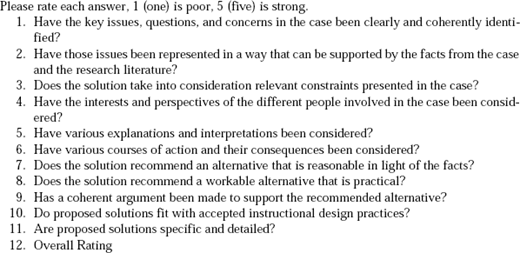
The learning outcomes were quantitatively measured on a team-by-team basis, using team-produced answers to four separate case studies. Three independent raters judged each team's answers to each of the four case studies. For each answer a score was assigned, ranging from zero to 60 points, based upon a rubric that included 12 criteria each worth five points. The case scores were used as a measure of the team members' combined understanding of the course content (see Figure 1).
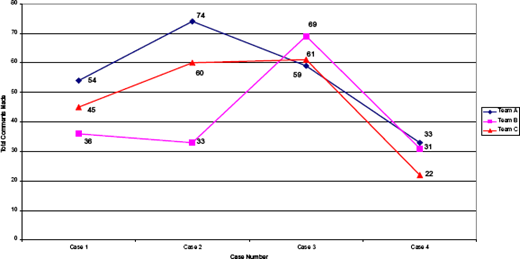
The resulting data (see Figure 2) revealed that, in all but the third case, Team A produced the greatest number of comments of the three teams (Case 1 = 54 comments, Case 2 = 74 comments, Case 4 = 33 comments). In the third case, Team B produced the greatest number of comments (Case 3 = 69 comments). However, in the first and second cases, Team B produced the fewest number of comments (Case 1 = 36 comments, Case 2 = 33 comments). Team C's comment totals were between the other two teams’ totals, except in the fourth case, in which they produced the fewest number of comments (Case 4 = 22 comments). It should be noted that less casework time was allotted, by the schedule, for the fourth case than the other cases, a likely explanation for the sharp decrease in comment totals for that case.
Community-building Comments
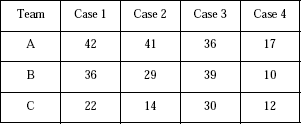
Each comment made by students was judged by a team of three raters to determine if it was indicative of community-building activity. In order to determine which comments were related to building community, raters looked for criteria that would suggest whether an individual comment was meant to connect with other team members in one of three ways indicative of community-building: practical, social, and interpersonal (see Table 1).
Using this rating rubric, trends appeared in the data for the community-building comments (see Figure 3) that were also in evidence for the total comments data. Team A had the highest number of community-building comments for Case 1 (42 comments), Case 2 (41 comments), and Case 4 (17 comments). Team B recorded the fewest community-building comments in Case 1 (22 comments) and Case 2 (14 comments), and Team C the fewest for Case 4 (10 comments).
Discrepancies with the Total Comments data appear only in the third case. Team B, as opposed to Team A, recorded the lowest number of community-building comments for Case 3 (30 comments). Also, Team C recorded the highest number of community-building comments (39 comments) for the third case.
Case Scores
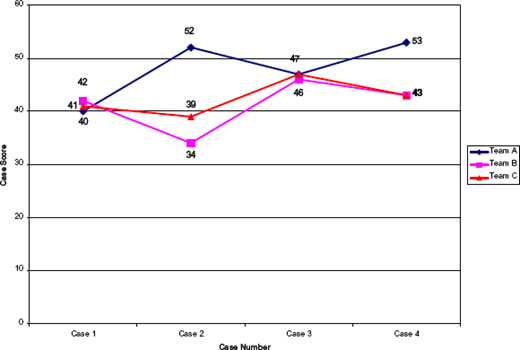
Case scores for the four cases (see Figure 4) revealed little difference in team scores for the first and third cases, with teams scoring within one or two points of each other. However, in the second and fourth cases, Team A scored ten to eighteen points higher than the other two teams (Case 2 = 52 points, Case 4 = 53 points).
Summary of Quantitative Data
The general trend revealed that Team A, in all but the third case, made the most comments, as well as generating the highest number of community-building comments. Team A also scored consistently high on all four cases relative to the other two teams. Team A scored very closely to the other teams in the first and third cases, and much higher on the second and fourth cases.
Team B appeared to be the least-connected group, except in Case 3, as evidenced by recording a low number of comments. Closer inspection of the third case revealed that despite an increase in total comments, Team B had the fewest of community-building comments (30 out of 69 total comments) of the three groups for the case.
Team C exhibited an average amount of community-building in comparison to the other groups. In the first two cases, the quantity of comments fell between the extremes for total comments and community-building. For the third case, Team C showed the highest number of community-building comments, despite not having the highest number of total comments. For Case 4, Team C had both the lowest total comments and the lowest number of community-building comments.
The following trends seemed to be in evidence:
Teams B and C scored similarly on case answers for all four cases (within five points of the other team's score). Team A scored similar to Teams B and C on the first and third cases but scored much higher on the second and fourth cases.
Overall, Team A made the greatest number of comments (220), as well as the greatest number of community-building comments (136).
Team A began making comments, including community-building comments, earlier (the first two cases) and at a higher rate (128 total comments, 83 community-building comments) than the other two teams.
Based upon the trends apparent in the quantitative data, the qualitative data were analyzed to interpret whether the numbers of comments and case scores might be associated with other factors, such as individual responsibility, isolation, and social connection amongst team members.
The following section reports the results of the qualitative methods used in the study. These results are the participants’ reported perspectives of their experiences in this asynchronous course.
Qualitative Results
The teams each developed a community within their own team and among the other teams through asynchronous interactions. The teams revealed a sense of satisfaction and confidence with learning asynchronously, as they became more familiar with how to interact with each other and with what to expect from each other within the limitations of technology and asynchronous learning. Research on learning communities shows that people significantly connect through face-to-face and personal interactions, versus connecting on a personal expression-limiting level through technology-based communication.
Communication via messages was the link for developing a sense of community. The feelings of being part of a community varied between teams and changed over time. We believe, based on respondents’ information, that feeling connected was caused by team members’ senses of responsibility, and differences in sense of responsibility contributed to the difference in performance. Students also reported the need for more socializing and real-time communication, thus the missing link to community development in asynchronous learning. While socializing and real-time learning may be the antithesis of asynchronous distance education, it does underscore the need to feel connected.
The next sections report the findings of the major qualitative themes that revealed where community did and did not develop in the data. These themes include sense of responsibility, feeling connected, and learning.
Sense of Responsibility
One of the main themes that emerged from the interview and journal data is that teams felt a differing sense of responsibility to the other team members in doing their work. Team A seemed to feel the most responsibility to their team members. One student stated, “I feel a great responsibility to the team.” A student in Team A relayed a sense of community responsibility in that they were aware that their actions affected everyone and wanted to have a positive outcome:
It’s not just letting myself down, whereas let’s say in class [traditional class], if I didn’t read the assignment, I really see mostly that other people would participate, and it is my loss, versus this class [asynchronous class] I see it more like I’m letting my group down
Another participant related community responsibility to the smaller class size:
It [feeling responsible] might also be a function of the size of the group that in a class it’s 26 people, and if I weren’t to communicate, maybe somebody else would. Whereas in a group of 4, you are much more responsible.
A feeling of guilt also existed, for a Team A student, when there were challenges to active participation. This student had difficulties keeping up with the community because of work travel: “[I] feel guilty like I’m not keeping up my end of the work.”
Team B members evidenced a less well-defined sense of responsibility within their community. One Team B member seemed confused about her responsibility: “The team work format is unclear, not sure of my responsibilities in this group.” That statement was made at the beginning of the course and a sense of what was expected from each other was developed over time, as team members solved problems (cases) together. Over time, natural leaders emerged in Team B. A Team B student stated, “I am glad for the leadership roles that some students have taken.” This may have been due to, or the cause of, the slow formation of community responsibility within Team B.
A member of Team C also expressed the sentiment that the team took some time to get to know each other and ultimately felt that everyone “carried their own weight” when she said,
This case was difficult for me because we were dealing with getting the program set up, feeling our way around one another as a team, and trying to decide how best to approach the case (our roles as team members), everyone carried their own weight.
Another student stated “I feel a great responsibility to the group” and another student stated that she felt “more responsibility in this course than in traditional course.”
Another Team C member stated that she felt the learning opportunity was directly linked to the sense of responsibility shared by the team members: “if [I] expected to have more responsibility and had more time, [the] class would learn more.”
We concluded that Team A more quickly developed a sense of responsibility, followed by Team C and, later, by Team B. This corresponds to the community-building comments and case score patterns. We believe that the posting of community-building comments encouraged the students in Team A to develop more intimate relationships, a contributing factor in developing a sense of responsibility. For example, a member of Team A noted this feeling of connection when she said, “I think I felt a little more connected with the group knowing a little more about what’s going on with them.” Most students noticed that there were fewer opportunities to feel connected in a distance education setting than in a traditional classroom setting, but that additional time helped them to feel connected to their team members. We suggest, based on the quantitative reporting of the types of comments, it is not time per se, but rather the increased degree of intimate communication that makes a difference.
A student in Team B noted that over time, she “felt more connected at the end, not at all at the beginning, but it grew,” while another stated that “getting to know each other helps.” This is consistent with the increase of messages that resulted in a stronger community for Team B as time passed. Once again, it also could explain why Team B’s case scores improved. One Team B student noted that “Our team members benefitted, though not instantaneously, but through group dynamics of sharing information this way adds perspective that may not be available in one-on-one instruction.”
The asynchronous communities developed more trust, as the result of the quantity and quality of feedback, and the community became stronger and more connected. We suggest that the quality of feedback is higher with stronger community.
A Team A member stated that a “common problem builds community.” Another Team A member said, “We have different ways of looking at a situation or question with regards to wanting more feedback to broaden their perspective.”
Conversely, a Team B member stated that “It would be good to have some type of feedback,” indicating a lack of communication, possibly resulting from a lack of trust built within the community. A Team C member stated, “Team members feedback was good” and another member of Team C stated, “brain-storming and feedback were congenial.” A Team C member stated, “learners developed a framework for feed back and solution/problem solving.”
Once again, Teams A and C demonstrated behaviors associated with a community while Team B lagged in this performance. This corresponds to Team B’s lower case scores or team performance. Each of the teams stated that they would have liked more socializing, defined as: verbally talking to someone, talking in live-chat, classroom interactions, and face-to-face interactions.
One Team B member reported that she would have liked to have been able to verbally talk to someone, and with a Team B member noted that “Email interactions seem less personal in chat.” Another Team B member stated, “missed off-line communications.” The team member reported the following: “I need to be in the social arena, but I would have arranged a telephone conversation because I think that is a viable alternative or a viable compliment.”
These Team B members were revealing their feeling and needed to have more personal interactions in their learning environment by verbally talking with their co-learners. These types of comments were not expressed as strongly by Teams A or C.
Team members in all three groups mentioned classroom interactions and face-to-face interactions as a more desirable way to get to know their co-learners. For example, one Team A member said “Would like to see everyone discuss the class and socialize more.” Another Team A member stated, “That [social interaction] is the only thing I miss about the classroom set-up.” Two more students in Team A recalled that seeing others was important and missed in their asynchronous chat learning experience when they said: “Miss seeing her [fellow student] in class,” and “Sometimes I think we would be able to connect better if we had face-to face talk.”
Team B and Team C members also mentioned their desire to have more classroom interactions and face-to-face interactions. One Team B member stated:
There were two people in the class I knew, and I was really hoping that I could be on their team, because I think if you establish something… like if I am thinking ‘I don’t know how to respond to this’, so you knew them and you could maybe deal with them, maybe, differently than with a stranger.
A Team C student noted that “traditional class characteristics are taken for granted, you relate more in person.” Another Team C student commented that the team would have liked to have gotten to know fellow students on a more informal basis:
We thought it would be real neat idea to have the whole class get together for pizza or something at the end; the group seems to be talking to one another more than at the beginning of the class; would like to suggest more socializing—more socializing would help bring people closer together and be more interpersonal; develop bond with your team needs to happen more.
Another Team C student relayed that more chat time helped develop bonding between fellow team members: “In our chat a considerable amount of time was spent on interpersonal stuff. I liked learning more about my team members.”
Learning
Learning occurred among the teams as their communities developed, working together to achieve the common goal of completing instructional design projects. Members of Team A reported that they learned through independent research, which happened in several different ways: “Learned through my own exploration and teams reference suggestions.” “Posted ideas before chat so we could have time to review ahead of time.”
Being out there alone is a great help in that I am developing a way to learn to solve the cases by looking at the real issues and not making too many assumptions . . . the cases are so realistic.
Even though the research was accomplished independently, the team members collaborated on their ideas and shared their findings that were beneficial to their learning process and to contributing to a sense of community.
Members of Team B reported that they noticed having more time to think about the projects before posting their responses, whereas in the classroom setting, the time is limited and limits the ability to think through issues as thoroughly as in the asynchronous environment. “Have ability to spend more time thinking about questions than in traditional classroom setting.”
I put more time in, I would read the message, I would print it out, I would think it out, I would try and research it, respond to it, I would post it. Whereas face-to-face in class, you have those 3 hours, that’s it.
Members of Team C also noted that they liked having more time to think about their responses to the learning issues: “Go onto the Internet to see if I can find an answer . . . I am so excited I liked having time to think.” “Can think about response, then post it. Able to research before responding go to the Internet to see other resources there.”
I like having time to reflect and react rather than just try to work as fast as you can off the top of your head in class. Finding solutions on your own is real-life experience.
Students on all three teams agreed that they were more satisfied with their contributions when having more time to think about their responses. The independent research activities among the teams revealed that a sense of satisfaction was achieved in the learning when they could spend more time thinking about their responses before posting their answers in chat. However, Team A and C students also noted the benefit in posting their research findings to share with other team members, as well as posting their responses early so that others could have a little time to think about it. Although shared learning was generally considered a positive experience across the teams, the types of social learning interactions that occur in the tradition classroom setting were missed.
Team A members reported that both shared experiences and independent research were valuable: “I wonder if there may be a way for the teams to share our papers after they are completed. I would like to learn from them.”
It’s tough for me to say whether I learned more from our shared experience or from my own attempts to formulate a solution. I might feel more connected in a traditional class because others used to bring up a lot of stories of their work that were relevant to what we were learning in class.
Team C members also reported that both shared experiences and independent research were valuable: “I learned from sharing” “Shared some of the stuff I found . . . posted it and decided they can read it or not.” “Learned through my own exploration and teams reference suggestions.” “I am very proud of our groups effort in coming up with solutions.”
A Team C member stated, “This case gave me the encouragement to break away from the security of relying on the questions at the end of the case and rely more on my own judgment.”
Conclusion
The purpose of this research effort was to explore the relationship between community and learning in asynchronous environments. Specifically, first, to determine if a stronger learning community would lead to increased learning and productivity, as indicated by better solutions and higher grades in case studies, and second, to look for evidence or indications of what caused students to form a learning community via asynchronous technology.
We believe that the descriptive data indicate that more peer interaction, as expressed by community comments, resulted in heightened learning, as evidenced by the case scores. This is consistent with Mason and Kaye (1990) who noted that “Growing out of this high level of interaction and the permanence of the discussion record is the possibility of a group creation, where people make leaps in understanding that are unlikely to happen in isolation” (p. 19). The importance of group interaction is supported by Grabinger’s (1996) assertion that while our own views and beliefs are individually held, our views are, in fact, influenced and expanded by information we receive from other perspectives. Thus we are more able to enlarge our own beliefs and more likely to take risks when supported by a community of other learners. The description describes a trend. This trend indicates the group that made the most community-building comments had higher scores on the case studies.
Further evidence can be found in the qualitative analysis of the learner journals and interviews. Once again, the team that usually performed the best expressed the strongest sense of responsibility to their fellow team members. According to Barab and Duffy (2000), “Most community members view themselves as part of something larger. It is this part of something larger that allows the various members to form a collective whole as they work toward the joint goals of the community and its members” (p. 38). Thus we consider that “viewing yourself as part of something larger” was expressed in terms of an obligation or responsibility to meet the needs of the group.
In this asynchronous learning process, most students reported gaining a sense of confidence from the act of learning about the subject and themselves. Building their self-confidence through independent and collaborative research and being proud of their team’s efforts and outcomes resulted in a sense of satisfaction among members of the learning communities. The desire for collaborative research was great when students wanted to get feedback, and this helped them feel connected to their team members. Even in the independent research activities, students reported wanting to share their research and benefit from others’ research.