Even as academics continue to debate whether distance education techniques are successful, the market demands increased distance education programs and a growing number of corporations are using e-learning to train their employees. We propose and examine a model comparing outcomes in 3 different pedagogical classroom settings: traditional, distance education using an e-learning tool, and hybrid setting (face-to-face with an e-learning tool). Results indicate that students who use e-learning tools demonstrate better synthesis of learning. Implications for future studies and recommendations for how to improve management education using e-learning techniques are discussed.
Introduction
Distance education has created enormous opportunities for the expansion of educational opportunities, especially in higher education. However, in spite of the successes and advancements in e-learning, there have been some disappointments and mixed reviews (Bernard et al., 2004; Ronsisvalle & Watkins, 2005), including evidence of poor quality (Ortiz-Rodriquez, Telg, Irani, Roberts, Rhoades, 2005). This poor quality is often associated with the lack of investment by host institutions, which has been compounded by the wrong perception of distance education (Moore & Kearsley, 2011), and reported high drop rates (Cookson, 1990; Dowdall, 1991; Parker, 1999).
Dhanarajan (2001) further warns that the increasing commercialization and technologization of distance education risks the loss of “our sense of equity and equality of opportunities” (p. 61). This comes at a time when “improving retention rates in postschool education has become a focus for policymakers and researchers throughout the Western world” (Zepke & Leach, 2007, p. 237) in light of high tuition and overall cost of operating postsecondary education systems. The impact of retention should be considered, especially for educational institutions that are now called to invest significantly to support e-learning strategies (Simpson, 2004).
Although a growing body of research has been conducted on the support and prerequisites needed to assure success of distance education programs (Shillington et al., 2012), less have examined learner theory and ways learning strategies can increase learner success within distance education.
Learner Theory and E-Learning
Learner motivation is known to have a positive result on learner success, but according to Gaswell (2008), a survey of some of the relevant theories (such as autonomous study motivation and achievement goal theory) do not provide any practical suggestions for what institutions can do to increase it. Simpson’s (2008) proposed “Proactive Motivational Support” is based on positive psychology (Bonniwell, 2006), the strengths approach (Alex Linley, Joseph, Harrington, & Wood, 2006) and Dweck’s theories of self (Dweck, 1999). According to Simpson (2008), building on students’ strengths, rather than focusing on overcoming difficulties, and encouraging students to believe that effort will improve results, rather than to believe that intelligence is fixed, have been shown to have an impact on student learning. The researcher makes a case that combining these with proactive support from the institution, which he has already demonstrated to have a major impact on student retention (Simpson, 2004), could provide institutions with some practical steps to improve student success. The type of assessment and its environment could also influence a student’s success in a distance educational environment (Gibbs & Simpson, 2004). Moreover, learner strategies and self-efficacy can all contribute to dynamic learning to improve learning outcomes. Consequently, the tools designed to facilitate learning and associated engagement as chosen learning strategies can only become increasingly more important at a time of technologization and increased e-learning efforts around the globe (Dhanarajan, 2001). However, do these tools really make a difference?
The purpose of this research is preliminary in nature as it seeks to test the effect that learning strategies including learning tools and method of teaching delivery may have on student synthesis of information. It also examines whether use of e-learning tools and method of teaching delivery moderates the relationship between student readiness to learn and the students’ ability to synthesize information learned during the semester.
E-Tools and Their Impact on Learning
Due to the changing nature of the teaching environment and the millennium effect of the traditional student population, the pursuit of research on the impact of new learner-centered strategies (including tools to support such strategies) must be prioritized (Zhang & Nunamaker, 2003), especially in light of the reported positive impact on overall students’ learning. Although advances in distance education have been well documented over time, Carnwell (2000) has come to the realization that learners are not necessarily prepared, and thus it cannot be assumed that they are able to use the tools made available to them. Although the link between technology and pedagogy is rarely smooth in any educational domain, Rogerson-Revell (2007) highlights that tools may help fill that important gap in educational outcomes.
To that effect, some research has narrowed on the learner’s anatomy and capacity (selfefficacy, strategies, motivation, and predisposition to name a few) and its impact on learning, and the role that learning strategies play in that relationship. Vanijdee (2003) specifically called for all stakeholders to facilitate the dynamic learning environment, including the provision of learning resources also emphasized by McNaught, Lam, and Cheng (2011). This, according to Vanijdee (2003), includes providing a self-access center designed to help the learner through careful material design, incorporation of activities and tasks that promote skills and greater awareness of materials. Studies have also found a positive relationship between use of resources and learning. To that effect, McNaught et al. (2011) found that the provision of these learning resources and the engagement of students positively related to aspects of learning scores, with a stronger relationship when e-learning strategies were in use. At the very least it can be argued that the use of such strategies and tools can be seen as ways to support learning and opportunities to reinforce learning.
Consequently, content providers (including publishers) have and continue to develop a large variety of learning strategy support tools (including web-based ones) to supplement their products with the promise of supporting learning in light of these changes and noted significance. One publisher reported a full letter final course grade difference for online tool users compared to nonusers (LearnSmart, 2013). The debate on the future of e-learning is regaining strength in light of the marketing of these tools, with some insinuating that the form of teaching (including online versus faceto-face versus hybrid) is less important than the learning tools used in teaching (e.g., online assessments from the textbook; online exercises and role plays).
Lockwood (1994) was one of the first to emphasize the importance of well-designed student-centered course materials in open and distance learning environments. While Hurd’s (2001) argument that such material substitutes for an actual teacher might be considered an overstretch by some and further fuel the critics engaged in this debate, Rowntree (1990) argues for the character of “tutorial in print” (p. 82), defined as well-designed course methods that give the student natural feedback regarding the success of their efforts. To that effect, Xiao (2008) found that a large-scale elearning model implemented in China had proved successful at supporting learners both structurally and pedagogically using “tutorial” technology. Explicitly, Xiao argued that new technologies could play a major role in the developments of English language e-learning because they made learning more flexible and interactive. He identified high-quality course materials as another key component of a student’s success, along with learner support and the use of new technologies. Although this research emphasized tools solely in an e-learning environment, such tools could arguably benefit all learners, especially considering the wide availability of technology in developed higher educational systems around the world. We argue that such “tutorial” technology can support learning regardless of the mode of delivery. Therefore we hypothesize: H1: elearning tool users will be better able to synthesize course material regardless of pedagogical learning design used.
Across settings, it is clear that personality impacts performance (Schmitt, Gooding, Noe, & Kirsch, 1984). Specifically, factors such as self-efficacy (Bandura, 1997), locus of control (Rotter, 1966), and confidence (Baumeister, 1997) not only impact performance (Erez & Judge, 2001; Judge & Bono, 2001), but also impact people’s beliefs about their abilities to learn (Payne, Youngcourt, & Beaubien, 2007). A growing body of research suggests that these factors specifically influence outcomes for those using e-learning tools. Hsia, Chang, and Tseng (2014) found locus of control and computer self-efficacy to be predictors of perceived ease of use and perceived usefulness of e-learning tools. Specifically, computer selfefficacy appears to be a consistent predictor of e-learning outcomes (Eom, 2011; Garavan, Carbery, O’Malley, & O’Donnell, 2010) and perceived ease of use of e-learning technologies (Jashapara & Wei-Chun, 2011).
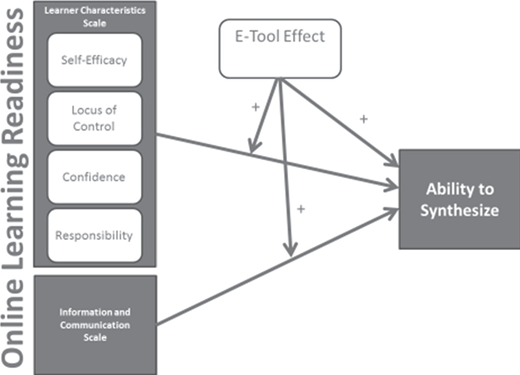
Bates and Khasawneh (2007) suggested that the relationships between self-efficacy, among other self-regulating antecedents, and online learning outcomes are more complex than had typically been recognized in the literature, therefore fueling a call for further studies. Their research hypothesized and confirmed a mediated model in which a set of antecedent variables influenced students’ online learning self-efficacy which, in turn, affected student outcome expectations, mastery perceptions, and the hours spent per week using online learning technology to complete learning assignments for university courses. In addition, Lynch and Dembo’s (2004) review of distance education and self-regulation literself-efficacy, locus of control, and confidence in use of technology can successfully predict e-learning outcomes as depicted in our model (Figure 1).
Therefore, we hypothesize: H2: e-learning tool usage will moderate the relationship between learner readiness and synthesis of course material.
Methods
We conducted a preliminary study as part of the curriculum and impact assessment that these new online learning tools might have on learners.
Participants
The study involved 91 undergraduate students enrolled in the same course at a comprehensive university located in the southeastern part of the United States. The students were enrolled in different sections over the same semester. Each section was associated with different pedagogical elements and designs. One section was a traditional face-to-face delivery without any additional online learning components (traditional); the second section was also a traditional face-to-face delivery but required the use of an online adaptive learning tool that deliberately forced the practicing of concepts on the learner through the use of an online quizzing system (hybrid); and finally the third section was a completely online delivery that required the same online adaptive learning tool usage throughout the semester as the hybrid class (online). Out of 91 participants, 43 respondents were enrolled in the traditional face-to-face section, 24 in the hybrid section, and 19 in the online section.
Measures
Readiness to Learn. Prior to the start of the semester, all section instructors asked enrolled learners to complete an online survey that collected demographic information and assessed readiness to learn. The readiness to learn instrument, developed and validated by Dray et al. (2011), was designed to assess participant’s attitudes and beliefs about online learning as well as their own personal learner preferences and technology and communication aptitudes. The instrument was reproduced with permission from the authors for the purpose of this study. The questionnaire used a 5point Likert scale (strongly disagree, strongly agree) to measure online learning readiness. The Online Learning Readiness scale consists of learner characteristics, and information and communication technology (ICT) scores.
The learner characteristics measured individual beliefs in their ability to complete a college degree, self-efficacy in writing and expression, orientation to time and time management, beliefs about responsibility in problem solving (academic and technical), and behavior regulation for goal attainment (Dray et al., 2011). The score assessed four subconstructs; self-efficacy (8 items, Cronbach’s alpha = .77), locus of control (8 items, Cronbach’s alpha = .70), confidence (1 item), and responsibility (1 item), while information and communication technology was measured as a single construct (8 items, Cronbach’s alpha = .77).
Items addressing self-efficacy looked to assess the individual sense of self-control. For example, students were asked to rate themselves on items including “I am good at completing the tasks independently” or “I feel comfortable responding to other people’s ideas.” Items associated with locus of control focused on the person’s perceived control over his or her own behavior with questions such as “I organize my time to complete course requirements in a timely manner” or “I achieve goals I set for myself.” Items associated with confidence and responsibility focused on their trust in completing the program or sense of responsibility toward completing their education with questions such as “I am confident in my ability to excel in a college program” and “I believe I am responsible for my own education; what I learn is ultimately my responsibility.” Finally, items measuring individual information and communication technology readiness included questions such as “When I have to look up information on the Internet for any reason, I am comfortable with the task,” or “I believe that I will continue to have daily access to a computer, the Internet and the software required in order to complete assignments for as long as needed to complete this program.”
E-Learning Intervention. Prior to covering or discussing a topic in class (including online discussion boards), both hybrid and online courses required that students engage the online adaptive e-learning tool made available through a publisher. The online tool consisted of the application of concepts and practice of concepts by each learner for each of the 16 chapters covered. The e-learning tool adjusted to mistakes or incorrect answers by supplementing the number of questions needed to complete the assignment. Consequently students who showed mastery, persistence and effort received 100% on each assignment as long as they correctly answered a minimum predetermined number of questions per topic. The questions were pulled randomly from a databank containing over 100 questions for each of the chapters.
Synthesis of Learning. A common published and course relevant case was selected and subsequently assigned to all sections, which was due by the end of the semester. This individual case study assignment was used to measure the learner’s ability to synthesize information as an outcome of the course. The same evaluation matrix was used across all sections. Instructors discussed the evaluation matrix in detail prior to conducting the grading.
Results
SPSS was used to examine the hypotheses based on intercorrelations, a one-way analysis of variance test (ANOVA), and multiple regression analysis.
Descriptive Statistics
The means, standard deviations, and intercorrelations for all measures are shown in Table 1. Examination of the intercorrelations suggests several patterns. First, it is important to note that the e-learning variable showed no significant correlations with any of the independent variables of our model, but was significantly correlated with the dependent variable, learning synthesis (r = 0.345, p < .01). Second, self-efficacy showed significant correlations with locus of control, responsibility and ICT (r = 0.523, r = 0.445, and r = 0.336 respectively, p ≤ 0.01). Third, locus of control was associated with ability to synthesize (r = 0.217, p ≤ 0.05), self-efficacy (r = 0.523, p ≤ 0.01), confidence (r = 0.348, p ≤ 0.01), responsibility (r = 0.423, p ≤ 0.01), and ICT (r = 0.236, p ≤ 0.05). Fourth, confidence showed no significant correlations except with locus of control. Fifth, responsibility was associated with self-efficacy and locus of control (r = 0.445 and r = 0.423 respectively, p ≤ 0.01). Sixth, ability to synthesize (r = 0.219, p ≤ 0.05), self-efficacy (r = 0.336, p ≤ 0.01), and responsibility (r = 0.312, p ≤ 0.01) were all associated with ICT.
Group Variance Evaluation
A one-way between subjects ANOVA was also conducted to test the possible effect that eLearning may have on all predicting variables directly. Table 2 shows that e-learning had no significant effect on any of the variables lending further support to the independence of our moderating variable.
We tested Hypothesis 1, that e-learning tool users will be better able to synthesize course material regardless of the pedagogical learning design selected. An independent-samples t test was conducted to compare students’ ability to synthesize using e-learning and not using elearning tools. There was a significant difference in the scores for e-learning (M = 83.78, SD = 13.78) and no e-learning (M = 72.57, SD = 13.84) conditions; t (81) = 3.626, p ≤.01. These results suggest that using the e-learning tool had an effect on the students’ ability to synthesize, thus lending support for Hypothesis 1.
Predicting Moderated Model Evaluation
We tested Hypothesis 2, that e-learning tool usage will moderate the relationship between learner readiness and ability to synthesize course materials. A composite score multiplying each predicting variable (ability to analyze) by the student’s respective e-learning score was created.
Table 3 examines the intercorrelations of variables showing a strong relationship (r >.40) between all factored variables, and a moderate relationship (r >.30) between confidence*e-learning, responsibility*e-learning,
ICT *e-learning and our outcome variable, namely ability to synthesize.
Second, using Aiken and West’s (1991) and Fairchild and MacKinnon’s (2009) recommendations, a multiple regression analysis was used to test if e-learning scores moderated the relationship between the readiness to learn overall construct and one’s ability to synthesize. The results of the regression indicated that none of the predictors significantly explained the model variance (R2 = .171, F (5,40) = 1.48, p = .232). Therefore, we were unable to support Hypothesis 2.
Discussion
The purpose of this preliminary study was to examine whether student use of an e-learning tool would impact their ability to synthesize
course information. The study also examined whether the use of the e-learning tool moderated the relationship between readiness to learn and ability to synthesize information. The results indicate that although the e-learning tool consistently predicts ability to synthesize information (in support of Hypothesis 1), the e-learning tool did not moderate the relationship between readiness to learn and ability to synthesize information (failure to support Hypothesis 2).
Our results failed to support Hypothesis 2. In our study, even though the readiness to learn dimensions (i.e., self-efficacy, locus of control, confidence, responsibility, and ITC) were typically intercorrelated, none were statistically significant in relation to the use of the elearning tool, and only two (i.e., locus of control and ITC) were related to the ability to synthesize information. This was surprising. Specifically, research by Dray et al. (2011) suggests that these variables should have been related to ability to synthesize. More so, there is an even greater body of literature suggesting that variables including self-efficacy, locus of control, and self-esteem tend to be consistent predictors of performance outcomes. Indeed, when these are considered in concert along with neuroticism, the four are described as core self-evaluation (Judge, Locke, & Durham, 1997) and have been found to predict a variety of organizational outcomes including job performance (Erez & Judge, 2001; Judge & Bono, 2001). While the statistical insignificance could be partially due to the sample size, it is also noteworthy that many of the relationships failed to even approach statistical significance.
Nevertheless, what is most interesting here is that the results supported hypothesis 1 despite the small sample size. Based on our research, the use of an e-learning tool enhanced students’ ability to synthesize information. This was true no matter how we looked at the relationship. That is, when we compared those who used the e-earning tool to those who did not use the e-learning tool, those who used the e-learning tool did better in the class. Moreover, when we only considered those who used the e-learning tool, those who used the e-learning tool most consistently (thus obtaining a higher e-learning tool score) scored best on the synthesis measure.
Unrelated to this study but as part of the authors’ work in classroom continuous improvement, students in the hybrid class and the online class were sent a brief follow-up survey to get their opinions on the use of elearning tools as a class enhancement. Of the 16 students who responded, 82% believed that the e-learning tool helped them learn and acquire knowledge in management, and 88% believed that the e-learning tool should be used in future classes. This further speaks to the validity of e-learning tools to enhance the classroom experience. Specifically, the elearning tools appear to help with learning synthesis. It is “icing on the cake” that students self-report appreciating the instruments as tools that accelerate learning.
Practical Implications
The preliminary research presented here has possible practical implications. The most obvious is to encourage students to use e-learning tools, as they appear to have some benefits, no matter the method of course delivery (face-toface or online). This also supports the idea that since e-learning materials are beneficial they should be developed to accompany a wide set of courses by book authors and their publishers. In the authors’ experience as professors, we have learned that not every subject comes with online e-learning support for students, thus limiting access to such meaningful tools. At this point, a plethora of options have been developed for large-enrollment classes (e.g., basic biology, chemistry, management, and accounting courses), but fewer tools exist to assist students in upper level or lower enrollment courses (e.g., leadership; entrepreneurship). Also in the authors’ own experience as professors, we have learned that evidence is sometimes needed to make a case to students, peers, and administrators in order to get buy-in for using online engagement tools. This is especially true with the significant rise in the cost of textbooks in recent years. The research presented here lends support to the idea that students will benefit from the development of more e-learning tools and that using e-learning tools in the classroom contributes to learning synthesis.
Limitations
There are several limitations in this study that deserve mention. The first limitation is the sample size. Specifically, by nature of the design, a little fewer than half of the participants completed the e-learning variable, which was treated as a potential moderating variable. Also by nature of the design, it was necessary to have three similar but different sections of the class offered at the same general time. The second limitation of the study is that the instrument used to measure individual readiness is still experimental and could benefit from further refinement as the original authors mentioned. Third, this study relied on self-survey data. The online and long nature of the instrument could have introduced some common method variance, which in turn could have inflated the correlations or affected the observed relationships in unknown ways. Fourth, the nature of who enrolled themselves in one teaching design over another (instead of randomly assigning students to one model over another) might have also influenced the outcomes of the study.
Further Research
Directly related to this study, further research aims at expanding the proposed model. Of considerable interest is gaining a more complete understanding of what, and how, technological or learner related factors may affect the relationship between e-learning tools and synthesis of information. For example, the incorporation of results from a standardized test administered across all participants as a dependent variable may increase the precision of the existing model.
Less directly related to this study, there is still much to be understood about e-learning tools. Over 40% of Fortune 500 companies currently utilize e-learning methods to train their staff (American Society for Training and Development, 2011) which is becoming increasingly comprised of millennials. As such, the ability to develop the analysis and synthesis skills of this emerging workforce, through the use of e-learning tools, is essential. To this end, future research may also consider the changing technological landscape including the advent of dynamic Web 2.0 technologies and increased mobile accessibility, which allows for individualized learning to take place wherever an Internet connection exists. This, combined with the distinctive generational characteristics of the incoming cohorts of millennials to be highly collaborative and social, achievement oriented, and expert users of technology (Altizer, 2010) provides the growing opportunity for future research. Here, we presented research that confirms that the use of e-learning tools accelerates learning synthesis.
We also collected ad hoc data that suggest that the users of the e-learning tools found the tools helpful and would suggest that they be incorporated in future classes. Yet to be understood is what perceptions this generation of learners have of classes that do and do not include technology enhancements. Have students come to expect e-learning tools be included in class? Does incorporating e-learning tools into curriculum increase the learners’ impression that the faculty member is more knowledgeable and better connected in the community, causing students to be more engaged in classes that incorporate these tools? Are the tools equally effective when poorly executed in a disorganized learning environment? Can the addition of e-learning tools help make-up for a disorganized learning environment? Are there certain subjects that benefit more than others from the incorporation of elearning tools? This is to say that future research may also aim to understand the inherent complexity associated with various modes of electronically mediated learning methods across generational divides in an effort to allow for truly individualized educational experiences. Through the optimization of elearning tools and methods based on the needs of the organizations’ workforce, such organizations may then be poised to gain significant competitive advantage in the increasingly knowledge-based economy of today.
Summary
As online learning courses continue to be developed, concern with the quality of online education programs continues to grow. The results of this study suggest that the use of online learning tools can facilitate student synthesis of information, no matter whether the learning occurs in an online setting or a traditional face-to-face setting. We found that students who had access to an e-learning tool were better able to synthesize information than students who did not have access to an e-learning tool. We also found that of those who had access to the e-learning tool, those who used it more did better than those who used it less. For both the academic pedagogical literatures and the training and development literatures, the clear implication is that e-learning tools can be used as a means of facilitating learning synthesis.