Language learners increasingly turn to virtual environments in order to overcome physical and geographical barriers that separate learners from target language cultures. Virtual environments that feature interactivity, physicality, and persistence allow language learners to participate in field trips, communication exchanges, and formal and informal training sessions. However, although virtual environments can provide valuable cross-cultural experiences, these experiences can be difficult to replicate. The enormity of virtual worlds, time zone differences, and language barriers complicate access to members of the target culture. Virtual environments experiences planned in accordance to third place theory may be ideal venues for cross-cultural interaction. This study explores how English language learners perceive cross-cultural interaction within planned, virtual exchange sessions.
Introduction
Effective language learning requires cultural awareness to understand social norms and expectations (Saricoban & Caliskan, 2011). This awareness focuses on beliefs, customs, world-views, shared perspectives, race, religion, and gender relationships to contextualize culture with language and promote student interest (Bahumaid, 2006; Moran, 2001; Seelye, 1988). When physical and geographical barriers separate learners from target language cultures, promoting cultural awareness is difficult. Some language learners have turned to virtual environments to overcome geographical limitations (Fageeh, 2011; Mekheimer & Aldosari, 2011). Virtual environments allow language learners to participate in field trips, communication exchanges, and training sessions as they interact with culturally relevant artifacts and people (Aldosemani & Shepherd, 2014; Diehl & Prins, 2008).
Although virtual environments provide valuable cross-cultural experiences, they can be difficult to replicate. The enormity of virtual worlds, time zone differences, and language barriers complicate access to members of the target culture (Aldosemani & Shepherd, 2014). Even when members are located, they may be uninterested in cultural discussions (McMinn, 2009; Warburton, 2009). This study explores how English language learners (ELLs) perceived cross-cultural interaction within planned, virtual exchange sessions. Specific research questions include:
What are ELLs' perceptions of cross-cultural communication when completing planned cultural exchange activities in virtual environments?
What are ELLs' perceptions of Second Life to host cross-cultural exchange experiences?
Cultural Learning and Virtual Environments
Culture may be understood as “a shared set of practices associated with a shared set of products based upon a shared set of perspectives on the world, and set within specific social contexts” (Moran, 2001, p. 24). Language constitutes the oral and written expression of culture. As individuals gain cultural awareness, they identify appropriate speech and behavior patterns within culturally relevant situations like sport, dining, and leisure events (Saricoban & Caliskan, 2011; Seelye, 1988).
Direct interaction with members of the target culture fosters cultural awareness (Fageeh, 2011; Mekheimer & Aldosari, 2011). Because large geographical distances may impede direct, face-to-face interaction, learners often rely on distance education tools for access and communication purposes. Yet, traditional distance tools are limited for cultural immersion. Communication exchanges focus on written or audio formats that prevent interaction with relevant objects (Mekheimer & Aldosari, 2011). Visually rich content associated with cultural events must be translated and interpreted through language representations. While the necessity to describe artifacts may increase language use, it may also increase apprehension and miscommunication (Fageeh, 2011).
To overcome these limitations, learners are turning to three-dimensional virtual environments like Second Life (Fageeh, 2011; Gillen, 2009; O'Brien & Levy, 2008). In addition to text and voice communication, virtual environments provide rich, immersive, visual experiences. They foster communication, reduce symbol systems required to discuss cultural objects, and enhance language learning (Diehl & Prins, 2008; Mikropoulos & Natsis, 2011; Peterson, 2006).
Avatar Representation
Avatars may also promote communication in virtual environments. They provide proxemics between objects and audiences, foster non-verbal cues (e.g., gaze, posture, gestures), and allow for immersive exploration (Mikropoulos & Natsis, 2011; Omale, Hung, Luetkehans, & Cooke-Plagwitz, 2009).
Avatars often resemble their users, though users may modify features to embellish or minimize age, attractiveness, and fashion (Bailenson, Beall, Loomis, Blascovich, & Turk, 2004; Diehl & Prins, 2008). These filtered identities influence behavior. Users “treat avatars that look like themselves more intimately than avatars that look like others” (Bailenson et al., 2004, p. 431). Additionally, undergraduate students disclosed more personal information when conversing with an attractive, same gendered avatar as compared to an unattractive one (Yee & Bailenson, 2007). Avatars allow users to mask certain traits and explore alternative roles and identities. Filtered appearances provide perceived anonymity and may reduce social inhibitions common in face-to-face interactions (Peterson, 2006). Although researchers have explored virtual environments for purposes of language acquisition and cross-cultural interaction (Fageeh, 2011; O'Brien & Levy, 2008), little attention was placed on avatar influence during these interactions.
Although 3D virtual environments encourage visual representation, interacting with target language communities remains difficult. Groups can be difficult to locate or unwilling to interact with strangers (Jones, Morales, & Kenzek, 2005, McMinn, 2009; Warburton, 2009). Open building policies and disguised users may hinder learners' abilities to authenticate exchanged information (Aldosemani & Shepherd, 2014). Language learners need interactive spaces with assurance that members of the target culture are present, willing to communicate, and able to verify cultural representations. Third place theory (Oldenburg, 1989) may help language learners develop these spaces.
Third Place
According to Oldenburg (1998, p. 16), third places are “public places that host the regular, voluntary, informal, and happily anticipated gatherings of individuals beyond the realms of home and work.” Third places share several commonalities that foster community development. They are created on accessible, neutral ground where people come and go without a sense of obligation. All social classes converge for conversation and joviality. Third places focus attention on conversation that builds social relationships with others. Finally, third places are managed by a host who coordinates gathering procedures so patrons can enjoy their visits.
Virtual environments that feature interactivity, physicality, and persistence in accordance to third place theory (Castronova, 2001) may be ideal venues for cross-cultural interaction (Diehl & Prins, 2008, p. 102). This research examined principles of virtual third places to promote cross-cultural interaction (Bahameed, 2008; Fageeh, 2011; Mekheimer & Al-dosari, 2011).
Methods
Setting
The English Language School at one midsize, Western university in the United States provides intensive language programs for international students. Students complete 15 courses that take them through 12 levels of English proficiency (ELS Educational Services, n.d.). Although students of various nationalities and languages attend this school, this study focused on students from Saudi Arabia.
While several programs existed to help Saudi students acculturate into U.S. society (e.g., orientations, student clubs, banquets, parties, daycare, workforce services), Saudi students anecdotally mentioned they lacked consistent and sustained interaction with native speakers. In an attempt to provide interactive opportunities for Saudi students, the researchers developed a space in Second Life for native English speakers and Saudi students to congregate, interact, and share cultural experiences.
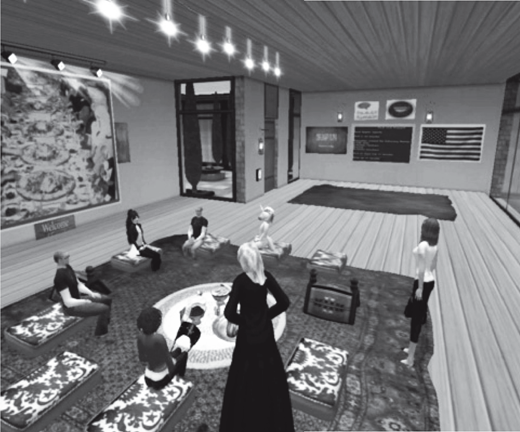
Using principles of third place theory (Oldenburg, 1989), researchers designed a traditional Saudi tearoom (see Figure 1). Seating was arranged in a circular position around a table with a teapot, cups, and food items to foster communication. Open spaces allowed for object placement (e.g., musical instruments, holiday decorations, sports equipment) to facilitate conversation. Slideshows, flags, and images were displayed on the walls. This space allowed Saudi and native English participants to congregate for hosted, voluntary, hour-long exchanges that were independent of school and university programs.
Participant Selection
Following university institutional review board approval, researchers invited Saudi students with sixth level English proficiency (i.e., medium) or above to participate. This cutoff ensured sufficient English proficiency for extended communication purposes. Saudi students were informed of the study, purposes, and requirements via e-mail sent through the university-sponsored Saudi Club. Researchers also invited Saudi students during meetings at the English Language School.
Interested students met with the lead researcher who introduced project goals, timelines, and participant roles. Six Saudi students (two females and four males) provided initial consent. However, one female ended participation prior to using Second Life because she lacked speaking confidence with diminished nonverbal cues. Remaining participants ranged from 21–37 years old. All had familiarity navigating the Internet and playing 3D video games prior to this study. One was familiar with Second Life (see Table 1). Participants selected pseudonyms used throughout this article.
Data Sources
Written reflections
After completing interaction sessions in Second Life, participants were given question prompts to describe their experiences (e.g., describe your experience interacting with people from different cultures in Second Life, write about the quality of the conversation activity, what are the pros and cons of cultural exchange through Second Life). Question prompts were developed in English and translated into Arabic to promote candid and accurate responses. Participants wrote entries in Microsoft Word and sent them to the lead researcher who translated them into English. Three native Saudis (an ELL teacher and two colleagues) unaffiliated with the study reviewed translations for accuracy.
Interview
Following Second Life sessions, the lead researcher interviewed participants using a semistructured interview protocol (Patton, 2002). The protocol asked 20 questions organized into three sections regarding the influences of Second Life on cross-cultural interaction, cultural dialogue, and third place promotion. Sample questions included: Tell me about your experience using Second Life for cross-cultural interaction. Describe your level of engagement over the interaction sessions. What were the main factors that made you engaged/less engaged with the conversation activity? What was the major benefit or concern of using Second Life for cross-cultural exchange? Questions were written in English and translated into Arabic. Interviews occurred in Arabic and were translated into English by the lead researcher. The same reviewers checked translations for accuracy.
Observation Journal
The lead researcher kept an observation journal throughout the study and included notes regarding Second Life activities, project progression, personal thoughts, ideas about conversation topics, analysis ideas, and memos.
Procedures
During fall 2014, researchers distributed e-mail fliers describing the project to the Saudi Club. Additional Saudis were contacted via Skype and telephone. Those interested were asked to attend an online or face-to-face, 60minute workshop. During the workshop, the study was again explained and consent obtained. Then a researcher instructed participants on avatar creation, Second Life installation, and program use. After participants logged into Second Life, the researcher taught basic commands (e.g., movement, object interaction, communication, search, and teleportation). Participants were encouraged to practice these commands until they became familiar. Then participants were informed of conversation topics they would discuss in future sessions and encouraged to search for cultural artifacts and locations in Second Life to illustrate these topics. Ideas, questions, and artifacts were submitted via e-mail to the lead researcher and checked for cultural appropriateness. Saudi students and native English speakers participated in separate workshops conducted in their native language.
Participants met in the designed tearoom (named the Cultural Café) to exchange ideas regarding selected topics during three weekly sessions. Each session lasted ~60 minutes. Following introductions, Saudi participants introduced the topic (e.g., family relations, food, social occasions, holidays, hobbies, and vacations) and described their traditions. Relevant cultural objects were also shown and described. Native English speakers then entered the conversation by comparing Saudi traditions with their own. Following these presentations, both groups asked and answered clarification questions. This exchange lasted ~40 minutes. Afterwards, the group teleported to culturally representative locations for additional discussion. Teleporting activities lasted 15 minutes per session and were visited in advance by the lead researcher to ensure accuracy and sensitivity. Each session occurred in English.
Following each session, Saudi participants wrote a journal entry regarding their experiences. After the final session, participants completed a face-to-face or telephone interview and submitted their journals. Interviews lasted between 30–45 minutes.
Analysis
Journal entries were translated into English, checked by external reviewers for accuracy and uploaded to NVivo 9. Interviews were transcribed, translated, checked for accuracy, and uploaded to NVivo 9. Initially, open coding techniques were used to identify partici-pant-defined ideas (Patton, 2002). Researchers documented these ideas in a codebook, defined categories, and provided representative code samples (Miles & Huberman, 1994). Constant comparison was used to identify and refine themes, categories, and sub-categories associated with research questions (Patton, 2002). Changes to the codebook as well as ideas for later comparisons were recorded and analyzed via memos (Miles & Huberman, 1994; Patton, 2002).
Results
Participants stated cross-cultural experiences in Second Life helped them gain cultural knowledge and clarified misconceptions. All participants stated they learned aspects of American culture unknown to them previously. Discussions helped them to understand purposes surrounding American activities and assume the perspectives of others. However, some participants wondered whether discussed topics represented cultural norms or individual traditions.
Cultural Knowledge
After attending Second Life sessions, all participants stated they learned new aspects of American culture, including expectations and approaches for travel, food, vacation, family life, hobbies, and holidays. Khalid explained, “there were aspects of American family life that were not clear for me and I learned much about them.” Turki wrote,
I gained lots of information about new things such as holidays. I understood more about Martin Luther King Day and why it is celebrated. I learned which holidays are secular and which are religious; Americans provided extensive information about each topic.
He added, “It was a very good experience and I benefited so much from the conversations about holidays, Americans life style, hobbies, activities, and I especially enjoyed listening to how they go hunting.”
All participants contrasted Second Life sessions with cultural exchange in face-to-face settings. They indicated that face-to-face sessions were often of short duration and focused on immediate information. Momen stated:
It is hard to find people in face-to-face settings who want to discuss and exchange cultural information. However, in Second Life individuals came to these sessions ready to talk … about cultures and learn new things. Because face-to-face conversations are ordinary talk, you rarely find people who want to talk or answer questions about culture.
Yara made similar comments:
It [Second Life] was a very beneficial experience and saved time…. In actual encounters we spend a long time until we are able to ask or learn about things we want to know (without any barriers). I liked the discussion and dialogue activity because we exchanged information freely.
Clarification of Misconceptions
Participants stated their interactions clarified misunderstandings. Khalid said,
American culture is understood from the perspective of its people (as the movies and TV shows from Hollywood do not reflect the real culture of the people). Throughout our conversations, we discovered that there are things that are so much exaggerated in these TV shows and movies and that there are things not presented. So we know from their experiences [that] certain information or ideas could help us understand the culture and help Americans better understand Arab culture.
When asked about the cultural exchange sessions Turki stated, “It will greatly help in bridging the cultural gap…. There are many people who have misconceptions about Arabs, Muslims, or Saudis and we can better understand Americans.”
Although participants identified cultural understanding as an advantage, Khalid questioned the generalizability of the information: “Though they [Americans] provided many stories about themselves, I still wanted to listen for more to know if it is a general trend for most Americans or just personal experience.”
Second Life Factors
Participants explained that the ease of tool use and avatar representations facilitated cross-cultural interaction.
Ease of Use
All participants stated that Second Life was easy to use. Yara said, “It [Second Life] was an enjoyable experience and easy to use at the same time. The sign up process was easy compared to the Xbox, for example. The program was easy to use.” Momen said,
there is nothing too complicated about it [Second Life]. It was simple to use, very basic, and the best part was the search button. You can get to anywhere you want using it. We could hear and speak very clearly, and it was so much fun to use.
Access
Ease of use also helped people access the space—making it more conducive to cross-cultural interaction. Yara explained,
What helped is that by pressing a button we are within a group of ten while I am sitting in my home. There is no need to drive far, ask someone to take me to a certain place, pay money to join such sessions, or have to travel a long distance. Just sign in and I am within a group.
Khalid said “signing up was easy. Accessing the program and the cultural café were easy and I did not need any help to access and attend the sessions.” Turki said “I did not have any problem accessing the café.” Perceived proximity and ease of use helped participants interact with individuals that may not have been easily accessible otherwise.
Yet, technical difficulties occurred among all participants. Khalid said “the experience was comfortable and went smoothly except for some technical difficulties in the first session.” Turki said he had problems “with the program itself because it was slow and had some issues in the voice quality.” Some participants reported computer crashes or high lag times. Others experienced slow Internet connections, audio problems, or were unable to initially navigate to the Cultural Café. Despite these difficulties, all participants indicated the application “was easy to use.”
Avatar Use
Avatar use also influenced perceptions of cross-cultural communication. All participants stated that avatars helped them interact with Americans, providing them with freedom of representation and expression.
Freedom of Representation
Avatars acted like a vehicle to introduce participant identities without directly presenting cultural information that could be stereotyped or misconstrued. This vehicle allowed Saudi participants to reveal and discuss their cultural identities and beliefs on their own terms. Second Life became a space to practice linguistic skills, improve fluency, and share information without embarrassment.
Rashid mentioned that the flexibility of avatar choices allowed participants to tailor how others saw them. The avatar helped him to have conversations with others that he perceived as difficult in real life settings because of his physical appearance.
My [actual] appearance might keep people away from me as I look like a conservative man. And, in actual life some people do not want to be around me. But if I have a nickname and virtual appearance, they will be more open…. For example, [I] can appear wearing a certain dress, be like an animal, or be in opposite gender appearance. This freedom of expressing self cannot be easily achieved in actual life.
Yara's avatar helped her interact with individuals of different genders.
It was [a] good experience because I was less shy. I felt more able to ask and exchange ideas, especially with men because I am very shy asking them questions in face-to-face settings.
Virtual encounters enabled Yara to interact more naturally with male participants, something uncommon in Saudi Arabia where genders are separated in most education and job sectors. Rashid made similar comments:
I don't feel comfortable having meetings with females and I am one of those who always try to avoid it. But in Second life, I am more outgoing and less embarrassed as we can talk to each other freely…. Certain religious and cultural restrictions that prevent us [Saudis] from interacting physically with the opposite gender in face-to-face settings are not present [in Second Life].
Freedom of Expression
Saudi participants indicated that interaction through avatars helped them feel more comfortable when discussing cultural issues in English. Rashid said,
It was a wonderful experience and especially helpful for people who are still learning the language as they will be more outgoing because no one sees them. So they have freedom of expression as they can discuss issues that they cannot discuss face-to-face.
Khalid said
It [the avatar] frees me from constraints of shyness and allows me to be more outgoing in conversing with others since I don't know them and they don't know my actual self…. They will judge me according to my virtual encounter with them.
Avatars initially acted as a buffer between all participants and native English speakers. They masked true appearance and gave participants courage to speak about cultural topics. However, interviews and journal entries revealed that this buffer was not meant to disguise or hide behind. Participants wanted to discuss their culture and beliefs. The avatar gave them a means to do this without feeling prejudged by their gender, clothing choice, and other visual representations. As they became familiar with the setting, participants forgot the buffer existed and discussed their beliefs freely. Yara stated, “I did not feel that I was in a virtual world, especially during the last session…. Sometimes I forget that I am communicating through my avatar and feel that I am really there with actual people.”
Host Role
Discussions were also facilitated by the researcher hosting the Cultural Café. Participants stated they enjoyed conversations because they were organized. The host encouraged participation, connected ideas, and kept conversation flowing. Khalid stated he “liked that the host was participating, asking questions, and trying to make everyone participate.” Turki mentioned:
The host was very creative. She was very active and managed the session in a professional way. For example, when we finished one topic we immediately started another so the flow of conversation was not slow and the time was used wisely.
Similarly, Yara said, “If there is no administrator managing the discussion, participants from both groups might not like the cultural café activities. For example, the choice of appropriate topics and the avoidance of sensitive issues is very important.”
However, participants made recommendations to improve sessions. These often focused on increased autonomy and time in discussing cultural topics. Khalid stated, “Allowing for more personal experiencesm and more stories [would be nice].” Rashid also suggested giving participants more control over discussion topics.
Each session should be the responsibility of one or two to facilitate and they should decide the topic…. It will be better if sessions are not only prepared and managed by the administrator of the café. More tasks should be given to guests.
Discussion
All participants stated they learned aspects of American culture during Second Life sessions that they did not know previously. They also indicated that discussions helped them understand the purpose of American activities (e.g., rodeos, pet care, Martin Luther King Jr. Day, and world travel). These discussions helped participants assume the perspective of others via personal interaction (Mullen et al., 2007). Additionally, participants stated that Second Life gave them a space to discuss and explain their own culture. Interaction built bridges of mutual understanding, empathy, and respect. Similar to findings by Bahumaid (2008), Citron (1995), Seelye (1988), Tomali and Stempleski (1993), and Tucker and Lambert (1972), discussions clarified ideas that were stereotyped or exaggerated in American media outlets. Despite obstacles like anxiety, misconceptions, and lack of cultural instruction in language classrooms, participants held meaningful conversations (Bahameed, 2008; Mekheimer & Al-dosari, 2011).
Ease of Use
Studies claim that Second Life has a steep learning curve (Warburton, 2009). This finding contrasts sharply with our research. Although every participant experienced technical problems, they were able to overcome them and indicated that Second Life was easy to use and navigate. This ease may be due to prior video game experience. All participants used video games that may have situated tasks in Second Life (e.g., avatar creation, communication, navigation, and construction). As society becomes more accepting of video games, familiarity with virtual environments may become more common. However, evaluating learners' skillsets prior to implementing virtual activities is important to determine training needs and approaches.
Avatars
Avatar use also facilitated cross-cultural interaction. Participants stated their avatars acted like a buffer, providing them with freedom of expression and representation. They felt less stigmatized in virtual settings and more protected from losing face if they made linguistic mistakes. Differences in appearance are generally accepted in Second Life and add to the visual diversity of the setting. This acceptance helped participants to enter conversations without fearing prejudgments based on appearances (Chang, 2007; Wang, Song, Xia, & Yan, 2009). This is consistent with Al-Harthi (2005) who stated that Arab online learners interacting with English native speakers prefer online interaction over face-to face settings due to a “reduced sense of social embarrassment” (p. 7). Participants in this study reported that virtual environments have more potential for communication than other online tools (e.g., VoIP, chat, synchronous video) because conversation is supported by virtual locations, objects, and interaction.
Projecting self on avatars can increase motivation to use virtual environments for knowledge acquisition. Participants stated they forgot they were interacting in a virtual world. Avatar use also fostered access to the target cultural group. Instructors can exploit the virtual environments to design activities for struggling learners who have difficulties in face-to-face communications and using the avatar element can be like a buffer that protects shy or reluctant learners in new interaction. However, more research is needed to explain other reasons from different cultures behind learners' sense of comfort in communicating through avatar for cultural or linguistic difficulties and how this could support or hinder cultural exchange
Third Place
The benefits of virtual environments suggest that avatar use in third place settings may exceed benefits via physical presence. Indeed, virtual environments may facilitate global third places as users gain access to cultures and communities throughout the world. While the purpose of this study was not to develop a third place over time, the theory guided planning and design of cultural exchange sessions. Participants suggested that site neutrality, social leveling, ease of access, and in-depth conversations occurred.
However, further research is needed to address issues that may arise when conversations continue over time (e.g., potential language barriers, changing host roles). The language of discussion was English and this may have inadvertently created power differences between English native speakers and English language learners. Certainly, hierarchical status could be established on participants' linguistic and conversational skills. The host role, and the influence of language and linguistic skills on social leveling and neutrality should be researched further in sessions of longer duration. The limited number of sessions in this study prevented researchers from considering the establishment of regulars, commonality, and a feeling of being at home away from home (Oldenburg, 1989). Although one participant invited a friend to the final session, it was unclear if the structure employed in this study would adequately support sustained community building over time through optional, culturally driven activities. Additionally, participants' focus on academic achievement may have predisposed them to attend learning sessions. Additionally, the number of Saudi ELLs with medium English proficiency was limited in the research site affected the duration and number of interaction sessions available with native speakers. Future research should tackle these potential challenges.