This article considers formal and informal learning activities in massive open online courses (MOOCs). MOOCs are often broadly positioned as either cMOOCs (based on connectivistic pedagogies) or xMOOCs (based on cognitivistic/behavioristic pedagogies). In a recent International Review of Research in Open and Distance article, Anders (2015) proposed a tripartite scheme for placing MOOCs on a continuum from content-based (xMOOCs) to community/task-based (cMOOCs) to network-based hybrids. Anders’ model is based on a meta-analysis of literature-based case studies of existing pedagogical approaches in MOOCs. In contrast, our in situ case study examined an emergent, hybrid MOOC design. The study shared in this article is focused on establishing the presence of both formal and informal learning activities in a network-based hybrid approach to MOOC design. The establishment of these two activity systems extended to include opportunities for boundary crossings between them. An outcome is a cultural-historical activity theory-informed model that extends commonly used and recognized MOOC typologies.
Moocs
MOOCs can be defined as larger class sizes, available online to almost anyone, and involving learning objectives, assignments, and evaluation. Two primary approaches to MOOCs are cMOOCs (based on connectivistic pedagogies) and xMOOCs (based on cognitivistic/behavioristic pedagogies). xMOOCs can be seen as instances “where traditional institutions use online platforms to extend access to onsite learning activities, resources, and events, typically based upon the transmission of content and verification of reception model” (O’Toole, 2013, p. 2). O’Toole (2013) upholds xMOOCs and cMOOCs as not only distinct, but as “extremes” (p. 1). However, “basic pedagogical approaches are very similar”: course materials are held in “a hub or central repository,” learners participate “through online forums, study groups, and (in Coursera and Udacity) organized meetings,” and automated software is often used to assess learner performances on quizzes or other assignments (Johnson et al., 2013, p. 12).
Learning Activity in MOOCs
Participants in either form of MOOC are identified as more self-directed (McAuley, Stewart, Siemans, & Cormier, 2010) than those involved in other types of online learning. Participants engage in “informal consumption, creation, communication and sharing of knowledge” (Selwyn & Simons, 2009, p. 2). MOOC participants are often portrayed as self-reflective, producing “self-generated thoughts, feelings and actions that are planned and cyclically adapted to the attainment of personal goals” (Littlejohn, 2013). They “self-organize their participation according to learning goals, prior knowledge and skills, and common interests” (McAuley et al., 2010 p. 4). Participants’ learning experiences are claimed to be influenced by a MOOC design’s tendency to “flatten hierarchy by allowing and forcing personal connection across the boundaries between teachers and learners in traditional academic and professional circles” (McCauley et al., 2010, p. 37). This latter phenomenon can arise most noticeably in that MOOCs often include a peer-evaluation system (O’Toole, 2013).
Haber (2014) typified xMOOCs as “the same lectures, reading and homework assignment, assessments, and discussions you would find in a traditional college class” (p. 47). xMOOCs tend towards formality “where learning is aligned to planned outcomes from an accredited curriculum and organized by a teacher who has a hierarchical relationship with students” (Wright, Short, & Parchoma, 2013, p. 54). Learning goals are typically defined by the teacher, and learning pathways are set within a bounded environment (Littlejohn, 2013). cMOOCs have been seen to follow “connectivist principles, where large numbers of participants self-assemble collections of knowledge, learning activities and curriculum from openly available sources across publically open platforms” (O’Toole, 2013).
Pedagogy, Androgogy, And Heutagogy
Anders (2015) argued that distinctions among pedagogical, androgogical, and heutogogical assumptions about teaching and learning processes are salient to categorizing MOOCs. He defined pedagogical approaches as inherently evoking “instructor control” (p. 45), involving highly structured content and tasks that allow for few, if any, opportunities for individual learner autonomy or self-direction. In contrast, androgogical approaches allow groups of learners to negotiate pathways to achieving “skills and competencies” with their instructor. Heutogogical approaches promote “self-determined learning” in crowds or networks for the purposes of achieving “higher-order capabilities” and “critical thinking” (p. 45). While Anders’ distinctions are valuable conceptual tools, his definition of pedagogy seems to be focused on behavioristic and cognitivistic pedagogical perspectives.
Behavioristic and Cognitivistic Perspectives on Pedagogy
A key tenet of behaviorism is “the principality of the individual (and her/his physical presence—i.e., brain-based) in learning” (Kowch, 2004, p. 87). Behavioralist explanations of the individual mind asks us to perceive cause-effect chains of environmental stimuli and embodied responses (Skinner, 1938). Learning then becomes a “direct reaction to the task set before a learner” (Vygotsky, 1978, p. 39). Behavioristic pedagogies focus on the efficient design of learning tasks and measurements of learning outcomes. Comparatively, cognitivistic pedagogies focus on logical ordering of content to be learned, tasks to be undertaken, and measures of outcomes. From a cognitivist perspective, the human mind is conceptualized as a system (Markauskaite & Goodyear, 2017) rather than an unseen intermediary between a stimulus and a response. From a cognitivist perspective, an individual’s mind operates “as central control mechanism capable of abstraction, goal-setting, and imagination” where cognitions are “system-bound functions and processes that enable thoughts, decision-making, and action” (Parchoma, in press). Both behavioristic and cognitivistic accounts of human learning focus on accurate replication of received knowledge within the confines of an isolated mind. Neither account provides a comprehensive picture of learning processes.
As Barsalou, Breazeal, and Smith (2007) have argued, cognition cannot be fully understood as limited to a collection of processes operating within a closed system because cognitive processes must coordinate with other internal (embodied) and external (socio-cultural and environmental) systems. (Parchoma, in press)
Pedagogical approaches that focus on either behavioristic or cognitivistic perspectives of learning lack considerations for sociocultural and environmental influences on learning processes. They fail to address possibilities for emergent knowledge.
Connectivistic Perspectives on Pedagogy
Connectivism involves “a more individualized or personalized perspective on learning” (Ryberg, Buus, & Georgeson, 2012, p. 51). Connectivism is “a pedagogy in which knowledge is not a destination but an ongoing activity, fueled by the relationships people build and the deep discussions catalyzed within” (Johnson et al., 2013, p. 11). Where behaviorism focuses primarily on what is internal to a learner, connectivism addresses “learning that occurs outside of people” (Siemens, 2005, para. 12). Downes (2017) argued that, “knowledge is itself a set of connections in network, a pattern of connectivity…. Learning therefore needs to be active, it needs to be networked-based, and it needs to be constituted essentially of interactions between networks of users” (p. 12).
Instructional designers following connectivism are more likely to design tasks focused on “connecting specialized information sets” (Siemens, 2005, para. 16), within “a more individualized or personalised perspective on learning” (Ryberg, Buus, & Georgsen, 2011, p. 51). cMOOCs may involve “software tools for discovery, connection, and cocreation” (Milligan, Littlejohn, & Margaryan, 2013, p. 150). Within connectivism, goals for learning “tend to be defined by the learner … learning pathways are open and ill defined … and interaction with others is expected but has to be initiated by the learner” (Littlejohn, 2013). Learning in cMOOCs can thus be identified as having “informal, incidental, learner-initiated activities” (Wright et al., 2013, p. 54).
Constructivist Perspectives on Pedagogy
Constructivist theory, most closely aligned with our work, draws on personal experience and contextualizes it: “the individual human subject engaging with objects in the world and making sense of them” (Crotty, 2010, p. 79). From a constructivist perspective, learning can be seen as “a negotiation between individual and social knowledge, whose contributions have a dialectical relationship and cannot be meaningfully separated” (Karagiorgi & Symeou, 2005, p. 18). Karagiorgi and Symeou (2005) argued that student-centered instructional environments would include authentic tasks and are supported through teacher scaffolding. In a constructivist learning environment, approaches such as the following are used: “situated cognition, cognitive apprenticeship, anchored instruction and cooperative learning” (p. 18). Learning emerges from the interaction between learners and the world around them.
Cultural-Historical Activity Theory
Cultural-historical activity theory (CHAT) gives weight to cultural, historical, as well as technological human activity. Activity theory “provides an effective lens for analyzing tasks and settings” (Jonassen & Rohrer-Murphy, 1999, p. 222). It provides a system to support the conceptualization of formal and informal learning as activity systems. The assumptions of CHAT “are consonant with those of constructivism” (Jonassen & Rohrer-Murphy, 1999, p. 62), particularly in the conception of knowledge construction emerging from interaction among humans and their contexts. Within activity theory “conscious learning emerges from activity (performance), not as a precursor to it” (p. 62).
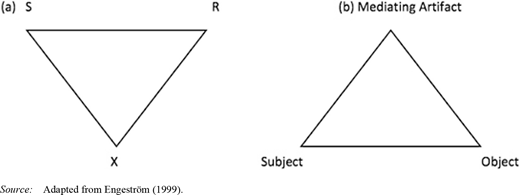
Activity theory posits human activity as mediated by tools, both Vygotsky’s model (Figure 1A) and the common reformulation (Figure 1B) include an individual or “subject” who uses a tool or tools (mediating artifacts) to achieve objectives (Engeström, 2009, p. 54; Vygotsky, 1978, p. 40).
Within activity theory “conscious learning emerges from activity (performance), not as a precursor to it” (Jonassen & Rohrer-Murphy, 1999, p. 62). Interaction between the human (subject) and the nonhuman (mediating artifact) begets knowledge construction (object).
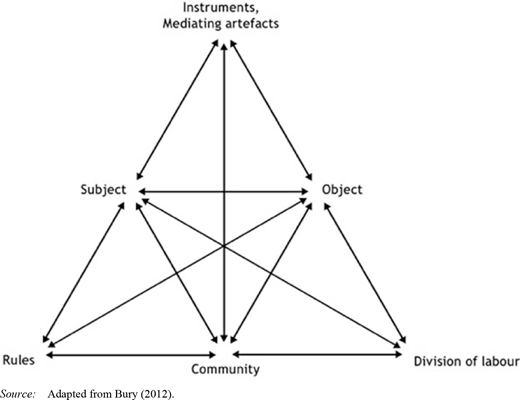
Engeström’s (2001) graphical representation of “Leont’ev explicated … crucial difference[s] between individual action and collective activity” (p. 54) extends the original triangle beyond the individual to include social or collective aspects of an activity system (Figure 2).
In this depiction, the subject also engages in an activity, mediated by artifact and directed towards an object. This activity occurs within a context of rules, community, and division of labor. All six elements within this activity system relate to each other, and yet tensions can develop within and between the elements. The following are examples of tensions related to the CHAT elements (Engeström, 2001): (1) “Primary contradiction involving tensions arising anywhere within any of the CHAT elements”; (2) “Secondary contradiction involving tensions arising between CHAT elements”; (3) “ Tertiary contradiction involving tensions arising between the new and the old activity system”; and (4) “Quaternary contradiction involving tensions arising between activity systems that may result in boundary crossings from one activity system to another” (Rückriem, 2009, p. 151).
This reconceptualization of an activity system “turned the focus on complex interrelations between the individual and his or her community” (Engeström, 2009, p. 55). Within this model, internal activities are examined alongside external activities as they transform into each other.
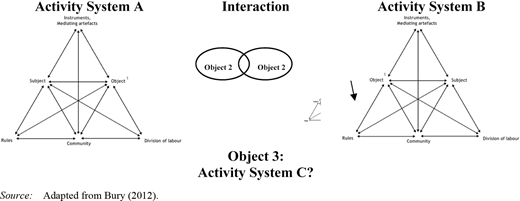
In third generation activity systems, boundary crossing includes the interaction of (minimally) two interacting activity systems (Engeström, 2001). In Figure 3, boundary crossing occurs when members of two activity systems engage in a shared object (Object 2), which results in a new, potentially shared or jointly constructed object (Object 3). When boundary crossing becomes purposeful and prevalent, the jointly constructed object can become its own new activity system.
When knowledge construction is the object, boundary crossing occurs when members of Activity Systems A and B engage in a shared object, sense-making (Engeström, 2001). This results in a new, potentially shared or jointly constructed approach to solving a problem. Sense-making in this context, Object 3, can be seen as the potential for collaborative knowledge construction.
Conceptualizing Learning Opportunities As Activity Systems
For the purpose of our project, conceptualizing xMOOCs as an instance of a formal e-learning activity system and cMOOCs as an instance of informal e-learning activity provides a means by which to compare and contrast these two approaches to MOOCs.
Formal and Informal Activity Systems
Formal learning, sometimes referred to as traditional or formal education, has been defined as “(i) organized deliberately to fulfill the specific purpose of transmission, (ii) extracted from the manifold of daily life, placed in a special setting and carried out according to specific routines, and (iii) made the responsibility of the larger social group” (Scribner & Cole, 1973, p. 555). It can also refer to “learners in classes being taught by teachers who deliver comprehensive, multiyear curricula” (Schwier & Seaton, 2013, p. 2). Formal learning is “institutionally sponsored or highly structured, i.e., learning that happens in courses, classrooms, and schools, resulting in learners receiving grades, degrees, diplomas, and certificates” (Dabbagh & Kitsantas, 2011, p. 2).
Informal learning has been defined simply as learning done “outside any educational institutions or organized courses” (Livingstone, 2007, p. 2). Indeed, informal learning is often defined as being “the opposite of schools” (Crowley, Pierroux, & Knutson, (2014, p. 466). Its characteristics have been identified as involving (1) “incidental, learner-initiated activities … delineated by absence of formal assessment” (Wright et al., 2013, p. 54); (2) “free choice, include a diverse and nonstandardized range of topics, and have flexible structures, socially rich interactions, and no externally imposed assessments” (Crowley et al., 2014, p. 466); or (3) “institutional, curricular, and externally imposed authority” (Wright et al., 2013, p. 54).
For Dabbagh and Kitsantas (2011) informal learning involves learning driven primarily by the learner and “happens through observation, trial and error, asking for help, conversing with others, listening to stories, reflecting on a day’s events, or stimulated by general interests” (p. 12). Informal learning “can be pervasive in peer-to-peer interactions within school, and formal learning may take place in non-institutional settings such as community centers, or during an ‘instructional moment’ when a parent mimics didactic instruction” (Bransford et al., 2006, p. 29). The term informal learning has a negative prefix adding both a negative denotation to the term, at the same time fixing it as opposite to formal learning. Compounding the negativity, as Billet (2013) pointed out, “to describe something by what it is not (that is, informal or non-formal is seen primarily in contrast within educational institutions) is unhelpful in characterizing and appraising it effectively” (p. 131).
In Table 1, each row lists a CHAT element (left hand column). The second column, offers CHAT generalized descriptions of formal learning from the broader and xMooc literature. Information presented in the second column serves to define formal learning broadly conceptualized as an activity system. Table 1 provides the means by which to conceptualize xMOOC as formal activity systems.
In Table 2, each row lists a CHAT element (left hand column). The second column offers CHAT generalized descriptions of informal learning from the literature. Information presented in the second column serves to both define informal learning as conceptualized as an activity system. In this Table 2, it provides the means by which to conceptualize cMOOCs as informal activity systems.
Conceptualizing xMOOCs and cMOOCs as “representing opposing pedagogies or ideologies … threatens to blur more interesting distinctions and overlaps between the two” (Haber, 2014, p. 40). In the following section, we examine the notion of boundary crossings in MOOCs.
Need for Boundary Crossings in MOOCs. Conole (2014) suggested learning “occurs along a spectrum from formal to informal; from loosely based resource-based learning to a structured time-defined course, which is accredited” (p. 72), whereas Hall (2009) noted that formal and informal learning should be connected to optimize learning and that learning is most effective when learners engage in both formal and informal learning activities. Boundary crossing between activity systems may lead to expansive learning activities, which “produces culturally new patterns of activity” (Engeström, 2001, p. 139), and potentially leading to a new activity system. Boundary crossing “occurs because human beings are involved in multiple activities and have to move between them” (Engeström, 2009, p. 315).
Bunderup Dohn (2009) proposed adopting pedagogical strategies that transcend discrepancies in e-learning (and/or Web 2.0) environments in order to accommodate these tensions. Such strategies would involve “boundary practice” (p. 354), an approach to learning that “borders on and to some extent incorporates the practices of” both working life and educational settings (p. 354). The development of a MOOC, specially designed to include opportunities for both formal and informal learning, is positioned as a form of boundary crossing object, where the intent is to have learners engage with interrelated “attributes of formality and informality” (Wright et al., 2013, p. 55).
Hybrid Mooc Design
Our project involved a design of a MOOC inspired by The Frankenstein Bicentennial Project (Arizona State University, 2014). In April 2014, one member of our research team was invited to join other scholars, educators, artists, and writers for a 3-day symposium hosted by Arizona State University. She was part of a subgroup of eight whose interests and experiences best aligned with the subtheme “MOOCenstein: Frankenstein Goes Global”:
The MOOC will use the novel, Frankenstein , as a gateway for connecting STEM content with humanities, social sciences and arts, and it is designed to create an international community of thinkers critically engaged with the ethical, legal and societal issues raised by Frankenstein beyond traditional college and university environments. (Arizona State University, 2014, para. 6)
Inspired by this goal and the working group, this member of our research team designed From Frankenstein to Post-Humanism . A key principle for the hybrid MOOC design was that it would be inclusive of learning opportunities arising from both formal dimensions (instructor-designed tasks) and informal dimensions (emergent, autonomous and collective, participant activities). The aim of the design was to encourage thought-provoking investigation, discussion, and ideas around the central concepts of the novel Frankenstein and posthumanism. Key activities included exploring ideas and themes raised in Mary Shelley’s Frankenstein, engaging in critical thinking and discussion within an international community that included opportunities to form subcommunities of individuals with shared research interests, and creating or curating artifacts, and showcasing a portfolio of accomplishments. The MOOC design functioned as the locus for our study.
The Study
Our case study was temporally situated within the design stage of MOOC course creation. The inquiry was guided by the question of how instructional designers perceived future learners’ opportunities for boundary crossing between formal and informal learning within the Frankenstein to Post-Humanism MOOC design.
The population was postsecondary level instructional designers. The sampling frame included those involved in instructional design (practitioners or academics) who had a minimum of 5 years’ experience, particularly in relation to e-learning in Canadian or U.S. universities. Prospective participants were selected from blogs and websites (some of which list instructional design, teaching and learning centers, and similar departments within institutions). Academic and conference papers were also used as sources. The result was a convenience sample of eight instructional designers. To retain anonymity, each participant was identified by the acronym ID and a randomly assigned number from 1 to 8 (ID1, ID2, ID3, and so on).
The “exploratory sequential” (Creswell, 2012, p. 541) research design for the case study involved three phases. Beginning with survey data and its analysis led to the development of questions for the semistructured focus group interviews with seven of the eight research participants who were divided into two focus groups. Focus group interviews were conducted for the purpose of gaining insight into participants’ approaches to analyzing the learning design in the MOOC. The focus group findings were then analyzed to develop the semistructured protocol for individual interviews. A semistructured interview process was used to allow the flexibility to pursue emergent ideas.
Phase I: Online Survey
The online survey involved participants completing a 45-question 4-point Likert style survey. The questions related to opportunities for formal and informal learning in the From Frankenstein to Post-Humanism MOOC design. Fifteen core questions were asked about each of three sections within the course design (introductory, core, and end). Enge-ström’s (2009) third generation of cultural historical activity theory (CHAT) informed the survey design. Survey questions were created to align with CHAT-elements, as illustrated in Table 3.
Participants were asked to examine the course design and then to complete the survey. The survey provided quantitative data and also functioned as a method of comprehensive introduction to the course design itself. It was orientation to key concepts explored.
Phase II: Focus Group Interviews
Once the surveys had been completed, research participants were invited to participate in a semi-structured focus group interview to provide more detailed information about their perceptions of opportunities for learners to engage in formal and informal learning opportunities. The focus group interviews included questions of how the participants would define formal and informal learning, and how they saw opportunities for formal or informal learning experiences in the MOOC design. Through the interview, opportunities for boundary crossing between formal and informal activity systems were explored. Data from the surveys were used to inform the creation of focus group interview questions. The following are examples of questions asked.
Phase III: Individual Interviews
The creation of individual interview questions followed a semistructured protocol based on Phase II data. A semistructured strategy allowed for exploration of key areas that emerged from the focus group data. The first question was designed to elicit responses related to the CHAT elements subject and community; the second question to the CHAT element object(ive)s; the third question rules; the fourth mediating artifacts; and the fifth division of labor. Included with the questions were selected quotations from the focus group transcripts that were particularly interesting, puzzling, or salient. For example, ID5 “So to a certain extent, even informal learning you have to design into your course.” Each participant was asked to comment further on selected quotations.
Data Analysis
The data were reported in a table that provided a comprehensive image of participant responses question by question. In order to undertake more refined observations, a method of scoring the data were used that involved the creation of codes. The codes (derived from CHAT elements and instances of formal and informal learning opportunities, as well as opportunities for boundary crossing) were then directly applied to the list of survey questions. In addition, summed scores based on the number of participants who selected each measure on a Likert style scale (strongly agree, agree, disagree, strongly disagree) were calculated. Along with this coding, cross tabulations were conducted to identify interdependent relationships between formal and informal learning opportunities, as well as between formal and informal CHAT elements. This information allowed us to “summarize the overall trends or tendencies” from the survey data (Creswell, 2012, p. 183).
A constant comparative method of analysis was used to examine the focus group and individual interview data sets (Creswell, 2012, p. 434), thereby identifying emergent themes arising from participants’ extrapolations of the survey data. Phases II and III data analysis involved examining tensions and contradictions between formal and informal learning opportunities in order to consider insights into participants’ perceptions of learners’ opportunities for boundary crossing. For example with the CHAT element rules, results were interpreted by identifying areas of contradiction or tension—specifically, “open” versus “structured” and “possibilities” versus “objectives.” This could underlie tensions and/or contradictions between formal and informal learning activity systems identified in the survey results. Tensions and/or contradictions within an activity system can lead to boundary crossing between activity systems. Corroboration of evidence across data sets were needed to garner a clearer understanding of the boundarycrossing potential within the MOOC design.
Discussion Of The Findings
Formal and Informal Learning as Activity Systems
Fundamental to answering the first two subquestions was the establishment of formal and informal learning as activity systems. The notion of formal and informal learning conceived as activity systems was presented in the literature review, with xMOOCs and cMOOCs operating as examples of formal and informal e-learning, respectively. Research findings upheld this conception of formal and informal learning as activity systems. Interpretation of the reported findings in order to answer our research questions began with charting formal and informal learning activity systems. This charting allowed for close examination and comparison of research findings to the literature.
In addition to the charts, research results related to the five themes (1, lost and found; 2, purpose and potential; 3, triggers and barriers, 4, individual in community; and 5, direction and self-directed). Through examination of the themes, quaternary tensions (between activity systems) provided insights and answers related to participant perceptions of learners’ opportunities for boundary crossing between formal and informal learning within the MOOC design. Results from the research data related to the CHAT elements extended examination and analysis of the participants’ perceptions of opportunities for formal and informal learning activities in the MOOC design to include perceptions of boundary crossing.
Building upon Table 1, from the data a fourth column was added that represents participants’ definitions of formal learning as drawn from the data (refer to Table 4). Each row in Table 4 demonstrates how the findings confirmed what was evident in the literature, and where they differed. Differences were interpreted to arise from the influence of the three distinct formal learning contexts compared in Table 4. For example, the row for rules, behaviorist/cognitivist theories of learning and xMOOCs was not indicated in the findings. This could be interpreted that how MOOCs “may vary in pedagogical underpinnings” (Ebben & Murphy, 2014, p. 335) is more often an aspect of xMOOC literature. Another likely context related difference was the participant perception of “payment associated.”
Similarities between the finding and the literature were also identified by scanning across the rows, again for example the CHAT element rules. Generalized descriptors of formal learning rules from the second column (planned and structured, planned curriculum, highly structured, and didactic instructional practices) run parallel to participant perceptions of rules from the fourth column (traditionally designed, systematic and structured, and structured learning path). As a result of such similarities across the rows, an overarching description can be derived. A formal elearning activity system involves predefined outcomes, and structured learning tasks, potentially influenced by behavioralist/cognitivist theories of learning, wherein specific learning management systems (LMS) influence primarily teacher driven interactions between teachers and students.
Similarly, drawing from Table 2 by adding a fourth column, Table 5 presents participants’ definitions of informal learning as drawn from the data. The table allows for easy access to compare and contrast the findings. That is, similarities in the descriptors could be seen across almost all the rows. For example, the similarities between the descriptors in the row mediating artifact, wherein the tools used in elearning such as MOOCs “encompass all forms of media—from text, to video, from sound recordings to immersive worlds” (Anderson & Kanuka, 2003, para. 11) are evident.
As a result of similarities in the descriptors identified across all columns and rows, an overarching description emerged. An informal e-learning activity system involves Web 2.0 tools, particularly social media, to achieve unknown or unknowable learning outcomes. This is often aligned with connectivist theory of learning and potentially involving a wide range of people, including life-long learners, peers, and lurkers.
Differences also became apparent from scanning the rows in Table 5. For example, with the CHAT element community, the generalized informal learning descriptors that descriptors from the literature (column two), and cMOOC descriptors (column three) differ from participant descriptors. The same row of column four offers cMOOC-related descriptors: learners, peers, instructors), connections with others via social media, and potentially including external experts. The far right or fourth column of the same row provides participant descriptors for informal community in a MOOC design: lifelong-learners and peers. Research participant perceptions of informal learning support the notion of informal learning as an activity system.
Moving from mapping CHAT element, in Tables 4 and 5, consideration of specific CHAT elements related to the five themes: (1) lost and found; (2) purpose and potential; (3) triggers and barriers; (4) individual in community; and (5) direction and self-directed.
First, the theme lost and found recognized a tension between formal learning CHAT element rules as a means of establishing and maintaining structure versus perceptions of unstructured informal learning. Quaternary tensions could also be seen in relation to the CHAT element object(ive)s. This was specifically found between formal learning where objectives are typically preestablished, whereas informal learning objectives may yet to be determined, if ever. Both of these themes and their related findings proved also to be corroborated by the literature.
Second, in relation to the theme individual in community, tensions and contradictions in relation to the CHAT element community proved emergent and thus difficult to perceive in a MOOC design. An interpretation of the emergent nature of community, therefore not likely visible in a MOOC design, was supported by the literature. The literature also supported observation of tensions identified in relation to both formal and informal learning mediating artifacts as potentially both supportive and inhibiting learning in the MOOC design.
Third, findings in relation to the theme triggers and barriers demonstrated participants perceived a greater number of instances of opportunities for formal learning within the mediating artifacts in the MOOC design. The literature supported observation of tensions identified in relation to both formal and informal learning mediating artifacts as potentially both supportive and inhibiting learning in the MOOC design.
Fourth, the theme purpose and potential indicated the objective(s) CHAT element was perceived by research participants as derived from learner need or preference, whether learning object(ive)s are predefined in a formal learning context, or possibilities available in an informal learning context. If the object of each activity system is learning, the outcome of the object will vary between the systems.
Fifth, the CHAT element division of labor related to tensions between teacher and selfdirection in formal learning also pointed to quaternary tensions between formal learning teacher direction and informal learning selfdirection. Within the perception of formal and informal learning in MOOCs, learner selfdirection or self-motivation (as indicated in Table 4 and 5) played a key role. “Any particular learner or group of learners may manifest elements of self-directedness in their learning whether it be within a formal … or informal learning” (Schwier & Seaton, 2013, p. 2).
Examination of participant definitions of formal and informal learning in the literature and the data answered our research questions in part and allowed for an interpretation supportive of the notion of formal and informal learning conceived as activity systems. Interestingly, another finding emerged from this study, supported by the literature, indicated that while formal learning was identified for what it is, informal learning was identified for what it is not.
Insights Drawn From The Data
Participants’ conceptions of formal and informal learning influenced their perceptions of opportunities for boundary crossing in a MOOC design. Examination of participant definitions of both formal and informal learning in the literature and from the data allowed for an interpretation supportive of the notion of formal and informal learning conceived as activity systems. Further, while formal learning was identified for what it is, informal learning was identified for what it is not. Overall, findings in this study were supported by the literature.
Formal and Informal Learning
Findings were investigated to identify participants’ perceptions of opportunities for formal and informal learning in the MOOC design (e.g., with the conceptualization of these learning contexts as activity systems). The use of negative wording (predominantly via prefixes such as un-and in-) to describe informal learning as not or opposite to formal learning particularly highlighted the participants’ perceptions of formal and informal learning as distinct activity systems. A conclusion to be drawn was that as the sample of designers who participated in the study work within formal learning environments, it is plausible participants’ professional experience was in a context where informal learning design was less likely to occur. Findings were examined to reveal interpretation such as the possibility of informal learning residing outside the professional scope of participants, and not typically be included in their instructional design thinking or practice.
Boundary Crossing
Findings supportive of formal and informal learning as activity systems allowed for examination of boundary crossing between these two systems (Engeström, 2001). Conclusions can be drawn in relation to each of the five major findings from this study.
First, a finding of our research was that participants in the study perceived that formal rules (as instantiated in course outlines, schedules, or assignments) as offering guidance to future learners for both formal and informal learning opportunities in the MOOC design. Formal rules would show future learners how to navigate content, assignments, and so on, therein providing a learning pathway or guide by which a learner could navigate a course. A conclusion to be drawn from this finding is that participants, as instructional designers in higher education contexts, placed primary importance on structure and guidance in course design. Instructional designers, such as the participants in this study, function within formal learning academic environments with numerous structures, systems, approaches, and procedures. It can also be concluded that informal learning rules may guide future learners’ social behavior (e.g., netiquette), even though this guidance is not directly intended to support learners through the achievement of learning goals. These two sets of formal and informal rules can be seen as setting a stage for a potential primary tension (Rückriem, 2009) arising within the CHAT element rules.
A second finding was that mediating artifacts or tools, particularly online technologies, can be supportive of, or prohibitive to, learning. Participants’ perceived technology in the MOOC design as involving in how learners interact with activities, resources, as well as with each other. Given that the design provided opportunities for future learners to use a varied range of tools, individual choices of mediating artifacts opened possibilities for secondary tensions (Rückriem, 2009) as a result between the CHAT elements of mediating artifacts and community continuity.
A third finding was that of participants’ perception of objectives in formal learning as known and knowable, and informal learning as unknown, possibly unknowable. This finding can be seen to align with Goodyear, Carvalho, and Bonderup Dohn’s (2014) questioning of “whether it is actually possible to design for someone else’s learning” (p. 139). What can be gleaned from this contradiction is that in the absence of formal learning objectives, informal learning perhaps could be seen to serve as a catalyst for an array of learning. Through informal learning, future learners will have the opportunities to seek information, test ideas, and develop new understanding through their own decisions and actions. Therefore, if we, like the participants in this study, consider the formal learning activity system as the benchmark activity system, then interactions with the informal, unknowable activity system are likely to result in tertiary contractions (Rückriem, 2009) between systems.
A fourth finding involved participants’ perception of self-direction as a factor in both formal and informal learning. What can be taken from this is that learners online, such as in a MOOC, take on a variety of roles and responsibilities. In other words, learners in online courses are primarily responsible for the task of directing their own learning. Therefore, the CHAT element of division of labor cannot be predicted, but will likely lead to boundary crossings, as a response to quaternary contradictions (Rückriem, 2009) among varied formal and informal roles and responsibilities.
The fifth finding demonstrated how participants did not perceive the potential for community in the MOOC design. Research participants’ experience with the MOOC, housed in a learning management system (LMS), occurred in the design stage. In other words the participants’ experienced the MOOC on their own. What can be concluded is that a community is emergent in a MOOC and it would be more apparent during or post implementation.
Summary
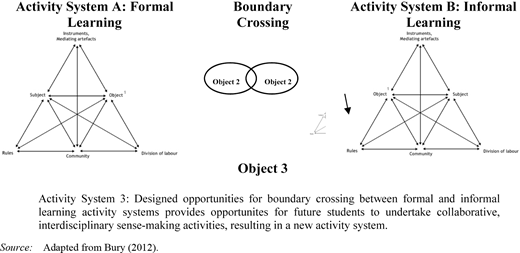
Participants’ perceptions of the MOOC design were mapped against CHAT elements. Figure 4 presents Object 1-learners with the general objective of engaging in formal learning, and Object 2-learners with the general objective of informal learning. Allowing for boundary crossing between these activity systems, Object 3 thus moves to a “potentially shared or jointly constructed object” (Engeström, 2001, p. 136).
From the conceptualization of boundary crossing in Figure 4, it is possible to conclude the possibility of not only mapping formal and informal learning, but also to map a new conceptualization of an activity system, specifically a MOOC activity system that arises from the tensions identified between formal and informal learning activity systems.
Conclusions And Implications
Our study provides evidence that designs for formal and informal learning opportunities can be conceptualized as separate but potentially interacting activity systems. The use of CHAT elements to analyze data collected from professional instructional designers’ perspectives on one MOOC design—which includes opportunities for both formal and informal learning activities—identifies potential primary, secondary, tertiary, and quaternary tensions and contradictions indicated that inclusion of both formal and informal learning activities within a single MOOC design that are likely to result in: (a) at least, the potential for future learners’ to cross boundaries between formal and informal activity systems and (b) even more likely, result in the emergence of a new, MOOC-specific activity system. These insights can inform both future research approaches to examining what happens in MOOCs and practitioner considerations for future MOOC designs.