This study investigated 10 public elementary schools that employed district technology coordinators to facilitate the implementation of classroom technologies. These technology coordinators act as change agents who sought out classroom teachers to serve as opinion leaders. These opinion leaders had the ability to influence the attitudes and beliefs of their colleagues with regards to which technologies were used and how they were implemented to enhance learning. The purpose of this study was to investigate how technology coordinators identified and selected classroom teachers as opinion leaders as well as the perceptions of the opinion leader’s colleagues. Using a qualitative study design, data were collected using structured data-collection instruments. An analysis of the data in this study supported the claim that technology coordinators were, for the most part, able to identify technology opinion leaders in their schools, but still overlook some potential leaders.
A nationwide emphasis on raising student achievement as well as teacher accountability has increased interest in studying school improvement and effective classroom instruction. Studies revealed that when it comes to school improvement, leadership matters (Gaziel, 2007; Hallinger & Heck, 1998, Marzano, Waters, & McNulty, 2005). Closing the gaps between what teachers are presenting and what students already know suggests the need to increase technology leadership knowledge and skills that go beyond the basics (Schrum, Galizio, & Ledesma, 2011). U.S. schools have invested billions of dollars on computer hardware and software (Compass Intelligence, 2010) due to the potential of technology to improve classroom instruction and student performance (Collins & Halverson, 2009; Zucker, 2008).
When it comes to how best to use these technologies to enhance learning and improve student performance, teachers look to an instructional leader to guide them in the implementation of these programs. Despite the abundance of knowledge on educational leadership, there is little known about the potential role of the technology coordinator as a change agent and the use of classroom teachers as opinion leaders to infuse technology into the teaching process. There has been little research on leadership in the area of technology (McLeod & Richardson, 2011) and even less research on how leaders demonstrate the extent technology can be used to support instructional innovation and improve teaching strategies (Dexter, 2011). A lack of research exists on the role that informal leaders, opinion leaders, and change agents play in the adoption of technological innovations in education (Ng’ambi & Bozalek, 2013). This study sought to address the gap in the research literature.
Technology leadership is necessary for the effective utilization of technology in schools (Anderson & Dexter, 2005). Anderson and Dexter (2005) concluded that although technology infrastructure is important, in order for educational technology to become an integral part of a school, technology leadership is even more so. This is because technology leadership has greater impact on outcomes.
Schools are implementing virtual classrooms, robotics, one-to-one mobile devices, and adopting digital versions of textbooks. There is also a surge in the assimilation of science, technology, engineering, and math (STEM) lesson planning. Teachers of technology have the responsibilities of meeting the Common Core Standards and preparing their students for state testing. With the addition of these technologies come great responsibilities and the need for leadership (Merisotis & Kee, 2006).
The effective technology leader should possess certain qualities and characteristics. School leaders should have a clear vision on how technology will be used to support teaching and learning. Technology plans should be developed and periodically revised to incorporate ever-evolving programs. As hardware and software advances, instructional leaders need to make access to technology readily available to staff and students. It is the leader’s responsibility to model effective technology usage as well as monitor and evaluate the integration of technology as to its effectiveness. Leaders in technology need to provide training and support to staff and establish policies to address the ethical and legal issues involved in the use of technology in schools. A leader of technology education should possess a clear vision of how the technology should be implemented as well as pay attention to the culture of leadership (Brown University, 2008).
Leadership is regarded as a process of giving direction to a group and the leader is identified on the basis of his or her relationship with others in the social group who are the followers. The leader, therefore, is in an emerging rather than predefined role, which can only be understood through examining the relationships within the group.
Administrators, particularly principals or directors of curriculum, have the title and responsibility of being the leader of instruction for schools. But, because these leaders are not in the classroom, they do not have as close a connection with the classroom teacher as does the technology teacher. Principals and directors are not always aware of the challenges faced by teachers. They do not always know of all the available technologies and how best to use them. Mundy and Kupczynski (2013) noted,
Despite overall increased access to technology both in and out of the classroom, technology is often still not being used to support learning and instruction in a meaningful manner. Teachers need to be helped to change the way they teach rather than just how to use computers. (p. 1)
For these reasons, leadership is necessary for the effectiveness and sustainability of school technology programs.
Many times, the people given the title of administrator of the district or school are not prepared or qualified to be leaders in technology. The technology coordinators and classroom teachers are in a position to have direct knowledge of the available technology. They are most often the ones keeping up-to-date with the ever-evolving devices and software. The technology teachers are in close contact with students and fellow teachers. They know firsthand the challenges faced by their colleagues.
Districts have a vested interest in sustaining the programs for which they have budgeted. Now, more than ever, we need the opinion leaders of technology to step up as leaders to support and guide teachers.
Many theories are emerging that contradict traditional thinking about leadership roles. These theories suggest the technology teacher can and should be considered a leader and not doing so actually hinders progress.
This discussion progresses from the importance of leadership in technology to the characteristic of a good leader and the roles various leaders play in technology implementation as well as the roles played by positional leaders as well as opinion leaders. This study examined the relative roles of the technology coordinator, the classroom teachers who used technology, and the opinion leaders who influenced them.
The Problem
According to Murphy (2001), “The problem with educational leadership preparation programs today is that they are driven by neither education nor leadership” (p. 14) but rather by economic, social, and political forces. Most states and institutions do not require any formal preparation concerning technology education or training for educators unless that is their area of certification, nor do states require school leaders to demonstrate knowledge or skills that encourage technology preparation for classroom teachers. Graduates in the education field are most likely ill-prepared to implement technology in their school districts (Schrum et al., 2011).
It is for these reasons it is critical for the technology coordinators/facilitators working in school districts to act as agents of change. As change agents, they can recognize and engage classroom teachers who serve as opinion leaders for their colleagues. Due to their technical credibility and trustworthiness as representatives of the group, others gravitate towards opinion leaders (Leonard-Barton & Kraus, 1985). These opinion leaders are informal leaders who have the ability to influence the attitudes and behaviors of others (Rogers & Kincaid, 1981).
The purpose of this study was to investigate opinion leadership and the role of the technology coordinator as the change agent within a public school system with regards to technology implementation. This study examined the role of the technology educator as a change agent with regards to the choice and implementation of technology in a public elementary school setting. The opinions of technology coordinators, facilitators, and classroom teachers were examined for similarities and differences as to who they perceived as the technology opinion leader. It explored the factors that contributed to the classroom teacher being an effective opinion leader with regards to technology usage and implementation. The focus of the study was to identify the technology coordinator as a change agent and how he or she identified a classroom teacher as an opinion leader for the implementation of technology in the teaching/learning process. This study explored the process by which the technology coordinator selected classroom teacher-opinion leaders to diffuse technology education and whether these selections agreed with who the survey instruments identified as opinion leaders according to Rogers’ (2003) definition.
Importance Of A Technology Leader
According to Puckett (2014), “A leader must expect excellence; however, (s)he must also display excellence” (p. 1). There are many leadership types and some leaders possess qualities that fit scenarios better. Studies suggested school and district policies, practices, and leadership can have an impact on the scope and manner in which teachers use technology (O’Dwyer, Russell, & Bebell, 2004).
According to Anderson and Dexter (2005), leadership is the key to promoting teacher’s use of technology. Dawson and Rakes (2003) found that many principals were uniformed and uninvolved in the role of technology in their schools. The principal is the assigned leader by position and title but because technology has such an impact on our lives, the technology coordinator is better equipped to impact change in the areas where technology directly impacts the teachers and students (Lai, Trewern, & Pratt, 2002).
Fullan (2002) acknowledged, “Effective school leaders are key to large-scale, sustainable education reform” (p. 16). Katzenmeyer and Moller (2001) concluded that reform takes place when teacher-leaders are allowed to flourish.
Technology support is important, but technology leadership is a stronger predictor of teacher use of computers in the classroom (Anderson & Dexter, 2005).
The opinion leader teachers who use technology are beneficial for assisting their fellow teacher. They guide others by demonstrating the different ways technology can be infused into the classroom learning environment. They are the teachers other staff members look to for support and ideas, but the technology resource teachers, themselves, do not always receive adequate support. Teachers, in order to integrate technology effectively, require support in the way of time, resources, and leadership (Strudler, Falba, & Hearington, 2003).
The influence of the technology coordinator is also critical. The school’s technology infrastructure, teacher skill and confidence level, and provisions of professional development are responsibilities normally assigned to the coordinator; however, little research has explored this role (McGarr & McDonagh, 2014).
Technology is a unique subject in that it is included in all other disciplines in some form or another. To prepare students for future education and the world of work, technology has to be infused into all areas of the curriculum. Teachers in self-contained classrooms require guidance and modeling to assist them in integrating subjects (Ramirez, 2011).
These responsibilities then become the charge of the technology coordinator. When the technology coordinator is perceived as a change agent, he or she will be able to promote the types of technology and the way these technologies are used in the lessons. Many teachers rely on their colleagues for technology support because they are on site and have knowledge of the curriculum and classroom (Dexter, Anderson, & Ronnkvist, 2002). Rogers (2003) said these technology teachers may not be in administrative positions but still promote technology integration at the classroom level because they are similar to the people they are helping.
The classroom teacher needs to be included in the technology leadership process. Technology coordinators explore the best ways to identify the opinion leaders who will set the example of how to incorporate technology into their students’ education. They are the workers in most direct contact with their colleagues and students. It is for these reasons further research into the nature of technology leadership is necessary (Langran, 2010; Sugar & Holloman, 2009).
Role Of The Technology Leader
Despite the efforts of schools, their technology integration is limited by their inability to individualize teachers’ learning about how to integrate technology effectively into their teaching. Also, schools typically fail to provide feedback to teachers on their technology integration efforts in the form of peer coaching (Dexter, 2011). According to Ng’ambi and Bozalek (2013), “For emerging technologies to be diffused in institutional social systems, more transformational and less transactional leadership is required…. Leveraging informal leadership is particularly critical in accelerating the uptake of emerging technologies practices” (p. 940).
An example of distributed leadership in the realm of educational technology is the position of the technology coordinator (Lai & Pratt, 2004). The technology coordinator position is described as a “position with a protocol” (Frazier & Bailey, 2004, p. 1). The responsibilities of the technology coordinator extends to include instructing teachers about technology, solving technical problems for teachers, providing access to technological resources, and collaborating with teachers to develop curriculum and materials to be used in the classroom (Sugar, 2005).
Formal leaders tend to have an internal institutional focus as their main directive, while change agents and opinion leaders use technologies external to the institution to improve practices (Ng’ambi & Bozalek, 2013). Thus, formal leaders need to work with opinion leaders to ensure management of institutions has heightened awareness of changes and innovations (Williams, Karousou, & Mackness, 2011). In effect, there needs to be a top-down, bottom-up, or distributed approach for the diffusion of technological ideas to occur (Ng’ambi & Bozalek, 2013).
The use of informal leaders is needed to infuse innovative practices (D’Andrea & Gosling, 2005). Formal leaders should collaborate with opinion leaders and be responsive to a wide range of change agents in the institution. Opinion leaders are beneficial to the process of communication and influencing innovative practices in education (Ng’ambi & Bozalek, 2013).
The Technology Coordinator As A Change Agent
A change agent is a person who influences a client’s decisions to adopt innovations. The technology supervisor, technology coordinator, and/or technology teacher, acting as a change agent, comes equipped with the degree and experience in the technology field. These change agents have solutions and ideas for improving classroom management and instruction using technology that may appeal to the teachers. In order to promote the infusion of these ideas and overcome obstacles of teacher fears and uncertainties, the technology change agent may further distribute leadership responsibilities by employing the use of opinion leaders. Rogers (2003) noted,
Diffusion campaigns are more likely to be successful if change agents identify and mobilize opinion leaders … [and] change agents’ success in securing the adoption of innovations by clients is positively related to the extent that he or she works through opinion leaders. (p. 388)
The traditional classroom of yesteryear saw the teacher presenting the contents of the syllabus, relying heavily on the textbook, and giving little consideration to the needs of the learner (Okojie, 2011). Today, teachers’ roles have become more complex. Teachers are required to know their subject matter but also possess technological skills and play the roles of instructional method specialists and technology education researchers (Okojie, 2011). With the infusion of technology as a classroom learning tool, teachers’ responsibilities have expanded. They are expected to seek solutions through critical thinking and challenging students to use a problem-solving approach. In this sense, teachers of technology assume the role of change agents (Okojie, 2011).
Computer teachers are needed who are willing to integrate technology in the classroom, keep up with innovations, and provide students the opportunities to use new technologies (Cakir & Yildirim, 2009; Göktas & Topu, 2012; Seferoğlu, 2007). Niess (2008) emphasized, “Tomorrow’s teachers must be prepared to rethink, unlearn and relearn, change, revise, and adapt” (p. 225). In preparing teachers for technology integration, leaders must establish a vision, set expectations, and track progress toward that vision. Leaders must develop members’ capacity by modeling and providing support (Thomas, Herring, Redmond, & Smaldino, 2013).
In most schools, the technology coordinator holds leadership responsibility but may not actually be an administrator. Their actual titles vary from district to district—from coordinator to director to specialist (Frazier & Bailey, 2004). The coordinator’s role has shifted from technically supporting teachers in a lab to promoting technology-enhanced lessons in the classroom (Glazer & Page, 2006). Lobos (2008) noted,
The first conclusion, as obvious as it may seem, is that coordinators are, at the same time, teachers who work in the same school and have been part of the faculty for several years. This is a very important issue that is not mentioned very often. Sometimes it seems natural and we take it for granted. However, this situation allows the introduction of new elements into school environments. Coordinators have taken part in the creation and redesign of cultural statutes, they are familiar with those statutes, and that makes them change agents. (p. 12)
A technology coordinator serves as an instructional expert by providing advice on how to incorporate technology effectively into a lesson (Sugar & Holloman, 2009). Twomey, Shamburg, and Zieger (2006) defined technology coordinators as those who “apply and implement curriculum plans that include methods and strategies for utilizing technology to maximize student learning” (p. 25). Technology coordinators need to be technical experts and capable of maintaining equipment as well as evaluating, purchasing, and informing teachers about new products (Twomey et al., 2006). Technology coordinators are expected to develop, assess, and lead technology initiatives (Sugar & Holloman, 2009). The technology coordinator plays a major role in the planning and implementation of technology, serves as a change agent, and provides professional development for his or her colleagues (Lai et al., 2002).
The Role Of Technology Opinion Leadership
Opinion leadership is the degree to which an individual is able to influence the attitudes and behaviors of others. Opinion leadership is not attached to the individual’s status or formal position. Opinion leadership is qualified by the individual’s technical proficiency and social accessibility and they serve as a model for their followers (Rogers, 2003). Rogers (2003) acknowledged, “The success or failure of diffusion programs rest in part on the role of opinion leaders” (p. 99).
Opinion leaders are informal leaders. They are members of the social system and earn the respect of others and serve as models. In the case of this study, opinion leaders are probably elementary teachers located in the school district in close contact with the technology-coordinator change agent. According to Rogers (2003), a diffusion campaign is more likely to be successful if the change agent is able to identify and properly use the opinion leader. Rogers said, “Change agents’ success in securing the adoption of innovations by clients is positively related to the extent that he or she works through opinion leaders” (p. 388). By harnessing the potential influence of these teacher opinion leaders, the technology change agent can increase the rate at which innovations can be diffused throughout the elementary school. Rogers set forth several adopter categories. The “early adopters” are more integrated into the local social system than innovators and have the highest degree of leadership (Rogers, 2003).
Larson and Meyer (2006) explained,
Faculty become aware of and are influences to adopt, or not, an innovation through communication…. At the persuasion stage— when potential adopters are forming or changing attitudes—it is interpersonal channels that involve a face-to-face exchange that are of greater importance. (p. 79)
In their study of the diffusion of STEM pedagogies, Larson and Meyer suggested that “for opinion leaders to influence others to use new pedagogical practices, they themselves must ‘buy’ into the innovation and feel compelled to tell others” (p. 85). To influence others to adopt innovative practices, opinion leaders can exercise more active influential strategies such as seminars, mentoring, or personalized discussions, as well as less active strategies such as letter or e-mail correspondence directing clients to a website.
Change agents can track the following steps to promote an innovation: create awareness of the innovation, strategically identify one faculty member believed to be particularly influential, provide incentives like extra time or reduced workload to allow for the implementation of new practices, encourage faculty to share their experiences at meetings and workshops, and assess results of and record data to show the resulting outcomes and benefits of learning (Larson & Meyer, 2006). The effective use of opinion leaders will accelerate and increase adoption as well as use interpersonal communication to reduce potential adopter’s uncertainty associated with innovations.
Technology resource teachers have been able to act as change agents in schools. The technology resource teacher can inspire other teachers with a vision of how to implement technology effectively by demonstrating activities the classroom teacher can use. Technology resource teachers also can relate to classroom teachers as a fellow professional who understands their situation. (Frazier & Bailey, 2004). Technology resource teachers can be leaders based on their position or the knowledge they possess (Leithwood & Riehl, 2003). If technology teachers are not given the opportunity to assume a leadership role, the ability of the school to sustain innovation becomes hindered (Langran, 2010).
According to Larson and Meyer (2006), faculty may learn about new pedagogies from websites, journals, and workshops but are more likely to be persuaded to try these pedagogies through interpersonal communication with an opinion leader. The ability to reduce the perceived risk and uncertainty associated with adopting new innovations is through the interpersonal communication and influence of the opinion leader (Rogers, 2003).
Riveros, Newton, and da Costa (2013) identified emerging themes shared by teacher-leaders. They generally arise from informal processes in their schools. Teacher-leaders develop a broader understanding of educational leadership as they begin to work outside their own classroom and are recruited into broader leadership roles. Teacher-leaders require structures that allow them to facilitate trust and collegiality with their peers.
As mentors and leaders, teachers of technology can help other teachers overcome barriers to technology integration (Kopcha, 2010). Twomey et al. (2006) offered the following:
Technology facilitators and technology leaders shoulder the responsibility to keep abreast of current trends and future prospects, mediating between all of the stakeholders. They are the proponents of technology who constantly look for new ideas and information to share with the teachers in their schools. In return, they must be able to teach technology skills as well as understand ways to utilize technology to support instructional goals. (p. 116)
Twomey et al. further offered,
District technology leaders have the most influential voice in district technology decisions. To create and sustain a vision for integrating technology into teaching and learning, districts need to create full-time positions for technology leaders. This position should be deeply involved in the district’s educational goals and strategies. Investing in technology leadership will foster a strong culture to support more effective integration of technology into the schools. (p. 124)
In some instances, faculty members have reported that they would not have taken risks or attempted new technology projects had it not been for the technology leader. The faculty preferred to receive assistance from the teacher-leader (Lundeberg Tikoo, & Willers, & Donley, 2004).
Methodology
The technology coordinators were surveyed as to whom they saw as the classroom teacheropinion leaders in the schools they served. All teachers in the service of the technology coordinator were also administered a survey to determine how well they fit the profile of opinion leader and if these were, in fact, the same people the change agent identified as an opinion leader.
Participants
One technology coordinator was surveyed in each of 10 school districts. A typical elementary school consisted of Kindergarten through Grade 6, with two sections at each grade. Approximately 10 teachers were surveyed per school. After 10 schools were evaluated, the total number of participants was 105. All participants were employees of the public school systems. Participants were male and female elementary certified teachers and administrators ranging in age from 25–65 years old with at least 5 years of teaching experience.
The first group consisted of the technology coordinators (change agents). One technology coordinator and or technology supervisor was selected from each of the 10 school districts. A questionnaire was issued to the technology coordinator containing questions regarding his or her background, education, and who he or she regarded as the opinion leader in their school.
The second group consisted of the classroom teachers who used technology in their lessons and activities. These teachers worked in the school and were in direct contact with the technology coordinator. The technology coordinator provided a list of these staff members. The classroom teachers were surveyed using an innovativeness scale and a local expert profile at their respective schools. This group was a volunteer sampling as not all teachers may have agreed to participate in the surveys. These teachers were surveyed to determine the opinion leaders of the group.
Data-Collection Instruments
The district technology coordinator was issued the Technology Coordinator Survey. The Technology Coordinator Survey was adapted from the Boston Society for Information Management as well as the studies by Cox-Cruey (1998). It used a Likert-type scale with demographic questions dealing with the technology coordinator’s responsibilities and role as a change agent and the factors contributing to their success.
The second survey, an Opinion Leadership Scale (Wright, Ryan, Dodge, Last, & Law, 2004), was used to question the technology coordinator as to whom he or she identified as the opinion leader. The Opinion Leadership Scale was modified from the Hiss, MacDonald, and Davis (1978) original.
A Local Expert Profile (LEP, Rice, 1994) was used to identify elementary classroom teachers as opinion leaders. A LEP is a selfreporting instrument designed to identify those individuals who serve as local experts. In the case of this study, the local experts were the classroom teachers who used the technologies in their daily teaching activities. This study used a LEP as a self-reporting instrument to verify the classroom teacher-opinion leaders. The LEP instrument consisted of 25 multiplechoice questions presented as categorical with Likert scale ranges.
The Innovativeness Scale, developed by Hurt, Joseph, and Cook (1977), was the second instrument employed to identify the opinion leaders. The Innovativeness Scale (Hurt et al., 1977) is a self-reporting instrument consisting of 20 items in a Likert-type scale and used to measure an individual’s innovativeness based on Rogers’ (2003) categories of adopters: innovators, early adopters, early majority, late majority, and laggards.
The Innovativeness Scale was issued to the teachers on staff in the elementary schools. This self-reporting survey assessed the extent to which the teacher fit the description of an opinion leader. The opinion leaders were those surveyed in the “early majority” section of the scale.
Results
The study asked, “What do you think is the most important responsibility for the technology coordinator/facilitator as a change agent?”
Responses were as follows:
The most important responsibility as a change agent is to stay current with technology and best practices. It is then their responsibility to share those techniques and ideas with the staff. They can do this through videotaping, blogging about it, modeling, or giving workshops.
Teachers are required to attend technology classes with their students, and since we will have a one-to-one initiative in Grades 4–6 next year, I think it is important for teachers to reinforce skills learned in class. I also try to introduce projects that can be integrated into any subject area, especially math and science. My curriculum is actually directly tied in with the science standards.
It is my job to help the staff, teachers, and students embrace change as technology moves around us very quickly. I must be one step ahead of the others with the new software and hardware available on a daily basis. It is equally important for me to figure out how these changes impact our daily school routines and balance this so it does not seem like an issue while implementing the change.
Visionary Leadership. Stated by Shanker & Sayeed (2012) where “Leadership can be defined as a social process of influencing other people’s orientation towards achievement of goals, it is a style that evolves itself around organizational change process directly and transforms individuals” (p. 470). Accordingly, visionary leadership is the single most crucial activity for a technology change agent. See also: http://www.cosn.org/ VisionToAction
“To be at the forefront of emerging technology and explaining why the district needs to the new technology.”
“To help the community be aware of what we are doing with the students in school, and to keep everyone on the same page.”
“The role of technology coordinator is very different in every district. Change is difficult.
I rely on my ‘heavy hitters’ to buy in to something and I support them… then others follow.”
“To work with the stakeholders in the district to understand that education is fluid system that is constantly changing and that we as a district need to be able to adapt and change with it.”
“Helping other teachers implement technology to enhance learning and not for the sake of using technology.”
The study also asked, “Who are the technology opinion leaders in your public school system and what characteristics do they have in common?” The technology coordinators/ facilitators were asked to name the teachers they saw as the technology opinion leaders in their schools. The LEP was then used to identify elementary classroom teachers as opinion leaders. This self-reporting instrument was designed to identify those individuals who served as local experts. In the case of this study, the local experts were the classroom teachers using the technologies in their regular teaching. The LEP consisted of a series of survey questions issued to the teachers who were in contact with the technology coordinator.
The highest possible score on the LEP (after weighting was considered) was 750 and the lowest score was 175. The local experts shared the same characteristics (perception of the innovation, venturesomeness, cosmopoliteness, connection to the social system, and experience with an innovation) as the early adopters/opinion leaders.
A third question asked, “How do these opinion leaders assist you in classroom technology infusion?”
Technology coordinators and facilitators responded as follows:
“They offer to share their lessons and ideas that they try in the classroom. They spread the word and are positive when they speak to others.”
Another technology coordinator/facilitator responded, “They give their insights and opinions on hardware and software that will be best used in the classroom. They also try out new technology and provide important feel back after they tested new technologies with their students and they seek out new forms of technology to be used. These teachers are not afraid of trying new things.”
“They all look for ways to incorporate technologies that enhance learning.”
“Yes, they help keep the equipment working well with our curriculum needs.”
“They are willing to learn and to train others.”
“The opinion leaders are the teachers that pilot program and initiative as well as being lead teachers at schools to provide assistance with technology questions or issues.”
“Having just been in the district a year, and reporting to the BA as the ‘tech operations guy,’ I am not sure I am yet aware of the technology opinion leaders in my district. Still working on this.”
“When others see the opinion leader using the technology and how the technology makes teaching more productive, they are more apt to implement it themselves.”
A fourth question asked, “How do these technology opinion leaders influence other teachers in their use of classroom technology?”
Technology coordinators/facilitators were asked how the opinion leaders in their schools influenced other teachers and how they used classroom technology. The following are some of the responses:
“These teachers are willing to talk about what they do with technology. They show others and volunteer to do lessons in their classes. One teacher has done various workshops throughout the school year.”
“As a power user.”
“They share their expertize [sic] with various members of the staff and faculty and offer assistance when planning future purchases. Their willingness to try new ideas makes it easier for others to consider the same.”
“They show how the technology can work and push others to use it.”
“They teach, they problem solve, they provide the best equipment available.”
“They assist teachers as needed. Teachers value their expertise.”
“They are teacher-leaders at different schools who model the infusion for instructional technology in the classroom. Their dynamic teaching style engages the students.”
“They are usually the first to buy-into the ideas of incorporation new technological resources and they set the examples for others to follow.”
A fifth question asked, “Is there agreement in the view of the teachers and the technology coordinator with regard to choice of opinion leaders?” When the 10 districts from which classroom teachers responded are analyzed, a margin of error in each district can be seen. District A’s technology coordinator/facilitator selected no opinion leaders and had no teachers ranking in the early adopter category, so there was an error of 0% in District A. The technology coordinator/facilitator in District B selected two of the four potential opinion leaders who did not rank in the early adopter scale giving that district an error rate of 50%. School District C missed 9 of its 13 leaders for an error of 69%. District D’s technology coordinator/ facilitator selected no opinion leaders and had no teachers ranking in the early adopter category, so there was an error of 0%. The technology coordinator in District E missed one of the two responding leaders for an error rate of 50%. District F’s technology facilitator missed one out of the 13 responding teachers for an error rate of 8%. District G missed identifying two of its leaders for an error of 16%. District H’s technology coordinator overlooked one leader and identified another incorrectly for an error rate of 25%. The technology coordinators in Districts I and J each overlooked one and incorrectly identified two opinion leaders for error ratings of 50% and 30%, respectively.
Discussion
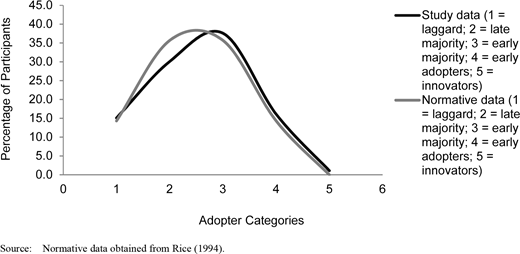
The LEP was implemented to collect data from the classroom teachers served by the technology coordinators/facilitators to determine if the teachers were, in fact, opinion leaders. Figure 1 displays a graphical representation of the data collected in this study compared to the normative data indicating a slight skew to the left. Rice (1994) indicated no one characteristic taken alone can be used to identify an opinion leader. It is for this reason all characteristics were totaled when scoring.
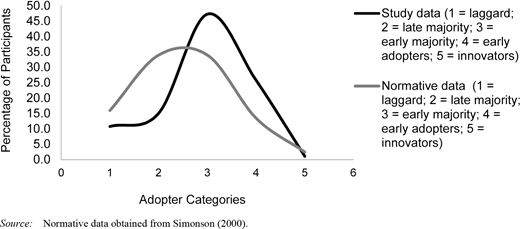
The Innovativeness Scale was incorporated to measure the innovativeness of the teachers. Figure 2 graphically depicts that the classroom teachers surveyed had a significantly lower percentage in the late majority category at 15% compared to the normative data at 34%. The study data revealed a higher percentage in the early majority category at 47% compared to the normative 24% and a higher percentage in the early adopter category at 26% compared to 14%.
When asked how the opinion leaders assisted with classroom technology infusion, technology coordinators/facilitators responded that classroom teacher-opinion leaders were those willing to share their lessons. These technology opinion leaders were also the ones who lent their insights on how best to use the hardware and software in the classroom. These teachers piloted programs and trained others.
When asked how the technology opinion leaders influenced others in the use of classroom technology, technology coordinators/ facilitators responded that classroom teacheropinion leaders were those who volunteered to do lessons in other classrooms. Their willingness to try new things made it easier for others to follow suit. Other teachers valued the expertise of these opinion leader teachers who set the example for others to follow.
When the selections made by the technology coordinators/facilitators were examined as to who they identified as opinion leaders, they selected a classroom teacher who scored as an opinion leader on the local expert profile, the innovativeness scale, or both a number of times. They were also incorrect a number of times when they chose a teacher who did not score as an opinion leader or overlooked one who did. All school respondents considered, the technology coordinators were correct on average about 70% of the time in the selection of a classroom teacher technology-opinion leader.
When all teacher respondents are considered by district, the classroom teachers surveyed selected the technology coordinator/ facilitator as a technology opinion leader on average about 60% of the time. Also, the classroom teachers chose the same teacher opinion leaders as the technology coordinator/facilitator on average about 47% of the time.
Conclusions
This study found several important conclusions about change agents and opinion leaders. One result derived from this study was that although technology coordinators/facilitators are able to identify the teachers who qualify as opinion leaders an average of 70% of the time, they still overlooked some potential leaders at their respective schools. Technology coordinators/facilitators can periodically use surveys like those used in this research to identify opinion leaders formally as those leaders might change. Also, about 47% of the classroom teachers identified the same opinion leaders as the technology coordinators/facilitators. School district technology coordinators and leaders should research ways to best promote the classroom opinion leaders in an effort to make them more recognizable as valuable sources for other teaching staff. Technology coordinators/facilitators may choose to promote classroom opinion leaders by distributing leadership responsibilities to these teachers. Teacher opinion leaders could be asked to share ideas at faculty meetings and be given the opportunity to conduct workshops for other staff members.
The goal of this research was to add to the body of knowledge relating to the technology coordinator/facilitator’s identification and use of technology opinion leaders in the best ways to integrate classroom technology. Classroom technology is ever-evolving and expanding. There will always be a need for the technology coordinator/facilitator change agent to be able to identify classroom-teacher opinion leaders.