This study identified conditions under which Interactive Instructional Television (IITV) is an appropriate choice of technology for delivering instruction in the K-12 school environment. Data relevant to the concepts central to this study were obtained through observational case analysis. Study participants consisted of the superintendents and IITV coordinators in three Manitoba school divisions that use IITV. Findings indicate that IITV is chosen as an instructional technology primarily as a mechanism for ensuring that rural students receive the same educational opportunities as do their urban counterparts. A by-product of this is the assurance that rural school districts survive.
Introduction
Rural education is an area on the verge of a major transformation that can be attributed to numerous pressures. School boards and administrators have difficulty attracting specialized teachers and staff to offer non-core, advanced, and specialized school programs. Declining enrollments often put these schools at risk because low numbers of students make it difficult to provide programs in many of the rural and remote schools.
According to Jordahl (1991), “declining rural populations, along with flagging economies and mounting teacher shortages, have forced many smaller, more isolated school districts to exclude from their curricula all but the most basic subjects” (p. 72). A related problem is the fact that providing for professional development opportunities for teachers, staff and administrators is more difficult in rural and remote schools. Consequently, “many rural high schools have had to graduate students without the background in foreign languages, higher-level math, and advanced science that today’s colleges and careers require” (Jordahl, 1991, p. 72).
Two decades ago, the technological options for delivering education over a distance were limited. Since then, a rapid expansion in the range and types of technologies available for use in education has occurred. Educational planners are now capitalizing on this increased availability by using cooperative arrangements between distance education and technology to solve the challenges facing rural schools. Telecommunications technologies such as fiber optics, microwave, satellites, slow-scan television, cable television, and microcomputer networking allow rural school districts to coordinate schedules and share resources, thereby providing an expansion of curricular offerings and educational opportunities for students (Barker, 1987; Kitchen & Russell, 1987).
Rural education planners opting to use telecommunications technology to provide alternative instructional delivery systems for students have a variety of technologies from which to choose. With so many available, how does one know which to choose? According to Kitchen (1988), “there are several factors that must be considered when developing an alternative delivery system” (p. 73). These factors include: educational effectiveness, efficiency, and long-range goals and objectives (Kitchen, 1988).
The issue of IITV application can be examined by considering each of these factors, as it relates to an IITV system. The educational effectiveness and efficiency of an IITV system can be ascertained by asking the questions: “Do students learn via an IITV system as well as in a traditional classroom?” and “Does the benefit of the system justify its costs?” Whether an IITV system assists the educational institution to achieve its long-range goals and objectives can be ascertained by asking the question: “Does the system provide flexibility and efficacy in meeting the educational institution’s goals and objectives?” (Kitchen, 1988). Kitchen’s questions can be rephrased to ensure that answers will include more than a simple “yes” or “no” response.
The rephrased questions include: “How does learning via an IITV classroom system compare with learning in a traditional classroom?” “How do benefits and costs of an IITV classroom system compare?” and “To what extent does your IITV classroom system provide flexibility and efficacy in meeting the educational goals and objectives?”
Literature Review
How does learning via an IITV classroom system compare with learning in a traditional classroom? In a survey of three high schools that used an IITV system, Nelson (1985) reported that students perceived little difference between the interactive instructional television class and the traditionally taught class. Additionally, teachers reported no significant differences in the students’ test scores, grades, and participation when comparing sections of IITV classes with classes taught in the traditional classroom (Nelson, 1985).
Whittington’s (1987) review of the general distance education literature led to the conclusion that students taking courses via interactive television achieve, in most cases, as well as students taking courses via traditional methods. According to Whittington, “live, interactive televised instruction is that which is offered via satellite or microwave delivery systems in real time to students who have immediate talk-back capability with the instructor” (p. 47).
How do benefits and costs of an IITV classroom system compare? One way of examining the issue of cost versus benefit is to review the alternatives. For many small rural school districts, survival in the face of high transportation costs, declining enrollment, increased state graduation requirements, and decreased state funding relies on the sharing of teaching expertise among districts (Kitchen & Russell, 1987). Hobbs (1993), concurs that “for many schools, the ability to technologically share teachers may mean the difference between closing the school—and therefore the community—and remaining a viable educational entity” (p. 3).
Another way to determine whether the benefits of an IITV system justify its costs is to examine its advantages and disadvantages, in light of costs. Barker, Frisbie & Patrick (1989) assert that although pricing is definitely important, the potential for interactive teaching/ learning and the fact that geographically dispersed student bodies can be served simultaneously are appealing advantages of IITV. It establishes a visual connection among participants which enables students to hear, see, and to communicate directly with the teacher (Pirrong & Lathen, 1990; Reed & Woodruff, 1995). Since the teacher can see and hear remote learners in real time, conversation and body language can be used to enhance communication. Frequent interaction increases understanding and encourages more personalized instruction. IITV allows for interactive teaching strategies such as questioning and discussion that can also help engage and motivate students by encouraging them to become active participants (Reed & Woodruff, 1995).
Disadvantages of IITV include
enormous cost associated with the technical set up, production, and transmission;the technical coordination, production, and delivery of a video conference for educational purposes is beyond the capabilities of most educators; and the triability, or degree to which video conferencing can be experimented with, is clearly much more limited than audio teleconferencing. (Garrison, 1989, p. 74)
To what extent does the system provide flexibility and efficacy in meeting the educational institution’s goals and objectives? Small networks in Minnesota, Illinois, and Oklahoma (Barker, 1989; Kitchen, 1987; Robinson, 1985) were among the first rural schools to report success in working with IITV systems. “Interest and participation by rural schools in two-way interactive TV systems has grown rapidly in recent years making it difficult to accurately document all those that are currently in the planning stages or actually in operation” (Barker & Taylor, 1993, p. 5).
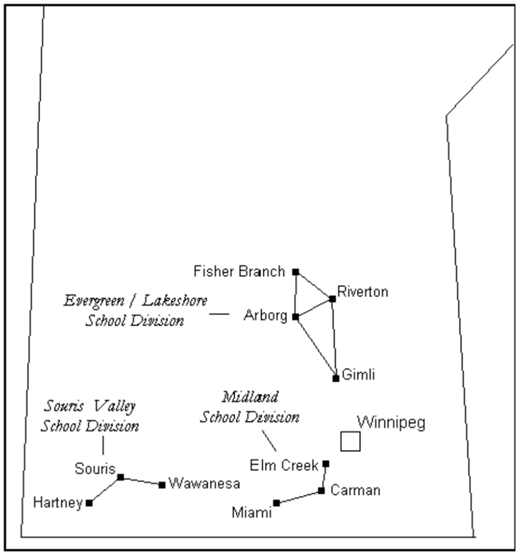
A study was conducted to identify conditions under which Interactive Instructional Television (IITV) is an appropriate choice of technology for delivering instruction in the K-12 school environment. Study participants included the Superintendents and IITV Coordinators in Midland School Division, Souris Valley School Division and Evergreen School Division, three Manitoba school divisions that utilize IITV (See Figure 1).
This study was designed to provide information relevant to the research question: Why choose IITV as an instructional technology? Answers were solicited by addressing factors proposed by Kitchen (1988), which include: educational effectiveness, efficiency and long-range goals and objectives.
Educational effectiveness and efficiency of an IITV system was ascertained by asking the questions: How does learning via an IITV system compare with learning in a traditional classroom? How do benefits and costs of an IITVsystem compare?
Whether an IITV system assists the educational institution achieve its long-range goals and objectives was ascertained by asking the question: To what extent does the system provide flexibility and efficacy in meeting the educational institution’s goals and objectives?
Study Findings
How does learning via an IITV system compare with learning in a traditional classroom?
Two out of the three school divisions sampled report conducting studies comparing learning via an IITV system with that acquired in a traditional classroom setting. According to L. Roche (personal communication, October 9, 1997)
In a study conducted by The Distance Education Branch in Manitoba, Evergreen School Division students taking math and science courses were found to be doing just as well, and in some cases better, when taking courses via IITV as they were in their other courses taught traditionally.
Midland School Division’s study revealed the same results. E. Wiebe (personal communication, October 7, 1997) explains “We did some statistical analysis, a number of years ago in which the results tended to present that students did as well as, and in some cases better than students in the traditional classroom.” L. Paulson (personal communication, October 6, 1997) was unable to answer for Souris Valley School Division stating “Our IITV System is currently not fully functional yet.”
How Do Benefits and Costs of an IITV System Compare?
All three school divisions sampled agreed that the benefits of IITV far outweigh the costs associated with installing and using the technology. In answering this question the following issues were addressed by representatives of each school division: educational equality/ rural school district survival, promotion of interactive teaching strategies, reduced costs, ability to set higher goals in education and performance indicators.
Educational Equality/Rural School District Survival
In all three school divisions, the primary reason for establishing and using IITV systems was to ensure that rural students receive the same educational opportunities as their urban counterparts. All three school district representatives concurred that in achieving educational equality for rural students via IITV, rural school district survival was ensured, as well.
According to Roche (personal communication, October 9, 1997) “the Interactive Television Network (ITV) was initially researched and implemented to address the growing rural concern of education quality and access.” Roche explains that students attending schools within the Evergreen and Lakeshore School Divisions were placed in the position where all options were not available with respects to course selection. This was in part due to instructor scarcity in certain program areas compounded by insufficient student numbers to justify program offerings. “The ITV network provides the flexibility and opportunity to students who were limited to the types of courses offered at their home school by linking up with as many as four schools to garner the required number of students to justify the delivery of a specific course” (L. Roche, personal communication, October 9, 1997).
Wiebe (personal communication, October 7, 1997) concurs with Roche by stating:
The primary reason for the installation and utilization of the equipment in Midland is that the student enrollments in our schools was, and continues to be, on the decline. There is a very high cost involved when you have a teacher teaching three or four students and that’s what we were finding happening in our two smaller collegiates (one in Elm Creek the other in Miami). Take for example: Physics 4OS class. In Miami there’d be three or four students requiring physics for what they wanted to go onto at university level and you would find the same situation at Elm Creek Collegiate and of course you would be tying up two teachers to teach lets say eight students. So that’s not very economic, is it? Basically what we realized could happen was that we could tie those two collegiates together, so now you have one teacher teaching eight students instead of two teachers teaching eight students. If you take a look at that over three or four or four subject areas, over a number of years, yes there are some efficiencies to be gained by using IITV.
Wiebe (personal communication, October 7, 1997) further explains:
Our collegiates were shrinking in number necessitating staffing reductions and a reeducation in the number of courses being offered. The playing field between our larger collegiate in Carman (approx. 470 students) and our two smaller collegiates in Elm Creek and Miami was becoming less level (my use of the term ‘playing field’ is in relation to our students, even our smaller collegiates/schools, having access to programs that are roughly equivalent to the programs that their urban counterparts are getting. Again bearing in mind that we can’t offer the specialized vocational programs in a small rural division like ours).Students were opting to go to Carman for courses they could no longer take in either Elm Creek or Miami. Was the closure of the two smaller collegiates just a matter of time? IITV was introduced in Midland to prolong the viability of our smaller collegiates. IITV allows us to share courses, particularly low enrollment courses between the schools.
Zuk (personal communication, September 9, 1997) agrees by stating that
one of the prime reasons an educational organization would choose to use IITV is to provide an equal opportunity for students to access courses regardless of their location, relative to the location of the instructor. If students cannot get access to the course offerings they need, they will often move to larger centers, thus compounding the problem small schools have in finding enough students to offer some courses. At the high school level, IITV helps to equalize opportunities for students in small schools where options are limited due to small enrollments.
Paulson (personal communication, October 6, 1997) adds that
we in Souris Valley are leveling the playing field between rural students and urban students. Use of IITV permits our ability to offer students the same kind of education as their urban counterparts, while at the same time enhancing our school district’s survival.
Promotion of Interactive Teaching Strategies
All three school divisions sampled report that they place a high value on interactive teaching strategies promotion. All three divisions agree that IITV usage promotes this.
Roche (personal communication, October 9, 1997) states that
two-way interactive television enables students from multiple, geographically separated schools to be technologically grouped into a single electronic classroom. Teacherstudent communication is two- way and instantaneous. Students and teachers can both see and hear each other at all times. The potential for immediate and full interactivity is the difference between two-way interactive TV and other distance learning technologies. Two-way interactivity greatly improves the educational process since students are participating and not just observing.
Wiebe (personal communication October 7, 1997) concurs that
for many years Independent Study (correspondence) courses had been taken by students in smaller collegiates to make up for courses that could not be offered through regular instruction. However, the high failure/non-completion rate ruled out this approach in Midland. We feel that IITV is the best possible alternative to regular classroom instruction. Any course offering that is not “face-to-face” (student to instructor) is less effective.
Zuk (personal communication, September 9, 1997) agrees that IITV provides most of the characteristics of a regular classroom for students who are many miles apart. Zuk states:
I believe it has been proven that most courses can be delivered with very little modification to curricula with the exception of some courses where hazardous hands-on experiences requires direct teacher supervision (i.e. Chemistry Laboratory). This technology provides students with the opportunity to interact on a personal basis with students in other schools, bringing the IITV class between schools almost to the same personal level as if the students were in one classroom together. Also the instructor and the students can utilize that extra medium of communication by viewing the communicator including their body language.
Reduced costs
All three school divisions sampled concur that IITV allows small rural school districts to realize cost savings while cooperating and sharing low-incidence courses without busing students or moving teachers from one school to another.
Roche (personal communication, October 15, 1997) explains:
because students don’t have to be traveling on buses costs are reduced. Reduced cost is evident through the travel money saved and productivity is increased because the time saved, in not traveling, can be used to work.If we didn’t have IITV, we would have to be sending students back and forth between towns to take courses and busing costs are very high. They get higher every year.
Wiebe (personal communication, October 7, 1997) concurs with Roche by reporting that
Miami Collegiate is approximately 20 miles from Carman and Elm Creek collegiate is approximately 13 miles from Carman. Miami Collegiate has close to 135 students while Elm Creek has 115 students. If those two collegiates were to close, approximately 250 students would need to be transported to the larger collegiate in Carman. The number of additional buses required to transport those extra students would result in extremely high additional transportation costs.
The Ability to Set Higher Goals in Education
All three school divisions sampled agree that IITV enhances the ability for rural schools to set higher goals in education.
According to Roche (personal communication, October 15, 1997),
Evergreen’s long term strategy for the IITV network is to enhance the availability of post-secondary education to the Interlake region by partnering with the universities and community colleges to deliver their curriculum. This post-secondary distance education initiative will be available to all communities within the region including the First Nations under the Interlake Reserve Tribal Council.
Both Wiebe (personal communication, October 7, 1997) and M. Zuk (personal communication, November 7, 1997) are anticipating an additional opportunity IITV will provide to rural school divisions when Phase two of the Canada-Manitoba Infrastructure Works Agreement: Distance Education Project commences. This phase will give schools opportunities to link to a provincial network which in turn will enable them to receive educational programs from virtually anywhere in the world. Classrooms linked to this larger network will be able to embark on “electronic field trips” to locations around the world, and serve as a community resource for videoconferencing, labor force training and community development (Manitoba Government, 1995).
Performance Indicators
In answer to whether or not the school divisions were looking for a return on investment when the IITV systems were established, all three school divisions replied no.
Wiebe (personal communication, October 7, 1997) explains
what we are really looking at here is leveling the playing field between the large collegiate in our division and the two small collegiates because we cannot, in the smaller collegiates be offering courses for three or four students in a particular course.
Wiebe provides an example of physics 300:
we just can’t afford to tie up a teacher for three or four students, a period a day, for a full year. But if we combined that course with, let’s say, Miami Collegiate together with Elm Creek Collegiate, now we have 10 or 12 students between the two collegiates. Better yet, if we use IITV to link the three collegiates together and have a class size of about 25, then the students in the small collegiates don’t have to take that program/course through independent study. They now get the next best thing to having the teacher right there in the classroom. IITV provides a teacher that they can see and hear and they in turn can be seen and heard by the teacher.
Wiebe (personal communication, October 7, 1997) further elaborates:
Our setting up an IITV system was not so much economics or a return on investment as it was the ability to prolong the viability of smaller schools.… if we can’t offer some of these vitally needed programs in small schools, then kids from the small schools will tend to transfer over to the larger collegiate and it’s just a matter of time then before you start to see those small schools become unviable. You then get closer to the point of where we have to consider whether we have to close those small schools.
Paulson (personal communication, October 6, 1997) concurs with Wiebe, stating that
first of all, we did not look upon IITV as being a financial investment. We obviously need to be careful about how much money we spend, but we are not interested in, for example, replacing teachers with this system because we are not a profit-generating agency. What we are doing is attempting to provide more options and more programs for our children to allow them to compete with urban students. So we are not really concerned about whether or not we are going to make money on this or even recoup our investment—in all likelihood, we probably won’t. What we will do is bring more opportunities to our children.
Type of Performance Indicators Used
All three school divisions use number of students being served and number of students pursuing further studies at university as performance indicators of whether the IITV system is achieving what it was intended to achieve.
Wiebe (personal communication, October 7, 1997) explains
If the rural school is unable to offer courses that students require, then the students will often move to the larger centers in order to access these courses. IITV allows rural school divisions to offer low frequency, specialized courses. Thereby preventing student enrollment decrease.
Paulson (personal communication, October 6, 1997) and L. Roche (personal communication, October 15, 1997) concur with Wiebe. Paulson states that
in using IITV we are leveling the playing field between rural students and urban students. Use of IITV permits our ability to offer rural students the same quality of education as their urban counterparts. This in turn allows them to compete equally for admission to university.
To What Extent Does the System Provide Flexibility and Efficacy in Meeting the Educational Institution’s Goals and Objectives?
All three school divisions sampled agree that IITV provides flexibility and efficacy in meeting their educational goals and objectives. According to Roche (personal communication, October 22, 1997), IITV provides flexibility and efficacy in meeting
the goal of using IITV to improve quality education for all students by: supporting and expanding the K-S4 school curriculum; supporting and expanding continuing education and post secondary education; and supporting and expanding opportunities for professional development of K-S4 school staff.
Wiebe (personal communication, October 7, 1997) and L. Paulson (personal communication, October 6, 1997) concur with Roche by acknowledging that in Souris Valley School Division and Midland School Division
the overall goal of using IITV is to level the playing field between rural students and urban students. Use of IITV permits the ability to offer students the same kind of education as their urban counterparts.
However, it was found that Evergreen School Division is the only school division that has expanded IITV usage beyond that of the school. According to Roche (personal communication, October 22, 1997),
ITV from an institutional perspective provides a distinct service to the individuals within the education system. However, the Evergreen ITV system has enormous potential to assist in increasing the accessibility and diversity of offerings to all members of the community. Utilization of the network not only provides opportunities to investigate methods of retraining, but also provides opportunities to investigate methods of involving local businesses, industries and governments in the training process. The network is used for regional committee meetings, area counterpart meetings, non-credit courses and credit community college courses. Negotiations are ongoing with the universities to provide courses to residents of the region without having to travel to Winnipeg or Brandon.
Conclusion
This study’s findings substantiate the information presented in the literature concerning the question of Why Choose IITV as an Instructional Technology. As is reported in the literature, the findings for all three school divisions sampled suggest that the primary reason for establishing and using IITV systems was to ensure that rural students receive the same educational opportunities as their urban counterparts. All three school district representatives concurred that in achieving educational equality for rural students via IITV, rural school district survival was ensured, as well.
The issues raised in the literature concerning whether “being able to see the other person” and the promotion of interactive teaching strategies are advantageous considering the costs are validated by this study’s findings. All three school divisions sampled reported that they place a high value on interactive teaching strategies promotion and are in agreement that IITV usage promotes this. IITV is viewed as the best possible alternative to regular classroom instruction. “Any course offering that is not ‘face to face’ (student to instructor) is less effective” (E. Wiebe, personal communication, October 7, 1997).
The findings of this study confirm the reasons given in the literature for choosing IITV as an instructional technology. Information acquired from school division representatives suggests that IITV is chosen as an instructional technology primarily as a mechanism for ensuring that rural students receive the same educational opportunities as do their urban counterparts. A by-product of this is the assurance that rural school districts survive.