Undergraduate research experience is a high impact activity with numerous significant benefits to students, faculty, institution, and the field. Despite the benefits, the literature notes barriers to undergraduate research, including a lack of awareness of opportunities, financial barriers, and time. It is unknown if online and distance education students experience the same barriers as students at a traditional campus. One common barrier is accessibility; it is unclear if students enrolled in an online or distance program have the same access to research opportunities. The effects of nontenure contingent faculty on undergraduate research opportunities is also underexplored. Outreach regarding opportunities, offering online-only opportunities, and training for faculty may drive undergraduate participation in scientific research in distance and remote settings.
Benefitsand Barriers to Undergraduate Research
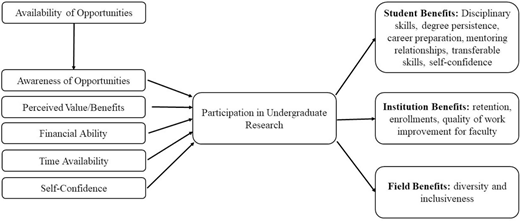
Since the term “high impact educational practices” (HIPs) was coined in 2008, it comes up often in scholarship of teaching and learning research and professional development. Undergraduate research is one of the commonly listed HIPs. The professional and personal benefits to students are numerous, including increased persistence, self-confidence, career preparation, enhanced mentoring relationships, development of transferable skills, networking opportunities, and balancing of intellectual independence and collaboration skills (Council on Undergraduate Research, 2017; Lopatto, 2006, 2010; Madan & Teitge, 2013).
Not only do students benefit, but faculty do as well! Faculty have reported improved career satisfaction, increased quality of their research program, and the formation of close mentoring relationships (Rorive & Brint, 2013; Zydney, Bennett, Shahid, & Bauer, 2002). Undergraduate research increases retention and diversity (Council on Undergraduate Research, 2017; Eagan et al., 2013).
Even with those benefits, some significant barriers exist. There is a lack of awareness of existing opportunities, the benefits of research experiences, how to approach and interact with faculty, and cultural norms associated with scientific research. Students may also see financial and personal barriers like time availability and confidence (Figure 1) (Bangera & Brownell, 2014; Morrison, 2017).
Undergraduate Research in Onlineand Distance Education
With the current emphasis on HIPs, what does that look like in the online and distance education environment? It is probably fair to say that online and distance students are less engaged in undergraduate research, though the literature is silent on this. Is this due to a lack of opportunity or a lack of interest? Are the benefits and barriers the same for online and distance students? What can be done to bring this HIP to our students?
Course-based research experiences are well supported in the literature, but what does that look like online? Do traditional undergraduate research opportunities (e.g., National Science Foundation’s Research Experience for Undergraduates program) appeal to the online student population? How could our online students collaborate with in-person research? What roles could we assign in our research projects to undergraduate researchers? Online students can easily contribute to a research project through professional and technical writing, data analysis, project management, and use of specialized software.
Currently, nontenure track instructors and contingent faculty, account for the majority of all academic faculty in the United States. Online courses are more even likely to be taught by contingent faculty (Ortagus & Stedrak, 2013). While they may be engaged in research, participation in research is unlikely to be a duty of nontenure track and contingent faculty. With fewer research faculty, there are fewer opportunities for students to engage in research with the professionals they are closest to. So who will build online research opportunities? Just as students face barriers, so do undergraduate research mentoring faculty. Do online and distance faculty face the same barriers as traditional faculty: time, resources, recognition, appropriate consideration for evaluations and tenure, and professional development aimed at undergraduate research mentorship?
A Call to Research
It is clear that further exploration in the area of online undergraduate research is warranted. An exploratory study of existing undergraduate research opportunities available to undergraduate students would be informative to understand if online students are provided similar opportunities as traditional students. A survey of online undergraduate students could identify their level of awareness of and interest in undergraduate research as well as their perceived benefits and barriers to participation. A revelatory case study could illuminate a theory regarding the influence of barriers to undergraduate research for online and distance students, providing institutions the opportunity to pursue action for an emerging problem.
If online students are indeed interested in undergraduate research, institutions wishing to increase access will need to consider how to adapt this high impact practice. Even with limited research, it is clear that a pilot program for undergraduate research within an online program will need to consider data-driven outreach, online-only research opportunities, and professional development for online faculty.