Teacher candidates are required to learn foundational teaching skills in order to successfully address the needs of all students in the classroom. Mursion, a commercial education product, is a mixed reality technology which aims to provide teacher candidates with diverse opportunities to practice and reflect on the execution of teaching skills with virtual avatars prior to actual field experience. In this article, 2 faculty members discuss different perspectives on the product and some of the factors that lead to effective implementation of Mursion in college classrooms. Implications for teacher preparation are discussed, including the outcomes of simulated teaching practices once embedded into college level courses.
Introduction
Within teacher preparation programs, instructors plan courses designed to develop both knowledge and performance-based skills related to teaching. Teacher preparation programs regularly integrate elements of experiential learning (i.e., learning through experience and reflection; Dewey, 1938) to develop and practice those performance-based skills. Because these skills take time to develop, it is helpful to facilitate multiple opportunities to practice with feedback. In some of our classes at Illinois State University, we have been using Mursion, a mixed reality technology environment, to provide teacher candidates with low-stakes opportunities to practice and reflect on the execution of these skills with virtual avatars prior to any field experience with real students.
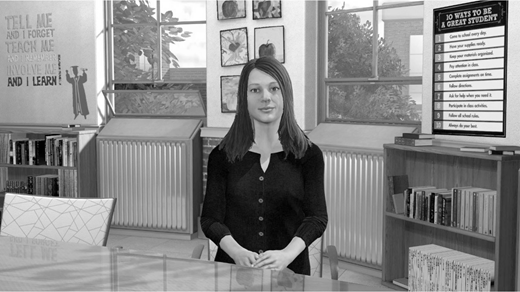
The Mursion environment is referred to as “mixed reality” because there are both human and computerized components working behind the scenes to create a realistic experience. The set-up for the system is simple. Set-up includes a computer, a camera, and a microphone so that participants can interact with avatars in customized scenarios up on a screen. The human component allows the avatars (see Figure 1) to talk and interact with the participant in real time, much as if they were actual people.
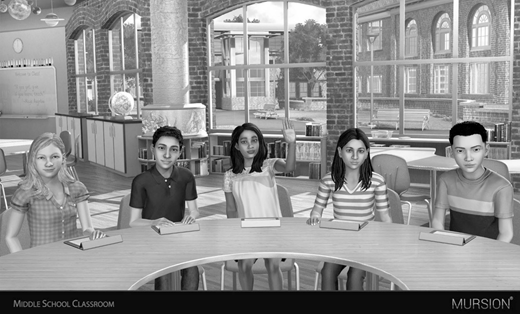
Additionally, when we have used Mursion at Illinois State University, special education teacher candidates utilize the classroom environment to teach lessons to a group of avatar students (e.g., Figure 2). This method has proven for us to be way for future educators to rehearse and master essential teaching skills as they engage in mock interviews and parentteacher meetings. Unlike live role-play simulations, when mixed reality technology is employed, we can customize the age, gender, and race of the avatars, and only one human is needed behind the scenes for any simulation.
Mixed reality technology is not new to teacher preparation programs. Over the past decade, similar technologies have been used to help preservice teachers develop specific teaching practices (e.g., Dawson & Lignugaris/Kraft, 2018) as a way to provide professional development and coaching for inservice teachers (e.g., Dieker, Hynes, Hughes, Hardin, & Becht, 2015; Vince Garland, Holden, & Garland, 2016). The ability to “pause” the scenario and provide immediate feedback and coaching to participants is one of the unique affordances of mixed reality (Dieker, Straub, Hughes, Hynes, & Hardin, 2014).
In this manuscript, we describe how mixed reality technology has been used within a specific course at Illinois State University. We also include the reflections and students’ feedback related to the implementation of mixed reality technology across two different academic semesters.
Impact of Students Learning from the Instructor Perspective
It has been demonstrated that when university instructors integrate high-quality technology, such as mixed reality technology, as part of their teaching, students are more likely to be engaged and motivated (Dawson & Linnugaris, 2018). Mixed reality technology can provide pre- and in-service teachers with innovative opportunities to develop and enhance their teaching skills within a safe educational environment. As with the introduction of any other type of new technology into the classroom setting, at first, it can be intimidating and perhaps complicated for the student to clearly understand the practical benefits that technology affords. As a new nontenure track faculty member, mixed reality technology was at first overwhelming to me as an instructor and that mindset was certainly reflected on my students’ attitudes toward technology. When first I implemented this type of technology, my major concerns were related to my teaching competency, in judging my abilities to explain, and prepare the students for this hands-on experience; specifically, I was required to determine how to segment the learning activities and provide appropriate instructional time and coaching for the students to have a great experiential learning.
My experience with mixed reality technology has now reached 2 academic years. During the first year of use, I employed mixed reality technology with only one section of undergraduate students. In the second year, I implemented with two undergraduate sections of the same course. Each section of this course has up to 25 students enrolled, majoring in special or general education. This course is at an undergraduate level and is named “Family, Professional, and Community Collaboration.” The aim of this course is to learn new strategies about building collaborative partnerships with individuals with disabilities, families, professionals, and community stakeholders. This course is a strong platform to embed new technology tools into the learning setting, since most of the assignments are related or connected to real life experiences (e.g., interview a parent of a child with disabilities). The learning activities using the simulation are aligned with the specific objectives. Implementing this type of technology in my course was optional,but I believe that instructors, must be willing to try new technologies and to model for students, the type of teaching that moves beyond from the traditional teaching methods.
One of the major assignments in this course is to design an interview for families of children with disabilities. The interview has to include at least 15 questions and the goal of the interview questions where for students to gather information about the family functions, interactions, school, and community collaboration. In this assessment I used mixed reality technology to prepare students for the actual interview experience. To prepare for the simulation, students worked in groups of three or four and the entire simulation experience lasted about five minutes. During that time, students practiced asking questions and responded to situations posted by the trained simulator or avatar. The simulation experience was unique but very similar with a daily teaching experience where educators are required to provide parents with informed answers and decisions related to their child learning needs.
This type of technology is innovative and authentic because students can practice teaching skills multiple times, receive feedback, and make tremendous improvements in the performance. But as with any other new technology tools, mixed reality technology is fully effective but only after multiple implementations. When mixed reality technology was first presented to me as an instructor, I did not have a clear understanding of the benefits and how this type of technology will help future educators master essential teaching skills. However, I was eager to try out this teaching method to see if it might improve my course outcomes. Additionally, I knew that simulation technology is becoming widely recognized as a key learning tool and my students will benefit from being exposed to an innovative technology means. Therefore, I tried to have a positive outlook and approach to encourage students who were almost frightened to try it. Even though I was told by my supervisor (a tenure track professor who managed this type of technology in our department) that mixed reality technology is a safe environment for making mistakes, I still remained somewhat uncomfortable with coaching my students during my first teaching experience. My lack of knowledge and experience was subsequently seen on the instructor’s course evaluations. Form the first attempt of mixed reality technology, students reported that the instructor lack of knowledge impacted their preparation and limited their learning during the simulation experience. However, some students (who will be teachers themselves someday) reported that the experience was educational, and also provided them a new perspective on approaching teaching using new technology.
My second year of implementing mixed reality technology in the same course saw a major improvement in outcomes. Some of the factors that made mixed reality technology more effective included: (a) ongoing communication and collaboration with a new department coordinator; keeping students informed about the process and the outcomes as the result of this experience; and embedded into the course planning some of the feedback I received from the students in the previous year.
The positive outcomes were also seen in the students’ feedback. For example, one student said, “I am very satisfied at how the meeting went and feel more prepared for my individual meeting coming up.” Another student complimented the “mother” (trained simulator or avatar): “I really enjoyed talking with student’s mother and loved being able to practice my questions and interview skills with her.” Additionally, one student talked about her personal reaction as how this experience will benefit her in the future “I think it was a good experience because it really made you feel the pressure of having to make questions on the spot.... I was very nervous, and she noticed that, so it was a little embarrassing ... I wish I knew what the avatar looked like ahead of time.” A couple of students from both sections mentioned that knowing ahead of time how the avatar face will look on the screen would have helped them be more comfortable during the simulation. Even though that was not a major issue, when I use the mixed reality technology in my other courses in the future, I will make sure I will provide students with even more specific information about the tool and the application process. Additionally, a few students suggested that having a role-play in the class with their group members to increase the benefit of their simulation experience even further.Overall, all students were very satisfied with this technology experience and throughout the semester they mentioned that the actual interview project was an outstanding learning due to the simulation experience.
International Perspective
According to the Institute of International Education (2019), the number of international students in the United States reached 1,094,792. The United States remains the top host of international students across the world. “International students studying alongside Americans are a tremendous asset to the United States,” said Marie Royce, Assistant Secretary of State for Educational and Cultural Affairs (World Education News and Reviews, 2008). Additionally, the number of U.S. students studying abroad also grew, approximately 1 in 10 U.S. students’ study abroad during their undergraduate career. Reversing that trend, according to Inside Higher Education, the number of international students has started to decline by 2.7% from March 2018 (World Education News and Reviews). Some of the factors that may impact the decline includes the immigration policies as well as the cutting back of scholarship programs in key countries such as Saudi Arabia. Countries such as Australia, Canada, and China appear to be part of the major competitors countries for recruiting international students. For example, Australia set a new record for international student enrollments (World Education News and Reviews, 2008).
Consequently, the new information and communication technologies has become global principles for learning, teaching, and providing scaffolding to enhance learning. Networked technology can enable teachers, students, and other professionals to connect and build global communities (Kozma, 2003). Bransford, Brown, and Cocking (2000) noted that technology can only make a positive impact on teaching when educators use it effectively and it is linked to the classroom curriculum. Strachan and Aljabali (2016) found that mobiles and laptops are the most used devices by undergraduate students. Additionally, most students are using a variety of software such as Blackboard, websites, YouTube, email and wikis, as well as other platforms that their university is using. mixed reality technology is a new form of technology and currently it is being used by more than 65 universities to prepare future K–12 teachers.
Possible Uses in Distance Education
Distance education plays a significant role in higher education, especially for adult learners. The majority of universities and colleges already use some type of online platforms or digital components, for teaching fully online courses or just parts of the courses. Some components include webpages, blogs, videos, or educational apps. The online format has been found to be beneficial because of the reduced time spent on traveling and the flexible schedule that allows students to complete the work on time (Bransford et al., 2000). Mursion technology is an innovative platform that can be successful implemented for distance education in a variety of areas. Mursion is a mixed-reality technology that can support all learners in acquiring new information and receiving immediate feedback. Furthermore, this mixedreality technology follows Salmon’s (2000) effective model of teaching and learning in a distance education format. Salmon’s model is based on five distinct stages of online learning including: (a) access and motivation, (b) socialization, (c) information exchange, (d) knowledge construction, and (e) development. When mixed reality technology is well implemented, it allows learners to engage in group problem-based activities related to real life situations.
Challenges and Recommendations
Like any instructional technology, implementation is not without its challenges. One such challenge is time. Creating a high-quality simulation experience requires advance planning because the facilitator is required to communicate with the avatar (the human working behind the scenes) ahead of time so they are knowledgeable experience objectives, the learning context, and scenario details to create a more realistic experience. Scheduling can be another challenge because, depending on the manner in which courses are scheduled and how many students interact with the avatars at once, may require much class time. The logistics of a particular set up may require time outside the regular course schedule.
Finally, perhaps one of the largest challenges for implementing mixed reality technology at any university is the cost. When we first started using mixed reality technology at our institution, we utilized small start-up grants to fund the sessions before moving to a site license model funded through student fees. We have since taken a break from the site license, recognizing that for this to be a sustainable model, this might have to be supported though a university-wide initiative. The cost and facilitation for a full site license can be overwhelming for a single department, so our informal calculations recommend having more planned use (say, 300+hours per year) if this pricing model is employed.
How can we mitigate these challenges and facilitate successful simulation experiences? We provide four recommendations and possibilities. First, we recommend starting small and then scaling up. Carefully consider which courses would be a good fit to begin implementation. Think about ways this technology can provide a safe, low-stakes environment to practice performance-based skills that could not easily be replicated with more traditional role play. For example, mixed reality technology allows the user to control the race, gender, age, etc. of the avatars and to control multiple avatars at once; this level of customization can be a challenge if an instructor relies on finding actors for role play. Utilizing diverse avatars may also be more appropriate for practicing skills that are more sensitive in nature, particularly with underrepresented and marginalized populations (e.g., culturally responsive teaching, communication with diverse families, difficult conversations).
In addition to considering appropriate courses, begin implementation with faculty who are willing to push themselves outside their comfort zone. We believe faculty mindset is more important than their technological competency for a successful simulation experience. Most of the technology knowledge needs are on Mursion’s end; the instructor/facilitator for the course just needs to be able to log in or restart the program if any technical issues arise.
Implementation barriers related to cost can be addressed by investigating multiple funding sources. One way to pay for sessions is to add reasonable course materials/technology fees, if that is a possibility at the institution. In courses that incorporate fees, we try to reduce student costs by using more source materials instead of expensive textbooks. Costs can also be reduced if students interact with the avatars in small groups rather than individually because less time will be needed. Our students also report feeling more comfortable interacting in groups. Another way to minimize cost is to reach out to another university that has a site license who is willing to facilitate sessions outside their university. These costs are often lower than booking directly from the company. A final recommendation for creative funding would be to find a way to turn this experience into a research study and tap into any available research funds at the institution. Each institution may have some funds available to support new and innovative research related to the benefits of embedding technology in the classroom. Mixed reality would be a great technology tool to be more researched and examined in order to fully understand the implementation as well as the benefits for future educators.
From a nontenure track perspective, ongoing training and professional development are essential for successful implementation of mixed reality technology. It is essential for all university faculty members to be on the same page, especially if the course has multiple sections, especially if the course has one or more than one section, or is a sequence course. The goal of these learning experiences is for students or future teacher educators to be able to connect with prior or/and future learnings, and if one of the faculty members is not stepping outside of their comfort zone, therefore students will lack knowledge or will be behind when applying in a new teaching experience.
From an international perspective, mixed reality technology is an essential tool that can be used to recruit international students at the undergraduate and graduate level. Students may become more familiar with the American universities and learning system by using the mixed reality technology, and these experiences may ease their transition and eventual enrollment in the American Higher Education. Additionally, this type of system can reduce the anxiety of language barriers for international students. American universities can use mixed reality technology in different world languages, in their advertising efforts so international students can review and study application or learning materials and are more prepared for their transition.
Conclusion and Summary
Mixed reality technology is an innovative and creative way to provide opportunities to practice and reflect on the execution of performance-based skills related to teaching in a low-stakes environment. There are different ways in which mixed reality technology can be used in higher education including skills training, distance learning, improved collaboration, as well as virtual trips. Furthermore, when repeated practice and structured feedback are provided to future educators, their skills have improved over time (Dawson & Lignugaris/ Kraft, 2018). In conclusion, leaders in higher education need to acknowledge the new generation of students and their learning styles. These students are raised in a technology-rich environment surrounded by varied digital devices and all the classrooms must be equipped with advanced technologies to engage and enhance the learning for all students. Mixed reality technology is an example of a technology that supports digital learners and provides opportunities to practice skills for instruction and management.
This innovative mixed reality technology enhances student experiences by providing in a variety of hands-on experiences such as parent/teacher conferences, job interviews, and classroom management. Moreover, it provides opportunities for students to practice different instructional procedures, such as STEM-related instructional strategies, as well as differentiated instruction and scaffolding, and in a variety of content areas. I was international student myself; I believe that this innovative method of learning appears to show tremendous promise for use with international learners. American universities and colleges should investigate and practice with this technology learning tool, afterwards, and should consider embedding it into introductory courses such as English as a second language as well as training seminars for the first-year bilingual students.
Using this technology, international students can learn English simultaneously with learning about the American culture or the culture of the university where they are enrolled without fear of failing the course or making a public language error that may impact their self-esteem. The college staff and faculty member use this technology to provide international students with unique learning experiences that will benefit their professional and personal experience from the very start of their studies. I personally believe that with this powerful technology tool my transition to an American university would have been easier and smoother. Due to the personalized and unique approach, mixed reality technology would had been an ideal way to help me refine my language, teaching, and personal skills without impacting real students or without having a negative personal experience.
Further, the use of this technology would have assisted me to better reflect on my experiences, practices, and build my knowledge and confidence for future learning experiences. More generally, these types of learning experiences would benefit the college or university instructors as they continually refine the introductory courses or seminars for upcoming international students. Moreover, these technologies are important tools to engage all learners regardless of their language ability and as teacher educators “we are tasked with preparing students for success in a world that is becoming more dependent on technology, a world that is also in need of a workforce that can think critically, solve real-world problems, and function entrepreneurially (Sheninger, 2014, p. 20). Finally, learning the nature of advanced technologies and their applicability in schools and universities is vital for all faculty and staff who work directly with students.