This multicase study describes the unique experiences of online instructors within a novel context of grant- funded online course design assistance in a large Midwestern university. Five instructors reflected on their experience, from conception to implementation of their asynchronous online courses, in individual debrief sessions conducted by the instructional designers of the courses. Such reflections helped both, the instructors and the instructional designers, to better understand the design process potentially leading to more effective online course designing and implementationexperiences, processes, and practices.
Online learning has revolutionized educational practices with new paradigms, pedagogies, and technologies employed to design courses that enhancestudent learning experiences. It provides higher education institutions with a low- cost, flexible way to reach a global audience (Casey, 2008). According to Allen and Seaman (2018), enrollment in distance education has increased for the 14th consecutive year in the United States, growing fasterthan ever before. Around 16.7% of students are at least taking one distance learning course. The 13th Babson Report (Allen & Seaman, 2016, p.3) on online learning states that “When more than one quarter of higher education students are taking a course online, distance education is clearlymainstream.”
During the past year, when the world was struck by the catastrophic COVID-19 pandemic, online and distance learning played a critical role in providing opportunities for continuous learning in higher education contexts (Dhawan, 2020; Misra & Chauhan, 2020). Undoubtedly, online learning in higher education will play a more significant role in the coming years.
However, for this mode of learning to be successful, it is of utmost importance to design learner-centric online courses that promote interaction, engagement, a sense of belonging, and community while allowing students to succeed in their learning goals. Jaggars and Xu (2016) explored four areas that impact student performance and satisfaction in an online course, namely (a) organization and presentation, (b) learning objectives and assessments, (c) interpersonal interaction, and (d) use of technology. Among these four parameters, the one that stood out and had the most impact on student performance was interpersonal interaction-specifically, frequent and effective student-instructor interaction (Jaggers & Xu, 2016). This finding brings us to the critical role that online instructors play in the successful delivery of an online course and in the design of online learning environments.
In the online context, the role of the instructor has been redefined and is multidimensional. Throughout the duration of an online course, the instructor has to adapt and change their roles from being a planner to a model, coach, facilitator, and communicator (Huer & King, 2004). However, an instructor’s impactful role is observed during the developmental stages of an online course when they plan, organize, and structure the course (Baran et al., 2011). These developmental tasks are considered one of online instructors' most important course design responsibilities.
The course design directly impacts student satisfaction; more structured/organized courses, more interaction, and collaboration and reflection opportunities lead to higher student satisfaction and performance (Kauffman, 2015). Baldwin et al. (2018) proposed a model to illustrate the course design process adopted by online instructors. He called it the Informal Design Theory, representing a dynamic problem-solving approach to the online course design process. They further articulated the need for a better understanding of this course design process to understand the instructor’s needs.
Our study delves into this aspect of online learning-the need to understand the experiences and processes of an instructor during the planning and implementation stages of an online course. To this end, a series of debriefs with instructors were conducted to understand how they adopted a course design process. For the context of this paper, the debriefs are a series of semistructured interviews conducted individually with each instructor after the first offering of their online course. This study presents the instructors’ stories that these debriefs helped unfold to better understand the instructors’ experiences and pedagogical needs for course development assistance. This understanding will help identify strategies and procedures to assist with those needs that will ultimately enhance the learning experience for the learner.
The following sections of the paper will elaborate on the context of the study, the conceptual framework, the research design, and the methodology, along with elaborating on the findings of the debriefs.
Context
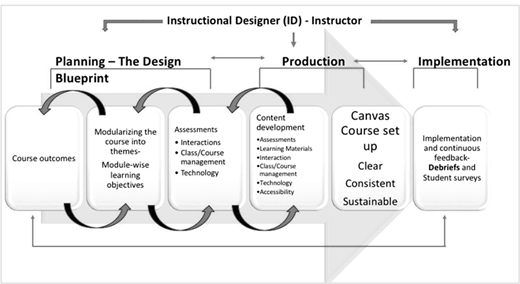
The study was conducted within the online learning unit housed in the colleges of engineering (COE) and liberal arts and sciences (LAS) at a large land-grant research university in the Midwest of the United States. The online learning unit awards grants (financial support) to instructors to design and develop their asynchronous online and blended courses. Grant- recipient instructors work collaboratively with a highly skilled instructional designer (ID) throughout the design and development process, wherein the ID provides technical, pedagogical, and instructional assistance.
The IDs that assisted the instructors who participated in the debrief sessions have extensive experience designing asynchronous online and blended courses and varying areas of expertise (e.g., more than 3 years working in engineering disciplines). The IDs worked with the instructors for 16-18 weeks, conducting needs analysis on the pedagogical and technological aspects of the course, consulting on research-based approaches for active learning,assisting instructors in the use of audio/video software applications, and advising on instructional choices at each step of the design process.
In a typical new development course project, the workflow includes a needs assessment, alignment of course outcomes to activities and assessments, consolidation of the course structure, regular meetings, content sequencing, assessment design, material development, and course site design. The IDs continue to provide the instructors with technical, instructional, and pedagogical assistance throughout the implementation phase.
The design process is grounded in an adapted analyze, design, develop, implement, and evaluate model in combination with backward design (Grant & Wiggins, 2005). Figure 1 shows the course design grant process, which consists of three collaborative and iterative phases: planning, production, and implementation. At the design phase’s conclusion and after the course’s first implementation, the IDs conduct debriefs with the course instructor(s). The debriefs allow instructors to reflect on their experience designing, developing, and implementing their asynchronous online/ blended courses.
Conceptual Framework
Online learning has revolutionized educational practices with new paradigms, pedagogies, and technologies employed to design courses to enhance student learning experiences. Online education provides higher education institutions with a low-cost, flexible way to reach a global audience (Casey, 2008). With the advent and growth of online learning platforms in highereducation, it has become critical to understand the role of online instructors in successful online course design. The foremost step in this direction is to closely examine the experiences of online instructors as they design, develop and teach their online courses. An approach to delve into theinstructors’ experiences is through debriefs.
Debriefing is an accepted practice in health care sciences for teachingand faculty development (Cheng et al., 2016). It is a discussion and analysis of onexy1s experience through evaluation and exploration of events and experiences (Garderner, 2013). It allows for identifying the areas of improvement and betterment (Garderner, 2013). However, debriefs as a mode to understand the experiences of instructors of higher education asynchronous online courses still need to be discovered. Debriefs, defined in the context of this study as semistructured interviews conducted with the instructors after the first offering of the course, allowed instructors to reflect on their experiences while developing and implementing their online courses. Through debriefs, it is possible to encourage instructors to critically self-reflect on their processes and experiences, revealing their thinking on how the course design process and implementation worked for them.
Reflecting thinking is familiar in educational contexts. In fact, Dewey (1933) was the pioneer in reflective thinking and recognized it as a specialized form of thinking. Dewey’s ideas led to the development of Schon’s (1983) reflective practice and the identification and distinction of reflection-in-action (during the experience) and reflection-on-action (after the experience) (Schon, 1988). Further, for adults, Mezirow’s (1996) transformative learning theory revolutionized our understanding of the way adults thought and experienced learning. In transformative learning theory, “learning is understood as the process of using a prior interpretation to construe a new or revised interpretation of the meaning of one’s experience to guide future action” (Mezirow, 1997, p. 162). Furthermore, transformative learning theory “involves transforming frames of reference through a crucial reflection of assumptions, validating contested beliefs through discourse, taking action on one’s reflective insight, and critically assessing it” (Mezirow, 1997, p. 11). Two essential aspects of transformative learning are critical self-reflection and critical discourse (Mezirow, 2006). The former encompasses the perspectives acquired through life experiences that enable us to perceive and understand our daily experiences.
Through critical reflection, adults can identify and reevaluate the assumptions on which these perspectives are constructed. Transformative learning theory provides the basis for understanding the instructors’ course design undertakings after the fact. Therefore, to understand the experiencesof online instructors as they go through the course design process, it is crucial to examine their reflections and the stories that unfold.
Research Design
This study followed a multiple-case study approach and examined the debriefs conducted by five instructors. The IDs conducted these debriefs after the first iteration of their online course. These cases allowed for a comparison of the experiences of instructors in designing and teaching their asynchronous online courses in different colleges within the university (Yin, 2009).
Data Collection And Analysis
The course instructors who participated in the study were from the COE and liberal arts and sciences. They mainly were novice online instructors with no prior asynchronous online teaching experience except for one of the instructors who had a year of online teaching experience. The course these instructors taught were offered in the semesters of fall 2015- spring 2016. All grant-recipients novice online instructors were invited to participate in this study by their assigned instructional designers. They were informed of the study’s goals, and participation was voluntary. Five of the instructors responded with their consent for developing their courses. This study followed all the requirements of the university’s human subject protection office. Pseudonyms are used to protect the identity of the participants and maintain their anonymity. Table 1 provides the profile of the instructors interviewed.
Ethnographic-style semistructured debriefs were conducted with these instructors, where the four stages of ethnographic interview protocol were followed: apprehension, exploration, cooperation, and participation (Spradley, 1979).
As the instructors reflected on their experiences designing and teaching their online courses, it was necessary not to impose any strict structure that would impede their thought process. At the same time, probing or followup questions were asked at stages where more clarification or detailed response was needed. These probing questions were asked mainly under four categories (a) experiences with asynchronous online course design, development, and teaching of the course; (b) strengths and weaknesses of the course; (c) experience of working with an ID; and (d) potential course improvements for future offerings.
The interviews took place in each faculty member’s office, lasted approximately 45 minutes to an hour and were audio recorded. The debriefs were conducted by IDs not initially assigned to work on the course design project with the instructor(s) to avoid any potential conflict or bias in their responses.
The three researchers involved in this study transcribed and analyzed the audio recordings. Each researcher read a transcription in its entirety to develop a sense of the data. Subsequently, the research team met to code one random transcription together line by line. As they coded, they added keywords and phrases that captured relevant initial ideas of the data.
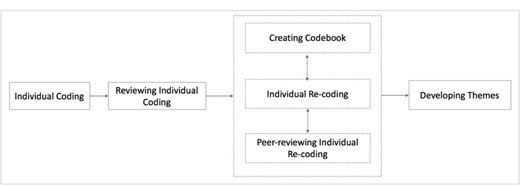
After that, the three researchers met to discuss each of the five analyzed transcripts. They discussed the preliminary codes and resolved any discrepancies. After reviewing all five transcripts, these were revised and open- coded, and a preliminary codebook was developed. The within-case analysis allowed the researcher to become more familiar with the cases. Using a preliminary code book, the researchers coded the transcripts individually again and met in pairs to review those. Through a peer-reviewing phase, the researchers reviewed each transcript and updated the codebook. Any disagreements were discussed, and the researchers resolved them by discussing and reaching a consensus (Brinkmann & Kvale, 2015). Adjustments were made, new themes were added if needed, and a consensus was reached for a final code book. Using the final version of the code book, researchers coded the five transcripts for the last time and compared them; the interrater reliability of more than 85% was established, and the emerging themes were finalized. Figure 2 Cycle for Data Analaysis.
Findings
The findings revealed that each instructor had a unique design journey. However, by crossanalyzing the ethnographic interviews, some common categories emerged: (a) teaching philosophy, (b) instructor’s learning during the design and development process, (c) online experience during implementation of the course, (d) instructor’s perception of online learning benefits, (e) instructor's challenges during course designing and during the implementation phase, (f) support from an instructional designer, (g) course improvements, and (h) instructor’s content development experience. The frequencies of each code occurring in the transcripts were also calculated.
After considering the frequencies of each code and thoroughly cross-examining the categories across the cases along with relevant evidence from the transcripts, two main themes emerged (a) the evolution of the instructor's understanding of an asynchronous online course: content planning and interactions, (b) the working with an instructional designer(Table 2). These themes, along with the categories associated with them, are detailed next.
Evolution Of Instructor’S Understanding Of An Asynchronous Online Course: Content Planning And Interactions
All instructors indicated that they had online teaching experience. Their understanding of the asynchronous online course and its design process evolved throughout the varied design phases and the delivery of the courses. In particular, instructors recounted their experience as designers of the courses by reflecting on their teaching approach, learning during the design and development stages, online teaching, perceptions of online learning benefits, and challenges during the design and delivery of the course.
Teaching Approach
While reflecting on and describing their experience designing the course, some instructors briefly mentioned their approach to teaching. Some instructors placed greater value on student interaction, while others mentioned the required skills for learning the content and the mechanisms used to distribute the workload for assignments. For example, Hannah said, “Programming is a lot like learning a language. You need to activate the vocabulary, and that’s what we were trying to do.” Additionally, she compared the timeline for homework between the online and the face-to-face formats, saying that she was used to “giving [students] homework assignments on, say, Tuesday and to the next Tuesday. One week really doesn’t work for online students because they usually have a weekend or the nights to work on.”
Some instructors who were accustomed to teaching face to face had a perception that inperson interaction between instructor-student and student-student in face-to-face settings would be absent in online teaching. For example, Alex said, “My overall perception was not particularly positive. The in-person interaction with the students, the opportunity for the students to interact with each other in the sort of larger social group, the reinforcement that came from being in the same place at the same time would be missing in online teaching.”
In addition, some instructors were accustomed to teaching face to face and were reluctant and conservative to adjust their teaching style. However, the fact that offering their course online would create an opportunity for those students who otherwise would not be enrolled in their course if the course was offered face to face helped some of the instructors decide to teach online. According to Alex, “I decided to offer our course in summer, entirely online, is that the student body that would attract would be people who might want to take this course and take it to face to face, but for some reason or another couldn’t fit into their schedules or some sort of extra commitment.”
Learning During The Design And Development Phases
Instructors recognized the importance of the learning outcomes in designing the learning activities and assessments. However, making this alignment explicit and clear through specific word choices in the description of assignments came as a revelation. For example, Dana commented “I had neverworked so carefully with the language choices and the Bloom's Taxonomy in terms of, “Okay, here’s the learning objective, here's the assignment, andherexy1s how that assignment fulfills that learning objective.” I had been doing that, but I never thought about the writing process to make sure thatthat happened.”
Similarly, preparing the online course outline helped create its structure and associated components for Hannah. She commented, “Setting the content and the objectives are most equivalent to the deliverables and the timeline. That helped a lot. That was my skeleton, and that helped me fill in the content pieces.” According to Alex, the explicit connection between the different levels of course design was something that he learned and was planning to incorporate going forward. In his words, “How each course outcome connects with an objective in particular modules, the work that is done with particular assessment is very helpful.” He also felt that this alignment exercise helped students understand the purpose of the assignment, presenting clearly why they were doing what they were doing in the course.
While digital tools usually aid in delivering content, instructors commented that during their online course development, they learned to use tools more often and more intentionally.
In Dana’s case, it never occurred to her that creating lecture notes in PowerPoints and recording them would be an option to replace her weekly text-based notes for students. She said, “This time I used a lot more, made better use of the technology available. Previously, I had typed up lecture notes that students had to read versus recording them with PowerPoints. That was all new, and I think that was more effective.”
Likewise, Hannah shared her positive experience creating the lecture recording by writing transcripts and using the Camtasia video recording software. She said, “Assembling the slide deck and then writing a transcript for every single slide worked for me. Once I had the transcript, I noticed that some things were easier to talk about and some things needed a little bit of fine-tuning.” She also mentioned that she eventually got used to using Camtasia software to record videos and felt more adventurous. She said, “By the end, I was a bit more adventurous, and I did some freestyle. Sometimes I was showing students hands-on software. At that point, I was really recording myself doing what I wanted them to see and talking about it, so I also talk out loud. Experience for them so they could follow along what I was doing. They also hear the thoughts.”
In addition, instructors’ understanding of what an online course encompasses was limited to equating it to delivering recorded lectures. In this format, a live face-to-face class was recorded and distributed to distance students, who would log in to the class synchronously or view the recorded materials later. A learning management system (LMS) was used primarily as a repository for lecture notes and the delivery of recorded materials. Learning to design their online course was, the reflection words of Mark, “a rather dramatic change in the way I teach my course.” Another example of an instructor’s understanding of the nature of an online course can be illustrated in Hannah’s comment: “I’ve taught some online courses. One thing that we sometimes do is to just tape a class while it’s happening. I always feel bad for those students who have to watch those tapes, because it’s about something that they just observe, and they donxy1t participate in it.”
Similarly, Aron mentioned,
I did teach ELO courses in past, but just did captures or face to face lectures, so when I actually was doing face to face lecture and have students in front of me, so I felt l was talking to other students. But when I was doing recording, just talking to the computer, it was a different experience but in general it was good.
All instructors acknowledged that there was an initial intense time investment in the content planning phase. This phase included creating observable and measurable course learning outcomes, modularizing and making the content more concrete, sequencing the content in meaningful and coherent modules, and detailing assignment instructions previously verbally presented in the face-to-face course. Instructors also acknowledged that the time invested in such content planning processes intensified in comparison to the planning phase of a face-to-face class. For example, Aron shared,“It was generally a good experience, although it took longer time than expected for preparation and trying to perfect the lectures and so on.” Similarly, Hannah felt surprised that planning to develop an online course involved a heavily front-loaded process. She said,
What basically happened was that for each movie that I made, I spend about 10 hours assembling the material and making all the slides, doing the voiceover, piecing everything together as a movie. About an hour for each minute is about a fair assessment of what I needed in terms of time.
In addition to spending more time on content creation for their online courses, the instructors mentioned that most of their time was also spent on grading assessments. Alex spent the “vast majority of time grading the assessments, reading what students had written and giving the feedback to their discussion posts.”
Learning Through Online Teaching Experience
Understating interactions, student-student, and student-teacher in an asynchronous online course was a learning experience for the instructors. With their prior face-to-face experience, interactions mainly consisted of inclass questions by students, immediate intervention by the instructor if needed, or another in-class communication. For course updates, the instructors would verbally announce them in class. Instructors relied on verbal and visual cues while delivering their lectures and paced the content covered in class or provided remedial lectures. However, in the asynchronous online environments, the absence of such interactions and immediate feedback made the instructors reflect on adjusting their teaching strategies, assessments, instructions, and support the workload students would do. Some comments relate to, “how to pace the lecture, that part is different, in the in-classroom lectures, I could have interactions with the students and then I can adjust the pace adaptively, If I know that students are not getting it, then I can stop it and slow down, gave more hindsight.”
According to Alex teaching online helped him think about how assessments can be redesigned in a way that the students have a clear sense of what is expected from them. In his words, “The biggest thing I learnt and need to do is have a clearer design of rubrics for the assessments in advance and to direct the students to it early, and often.”
Dana, in turn, compares the work and emphasis placed on a face-to-face and an online class. She mentioned the workload in a face-to-face class “you can’t do in an online class. I think that's partly because, during class time, we do a lot of the work, and online it's more students driven in terms of when they do it.”
The instructors critically examined the nature of interactions in an online class. For these instructors, interactions were redefined according to the affordances of the LMS or the online meeting applications, such as Zoom. Instructors’ understanding of the nature of an online asynchronous space evolved from being apprehensive of the type and quality of interaction to valuing the various channels by which interaction was facilitated along with the frequency and quality of communication. In their respective courses, instructors also had online office hours at scheduled times and days where students could come and interact with the instructor synchronously. Instructors heavily employed graded and nongraded discussion forums to facilitate interaction. According to the instructors, such platforms promoted student-student engagement in the online space. For example, Aaron commented, “The discussion forums, in fact, supplemented the completely asynchronous teaching mode by having students actually engage in the discussions and so on.” The discussion boards were also seen to promote cognitive presence and engagement. Aaron also mentioned, “I think the discussion forums were actually very good rather than just talk to the computer, the students watching the videos and so on, so engaging them in the discussion through the discussion forum, this was actually very helpful.”
Nevertheless, the asynchronous nature of the discussion forums posed challenges to instructors to intervene timely when the topic of the discussions was drifting from its focus and bringing superficiality to the posts. For example, Dana pointed out that,
in the online version, since students were doing things at different times, there was sometimes, some disagreement on concepts and it was happening, which a lot of students posted at 3:00 am, I wasn’t monitoring it, so I couldn’t intervene and make a correction.... Then, once I did add my thoughts in, I don't know if the students actually even came back and read it.
Hannah, in turn, mentioned that she had thought that the depth of the discussions would involve critical thinking as exhibited in the face-to-face class; instead, the discussions “didn’t quite work out. The discussions were much more shallow. [Students] didn’t seem to really get into the material. There were a lot of preconceived notions, and they kept repeating those preconceived notions.”
The instructors compiled any critical information shared in the discussion forums or via emails and shared it with the class using the Announcements tool in the LMS. This process of communicating further evolved instructors’ understanding of how critical their presence was for keeping a regular stream of communication with their students. By communicating with students often, instructors could also reflect on the course continuously. This is illustrated in Walter’s comment, “Also, they interact among themselves online, and that’s good because if one student has a question, then others can help him or her.”
Whereas Hannah mentioned that in her class, the interaction with students mainly took place via the announcements tool in the LMS. She said,
I use the announcement tools to make regular announcements. Whenever there were two, three questions that I had got from students via email, I would collect all of those and just give them an update or remind them of their lines or try to clarify something on the syllabus that wasn’t quite clear. Usually, my announcement has three or four points. It was mostly me checking in with them.
Perceptions of Online Learning Benefits
For some instructors, it was evident that the online format benefits the students and instructors alike. These advantages ranged from the flexible timeline of assignment submissions to connecting concepts to application exercises. For students in Hannah’s statistic class to demonstrate they could program and resolve questions, the quizzes were flexible. The online quizzes facilitated a two-way approach, checking for understanding through an active task that could be done unlimited times. Hannah described the quizzing approach as follows,
we had something that we called fast finger programming. We would give [students] a dataset ahead of time and say, “The maximum yield that year was …” Then out of a set of questions, [students] had to pick the maximum which means that on the side, they had to have the program open and determine quickly within two minutes how they could get the quantity. Then in the response report, the little piece of code that they could use to get that quantity. They have to actively put something in rather than us asking them pas- sively.get points if they repeat . they could do [students] them in unlimited number of times. They would, for sure, get the points out and if they have to redo it 10 times, so be it. It was a set of usually 20 questions or so, and they had to do five [randomly selected].
For other instructors, the online course offered students a feasible learning option when they could not enroll in a face-to-face class. According to Alex, “The online format is an opportunity to bring the material to people who want it, who are interested in it, but who can’t otherwise get to it.”
Challenges During The Course Design And Delivery Phases
All instructors reported challenges in the design and delivery stages of the online course. These challenges included an increased workload, a reconceptualization of the course structure, a change of mindset, and using digital tools. Despite some instructors’ prior online teaching experience, there was a steep learning curve as they engaged in a structured yet flexible design process. The learning curve for Dana involved designing the course in weekly modules to provide more consistency to the content and to get used to the pace of students’ work each week. As she pointed out,
With the module method, we opened the module on a Sunday, and the students had seven days to complete all the work for that module. Where in my face-to-face classes, I’m used to saying, “Okay, this is due on Friday… I had to get accustomed to students working at different paces. There were certain students who would do everything on Sunday and others that would submit things at the least minute on Saturday. It was just sort of a different mindset in terms of things continually coming in versus all at once.
Teaching the online course required instructors to set a plan for monitoring students’ participation and grading assignments. While the face-to-face class had a structured weekly schedule when students came to class and submitted assignments, the online format, while giving students broader flexibility to complete their coursework, required that instructors set a plan for the workload. Dana commented that “I felt like I had to be much more committed to checking email, and checking in with the class, because there wasn’t that face-to-face instruction, but also because students worked at their different paces.”
Whereas for Alex, grading, while providing effective and helpful feedback, was his biggest challenge. For him providing feedback different than the assessment instruction was a challenge. In his words,
If they just didnxy1’t do it, or what they did seemed to suggest they clearly didn’t understand what it was that was being asked of them, that is a greater challenge, because that requires me to figure out what kind of comments, what kind of feedback I can give back such that when they attempt to do it the next time that they will do it better. How to make that feedback sound different from the instructions that I gave them at the front end.
The instructors were amazed at the workload required to develop their online courses. Hannah shared that
What was really a surprise to me was how heavily front-loaded online courses are. In retrospect, I should have started earlier. I did start sometime in May. At that point, my summer was booked with conferences and travel. I just didn’t have a lot of time or not enough time to prepare all of the online materials.
Aron said,
the main challenges actually were, first the deadlines. For example, I know I had to post the lectures online at a certain time and other issue was that specially at the very beginning to prepare a lecture, it took a long time, for example I had to record them and edit trying to perfect the lecture.
Instructors also faced challenges in adjusting to grading in the online environment. For Dana, providing feedback felt “less personal since I was clicking buttons versus writing much feedback.” Dana relied heavily on rubrics and could write less feedback than she was used to in the face-to-face class.
The second major theme that emerged from the analysis of the debriefs was the working relationship between the instructor and the ID. Specifically, instructors described their experience in terms of the support from an ID while also discussing their content development experience and future course improvements.
Support From An Instructional Designer
Instructors recognized the value of collaborative work with their IDs. They expressed their appreciation for the guidance received regarding content sequencing, that is, the length of each module, the pacing of the different assignments, and the type and format of assignments. They also received guidance on creating their syllabus and schedule and LMS design, including course structure, layout, visual elements, and navigation. Aaron described the suggestions he received and how important those were, including different methods of assessment, especially discussion forums. For him, “[discussion boards] played a pivotal role in getting the online students involved because, without these discussion forums that you have suggested, I think that the interaction with online students would have been to a much lesser degree.”
According to the instructors, their IDs helped with project management tasks, facilitating advancement in the course design in a timely manner. Some comments that support these findings include the following:
Also, follow up on the deadlines, also the email messages that [ID] used to send us. Actually, this kind of puts some kind of pressure actually, not in a bad way pressure on us to pay more attention to recording the lectures and putting the material online. Otherwise, things may have dragged a little bit, yeah … the responsiveness is excellent and very helpful. I never could have done this without the help that I got . I liked that the ID, at least, seemed to have a plan. I don’t have a plan going in. The ID worked with me with weekly deadlines. Chunking up the material helped me design the course.”
Some of the instructors reflected on the evolution of their partnership with their IDs. These instructors recognized that the relationship was collaborative toward a common goal where they worked as a team,
I think [ID] and I had a great working relationship. She presented ideas. She was very efficient in terms of, here’s our agenda for what we’re going to talk about, by the next time we meet, here are some of the things you’re going to accomplish, here’s the thing I’m going to accomplish. I felt like it was a really great collaborative process. (Dana)
Additionally, instructors valued the knowledge and pedagogical expertise that their IDs brought to the projects. The ID lens helped the instructors take up some challenges to reconsider their approach to content coverage and workload. As Dana highlighted in the interview,
When she pushed me from changing this course calendar from dates to modules, like, kudos to her for doing that . because it made life a lot easier . because of her experience, [she] could look at it and say, “You’re making a lot of work for yourself.” And I couldn’t see it at the time, but with her experience she would jump in and say, “Oh, you need to streamline, or cut, or something,” so that was really helpful.
Alex mentioned that the guidance he received from an ID on converting a large- scale face-to-face 16-week course with substantial content to an 8-week summer online course was invaluable. In his words, “The sense of what was appropriate amount of material to assign from week to week in terms of reading and assessments. What are the kinds of online resources, clear instructions, clear rubrics is the kind of feedback of help received from ID and was absolutely essential, and made the course successful as it was, I feel.”
One salient challenge that instructors faced was identifying ways to involve students in the online environment. Working with IDs helped instructors overcome this challenge by following best practices and alternative assessment ideas. Aron appreciated ID’s help identifying alternative assessments for his course, which helped in student involvement. In his words,
ID proposed four different methods of assessments, actually discussion forums; in fact, I think they played a pivotal role in getting the online students involved because without these discussion forums that ID had suggested, I think that the interaction with online students would have been to a much lesser degree.
Future Course Improvements
The design and teaching of the online course allowed instructors to reflect on their experience and use the challenges faced as catalysts for improvements. The redevelopment activities ranged from visual design and iconography to the length of the course and workload for students and instructors. In Dana’s discussion-based class, the improvements related to reducing the seats open for the course and the length of the lecture videos. The class involved a heavy load of reading and writing required for students to participate in the discussions actively, and Dana pointed out that “for 40 students, I couldn’t write the feedback that I’m used to in the face-to-face class... and do that in a timely manner.” In addition, she planned to shorten the lectures to less than 16 minutes.
Content Development Experience
The content development experience explicitly related to the process from planning to creating the learning materials, activities, and assessments. For example, structuring the course into coherent and logical modules, creating a detailed course schedule for the whole course with precise due dates for all deliverables, and sequencing the content, were some of the most common comments in the debrief interviews. Aligning assignments to outcomes and clearly describing their purposes and instructions was critical for the online class. Dana explained that she had to describe the assignments in more detail for students to understand the expectations. She had to“think about the way in which the instructions were written for assignments and write out everything I would normally supplement with verbal instructions.... Okay, when I’ve given this assignment before, what were the questions students asked?’ to try to be more proactive with that as I wrote the assignments.”
Also, planning, shortening, and recording lectures were challenging and gave the instructors a new perspective on structuring and planning the content. Walter commented “breaking the lecture into smaller parts. This was actually difficult for me to understand the students would like to see 15 minutes or 20 minutes maximum lecture.”
The development of the lectures was a “time-consuming” process that involved most of the instructors in learning how to record, pace, and edit the video recordings themselves.
However, developing the content was regarded as a good learning experience.
Discussion
This paper examined instructors’ experiences developing their online courses through debriefs. The two main themes that emerged from the data included (a) the evolution of the instructor’s understanding of an asynchronous online course and (b) working with an instructional designer. These themes encapsulate several concepts that illustrate the experience of instructors designing their first online courses (refer to Table 2 for details of these concepts and themes). These two themes will be discussed in detail in the following sections.
Evolution of Instructor’s Understanding of an Asynchronous Online Course
While the instructors in this study recognized the importance and relevance of the course learning outcomes, it needed to be clarified how to use the outcomes as a guide to design the learning activities and assessments. During the development process, instructors aligned the content and assignments they created to the course outcomes. In other words, the instructors used the learning outcomes as starting points to identify how students would be able to demonstrate their learning (Biggs & Tang, 2011). The instructors also relied on the outcomes to design transparent assessments with clear deliverables, time lines, and instructions. Instructors further reflected on how the outcomes facilitated restructuring the content into more manageable pieces and helped them in the intentional use of digital tools. Instructors entered into a discovery stage with several revelations to develop an understanding that in order to develop their online course, it was paramount to adopt a student-centered strategy guided by the outcomes.
Considering that the instructors in this study had vast face-to-face teaching experience, the online learning environment challenged them to step out of their teaching comfort zone. At the beginning of the design projects, these instructors needed help to envision interactive online communication with students. For most of these instructors, not seeing the students and their interactions prompted them to consider that the online space would isolate students and would prevent them from a robust and engaging exchange of ideas, a common concern many instructors have about online learning (Boulos et al., 2005; Comer & Lenaghan, 2013).
Furthermore, instructors feared that the online space would prevent them from communicating with students efficiently; delivering the instructions and course information verbally. Unbeknownst to instructors, they were concerned with their online presence in the course; however, this presence was narrowly believed to be similar to being present physically in the face-to-face class. The instructors were concerned about conveying a sense of presence in an environment where participants do not see each other in real time. Thus, instructors were evolving in their understanding that their presence would involve more than being there; it would include using different means and tools to guide the students’ learning experience (Kelly, 2014)
Despite instructors’ plans to utilize several methods to interact with students, including announcements and discussion boards, these instructors wondered if communicating with students, as they usually did face to face, would be possible online. However, during the delivery of their courses, the instructors realized that being present in the online environment was not only possible but that interaction in the online space goes beyond giving instructions on assignments or promoting student-to- student interaction. Instructors became aware of the affordances of the online environment to allow for different types and formats of interaction, ranging from scheduled office hours, more intentional feedback on assignments, the use of announcements, and nongraded discussion boards.
Along with the topic of interaction, instructors realized that their presence understood as the instructor being there or making them “visible and real” to students, was one critical aspect of their online teaching (Kelly, 2014). Nevertheless, the asynchronous nature of the courses posed an additional challenge to instructors timely intervention. Some of the instructors raised concerns about needing help to monitor students’ contributions in the discussions and intervene timely if needed. These instructors could have realized that the online environment’s asynchronicity gives the advantage of carefully responding to the posts and enhancing the quality of the interactions (Rovai, 2007).
Working With an Instructional Designer
Instructors in this study worked closely with an instructional designer throughout the online courses’ design, development, and delivery. While working with their IDs, the instructors realized that designing their online course would demand substantial time and continuous pedagogical adaptations to meet the goals, of course, design quality (Burdett, 2003). The content preparation workload for the instructors in this study increased substantially during the design and development stages. The intensity and time necessary for creating the course plan and learning activities were unexpected by all instructors.
The front-loaded process that the instructors followed required them to plan a course blueprint that would showcase a modular (e.g., weekly, unit, chapter) content structure organized cohesively and aligned to the outcomes. While instructors should have completed the development of all the content, including activities and assignments, prior to delivering the course, some course developments happened while the courses were in progress. This impacted even further the time commitment and availability of instructors to create the content and learning materials in the LMS in a timely manner, with some instructors needing to be a week ahead of students’ completion of the previous weekly module. Considering that a practical approach to the quality of the course design is to have a consistent structure and, thus, the learning experience (Rottmann & Rabidoux, 2017), instructors realized that they needed to also plan for the course delivery. This plan involved ensuring that all content modules had a consistent structure and organization, strategizing the instructors’ participation in the discussion boards, and establishing a time frame for grading assignments.
In addition, instructors placed greater value and praise on the collaborative and supportive demeanor of their ID for the successful development of the course. According to the instructors, the assistance from the IDs exceeded the course design process. Instructors acknowledged that IDs facilitated project management tasks, including keeping pace with the time lines, and balanced the workload for developing and delivering the course.
A remarkable aspect of the ID’s support is that instructors view it as a collaborative endeavor. This collaboration allowed IDs to guide instructors in the course development project through their pedagogical, technological, and learning theories expertise. In contrast, instructors trusted the instructional design choices regarding course design and delivery. Instructors viewed these collaborations as an important part of their support system.
However, instructors appeared to have been challenged during the conversations with their IDs, becoming aware of the reasons for the instructional design decisions (e.g., breaking down the content into manageable pieces and creating rubrics). This was captured within a conducive environment that allowed IDs to challenge misconceptions of instructors about online teaching and learning and for instructors to move from their instructional/teaching comfort zones. The collaborative experience that instructors had with their IDs underscores the recognition that to function as an effective team member, it is critical to value the different talents that each other brings into the course development projects, facilitated through active listening and trust (Richardson et al., 2018), and to meet instructors where they are in their online pedagogy.
Conclusions
This multicase study highlighted the experiences of an instructor through the design and development process of their asynchronous online course. The findings presented how the instructor’s beliefs related to online learning and teaching evolved during the design phases of their courses as they worked with an ID, particularly their understanding of an online course, the work and time commitments needed to design one, course interactions, content planning, and sequencing. The findings also showcased the value IDs bring with their pedagogical and technical skills and project management strategies. These debriefs go beyond making the experiences and reflections visible. However, they also represent a step toward making the instructor a reflective practitioner, which is seen as a combination of selfawareness, reflection, and critical thinking (Eby, 2001).
The instructors in this study had the opportunity to list the ways to better their course for an enhanced learning experience. In contrast, IDs identified the areas where instructors could be better supported throughout the design and development endeavor. Conducting debriefs after the design process can be a critical tool for the instructors to reflect on their design process and teaching adaptations for online environments. It is also an insightful tool for IDs to improve their approach to pedagogical and technological assistance. A better understanding of processes and philosophies for the instructor and the IDs can lead to more effective course designcollaborative practices and potentially better learner experiences.
Limitations And Future Study
This multiple-case study was conducted in a particular university setting within an online learning unit that awarded a grant for funding the design and development of online courses with the support of an ID. While the study provides deep insights into faculty experiences, the findings should be cautiously applied to other educational contexts with a different culture and support system.
This study can be extended to examine how such reflections enhance the design process and lead to better asynchronous online courses. Conducting further debriefs with instructors experienced in asynchronous online teaching can provide a better understanding of their instructional decisions to enhance students’ learning, communication, and types of presence. The study presented here could be further extended to be included as one critical step in any instructional design model.