The researchers explored Tennessee parent reasons for choosing a K-12 public school district virtual school for their children. Tennessee virtual public school principals were asked to forward a survey link to parents. Results indicated that parents believe that the virtual school option provides learning opportunities that better meet student needs and a structure that supports family flexibility. Additionally, some parents experienced the traditional school environment negatively and the virtual school provided an alternative. This study adds to the existing and emerging knowledge on parent reasons for choosing a public school virtual option and provides direction for additional research.
Introduction
Many teachers, students, and parents were introduced to schooling beyond brick-and-mortar schools because of the COVID-19 pandemic. Indeed, online learning enrollment increased in many states during the pandemic as an alternative to in-person instruction, which was uncertain (Gewertz, 2021; Richards, 2020; Schwartz et al., 2020). Some expected this increase to be temporary, but current virtual school enrollment numbers indicate that an online K-12 learning option is increasing. For example, in Tennessee, this study’s state, the Department of Public Virtual Schools’ application approvals increased from 17 in 2019 to 61 in 2023. Thus, there has been a trend toward virtual schools as a permanent school-choice option. A survey of Tennessee’s virtual school principals found that 91.67 % of the respondents expected their enrollment to increase for the 2022-2023 post-pandemic school year. Moreover, increasing evidence shows that virtual learning environments will continue to exist in some form (Stephenson et al., 2021). Many educators purport that the digital revolution will continue transforming how students learn.
Virtual schools are increasing, offering many parents and students an attractive alternative to traditional brick-and-mortar schools (Bennett & Bennett III, 2019). While K-12 virtual schools were once considered an inferior option to traditional schools, their enrollment has increased exponentially as a quickly growing, desirable educational alternative (Hennick, 2021). Consequently, many students and their parents have discovered that the virtual learning environment offers flexibility, personalization, and increased family time (Chang-Bacon, 2021; Gewertz, 2021; Klein, 2021). In addition, this alternative to traditional schools is a welcomed option for students who experience bullying or peer pressure in traditional K-12 schools.
Family Needs and Learning Preferences
Parents also consider academic quality when choosing a school. Although some studies indicate that students’ test scores are lower in cyber schools (Bueno, 2020: Halloran, 2021), parents view academics from a more holistic perspective. Many parents do not define Academic quality exclusively as test scores but includes factors such as a better learning environment, curriculum, smaller class size, and individual attention (Erickson, 2017). Additional research indicates that a remote or hybrid model better serves specific student learning styles. For example, special education students often experience anxiety and bullying in the structured traditional school that is reduced in a virtual school environment (Aloizou et al., 2021; Beck et al.,2014; Marshall & Neugebauer, 2022; Shaw & Shaw, 2021; Tonks et al., 2020). Then, some students achieve more at an accelerated pace and, therefore, have increased opportunities to take courses unavailable in traditional schools (Marshall et al., 2022).
Of the US K-12 students, 14% are enrolled in optional schools, including charters, private, and magnets (Saatcioglu & Snethen, 2022). Studying Kansas City schools, Saatcioglu and Snethen (2022) identified 19 school-choice options; however, none included virtual schools or hybrid in-school/at-home options. In this study, we explored Tennessee virtual school parents’ reasons for choosing a public virtual school for their children. We surveyed parents to understand reasons for choosing a public virtual school, including family flexibility, education advantages, parent involvement, and negative school issues in the traditional setting.
School Choice Post-Pandemic
The at-home learning structure required during the COVID-19 pandemic increased awareness of virtual schools as a new option. Previously unfamiliar with virtual schools, parents were exposed to remote technology as an instructional format. Although many parents disliked the learn-at-home option, others found it preferable for their youngsters versus the traditional brick-and-mortar format. Although limited, research on students in virtual schools points to various students who might learn better through a remote or hybrid model. For example, studies indicate that special education students often experienced anxiety in the structured traditional school, which was reduced (Aloizou et al., 2021; Marshall & Neugebauer, 2022; Shaw & Shaw, 2021). Other students welcomed opportunities to take courses unavailable in the traditional school, increasing opportunities for additional choices (Marshall et al., 2022). Increasing numbers of students and their parents have discovered that the virtual learning environment offers flexibility, personalization, and increased family time (Chang-Bacon, 2021; Gewertz, 2021; Gratz et al., 2022; Klein, 2021). Another parent’s reason for embracing this alternative to traditional schools is the desire to leave a negative social environment where students experience bullying or peer pressure. Because many students benefit from learning in a virtual school, Marshall et al. (2022) suggest that increased access to full- and part-time online options should be a priority for policymakers and school leaders.
During the pandemic, a learn-at-home educational option was a positive experience; and many did not want to return to the traditional school structure (Jochim & Poon, 2022). In the Center on Reinventing Public Education survey of 152 parents, two-thirds cited at least one benefit of a family-centered approach compared to the traditional pre-pandemic school experience. The results have profound lessons for educators and policymakers to consider in providing an education that is best for all students (Gewertz, 2021; Jochim & Poon, 2022; Schwartz et al., 2020). According to Jochim and Poon (2022), the student-centered learning environment had the following advantages: (a) families gained information about and influence over their children’s education, (b) families were brought closer together, and (c) children felt known and valued because of the social and emotional support they received. Studies have also revealed that families would like to preserve the benefits of a more intimate and customized educational experience for their children (Jochim & Poon, 2022; Zhao & Watterson, 2021).
Parents’ Reasons for Choosing a Virtual School
Parents’ reasons for choosing virtual schools vary based on demographics, including geography. Rural families might be more interested in expanded curricula (Shakeel & Henderson, 2019). Other parents seek to remedy problems their children experience, such as bullying, lack of personalization in educational programs, and limited opportunities for flexible scheduling (Beck et al., 2016). The demographics of parents choosing a virtual school also vary. In Jochim and Poon’s (2022) study, parents were not just White but were educated and affluent. Black and White families reported that 80% were college graduates, and 40% had graduate degrees. In addition, half reported an income of $120,000 or more.
Tonks, Kimmons, and Mason (2020) studied reasons why parents of special education children leave a traditional school for a virtual school. One reason was negative experiences with the traditional school, with bullying being the most common. A second reason was improved educational opportunities for students; specifically, students can go at their own pace, and a flexible schedule allows work to be done according to the students’ determination and preference. In a study of high school online credit-recovery schools, Schweitzer and Schweitzer (2015) found that parents chose the school due to a negative relationship—both academic and social—with the previous school. The benefits they found were improved academics and social relationships; increased learning flexibility, i.e., working at one’s own pace; increased communication with teachers; and increased satisfaction with the curriculum.
Additionally, there is a difference in assorted studies’ findings before and after the COVID-19 pandemic (Mann et al., 2016). Before the pandemic, most distance education was online, with little recognition of students’ social needs. Afterward, more attention was paid to a virtual school with online, face-to-face, Zoom, or other interactions. The newly emerging post-COVID virtual schools might be best described as hybrid, with some online and some in-person educational opportunities. However, changes are required within and outside traditional schooling to accommodate parental demands. Examples of needed changes such as accommodating and integrating in-person and virtual support and a more flexible student-centered day (Jochim & Poon, 2022). Such flexibility requires a partnership with parents, recognizing their assets, and making resources such as curricula available.
Conceptual Frame: Choice Theory and Schools
People want freedom in most, if not all, facets of their lives (Glasser, 1999). We are accustomed to choices in the United States, from choosing a place to live to selecting from many grocery products on the shelves. Choice theorist William Glasser (1999) asserts that we are more in control of our lives than we realize and that taking control results in better choices. A contrast to choice is external control, whereby those with power use coercion to get their way. An example of external control is when others tell us what is right for us and force us to do what they believe is right. The powerless accept such control when they believe they cannot choose otherwise, and that resisting is useless (Glasser, 1999). School choice advocates believe the educational monolithic system is naturally coercive (Hess, 2020). That system starkly contrasts the choices people desire and the marketplace operating in most areas of US life, with most people rejecting monopolies (Tyack, 2003).
Proponents of school choice argue that there is not one best type of school and that matching students to an appropriate option is the priority. This view of choice also gives parents the power to identify schools that fit their children’s and their families’ needs. Moreover, parental choice results in greater parental commitment and increased student engagement (Erickson, 2017; Tyack, 2003). Applying choice theory to education requires parents to find and use information to match their children’s needs to the appropriate school option (Bosetti & Pyryt, 2007; Erickson, 2017; Rohde et al., 2019; Shuls, 2018).
Exercising choice assumes that parents and students are aware of their options. Although studies are limited in identifying how parents learn about those options, available data have identified other parents as a source of most information (Erickson, 2017). Knowing options to choose a school has been described as filled with pressure in Arizona’s educational choice and vigorous charter school markets (Potterton, 2020).
Methods
Purpose
At the inception of charter schools and voucher proposals in the 1990s, competition among schools was thought to produce better schools for all (Bridgeforth et al., 2022). The current study’s perspective is that in the post-COVID-19 era, choice is more a matter of finding the best fit for students and families regarding academic and non-academic needs. We consider a K–12 public virtual school choice not as a method of school reform but as a parental right and responsibility to find the best school that meets a child’s unique educational needs. Virtual schools with online or hybrid learning offer an additional option.
Research Question
This study was based on the following research question:
What reasons contribute to Tennessee parents enrolling their children in a K–12 public virtual school?
Survey Population
This study’s population was obtained by asking principals of Tennessee virtual schools to forward a survey link to their student’s parents. This approach was the only option for accessing parents because parent data was not publicly available. A total of 9,705 parents enrolled their children in a virtual school during the 2021-22 school year and became part of the survey population. Of the returned survey responses, 192 were usable. Of the respondents, 81.3% were female, 81.3% identified as White, and 56.8% were middle class. In a question asking for education levels, 78% of the parents indicated they had some college, and 40% responded that they had a bachelor’s degree or above. The survey also asked parents to provide information about their children. The survey revealed that 51% of the students enrolled in a virtual school were female, and 77.6% were Caucasian or White. Most students (57.8%) were enrolled in their first virtual school year. Grade levels were K–5, 26%; 6–8 (31.8%); and 9–12 (42.2%). To avoid skewing, we eliminated data from respondents who did not complete the survey. Also, the missing variable in a table indicates that respondents did not select an answer for that question.
Survey Development
A previous study examined parents’ reasons for choosing a virtual school before and during the pandemic. It was conducted in a K–12 non-public, non-traditional, online, and hybrid school serving students and families using classical home-centered education. That school was chosen because it was conveniently located. In addition, the school retained data from interviews and an extensive questionnaire that parents must complete in the application process. One of the questions asks parents to identify the reason for choosing the virtual school. The principal provided access to the data for 2017 through 2021, involving 149 high school students, 179 in middle school, and 181 elementary students. That exploratory study generated the following themes that became the basis for the current study’s survey: (a) dissatisfied with the environment and learning, (b) desired individual learning, (c) students had special education needs, (d) began homeschooling during COVID and continued afterward, and (e) wanted more family time. We did not use themes indicating a religious or a classical education as a reason for choosing because they did not apply to our study.
This study’s survey consisted of five student demographic questions, four parent demographic questions, and five questions about choosing a virtual school. Questions related to parents choosing a virtual school were positioned on a Likert scale with items ranked at various levels of importance from not important (Level 1) to of the highest importance (Level 6). An even-number Likert scale was chosen to eliminate a neutral position within the interval scale. Survey questions were grouped into sections to understand parents’ reasons for choosing a virtual school; the questions were related to family flexibility, educational advantages, parent involvement, social opportunities, and negative issues in a traditional school. A four-point Likert scale from strongly disagree to agree strongly was used to determine parents’ perceptions regarding social opportunities. Experts and practitioners experienced in virtual schools reviewed the survey for face validity.
Survey Data Collection and Analysis
After receiving permission from the University of Tennessee’s Institutional Review Board, the survey was delivered electronically through QuestionPro, an online survey program, in January 2022 and remained open through May 2022. During this period, principals were sent two reminders to forward the survey link to parents. Parent survey data were analyzed using Statistical Package for Social Sciences (SPSS) Windows 28.0. The data were evaluated using percentages, numbers, means, and standard deviation measures to create descriptive statistics tables and frequency tables for students’ and parents’ demographic information and the questions on parents’ choice. Bar graphs were also created using the data to visually present group comparisons.
Results
The parent survey results were documented in subsections of similar content related to parents’ reasons for choosing a virtual school identified in the first study. The survey was designed to be effective and efficient, with Likert items offering various levels of importance. Although treating Likert scale responses as interval data can be problematic (Bishop & Herron, 2015), doing so allowed for evaluating trends, program effectiveness, and comparisons.
Parents’ Reasons for Choosing a Virtual School
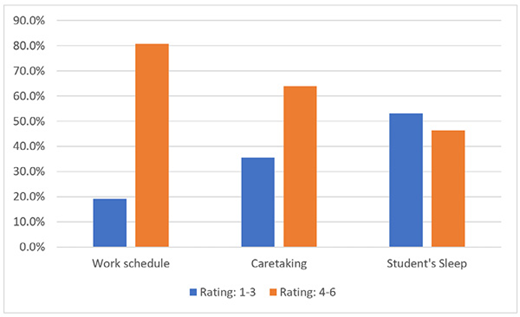
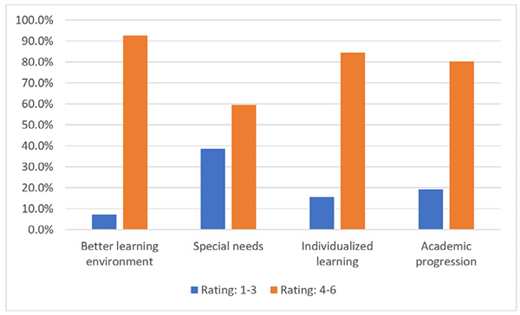
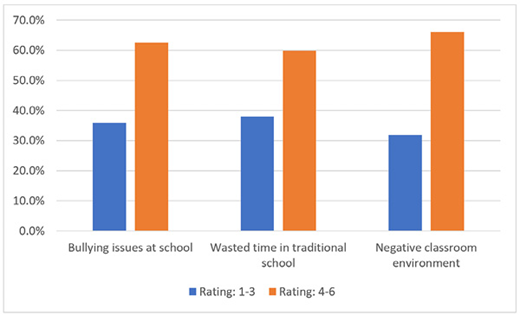
Parents were asked to report how they perceived the importance of several reasons for choosing a public virtual school over a traditional public school. A six-point Likert scale measured parents’ responses to the survey questions involving family flexibility, education advantages, parent involvement, and negative issues. A four-point Likert scale from strongly disagree to strongly agree was used to determine parents’ perceptions regarding social opportunities. Figures 1 through 3 document the parent ratings in groups of importance from 1 to 3 (lowest) and 4 to 6 (highest tables 1 through 3 document the mean ratings for all the reasons within each category).
Family Flexibility
Survey questions related to family flexibility allowed parents to identify the importance of each reason for choosing a virtual school. A six-point Likert scale was used, with 1 being not important and 6 being most important. The first question about family flexibility was about time flexibility around parents’ work schedules, caretaking, and students’ sleep schedules. Figure 1 shows the cumulative percentages for Ratings 1 to 3 and 4 to 6, which document the parents’ rating of importance for family flexibility. According to the frequency statistics, the category of time flexibility related to work schedule had the highest ranking, with 65% of the parents responding in the 4 to 6 range of importance. A close second, caretaking, was 63%, and student sleep took the third spot at 40%. Parents rated students’ sleep of lowest importance at 53.1%. The descriptive statistics (Table 1) show a similar comparison with time flexibility related to work schedule at a 3.89 mean, caretaking at 3.88, and students’ sleep at 3.16.
Educational Advantages
The survey questions also assessed parents’ reasons for choosing a virtual school related to educational advantages, such as a better learning environment, special needs, individualized learning, and academic progression. As shown in Table 2, parents’ responses revealed that more parents (mean of 5.23) chose a virtual school related to educational advantages for better learning opportunities, with more individualized learning following closely (mean of 4.78). The descriptive statistics showed academic progression with a mean of 4.61 and special needs with a mean of 3.75. Based on the frequency data from the parent surveys, a better learning environment was at 92.7% in importance for Levels 4 through 6, with individualized learning at 84.4%, academic progression at 80.2%, and special needs at 59.5% (Figure 2).
More Parent Involvement
Parents prioritized involvement when enrolling their students in a virtual public school. Out of 192 parents who responded to the survey, 82.5% chose Levels 4 to 6 as important for increasing parent involvement in their children’s learning environment. The descriptive statistic for parent involvement was a mean of 4.63.
Negative Issues in Traditional School
Parents were asked about their children’s negative experiences in a traditional school that influenced their decision to choose a virtual learning environment. Three reasons unrelated to COVID-19 were presented: wasted time, negative classroom environment, and bullying. As noted in Figure 3, 68.8% of parents chose wasted time as the top negative reason, 65.3% chose bullying as a close second, and 59% chose wasted time. As documented in Table 3, descriptive statistics related to negative reasons revealed that a negative classroom environment had the highest mean at 4.12, bullying at 3.92, and wasted time at 3.73.
Social Opportunities
One of the criticisms of virtual schools is that students do not have the opportunity to interact with peers of their age. Two questions on the survey were about opportunities to interact with others outside their children’s traditional school environment and to interact more with family members. The majority (69.8%) of parents agreed or strongly agreed that their children could interact with others not in the traditional school, and 86% of parents agreed or strongly agreed that their children could interact more with their family members. Based on a 4-point Likert scale, strongly agree to strongly disagree, the descriptive statistics showed a mean of 2.87 for students’ ability to interact with others not in the traditional school and 3.23 for students’ ability to interact more with family.
Discussion and Implications
This study explored why Tennessee parents choose a K–12 public virtual school for their children. Our conceptual study’s frame viewed school choice as the right and responsibility of parents to find a school that best meets their children’s unique educational needs. The study’s findings emphasized reasons for parental choice of a virtual public school, such as family needs, flexibility in schooling structure, and opportunities for learning better matching students’ needs. In addition, this study found that parents desired more involvement in their children’s education and believed such involvement was more likely to be achieved in a virtual school. These findings are consistent with other research (Aloizou et al., 2021; Marshall & Neugebauer, 2022; Shaw & Shaw, 2021; Tonks et al., 2020).
Furthermore, most Tennessee virtual school parents who responded to our survey sought to accommodate their work schedule and obtain family flexibility. In addition, 90% of parents wanted a better learning environment for their children and provided specifics, including accommodation for special education needs, opportunities for individualized learning, and a more effective academic program. These findings are consistent with prior research on parents’ reasons for choosing a virtual school (Chang-Bacon, 2021; Gewertz, 2021; Gratz et al., 2022; Klein, 2021).
While the reasons above might be viewed as positive, families also chose to escape what was viewed as a negative learning environment or untenable situations such as bullying. The literature often cites the avoidance of or escape from bullying, including the work of Beck et al. (2016). These findings align with our study’s results. In addition, our results indicate that wasted time and a negative classroom environment in the brick-and-mortar school were conditions most respondents chose to avoid.
A criticism of virtual schools is that students do not have the opportunity to interact with peers of their age. In contrast, 69.8% of parents agreed or strongly agreed that their children had opportunities to interact with others outside the traditional school, and 86% agreed or strongly agreed that their children could interact more with family members.
Exercising choice assumes that parents and students are aware of school options. Understanding the complexity of a virtual public-school choice leads to exploring how parents obtain knowledge about this option. It has been suggested that families during the pandemic became familiar with a learn-at-home option, and many did not want to return to a traditional school (Jochim & Poon, 2022). Although studies are limited in identifying how parents learn about options, a common source of most information is other parents (Erickson, 2017). However, this source is limited to whom parents know. Additional research is needed on (a) how parents obtain information about virtual public schools and (b) schools and districts as sources of parent information. Data from our previous study on virtual school principals (Author & Author, 2022) indicate that students and families are most likely to seek virtual options when there is a problem in the traditional school, such as a lack of academic success. In addition, if parents’ demand for a virtual school option continues, we agree with Jochim and Poon’s (2022) observation that changes will be required within and outside traditional schooling to accommodate this demand.