The author of the book is Dr. Jon Dron. This book includes education, learning, and teaching through a technological lens that focuses on the parts we play in technologies, from language and pedagogies to computers and regulations. Jon Dron is the Associate Dean of Learning and Assessment in the Faculty of Science and Technology at Athabasca University. He has received both national and local awards for his teaching and is the author/co-author of over 150 academic publications in the fields of education and technology. This book consists of 300 pages and in June 2023 by AU Press, Athabasca University.
The book Structure
This book talks about understanding learning technology as a participant, not just a user, from a deeply and inextricably human perspective. The beginning of the speech in the prologue section of the book is very effective for the reader by creating an intellectual challenge by posing a question about a seemingly worthless piece of wood that fell on the ground and its many functions in human life that remain out of sight. This book is about the technological nature of education. Therefore, what follows is broadly related to teaching processes, methods, tools, procedures, techniques, theories, principles, and models. How technology, from symbols to tools, from pencils to timelines, from poetry to textbooks, can support or inhibit creativity, ability, flexibility, enthusiasm, enjoyment, and of course, learning. The author shares her experiences, opinions, suggestions, and intellectual and theoretical challenges and guides the reader to the right conclusions about the subject.
This book has three main parts, 10 chapters, and an introduction. The introduction sets the scene.
Part 1: It includes chapters 1 to 5, which deal with the nature of technology and that education is primarily a technological phenomenon.
Chapter 1: Education is embedded in our built environment. Referring to the allegory of spotting an elephant. In such a way the author mentions the elephants in the classroom that are rarely seen but hover over us and fill the space. That bad teaching method can lead to good results and vice versa. This chapter is just a handful of anecdotes that you can interpret as you like, and the next chapter will include more direct observations of some of the more notable anomalies that coaches live with, but which are largely ignored or attempted. They pay attention to it and explain it in unacceptable ways.
Chapter 2: refers to some features of educational systems such as the necessity of rewards and punishments to promote learning.
Chapter 3: Examining a wide range of different meanings of the word “technology”, which turns out to be very difficult and complex.
Chapter 4: How technologies work and how they evolve.
Chapter 5: Exploring the Different Ways We Engage with Technologies.
Part 2: includes chapters 6 to 8, which focuses on educational methods and theories and points to the developed role of technology in part 1 in the educational process.
Chapter 6: examines the types of technologies and the collaborative model in teaching.
Chapter 7: Expression of teaching theories.
Chapter 8: refers to technique, expertise, and literacy in the discussion of technologies. It provides information about the nature of technology and the complex interaction between us and our creations.
Part 3: includes chapters 9 and 10, which deal with the stories and observations of the introduction for an in-depth explanation.
Chapter 9: Helping to show some of the ways it can be used to guide, interpret learning, and practice teaching.
Chapter 10: How Collaborative Education Works.
The author of this book believes that humans are naturally in search of learning, so people should be made to learn. “Almost all technologies are assemblages, often mutually constitutive.”
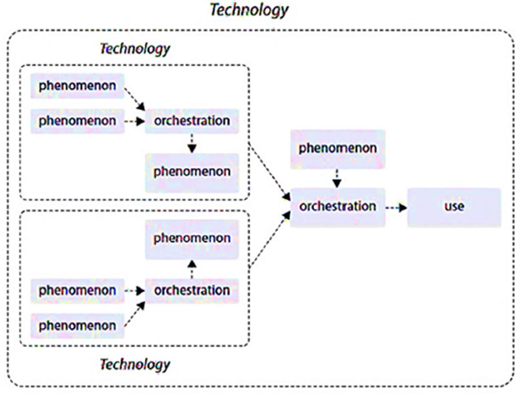
A stick that fell from a tree is not a technology at all, by any definition. It’s just a stick. However, if someone picks it up and uses it to reach for an apple on that tree, it has become a tool assembled by a method (orchestration) using a technique (manual skill and movement pattern). To achieve A goal (obtain an apple).
The author emphasizes that if we want to understand education as a technological phenomenon, we need a clearer and more comprehensive definition, and that is technology. Many things that are not physical objects are commonly known as technology, from university regulations to mental calculations to operating procedures for factories, and what made the wood that made this book a technology was not the wood itself. Rather, it was what was done with it. Every practical invention (at least) is a technology.
Technologies make it easier for humans to use phenomena. Each technology provides efficiency and ease of use through the effects of phenomena through orchestration (creating harmony between phenomena) and vice versa As mentioned, Wood falling from a tree, by any definition, is not technology at all. It’s just a stick. However, if someone picks it up and uses it to reach for the apple on that tree, it has become a tool that uses a method (orchestration) using a technique (manual skill and movement pattern) to achieve the goal (to get an apple). Almost all technologies fall on a spectrum between soft and hard. Hard and soft techniques are inseparable twins: hard techniques provide technologies that connect and expand our collective minds, enabling us to perform more physical and cognitive activities. Soft motor techniques provide passion, creativity, adaptability, and inspiration.
One of the important parts of this book is that the author tries to present an algorithm for teachers to use in teaching design.
Provide an algorithm for teachers looking to structure a lesson or course design:
Gaining attention
Informing participants of objectives
Stimulating recall of prior learning
Presenting the content
Providing learning guidance
Eliciting performance
Providing feedback
Assessing performance
Enhancing retention and transfer.
Conclusion
Technologies are often concerned with making our lives and the things that we do with our lives better, but this does not always mean that they should be faster and more efficient, reliable, or cost-effective. We should choose what we give up to the machine with inordinate care. This is especially true of education, which is above all about ways of being in human society. When, for example, we trust in an AI tutor to guide us, or accept the verdict of a learning analytics engine that tells us what we should do (or what we are doing wrong), we run the risk of becoming parts of its circuitry rather than it being a part of ours. When the design of an LMS, a timetable, or a classroom encourages us to take the easy path, we are letting ourselves be part of it rather than orchestrating it as part of us.
As soon as we become aware of this, we can take steps to change it: we can assemble it into our orchestrations as just more stuff in the assembly, replace it, or (sometimes) modify it. Perhaps we will even accept it as a good or necessary thing. The author illustrates how educators can leverage technology to create engaging, interactive, personalized learning experiences through case studies, research findings, and practical examples. This book presents innovative views about technologies in the field of teaching to improve the quality of learning for students. This is a valuable resource for Education policymakers, university presidents, managers, and all researchers and professors who work in the field of technologies of education and learning. The prose of the book is very eloquent, smooth, and fluent, and the content of the book has been able to cover all scientific activities in the field of technology and teaching without any ethnic or racial bias. The structure of the book is very coherent and each chapter of the book has an integrated structure with important topics in the field of technology and teaching and each chapter has used appropriate figures and tables.