The purpose of this study was to examine trust during adult online learning.
This basic qualitative study used Knowles’ andragogy process for program development and Henschke’s elements of trust as a conceptual framework to examine trust during adult online learning.
Major findings included the adult online learner’s trust in and from people, in processes, and in self.
These findings offer implications for trust development during online learning and include a call to action for online instructors, academic advisors and adult learners.
The examination of trust during online learning is underrepresented in research, particularly with andragogy to support the study. With the rise in online learning, we must better understand how to build trust among people, processes and self.
Introduction
Trends in higher education include the increasing prevalence of online learning, offering benefits to nontraditional students and adult learners. The National Center for Education Statistics (NCES, 2023) reported 10+ million students took one or more distance education courses. Almost half of those students exclusively took distance education courses, defined by NCES (2023) as using technology to access synchronous or asynchronous instruction and substantively interact with the instructor. For busy adult learners, online learning can make the difference between pursuing or not pursuing their degree.
Online learning offers numerous benefits but also presents challenges for adult learners, who hold multiple roles and balance responsibilities, competing priorities and heavy workloads (Rose, Ross-Gordon, & Kasworm, 2024). Needing accessibility and convenience, they often pursue online programs (Gale, Erisman, & Cunningham, 2022) but face challenges resulting from isolation, miscommunications and difficulty accessing student support services (Kara, Erdogdu, Kokoc, & Cagiltay, 2019). Building trust, defined as confidence that another will act to promote or fulfill common desired goals (Rempel, Ross, & Holmes, 2001), may provide one solution to help adult online learners. Henschke (2012) maintained trust during learning makes all the difference in developing and sustaining adult learners. Trust merits further examination to maximize the benefits and mitigate the challenges of online learning.
For adult and nontraditional students, trust increases student engagement, motivation, depth of learning (Merriam & Baumgartner, 2020), and self-efficacy (Bandura, 1997) and decreases anxiety and stress (Lunenburg, 2011). Merriam and Baumgartner (2020) highlighted past experiences as tools to develop a sense of self and trust, and Archer-Kuhn and MacKinnon (2020) found trust in people and processes enhances the student-instructor relationship and positive learning experiences. In online learning, O’Brien and Renner (2002) identified trust as key in enrolling and persisting in online learning. However, fostering and facilitating trust requires purposeful effort and action.
Instructors play a significant role in the development of trust during learning. Brookfield (2015) encouraged authenticity, openness and honesty to build a foundation of trust with learners. When instructors model authenticity, the learner can be vulnerable, a necessity for trust development (Archer-Kuhn & MacKinnon, 2020). Furthermore, immediate feedback, regular connections and differentiation between administrative and personal interactions create a climate of trust (Conceição, 2016). Trust-building requires time and consistency in all student interactions (Corrigan, Powell, & Rüsch, 2010) and merits additional research during adult online learning.
The purpose of this study was to examine trust during adult online learning. Two research questions guided the study: How does adult online learning align with Knowles’ andragogy process for program development, which includes trust as an element? How does trust manifest during adult online learning? The answers to these questions will inform theory and practice for trust during online learning and offer implications for adult learners and instructors.
Conceptual framework
The American Association for Adult and Continuing Education (AAACE, 2024) bequeaths the Malcolm Knowles Award to recognize the outstanding leadership of programs serving adult learners. Inspired by the award, this study used Knowles et al.’s (2020) andragogy process for program development paired with Henschke’s (2012) research on trust in teaching as a conceptual framework to examine trust during adult online learning. This section discusses each framework component.
Andragogy process for program development
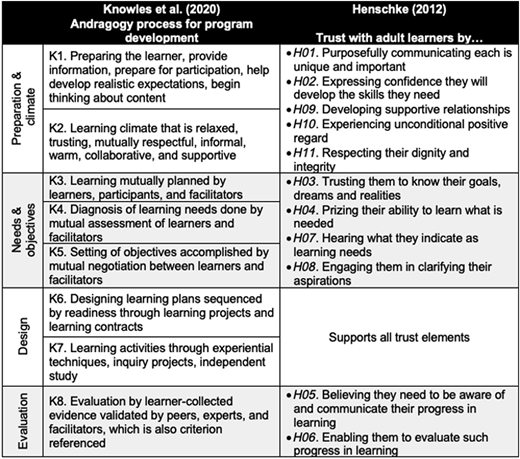
Building on the theory of andragogy, Knowles, Holton, Swanson, and Robinson (2020) refined an 8-step andragogy process for program development. The steps logically and practically represent four clusters – preparation and climate, needs and objectives, design and evaluation (see Figure 1). Within each cluster, we indicate the step number in parentheses.
The preparation and climate cluster comprises two steps. In the first, the instructor prepares the learner (K1) by providing relevant information and planting seeds for active participation, realistic expectations and upcoming learning content. The second, establishing a climate conducive to learning (K2), specifically identifies trust as contributing to a learning experience that is “relaxed, trusting, mutually respectful, informal, warm, collaborative, supportive” (Knowles et al., 2020, p. 52). The resulting open, honest, and nonjudgemental climate allows for active participation by the adult learner and modifications to instruction by the instructor to meet each learner’s unique needs and goals (Henschke, 2012). This atmosphere enhances the usefulness and significance of the learning experience and empowerment of the learner, along with reciprocal feelings of respect, trust and value between learner and instructor. While the remaining steps of an andragogy process for program development do not specifically include the term trust, each supports trust development.
The needs and objectives cluster comprises three steps, focusing on mutuality between the adult learner and instructor in three areas – planning of learning (K3), assessment of learning needs (K4) and negotiation of learning objectives (K5; Knowles et al., 2020). This collaborative approach balances the power dynamic between learner and instructor, so adults have ownership of their learning. Mutual planning can include choosing learning content or determining the pace of the program or course; mutual assessment acknowledges the internal motivations of the learner; and mutual objectives setting recognizes adult learners as self-directed. This dialogue ensures alignment among the learners’ needs, the learning objectives and plan, and educational outcomes and standards defined by educators or institutions (Brookfield, 1986). Mutuality increases relevance and meaning in learning, leading to greater transfer to the workplace or life.
The design cluster comprises two steps: learning plans organized by readiness (K6) and experiential learning activities (K7; Knowles et al., 2020). Collaborative learning plans and tools, such as learning projects and contracts, further foster ownership and self-direction in the learning process. Such design promotes deeper and more permanent learning compared to other methods (Tough, 1979). Experiential learning, including inquiry projects and independent studies, provides opportunities for adult learners to reflect on their experiences and make connections between theory and real-world application.
The evaluation cluster solely comprises learner-collected evidence for criteria-based evaluation (K8) of learning (Knowles et al., 2020). In this process, adult learners and instructors discuss progress and provide feedback and evaluation of the learning process through reaction forms, group discussions, and pre-and post-tests, and mutually reassess needs and measurement of learning. Including adult learners in the evaluation process promotes agency in learning and encourages reflection to make the experience more meaningful and effective (Brookfield, 1986). Collectively, the eight steps support adult learners, facilitate adult learning, and promote trust development.
Trust in teaching
Henschke (2012) researched trust in teaching and identified 11 elements to create a foundation of trust between the instructor and student. Because these elements support each other and complement Knowles’ work, this section overviews the elements using three of the same four clusters (see Figure 1) with the unused cluster, design, supporting the other three.
The preparation and climate cluster comprises five elements, including Henschke’s (2012) overarching ninth element, developing supportive relationships (H09). He found instructors can build trusting relationships by communicating to the learner that their needs are unique and important (H01), expressing confidence that learners will develop the skills they need (H02), exhibiting unconditional positive regard (H10) and respecting their dignity and integrity (H11). This creation of a trusting environment can be practiced by asking the learners about their goals and what they hope to gain from the course(s) and by allowing the learner to share their opinions and perspectives before the educators (Risley & Petroff, 2014). Trust begins with developing supportive and respectful relationships, which is especially important in learning contexts because the learner needs to know they are respected and heard.
The needs and objectives cluster comprises three elements, and the design cluster comprises one element. Henschke (2012) encourages instructors to focus on the goals and needs of learners to build trust. Instructors must trust learners to know their goals, dreams, and realities (H03) and hear what learners indicate as their learning needs (H07). Through this knowing and hearing process and effective program and course design, instructors can critically assist learners in clarifying their aspirations (H08). Once clarified, instructors can prize their ability to learn what they need (H04). Risley and Petroff (2014) noted that much of this can be accomplished through thoughtful course design that includes reflection assignments, discussion board prompts that draw on the learners’ experiences and keeping lines of communication with the learner open. By showing interest in the learners’ goals and needs, the learner feels valued and trust grows.
The evaluation cluster comprises two elements related to progress and evaluation. Henschke (2012) urged instructors to believe learners need to be aware of and communicate their own progress in learning (H05) and enable learners to evaluate their own progress in learning (H06). These elements foster agency in the learning process and show the learner that the instructor trusts them to be part of the evaluation process. Risley and Petroff (2014) recommend utilizing self-assessments, learning contracts, and informal check-ins as the suggested methods to facilitate trust related to learning progress and evaluation. Allowing learners to communicate their progress invokes ownership in the learning process, allowing trust to develop further. Collectively, the 11 elements guide the understanding and application of trust development in teaching.
Method
According to Merriam and Tisdell (2016), basic qualitative studies are frequently used in applied fields of practice and may be “the most common form of qualitative research found in education” (p. 24). Such an approach allows researchers to inform practice, address real-world problems and contribute to practitioner development. This section discusses the online program as context, instructor and learner participants, data collection and data analysis.
Online program and study participants
The study was situated at a large public institution in the South in an online master’s program that primarily served adults. The Master of Arts or Master of Science in Interdisciplinary Studies program offers a customizable degree emphasizing theoretical knowledge and foundational skills in organization development, workplace education (teaching and training), and leadership studies. The 39-semester credit hour program consisted of three modules – Entry with three required courses, Academic with seven elective courses from a variety of disciplines, and Applied Research with three required sequential courses. In the latter module, adults learned about interdisciplinary research, identified a real-world problem meriting examinations, then designed, conducted and disseminated findings from a study.
To identify participants, the current study used purposeful and convenience sampling to identify five instructors and 82 primarily adult learners who participated in the applied research module during the two years since the last redesign. To comply with institutional review board (IRB) guidelines for existing educational data, we provide aggregated information about the instructors and publicly accessible information about current learners in the program. The instructors held PhDs in adult education or closely related fields, including the graduate program coordinator, who provided academic advising and four instructors who taught the applied research module. The three women and two men represented Asian, East Asian and White, non-Hispanic races/ethnicities and ranged in age from 30s to 60s. Current students comprise 64.8% women and 35.2% men who are 40.7% Hispanic; 29.6% White, non-Hispanic; 20.4% Black, non-Hispanic and 3.4% of unknown race/ethnicities. Based solely on 25+ age, 81.5% are adult learners. However, adding nontraditional student characteristics increases the percentage, such as younger students attending school part-time or adult students working full-time or with dependents.
Data collection and analysis
Data collection included publicly accessible online sources, such as the course catalog, institutional research data and the program website; and confidential sources, such as student and alumni survey results as well as students’ evaluations of teaching, course assignments, comprehensive examination submissions, testimonials and correspondence. In addition, data included the agendas and notes from weekly small- and large-group research meetings over four months.
Data analysis followed Creswell and Poth’s (2024) five-step data analysis spiral. In Steps 1 and 2, we used a shared site with restricted access to organize and review data for overall meaning. Step 3 used Saldaña’s (2021) two-cycle method to code data, beginning with provisional coding using elements from the study’s conceptual framework, followed by focused coding related to trust during adult online learning. After confirming inter-coder agreement, we grouped common codes into themes. To develop and assess interpretations, Creswell and Poth’s Step 4, we examined interconnections and linked themes to the conceptual framework and literature for context and meaning and used member checking with the instructors (per IRB guidelines). In Step 5, we created figures to represent and visualize the data and communicate findings.
Findings
The study examined trust during adult online learning. This section presents the findings organized by the two research questions – an andragogy process for program development and trust manifestation during adult online learning.
Andragogy process for program development
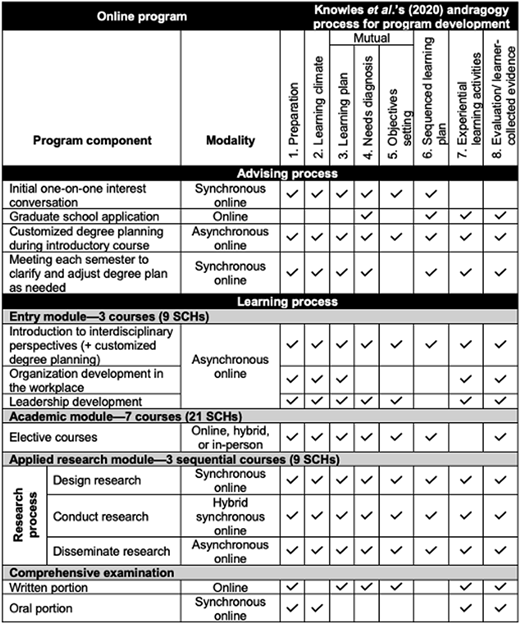
The first research question asked how online learning aligns with Knowles’ andragogy process for program development. Figure 2 presents the major components and modalities of the online program and alignment with the process steps, as indicated by a checkmark. For example, in the advising process, one program component – a customized degree plan during an introductory course – met all of Knowles et al.’s (2020) process steps, as indicated by eight checked boxes. Similarly, the learning process included several program components aligned with all eight process steps – the introductory course and the three courses comprising the applied research module.
Unchecked boxes indicated a lack of alignment due to three underlying reasons—irrelevance, limitation, or opportunity. To illustrate a lack of alignment due to irrelevance in the advising process, the first program component – initial one-on-one interest conversation – excluded Knowles et al.’s (2020) experiential learning activities (K7) and an evaluation of learn-collected evidence (K8) because formal learning had not yet occurred. To illustrate a lack of alignment due to limitation, in the advising and learning processes, governing boards and accreditation bodies usually have specific requirements for objective setting, but instructors can often provide choice and flexibility for some mutually developed objectives. To illustrate an opportunity, we will add some mutual objective setting in the advising process, specifically during synchronous advising appointments and in the learning process. Overall, the findings indicated adult online learning aligned with an andragogy process for program development, which includes trust as an element.
Trust manifestation during adult online learning
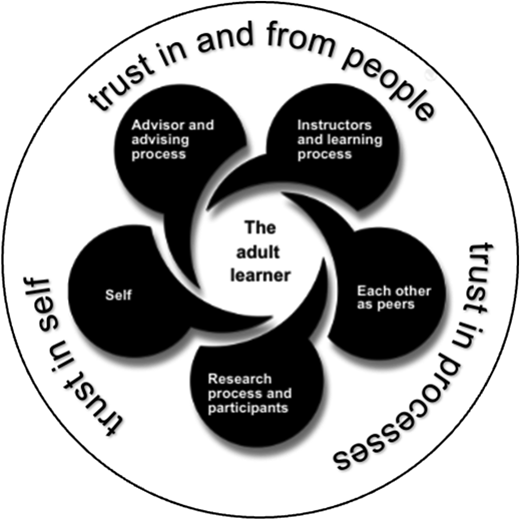
The second question asked how trust manifests during adult online learning. Major findings included adult online learners’ trust in and from people, processes and self (see Figure 3). The program coordinator described the multi-faceted and iterative process of trust during online learning, “Trust begins with the student and advisor trusting each other, which leads to students trusting instructors and the learning process. Furthermore, trusting instructors leads to trusting the process of working with peers, which results in trust in themselves.” As a result, adult online learning moves from a transactional event between instructor and student to a transformational culture involving academic advisors, instructors, students and peers as partners.
Trust in and from people included trust in the academic advisor, instructor, peers, and research participants. Over time, adult learners developed reciprocal trust in the advisor, instructors, and each other. An adult learner highlighted the instructor’s action in a testimonial: “My instructor had a remarkable ability to create an engaging and inclusive learning environment. She brought her values to the classroom, making the space inclusive for all students to feel psychologically safe to express and pursue our interests.” Instructors created learning environments that felt welcoming and inclusive. In the applied research module, adult learners fostered trusting relationships with their research participants. Similarly, they developed trust with external leaders or topic experts in some elective courses when interviewing them for assignments.
The study found trust in processes such as advising, learning and research. Trust in the advising process develops through the advisor’s approachability and availability to discuss goals, course selections and program experiences. Trust in the learning process benefits from instructor engagement, access to the instructor and effective course design. For trust in the research process, an instructor linked three trust areas: “Our goal is for students to trust the research process, which begins with trusting the course and the instructor.” The development of trust during the advising, learning and research processes hinges on the instructor initiating advising meetings and thoughtful course design.
Throughout the online learning experience, adults developed trust in self, often expressed when successfully passing the comprehensive examination and advancing to graduation. One adult learner articulated a sentiment shared by many when reflecting on the journey: “I valued my professors holding me to higher standards because they showed me that I was capable of more than I thought.” During adult online learning, trust manifested in and from people, in processes and in self.
Discussion and implications
Adult learners and instructors can jointly plant, nurture, and grow trust to maximize the opportunities and mitigate the challenges of online learning. The current study found alignment among Knowles et al.’s (2020) andragogy process for program development with an element of trust and Henschke’s (2012) elements of trust in teaching, which creates opportunities for adult learners to develop trust in and from people, in processes and in self. For discussion related to instructors and the learning process, we defer to scholars who have researched and discussed effective instructional practices in online learning for nontraditional students (see Adeyemi, Lewis Miller, & Manderfeld, 2023; Bloomberg, 2022; Kuo, 2015; Rogers-Shaw, Carr-Chellman, & Choi, 2018; Sull, 2023). This section discusses findings less frequently discussed in the literature – the academic advisor and advising process, peers, the research process and participants, and self.
Online adult learners, academic advisors and the advising process build trust
Long before metaphorically stepping into the online classroom, adult online learners interact with academic advisors or program coordinators. Advisors create program pathways for adult learners (Jennings, 2021), provide early advising appointments to discuss academic goals and program alignment (Rose et al., 2024), and thus initiate the development of trust. Knowles et al. (2020) stressed the importance of preparing adult learners and mutually diagnosing their needs, and Henschke (2012) urged instructors to acknowledge, support, value and help clarify the unique needs and goals of learners.
The current study found that the advising process begins before the adult learner applies to a program with advisee-advisor meetings, ensuring the course of study and learning process will meet the learner’s goals and needs. Once admitted, learners benefit from ongoing discussions about their goals and needs to clarify aspirations. Due to the complexity of degree planning in interdisciplinary studies, the current study included degree planning as part of an introductory course and continued the advising process throughout the program using check-in appointments. Milman (2021) confirmed instructor check-ins foster trust in online learning environments. Advisors plant, nurture and grow trust when they engage adult online learners, beginning and developing supportive relationships throughout the advising process and program.
Adult online learners build trust with each other as peers
In addition to advisors and instructors, adult online learners interact with and learn from each other as peers. Online interfaces, such as a learning management system, can facilitate learner interaction with other students and the vicarious learning that happens while watching others engage and discuss (Cherrstrom et al., 2019, 2024). Trust plays an integral and critical role in helping to bridge the lack of common space and time (Henschke, 2012). The current study identified peer-to-peer interactions as a facilitator of trust. Knowles et al. (2020) supported a collaborative learning climate wherein peers participate in the learning evaluation process. Henschke (2012) encouraged instructors to develop supportive relationships with learners, and this study expands such supportive relationships to include those between and among adult learners.
Adult online learners develop trust in the research process and with participants
Adult learners benefit from developing research skills, and trust in the research process and with research participants grows over time. Employers value applied learning experiences and are more likely to hire graduates who have participated in one (Finley, 2024). Knowles et al. (2020) concluded experiential learning provides opportunities for adult learners to reflect on their experiences and make connections between theory and real-world application. Henschke (2012) further asserted that such reflection, along with trusting the learner to learn what they need, facilitates trust development.
The current study found adult learners identify research topics that initiate trust and agency and reinforce motivation during the process. Furthermore, a simplified, step-by-step research process and tools ease and inspire confidence in the learning and research processes. Instructors scaffolded the learning and research processes using synchronous, then blended, and finally asynchronous online instruction as learners developed into researchers. Tools included writing templates for the research proposal and report; Zoom for synchronous class meetings; one-on-one meetings to discuss research and data collection; and semi-structured field notes prompting reflection about the research process, data and participants. Conducting research requires trust building between the learner and their participants (Merriam & Tisdell, 2016), and adult learners in a scaffolded research process develop trust and confidence in data collection and with participants, easing the process and adding meaning.
Adult online learners develop trust in self
Adult learners develop trust in self during online learning. Higher self-efficacy is associated with greater self-trust in learning contexts (Bandura, 1997). Likewise, Knowles et al.’s (2020) andragogy process for program development emphasizes the adult learner’s role in mutual learning plans, needs diagnosis and objectives setting with the instructor, requiring a strong sense of self to take control of one’s learning process. While primarily focused on the teacher’s trust in learners, Henschke’s (2012) elements of trust include learners knowing their needs, goals, aspirations and ability to learn what is needed, requiring self-efficacy, confidence and trust in self.
In the current study, instructors found encouragement from instructors, peers and research participants to recognize new knowledge and skills and develop trust in self. During the comprehensive examination, learners reflected on their growth throughout the program, including trust and pride in self. Feelings of accomplishment from conducting research and completing a program positively influence endeavors beyond the online classroom, transferring to work and life. With newfound trust and confidence in self, adult learners often earn promotions, find new jobs, make career changes or pursue advanced degrees. Collectively, this discussion illuminates trust building via the academic advisor and advising process, peers, the research process and participants, and self, offering implication and a call for trust.
Implications
This study offers implications for theory and practice related to trust during adult online learning. For theory, the study adds the online experience to Knowles et al.’s (2020) work on the andragogy process for program development and the adult online learner to Henschke’s (2012) elements of trust in teaching.
The study also offers implications for practice. To develop trust in and from people, we urge instructors to expand the idea of instructor from most often invoking visions of a teacher to include the academic advisor as one of many roles played in various contexts. Historically, advisors have prescriptively guided adult learners in navigating educational programs (Murray-Johnson and Ross-Gordon, 2024). The current study illuminated the advisor as iteratively working with learners to mutually identify and clarify goals, design online learning, and plant, nurture and grow trust. Echoing Knowles et al.’s (2020) mutuality and Polson’s (1994) emphasis on developmental advising with joint establishment of goals and plans, we stress the dual role of advisors in guiding adult online learners to and through the learning process with mutual and joint actions.
Through advising, learning, research and other processes and activities, we urge instructors to create opportunities for adult learners to connect with each other and encourage adult learners to value and leverage such connections. Peer learning and support enhance student engagement (Topping, 2005) and build helpful trust for adult online learners. Collaborating, celebrating, commiserating, strategizing and evaluating with peers contribute to trust development and create a richer learning process and experience.
To develop adult learner trust in processes, we recommend instructors identify, explain, and model the advising, learning, research and other relevant processes. Reflection on such underlying processes further facilitates trust, develops new knowledge and skills, and therefore, should be included in program and course design. Instructors can create and facilitate the experiential learning opportunities encouraged by Knowles et al. (2020) to develop and transfer skills to the workplace, especially those identified by Finley (2024) as highly valued by employers (e.g. critical thinking, problem-solving, communication). When adult learners participate in planning and evaluating learning –for example, in degree planning, by self-identifying a research topic, and giving and receiving peer review feedback – they develop trust in the underlying process.
To develop trust in self, adult learners can leverage trust in and from others and in processes and realize the process requires time and reflection. The current study found trust developed in and with academic advisors, instructors, each other and research participants as well as in the advising, learning and research processes. Reflection during programs, within courses and just prior to program end contributes to trust in self (Brookfield, 2015), as adult learners realize how far they have come and what they can accomplish with their new knowledge and skills. We suggest instructors include reflection in programs and courses, for example, in a capstone course or comprehensive exam, for adult learners to reflect on trust in self and the application of such trust in and beyond online learning.
In addition to these implications, we offer ideas for future research to address the limitations of the current study and to further advance this research. Since this study is situated in one online program in interdisciplinary studies at one large public institution, future studies might examine trust development for adult online learners in similar and different contexts, programs, disciplines and institutions. Future research related to trust in each of the processes – advising, learning and research – merits further examination in addition to other relevant processes, such as academic writing in online learning. In addition, future research can examine the adult learner’s perspective on how trust is begun, facilitated and nurtured in online learning, and follow-up studies could identify and measure the effectiveness of interventions focused on trust development.
In conclusion, this study found adult online learners develop trust in and from people, in processes and in self. Trust in and from people included the adult learner and their advisors, instructors, peers and research participants; trust in processes included advising, learning and research; and trust in self during online learning and beyond. Trust forms through a multi-faceted and iterative process, beginning prior to program admission and developing throughout the adult learner’s time and experience in online learning. We encourage instructors and learners to pause and reflect on trust and how, together, we can plant, nurture, grow and harvest trust to benefit all.
Author note
At the most recent conference of the American Association for Adult and Continuing Education, the authors of this manuscript received the Malcolm Knowles Award for Outstanding Adult Education Program Leadership. This manuscript discusses the study underlying the nomination for the award. Therefore, we disclose the award win here and made every effort to preserve anonymous review in the writing of the manuscript.