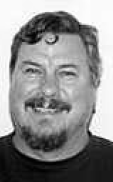
On March 26, Dan Coldeway, recently of Dakota State University, in Madison, South Dakota, died. Dan joined the faculty of Dakota State as a professor in 2001 after serving for 23 years on the faculty of Athabasca University in Athabasca, Alberta, Canada. Dan received his B.S. degree in psychology from the University of Utah in 1971, his M.A. in experimental psychology from Western Michigan University in 1972, and his Ph.D. in psychology from the University of Illinois in 1974.
It is not the custom of the Quarterly Review of Distance Education to comment on the passing of those involved in the field. However, the death of Dan Coldeway prompts a change in that policy. His long commitment, leadership, insights, and efforts for the field of distance education have made an indelible mark on the practice, and on the people who consider themselves distance educators.
I have known Dan for over a decade. His spoken and written insights about distance teaching and learning have been often insightful, and sometimes profound. And I love to quote him in my own work.
One story I often tell about Dan involves what is now referred to as the concept of Coldeway's Quadrants. As I tell it, this story is part fact and part fiction. The facts are that Dan had the ideas and presented them in such a way to clarify them for easy understanding. The fiction is in the telling of the story.
The fictionalized version of the story goes like this:
During a late afternoon break in the Sharing the Experience Conference sponsored by Oregon State University and held in the Portland Marriott in the early 1990s, I was walking through the lobby and heard a commotion in the lobby lounge. Inside, I could hear Dan Coldeway holding “court” for a half dozen fellow convention-goers. He was expounding on his recently completed keynote address and was answering questions to his highly attentive audience. I eased into the lounge and listened. It was fascinating.
During the discussion, he pulled out a cocktail napkin and began to write. First he drew an x-y axis, and then he labeled each quadrant. In the upper left he wrote ST-SP, in the upper right he wrote ST-DP, in the lower left he wrote DT-SP, and in the lower right corner he put the letters DT-DP. He went on to explain that his bar-napkin creation actually represented various categories of education. ST-SP represented education for learners and instructors at the same time and in the same place–traditional education. ST-DP was for education at the same time held in different places–synchronous distance education, often delivered using interactive telecommunications technologies. DT-SP meant education at different times but in the same place–for example, when students come to a learning center to receive instruction from a computer-based lesson. DT-DP, the final quadrant, represented education occurring at different times and in different places, the category Dan felt represented distance education in its purest form.
The discussion immediately took on a new liveliness. Many of those attending Dan's impromptu seminar were staunch advocates of telecommunications technologies and did not agree with the implication that distance education is not best when delivered using live, interactive video technologies. Others took differing opinions, and Dan kept the conversation interesting with his comments, explanations and ideas.
No consensus was reached that night, but I suspect that many if not most who were there remember Coldeway's Quadrants, and Dan's insightful explanations.
Well, if the truth be known, the lobby lounge, cocktail napkin, and impromptu seminar were fabrications. He had talked about the quadrants during his convention keynote address. The lounge “session' was actually a free-flowing discussion of many topics.
Later, I told Dan about my use of this “story” in articles and speeches when I was attempting to place distance education in an easily understood context. He seemed to be pleased. I even got the feeling that he wished it had actually happened like the story.
At any rate, the concept of the quadrants, now referred to by many in the field as Coldeway's Quadrants, is one of many ideas that Dan Coldeway has given to the field. It will be remembered. It is one of many contributions to distance education by this man, this scholar, this professional. And, I wish I had the cocktail napkin.
Michael Simonson