Editors' Note: This case contains a description of a large-enrollment accounting course. Unlike Cases 1-3, this case grew out of a faculty member's desire to increase the efficiency of teaching the course. The question was, “Can class time be more instructionally effective if students first master basic accounting knowledge and skills online?” In the first three cases faculty were primarily interested in accommodating students to help them improve their learning. In this case, the authors are interested in the possibility of using blended approaches to reduce faculty time, re-focus student time, and raise the possibility of using blended learning as a way to admit more students to a given academic program.
Based on our experience the most common reasons for implementing a blended course are to improve the effectiveness and efficiency of both learning and teaching. Many colleges and universities are experimenting with “blended learning” models of teaching that substitute some in-person class meetings with virtual sessions. Some experts predict that within five years, a significant number of classes will be taught using the blended learning model (Young, 2002). This represents a shift in thinking from the recent past that saw universities focus on complete online program offerings as they marketed to students not able to come to their campus in person. Graham B. Spanier, president of Pennsylvania State University, claims “the convergence of online and resident instruction is the single greatest unrecognized trend in higher education today (Young, 2002).” Any experienced teacher, for example, has likely “re-taught” topics outside class that were covered during the face-to-face lecture. This might be called teaching inefficiency—time required of the instructor to teach again what has already been taught. If students could access online resources without needing to ask the instructor directly, teaching efficiency could be improved. Likewise, if an instructor could present information online that would be impossible to present in class, teaching effectiveness might be improved.
Learning Effectiveness
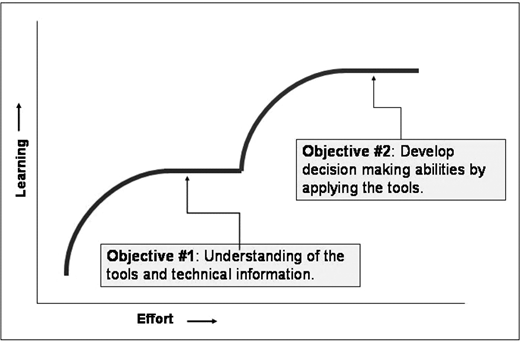
But saving time for instructors is clearly not the ultimate goal of instruction. The most important aim of any course is to ensure high levels of student learning—learning for understanding, learning that endures long after the final exam is completed. Professors who teach large classes, for example, have found that blended learning methodology has shown them the advantages of accessibility to course content, effectiveness of lectures, and connectivity between student and professor (Johnson, 2002). The authors believe that blended course designs can potentially increase both teaching efficiency and learning effectiveness. And the kind of learning effectiveness to which the authors refer is higher order learning, critical thinking skills that most instructors include in their ultimate goals for a course. Figure 1 shows the duality of most course objectives: (1) providing students with the tools they need so that they can (2) apply the tools to solve real problems. Blended learning environments may allow learners to pursue both types of objectives more effectively by providing them with access to critical knowledge when they need it and by permitting them to obtain more timely feedback from peers and instructors as they attempt to apply new knowledge to solving problems.
Implementing a Blended Learning Model in an Accounting Course
In a typical accounting course, at least half of the class time is consumed by talking about formulas, equations, solving problems, and doing homework from a textbook. Some of the teaching tools include debates, discussions, and interactive question and answer sessions. Students also often perform a role-playing situation where they have to incorporate all the technical material into decision-making tasks that would be hypothetically faced by managers.
In essence, there are two objectives in the majority of accounting classes: (1) to understand the technical material and (2) to be able to apply the technical material. These steps, however, are sequenced. That is, students have difficulty participating in a discussion relating to the application of technical material if they lack the foundation that would permit to understand this material.
Blended Learning in Accounting 440 at BYU
Accounting 440 is a course specifically designed for finance majors. Most of these students either self-selected out of accounting or they did not demonstrate sufficient aptitude with accounting to be admitted to the program.
The course contains much technical material, but the students' background at entry point varies significantly. Some need to hear this technical material only once, and with a brief refresher, are ready to proceed to the next level. However, other students need a point-by-point explanation of many of the topics covered in this course.
To compensate for some of these differences in students' backgrounds, a blended learning approach was adopted for this course. The implementation was such that all the textbook examples and all the homework were covered outside of class in an asynchronous format. This was accomplished using technology to produce multimedia presentations. In these presentations the professor covered all the different homework problems and text information. This was not just a matter of providing answers to the homework, but walking the students through each lecture in great detail describing where the numbers come from and how the solutions are derived. Instead of merely a solution, the student was provided a complete picture of the accounting information in the homework problems.
Technology enabled the professor to create the diagrams. The presentations that would have been used on the chalkboard, overhead, or live computer screen were produced in a presentation students could access online or by CD. Students could see the formulas, their relationships, how the computations were made, and how the financial reports were to be assembled. Further, the technology facilitated the students' use of a table of contents to move directly to any key point in the discussion. Students watched these discussions from start to finish if they chose, or they could access any topic of choice at any point in time in a non-linear manner. This allowed students to be more efficient with their time. They needed only to listen to the points where they are confused. It also allowed greater efficiency for the professor because he or she needed only to offer the discussion together once, and as in the case of Accounting 440, a hundred different students could listen to it as many times as they like, and any piece or segment they chose.
These homework problems and multi-media presentations were used in two different ways. Sometimes they simply supplemented the classroom discussion. That is, the technical material, instead of being discussed in class, is discussed outside of class; this allows students to come to class simply to answer any questions they may have but the material does not need to be taught from start to finish. This created open-space in the class schedule. So on days where these technology tools were used to supplement the classroom, the class could still meet. The objective in meeting, however, was not to cover the technical material, it was to come prepared to discuss it, to move to the higher level of critical thinking of discussion, of interactive questions and answers about the material. The blended learning approach enabled this open-space to be created in the classroom where additional discussion and implement issues could be covered.
After a six-week exposure to this method of instruction—using the Internet and dedicating classroom time to explain theory and case study—the students were surveyed regarding preference to this blended or blended learning approach.
The survey was administered as a class assignment, and 97 of the 104 students responded within three days; those who did not were out of town. Sixteen questions were asked, included four open-ended questions that gave the student the opportunity to elaborate their feelings concerning any difficulties they have had in the online learning experience during the previous six weeks.
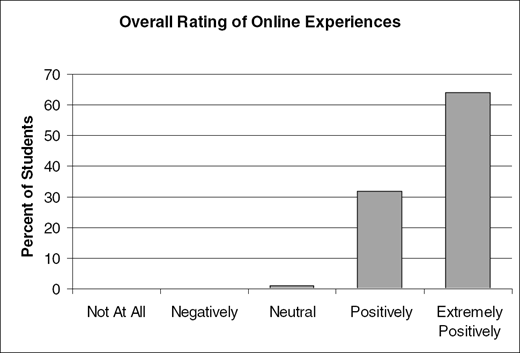
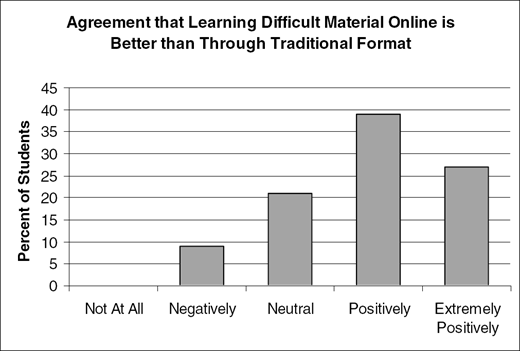
As illustrated in Figure 2, 67% of the class rated their overall online experience extremely positive. Combined with those who had a “positive” experience, the rating is 98%. Figure 3 indicates that 82% of the respondents think that learning difficult material online is better than learning challenging material in a traditional format.
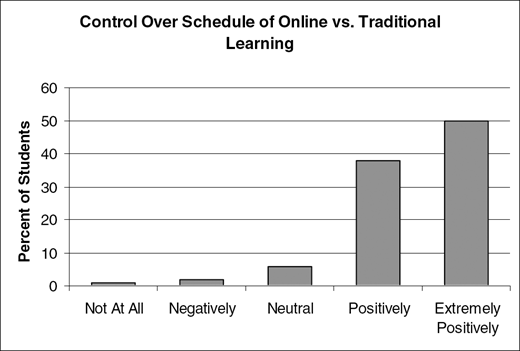
Significant benefits of blended learning are flexibility, time management control, and pedagogical effectiveness (Aycock, Garnham, and Kaleta, 2002). In blended courses, students can participate in the online instruction on their own time. They can repeat different, hard-to-understand portions of the pre-recorded lecture repeatedly. The students were asked their preference in learning difficult materials online versus the traditional classroom approach as well as to evaluate their opinion about having control of their own time. Figure 4 shows that 69% of the students preferred learning difficult concepts online to the traditional classroom instruction approach. Figure 5 illustrates that 40% thought positively that online learning gave them more control of their time, but an additional 53% indicated they were extremely positive about that benefit.
Comments from open-ended questions indicated that online material helped alleviate some of the inconvenient steps students normally undergo to get answers to questions from the professor than in a more traditional class room setting. One student reported that “It is often difficult to hunt down the professor at a time when our schedules are compatible. If you don't get a clear explanation in class, you often feel uncomfortable asking the professor to repeat the answer or take time to further explain something that was perhaps clear to all the other students.” Another added “I was able to listen and watch a problem being solved online and it helped me to watch the professor solve the problem and then compare it to the work I had done.”
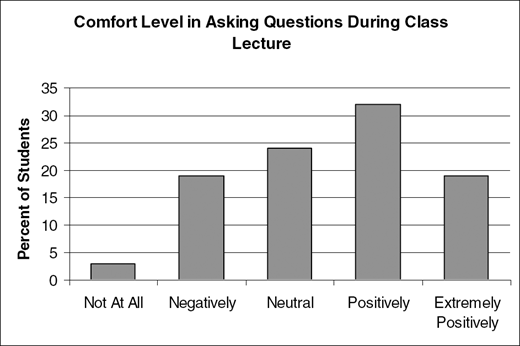
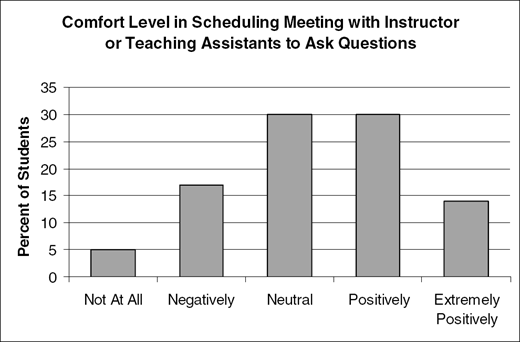
These comments are substantiated in the next two figures that illustrate the degree of comfort the students have in asking questions to the professor or searching for a teaching assistant. Less than 50% of the students feel positive or very positive about asking questions (Figure 6), and only about 45% feel positive about searching for a teaching assistant for additional help (Figure 7). This should not be taken as a negative indication, but does set the stage for one of the advantages of blended courses. One student summed it up: “I am not shy about asking questions in class, but I know that when I do, there are obviously several who already understand the concept. I know I am holding those individuals back.” Another reflected why the distribution between the choices of comfort level in asking questions is so diverse:—“It's more a matter of convenience than an issue of being uncomfortable. It is often difficult to hunt down the professor at a time when our schedules are compatible. This is not an issue with the online material.” Another further explains that “The online material is great in helping me to learn at my own pace, plus I can review it as many times as I need to without ever having to leave my own home.”
A major benefit in blended learning is that students can learn at their own speed, and that this tool reduces the need to ask questions of the professor. “Usually, online presentations of the subject matter cover any questions one may have when reading the book, because the teacher knows what questions the students have had in the past.”
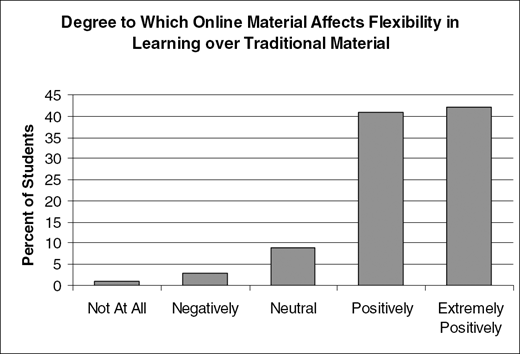
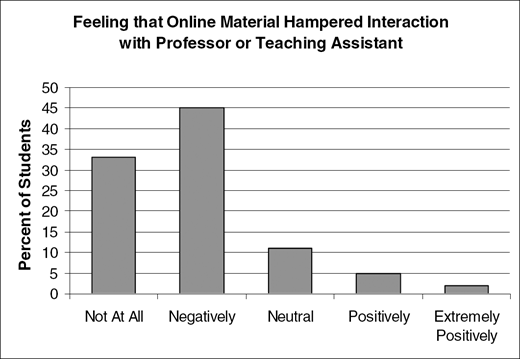
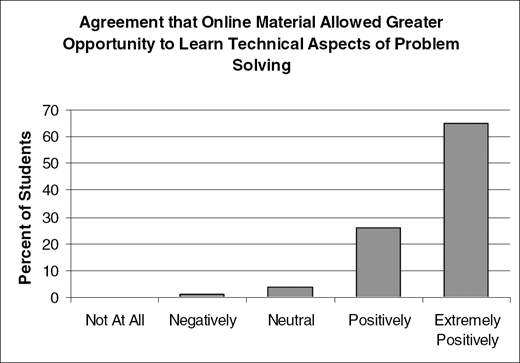
There is a feeling by those new to blended learning that the online experience restricts interaction. When questioned about this, almost 80% of the class said online material did not hamper their interaction with the professor as illustrated in Figure 8. In addition, 87% were positive about the material giving them greater flexibility in learning the technical aspects of problem solving as shown in Figure 9.
The data show that Accounting 440 students prefer the blended learning method over the traditional face-to-face approach. Additionally, this survey suggests at least three major advantages: a more effective way of learning difficult concepts faster, control over personal time schedule, and a better way of getting answers to questions.
Learning Difficult Concepts
The students reflected on the blended learning environment by giving such feedback as “After I attempt the problems or get stuck while attempting the problems, I could refer to the online help to get through it. Then, when going back over the problems, I was confident that I knew the correct answer and that I knew what to do with the tricky parts.” Others felt as if they had the luxury of personalized assistance such as “It's like having a one-on-one personal tutor to take you through the steps of the problem. If you don't get it, you just go back and replay the section.” Yet another related that “It is a great device to make sure you are on the right track and also to see the whole picture rather than studying something unrelated to my interests. It may sound strange, but it motivates me to learn more, especially reading assignments. It motivates me to desire to learn more. Only in such a way I will be able to filter the information that is coming.”
However, because learning styles are different, not everyone saw the blended course as the solution to learning new concepts. One student reported that blending “doesn't imitate real world experience. We will have to work with people and bounce ideas back and forth in the real world. This approach puts a person in their comfort zone and limits the interaction.”
Control Over Personal Time
Another advantage of blended is that it reduces the amount of time in class, and the students can determine when the time is right for them to focus on the material. Said one respondent, I enjoy “learning at my own pace and I actually learn and understand the material.”
Not all students have convenient access to high-speed technology. As expressed by one such student, “I just wish that on some of the easy points, you could click through a little faster.” Overall, however students stated that the online learning helped them learn more efficiently as expressed by this student: “I thought the step-by-step process on the homework assignments allowed me to check my own work step-by-step as well. This contributed to not just getting the right final answer, but also getting the right reason for doing each step. I could also quickly review the material right before class.”
Getting Answers to Questions
The accounting students indicated this manner of instruction allowed them to get answers to their questions as the questions surfaced. One student praised the process: “It goes through it in a simplified way, step-by-step. When you can see, hear, and follow, it really sinks in.” Another said the process coached them along the way as expressed by this student:
I feel the online material helps “bridge the gap” between the textbook explanation and end of the chapter questions. Too often the text seems vague in its explanation of the steps to a specific problem or how it deals with variations the questions present. The online material shows every step and does a very good job of making appropriate comments as to why we performed each step and its impact upon the entire question.
Cautions were expressed however, that remind the student that this process requires self-motivation. One student said, “the only negative is the tendency to follow along and understand without doing the problem on your own. I am well aware of the need to know how to do these things without the aid of the online material, but the temptation to just listen and not do is great.”
Conclusion
With favorable reaction to blended learning from students in Accounting 440, questions arise about other courses. For example, would students in an art history, psychology, or biology courses have a similar experience? And if the method is applicable to other types of courses, what are all of the possible implications for an institution that invests heavily in blended learning approaches? Could and institution, for example, admit more students because faculty are spending less time teaching certain courses? Could institutions offer more and smaller sections of courses if blended learning environments were implemented on a broad scale?
In the future, distance learning of all methods will flourish, but schools should not plan to close classrooms or shut down parking lots. Many students need the face-to-face contact that is not found in even the most sophisticated of internet offerings. Technology can create boundaries, by many cyber learners will find ways to tear down those boundaries (Snell, 2001).
Advocates of developing blended learning models for universities support the expansion of capabilities to provide more students the opportunities for education. One such scholar proposes a model that “incorporates creative uses of technology, architecture, and people (Bleed, 2001).” In the Bleed model, there would be 50 percent virtual instruction and 50 percent in-class instruction, or what he calls “half bricks and half clicks.”
Instructional design accomplishments such as the one in Accounting 440 demonstrates that the need of students for flexibility in schedules while staying on track to complete their coursework in a timely manner, can be compatible with those of the institution to increase efficiency and capacity. However, these issues, among the others identified in this conclusion, need to be investigated in further studies.