The constructivist concept of social negotiation of meaning recognizes peer interaction and feedback as an important factor for expanding meaning. This concept has particular relevance in the context of developing habits of reflective thinking in teacher preparation programs. This article describes an approach to increasing opportunities for peer feedback for preservice teachers in a traditional face-to-face course using a hybrid instructional design that combines distance education teaching methods with traditional instruction. The theoretical base, instructional model, course design, and an overview of student participation from 3 semesters of implementation are presented.
Contemporary teacher preparation programs still call on John Dewey's reflective thinking model to prepare preservice teachers to be reflective practitioners. A reflective practitioner will understand that improving one's teaching starts within as a process of reflecting on one's own experiences (Canning, 1991; Cruikshank, 1987; Schon, 1983). Cooper (1999) extends ideas of the reflective process with the concept that the best way to learn about oneself as a teacher, and directly influence the type of teacher one wants to be, is to reflect deeply, self-assess, and seek feedback from others. The importance of feedback is even more amplified when it is considered in the context of Vygotsky's (1978) understanding of sociocultural constructivism as a process for social negotiation of meaning. Teacher preparation programs endeavor to stimulate preservice teacher reflection through varied experiences that include written observation assignments, private journals, and dialogue with mentor teachers, and class discussion. Limited class time and the typical class trend of students acquiescing to the few most verbal participants (King, 2001) in face-to-face discussion invariably restrict reflective interaction by all students. One way to foster reflective student interaction in traditional face-to-face courses is to use distance education discussion technologies.
Background
Computer-mediated communication (CMC) provides mechanisms for both synchronous and asynchronous communication (Reed, 1999). Synchronous refers to computer conferencing activities such as chat where communication is immediate and all interaction takes place within the same time frame. Examples of asynchronous communication are e-mail or Web-based discussion forums where there are delays in communications and interactions take place at different times. Web-based discussion forums common to distance education are of particular interest to this case. Duffy, Dueber, and Hawley (1998) highlight the effectiveness of technology-based asynchronous applications as a means to promote reflective thought. According to Harrington (2002), “[c]omputer conferencing activities can be uniquely structured to provide opportunities for communication that is educative.… In doing so, they provide opportunities for fostering students’ development and illuminate that development as well” (p. 325). Additional research suggests that asynchronous, computer-mediated discussion can encourage the participation of students who seem reluctant to participate in traditional face-to-face classroom settings (Groeling, 1999).
Design Considerations
The goal of this study was to increase student interactions and reflective thinking. The heightened awareness of learner interaction found in distance education research provides deeper insight into planning in any instructional context. Based on Moore's (1989) delineation of the three levels of learner interaction: student-to-content, student-to-instructor, and student-to-student, there are several ways to improve student interaction (Moore & Kearsley, 1996).
Asynchronous Web-based discussion forums can afford students more time to formulate reflection ideas and assist greater precision in personal expression.
Shared reflections can be retained in a Web-based discussion forum and offer students a time delay for comparison and evaluation of peer exchanges to expand individual explanations.
Web-based archive of course resources can expand student access to content information.
The use of online group projects to the Web can expand opportunities for the transfer of information among students.
Discussion forum transcripts can provide the professor with permanent records to study the effects on individual and group growth in the reflective process.
Given the numerous benefits to be derived from distance learning technologies the decision was made to augment a traditional face-to-face course.
Existing Infrastructure
WebCT is the standard tool for distance education courses at The University of Texas Pan American. Thus, the decision was made to use WebCT.
Course Design
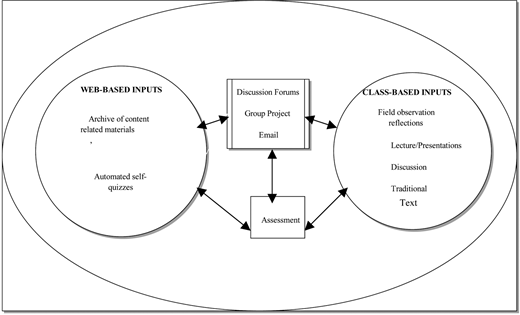
Based on research findings, the following components and materials were added to the course Website for each traditional face-to-face course: an announcement area, discussion forums, chat rooms, a project presentation area, a calendar, an assignment area, a course content archive titled “study resources,” and automated content quizzes. Augmenting the course with these components resulted in a hybrid model that merged face-to-face classroom and distance education teaching methods. Figure 1 depicts the model.
As indicated in Figure 1, the hybrid communication area becomes the focal point for class communication and generates multiple bidirectional paths that affect all course areas.
Instructional Strategies
The following instructional strategies were enacted within the hybrid model:
Student access to content materials was expanded through an archive for class and other content related materials, for example, the syllabus, lecture notes, readings, in-class PowerPoint presentations, a “Webliograhy,” the grading rubric, and so forth.
There were three observation discussion forums in which each student posted an initial reflection essay about the topic on specified due dates. The week following the posting date, students discussed and responded to one another's reflections. Each student was required to post at least one response to another student. Responding in discussion comprised 50% of the grade for each observation assignment.
The chat areas were used for synchronous seminar discussions required by a group project. Each class was randomly divided into groups of four to five students each, resulting in four to five groups per class. Each group was assigned readings from a series of articles from professional journals. After reading the articles, the group participated in a chat with the professor to explore the topics. The seminar chats took place in WebCT rooms equipped to record chat transcripts. These transcripts were sent in e-mail to each group member so that they would have a complete record of the ideas discussed. After the seminar chat students collaboratively authored a paper rendering their synthesis and evaluation of the articles. The final paper was converted to HTML format and was uploaded to the group presentation area and used by the group for the in-class presentation.
E-mail was used for communication between the professor and individual students, and student project groups used e-mail for collaborative writing and other project communications.
Assessment Strategies
The goal of stimulating interaction and higher order thinking as the foundation of reflection guided the development of assessment strategies. To achieve that goal the following steps were taken.
The professor created a five-point rubric based on Bloom's Taxonomy (Glover, Bruning, & Filbeck, 1983) to assess levels of cognitive activity achieved in student reflections posted to Web-discussion boards, essay exams, and group projects. In class, students were introduced to the taxonomy. Class activities to reinforce student understanding of the taxonomy included lecture, discussion, and concept mapping with Inspiration software (www.inspiration.com). Inspiration was used to stimulate and demonstrate thinking, and to enable students to correlate their thoughts to the levels of the taxonomy and self-evaluate. The rubric (see Appendix A) was posted in the Study Resource section of the course Website.
Automated multiple-choice quizzes were created for each textbook chapter and made available within WebCT on the course site for student use as a means of self-assessment.
Traditional midterm and final essay exams were administered in class. A question was included on the final exam for each student to evaluate the project of another group.
The remainder of this article presents methods, an overview of participation outcomes, and brief samples of preservice teachers’ reflection postings within the hybrid model.
Methods
Explanation of Reflective Thinking
Reflective thinking assumes that cognitive activity leads to growth in higher-order thinking like inferences, synthesis, analysis, and evaluation. According to Doolittle (1997),
Vygotsky believed that an individual's immediate potential for cognitive growth is limited on the lower end by that which he or she can accomplish independently, and on the upper end by that which he or she can accomplish with the help of a more knowledgeable other such as a peer, tutor, or teacher. (p. 85)
The cognitive distance between the lower and upper ends is what Vygotsky referred to as the zone of proximal development (ZPD) (Doolittle, 1997). Vygotsky (1978) defined the ZPD as the difference between a learners’ actual developmental level as demonstrated by independent problem solving and the level of potential development as expanded through expert guidance or in collaboration with peers that are more capable. Within the ZPD, learners mutually benefit from social group processes and create new means for learning and understanding. For preservice teachers, peer interactions discussing observations of everyday classroom activity expands their opportunity to learn about teaching practices. Standing observation requirements in field-based teacher-preparation programs provide a mechanism for preservice teachers to synthesize and evaluate learned theories and ideals. Ideally, observations also provide a focal point for discussion and peer feedback.
The Context
The course is situated in a secondary teacher preparation program that includes three block divisions covering three semesters that culminate in student teaching during the third and last block. The hybrid model was implemented in the first semester, Block I, Foundations of Education course in which students spend one day per week in field observations. A standard foundation of education textbook was used for the course.
Data Collection
Participation data was tracked over a three-semester period in six course sections of the Foundations of Education course. The primary data sources were the WebCT participation records, chat and Web discussion forum transcripts, and e-mail during the three-semester period, spring 2002, summer 2002, and fall 2002. All use of WebCT occurred outside of scheduled class sessions. Student evaluations were administered in each course at the end of each semester.
Participants
All participants were junior or senior level students in secondary education teacher certification courses. Most students were already accustomed to accessing posted course materials on WebCT course sites. In terms of gender, the class groups were almost evenly divided with 51% female and 48% male students; 91% of the students were Hispanic. The participants continued to meet for traditional classroom sessions but also participated in required Webaugmented activities, discussion board forums, chat, and e-mail.
Outcomes
Participation
Table 1 summarizes the frequency of student postings to Web-based discussion forums and private e-mail to the professor.
WebCT activity logs verified that 100% of the students contributed to the three discussion forums. Ninety-five percent of the students exceeded the minimum requirement of one response. The average number of postings per student over the three-semester period was 14, or approximately 5 postings per topic. This level of participation has significant value in comparison to typical classroom discussions believed to average a maximum 20% level of student participation with some students not participating at all.
There was also a high instance of e-mail to the professor. Some of the e-mails were to ask questions about grades, absences, or other individual matters. However, many of the communications requested the professor's opinion on observations and reflections. When appropriate, the responses were made in class for group benefit but otherwise individual responses were required. Though e-mail responses did require more time from the professor, the overall activity was considered beneficial to teacher-student interaction.
WebCT tracking tools counted the number of times students accessed the course and the number of items read. Student tracking records indicated a surprisingly high rate of student access to course content resources outside of class time.
All students completed the automated self-quizzes and frequently commented that they served as a good reading guide.
Discussion Forums
Qualitative analysis of student postings also confirmed the value of the Web-discussion forums as an appropriate arena for reflection. Initial essay postings demonstrated student attempts to correspond to the cognitive levels described in the rubric provided. All students demonstrated levels of higher order thinking in their initial postings. The required initial observation essay postings averaged one to one and a half pages in length. The length of the initial posting is interpreted as an indication of the students’ attempt at careful deliberate reflection.
Examples from Discussion Forum
In order to stimulate original reflection, topics were stated in a nonprescriptive manner. For example, after class presentation of a chapter that covered the philosophical antecedents of American education, students were asked to observe and reflect about philosophical influences detected at their school observation sites. This open-ended initiation to reflection gave students a chance to wonder and expose concerns about their future responsibility to maintain classroom discipline and explore their ideas in relationship to their classmates’ ideas. The following are excerpts from response postings in that first reflection effort.
Excerpt from an initial reflection:
I think Pestalozzi's ideas could bring a needed perspective to handling troubled students with more compassion. Sometimes teachers seem quick to blame and punish students instead of trying to bring them to a better idea of how to behave in the class.
In response Maria (not student's real name) stated:
I agree, Peztalozzi's concepts about education are of major value in today's society. The Peztalozzian method includes the expression of love, understanding, and patience for children. I believe this is a major issue. Teachers should take an extra step in showing students that they care. This extra effort will definitely have an impact on a child's life. For example, most students misbehave because they feel that no one cares about them or understands what they are going through. By showing them otherwise, the students will appreciate their effort and respond in a positive manner. When I was observing, I noticed there were many students that clearly had trouble at home. When they came to school they tried to release their anger and anxiety on other students or teachers. There was one occasion when a student decided to completely ignore my mentor teacher. When the teacher asked for his cooperation, the student talked back and used a lot of profanity. My mentor looked at him with a very serious face. He obviously looked upon him with disapproval. The situation in the classroom was so tense that I thought the teacher would certainly tell him a thing or two and kick him out of the classroom. Instead, the teacher simply asked him in a calm and steady voice, “Have I ever shown any disrespect towards you?” The student certainly looked ashamed because the teacher did not react in a negative manner. The teacher proceeded by telling him that he was a good student and that if he respected him, he should certainly reciprocate that respect. To make a long story short, the student gave the teacher a sincere apology and the class continued as usual. This student participated and behaved from then on. This to me was amazing. Most of the teachers did not even put up with a pin dropping on the floor. This history teacher is a clear example that it is possible to apply Peztalozzi's concept of the expression of LOVE, UNDERSTANDING, and PATIENCE for children.
Response to Maria:
Thank you for sharing your example with us Maria [not real name]. As future educators we plan to implement ideas such as Peztalozzi's theory of love and kindness. However, when the true test occurs when that particular student pushes one's buttons will Peztalozzi's theory kick in? Well, if at that moment it does not, perhaps Maria's example will.
The above excerpts demonstrate student attempts to synthesize class content information and relate it to the field observation classroom setting.
The following excerpts in the same forum demonstrate student efforts to expand the topic of teacher-student respect.
Response to another student's somewhat naïve comment that
“most students fail because they lack positive role models”:
Susana (not real name), you bring up many valid points in your essay. I strongly agree with your idea of mutual respect. Teachers should respect their students and the respect will be reciprocated. But I have to slightly disagree with your bold statement that students fail because they lack positive role models. I believe student failure is individual and a lot more complicated including that sometimes they fail because they choose to. I believe all students have the ability to decide whether or not school is important to them.
Response:
How would you determine that a student fails because they want to?
Another student added:
I agree that there is a great need for respect between teachers and students. However, I think that when teachers are too strict with their students, it creates an opposite effect. When teachers are too strict, students start viewing them as parents, police, or other authority figures that students want to rebel against at this age. There are other ways of gaining respect from students such as respecting them as young adults and giving them more responsibility over their work. Being too strict translates to too many rules, which teenagers love to break.
Responses to another student's expansion of the topic into character and values education:
Character education is a very controversial issue in today's educational system. I personally believe that all schools should implement some sort of character education class. There are a lot of social problems in schools. By teaching this [character education] I would say that it might contribute to a decrease in violence, pregnancy, and substance abuse. Also, I believe that it can help teach values to children whose parents are absent from the home because of working and busy schedules. This type of class can be implemented into the regular, special education, and the gifted curriculum.
Response:
Hilda [not real name] you are right when it comes to social issues being addressed in school. It's a sad note to see that parents do not discuss issues like that with their kids. I guess they still live in their own time when it comes to everyday issues like that. What needs to be looked at more is the boundary that is set between what a student should talk about with teachers and what a teacher is allowed to discuss with her students.
Response:
The school I'm at is implementing a discipline program that includes character development like you mentioned. Although there are currently no guidelines for measuring the overall effectiveness of these programs, my mentor says they have seen a difference in one area. By examining the overall number and specific referrals sent to the office, there are two things evident. The first is that the numbers [discipline referrals] are down drastically from two years ago when there was no district implementation. The second item is that upon further examining these referrals, one can see that they are more severe. This shows that many of the little things that set students off are sliding, students are now “turning the other cheek,” if you will.
Keeping in mind that I am an “observing teacher”, and may be impartial to some of the instant results I see, I do firmly believe in this district wide initiative. The building of both social skills and character development is essential to both their future and ours.
The posting above is an example of student attempts to analyze, synthesize, and evaluate the application of content topics in school settings.
As expected in the first forum, student responses were somewhat naïve but exposed varied levels of student understanding and demonstrated student efforts to expand topics and place reflection in a professional context.
All students posted, and all students received responses from classmates. Students maintained a courteous tone in their postings and responses. These aspects of postings were interpreted as evidence that students were willing to scaffold classmates’ ideas and contribute to expanding their fellow students’ thinking. The level of personalization and regard evident in postings provided further evidence of the thoughtful introspection necessary to initiate reflection.
Group Project
All groups completed the group project assignment that required outside reading, participation in a synchronous chat seminars, collaborative authoring of the group's analysis and interpretation of the articles, and final posting of the group document to the student presentation area. All group chats took place in the evening or on weekends. The professor initiated the chat seminar and remained online with students for 1 hour. However, the WebCT chat transcripts indicate that all groups continued discussion after the professor left the group. The longest chat continued for a total of 3.5 hours. All final projects demonstrated levels of synthesis and evaluation. This activity also provided an experience with group dynamics that included both positive and negative aspects. For example, some groups reported difficulty with group member followthrough in meeting co-authoring responsibilities in a timely manner. When this occurred a designated group member contacted the professor via the WebCT e-mail. The professor did not intervene but coached the group through e-mail to negotiate the conflict. Students resolved all conflicts to the benefit of the group. As a process, this exercise functioned well to give students a first-hand experience with the sometimes difficult logistics of collaborative learning. The success of group project activity is interpreted as evidence of students acquiring a heightened perception of uncompetitive interdependence important to processes of sociocultural constructivism.
Student Evaluations
At the end of the semester students were asked to comment about using the hybrid communication format for observations and interaction with classmates. It is important to note that there were no negative responses to this question. Following are some representative student evaluation responses.
Question: What did you like and dislike most about the discussion forums?
I like being given time to get my thoughts together and post at convenient times.
I have small children—I liked being able to talk to classmates without having to go out.
I got a lot of good ideas from classmates.
WebCT is awesome, I really feel like I know what my classmates are thinking.
Posting does force you to think on a higher level and explain better to other class members as well.
Question: What did you like and dislike most about the group project activity?
I like the on-line chat—never done it before.
Group work was a bit difficult due to lack of cooperation from peers—some people didn't do their work on time.
I know how to change a paper to html and post things to the web now.
E-mail between the professor and students also received high ratings from the students with no negative comments. One student commented, “It was great—I didn't have to wait for office hours or class to ask the professor a question.” E-mail seems to have enhanced opportunities for professor individualized feedback and scaffolding of reflective practice.
General Question: Please feel free to make any additional comments about course activities and procedures.
I liked going back to notes and powerpoints—when I was sick I could keep up.
The quizzes kept me on track with reading and let me know if I got it.
I got ideas for teaching history this way.
It was a lot of reading and writing but it did help me do better on the essay tests.
The tests were fair.
I liked being able to see the powerpoints more than once.
That rubric really helped me write better.
Student responses to the final open-ended question encompassed most course components. The majority of students noted access to content outside of class time as a positive addition to the traditional class. Almost all of the students mentioned the quizzes and the grading rubric as valuable for self-assessment. Many students mentioned that this approach required more reading and writing than the traditional class. However, none of the comments regarding the enhanced reading and writing were negative and many commented that they found it useful.
Conclusion and Recommendations
Constructivism holds that knowledge is built by the learner actively engaged in interpreting the external world through social negotiation of meaning and common representations shared with others. At the time of this study, preservice teachers shared their reflections in traditional face-to-face class settings. However, as is typical in classroom discussions, not all students participated equally. Frequency of student participation in Web-based discussion forums affirmed that the hybrid model combining face-to-face classroom instruction with distance learning methods expanded student interactions and opportunities for feedback. The final evaluation of student production indicates that social negotiation of meaning encourages progress toward higher-order thinking and contributes to developing reflective thinking habits. The use of asynchronous discussion boards in a traditional class allows students to participate more deeply because they “have had an active, multi-level learning experience that has given them a strong background in the subject … and [are] motivated to talk about it because they have personalized the material” (Creed, 1999).
Since student engagement is always a desirable goal, it is important to consider that there were no negative student comments on evaluations about additional time required to participate in chats and to use the discussion boards outside of class time. In fact, most students seemed to place high value on the asynchronous aspect of the discussion forums and maintained discussion with little input from the professor. In this case, using students’ reflections to foster dialog in the hybrid model functioned well to encourage interdependence and interpersonal interaction with peers, a factor understood to extend the upper levels of the ZPD.
The use of Web-based technology in face-to-face instruction also requires “instructors to reflect on the new expectations, demands, and social dynamics resulting from the new medium” (Soules, 2004). The enhanced flow of written communication caused by use of the hybrid model requires serious consideration about the amount of input from the instructor. One recommendation is that instructors using this format incorporate mechanisms for student self-assessment as an integral part of the course in order to maintain a reasonable workload. In this course self-quizzes, the writing rubric, peer feedback, and group responses to common questions were techniques used to maintain instructor input at a manageable level.
In general, the integration of distance education methods seems to have improved the course in all aspects. One of the most affected areas was assessment. The automated quizzes established a new mechanism for student self-assessment. The bidirectional flow of information within the hybrid model and tracking records of interactions enhanced assessment procedures. The fact that the discussions were posted, instead of just verbalized in class, provided concrete data to assess the level of student discussion contributions. From the research perspective, using Web-based discussion forums tends to preserve data more efficiently and extends the capability for in-depth analysis of student cognitive growth in reflection activities. In this case, an analysis of discourse to assess students’ cognitive growth is planned.
APPENDIX A Bloom's Taxonomy
WHO: Benjamin Bloom, 1913-1999, a renowned educational psychologist and educational theorist.
WHAT: Taxonomy of educational objectives: Handbook 1, the cognitive domain (Bloom et al., 1956)
Bloom's Taxonomy, briefly describes the understood levels of critical thinking. Let the levels of the taxonomy guide your thinking and writing about the issues presented in this course. The overall goal is to practice critical thinking skills so you can better lead your own future students through the steps.
Grading Rubric
Writing will be graded on a scale of 1-5. The level corresponds to the taxonomy in the following manner:
Knowledge
Comprehension
Application
Analysis
Synthesis and Evaluation
The grading scale based on the Taxonomy is as follows: Level 1 = D, Level 1-2 = C− to C+, Level 3-4 = B− to B+, Level 5 = A− to A. To achieve an A on writing assignments posted to the Web-discussion forums, you must demonstrate synthesis and/or evaluation of the topic at hand.