This article describes how online discussion groups and visual collaboration can be used in combination to build and support a virtual community of learners. Data derived from several online discussion groups are presented, and the support needs of learners are highlighted as a key factor of success.
MOTIVATION, SUPPORT NEEDS, AND LEARNING DOMAINS
It is widely acknowledged that attrition rates in distance education are generally greater than those in traditional higher education and may be as high as 50% (Moore & Kearsley, 1996; Ross, Morrison, Smith, & Cleveland, 1990). Distance learners tend to require more support than their classroom-based counterparts (Gibson, 1996, 1998), and support needs in distance education link directly to individual motivation (Osborn, 2001). Motivation is a key factor in any learning enterprise, and in distance education, it appears to be particularly crucial. Social isolation poses a significant problem for some distance learners, as does the reduction in motivation normally engendered within traditional student communities (Yorke, 1999). Motivation contributes to success, along with a number of other critical factors, including maintenance of attention and the will to complete; social support, including mutual encouragement, sharing of ideas, problems, and triumphs; and ready access to resources, the tutor, and the peer group. Lack of any will guarantee that online learning environments will not provide the easiest route to obtaining postgraduate qualifications.
Many distance education students are mature, with full-time jobs, domestic commitments, and other agendas that compete with the amount of time available during a standard week (Willis, 1993). Students often cite time taken up by family and tiredness after work for nonattendance at tutorials (Fung & Carr, 2000). These factors highlight the importance for distance learners to receive support throughout their programs of study. Student support may therefore be the most important issue affecting the success or failure of online learning.
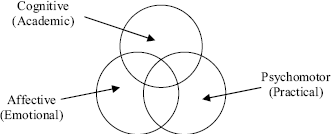
Carnwell (2000) has categorized learning support in distance education into the three discrete areas of academic, emotional, and technical-practical support. Academic support naturally maps across the cognitive domain originally described by Bloom (1956), as shown in Figure 1. Students are anxious to know how they can pass their assessments, and where they need to go to access the reading materials needed to understand the subject they are studying. The emotional needs of the learner are affective in nature, and thus fall into this learning domain as classified by Krathwohl, Bloom, and Masia (1964/1972).
The technical-practical support that students require is located within the skills (or psychomotor) domain. Students may, for example, forget their password, or find difficulty downloading a file they require to complete an assignment. If help is not quickly forthcoming, students may become frustrated and reject the technology (Wheeler, 1993) and some students may terminate their studies. Support of a practical nature may be pitched at a lower level than the support offered in the other two domains, but may nevertheless be just as crucial to the learner’s success. The manner in which online learning is designed and delivered will usually determine the method through which students can be supported. Support can be provided by the tutor or subject specialists, but also by the student peer group, or in some cases through the structure and content of the learning material, or through software features.
PROBLEM-BASED LEARNING
Problem-based learning (PBL) methods emerged as a means of promoting deeper cognitive engagement. PBL strongly promotes the development of skills through the use of complex, real-life problems, motivating students to generally approach learning in a deeper manner (Duch, Groh, & Allen, 2001), facilitating critical thinking, cooperative working, verbal and written communication skills, and lifelong learning skills.
Distributed PBL (dPBL) is a version of PBL that can be offered to distance learners. Learning is mediated through computer technology, and a shared, “virtual” distributed learning environment is used to enable students to collaborate. A powerful PBL utility enables teachers to present students with authentic problems they might encounter in the “real world.” Students must also practice problem-solving skills while reading more widely and investigating more deeply the structure and context of the presented problem. To facilitate this, tutors must act as guides and facilitators in the process, and may even adopt a learning role themselves (Roblyer, Edwards, & Havriluk, 1997). The learning group is encouraged to collaborate as a team with each member monitoring the progress of others whilst simultaneously assessing their own (Barrows, 2002). This distributed community of practice therefore encourages a self-regulating and autonomous body of students. Online collaborative knowledge building approaches have previously been used to promote effective learning in in-service teacher training (Ahlberg, Kaasinen, Kaivola, & Houtsonen, 2001) and to establish communities of practice in CMC-based initial teacher training (Clarke, 2002; Tsui & Ki, 2002).
THE ONLINE MODULE
The online module, titled “Information and Communication Technologies in Teaching and Learning: Theoretical Perspectives,” is presented in dual-mode format. Perhaps more accurately, it utilizes a number of modes, so it is in fact “multiple-mode,” incorporating face-to-face and technology-mediated modes, synchronous and asynchronous media, and encouraging both independent and collaborative study (see an elaboration of this in Wheeler, 2001). This is reflected in face-to-face teaching and learning (lectures, seminars, group work, and discussion), online delivery (electronic resources, online discussion, problem-based learning scenarios, and online multiple response question assessment), videoconferencing and dual mode tutorial support (synchronous via telephone, asynchronous via e-mail). The multi-modal characteristics of the course combine with the problem-based learning materials to endow the course with its power and flexibility.
Successful completion of the module earns students 30 credits toward a master’s degree in education, constituting 25% of the taught element of the degree. If they successfully complete a second related independent study module, students earn another 30 credits, thereby completing half the taught portion of the degree. A differentiated assignment at the end of the course contributes toward the mandatory assessment of each student’s learning. Differentiated assessment allows the learner to select a form and focus of assignment relevant and applicable to his or her professional practice from a range of assignment options. A large proportion of the course is delivered on the Web through a specialized platform known as MTutor. Before MTutor is described, it is important to review the limitations of computer-based learning (CBL).
“MINDTOOLS” FOR LEARNING
Jonassen, Peck, and Wilson (1999) have argued that CBL has fallen short of its optimum value due to misapplication of its potential and have called for a radical change. Indeed, Jonassen has recently argued that most online learning does little more than replicate face-to-face lectures (Jonassen, 2002). He argues that, in traditional forms of CBL, computers are expected to “do the teaching,” while students are expected to “memorize” the materials. This represents a linear “drill and practice” approach to teaching based on the knowledge transmission model, and fails to support meaningful learning, because computers can store information more efficiently than humans, and humans can teach better than computers. Jonassen and his colleagues have called for a reversal of these functions, where computers are used for what they do best, liberating the student to explore, discover, and create personal meaning from diverse sets of material in an active manner.
Technology, they argue, should be used to engage the student in thinking and knowledge construction rather than merely as an information transmitter. Jonassen and his colleagues call for the computer to be used as a “mindtool” to promote open-ended learning. The mindtools approach challenges the established “computer-based learning approach” in which knowledge resided in the machine and was systematically delivered to the student. Instead, students bring their knowledge to the computer, which provides a fertile environment within which the student can construct new knowledge through proactive exploration and collaboration with others. MTutor can per form these mindtool functions by providing the remote student with a combination of meaningful, open ended learning in the form of PBL, and a flexible, nonlinear environment within which to study.
DISTANCE LEARNING
MTutor is a Web-based system into which a range of problem-based activities, scenarios, and online resources can be assembled and presented. It also houses a comprehensive discussion group facility and a range of multiplechoice and multiple-response question options. It uses specialist (common gateway interface) software to facilitate the presentation of online survey questionnaires for evaluation purposes. MTutor has previously been used successfully to support problem-based learning in health studies, engineering, and psychology (Culverhouse & Burton, 1998, 2001), although each of these had been implemented within a networked campus-based environment. Now, in order to deliver the new module, MTutor is being used for the first time as a platform for a truly distance-based course. Web-based learning appears to lend itself readily to dPBL, and the next section of this article discusses these possibilities.
PROBLEM-BASED LEARNING
Problem solving is probably one of the most important skills students can acquire, because it enables generalizability across diverse problems encountered in everyday life. We encounter problems every day, some of which merely take a minute or two to solve. Others take days or even years to circumvent, and then often with no guarantee of success. Problem solving is therefore a key component of the lifelong learning process, involving many cognitive resources and much commitment and practice.
Problem-based learning can be characterised as learning that is based on the thinking-through of real life problems or, to use a more appropriate term, situated cognition. Of course, everyday problems are rarely clear-cut in nature, as many have no structure and may bear no similarities to previously-encountered problems.
ILL-STRUCTURED PROBLEMS
The presentation of ill-defined or ill-structured problems has a number of advantages but, according to Simon (1973), they are primarily representative of real-life situations and thus can have practical outcomes. Simon (1978) has argued that ill-structured problems exhibit three key characteristics. First, they are more complex and have less-definite criteria for determining when the problem has been solved. Second, not all the information has been provided in the presentation of the problem, leaving several gaps for the learner to fill in. Finally, ill-defined problems have no apparent “rules” that can be immediately applied. It is also conceivable that ill-structured problems offer better generalizability potential across diverse problem types. Nevertheless, the extent to which a problem is ill-structured may depend on the skills and knowledge that the learner brings to bear on the problem.
Learners with the requisite knowledge may perceive a problem to be better-defined than those with no, or little, knowledge (Frederiksen, 1984). Moreover, student-centred learning can be supported using ill-structured problem solving. Kahney, for example, has asserted that ill-structured problems tend to encourage learners to define the problem themselves (Kahney, 1994). This leads, in turn, to greater motivation and, ultimately, the construction of personal meaning within individualised contexts.
The online element of the module is problem based, enabling students to immerse themselves within situated aspects of the theory, such as real-purpose tasks and transformed teacher roles (Jonassen, 1996). Ill-structured problems of this nature are presented for them to address. The first scenario, for example, takes the form of a heated debate between two teachers in the staff room. One teacher is opposed to the use of in formation and communication technology (ICT) across the curriculum, while the other is a strong advocate. Their polemic is analyzed by the students, and a range of theoretical and practical issues are teased out which they later discuss online with their peers and the tutor.
DISCUSSION AS LEARNING SUPPORT
Generally, each student will abstract the meaning he or she feels to be uppermost in the presented dialogue, and this will invariably be an issue or set of issues that impact on his or her own professional practice in some way. Humans are social beings who depend on feedback from their peers to validate their own beliefs (Jonassen, 1998) and online discussions are ideal environments within which this kind of learning can be propagated. The argumentative nature of the ensuing online discussion encourages each student to further construct, deconstruct, and reconstruct their own personal meaning from the problem and its implications. Yet, within the argumentative nature of the dialogue, cooperative processes have been seen to emerge. Cooperative dialogue can occur, for example, when students “take sides” during online discussions, or where they work together to justify a particular position adopted. Incidentally, Ravenscroft (2001) suggests that such cooperative dialogue can be achieved as effectively through an intelligent computer system as through a human tutor. However, this notion of machine intervention must at present be little more than a utopian ideal for the vast majority of educational providers and so remains little more than an application for future use.
Thus, for each learner and over a period of time, a mutual climate of support is developed as the learner’s cognitive development is incrementally shifted through a process of negotiation and cooperation in dialogue.
ACADEMIC SUPPORT
As previously stated, academic support is directly related to the cognitive development processes of learning. Academic support need not always originate from the tutor or course team, but can just as easily be provided by more knowledgeable students within the group. Online groups quickly discover which members have the best skills and experience for each emergent task or problem, usually through a degree of self disclosure, as highlighted in the following posting about technophobia and computers (Note: all names are pseudonyms to maintain participant anonymity.)
[3 December 20:12] Grace: I have submitted my ‘How I Done It’, This tells that I used my experience of adult learning and fears and related it to the topic under investigation. [....] I had ten 11-12 year old children. I got them to create a little web page on WORD. They loved it but the teachers were clearly shocked that these children had created these pages. I also detected fear.
Grace reveals that she has had experience teaching both 11-12 year olds and adults. Later in the module, if either of these topics arises, other members of the group may remember her expertise and ask her directly for her opinion, thereby tacitly requesting support within their own zone of proximal development. An exemplification of this occurs during an online dialogue about computer-mediated communication (CMC). One student offers help following the request of another group member, and this help derives from his greater knowledge of available resources:
[4 January 22:09] Sylvia: Many of my students have learning and/or physical disabilities. Any suggestions over the best way to make CMC accessible to such people?
[5 January 20:23] Colin: Sylvia, there’s a good article on this in a newsletter I found on a Hong Kong Web site recently— address as follows: [he provides the Web address]
EMOTIONAL SUPPORT
Emotional support is arguably the most vital support for learning in online environments, as distance learning is generally devoid of face-to-face support, and students often have problems understanding course information (Baker, 1986). This deficit can lead to frustration, anxiety, and other negative emotional responses. Negative emotions also result when students cannot gain easy access to course materials. The following exchange on a course discussion group starts off as a nervous plea for technical support and then generates its own humour and emotional support:
[19 November 20:14] Sophie: Steve, this is Monday and I have come expectantly onto [name of the course Web site] to have a look at the second tutorial, but no Devon version available. I even tried to log onto the old Jersey version but it won’t accept my name/password. So I’ve resorted to coming back to this discussion group even though it has officially closed! I’m feeling exceptionally asynchronous!
Sophie’s plea for help is confirmed by other students within 11 minutes of her posting her discussion contribution:
[19 November 20:25] Andrew: As with Sophie, I too have been refused entry into Tut2. Only a blip to be sure but it shows that we’re ready and willing! (-} anonymous chat room lurker.
[19 November 23:00] Gina: me too - we must be realy sad
Within 24 hours, several other students have joined in the exchange, with one providing the solution:
[20 November 18:53] Jack: It is there—I have been on it!!! Instead of going into WiP (work in progress), click on the students button. This gives a list of all the current tutorials—scroll down the list and there it is!!! Jack.
[21 November 12:11] Andrew: Well spotted Jack. Thanks.
[21 November 21:16] Rachel: well I’ve done all those things and it won’t let me in.
[21 November 21:26] Jack: Were you clicking the tutorials listed for the Devon group? It is directly below the Jersey group—with identical tutorial lists!
[22 November 21: 22] Rachel: yes but nothings happening!
At this point, with the frustration mounting, the tutor intervenes and provides practical (technical) support for the group. Once technical issues are resolved, the frustration subsides and emotional support is no longer high on the agenda. In another recent publication (Wheeler, Kelly, & Gale, 2005) a fuller analysis of online dialogue was presented, including analysis of post-module student interviews.
EVALUATION METHODS
Throughout each module delivery, five methods are employed to enable as full- and wideranging an evaluation as possible. The first method involves the automatic tracking of student activities within the MTutor Web-based learning environment. This enables the tutor to provide students with support in the form of remedial help if required, and will indicate how each individual student reaches or approaches expertise within each discrete problem space.
The second method of evaluation is a two-part paper-based questionnaire completed by each student at the start and the end of the course, to determine changes in learning style, preferred approaches to learning, and a measure designed to elicit student perception of transactional distance (see Moore & Kearsley, 1996; Wheeler, 2000; 2002). Transactional distance is the psychological distance perceived by students when separated from their teacher and peers. The manner by which teachers use technology to mediate communication over distance may have the potential to reduce as well as amplify any misunderstandings and other negative effects associated with transactional distance (Wheeler, 2002, 2004) .
Third, a questionnaire presented on screen at the conclusion of the online delivery gathers data from each student on technical and logistical operations. This includes, for example, how quickly each student has been able to adapt to the new way of learning, how difficult each has found the problem spaces, the appearance of the material, ease of navigation around the Web-based learning environment, and how well the material has been sequenced and presented.
The fourth method of evaluation is a quantitative record of each e-mail and telephone call initiated by students to the tutor. This is complemented by a content analysis of each email communication, the results of which will be presented in other papers.
Finally, for the fifth evaluative method, each student is asked to keep a reflective diary of his or her experiences, which will include verbal feedback from a focus group at the conclusion of the course. Attrition rate and completion data will complete the picture of the success of the course. The online student contributions data provide an analysis of the efficacy of dPBL approaches. Names of contributors have been changed to protect identities.
REFLECTIONS ON SUPPORT NEEDS
The first two deliveries of the online module yielded rich data about the success of the course and the satisfaction levels of the students. Generally, students reported that they appreciated the opportunities to collaborate together through discussion groups. It was considered an important social support structure, scaffolding their academic thinking through problem solving. Emotional support was forthcoming between group members, in various forms, including encouragement and humour.
As time passed and the group members began to develop interpersonal relationships, the use of emoticons gradually decreased, indicating that the use of such symbols may initially have been a device employed to minimise any potential misunderstandings. Practical support was also given freely by group members at early technical problem stage, but when students reached the limit of their knowledge, the tutor and the course team intervened.
CONCLUSIONS
Distributed problem-based learning is a reworking of the established case study approaches familiar to the medical profession. It is a nascent online method, mediated by technologies that are still unfamiliar to many. Thus, a great deal of opportunity exists to research the effectiveness of dPBL and its place specifically in postgraduate studies and generally in distance learning.