Using collaborative critical reflection as an index, this study examines the asynchronous and face-to-face discourse of 28 suburban Chicago elementary teachers developing problem-based learning (PBL) curriculum. Statistical analysis of the corpus produced by the 2 mediums shows that the asynchronous online network emerges as the medium of choice for addressing more theoretical and reflective discourse related to PBL development. Where face-to-face collaboration was convergent task focused, the asynchronous discourse environment is more suited for divergent task outcomes. The results of this study will help those who facilitate learning in the online environment understand the capabilities of interactive technologies in supporting cognitively complex learning outcomes and determine the pedagogical structures that encourage those outcomes.
INTRODUCTION
The online learning environment integrates multimedia (audio, video, graphics, etc.) and instructional content into a single delivery system under computer control. Within these online learning systems are hosted a number of management, design, and organizational features that require an instructor’s close attention. Though an instructor’s foremost concern is with identifying the appropriate content for the level and readiness of a learner, equally important is determining ways to productively engage learners within the sometimes challenging context of the online learning environment.
The multiparticipant capacity of wide area networked computer technology provides a unique opportunity to engage learners who otherwise would not have access to select learning opportunities. Yet, a time- and effort-intensive challenge lies in developing suitable cognitive activities that help the learner progress toward specified learning outcomes (Hawkes & Coldeway, 2002). Within the distance education field there is growing use of group-based collaborative activities to encourage learner development. Using any one or a combination of online communication tools such as synchronous chat rooms, threaded discussion boards, or other multiuser environments, an instructor can design tasks that involve the combined interaction of the learner, course peers, and the instructor to create richer, deeper constructions of the course content.
This article will describe the rationale for the use of group task activities and a process for using them in the online environment. The collaborative nature of tasks is discussed and critical, collegial reflection is introduced as a valued outcome of peer collaboration. The relationship between collaboration, reflection, and dialogue are presented in the context of convergent and divergent tasking. Data are presented that illustrate how reflective outcomes emerge more from divergent group interactions hosted via an asynchronous forum, while convergent outcomes emerge more from face-to-face encounters. The results may help online course instructors and designers better understand the efficacy of group tasks on learning outcomes.
GROUP-BASED TASKING TO PROMOTE ENGAGED LEARNING
Group tasks have their origin in collaborative learning. Collaboration has been defined as “a coordinated synchronous activity that is the result of a continued attempt to construct and maintain a shared concept of a problem” (Roschelle & Teasely, 1995, p. 70). Whereas collaborative group tasks rely on the mutual engagement of learners, cooperative tasking involves the division of labor, task specialization, and individual responsibility. While cooperative tasking is the combining of completed parts done in isolation, collaborative learning is a process of shared creation in which a group of individuals interact to complete a pre-assigned or open-ended task (Panitz, 1997).
Research studies have shown a number of benefits of collaborative group tasking. In the process of helping each other learn, participants create a scaffold for one another’s efforts that produce more sophisticated ideas and strategies than group members would be able to achieve alone (Webb & Palinscar, 1996). Learners are likely to have higher self-efficacy for performing a task when they know that group members may be able to model effective learning and problem solving strategies for one another (Brown & Palinscar, 1989). Effectively designed group tasks show that learners of all ability levels and type (male, female, members of minority groups, students at risk for academic failure, etc.) can realize the benefits of increased academic achievement (Nichols, 1996; Perez, 1998). Collaborative learning activities also promote higher-level thinking skills as participants develop greater metacognitive awareness when “thinking-aloud” through emergent tasks (Good, McCaslin, & Reys, 1992; King, 1999).
The group act of “thinking aloud” creates shared meaning and interaction on collaborative tasks through dialogue (Rose, 2002). From a social cognitive perspective, collaborative acts are undertaken by multiple group members engaged in a process in which learning involves sharing and examining ideas with peers (Vygotsky, 1978). Comparing and contrasting individual beliefs against those of a group constitutes a process by which meaning—and subsequently knowledge—is formed. This process is one in which assumptions and beliefs are examined, challenged, rejected, or adopted through discourse and critical inquiry among a group of people who share the goal of completing a certain task.
Collaborative dialogue strongly influences what students learn and how they learn it. However, dialogue is only an intermediate effect and should be gauged as a medium leading to a more valuable learning outcome (Anderson, DiPlessis, & Nickel, 2001). This study identifies collaborative critical group reflection as a valued and terminal outcome of computer-supported asynchronous interaction. Reflection is noted to be an element of collaboration, an affiliate of dialogue, and a critical step in the process of social learning (Darling-Hammond, 1996; Putnam & Borko, 1996). Reflection is a continual process that engages learners in framing and reframing problems while designing and evaluating solutions. In the context of asynchronous interaction, reflective properties are what our experience suggests has interdisciplinary application to learners, courses, and content.
CONVERGENT AND DIVERGENT TASKING
Collaborative group interactions can be varied in their outcomes, but often require learners to engage in either convergent or divergent processes. Convergent and divergent tasking emerges from Kolb’s (1984) experiential learning theory which holds that learning and knowing results from a transformation of an experience into a varying state of action. Actions can be either convergent or divergent, depending on the nature of the task. By definition, convergent tasks are geared to result in a single best answer or solution. Groups engaging in convergent tasks direct their dialogue toward the justification of a decision and apply active experimentation in reaching a solution. The line of questioning in convergent tasking tends toward single, short answers and may require only modest cognitive processes.
In contrast, divergent tasks explore alternate ideas and implications from many perspectives. Divergent tasks require the contributions of new knowledge by group members from which more than one goal or solution may emerge. Because divergent tasks can be heavily influenced by the cognitive styles and experiential base of the participants, the outcomes may vary significantly. The inferential and evaluative nature of divergent tasking suggests it can be a cognitively challenging process.
Much of the literature about group tasking in the online environment puts convergent tasks on display. For example, Guan and Mikolaj (2002) found that student groups participating in convergent tasks in a Web-based commercial liability risk management course learned more working in a group than alone. Other studies report enhancements in learning, course satisfaction, and academic empowerment when students are engaged in group-based convergent task activities (Sorg & McElhinney, 2000; Winograd, 2000). In a study of two MBA online distance education courses, Liu (2004) found that convergent task activities served to align loyalties and create a sense of community in task-based groups that was far greater than loyalties and sense of community between all students in the course. In a comparison of online and face-to-face students in a convergent task-based environment, Hoag, Jayakar, and Erickson (2003) found the effects of technology in an undergraduate telecommunications management course had no impact on the learning of the two groups, as no differences in interaction qualities were noted. This study is unique in that it compares the online environment with the face-to-face environment in terms of learner satisfaction and team learning. These terminal course outcomes are important, but there is little about the group dialogue or the nature of the task that help us understand the capabilities and limitations of the technology in promoting reflective outcomes and higher-order thinking.
In this study, we examine the experiences of inservice elementary teachers engaged in an extended team-based curriculum development task. In examining the dialogue they produce in both face-to-face and online environments, we find the discourse serving very different outcomes. It is hoped that the results of this study will help us understand the capabilities of interactive technologies in supporting cognitively complex learning outcomes and determine the pedagogical structures that encourage those outcomes.
METHODS
This research involved 28 fifth- and sixth-grade teachers who volunteered to participate in problem-based curriculum development in a large suburban Chicago elementary school district (see Table 1). The distinguishing feature of the problem-based learning (PBL) model employed here is emphasis on codevelopment. For teachers, the objective is to establish a rich knowledge-building community of practice around problem-based learning. Participating teachers work on PBL curriculum development and deployment with colleagues from their own and other schools in the district. Persistent contact with coparticipants outside of their school is encouraged to even further engage teachers around highly authentic tasks—curricular and instructional—that apply directly to their classrooms and schools.
To support the year-long initiative to build teacher capacity for developing PBL curricula, teacher teams of three to four members met on select days after school. Because union policy and district activities limited the face-to-face contact between teachers participating in the project from various schools, network communication channels were used to host some of the ongoing curriculum codevelopment and communication among teachers. The primary asynchronous communication mode was e-mail. It is the communication generated through e-mail that constitute the primary data by which team dialogue and the resulting reflective outcomes are examined.
To determine the nature of interaction when teachers communicate under normal circumstances, teacher discourse was gathered by audio recording six face-to-face meetings of teacher work groups ranging from the start to the end of the program. Teachers were informed that their meetings were being audio-taped as a part of the data collection for project evaluation. Teachers were not aware that their interaction or reflective dialogue were the variables of interest in this study.
The recording of the face-to-face meetings ran concurrently with the collection of ongoing group asynchronous communication. Teachers were free to use the communication tools in any way they chose. The interaction was neither moderated nor facilitated, presenting an opportunity to see how and for what purposes computer-supported asynchronous communication naturally evolved. Though participation via electronic means was not required of teachers, it was assumed that given their geographic distance from—and lack of contact with— other team members, teachers might use the communication mode to address the complete content development tasks for the integrated PBL curricular units.
The e-mail interactions between project participants produced 179 usable messages posted over a four-month period. This total does not include messages posted by administrative staff, misposted messages (resent, misdirected), cross-posted messages from other forums, or messages authored by nonproject personnel. The audio-recorded face-to-face discourse—which served as a comparative frame of analysis to the e-mail—was “chunked” to equalize in size and number the discourse units produced through the two forms of communication. The chunking of face-to-face discourse was guided by principles of distributional accountability (Schiffrin, 1987). Groups of exchanges are said to be distributionally accountable when they perform the same function. The chunking process of the face-to-face discourse resulted in 222 distributionally accountable discourse chunks (see Table 2).
To compare the reflectiveness of the interaction, a team of three raters, independent of the school district, were trained to rate each of the face-to-face and electronically produced messages. The training was focused on using the Simmons et al. (1989) taxonomy for assessing reflective thinking. This taxonomy of reflective levels for group discourse range from a point where responses merely describe events and appear disconnected from the observer, to a point where responses richly describe events and attempt to explain them in light of theory or principle. Raters judged each of the chunked exchanges in the face-to-face dialogue (n = 222) and the asynchronous dialogue using the seven-level rubric described above.
RESULTS
To understand better the content and purpose of the face-to-face and asynchronous dialogue, each message was analyzed and categorized by primary theme. To determine the scope and frequency of message purposes, several categories were identified into which the messages were classified. At the end of the analysis, 12 final categories of message purpose had been identified. These categories include (1) social exchanges; (2) logistics, which include the setting of meeting times, the announcement of local and regional conferences, and confirming the receipt of materials; (3) technology use, which included all the messages and exchanges about teachers’ use of the technology such as opening a network file folder and sending an e-mail attachment; (4) general PBL development, which addressed activities such as identifying problem questions, instructional activities, and delivery strategies; (5) PBL and technology integration, which addressed what technology for student engagement would be integrated into the curriculum and where and how it would be used; (6) review of curriculum implementation events, which involved summarizing and critiquing curriculum delivery; (7) student assessment; (8) classroom roles, which included ideas about when teacher and student might assume the role of guide, facilitator, and cheerleader and if students should conduct learning activities in small teams or as a whole group; (9) divergent analysis, which involved addressing PBL issues from the perspective of a new or external experience such as PBL delivery where multiage grouping is concerned; (10) resource sharing, which included the exchange of PBL print information or the posting of PBL-related Web sites; (11) motivation/encouragement; and (12) general topics where school-related issues have no immediate bearing on PBL activities.
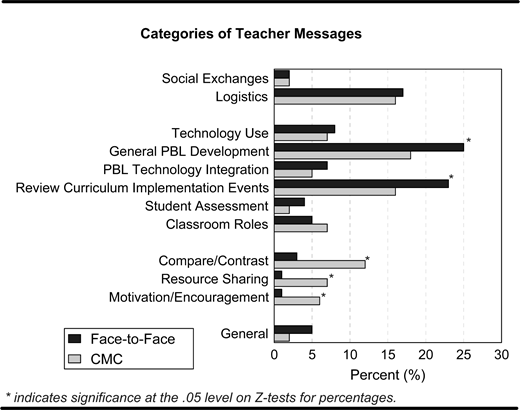
Figure 1 compares asynchronous with face-to-face communication on the 12 message content categories previously described. The over-all face-to-face and asynchronous message distribution significantly differed from each other in a chi-square test of association (χ2 = 40.54, p < .001). In the first two categories, which set the tone and parameter for participation, there is little difference between the proportion of face-to-face and asynchronous messages. The next five categories are directly related to the production and delivery of technology-supported problem-based learning curricula and comprise tasks that are convergent by nature. While there are only minor differences between face-to-face and asynchronous messages in the technology integration, student assessment, and classroom role categories, there are significant differences (z-test for percentages at the .05 level) in the general PBL development and implementation review categories.
Comparative data show actual curriculum design and development discussion is more prevalent with face-to-face discourse as the medium. The findings suggest that teachers felt more comfortable deliberating and conferring on ideas related to their curriculum in person. Where face-to-face contact is the medium of preference for discussing the details of curriculum development, the asynchronous online network emerges as the medium of choice for addressing more theoretical and perhaps reflective discourse related to PBL development. While a more direct comparison of reflective content between mediums is presented later, examples of asynchronous dialogue indicate the online environment is more frequently where teacher participants examine the events and experiences of PBL curricular development in light of guiding theory, contextual factors, and common cause and effect. The online dialogue seems to indulge itself in new information or understanding by asking “What does it mean when we do …?” types of questions, as opposed to face-to-face questions such as “How did we do …?” and “What if we did …?”
REFLECTIVE QUALITIES PRODUCED BY THE TWO MODES OF DIALOGUE
To determine the levels of collaborative reflection in the dialogue of project participants, the ratings assigned to the online e-mail messages and the face-to-face discourse chunks by the independent raters were tested for their consistency. Interrater reliability analyses on the face-to-face discourse achieved an item alpha level of .80, while the asynchronous discourse achieved an item alpha level of .87. When the two communication mediums were compared on their overall level of reflectiveness, an independent t test for equality of means between groups shows that asynchronous communication has significantly higher ratings on the reflective scale than does face-to-face communication (see Table 3).
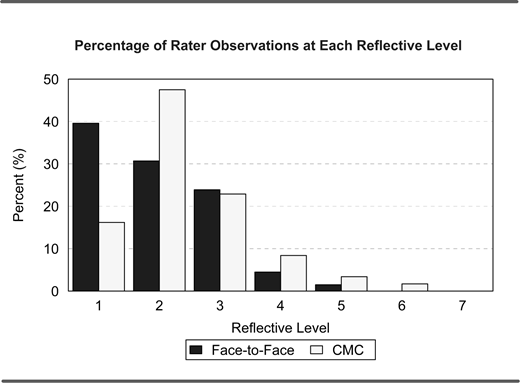
A breakdown of the ratings of reflectiveness in Figure 2 shows the percentages of ratings assigned to each of the seven reflective levels. The majority of messages (70% for the face-to-face, 63% for asynchronous) were rated at the first and second levels of reflection and generally show that neither asynchronous nor the face-to-face discourse is abundantly reflective. The fact that two very different distributions appear for each discourse mode with positive skews of very different strengths (stronger at the higher end for asynchronous than face-to-face discourse) suggests that the two mediums might serve very different purposes where reflection may have an intended or unintended role.
REFLECTION OVER TIME
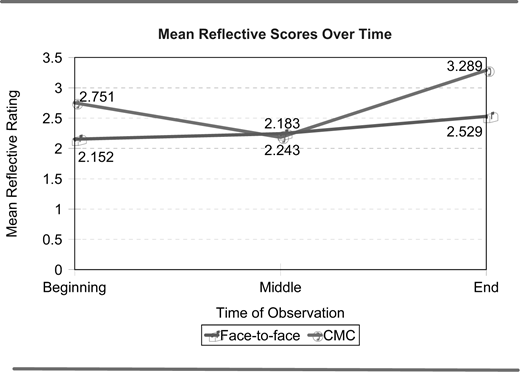
Information further defining the relationship between the face-to-face and asynchronous discourse explores the possibility of any increase in discourse reflectiveness over the duration of the project timeline. Two face-to-face teacher meetings recorded at the beginning, middle, and end of the project period were compared with each other. A similar comparison was made of the asynchronous discourse. Each of the 179 asynchronous messages were chronologically ordered and then divided into thirds. Comparisons of the first third of the messages were made against the second and final thirds. Figure 3 illustrates the change in reflection over time between the two mediums.
The face-to-face discourse shows gradually increasing reflectiveness over time from each of the three observation periods to the next. When the means scores for the observations at the three periods were tested for statistical significance, one-way analysis of variance shows no significant (F = 2.946, df = 2/219, p > .05 level) difference.
The online asynchronous discourse shows a curious pattern over the three observation periods. Between the first and second periods, reflective scores decreased, while the second and third periods show a relatively steep increase. When the differences between the reflectiveness at these three time periods were tested, a one-way analysis of variance indicates a significant difference (F = 20.707, df = 2/176, p > .000 level). Posthoc tests (Student-Newman-Keuls [SNK] posthoc analysis for homogeneous subsets) on the means indicate differences between each of the three means observed.
The increase in online reflective scores occurs only after a significant drop in the second of the three observations over time. Differences over the three time periods are possibly explained by the early initial use of e-mail by participants who were experienced and skilled at using the medium and confident the forum was safe a safe place to share their perspectives. As teachers less confident in the medium forayed into the discourse, their contributions reduced the overall reflection scores produced. More comfort and trust in the e-mail listserv prompted more thoughtful and professionally intimate and reflective posts by the time of the third observation.
DIVERGENT OUTCOMES AS A FACTOR OF TIME AND ACCESS
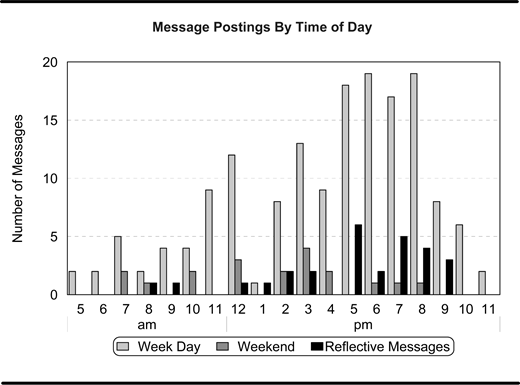
An analysis of forum and server log-file data suggests that those who participate in CMC online group activities do so more when they have access at home. Times of message postings show that messages posted during the normal times a teacher might be found at school, from 7:00 A.M. to 5:00 P.M., account for only 37% of all the messages posted (Figure 4). The bulk of postings (41%) usually take place in the early evening hours of 5:00 P.M. to 9:00 P.M. followed by communications posted on weekends (11%) and in the late evening hours between 9:00 P.M. and 11:00 P.M. (9%). These data show that home may not be the only place where the bulk of asynchronous e-mail messages are posted, but it is where the most reflective contributions to the discourse are made. The black-colored bars (reflective messages) also in Figure 4 show a positive correlation to the light-colored bars (postings by time of day). Of all the messages rating a “4” or higher, indicating a highly reflective message, 80% of them appear during the early and late evening hours.
DISCUSSION
When teachers in this study convened in their teams to work face-to-face on their PBL curricula, the audio transcripts of a selected number of those meetings show that their work was convergent task focused. Though these discussions were dotted with what independent raters determined were reflective exchanges, face-to-face discourse failed on several dimensions of analysis to reach the levels of breadth and depth teacher reflection in the asynchronous discourse. This study finds that the convergent group tasks of PBL development, such as identifying instructional strategies for a particular learning outcome or aligning assessments with disciplinary or state learning standards, foster limited critical group reflection. Unless critical reflection is planned as a part of the process or becomes an objective of a face-to-face meeting itself, reflective activities will be sporadic at best.
In the asynchronous discourse, collaborative processes were distinctly divergent as participants took their dialogue beyond curriculum development tasks and more frequently deliberated on questions such as: Why are we doing this? What are the long-range consequences of this decision? What meaningful relationship does this activity have with key learning outcomes? These were topics deeply embedded in the content, processes, and events of curriculum development, but that had generally eluded teacher teams when in the face-to-face setting.
Using collaborative critical reflection an index, this study shows that the asynchronous discourse environment is more suited for divergent task outcomes than is the face-to-face discourse environment where teacher teams were at liberty to use either modality in their curriculum development work. Where face-to-face collaboration was convergent task focused, asynchronous collaboration coupled teachers and content to examine beliefs and to arrive at new understandings of professional practice.
These findings complement the summary offered by Slavin (1997) who suggests that complex and ill-structured tasks—divergent in nature—are well suited for the collaborative environment where dialogue, friendly debate, deliberation, and reflection are applied. Well-structured tasks, in contrast, are less apt to challenge or maximize the cognitive capabilities of a collaborative. That these critically reflective, divergent task outcomes could be accomplished in the online environment attests to the authenticity of the setting to create conditions that increase the effectiveness of the social construction of knowledge (Jonassen 1991, 1994).
A final finding of this research is vital to the success of interaction in the asynchronous environment. The key to supporting asynchronous discourse participants in meaningful, thoughtful, sometimes personally revealing dialogue is the “climate” of interaction. Climate involves the extent to which teacher teams feel comfortable taking risks in terms of communicating their ideas. McKinley (1983) suggests that “a free exchange of ideas, opinions, and feelings is the lifeblood of collaborative learning” (p. 16). The online union of teacher and technology serves a valuable purpose when the contributor feels confident that online peers will both accept and treat their contributions respectfully. Previous to the online discourse produced by teacher teams in this study, teachers had established functional ways of working together and participants had a positive shared group identity. This climate of acceptance likely contributed to asynchronous interaction that was descriptive and ultimately reflective.
STUDY LIMITATIONS AND SUGGESTIONS FOR FURTHER STUDY
While this study provides a perspective on how computer-mediated asynchronous discourse supports divergent task outcomes, there are several limitations to consider that restrict its scope and generalizability. First, participants in the discourse were fairly homogenous in both educationally philosophical and demographic ways. Teaching at similar grade levels and having similar backgrounds may have both augmented and hindered divergent task outcomes in important ways. Similarly, teachers included in this study were volunteers to the PBL project. Although they each had their own reasons for participating in the project, their interest and attitude toward learning with and about computer-mediated technologies may make them different from their peers.
Reflection is generally defined in this study as a collaboratively-built outcome. There is another facet of reflection that is an individual, internal, and private activity. This study recognizes the value of that form of reflection, which for many teachers is probably automatic. To say that a certain level of reflection was generated in an asynchronous forum does not account for internal reflective processing that, itself, could be powerfully motivating.
Finally, one concept potentially confounding these outcomes is the belief that divergent and convergent thinking are a result of individual learning styles. A learner predisposed to divergent or convergent thinking will impact group operations in a way unique to other predominant learning styles. It is possible that the composition of PBL task groups was weighted with individuals of one of the two learning styles, which would have impacted the reflective outcomes produced by or lacking in a group.
As a springboard for future research, this study packaged discourse in very small chunks and by doing so limited both the scope and extent to which reflection was analyzed. It is certain that results would have been different if entire strands of discourse on individual topics would have been analyzed. Riel (1994) calls this type of analysis semantic trace analysis. It is an approach to computer-mediated discourse study that focuses on the content of the messages, tracing the development of ideas as they are introduced over a multitheme discussion. Such an analysis, with the record of who makes reflective contributions, under what circumstances they are made, and how participants interact to encourage online peer reflective contribution, would influence the conceptions we currently hold about online environments and their capacity for providing access to professionally relevant teacher knowledge.
Another potentially useful dimension to study involves some analysis of the tasks and roles participants perform throughout the project. For example, without facilitation, teacher teams produced reflective outcomes at only modest levels. The role of a group leader who would focus participants on convergent and divergent task-related matters would produce significantly different results. Also, an analysis of subtasks (e.g., generating ideas, developing ideas, and synthesizing ideas) would indicate what levels of reflection are produced at various stages of dialogue.