Distance education course designers working alone often do not have the luxury of fully developing their instruction before releasing their courses to students. The Individual Iterative Instructional Design (I3D) model is useful for educators who both develop and present their distance learning instructional units in areas ranging from higher education to the K-12 environment. By combining the flexibility of Morrison, Ross, and Kemp’s (2003) model, the effectiveness of Gerlach and Ely’s (1980) model, and the iterative nature of Sims and Jones’ (2002) model, the I3D model adjusts the level of ID effort in each iteration without requiring more resources than individuals working alone could muster. The I3D model’s 3-cycle development process also accounts for the varying amount of work instructional design requires during course development.
Instructional development (ID) models tend to be rooted in a particular design environment. Gustafson and Branch (2002), for example, divide the models they discuss into those oriented toward classroom instruction, those oriented toward developing instructional products, and those designed by large systems. Other classification schemes could be developed, and certainly models used for instruction could vary widely depending on the intended scope and level as well as the number of people involved in its development. But what about the individual educator, especially those developing and presenting their own online instruction? Can an ID model address their needs and be robust enough to accommodate environments as varied as elementary schoolrooms and university classrooms? The iterative individual instructional development model attempts to be that single model for the individual instructor who is both the developer and presenter of distance instruction.
Id Models for Online Instructional Developers/ Presenters
While professional instructional developer/ presenters may have varying amounts of outside assistance from their institutions, for this model they are considered solely responsible for developing, delivering, and assessing their instruction. Instructional environments differ from the prescription of outcomes in public schools to the more general freedom to specify outcomes in higher education. They also differ in the length of the instructional module that is the focus of the ID effort. Elementary school instructional cycles tend to center on the weekly lesson plan, so that focus shifts from the lesson of the moment to the planned outcomes for the week. The success of the previous day’s and week’s lessons influences the instructional development of the following lessons. In higher education, while attention is given to the lessons being taught at the moment, it is also drawn towards the fit of each day’s lessons into the goals of the entire course. The learning cycles expand to entire course offerings and the fit of the lesson in the course considered as a whole.
Several instructional models could be applied to the varied settings of individual developer/presenters. The first is Morrison, Ross, and Kemp’s model (Morrison, Ross, & Kemp, 2003; Gustafson & Branch, 2002), which breaks up what Morrison et al., (2003) call the “four fundamental components [of] learners, objectives, methods, and evaluation” into nine nonlinear developmental “elements” (p. 7). Key features of this model are its non-linearity, which allows instructional designers to enter the development process at any of the nine elements, and its emphasis on continual assessment and development. This model’s comprehensiveness seems more appropriate for designing large online instructional modules and too unwieldy for developing short, single-purpose lessons. It also assumes a constant level of development effort throughout the instructional cycle.
Gerlach and Ely’s instructional design model as described by Gustafson and Branch (2002) is described as suitable for the K-12 classroom. It takes the instructional designer/ presenter through five phases of ID in a linear, stepwise manner. The first phase involves specifying both the objectives and the content of the instruction. Gerlach and Ely see this as a natural beginning point and indicate that objectives and content should be considered together. They next assess the entering behaviors of the learners to identify learning gaps that instruction will need to address. Gerlach and Ely combine into the next phase (a) determining the instructional strategies to employ (ranging from lecture to discovery), (b) the organization of the students during their activities (from group work to individual work), (c) how time will be budgeted among the activities, (d) where the activities will take place (including work outside the classroom), and (e) the instructional resources needed to assist in the learning. Gerlach and Ely bypass instructional delivery and skip to assessing the instruction both in terms of student learning and the “effectiveness and efficiency of the instruction” (Gustafson & Branch, 2002, p. 22). This assessment is used as feedback to alter the instructional objectives and content. This relatively simple model could be used by developer/presenters in a wide variety of environments; however, it seems too rigid and assumes the same amount of workload for both new units and units that have been taught several times.
The Three Phase Design model of Sims and Jones (2002), intended for producing large-scale Web-based learning modules, conceives of the ID process as phases during which the instructional unit becoming gradually more settled and fixed; that is to say a process of “iterative development or successive approximations” (p. 4). The first iteration is a “prototype” used to “test the water” or see that the instruction being developed is on target before investing heavily into resources for the course. After the prototype is tested, the second phase expands the course into full functional mode that is released to students. The course is again evaluated and a third phase refines the course to its relatively permanent final form. During these phases, Sims and Jones assume a number of professionals are involved in the ID.
The Morrison, Kemp, and Ross model provides robustness while the Gerlach and Ely model provides simplicity and low overhead. The Sims and Jones model adds the element of changing design focus during successive developmental iterations. A combination of these three design theories should provide a satisfactory basis for instructional design by designer/presenters in online learning environments.
An Individual Iterative Instructional Design Model
The idea of successive iterations in the ID process and of changing the focus of development as the instructional unit passed from initial development to refinement has intuitive appeal. Iterative development is fundamental to any type of repeated instruction such as that delivered in both colleges and K-12 institutions. A school or college unit lasting several weeks may undergo several changes while it is being offered as developer/presenters continuously evaluate the effectiveness of the unit. Between course offerings or school years, the effectiveness of units previously taught is re-evaluated before they are taught again. Creating a new instructional unit is at an entirely different level of effort from revising and refining that unit, although many of the same steps are involved.
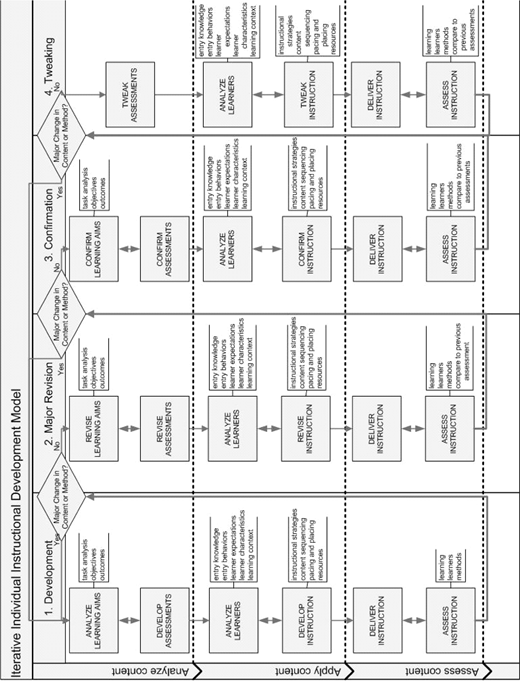
The Iterative Individual Instructional Development Model (I3DM) is meant to model the instructional development process of those who develop and present instructional units, online and face to face, that are repeated with different learners over time. The model as diagrammed in Figure 1 is built on three developmental iterations (development, major revision, and confirmation) and a fourth iteration (tweaking) that repeats as often as the fully developed instructional unit is taught. At the end of each iteration the question is asked whether there has been a “major change” in the content or teaching method. Such a change could be a result of a curriculum revision or a fundamental change in teaching methods, such as converting from a face-to-face to an online course. When the answer is “Yes,” ID returns to the beginning of the entire process for a complete redesign.
The Model in Detail
Each iteration is divided into three phases: analyze content, apply content, and assess content. Each box in the diagram represents an ID process. The open-ended boxes coming off the right of process boxes contain activities that could occur during that process. There is no implied order or hierarchy in this list of activities, which is loosely based on early activities presented in the Gerlach and Ely and the Morrison, Ross, and Kemp models.
The analyze content phase includes analyzing the learning aims of the instruction and developing the instructional assessments. Analyzing the learning aims is accomplished by performing task analyses, developing objectives, and identifying outcomes. With these identified the methods for assessing them can be addressed. These two steps are joined by a double headed arrow indicating that they are mutually dependent upon one another and occur in tandem. Specifically, assessment instruments evolve out of task analyses, objectives, and outcomes, while selecting realistic and appropriate assessment methods introduces a powerful means for keeping objectives, tasks, and outcomes within the realm of the doable. Implicit within this analysis phase is a needs assessment that continually evaluates (a) whether the needs that are revealed are addressable via the proposed instruction, and (b) the scope of the instruction as new needs surface to prevent the unit from expanding to an unreasonable size.
During the apply content phase, the instructional goals and their assessments are applied to specific target groups. The learners are analyzed during the first step in this phase by (a) identifying their expected entry knowledge and behaviors, (b) identifying their characteristics (e.g. age and cultural background) and expectations (willingness to learn and what they hope to get from the instruction), and (c) examining the learning context (e.g., the environment in which learning will take place, organizational support for the learning, learning criticality, and the time allotted for it). During the second step of this phase, the instruction is developed by (a) selecting instructional strategies (e.g., mnemonics, paraphrasing, outlining, and diagramming), (b) sequencing the content in a way that best allows the strategies to be applied (e.g., by difficulty level, familiarity, expected interest of the learners, some special property of the content, or by an imposed unifying concept), (c) fitting the pacing of content delivery to the ability of the learners, and (d) selecting the supporting resources for the learning. These two steps are joined by a double headed arrow in the diagram to indicate their reciprocal relationship: As the learners are analyzed, the instructional methods used in the classroom will change, and the instructional methods chosen will foreground different learner characteristics.
The assess content phase consists of delivering and assessing the instruction. Although many instructional models omit instruction delivery, this model sees it as a vital part of instructional assessment and hence of instructional design. The I3DM is intended to be used to develop units of learning that could occur during a time span reaching several months, during which instructional delivery is a prolonged activity punctuated throughout with assessments that give critical feedback that changes instruction as it is being delivered. Instructional methods may change because of the assessment results, causing a need to change or add assessment instruments to the course that measure the results of the altered methods.
The Iterations
The I3DM is characterized by permanent iterations that are increasingly damped. During the first three iterations of the I3DM, the same six processes are carried out, but the intensity of the scrutiny to which the instructional unit is subjected and the corresponding degree of change made decreases with each iteration. The model expresses this by changing the wording of the verb used in the processes to “revise” in the second iteration and “confirm” in the third. The major commitment in time and mental energy to produce the original instructional unit is replaced in the second iteration with a critical eye toward systematically revising the unit by rethinking the learning aims, assessments, and instructional methods based on the first delivery of the instruction to real learners. The learners still need to be assessed (as they do in all iterations), and the revised instruction is delivered and assessed. In the third iteration, practically all of the needed changes should have been made, and the instructor simply confirms that the instructional aims and methods and the assessment instruments are satisfactory. Thereafter, the three iterations and their six steps are continually repeated during the life of the instructional unit, with only minor changes in method and content expected from each iteration.
This is not to say that the unit will cease to evolve. This gradual adjustment of the unit over time is referred to in the diagram as “tweaking.” Note that there is no process in the Tweaking iteration regarding the learning aims. The model assumes that these aims have been well established and will not change unless there is a major change in the unit content. However, instructors will continue to “tweak” the assessment instruments and the instruction, and learners will continue to need analysis to help decide what “tweaking” is needed. This tweaking iteration will be repeated each time the unit is taught; thus, the unit will be revised in some manner each time it is offered.
The I3DM allows the instructional unit to be completely overhauled. The model assumes that such an overhaul will not occur in the middle of instructional delivery, but will occur after the unit has completed its current iteration. This need for an overhaul is shown in the model by the diamonds at the top between iterations asking the question, “Has there been a major change in the content or method?” Whether a change in content or method is major is a judgment call. If it is, no matter how many iterations the unit has undergone, it returns to the initial iteration to receive a comprehensive revision.
While K-12 developer/presenters may have a plan for instructional delivery of material that is spaced out over the entire year (or have a plan that is formulated for them by the state or school district), their instructional development centers on the weekly plan. During the first iteration of this instruction, teachers must develop instructional methods for their various subjects that present a week’s worth of information for all subjects. This material is delivered and assessed during the week, and occasionally over the course of 9 weeks to half a year. Course materials may be offered only once in each academic year. Thus, it may require three academic years for the same materials to be offered to students and the material to be fully developed. This has two implications. First, the I3DM model requires that developer/presenters take diligent notes about how well the instruction worked and what should be changed the next time a unit is offered. Second, at any time during those three years, curricula could change, forcing the developer/presenter to begin the ID process again with the new curricula. Since the amount of ID work required in this model is greatest during the first iteration and decreases significantly thereafter, institutions that change their curricula often subject their developer/presenters to a far heavier ID workload than those in institutions in which the curriculum remains fixed for at least 3 years.
Conclusion
The I3D model is designed specifically for modeling instructional design in formal education environments, where learning units are typically constructed by individual instructors. It is designed to be simple and flexible enough for a single educator to use while reflecting the real-world needs of the full-time teaching environment. The I3D model can guide developer/presenters in a wide variety of educational environments to develop their own instructional units. It sees ID as an iterative process that does not wait for the design process to finish before using the product, but refines the instructional unit through use as it works its way to completion. The five or six processes in each iteration are readily understood and form a simple model that adjusts the scope, aim, and effort of ID as the instructional unit matures. The refining iterations in this model indicate that developer/presenters change their focus as their courses mature. If they are using a course that is already well developed, instructors can enter the model at the second, third, or fourth iteration. The level of ID effort lowers in each successive pass through the model to match the need for further refinement. It should serve well the individual developer/presenter in all areas of education.