


Introduction
Start with the children . . . they are the present and future and serve as our guiding star for society’s purpose, value, and quality of life.
Imagine a doctor entering the operating room and not being familiar with the patient’s history, current condition, or required treatment, or a chef preparing a banquet without having the ingredients to create his world-renowned entree. Imagine an auto mechanic who doesn’t have the proper tools to get a vehicle to meet safety standards, or the baseball player without the skills to be on the team and to perform as a contributing member. These scenarios are headed for dismal outcomes because someone didn’t plan for what should happen, how to make it happen and what the implications might be if it does happen.
Now imagine these same individuals as products of an education system (one that already exists, or one you envision) that starts long before and continues long after any formal training. Imagine tools that would allow learning to occur beyond the traditional forms of instructional delivery (e.g., a doctor interacting in an online forum with surgeons around the world, an auto mechanic participating in two-way video of mechanical systems repair, or a baseball player engaging in simulations of game strategies and play techniques). At the same time, imagine these same individuals being our children, born into a learning system that is designed to be life long, a system that prepares them to be self-sufficient, selfreliant contributing citizens of a democratic society (e.g., performing as collaborative partners, creative problem solvers, effective communicators, and self-regulated learners).
Educators have a responsibility to provide our children with such opportunities to enhance their learning experiences. Furthermore, we owe our learners the freedom to explore and to perform their acquired skills with purpose for self and with value to others. In an era of ever-changing information and knowledge, this technology-driven learning system is the cornerstone for meaningful lifelong skills and high quality performance required by its citizens for the world of today and tomorrow.
Is this learning system described above limited to a specific learning environment? No; it can be found in a school/training classroom, an operating room, a repair shop, or a baseball diamond. And with the rapidly changing tools and applications of technology, similar learning environments can be accessed anytime, anywhere, through a variety of delivery systems (e.g., interactive television, Web-based instruction, two-way videoconferencing, Intraand Internets, and virtual classrooms, offices or forums).
When discussing educational technology in the twenty-first century, two terms are often used interchangeably: distance education and distributed learning. However, there is a distinction between the two. Distance education is defined in this paper as the separation in location between the learner and his/her live instructor or instruction. Distance education has been a means to provide high quality educational opportunities and experiences to the masses that otherwise may have been unreachable due to physical location constraints or barriers.
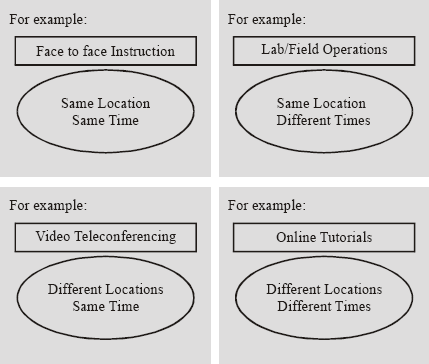
A subsystem of distance education is distributed learning. With distributed learning opportunities, learning occurs in any of four different learning environments based on time and location. The four learning environments with examples of delivery systems are (see Figure 1):
Same time/Same location (e.g., real or virtual face-to-face instruction).
Different times/Same location (e.g., computer labs, field-based operations).
Same time/Different locations (e.g., interactive television, videoconferencing).
Different times/Different locations (e.g., online tutorials, web-based instruction).
A great advantage of distributed learning is that it fosters self-regulated learning by permitting a learner greater choice to access instructional resources anytime and to have greater control of his/her learning pace.
Another advantage of distributed learning, as compared with traditional classroom-delivered instruction, is the opportunity to collaboratively learn side-by-side with others, whether they are next door or around the world, anytime and from anywhere. Distributed learning enhances the opportunity to deliver high quality education.
Distance education via multi delivery systems is providing opportunities for learners to experience, learn, and perform tasks some have only dreamed of or wished for. Imagine a preschooler using multimedia software to virtually visit animals in a zoo, or clowns in a circus. Imagine a first grader who is an emergent reader seeing familiar nursery rhymes on a computer screen in which he or she sings along with the video, audio, and text versions simultaneously as many times and for long as he or she wants. Imagine a seventh grader building a Web-based multicultural thematic unit of study with “key pals” from around the world, or a tenth grader using interactive television and videoconferencing to discuss current events with noted social scientists or related experts.
Where do we start this expanded vision of life-long distance education and distributed learning? We start with the children, believing they are the present and future and serve as our guiding star for society’s purpose, value, and quality of life. Because children enter our school systems already immersed in a world of technology, it makes sense to start with the children.
Second (and more important), if distributed learning truly improves the quality of education, then it is our moral obligation to start with the children. Third, the skills children automatically use in distributed learning facilitate our main goal, their development as self-sufficient and self-reliant citizens. Finally, learner achievement and satisfaction are positively influenced when learners are given greater control over their learning, both in pacing and accessing resources. These will be direct benefits for our children when we have created a learner-centered environment.
The information and knowledge age is giving educators, along with policy and decision makers, an exciting opportunity to redesign, if not reengineer, our current K-12 and postsecondary education systems. There is a demand from the global society, the workplace, the military, higher education, and local communities for our children to be skilled achievers and performers. In the midst of constant change in technological advances, information explosion, and rapid knowledge acquisition, educators and policy and decision makers are being charged with an important task. They must identify which critical and valued skills are required of our K-12 learners to function successfully as self-reliant, self-sufficient citizens.
In current education reform efforts, there are countless interventions that have only served to “tweak” the education system (e.g., modifying the school calendar, initiating instructional and noninstructional programs, changing reporting/grading systems, lowering class sizes, purchasing large quantities of expensive hardware and software). However, many of these attempts are mere “Band-Aid fixes,” resulting in no significant long-lasting change. We must accept that when we attempt a large-scale intervention, we are operating in a system comprised of many inter- and intrarelated subsystems. A change in one will undoubtedly affect another. So we need to reexamine the system as a whole.
In this comprehensive look at the pre-K-12 and postsecondary systems, we must challenge ourselves to think “outside the box,” away from traditional teacher-or teaching-centered large-scale interventions. We must recognize the power, influence, and effect of technology on learning processes, both processes and outcomes. We must envision a learning system where learners are self-regulated, motivated, and inspired to share information and knowledge with others, and where learner achievement and satisfaction are measurable and attainable results.
This commissioned white paper will address the first of the Governor’s Capital City Conclave on Distance Education themes, “Start With the Children.” The purpose of this white paper is to raise issues and promote discussion about learning environments that will take many “outside the box” of traditionally delivered instructional systems. It will present important factors that influence education, specifically teaching and learning. And, most important, it will address the development of life-long learners, starting with the children. Topics addressed in this white paper are:
Delivering high quality education to all children, from infancy to adulthood.
Changing the role of the teacher.
Life-long learning.
Improving educational quality.
Delivering Quality Education to all Children
What is meant by high quality education? Learning is broadening one’s mind and heart. What we learn is filtered through the senses of each individual. High quality education is built upon updated or new information and knowledge. Sustaining high quality education is the challenge every time learning opportunities occur and in today’s world they are happening at overwhelming rates. Today’s digital technology enhances communication, and distributed learning leads learners to interact with the information and knowledge, in addition to one another. These opportunities may result in our children becoming highly motivated and active learners.
Since we live in a global society, technology is a powerful means for delivering our experiences and knowledge quickly and accurately to others. Our goal as educators, parents, mentors, coaches, and employers is to provide opportunities for all learners, including ourselves, to “learn-on-demand,” not merely “just-in-case,” and to share or collaborate with others in the process.
Education is a complex system, and implementing or delivering a large-scale intervention must address the phases of a systematic design process (i.e., planning, analyzing, designing, developing, implementing, evaluating, and revising). These phases are continuously revisited (an iterative process), promoting continuous improvement and results in sustained delivery of high quality education.
Distance education expert Donald P. Ely (1990) has examined conditions that facilitate implementation or delivery of educational technology innovations. To address the implementation of a large-scale intervention and its effects on teachers and learners, the following conditions and questions should be answered:
What are the current and desired knowledge and skills of teachers, learners, and support staff required for achieving the goals of Dakota Digital Network (DDN)?
What resources (e.g., hardware, software, ‘warmware’ [human resources]) are available to teachers, learners, and support staff to make the implementation [role change] successful?
How will time and support be made available to teachers, learners, and support staff to acquire knowledge and skills, to plan for use, to explore/discover/practice, to integrate, and to reflect upon/evaluate what they are doing?
What rewards and incentives exist to satisfy the teachers, learners, and support staff who innovate?
How will teachers, learners, and support staff be empowered to participate (e.g., shared decision making either directly or through a surrogate)?
Will there be firm and visible evidence that there is endorsement and continuing support (i.e., commitment of stakeholders) for implementation of the innovation?
Will there be executive leadership (e.g., superintendents, school boards) and project leadership (e.g., district, school, and instructional staff) for the innovation being implemented?
Comparisons of Teaching and Learning Paradigms
| Teaching Paradigm | Learning Paradigm |
|---|---|
| Faculty focus | Student focus |
| Faculty as teacher | Faculty as synthesizer, navigator, and coordinator of learning |
| Talking head/sage on stage | Multiple instructional delivery systems |
| Faculty as conveyor of information | Information from many sources (e.g., Internet, electronic libraries and databases) |
| Input orientation (e.g., resources, and institutional effectiveness and efficiency) | Output orientation (e.g., learning library, classrooms, and faculty) |
| Classroom/site-based | Not limited to classroom/site-based |
| Group/class delivery | Individualized delivery and collaborative learning with group communications |
| Massive infrastructure | Distributed infrastructure |
| Campusor school-based learning | Ready learning (e.g., anytime, anywhere) |
| Rigidity | Flexibility |
| Mostly a continuation of the past | Innovation/creativity, uncharted areas |
| Transactional approaches/fixes | Transformational approaches and processes |
Only when all these conditions and questions are addressed will opportunity exist to successfully deliver high quality education.
Changing the Role of the Teacher
In order to (in the words of futurist Alvin Toffler) learn, unlearn, and relearn, a learner must be self-regulated and self-motivated. The learner, not the teacher, must be the center of the new twenty-first century learning environment (live or virtual).
In order to achieve a learner-centered environment, teachers must change roles. How do they do that? To change a role is to first change a mindset. In order to change their mindsets, teachers must view the DDN initiative (and all other interventions) not as a technological innovation, but rather as an educational innovation. They should view technology tools as vehicles for delivering education, not viceversa. They must share a compelling vision to change from the status quo to a more desirable state. Not only must they share the vision, they must buy-in, enough to motivate, inspire, maintain, and sustain themselves and others to accomplishment. They must want to be entwined in an educational environment that is shifting from providing instruction to producing learning.
The constant change in technological advances, information explosion, and rapid knowledge acquisition is demanding a learning/learner-centered environment. No longer can teachers function as the sole source of knowledge. They must adopt the teaching/ learning paradigm shift and embrace the use of technology to enhance the learning processes. Organizational change management/leadership expert Dale W. Lick offers an explicit comparison of the teaching (old) and learning (new) paradigms (see Table 1).
Strategic planning experts list one of many critical success factors for reaching desired results as the ability to differentiate between ends and means (distinguish between what and how). Kaufman, Herman, and Watters (1996) describe ends as results, consequences, accomplishments, and payoffs (e.g., self-reliant, selfsufficient citizen). Means are the ways to deliver ends (e.g., teaching, learning). Learning is a means to an end and the process for leading a learner to that end, improving the quality of life for both the learner and for those with whom he or she interacts.
Technology, by definition, is the set of processes used to solve issues or problems. Education is also a process and one means to reach the vision. Both technology and education are means, not ends in this change effort. The end will be the attainment of desired results/expectations, the learners becoming self-sufficient, self-reliant contributing members of society.
Leading and noted experts in education reform, including Branson (1998), write that our education and training leaders are shifting their learning paradigm from teaching-centered to learning-centered. Teachers in today’s schools are no longer the sole source of knowledge. Teachers are becoming learners sitting side-by-side with their students, driven by the constant flow of new information and knowledge. Teachers are recognizing the shift from learning competitively to learning cooperatively, an attitude that says “we are all in this together.” Therefore, in education today, results, achievements and performances are being attained more through collaborative effort, in addition to individual effort.
Learner support must be embedded in this learner-centered approach. Distance education expert Michael Moore (1998) has suggested that “all distance learners want and deserve” the following:
Instructional content that they feel is relevant to their needs.
Clear directions for what they should do at every stage of learning.
As much control of the pace of learning as possible.
A means of drawing attention to individual concerns.
A way of testing their progress and getting feedback.
Materials that are useful, active, and interesting.
To this list I would add two more points: (1) access to information and knowledge, and (2) the opportunity to construct, individually and with others, new information and knowledge. A key component to distance education is the interactivity that is afforded. The Internet and Intranets allow learners to create online knowledge-sharing communities anywhere, any time, and any way.
Life-Long Learning
Life-long learning is learning that is self-initiated on demand by a learner throughout his or her lifetime. The state of Florida designed a technology-driven large-scale education reform initiative in the early 1990s around the concept of life-long learning Florida School Year 2000 was a comprehensive effort to increase the productivity of public school students in Florida through developing, testing, and implementing a technology-supported system of schooling. In 1989, the Florida Department of Education asked the Center for Performance Technology to direct this multiyear initiative. For more information, see http://cpt.fsu.edu/sy2000/SY2000.html. The following performances were the outcomes expected of all students in the state of Florida. These accomplished performances are of a life-long learner (e.g., as a child, student, employee, parent, neighbor, and citizen) and of a teacher/mentor/coach to others.
Self manager
Capable worker
Adaptable problem solver
Innovative producer
Effective communicator
Active facilitator
Responsible collaborator
Since this list was created, significant insights and advances have been made in distributed learning and distance education. Today the list should be lengthened to include self-regulated learner, multiculturally sensitive worker, and systems manager. Whether our children are engaged face-to-face in learning environments, or from a distance, we should expect them to achieve each of these life-long skills and performances so they may become productive and contributing members of their families, neighborhoods, schools, and communities, both near and far.
Improving Educational Quality
Digital technology surrounds us and so does the demand to improve the effectiveness and efficiency of our daily living, our world of work, and services we expect as consumers. With this demand arrives the opportunity to provide our learners and workers the required information, knowledge, tools, and applications to be functional citizens. Ten years ago, who would have imagined we would be using banking services via ATMs, checking out items at self-scanning devices in supermarkets, or using library card catalog “search and find” databases? Not to mention pumping gas with debit card options, making airline reservations online, or locating missing persons or finding weather conditions around the country or world online.
We know there are many ways to use digital technology. It has helped us do our work more effectively and efficiently. It has given us access to functions and services we formerly relied on others to provide. Digital technology provides all of these improvements in learning:
Productivity tools (e.g., word processor, spreadsheets, computer-assisted design).
Access to the latest information and knowledge databases (e.g., Web, Internet, Intranet).
Enhanced communication in terms of time and location (e.g., anytime, anywhere).
Distributed learning is as successful as the effectiveness and efficiency that digital technology offers and provides learners. Training and educating are no longer confined to a bricks and mortar environment. We have the opportunity for distributed learning to reach all learners, anytime, anywhere. The decision is not whether we should use distributed learning; the question is how and for what purpose we should be using it.
In order to know whether we are succeeding, we must take the time and effort to measure and evaluate these large-scale interventions (e.g., cost-benefit or return on investment). When measuring the effectiveness and efficiency of digital technology tools and applications, consider improvements on other indicators of student performance besides student academic gains (e.g., student attendance records, graduation rates, documented student involvement and participation, or attitudinal changes in learner satisfaction and confidence). Keep in mind the important need for measurable criteria, which must be aligned with desired results/expectations.
Assumption and Issues for Discussion
Assumption: Life-long learning performance outcomes are expectations of all learners, from infancy to adulthood.
Discussion: How can the application of digital technology tools enhance the development of these achievements and performances?
Assumption: We believe distributed learning opportunities foster learner/ learning-centered environments.
Discussion: How does a distributed learning model in itself foster a learner/ learning-centered environment?
Assumption: We need to shift from a curriculum-driven/teacher-centered approach to a performance-driven/ learner-centered approach to learning while incorporating effective and efficient uses of technology tools and applications.
Discussion: How do we assess, measure, and evaluate the outcomes of a paradigm shift to know if it has succeeded in terms of learner achievement and satisfaction?
Assumption: A systems approach is critical to the design and development of a large-scale intervention.
Discussion: Referring to the conditions for successful implementation of technology innovations, how do we strategically plan, measure, and assess design, development, implementation, and evaluation processes/phases of this largescale intervention to ensure success?
Conclusion
Once children experience a distributed learning environment, they have the opportunity to become life-long learners, anytime and anywhere. With experience, they will become the advocates and change agents for others to follow. We would be remiss not to give them the opportunity, but more importantly, we would remiss if we did not plan, design, develop, and evaluate whether they achieved anticipated results or accomplishments. We have a responsibility to create the environment, one that will make a difference in their lives and the lives of others who follow their lead.
We live in an exciting information and knowledge age, filled with technological opportunities and challenges. It is as much a journey (process) as a destination (end). Where we are headed should be clear and shared among all willing to enjoy the destination. If children are truly our present and our future, then our vision should be what we want for tomorrow’s children. We must start with the children, as their survival is the reason we educate. We must embrace an educational system that delivers life-long skills to improve the quality of our children’s lives. We must recognize the power of technology for reaching out to and connecting all learners as collaborative partners in a global society.
How we get there will be our traveling mission, filled with risk-taking adventures and opportunities. As with any change, there will be some who choose not to go; they will be left behind. There will be some who choose to go by plane, boat, car, or foot; they will eventually arrive. There will be some who choose to be the first to go, and others who will take their place in line and wait to see what happens to those before them.
I believe it will be those who engage their hearts and minds in this conclave and who will pave the way for others to follow. You are the leaders creating and leading the change. Just remember your guiding star—the children.

