


This study examines the degree to which doctoral learners at a distance education university feel connected to other learners, faculty, their school, and the university. Using a pictorial measure of 2 circles with various degrees of overlap, the participants in this study (N = 395) saw themselves as more connected to people than to institutions. Most learners were at least minimally connected to other learners (68%) and to faculty (64%). More than 40% of the learners felt no connection to their school or university. Suggestions for fostering connectedness are included.
Introduction
Community is part of the discourse on higher education (McNay, 2005). The online learning literature reflects a strong interest in the process of creating community (Barab, MaKinster, & Scheckler, 2004; Brown, 2001; Swan, 2002; Swan, Shea, Fredericksen, Picket, & Pelz, 2000). Core features of academic communities include learning and connectedness (Beattie, 2002; Rovai, 2002). Yet for many, university life is fragmented, disconnected, and isolated (Bibeau, 2001; McNay, 2005). While multiple studies have investigated factors associated with learning communities (Garrison, Anderson, & Archer, 2000; Gunawardena & Zittle, 1997; McDonald, 2002; Picciano, 2002; Tu & Corry, 2002; Tu & McIsaac, 2002), few have studied the process of community building through the voices and perspectives of the learners themselves (Black, Dawson, & Priem, 2008; Haythornthwaite, Kazmer, & Robins, 2000; Moisey, Neu, & Cleveland-Innes, 2008; Vrasidas & McIsaac, 1999). The present study continues that work by investigating the perceived connectedness of doctoral learners at a midwestern distance education university to other learners, faculty, their school, and the university itself.
Communities and Connectedness
Academic Learning Communities
One of the hallmarks of a graduate academic community appears to be how connected the individual feels to the community, or to elements of the community (Beattie, 2002; Rovai, 2002; Thurston, 2005). This is easy to observe at a landed university where colors are worn and sports are played. However, in the distance education environment, learners have little tangible connection with the physical university. School spirit, cohesion, and interdependence are aspects of connectedness that must be conveyed through technology (Rovai, 2003). Paradoxically, while technology can solve the problem of geographic isolation, it can create issues with social isolation (Bibeau, 2001). Creating an academic learning community is considered a fundamental strategy to combat isolation (Bibeau, 2001; Haythornthwaite, Kazmer, Robins, & Shoemaker, 2000), help learners develop online identities (Cousin & Deepwell, 2005), and to support knowledge construction (Moisey et al., 2008) and meaningful learning (Garrison et al., 2000).
Connectedness
Connectedness is one of the characteristics of learning communities (Beattie, 2002; Rovai, 2002). Connectedness is related to an individual's opinion of him- or her-self in relation to other people (Lee & Robbins, 1995). Sensitivity to others is an indicator of connectedness (Aron, Aron, Tudor, & Nelson, 1991; Van Assen & Bekker, 2009), as are cohesion, spirit, trust, interdependence (Rovai, 2002,2003) and altruism (Cialdani, Brown, Lewis, Luce, & Neuberg, 1997). Interconnected activities are characteristic of close, communal relationships (Aron, Aron, & Smollan, 1992). Connectedness has also been associated with wellbeing among international students (Rosenthal, Russell, & Thomson, 2007).
Connectedness facilitates higher achievement (Rovai, 2003), improves academic self-esteem (Karcher, 2009), increases learning transfer (Sontage, 2009), and increases course and program satisfaction (Moisey et al., 2008). On the other hand, disconnectedness may lead to difficulty with the course, failing grades, non-completion, or withdrawal (Waltonen-Moore, Stuart, Newton, Oswald, & Varonis, 2006).
Lee and Robbins (1995) and Rovai (2002) developed text-based instruments that measure connectedness. The Social Connectedness Scale assesses the emotional distance between an individual and other people, both friends and society (Lee & Robbins, 1995). The Classroom Community Scale focuses on interaction among community members; learners' feelings of connectedness, cohesion, spirit, trust, and interdependence; and the degree to which learners believe their educational goals are being met (Rovai, 2002).
Aron et al. (1992) developed a pictorial measure of connectedness that creates an interval-level scale to evoke an individual's sense of being interconnected. The Inclusion of Other in the Self (IOS) Scale was originally used to measure closeness in romantic and friendship relationships (Aron et al., 1991). Respondents select the depiction of two circles with various degrees of overlap that best describes the connectedness of their relationship. In a close relationship, there may be a sense of general union of self and other (Aron et al., 1992). As in the example of school spirit in which colors are worn at a sporting event, fans display an interconnectedness with one another and with their team. Because the IOS Scale is intended to capture the perception of relationships, it has been adapted in this study to explore the perceived relationship between learners and their interconnectedness with aspects of their academic learning community.
Method and Procedure
Sample
A sample of 1,000 doctoral students in the schools of education and psychology at a Midwestern distance education university was randomly selected by the Office of Institutional Research. Of those, 10 were eliminated because they were in a class where the researcher was the faculty or had the researcher as a committee member or advisor. For the 990 remaining students in the sample, 18 surveys were undeliverable, leaving a sample of 972. A total of 395 responses yielded a 41% response rate.
The sample ranged in age from 27 to 72, with a mean age of 48 and a standard deviation of 5.66. While 15 had been in graduate school less than a year, the mean time spent at the university was 2.5 years (SD = 1.75). Female respondents comprised 69% of the sample; males comprised 31%.
Instrumentation
The research instrument was adapted from the Inclusion of Self in Other (IOS) questionnaire developed by Aron et al. (1992) to address perceived connectedness to four aspects of a university: other learners, the faculty, the school, and the university.
Research Question
This study was designed to explore four questions. In terms of connectedness: (a) what is your relationship with other learners? (b) what is your relationship with the faculty in your classes? (c) what is your relationship with your school? and (d) what is your relationship with the university?
Procedure
Approval for the study was obtained from the Office for Institutional Research and the University IRB. The IOS questionnaire was delivered online through SurveyMonkey. Two requests for participation were sent by an e-mail that included the link to the IOS questionnaire. The SurveyMonkey site collected the responses and eliminated the e-mail addresses from the response set. The second e-mail to nonrespondents was sent 10 days after the initial request. In addition to choosing the pictorial representation of perceived connectedness, respondents had the opportunity to comment on each question. The qualitative data was analyzed thematically.
Results
Connectedness to Other Learners
Question one requested the perception of the relationship with other learners, in terms of connectedness. Eight percent did not respond to the question. The responses were clustered around the middle of the range, but there is wide variability in the scale (see Figure 1). The distribution of responses shows that 68% indicated some degree of connectedness, as shown by circles that overlap to some extent. Thus, most learners were at least minimally connected to other learners.
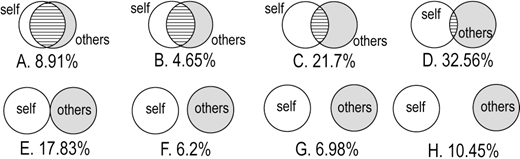
Compared to connectedness to faculty, school, and university, the results for connectedness to other learners represent the greatest extremes. Nine percent of the learners felt the greatest degree of connectedness to other learners, while 10% felt the greatest degree of distance.
For the comments related to question one, the primary theme was that there was no relationship developed with others outside of class. The following quotes exemplify what was said:
“While in contact with other learners, there is no relationship beyond a professional association and academic discussion.”
“I have never been close to any class mates. There is not time to develop any type of comradery [sic].”
Connectedness to Faculty
Question two requested the perception of the relationship with the faculty in your classes, in terms of connectedness. Nine percent of the respondents did not reply to this question. Although the scores clustered in the middle of the range, there is wide variability (see Figure 2). Most learners were at least minimally connected to faculty, with 64% depicting some degree of connectedness.
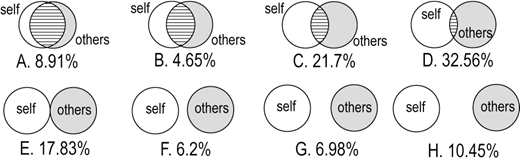
Only 5% of the learners depicted the greatest possible degree of connectedness in their relationship with faculty. Yet, only 6% depicted the greatest possible degree of separation, meaning that relatively few relationships with faculty were at the extreme ends of the range.
For the second question, the theme from the comments was the presence of the faculty in the classroom:
“Slight interaction with faculty, basically good relations but definitely distant.
“There have been some faculty that have been very personalable, [sic] but not many. Not many offer feedback on your assignments or suggestions for improvement.”
Connectedness to the School
Question three was, “What is your relationship with your school?” This was intended to refer to the school within the university. Fourteen percent of the respondents did not reply to this question. As with the first two questions, the scores clustered around the middle of the range; 59% indicated some degree of connectedness (see Figure 3). Most of the learners see themselves as having at least a minimal connection to the school.
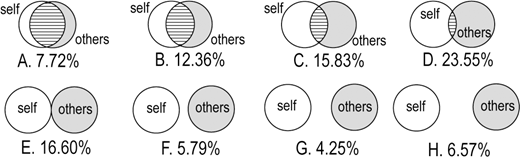
The degree of connectedness to one's school was less than the perceived connectedness to other learners or to faculty. As with questions two and three, the highest percentage of responses (23.55%) depicted the circles with only a small area of overlap, indicating a small degree of perceived interdependence.
Comments for question three were related to the staff and their role with the students:
“I don't have any contact with faculty outside of course room work. Once in a while I am in contact with my adviser only if there is a problem.”
“Rely greatly on the Learner Support team, advisor, enrollment advisor, etc.”
Connectedness to the University
Question four asked the students to measure their relationship with the university. Fourteen percent of the sample did not respond. The percentage of respondents who indicated some degree of connectedness was 58%, slightly less than question three (see Figure 4). Again, most of the learners saw themselves as at least minimally connected to the university.
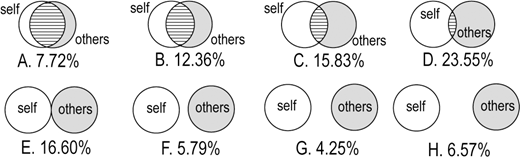
As with the previous questions, the highest percentage of responses (23.23%) depicted the circles that indicate only a small degree of perceived interdependence.
The comments related to connection to the university focused on self:
“I pay for my classes and get a grade!”
“I really feel [the university] does care about my successful completion of my program.”
“Because of my advisor, it has been very good.”
“Thanks only to my advisor.”
Chi Square Analysis
When examining the greatest possible degree of connectedness (category A) to other learners, faculty, school, and university, respondents had the closest relationships to other learners (8.9%), followed by school (7.7%), university (7.1%), and faculty (4.6%). In terms of the greatest possible degree of separation (category H), respondents indicated other learners (10.5%), school (6.6%), faculty (5.8%), and university (4.7%).
Crosstabs and Pearson chi square tests (using SPSS version 16) were run for all questions to determine the difference in the distribution of responses. None of the chi square tests was significant. Thus, there was no difference among the four questions in the distribution of responses. Overall, the learners see themselves in at least a minimally connected relationship to the aspects of the university measured.
Discussion
The sample of graduate students in a distance education university saw themselves as more connected to people than to institutions. Learners and faculty scored higher on the connectedness scale than school and university. This supports Lee and Robbins' (1995) definition of social connectedness as being related to one's opinion of oneself in relation to other people. The results contradict Beattie's (2002) finding that students who are in a connected relationship with instructors are committed to the larger community. The results also run counter to Freiberg and Lamb (2009), who hold that personal connections with instructors can promote school connectedness.
At the distance education university under study, faculty standards require responding to each learner substantially at least once a week, among other expectations for faculty-learner interaction. What may be lacking is immediacy, one aspect of social presence that enhances perceptions of closeness to others (Pelowski, Frissell, Cabral, & Yu, 2005; Swan, 2002). In addition, although the course room appears to be the center of activity, limited time with faculty and other learners may be one of the barriers to developing a connection.
More than 40% of the learners felt no connection to their school or university. This has ramifications for retention of current learners and referrals of prospective students. Of interest was the focus on staff support as representing the university to the learner. For these learners the consistent presence of support people was important. This includes technical support as well as academic support services. Providing the nearly 24-7 support for online learners is a feature of the university that is noted as being critical to the success of the learners. Providing, as well as marketing, these types of services can be perceived as a retention tool.
Conclusion
If learners in distance education universities are to benefit from a sense of connectedness to other learners, faculty, the school, and the university, every aspect of the university needs to support activities that foster cohesion, spirit, trust, and interdependence (Rovai, 2003). To foster connectedness to other learners, Bibeau (2001) recommends encouraging them to work together. To foster connectedness to faculty, Swan (2002) recommends providing immediate feedback. Weiss (2000) recommends using expressive language, having instructors share their biographies, and modeling appropriate interaction. Establishing a relationship mentor/advisor early in the graduate program may also be an area to investigate, as this relationship would establish a continuing connection to the school and university. Another strategy to foster connectedness to the school and university are programs that give learners more of a sense of identity, connection to the institution, and appreciation for the breadth of the university. In that way, a robust academic community would be nurtured and would enrich the experience of learners in distance education universities.

