


Web 2.0 technologies have potential for teaching and learning, but show a slow rate of adoption in education. The purpose of this study was to examine the factors that contribute to high school teachers' intention to use Web 2.0 technologies for classroom instruction. Research questions examined were (a) To what extent are high school teachers using Web 2.0 technologies for classroom instruction? (b) What opinions do high school teachers have regarding Web 2.0 technologies for classroom instruction? (c) Which factors best predict the decision of high school teachers to adopt or not Web 2.0 technologies for classroom instruction? The decomposed theory of planned behavior was used as theoretical framework.
A survey design was employed adapting Ajjan and Hartshorne's (2008) questionnaire. Participants were high school teachers from a specific school region of Miami-Dade County Public Schools. Data from 137 participants were analyzed using descriptive and multiple regression methods. Findings showed that teachers do not use these technologies: blogs 51.1%, wikis 36.5%, social networking 53.3%, social bookmarking 59.9%, and audio/video conferencing 41.6%. Many did not plan to use them at all.
Regarding predictors of teachers' behavioral intention to use Web 2.0 technologies: attitude, subjective norm, and perceived behavioral control were significant predictors, with attitude the strongest (ß = .634); of the decomposed factors, perceived usefulness and compatibility were significant predictors. Teacher comments suggested that lack of equipment, lack of training, lack of funding, security issues, and firewalls were possible obstacles affecting perceived usefulness and compatibility.
Introduction
The evolution of Web 2.0 and social software are altering the way students communicate, collaborate, access, learn, and seek new information (Campbell, Wang, Hsu, Duffy, & Wolf, 2010; Drexler, Baralt, & Dawson, 2008; Greenhow, Robelia, & Hughes, 2009). Researchers (e.g., Bernsteiner, Ostermann, & Staudinger, 2008; Crook, Cummings, et al., 2008; Drexler et al., 2008; McLoughlin & Lee, 2010) have supported the collaborative affordances of Web 2.0 technologies for classroom learning. These technologies have continued to evolve rapidly, and unless researchers study their impact on learning, educators may not harness their benefits for diverse learners and utilize them successfully (Valentine & Bernhisel, 2008). Furthermore, these technologies have possible implications for educational transformation, yet educational establishments are showing resistance to the assimilation of these technologies in the classroom (Conole, 2010; Drexler et al., 2008; Greenhow et al., 2009; Norton & Hathaway, 2008).
Research is needed regarding the tensions school institutions and schoolteachers are experiencing, as well as the affordances of Web 2.0 technologies for learning in order to help leadership, teachers, and students learn to use them beneficially. Though administrators see potential in these Web 2.0 tools, they have concerns regarding the existence and implementation of adequate policies to monitor and support teachers adopting Web 2.0 for classroom learning (Lemke et al., 2009). Hence, it is important to understand what may be affecting teachers' acceptance and adoption of Web 2.0 technologies so that leadership can “predict, explain, and increase user acceptance” (Davis, Bagozzi, &Warshaw, 1989, p. 982).
The purpose of this study was to examine the factors that contribute to teachers' intention to use Web 2.0 technologies for classroom instruction. Teachers have diverse beliefs regarding technology integration in the classroom (Timucin, 2009), and intention is an important construct in determining whether a person will exhibit a particular behavior (Taylor & Todd, 1995). Therefore, the study was framed within the decomposed theory of planned behavior that is “designed to explain teachers' use of instructional technology by exploring many of the social, institutional, and personal factors that influence the extent to which the technology will be used” (Shiue, 2007, p. 429). Additionally, the theory “provides a fuller understanding of usage behavior and intention and may provide more effective guidance to IT managers and researchers interested in the study of system implementation” (Taylor & Todd, 1995, p. 170).
The study examined the following research questions:
To what extent are high school teachers using Web 2.0 technologies for classroom instruction?
What opinions do high school teachers have regarding Web 2.0 technologies for classroom instruction?
Which factors best predict the decision of high school teachers to adopt or not to Web 2.0 technologies for classroom instruction?
The term Web 2.0 technologies was used in this study according to Fisher and Baird's (2006) adapted definitions from Wikipedia and Wiktionary of Web 2.0 and social software:
Web 2.0 generally refers to a second generation of services available on the web that lets people collaborate and share information online” and “social software enables people to connect or collaborate through computermediated communication (wiki, weblog, podcasts) and form online communities. (p. 28).
Technologies considered for the study were blogs, wikis, social networking, and social bookmarking.
Participants of the study were high school teachers from five schools in the southernmost region of a large urban county in Florida. A cross-sectional survey research design was employed and data were collected via the Web 2.0 for Learning in the High School Classroom Questionnaire (WLHSC) adapted from Ajjan and Hartshorne's (2008) questionnaire. Data from 137 participants were analyzed using descriptive and multiple regression methods. Two multiple regression analysis were conducted with teacher's behavioral intention as the criterion variable. Predictor variables used for the first multiple regression analysis were attitude, subjective norms, and perceived behavioral control according to the theory of planned behavior (Taylor & Todd, 1995). These three main factors were then decomposed further and a second multiple regression analysis was performed for the subfactors.
It was expected that the findings of this study would be useful for high school administrators to analyze the present opinions and attitudes of teachers regarding the use of Web 2.0 technologies for classroom learning. Therefore, these findings my help administrators plan research-based change grounded in valid theory. Additionally, according to Simonson (2008), research related to the use of Web 2.0 is imperative for distance education. Though this study focused on high school face-to-face teachers, distance learning is growing rapidly in the secondary school population (Ahn, 2011; Barbour & Reeves, 2009); therefore, research` involving high school teachers and Web 2.0 technologies may help to expand the knowledge base for both face-to-face and distance education for this population.
Literature Review
The following literature review presents research related to the educational use of Web 2.0 technologies and to teachers' concerns and beliefs of the use of such technologies. Additionally, the decomposed theory of planned behavior and the factors that may affect teachers' intention to use Web 2.0 technologies as innovations for instruction are discussed.
Educational Use of Web 2.0 Technologies
Clark et al. (2009) conducted a study with 11-16 year old students to determine what technologies they were using, whether they were using them in school, and whether they were using them to support learning. The findings showed the students were using Web 2.0 technologies to support learning but not in a sophisticated manner. Out of 51 students, 45% reported using Web 2.0 technologies for schoolwork, 49% reported using these technologies in school during lessons, 49% used these technologies in school during their free time, and 100% used Web 2.0 technologies outside of school. There were a total of 30 different Web 2.0 sites identified by the students that included social networking sites. The most popular sites were MSN (88%), Bebo (67%), and Facebook (59%). Students in school used each of these 30 sites, although Bebo was not used for learning. The students were asked to generate a mind-map of their technology usage and to include how they used these technologies. Additionally, the students were asked to draw on an overlay map and indicate which technologies they can, cannot, and cannot but do use. The mapping activity showed that students were “proactive in finding ways to circumvent the rules” (p. 64). Additionally, this study found the use of Web 2.0 technologies in schools is still poorly understood by both teachers and students. Students did not appear to be using these technologies for in-depth learning and only a few students mapped the technologies for use as creative activities.
Grant (2009) conducted a case study on classroom use of wikis during a 3-week period and studied the collaboration of six students participating in three different wiki groups. Grant found that only one student tried to edit another student's work, and this was met with complaints from the other members. Students did enjoy publishing their work, but collaborative work was not witnessed by the researcher. Grant stated that this was a small, short study of a school that had never used a wiki before.
Grant's (2009) work supports the findings of a study by Lund and Smordal (2006) carried out in a Norwegian upper secondary school. This project included four researchers and studied several teachers in several classes using longitudinal interventions. The students were of an average age of 17, and a total of 31 students were studied during wiki projects in two classes. This study also showed that students needed guidance from the teacher in order to actively edit any other student's content and even when encouraged, the edits were usually spelling corrections.
Guth (2007) compared the interactions of 28 students with two different types of wikis. These students were participating in a blended advanced-English-language course at the university level. Students participated in two 10week courses, one using a semiprivate wiki (two different universities) and another using a public wiki hosted by the University of Geneva. Students also communicated informally through the video conferencing tool, Skype. Guth found through personal blog posts, transcripts, interviews, and other qualitative methods that students also needed intervention from the teacher and felt uncomfortable editing other students' work even though collaboration increased in the public wiki. Additionally, the students were more careful about their work on the public wiki. Guth stressed limitations to this qualitative study due to differences in the courses compared and the different time length of the two courses. More research seems needed on the use of public versus semipublic wikis for classroom use.
An important construct in the decomposed theory of planned behavior is the individual's attitude towards the innovation (Taylor & Todd, 1995). Attitude can be further decomposed into perceived usefulness, perceived ease of use, and compatibility. Following is a discussion of research literature addressing these attitudinal constructs with regards to present-day concerns and beliefs by teachers of the use of Web 2.0 technologies for classroom instruction.
Secondary school teachers surveyed by Crook, Fisher, et al. (2008) reported that though 75.2% of teachers use wikis, only 32% had used them in their classroom. Grant (2009) stated that most studies of wiki use come from the area of higher education. In the National School Boards Association (2007) report researchers asked teachers to rate social networking sites and found that teachers were unsure of the value of social networking sites for education. Additionally, the U.S. report by Gray, Thomas, and Lewis (2010) found that 22% of teachers reported rarely using blogs, while 16% reported that they used blogs sometimes or often for their classroom instruction, preparation, or administrative tasks. Likewise, 14% reported that they rarely used social networking websites for the previously mentioned purposes, while only 8% reported that they sometimes or often used them for these tasks.
On the other hand, researchers find favorable potential in Web 2.0 technologies for easing classroom technology integration due to their free availability and low cost (Buffington, 2008; Gooding, 2008; Holcomb & Beal, 2010). According to Gooding, teachers are finding these technologies easy to use but their understanding and appreciation are still evolving. Conversely, a survey of 206 online teachers' conducted by Crook, Fisher, et al. (2008) found that though 53.9% state that Web 2.0 technology could be useful, 37.4% thought they would be time consuming to adopt. Additionally, when these teachers were asked to determine if these technologies would be hard to manage in the classroom, 18.7% answered “frequently,” and 47% answered “occasionally.”
Teachers' Concerns and Beliefs of the Use of Web 2.0 Technologies
A study by Conole (2010) offers insights and into what teachers may find helpful in aiding them to adopt certain Web 2.0 technologies. Conole devised an Open University social-networking site called Cloud Works to address the lack of adoption of Web 2.0 technology by teachers. The objective of Cloud Works was to help develop teachers' skills and share best practices and information. In analyzing teachers' interactions and comments from Cloud Works, Conole concluded the following: teachers expressed a need for time to evaluate and adapt these technologies, a need for communities of practice, concern regarding social networking tool combinations sometimes appeared confusing to use, and the possibility of inappropriateness of many social networking tools that were not developed for socialization not educational purposes.
Crook, Fisher, et al. (2008) found that 46% of teachers believed students should have the option of working with wikis, and 32% have already used wikis for classroom lessons. Crook, Fisher, et al. discussed possible problems with teacher involvement by expressing “examples of teachers editing wikis for work purposes are comparatively few” (p. 23). Crook, Fisher, et al. found that 81.9% of the teachers surveyed favored more student collaboration, and 65.2% thought that Web 2.0 technologies could foster collaboration amongst students. However, 41.2% had never used Web 2.0 technologies for classroom collaborative student projects.
Grant (2009) studied three United Kingdom ongoing class wiki projects at the secondaryschool level, and based on student interviews and qualitative observation he did not find students collaborating as desired. Grant noted that teachers expressed a desire to have students work independently and this lack of encouragement may have caused students to collaborate less. He also noted through comments that some students were wary of assessments as evidenced by a student quotes: “There should be locks on it. Because they could write rubbish stuff and then you'd get told off for it (Mary)” (p. 111). Grant goes as far as to suggest that the teachers' attitudes on collaboration may need to be analyzed further and that the pedagogical debate of collaboration versus traditional teaching pedagogy may be the true debate being brought to the table by the Web 2.0 technologies.
A repeated theme of researchers that support Web 2.0 technologies for learning is their desire for collaboration amongst students. Bose (2010) discussed the importance of Web 2.0 technologies because they support collaboration. Sawmiller (2010) stated that “online tools such as blogs support collaboration among students and teachers” (p. 46). The broad survey and interview research report by Crook, Fisher, et al. (2008) of United Kingdom secondary students, teachers, key staff, and managers discussed earlier looks at a broad range of issues and possibilities of uses of Web 2.0 technologies for classroom learning. Crook, Fisher, et al. investigated whether teachers desired collaboration. They interviewed 100 teachers in 27 schools throughout the United Kingdom and found that “not all teachers interviewed saw collaboration as desirable, and some mention was made of the influence of the assessment system, which emphasizes individual attainment, and translates in some cases into anxieties about plagiarism and guidance to avoid collaboration” (p. 37). According to an online survey administered by Crook, Fisher, et al., 206 teachers, managers, and staff found that 81.9% of the teachers felt their students did not have the required experience for successful collaboration.
Decomposed Theory of Planned Behavior
The decomposed theory of planned behavior was used as the theoretical framework for this study. Figure 1 shows the decomposition of the three determinants of teacher's intention to use a Web 2.0 technology according to the decomposed theory of planned behavior. The use of the technology is determined by intention that, in turn, is determined by three factors: attitude, subjective norms, and perceived behavioral control (Taylor & Todd, 1995). Each factor is further decomposed according to the decomposed theory of planned behavior.
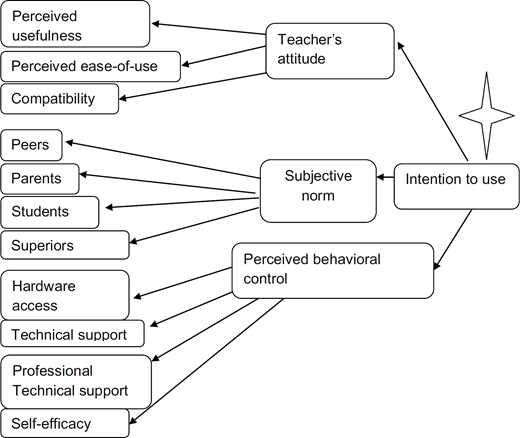
The Decomposition of the Three Determinants of Teacher's Intention to Use a Web 2.0 Technology. Intention of teachers to use a Web 2.0 technology is determined by three constructs. The flow chart depicts the individual decomposition of each of the three constructs into factors that in turn may affect teacher's intention to use the Web 2.0 technology.
The Decomposition of the Three Determinants of Teacher's Intention to Use a Web 2.0 Technology. Intention of teachers to use a Web 2.0 technology is determined by three constructs. The flow chart depicts the individual decomposition of each of the three constructs into factors that in turn may affect teacher's intention to use the Web 2.0 technology.
Subjective norm “refers to the perceived social pressure to perform or not to perform the behavior” (Ajzen, 1991, p. 188). Perceived behavioral control refers to how easy or difficult it is to accomplish a task as viewed by an individual. Included in the individual's perception is his or her view of the resources available for the task and his or her own self-confidence in carrying out the task (Ajjan & Hartshorne, 2008).
One of the three factors determining intention to adopt is attitude (Taylor & Todd, 1995). Ajjan and Hartshorne (2008) decomposed the factors that affect teacher attitude to adopt an innovation into perceived usefulness, perceived ease-of-use, and compatibility. Perceived usefulness is the individual's perception of how well this innovation will help them perform their job (Davis, 1989). Perceived ease-of-use is “the degree to which a person believes that using a particular system would be free of effort” (p. 320). Compatibility is “the degree to which an innovation is perceived as being consistent with the existing values, past experiences, and needs of potential adopters” (Rogers, 2003, p. 15).
A second factor that determines intention is subjective norm (Taylor & Todd, 1995). Ajjan and Hartshorne (2008) considered three subjective norm groups that affect an individual's intention to adopt a technology: student influence, peer influence, and superior influence. According to Baeck (2010), “parents increased engagement in school influences the power balance in the social field of the school” (p. 324). Therefore, parents can act as a subjective norm group though the authority belongs to the administration so they are a peer influence.
A third factor that affects intention to adopt Web 2.0 technologies for classroom use is perceived behavioral control (Taylor & Todd, 1995). Perceived behavioral control is influenced by self-efficacy and facilitated conditions (Ajjan & Hartshorne, 2008). According to Bandura (1997), self-efficacy deals with the comfort level of an individual when using technology. Ajjan and Hartshorne (2008) define facilitating conditions as “the availability of resources such as time, money, and other resources needed to use the technology” (p. 74).
Research Methodology
A cross-sectional survey research design was employed and data was collected using the Web 2.0 for Learning in the High School Classroom Questionnaire (WLHSC). Descriptive data on the frequency and percentage of each demographic question was calculated to produce a profile of the participating teachers. Research Questions 1 and 2 were answered using descriptive statistics, and Research Question 3 was answered using multiple regression analysis. Two separate linear multiple regression analyses were conducted. The three main predictor variables of the theory of planned behavior before decomposition of the constructs are: attitude, subjective norm, and perceived behavioral control. An initial linear multiple regression was used to analyze the predictive value of the three main constructs in order to predict the criterion variable of intention or behavioral intention to use Web 2.0 technologies in the classroom. This was followed by a second linear multiple regression of the decomposed predictor variables of these three main constructs.
Participants
The target population for this study consisted of high school teachers from a region in a large southern Florida county listed as the fourth largest county in the United States (National Center for Education Statistics, [NCES], 2010). According to the county's web page database, Miami-Dade County Public Schools (M-DCPS) has a total of 53 high schools (M-DCPS, 2010). Nonprobability convenience sampling was used to sample the participants because administrative approval and cooperation from the school principals was required. Thus, schools with administrative approval were selected. Six high schools comprised the southernmost geographical region of this South Florida school district. According to individual school improvement plans the total number teachers in this southernmost region was 944. One school principal refused to grant permission to survey the school's teachers. Therefore, 800 teachers from the remaining five schools were invited to become part of the sample population for this study. All participants received the option to opt out of participation, and participants' anonymity was guaranteed.
Instrument
The WLHSC was an adoption of the Ajjan and Hartshorne Questionnaire (AHQ) that was developed and validated by Ajjan and Hartshorne (2008) for use with college faculty. The WLHSC reflected changes for use with high school teachers and was prepared to be administered in both a paper format and in a web-based format. Permission was obtained via e-mail to adapt, use, and print the AHQ (R. Hartshorne, personal communication, April 8, 2010).
Ajjan and Hartshorne (2008) developed their instrument based on Likert-style questions from prior studies (Baylor & Richie, 2002; Davis, 1989; Taylor & Todd, 1995). The WLHSC is divided into three sections: Section A, demographics; Section B, Web 2.0 technologies; and Section C, participants' behavioral intention to use Web 2.0 technologies.
Demographic items in Section A of the WLHSC included the grade category of their school, the subjects taught, gender, years of experience, advanced degrees, and digital nativity categories based on being born prior to January 1, 1980 or on January 1, 1980 or thereafter. Section B, Web 2.0 technologies. Questions addressed participants' degree of comfort, amount of usage, and their perceived advantages of using specific Web 2.0 technologies. Section C addressed participants' behavioral intention to use Web 2.0 technologies, according to the predictor variables of the decomposed theory of planned behavior. Section C included Ajjan and Hartshorne's (2008) original series of items that examined the factors in the decomposed theory of planned behavior that measured teachers' perceptions using a 6 point Likert scale (Don't Know = 0, Strongly Agree = 1, Agree = 2, Neutral = 3, Disagree = 4, Strongly Disagree = 5). These predictors variables were “actual usage/behavior, behavioral intention, attitude, ease of use, perceived usefulness, subjective norms, perceived behavioral control, peer influence, superior influence, student influence, compatibility, facilitating conditions (technology and resources), and self-efficacy” (p. 75).
Procedures
The invitation flyer describing the purpose and importance of the study, along with the web address of the study and an assurance of anonymity, were placed in each teacher's school mailbox. This letter was also included in the SurveyMonkey web address providing teachers with an option to complete the WLHSC through the SurveyMonkey website. A hard copy of the WLHSC was provided to increase the likelihood of teacher participation by providing multiple formats.
The hard copy and forwarded e-mail invitations contained a participation letter with a consent clause. An eligibility question was included in the WLHSC to assure that only teachers of the selected schools would complete the study. In the online version, the software directed participants to a “thank you page” if they answered No to the qualifying criteria question. A question asked teachers for their school location number. A school location number is a four-digit number that is used to identify the schools by M-DCPS. This identified in which school the teacher worked and validated that the participant was an M-DCPS employee.
A follow-up invitation flyer was placed in the teacher's mailbox 1 week later and a survey box was placed in the school mailroom. The final survey box collection was accomplished on the following week. The invitation flyer served as a reminder to teachers who had not initially responded and contained a link to the online SurveyMonkey participation letter and questionnaire.
Five of the six school principals from the selected school region granted permission for the study. All of the teachers from the five schools were invited to participate in this study. All participants had the option to opt out of participation, and participant anonymity was maintained.
The WLHSC was answered either online or in paper format by 152 participants. Three surveys were eliminated because they did not meet the inclusion criteria (i.e., individuals answered that they were not teachers). Another 12 surveys were eliminated because the participants did not complete Section C of the questionnaire's 31 questions. Therefore, data from 137 participants were considered valid. The response rate thus was 0.19%. Though this response rate was low, only 260 teachers were required for sampling. An oversampling was done to increase the response number.
Discussion of the Results
Table 1 shows the demographics that provide a profile of the participants. More female teachers participated in the survey than did male teachers. Most of the teachers were digital immigrants (born before 1980).
Participant Demographic Results of Age, Subject, Teaching Experience, Degrees and National Board Certification, and School State Grade
| Variable | Value | Frequency | Percent |
|---|---|---|---|
| Gender | |||
| Male | 43.0 | 31.4 | |
| Female | 94.0 | 68.6 | |
| Age | |||
| Born before 1980 | 116.0 | 84.7 | |
| Born after 1980 | 21.0 | 15.3 | |
| Subject taught most | |||
| English | 33.0 | 24.1 | |
| Math | 24.0 | 17.5 | |
| Science | 25.0 | 18.2 | |
| Foreign Language | 4.0 | 2.9 | |
| Art/Music/Drama | 3.0 | 2.2 | |
| Other | 36.0 | 26.3 | |
| Teaching experience | |||
| First-year teacher | 2.0 | 1.5 | |
| 1-5 years | 24.0 | 17.5 | |
| 6-14 years | 56.0 | 40.9 | |
| 15 + years | 55.0 | 40.1 | |
| Degrees/advanced national board certification | |||
| Advanced degrees | 87.0 | 63.5 | |
| National Board | 11.0 | 8.0 | |
| NA | 49.0 | 35.8 | |
The study's target population appears to compare well with M-DCPS and the United States average for years of teaching experience. The average years of teaching experience in M-DCPS was 11.9 years in 2008-2009 and 12.1 years for the entire state of Florida. For the entire nation, the percentage of teachers teaching over 10 years was 52.9 and for teachers with 3 to 9 years the percentage was 33.9 (Miami-Dade County Public Schools, 2010).
In order to explore the opinions of the participating high school teachers of these Web 2.0 technologies, the WLHSC contained questions regarding the participants' comfort levels, usage behavior, and perceived relative advantages of using Web 2.0 technologies for classroom instruction. The percentage of actual usage of the different Web 2.0 technologies and teachers' perceptions of these technologies were calculated and tabulated in total and by the previously discussed subcategories using the demographic items. Figure 2 shows the percentage of respondents' comfort level by category (Never Use, Novice, Competent, and Proficient). Respondents were more comfortable with wikis and social networking than with blogs, social bookmarking and audio/visual conferencing. It is important to note that their comfort level included personal usage. All experience categories had above 50% of the participants self-selecting the Never Use category.
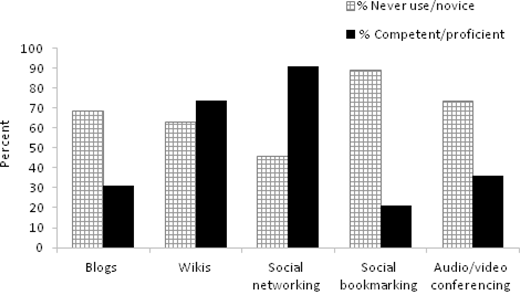
Comfort level comparison of the region's high school teachers and Web 2.0 technologies (N = 137). This figure presents a comfort level comparison of the percentage of the region's high school teachers who selected the categories Never Use or Novice with those high school teachers that selected Competent or Proficient by Web 2.0 technology.
Comfort level comparison of the region's high school teachers and Web 2.0 technologies (N = 137). This figure presents a comfort level comparison of the percentage of the region's high school teachers who selected the categories Never Use or Novice with those high school teachers that selected Competent or Proficient by Web 2.0 technology.
Teachers' Use of Web 2.0 Technologies for Classroom Instruction
Most participants were not using Web 2.0 technologies for classroom instruction in the regions high schools of this southern Florida county (see Table 2). Therefore, though Web 2.0 technologies seem to support collaboration among students (e.g., Bernsteiner et al., 2008; Crook, Cummings, et al., 2008; Drexlar et al., 2008; McLoughlin & Lee, 2007), many teachers have no plans at all to use these technologies. Only a small minority use these technologies in this school region. Regarding the frequency of use of wikis, 56 participants selected one of the following usage categories (Use Occasionally, Frequently Use, and Always Use) for wiki usage, while 13 participants selected any of the usage categories for social bookmarking (see Table 2). A U.S. report by Gray, Thomas, Lewis, and Tice (2009) also found low usage of blogs and social networking sites by teachers. Therefore, it appears that Web 2.0 usage is lagging even though it shows promise for classroom integration. Crook, Cummings, et al. (2008) equate these technologies to moving targets and therefore teachers may not be sure how compatible they are especially if these technologies continue to change so rapidly. Conole (2010) reported that teachers expressed a need to evaluate and adapt these technologies prior to deciding whether or not to implement in their classrooms. Brzycki and Dudt (2005) noted that teachers may be experiencing negative effects to excessive innovations that may lead to a feeling of being overwhelmed. This could lead them to view these technologies as not easy to use and question the degree of compat ibility for classroom use due to time constraints. If teachers are not allotted the time to become familiar with the new technologies and the technology continues to change rapidly, teachers may feel that these technologies may not be useful for their classroom teaching and question the compatibility of their use in classrooms until they are given the appropriate evaluation of these tools and appropriate training.
Percentage of Participants' Usage of Web 2.0 Technologies in the Classroom
| Web 2.0 Technology | Usage Categories | |||||
|---|---|---|---|---|---|---|
| Don't Use and Don't Plan to Use | Don't Use But Plan to Use | Use Occasionally | Frequently Use | Always Use | NA | |
| Blogs | 51.1 | 27.0 | 10.9 | 4.4 | 2.2 | 4.4 |
| Wikis | 36.5 | 19.7 | 27.0 | 9.5 | 4.4 | 2.9 |
| Social networking | 53.3 | 19.7 | 12.4 | 6.6 | 4.4 | 3.6 |
| Social bookmarking | 59.9 | 24.8 | 6.6 | 1.5 | 1.5 | 5.8 |
| Audio/video conferencing | 41.6 | 35.8 | 10.9 | 4.4 | 2.9 | 4.4 |
N = 137.
The percentage of respondents using wikis was higher (40.9%) and showed a slightly more favorable outlook for classroom adoption than did social bookmarking (9.6%), social networking (23.4%), or even blogs (17.5%). Lag of adoption became more apparent with experienced teachers. The percentage of respondents that used wikis in the classroom at least occasionally, if not frequently or always was 40.9, which is slightly higher than the amount reported for United Kingdom teachers (32%) in the study by Crooke, Fisher, et al. (2008). The slight increase may be due to a 3-year difference in the two studies (see Table 2).
Teachers' Opinions of Web 2.0 Technologies for Classroom Instruction
Over 60% of participants thought that Web 2.0 technologies would improve student interaction with teachers. For all Web 2.0 technologies approximately 50% or more of the participants selected the category of Don't Use and Don't Plan to Use. Additionally, one teacher expressed concerns about liability in the comment section: “The issue of social media in the classroom becomes an issue of feasibility vs. liability. In order for it to be feasible, it would require too much policing.” Therefore, Liability comes into play from inappropriate use." even though teachers' opinions were that student/teacher interaction could be improved through the use of Web 2.0 technology, it is important to further analyze whether this would be viewed by teachers as a strictly positive opinion. The Open University's social networking site Cloudworks was developed to help teachers with Web 2.0 technology adoption and Conole (2010) concluded that some teachers thought that because social networking technologies were developed for social purposes they were inappropriate for classroom use.
Additionally, teachers have lost jobs and have found themselves in trouble using social networking sites (Chiaramonte & Gonan, 2010; Foulger, Ewbank, Kay, Popp, & Carter, 2009). According to Foulger et al., there is a need to define teacher's rights regarding online activity and their duty to educate. This may require further questions and analysis in future studies.
Fifty-three percent of the participating teachers believed Web 2.0 technologies could improve student learning while only 38% thought it would improve students' satisfaction of the course. A total of 52.6% did believe that it could improve students' interaction with other students; only 30.7% thought they could easily integrate these technologies into their course, and few teachers (18.2%) thought it could or would improve students' writing ability. Twenty-one percent selected that they Did not know if these technologies would possess an advantage for classroom learning (see Table 3). In the open comments section, three teachers thought it could have a negative impact on students' reading and writing. One teacher expressed concerns about copying and pasting:
Participants' Opinions of the Advantages of Web 2.0 Technologies for Classroom Instruction
| Opinion | Frequency | % |
|---|---|---|
| Improve students' interaction with teachers | 85.0 | 62.0 |
| Improve students' learning | 73.0 | 53.3 |
| Improve students' satisfaction with the course | 52.0 | 38.0 |
| Improve students' interaction with other students | 72.0 | 52.6 |
| It could be easily integrated into my course | 42.0 | 30.7 |
| Improve student's writing ability | 25.0 | 18.2 |
| Don't know | 29.0 | 21.2 |
Multiple response, N = 137.
Even, though I consider myself proficient in web 2.0 I am old fashioned in thinking that we are not doing the children a service by having them rely on technology so much. I feel that some of the kids are not capable of putting together a unique thought because all they do is cut and paste off the internet. If they had to sit down and open an encyclopedia and type the assignment on a typewriter, at least then you know the work was thought out and their own. Do you cite again?
Jenkins et al. (2006) discussed this behavior by present day teens as a concern for many in the educational community and thus this has been called the Napster generation. Comments made in the study by teachers indicate a related concern regarding students' frequent use of copying/pasting without appropriate credit to the original sources. This concern may also be reflected in the low percentage of teachers who hold a favorable opinion of Web 2.0 technology for the improvement of students' writing skills.
Best Predictors for Classroom Adoption of Web 2.0 Technologies
Two separate linear multiple regression analysis were conducted to determine which factors best predict the decision of teachers to adopt or not adopt Web 2.0 technologies for classroom instruction. The first linear multiple regression analyzed the predictive value of the three main constructs of the decomposed theory of planned behavior (i.e., attitude, subjective norm, and perceived behavioral control) to predict the criterion variable of intention or behavioral intention to use Web 2.0 technologies in the classroom.
Findings showed that all three main constructs significantly predicted behavioral intention of the participants to use the Web 2.0 technologies for classroom learning. The strongest predictor was attitude (ß = .634, t = 10.130, p < .001), while subjective norm and perceived behavioral control were minor contributors to adoption. This was similar to Ajjan and Hartshorne's (2008) study on faculty adoption of these technologies. According to Ajjan and Hartshorne (2008), “Path analysis confirmed that attitude (ß = 0.830, t = 12.224) was the only determinant that had a very significant effect on behavioral intention” (p. 77). Attitude was not as strong a predictor of behavioral intention for this region's high school teachers as for university faculty participants in the Ajjan and Hartshorne (2008) study.
A second linear multiple regression was used to analyze the decomposed predictor variables (i.e., facilitating conditionsfor the categories of resources and of technology, subjective norm superiors, subjective norm peers, subjective norm parents, perceived usefulness, self-efficacy, ease of use, and compatibility). Perceived usefulness (t = 3.429, p < .05) and compatibility (t = 3.481, p < .05), each significantly predicted behavioral intention to use Web 2.0 technologies for the high school classroom. The other factors were not significant predictors of Web 2.0 classroom usage. Therefore, teachers' lack of adoption of these technologies in this southern region of M-DCPS may be due to their perceived usefulness for these technologies, followed by how compatible they perceive these Web 2.0 technologies to be for classroom instruction.
Some respondents discussed problems in the comments section related to perceived behavioral control (i.e., facilitated conditions with technology or resources), but perceived usefulness was a stronger predictor on teachers' intention to use Web 2.0 technologies. Filters may be affecting teachers' feelings of perceived usefulness and compatibility due to access difficulties of Web 2.0 technologies in the classroom. According to surveys conducted for the National School Boards Association (2007), 98% of schools nationwide use some form of filter to block websites deemed inappropriate, 62% had rules against bulletin boards and/or blog participation, and more than half did not allow social networking participation. Therefore, teachers may be wary of the risks and this should be further analyzed.
Limitations of the Study
There are several limitations to multiple regression. According to Huck (2008), “regression coefficients (or beta weights) do not provide a pure and absolute assessment of any independent variable's worth” (p. 422). The term “independent variable” is equivalent to the term “predictor variable”; thus, changes in the predictor variables can affect the beta weights. Additionally, the results of a multiple regression analysis are not to be interpreted as causal but correlational (Huck, 2008).
Teacher participation was a limitation of this study and therefore oversampling was used to try to ensure the necessary participation number. One school's principal refused to grant permission to survey the school's teachers. The survey was conducted during the last month of the school year, which was filled with required end-of-the-school-year documentation and activities for teachers. It is also valid to note it had been a turbulent year for the school district due to several factors: financial constraints, testing included Florida Comprehensive Assessment Test (FCAT), and end of year exams being piloted in schools for biology and algebra. Moreover, the state legislature was passing a bill tying teachers' pay to test scores and teachers were informed they would have to contribute 3% of their pay towards retirement. All of these factors may have affected the willingness of teachers to participate.
Additionally, two of the answer choices in Section B, No. 3 of the WLHSC (multiple response choices) were omitted from both the screen and the paper questionnaire version, even though they appear in the online survey database. This may possibly be due to formatting irregularities.
The questionnaire did not include questions on the subjective norm groups of students. Other questions pertaining to students were included and superiors, peers, and students' parents were included. It is recommended that future studies analyze the effect of the subjective norm category Student.
Implications for Practice and Theory
If the United States Department of Education is demanding more technology integration (International Society for Technology in Education [ISTE], 2008; U.S. Department of Education, 2010), then Web 2.0 technologies appear to be the most economically feasible technologies to adopt for the classroom, since many are free to those with Internet access. Why high school teachers appear reluctant to adopt these technologies requires important research focus, especially because these technologies are changing so rapidly. According to the findings of this study, the factors of perceived usefulness and compatibility appear to be the primary factors standing in the way of adoption of these technologies by participating high school teachers. Thus, this study sheds light on the important factors limiting teacher adoption of Web 2.0 technologies for classroom instruction.
Furthermore, this study found that attitude was the strongest predictor of the three main undecomposed predictor factors that affect behavioral intent (t = 10.130, p < .001). Ease of use is defined as the degree of freedom regarding the effort required to use a particular innovation (Davis, 1989), and it is a decomposed factor of attitude. Instructional technology support and training also affects perceived ease of use. Likewise, the individual's view of the resources available for the task and their own self-confidence in caring out the task also affect ease of use (Ajjan & Hartshorne, 2008). This study shows that because attitude was the greatest determinant of Web 2.0 technology use, perhaps educational leaders should focus on job environment issues that can affect teacher attitude.
Recommendations for Future Research
Research Question 1 examined the extent to which the region's high school teachers were using or planned to use Web 2.0 technologies for classroom instruction. According to Dahlgren (2009), the educational reform movement has made teachers feel insecure and job security for teachers in today's climate has been threatened. Dahlgren discusses the educational reform trend and how it has endangered academic freedom and has made some educators and administrators wary of using material that are not approved by the state or district. Some teachers in the United States have been reprimanded for using Web 2.0 technologies, while many teachers have lost jobs (Foulger et al., 2009). On the other hand, in M-DCPS a local newspaper gave some favorable accounts of teachers using these technologies for classroom learning (Cohen, 2010). Regardless, the current climate created by the educational reform movement may make teachers even more wary of using any Web 2.0 technology in the classroom. Thus, the current educational reform trend may be affecting the willingness of teachers to adopt new Web 2.0 technologies. According to Dahlgren “In contrast to the wealth of material regarding intellectual freedom in the university setting, there has been a relative lack of literature regarding conceptions of and threats to academic freedom for secondary level teachers” (p. 28). McLoughlin and Lee (2007) stressed that both the affordances and the risks of Web 2.0 technologies must be understood. Therefore, research in the area of teacher perceived academic freedoms and Web 2.0 technology may shed further light on the reluctance of teachers' to adopt these technologies for the classroom. There is a possibility that the use of these technologies may pose a perceived risk to the high school teachers' job security. Additionally, future research may look at teachers' morale and attitude due to the current accountability push in the educational reform trend coupled with the demand for classroom technology integration.
Teachers may have concerns regarding their interaction with students, especially during their personal time outside the school day. According to the National Council for the Social Studies (2008), “Web 2.0 tools such as blogs and wikis support active learning while extending teaching and learning beyond the four walls of the classroom” (p. 29). Yet, if teaching and learning is to be extended outside the classroom major concerns may arise for teachers due to further intrusion of work time into their personal time. Teachers already take work home for grading. A Delphi study may be beneficial in order to investigate issues and policies that address teachers' privacy, responsibility, and liability with regards to their personal time and their students' needs. Research into improving school policy and school procedures for Web 2.0 technology use may aid teacher adoption. These policies and procedures must address both school time and extended learning time.
Both Clark (2001) and Buckingham (2007) conclude that media effects tend to be exaggerated. With the current pressure in U.S. education for technology integration (ISTE, 2008; U.S. Department of Education, 2010), some teachers may be wary of jargon and fads. Therefore, future research may benefit from concentrating on specific collaborative Internet technologies. It must be noted that there are numerous technologies that fit the definition of Web 2.0, and not all of these technologies may be appropriate for classroom use. Fisher and Baird (2006) adapted the following definition: “Web 2.0 generally refers to a second generation of services available on the web that lets people collaborate and share information online (wiki, weblog, podcasts) and form online communities” (p. 28). The idea that the term Web 2.0 was too general a term and therefore susceptible to being viewed as fad or jargon was pointed out by at least one teacher, who commented:
Your use of the term “web 2.0 technologies” is too generic and too general; hence a lot of my (and I suspect others) reply was “neutral.” I say neutral because I use web images and video quite often, rarely use wikipedia, and would never consider using “facebook” or other social media in my classes. You need to be more specific. I would avoid the jargon of “web 2 technologies” if I were you.
If teachers are presented with research on specific Web 2.0 technologies that also give them examples of approved beneficial uses of that particular Web 2.0 technology, this may improve the adoption rate of that specific Web 2.0 technology. Therefore, research on which Web 2.0 technologies give the most classroom learning benefits paired with research on how these technologies can be safely and successfully integrated into the classroom may benefit all involved in the educational process.
The second question of this study explored the opinions high school teachers had regarding Web 2.0 technologies for classroom instruction. Though 62% of the respondents' thought that Web 2.0 technologies could improve student/teacher interaction, 53% thought that these technologies may help improve student learning, and 52.6% thought that student to student interaction may benefit from the use of Web 2.0 in the classroom. Nevertheless, a total of 18.2% thought these technologies could help improve writing skills. Therefore, research on whether specific Web 2.0 technologies are able to improve student writing skills would be of importance to educators. Accordingly, both leadership and the classroom teachers require proven benefits from the respective Web 2.0 technology for student learning. While research on individual technologies is prevalent at the university level, research is lacking at the high school level and additionally in the middle school and elementary grade levels.
Research Question 3 explored the predictor factors of high school teachers to adopt or not adopt Web 2.0 technologies for classroom instruction. This study found that perceived usefulness and compatibility appear to be the primary factors standing in the way of adoption of these technologies by participating high school teachers.
Grant (2009) suggested that the teachers' attitudes on collaboration may need to be further analyzed and that the pedagogical debate of collaboration versus traditional teaching pedagogy may be accentuated by an analysis of the adoption difficulties of Web 2.0 technologies. However, it may not be easy to incorporate online collaborative work in the high school classroom, especially with the demands currently being placed on classroom teachers for test score accountability. According to Winters, Trivitt, and Greene (2010), “Florida is among the states most heavily invested in high-stakes testing” (p. 139). Teachers must teach a very strict curriculum due to increased accountability demands and collaboration takes time, especially when dealing with online collaboration that is new to many teachers.
Compatibility of individual technologies must be established through research to improve behavioral intent and to ensure that they are appropriate for classroom use. The research must be broken down by individual Web 2.0 technology. Most of the research on individual technologies is at the postsecondary level. More research is needed at the high school level. Furthermore, the middle school and elementary levels need research on compatibility of individual Web 2.0 technologies for that level of classroom teaching and learning. Teachers do not appear to be sold on the perceived usefulness and the compatibility of these technologies. A study of the effects of high stakes testing and teachers' perceived usefulness and compatibility of these technologies due to possible time constraints may prove beneficial.
It also may be beneficial to review teachers' perception of issues regarding funding and technology in a period of time when funding may be questionable for many school systems. In today's economic crisis many schools are experiencing and fearing additional dramatic funding cuts (Bender, 2011).
Summary
Most participants of the study were not adopting Web 2.0 technologies for classroom use. Of the three main constructs of the decomposed theory of planned behavior, attitude appeared to be the biggest determinant of intent. When these constructs were decomposed, perceived usefulness was the greatest determinant of intent, followed by compatibility of the technology for classroom use. Future research should concentrate further on individual Web 2.0 technologies and include more studies in the K through 12th grades. Web 2.0 technologies represent just one facet of ever growing instructional technologies that continue to be available for teachers to implement and students to access. As researchers, answers must be sought to link students' needs with teachers' initiatives and developing technologies.

