


Online education is becoming increasingly popular among both traditional and nontraditional students. Students gravitate to the flexibility of online courses, which allows them to work around jobs, family, and other responsibilities. While online program growth continues, these programs present several new challenges to educational institutions and their successful implementation requires a clear understanding of several factors that are at the root of these challenges. We propose 2 intuitive relational diagrams featuring roles and interaction among faculty, student, technology, and institution that could serve as a conceptual framework for developing successful online education programs.
Introduction
The popularity of online education is ever increasing with almost 4.3 million undergraduate students taking at least one distance education course (National Center for Education Statistics, 2011) per year. About 0.8 million of these students took their entire program through distance education (National Center for Education Statistics, 2011). Some factors related to this trend include student demand for flexible schedules, increased course availability, and increased student enrollment options. Online programs serve as a great opportunity for educational institutions to grow their educational programs. However, the success of an online program ultimately depends on the ability of the faculty and institution to provide quality online education (Allen & Seaman, 2006). Extant literature has emphasized on the importance of faculty, educational institution, and technology for attaining online education success. However, it has left out several key interactions between these entities from this discussion, in addition to student responsibilities (Finch & Jacobs, 2012; Mayadas, 1997; McLean, 2005; Thompson, 2003).
We believe that while these four components (institution, student, faculty, and technology) are necessary and important as single entities for delivering and utilizing online education, the larger risks and rewards for online education occur where these components intersect. This article attempts to develop a framework to aid in understanding the significance of the key interactions between these four components and their relevance to online programs by reviewing previous research in online education and bringing it together to represent a more holistic view of online education. Specifically, we develop two relational diagrams that could serve as the conceptual framework for online programs. Further, we discuss challenges in successfully achieving and maintaining the aforementioned interactions and provide examples from extant literature and our personal experiences for successful implementation of online education. We examine additional relationships within the components that serve as additional opportunities and risks to institutions. For instance, student-student interactions beyond the classroom in the form of professor evaluations on noninstitution websites, e-mail and phone communication, sharing of work from previously enrolled online courses, etc., need to be considered when developing online programs. These can have significant positive as well as negative implications on the quality and success of the online programs offered by an institution.
Conceptual Framework
We propose a relational diagram that presents the interactions between four primary components (institution, faculty, student, and technology) that have a significant impact on online education (Figure 1). This does not discount the responsibilities of the components on their own (such as faculty members maintaining their expertise over time). In Figure 1, we show six pairwise relationships between components. We attempt to bring together diverse and focused research articles in online education to create a more comprehensive and holistic conceptual model for online programs. To accomplish this, we first highlight challenges that exist with the interactions between key components (students, faculty, technology, and institution) from an online program perspective. Then, we present some mechanisms for resolving these challenges based on investigation of extant literature. Finally, we propose a second relational model that builds on the basic assumptions of the first model (Figure 2).
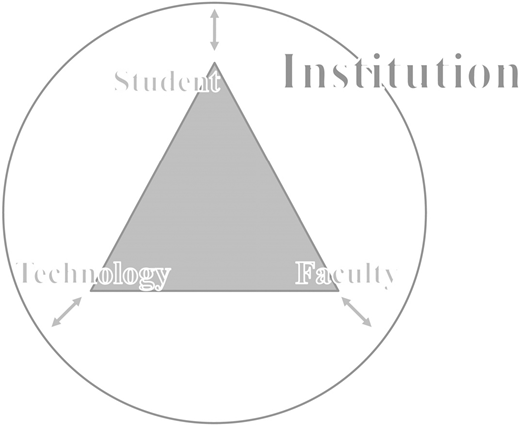
Macro View of Online Education Components
Macro View of Online Education Components
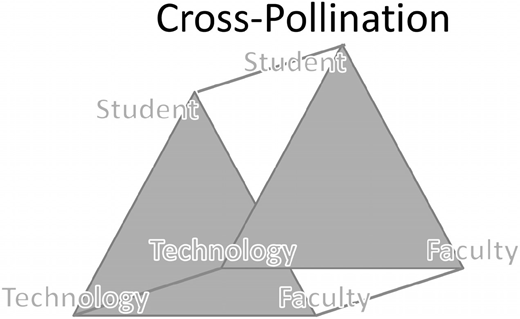
Cross-Pollination of Students, Technologies, and Faculty
Cross-Pollination of Students, Technologies, and Faculty
Student ↔ Faculty
Perhaps the most important interaction that takes place at an institution is between the students and faculty. In an online environment, the importance of this interaction is no less important. Research has shown that about 55% of communication happens nonverbally (through facial expression and body language), about 38% is tone (called “vocal liking”), and about 7% is verbal (Mehrabian, 1972, 1981). As a consequence, two major components of communication are limited in many online courses—tone and facial expression/body language. We can probably think of cases where nonverbal communication is not a key aspect of our communication (e.g., e-mail, instant messaging), but we often are more comfortable in those situations because we have an initial impression of the other parties. In a new relationship, such as that between a student and a faculty member in an online class, there may not be that “first impression” to rely on as a substitute for nonverbal and tone aspects of communication. Fortunately, in an online course, there are some steps that both the student and the faculty can take to help overcome the limitations to communication found in many courses.
Course Development
The first step to combatting the limitations of communication that are often found in online courses is a thorough course development process. Course development should focus on both course content and delivery of instruction. Specifically, course content should be accurate, current and cover all the concepts students are expected to learn when taking the course (Zhu, Payette, & DeZure, 2003).
Interaction and Feedback
Interaction and feedback are important behaviors influencing student motivation and involvement. Faculty concern and communication with students helps those students get through rough times and continue working (Chickering & Ehrmann, 1996). It is important for instructors to actively engage their students to promote advanced understanding, rather than allowing students to be passive consumers of information (McKeachie & Svinicki, 2005). Immediacy, presence, and feedback are each important aspects of the student-faculty interactions.
Verbally immediate behavior by instructors has been found to positively affect student performance. This can be achieved through initiation of discussions (Arend, 2009), asking questions, using self-disclosure, addressing students by names, using inclusive personal pronouns, responding frequently to students, offering praise, and communicating attentiveness (Arbaugh, 2001; J. D. Baker, 2004; McAlister, 2001; O'Sullivan, Hunt, & Lippert, 2004).
Presence has been found to positively impact student learning, cognition, and motivation. Methodical design, establishment of time parameters and group norms via conventions of netiquette, and facilitation of discourse (C. Baker, 2010), and weekly announcements are excellent ways of achieving presence as an online instructor.
Students need chances to reflect on what they have learned, what they still need to know, and how they might assess themselves. This can be achieved effectively via prompt faculty feedback. Instructor feedback has been shown to improve student involvement in discussions (Meyer, 2007), enhance student motivation for learning, and stimulate student interest in class (Mory, 1992). Pyke and Sherlock (2010) have classified feedback into three types: corrective, motivational, and technology-oriented. Corrective feedback, the most important of the three, should not be restricted to grading/verification of student work, but should also help students better understand the concepts and guide them in correcting their work (Kulhavy & Stock, 1989). Motivational feedback, unlike corrective feedback (which is task oriented), is aimed at motivating the student towards better performance.
Communicate Expectations
Setting expectations is an important step for a faculty member to make in an online course. These expectations should not only communicate the deliverables for the course, but also the nature of the interaction between faculty and students and between the students. This is more critical for those students who may have a tendency to shirk preparation and lack a willingness to exert themselves since self-motivation can be more difficult in an online environment. Expecting students to perform well has been found to be a self-fulfilling prophecy. This includes an emphasis on time on task, clear communication of the assessment criteria, et cetera (iNACOL, 2010). Since there is no face-to-face interaction between faculty and students, taking the time to stress these aspects can improve online education success. In other words, students may not feel the same pressure to perform up to expectations when they are not physically standing in front of a faculty member. Finally, given the “distance” of the relationship between students, as well as the pseudo-anonymity students have in online classes, setting a clear communication etiquette policy is wise.
Assessment of Student Learning
To take advantage of the relationship established between faculty and students in online classes, the students need to believe that the course assesses their knowledge accurately and appropriately. This may seem like an obvious point, but it is relatively easy to lose alignment between course objectives, course content, and course assessments in an online course. There also may not be as many opportunities to clarify the links between objectives, content, and assessment in an online class. So additional care should be taken to ensure the students understand the connections.
Additionally, students need to believe in the integrity of the course. There is a perception that it is easier to cheat in an online class, which may have negative effects on the commitment of enrolled students as well as undermine the credibility of the institution. Results of a study suggest that 73.6% of the students in the sample held the perception that it is easier to cheat in an online versus a traditional course (King, Guyette, & Piotrowski, 2009). Prevention or reduction of fraud is possible if chances of the fraud triangle (opportunity, incentive, and rationalization) are reduced (Wells, 1997).
Some possible activities to decrease the likelihood of cheating (and improve the perception of the integrity of the course) are algorithmic/numerical assignments that require a process to reach the solution, discussions, proctored exams, and team projects. One effective way of achieving this is through assignment of a significant number of activities with minimum weight because having only a few activities with large weights might facilitate the fraud triangle. Other practices that have been shown to deter cheating in online classes include the following: providing students with an academic honesty policy (Olt, 2002), clear communication by the faculty on consequences of cheating (Chapman, Davis, Toy, & Wright, 2004), electronic submission of assignments (McMurtry, 2001), and proctored tests that include randomized questions (Serwatka, 2003; Shuey, 2002; Vachris, 1999).
Student ↔ Technology
While there is an obvious relationship between the student and the technologies they must utilize in an online class, there is much variability in the satisfaction of the students with this relationship. Some students will find the technology requirements for online courses to be rather elementary, while others (often nontraditional students) may have more struggles and frustrations. As a result, online programs should take some steps to improve the relationship between students and technology required for their online courses.
Student-Centered and Intuitive Systems
Technology adoption should be done keeping in mind the frequent interactions that numerous students enrolling in online programs will have with the system selected. Since the technology is a delivery mechanism for course content and repository for accepting student work, it should be intuitive for students to use and have an effective and accessible help system. This is particularly important for online courses because help desk support may not be available at the hours when students are doing their work for online classes. Students today are highly familiar with popular web-based software that undergoes constant evaluation and frequent improvements—and they are expecting similar ease of use and intuitive design from their online course technologies.
Technology Orientation for Students
While students have different skill levels with technology, success of an online student nonetheless depends to a considerable extent not only on learning and assessment, but also on these technological skills. Furthermore, while it is appealing to have intuitive systems with which students interact, the reality is that the improvement cycle time for learning management systems and class technologies is much slower than technologies provided to the broader consumer base (e.g., Amazon.com, Facebook). As a result, students often need training in the basic skills of file management, sending and checking e-mails, locating course materials, accessing discussion posts, using chat rooms, et cetera. (Mandernach, Gonzales, & Garrett, 2006). A good tool for helping students gain the necessary technology skills is an institution mandatory online student success course (Beyrer, 2010). This should ideally use rich demonstrations, like screen capture and video, to demonstrate the necessary skills for online courses.
Technology is essentially a double-edged sword, bringing great benefits to students while potentially introducing increased risks for misuse. For example, increased use of technology has been shown to increase the risk of plagiarism, cheating, and discourteous behavior among students (Glenn, 2008). These risks need to be factored in carefully in all the technology-related decisions made by institutions and faculty.
Student ↔ Institution
In the traditional institutional setting, the student is able to leverage the possibility for face-to-face communication through the option of physically entering institution buildings, allowing the benefits of face-to-face communication such as body language and real-time interaction. In most cases, an electronic or online substitute is not offered, making many of the administrative tasks the student must undertake more difficult and time consuming. For instance, tasks like student advising or even acquiring a student identification card can require physical presence on campus. Even processes such as applying for financial aid that are increasingly computer based are often significantly easier when real-time interaction is possible.
Of course, administrative processes and requirements are not the only significant interactions between institution and students. Students in entirely online environments are not able to participate in institution activities at the same level and richness as students that physically attend campus. For instance, institutions are not likely to offer academic and social clubs for online students, or any tools to facilitate this type of participation in the institution. While online students likely realize they are willingly foregoing these possibilities, institutions could take additional steps to accommodate these students. In fact, there may be tangible benefits for the institution in terms of student persistence, a commonly acknowledged problem of online education (McGivney, 2009), through provision of tools for involving online students in broader institution activities.
While they may be challenging, there are some steps that institutions can take to enhance the relationship between itself (administrative employees) and the online students.
Student Advising and Other Support Services
Mayadas has stated the importance of having a good student advising system available to online students (1997). This should include advisors that are well versed in the differences that may be encountered in online courses in general so that they can assist students in deciding which delivery methods suit them best. Advisors should also be able to guide students regarding total number of courses they can handle during a semester given there may be some differences in the time commitment required for online classes. In other words, while online courses are considered to be more flexible, the increased responsibility on the student for active learning may lead to a greater time commitment. This knowledge can be critical for students that work full time. Advisors should also help students set reasonable expectations for taking online courses. Other student support structures include providing students with information about programs, admission requirements, tuition and fees, books and supplies, technical and proctoring requirements, availability of hands-on training, how to use services like interlibrary loans, campus libraries (Merisotis & Phipps, 2000), credit transfers, placement testing, financial aid counseling, et cetera. Consequently, as online programs grow at individual institutions, it is important to have staff that can cater to the unique needs of the online student that may be far away from campus, as well as technologies that support effective asynchronous and synchronous communication with students.
Career Services Offerings
In most cases, students are attending institutions to increase their knowledge and skills so that they are more attractive to the workplace. For students that operate entirely online, they generally do not have the same access to career services offerings, like resume help, cover letter coaching, job postings, and other helpful resources. Given that their career is often driving their continued education, institutions can provide great value to online students by leveraging some of the same communication technologies that courses use. The provision of this service will go a long way to fostering a long term connection with the student, especially when career services can match that student with an employer. Several examples of a virtual career centers that aim to help online students receive the same career development support as traditional on campus students are available (California State University-Fullerton, 2011; University of Central Florida, 2011).
Institution Engagement and Immersion Offerings
Institutions recognize the benefits of student and alumni commitment reaped through student persistence (prior to graduation) and monetary (and other) contributions back to the institution upon completion. Forward-thinking institutions will recognize an opportunity with a growing number of online students that are graduating, but may have difficulty encouraging the same level of contributions from students that do not have the broader on-campus immersive experiences. These alumni are no less important to the institution, and institutions should take steps to engage students in deeper extracurricular experiences for both the positive effects it will have on the online student population and the potential rewards it will bring for fundraising. While achieving the same level of immersion for online students as resident and traditional students may not be possible, it does not mean that these opportunities should not be identified and provided (Glenn, 2008). Fortunately, free technologies like Google Hangouts and Skype, and licensed technologies like Adobe Connect and Blackboard Collaborate, will allow institutions to have richer interactions with students, both present and former.
Support Services for Students
One of the greatest burdens on faculty in online environments comes from dealing with student issues beyond the content of the course itself. Institutions can mitigate the issues associated with student needs beyond the course by providing support resources for students. In particular, students need access to general support services and to technical support. Student failure in online courses can be generally attributed to the following: unreasonable expectations, lack of technological know-how, inappropriate online communication etiquette, poor time management skills, lack of experience working on team projects with members at different locations, and inadequate opportunities to evaluate online versus traditional learning environment suitability before registering for actual courses. These challenges can be overcome through development of mandatory online student success courses to become eligible for online education (Beyrer, 2010).
Additionally, institutions should ensure students have constant information technology support online and by phone (even 24 hours if needed), and easy access to software upgrades (Mayadas, 1997). In addition, frequent updates on changes in system requirements, web browsers etc. should be provided to students to reduce frustrations and avoid any handicap to student performance. While these services are targeted for students, they greatly reduce the burden on faculty when properly advertised to students. Faculty are often ill-equipped to handle technical and student success issues, and lack of support at the institutional level for these needs reduces greatly the satisfaction of faculty teaching online.
Faculty ↔ Technology
Given the technology-dependence of delivering online courses, faculty have to ramp up their understanding of available technologies to keep pace with improvements that improve the overall experience for online students. There are a number of ways that faculty can keep pace with technology, starting with a sincere interest in looking for ways to increase the richness of their course offerings. Without a desire for some experimentation with technology and a willingness to tinker, faculty commonly have difficulty improving the quality of their online courses. Fortunately, there are some avenues to assist faculty in their interactions with technology for online environments.
Instructor Training and Technological Know-How
Many institutions have in place specific technology training resources, which is fortunate given that instructor training is critical to online learning outcomes. Technically prepared faculty have been found to spend more time on actual teaching than on the technical aspects as compared to less prepared faculty (De Gagne & Walters, 2009) since the technology presumably becomes second nature with more understanding.
Continuous Technology Improvement
For faculty, the good news is that software that supports both the creation of content and the delivery of online courses is becoming both more sophisticated and easier to use. Where producing online videos just a few years ago required a studio, expensive equipment, and staff to shoot and edit the footage, faculty can now use a wide variety of video devices and produce their own videos inexpensively with relative ease on their own computer using tools like Camtasia Studio (2011) and Panopto (2011). There are many tools that capture activity on computer screens in a manner similar to the classroom whiteboard, like Blackboard Collaborate (2013). Additionally, most tools export content to standard formats that reduce the number of compatibility issues that can arise in online environments. Perhaps the most fortunate aspect of this continual improvement is that the ease-of-use qualities of these tools is outpacing their complexity, meaning faculty can use technology more intuitively with less need for training. This aspect also encourages faculty to explore more on their own.
Faculty ↔ Institution
Beyond technology-specific support for faculty, institutions can assist individual faculty efforts in online education by providing an umbrella of services at a broader level. Among these offerings are administrative and monetary support, pedagogical support, and mechanisms to ensure ethical learning.
Administrative and Monetary Support
Faculty satisfaction is one of the five pillars of a quality online education (Mayadas, 1997). For years, faculty who set off in the direction of online education felt isolated and alone in figuring out the details of offering a course virtually. This has led numerous faculty to avoid the hassle and stick with traditional classroom teaching in many cases. The institution can take steps to facilitate development and teaching of online courses by providing the appropriate administrative direction and staff to complete the necessary paperwork or other hurdles. Additionally, to encourage greater faculty participation, institutions have often offered monetary incentives to faculty developing online courses as subject matter experts and to those teaching them. Such incentives have been shown to encourage online teaching (Betts, 1998; Jones & Moller, 2002; Rockwell, Schauer, Fritz, & Marx, 1999; C. Schifter, 2002; C. C. Schifter, 2002). Other similar incentives include consideration of online efforts during tenure and promotion evaluations. This has been shown to improve the level of job satisfaction as well as the amount of support and recognition faculty receive from peers (Bonk, 2001; Parisot, 1997; Rockwell et al., 1999).
Pedagogical Support
Given the variations of assignments, assessments, and general engagement of students in an online environment, faculty are often stepping out of their comfort zone when designing and teaching online courses. Institutions can help alleviate some of the anxiety that comes with this shift by providing expertise in online course design and teaching in the form of instructional designers. Modern instructional designers focus much more on virtual delivery of content, assessment, and assignments than in years past. This makes trained instructional designers invaluable to faculty members since instructional designers can discuss pedagogical issues and partner with faculty to help develop some of the course content (while leaving the subject expertise to the faculty).
Mechanisms to Ensure Ethical Learning
Perhaps still the most problematic concern or fear in online environments is the potential for unethical behavior by students. While this is a valid concern (in online and face-to-face environments), there are a number of mechanisms available to help deal with this concern. Among these are proctoring, course design, and technology solutions.
In some cases, faculty still wish to give final exams in person. To give students flexibility, while still issuing a photo-verified final exam, many institutions offer proctoring options. Of course, certification of proctors is critical for promoting ethical learning. Since it can be difficult to check every proctoring center, the institution should provide support services to faculty in terms of verifying the proctor information. According to Koch (2000), “fear of lawsuits, time required to handle cheating incidents, lack of institutional rewards for catching cheating, [et cetera], are all listed as rationalizations for this behavior” (p. 753). Institutions also must support and motivate faculty to report and take action against academic dishonesty. It is in the best long term interests of the institution to police and punish academic dishonesty because not doing so only worsens the problem and also leads to a gradual substitution/demotion of courses less susceptible to cheating practices by those more prone to it (Gresham's Law).
Institutions can also support faculty by providing integrity checks for faculty. These tools have become readily available from a variety of sources, such as Turnitin (http://turnitin.com/) and SafeAssign (http://www.safeassign.com). While expensive, they provide more confidence that homework submissions are unique to a student, that writing is not plagiarized, and that assignments across time are also legitimate. These systems also send a signal to students that their work is being monitored for cheating, which in itself is a deterrent from academic dishonesty.
Institution ↔ Technology
Since online offerings are technology-dependent, it is critical for the university to provide the infrastructure necessary to deliver content to students in a reliable and fast manner. Institutions without the proper infrastructure and support of technologies will have frustrated users, both faculty and students. In fact, online education programs at institutions that are not simply equipped with technology, but are protechnology overall have been shown to be more successful (Clark, Holstrom, & Millacci, 2009).
However, institutions do not have unlimited resources for building technology infrastructure, especially during phases of rapid growth. At institutions where there is a heterogeneous expansion of online programs, the technology acquisition process is even more difficult. Some colleges or departments within the institution may be more “mature” with online education and have different technology needs than colleges just entering into online instruction. There can be substantially different technology requirements for leveraging large amounts of video and audio files versus more text-based course offerings. As a result, there can be a continual struggle to determine whether to adopt technology in different areas of the institution or institutionwide, and when that decision should be made. Many of these decisions are at times simplified, for better or worse, by institution technology decision models (e.g., centralized, federated, or decentralized models). In other words, a structured acquisition process may reduce the options considered during selection decisions.
In some cases, institutions may have development capabilities on campus to help construct tools to support online education. For instance, instead of a marketplace solution for housing videos produced by students, institutions may choose to develop their own solution that is designed for the particular needs of the institution audience. Of course, not all institutions will have development capabilities or resources on that level and purchasing technology may be the only option.
While much of this discussion is related to how the institution will support the technology needs for online education, there is also a missed opportunity by the institution to leverage technology to understand more about their online programs. Part of this is due to the limitations of the systems that are available to institutions off-the-shelf to collect usage data and other indicators of technology use. There can also be compliance concerns about collecting certain data about students that must be thoroughly evaluated. However, in many cases, there is simply a lack of strategy for how data could be leveraged to better serve the students, faculty, and how to gauge future technology purchases.
The Impact of Cross Pollination
To this point, we have discussed a framework that leverages the most commonly examined and researched aspects of online education. These, however, are not the only relationships present in institutional settings. In this section, our focus is on examining the potential positives and negatives of “cross-pollination,” or communication within the components.
The framework portrayed by Figure 1 presents a traditional view of roles for each of the four components (students, faculty, institution, and technology), but is not adequate in light of technological advancements that have enabled much higher interaction within the student, faculty, and technology communities. Cross-pollination is in essence a “back channel” communication within each group. We believe this model (Figure 2) extends to fit increasingly integrated and social communication environments, which are beginning to have a real impact in online education. This view is critical in any dialogue about online education especially among administrators.
Student ↔ Student
There are two primary interactions between students outside of classes that can influence online programs: direct and indirect. Direct communication between students often occurs between former and current classmates in a manner similar to traditional settings, albeit more likely to occur through various communication technologies. Students discuss the class experience, which professors to choose for upcoming courses, and tips for success. Students will commonly use telephones, e-mail, face-to-face meetings (where possible) or tools like Facebook for direct communication (Facebook can also be an indirect tool depending on the user's privacy settings). There are positives and negatives of this interaction. For example, they may share assignments across terms, making the use of plagiarism check systems even more important when appropriate. They could also challenge the integrity of the online course, undermining the demand for the course or future integrity for the course. However, they may also reinforce expectations for online classes, the skills and dedication necessary and additional learning benefits that they gained in an online environment.
Indirect communication also occurs in the online environment through tools like Twitter, RateMyProfessor.com, and MyEdu.com. These tools can be both beneficial and damaging for the institution or individual faculty. This is a primary motivation for encouraging faculty members to ensure that their classes are of high quality and their relationship with students in the course is positive and effective. With the various communication tools available today, negative word of mouth can reach much farther and enough poor experiences can quickly damage the perception of overall program quality. It is not clear if the most motivated commenters are negative for these tools and there are also concerns about their validity due to possibilities of abuse of these tools (Otto, Sanford, & Ross, 2008).
The primary means to ensure positive outcomes from student-student interactions beyond courses and on the broader Internet is to maintain high quality (and continually improve) in online courses across the board. Institutions should also undertake an initiative to monitor public channels for indications of poor quality and publicly make efforts to remedy complaints where pertinent. This type of brand monitoring is common in the corporate setting, and should be included in brand management for institutions as well.
Faculty ↔ Faculty
Faculty are obviously on the frontlines of education, and in online environments where techniques and technologies are continually changing and hopefully improving, they are a primary source for hands-on knowledge. A common problem in many institutions is a lack of communication between faculty about the classroom experience (e.g., new ideas, failed efforts, etc.), and this is compounded in environments where online classes are taught by off-campus faculty. These faculty are often reluctant to share their experience and “lessons learned” with others for several reasons. They may not have a good connection to the traditional institution faculty, they may not have the best tools to communicate their experiences or give feedback to others, or they may believe their ideas are not novel.
There are several real benefits to facilitating communication about online teaching between faculty. Faculty are able to transition more smoothly from a face-to-face to online classroom with fellow faculty support. It helps faculty learn about new techniques and experiences other faculty had when they incorporated it in their courses. It reinforces faculty faith in methods of instruction they use and it also provides faculty with moral support and space for airing frustration when facing similar problems as other faculty (Kyei-Blankson & Keengwe, 2011).
Of course, negative word of mouth can spread about the online teaching experience as well. The institution is often well served by implementing communication structures among the faculty to help monitor and alleviate concerns as well as promote successes. Some possible avenues for encouraging communication are committees, faculty surveys, brownbags, and/or newsletters devoted to online learning. These tools can help encourage buyin from faculty while communicating to administration what aspects need improvement. Additionally, these tools can also bridge the gap between online faculty and face-to-face faculty that are skeptical of online teaching.
Technology ↔ Technology
Students' expectations of technology in online programs are heavily influenced by their broader technology experiences with smartphones, social networking, and even their personal computers. They expect applications to work seamlessly, have richness and clarity, be simple to use, and at times fun. They often do not realize the amount of resources required to create these experiences (like those created by Apple for example), or the limited budget at institutions to develop software. Thus far, learning management systems are improving with each iteration, but are still much less intuitive than popular systems and websites frequented by students today. Nonetheless, these marketplace systems and websites set student (and faculty) expectations and online programs need to continue to chase the experiences that students are seeking, technologywise.
Given that the target is always moving, and the absence of a single system that delivers learning content in a way that compares to the students' broader experiences, institutions need to consider ways to integrate technologies as seamlessly as possible. There are tools available to allow students to have video and audio discussions, for example, but these systems often require the students to leave the learning management system and learn a new interface. This experience, while still an improvement, is not seamless and results in some dissatisfaction for the students (and faculty). Additionally, much of the material in online classes is “stuck” within the particular course. Students must manually move the content to their personal devices to have it available after the close of the course at the end of the semester, so their submitted work may be difficult to access. A better structure would enable students to leverage a “cloud storage” option so that they can access material in years to come much like previous generations kept notebooks on a shelf for reference.
Ultimately, there will be learning management systems that are more intuitive and more closely match user expectations. In the meantime, institutions should take advantage of opportunities to integrate technologies to make the online learning experience richer and less “clunky.” It is admittedly not an easy process, and will be full of tradeoffs due to limited resources, but the goal should be to get away from numerous siloed systems.
Conclusion
Successful online education is critical to success of the institution, teaching faculty, and careers of the students. Increasingly, growth of the educational programs at institutions to a large extent depends on its ability to provide a quality online education. Quality of the online education offered, in turn, depends on the understanding by institution administration, faculty, and students about their roles and responsibilities. In this article, we have presented some of the most important pieces of the online education puzzle and have framed the discussion in terms of the key interactions that need to be bolstered and managed for rolling out successful online programs. The understanding of the interactions between components (students, faculty, institution, and technology), underlying challenges, methods to overcome them, as well as the cross-pollination that occurs between components (students, faculty members, and technologies) should benefit institutions already running online education programs as well as those that are planning to plunge into this enticing market in the near future by recognizing that the various components cannot be treated independently.
There are several directions that future research could pursue. For instance, empirical studies to check effectiveness of tools and techniques suggested for successful implementation of various interactions discussed in this study is a matter worthy of future research (for example, effectiveness of software to prevent academic dishonesty like Turnitin and SafeAssign). Student retention continues to be a serious issue affecting online programs, which might be due to lack of intrinsic and extrinsic student motivations. Faculty-student and student-institution interactions need to account for these issues when designing and evaluating online courses and programs. Research on mechanisms that could better prepare students prior to enrolling in an online program is notably lacking as well.

