


Online education is increasingly prevalent in graduate schools of teacher education. Questions arise, however, as to the effectiveness of the online facilitated graduate internship. This article examines perspectives of librarian site supervisors within online supported internships. Perspectives in regard to program support and self-perceived readiness to supervise interns within an online facilitated graduate program were the focus of this study. A web-based survey was distributed to site supervisors who had previously served an online facilitated internship. Findings point to responsive program improvement for graduate educators to enhance support of on-site supervisors and interns to strengthen the online facilitated internship.
Introduction
Across the nation, schools of education are receiving criticisms for inadequate preparation of the nation's teachers (Wagner, 2008). Although teaching learners to teach is not an easy task, colleges and universities continue to strive to produce graduates who are prepared to contribute and to succeed in various teaching positions. A review of higher education, both nationally and internationally, shows that graduate programs widely embrace the concept of the traditional clinical experience. For future school librarians the clinical experience offers a unique opportunity for providing an avenue to experience professional work while continuing to have access to academic support.
The teaching and learning of library science skills in real-life context offers the opportunity for graduate schools to do a more effective job in the preparation of future professional school librarians (Stefl-Mabry, Dequoy, & Stevens, 2012). The American Library Association Core Competences of Librarianship, American Association of School Librarians Standards for Initial Preparation of School Librarians, International Society for Technology in Education, the National Board for Professional Teaching Standards, and the North Carolina Department of Public Instruction Standards for the Master of Library Science Degree/School Library Media Coordinator License together provide clear guidelines for library science programs to address the issue of clinical competencies. The university program under review for this study, the master of library science program, firmly advocates the value of the clinical experience as reflected in the literature (Ball, 2008; Jurkowski, Antrim, & Robins, 2005; Shannon, 2008). This study was initiated to gather data to improve the program's clinical experience, the professional internship, specifically a distance learning facilitated internship.
The program under review by the researchers is completely online and is based on goals and objectives established by the department of library science (DLS) faculty through the curriculum development process. This process evolved through systematic planning by the department of library science curriculum committee in response to requirements for licensure from the state Department of Public Instruction (DPI) and the Standards for Initial Preparation of School Librarians designed by the American Library Association/American Association of School Librarians. Based on the program goals and objectives, the curriculum addresses the theory, principles, values and practices necessary for American Association of School Librarians students to succeed in their professional library careers. The master of library science program fosters curricular goals and objectives through a variety of educational experiences, culminating in the capstone clinical experience, the professional internship. The internship is a crucial, culminating link between theory and practice. This complex activity provides the means by which individuals may become critically conscious of themselves as professionals, applying theory gained in coursework in the totality of a real-life experience (Brown, Collins, & Duguid, 1989; Lave & Wenger, 1991). An effective, on-site credentialed librarian as supervisor is essential to the process.
Technology in Library Science Internships
Technology played a strong role in this study, which focuses upon the need for support of site supervisors by university programs, as the program under review is offered entirely online. The course management system Black-Board was used for the online facilitated internship. Discussion threads, blogs, video, and online evaluation and assessment formats were used. Coursework may be effectively adapted to the online arena, breaking conventional teaching modes and making advantageous use of rapidly expanding technology in allowing teacher and student to communicate, exchange work, pursue evaluation/assessment, and generally provide solid core subject education (Guoying, Shunxing, & Jiyue, 2005). However, concerns remain with the internship component. The clinical experience, the crucial link between theory and practice, is perhaps the most difficult program component to supervise and facilitate in an online environment (Dotson, 2010). Particular attention and effort are required to maintain contact and support with and for site supervisors who are working in distant schools and sites. The goal of this study was to understand the perspectives of supervisors who have experienced an online supported internship. Understanding these perceptions and making advantageous use of the technology available today is essential for continuing program improvement. The perspectives of the site supervisor role were examined through the lenses of situated cognition theory and the precede-proceed model.
Theoretical Framework
Situated Cognition
This examination of the site supervisor role through the lens of situated cognition theory is based upon the perception that learning is constituted through the sharing of purposeful activity (Brown et al., 1989) in the preparation and practice of future school librarians. Situated cognition offers a theoretical foundation for examination of the role of the site supervisor for teaching and learning in the real world context.
Through a professional internship in a real-life setting, interns gain experience, hone skills, and test professional dispositions under the supervision of trained and certified site supervisors. Students are able to assimilate what is learned in coursework more thoroughly when they are able to see it in real-life practice (Ball, 2008; Daix & Epps, 2001; Feldman et al., 2009; Kelsey & Ramaswamy, 2004; Vecchio, 1987). Learning, in both theory and practice, promotes the social construction of knowledge related to a particular field of study (Brown, Collins, & Duguid, 1989). Theorists posit that placing learners in programs conducted within the professional field, under direct supervision, leads to effective development of professional competency and success (Berry, 2005; Brown et al., 1989; Kirshner & Whitson, 1997). During internships, interns are guided to inquire, think critically, gain knowledge, draw conclusions, make informed decisions, apply knowledge to new situations, and create new knowledge under the direction of both a university supervisor and a site supervisor. The interns gain understanding through a process of both inquiry and practice (American Association of School Librarians, 2010).
Research supports the value of an internship within the graduate study program intentionally incorporating inquiry, increased freedom and professional responsibility with the guidance of on-site supervisors (Ball, 2008; Brown et al., 1989; Dotson, 2010; Jurkowski et al., 2005; Kirshner & Whitson, 1997, Shannon, 2008). Site supervision is probably the most important component of the internship (Feldman et al., 2009; Kelsey & Ramaswamy, 2005).
Educators, as professionals involved in the preparation of future school librarians, face challenges in providing clear and visible guidance to the students they teach, particularly in online programs. Data has affirmed that university supervisors and site supervisors are the primary sources of support for interns engaged in fieldwork (Dotson, 2010). University supervisors observe, mentor, and guide from a distance to help develop the skills and dispositions needed in exemplary librarians (Jones & Bush, 2009). In contrast, site supervisors serve daily directing and guiding interns face to face. Ongoing interaction between site supervisor and academic institution is essential to assure that all participants have a clear understanding of the goals and process, in order to provide the most challenging and varied experience to the intern within the professional setting (Callison, 1985; Orchowski, 2005). Close interaction and open communication are hallmarks of an effective internship program (Dixon, Cunningham, Sagas, Kent, & Turner, 2005; Orchowski, 2005).
A critical component to any successful internship experience is the site supervisor. The site supervisor is an “in-person” facilitator, mentor, and model in the practice and inquiry process. Internship site supervisors monitor student progress and determine that instructional guidelines are being met. Site supervisors have an opportunity to expose interns to the myriad tasks and activities inherent in the library, ideally integrating theory and practice while permitting interns to examine their own perspectives on the art and science of librarianship (Aho, Franklin, Wakefield, & Wakefield, 2006; Callison, 1995; Orchowski, 2005; Stueart, 1989). In an online facilitated internship, the development of skills and understanding of practice within community is dependent upon skilled supervision within the situated learning experience (Batson, 2011).
Precede-Proceed Model
This study of the site supervisor role is also examined through the lens of the PRECEDE-PROCEED model. The PRECEDE-PROCEED model has been used to plan and evaluate health behavior change programs. The model has two main components, the PRECEDE and the PROCEED (Green & Kreuter, 1999). The PRECEDE component serves well in evaluation of perceptions and was the focus of this study. PRECEDE is the acronym for “Predisposing, Reinforcing, and Enabling Constructs in Educational/Environmental Diagnosis and Evaluation” (Figure 1). Those constructs are factors that influence the behavior change process. Predisposing factors include individuals' knowledge, skills, beliefs, et cetera.
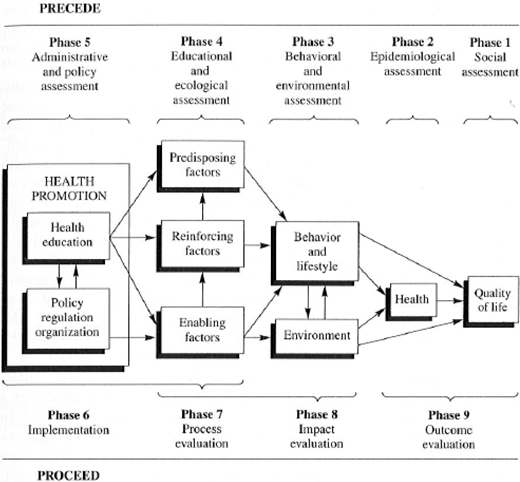
PRECEDE-PROCEED Model
PRECEDE-PROCEED Model
Reinforcing factors are those rewards or incentives that motivate people to continue existing behaviors, such as vicarious reinforcement, peer influence, et cetera. Enabling factors include programs, services, policies, resources, et cetera. Site supervisors' perceptions of their roles, responsibilities, and online facilitated internship programs can be classified into three domains: predisposing, reinforcing, or enabling. These domains have direct and indirect effect on the success of internship programs.
Purpose of the Study
While studies highlight the advantages of an internship and extensive research exists as to the value of an internship within the graduate study program, currently, according to the National Council for Accreditation of Teacher Education (2010), there is not a large research base on what makes clinical preparation effective particularly in online facilitated programs such as the one under examination for this study. More specifically, there is little research drawing upon the perceptions of site supervisors who represent a key component in the internship process, in regard to evaluating the process (Church, Dickinson, Everhart, & Howard, 2012; Shannon, 2008). Acknowledging the significance of site supervision in the process of the internship, the researchers in this study were led to examine the concerns and perceptions of the site supervisor. Current data on the perceptions of the site supervisor in an online facilitated program is needed to improve the online facilitated internship and to assist the library science profession in producing the most prepared graduates. As this crucial element was lacking, this study will fill the gap regarding current data addressing the perceptions of site supervisors and will maximize effectiveness and efficiency of online facilitated internship programs.
This research looks specifically at the perceptions of site supervisors regarding the roles and responsibilities of those serving interns in the field. This is an important step toward empowering site supervisors of library and information science interns to meet the educational needs of those they mentor, and to offer avenues for improving and strengthening the library science professional internship at the program under review.
Research Questions
Applying a PRECEDE model, the following research questions were examined:
What were site supervisors' perceptions regarding predisposing, enabling, and reinforcing domains for the online facilitated internship program?
Were there significant relationships between the three domains and the success of the internship program?
What did qualitative data clarify for us regarding the site experience?
Method
Participants
A total of 72 participated in the study from May 2010 to July 2012. The data were collected over a five-semester time period. One person who was not a certified site supervisor was removed from the study, which leads to 71 valid responses. The participants worked in different settings, with 43.1% at primary settings, 24.6% at intermediate settings, and 32.3% at secondary settings. They held a wide range of leadership positions such as principal, chair, manager, media coordinator, team leader, director, school improvement team member, etc.
According to the literature there is a general conclusion that leadership style and situational differences are strong predictors of association (Edwards, 1994; Hunt & Liebscher, 1973). Findings from Vecchio (1987) indicate that supervisors are likely to react differently based upon individual preferences. Therefore the use of demographic scores for participants of this study was limited.
Design and Procedure
A mixed methods design was implemented to collect both quantitative and qualitative data at the same time. This study used a 19-item web-based survey, “Internship Site Supervisor Perceptions Survey” (ISSPS), which was developed by the author/researcher to gather data. Content validity was used to assess the validity of the instrument and to measure the language and construction of questions. Additionally a pilot study was conducted with a small group of practicing librarians, a convenience sampling of 8 librarians engaged in supervisory positions. The Internship Site Supervisor Perceptions Survey included both open- and closed-ended questions.
Data were collected from a predetermined population including certified librarians nationally, but predominantly from the southeastern United States, because this was the area in which most of the interns served. Individuals who have served as site supervisors for online facilitated internships were invited to participate in the confidential survey. The research population was accessed through the cooperation of fieldwork supervisors affiliated with the graduate school under review. Site supervisors included individuals from public schools, including large, small, rural, and urban. Surveys were sent to site supervisors at the end of each student internship experience. Site supervisors were questioned about their experiences and perceptions during the process of intern supervision in the library science program. The university's institutional board approved the research prior to implementing the study.
Measures
The Internship Site Supervisor Perceptions Survey included 15 closed-ended questions and four open-ended questions in order to collect data on site supervisors' perceptions regarding the online facilitated internship program. Four questions asked participants to report their leadership position, working setting, certified librarian status, and supervisor status.
Ten questions tapping predisposing domain, enabling domain, and reinforcing domain were measured with a 5-point Likert scale (1 = strongly disagree, 5 = strongly agree), excepting one question which asked the length of the internship and used a dichotomous response option.
Predisposing Domain
Two questions measured supervisors' self-confidence in having the skills necessary to mentor interns in best practices, including appropriate use of resources and technologies, and in feeling comfortable with the internship (Cronbach's alpha = .85). One question reflected the need of additional preparation for site supervision.
Enabling Domain
Five questions explored the length of the internship, the clarity of expectations for an internship supervisor and the role in the assessment of an intern's performance made by the university's department of library science, and the university program supports available when supervisors had questions about an internship (Cronbach's alpha = .80, n = 5).
Reinforcing Domain
Two questions assessed the perceived values of the internship for both the intern and the school program or organization, addressing the benefits of hosting an intern and whether they would continue taking interns from the department (Cronbach's alpha = .81, n = 2).
Open-Ended Questions
Four open-ended questions asked participants to list any specific areas on which the graduate internship program should focus for site supervisors' preparation, necessary skills and challenges of being a site supervisor, and any comments about experience with the intern.
Outcome
One question was used to evaluate the success of the internship process based on site supervisors' views.
Analysis
The quantitative data were analyzed using SPSS 20.0. Variables for three domains were regrouped into dichotomous variables (agree versus disagree and neutral). Fisher's exact tests were conducted to examine the relationship between predisposing, enabling, and reinforcing domains and success of the internship.
For the open-ended questions, the texts were read and coded. The notes were made directly on the print out, and key words, sentences, and quotes were highlighted. A twoperson coding team, first and second authors, independently coded qualitative data into themes and reviewed the texts again when there were discrepancies. Then the themes were grouped into similar categories based on the PRECEDE model.
Results
A majority reported positive perceptions of all three domains including self-confidence in assuming supervisor responsibilities, preparation and program support from the university, and incentive for continuing the internship. Fisher's exact tests showed that there were significant associations between success of the internship and predisposing domain (except for additional preparation) and reinforcing domain (p's < .05). Clarity of expectation from the university was the only significant factor influencing success of the on-site internship in enabling domain (p < .05) (Table 1).
Associations Between PRECEDE Model Domains and Success of Internship
| PRECEDE Model components | Success of Internship | P* | |||
|---|---|---|---|---|---|
| Agree | Disagree/Neutral | ||||
| N | % | n | % | ||
| Predisposing Domain | |||||
| Necessary skills | .03 | ||||
| Agree | 57 | 86.4 | 2 | 40.0 | |
| Disagree/Neutral | 9 | 13.6 | 3 | 60.0 | |
| Felt comfortable | .00 | ||||
| Agree | 64 | 97.0 | 1 | 20.0 | |
| Disagree/Neutral | 2 | 3.0 | 4 | 80.0 | |
| Additional preparation | .31 | ||||
| Agree | 14 | 21.2 | 2 | 40.0 | |
| Disagree/Neutral | 52 | 78.8 | 3 | 60.0 | |
| Enabling Domain | |||||
| Adequate length of internship | .12 | ||||
| Yes | 59 | 89.4 | 3 | 60.0 | |
| No | 7 | 10.6 | 2 | 40.0 | |
| Clarity of expectation | .049 | ||||
| Agree | 55 | 83.3 | 2 | 40.0 | |
| Disagree/Neutral | 11 | 16.7 | 3 | 60.0 | |
| Clarity of role | .17 | ||||
| Agree | 56 | 86.2 | 3 | 60.0 | |
| Disagree/Neutral | 9 | 13.8 | 2 | 40.0 | |
| Program supports: contact | .09 | ||||
| Agree | 60 | 90.9 | 3 | 60.0 | |
| Disagree/Neutral | 6 | 9.1 | 2 | 40.0 | |
| Program support: responses | .37 | ||||
| Agree | 41 | 63.1 | 2 | 40.0 | |
| Disagree/Neutral | 24 | 36.9 | 3 | 60.0 | |
| Reinforcing Domain | |||||
| Perceived values | .04 | ||||
| Agree | 62 | 95.4 | 3 | 60.0 | |
| Disagree/Neutral | 3 | 4.6 | 2 | 40.0 | |
| Continue taking interns | .01 | ||||
| Agree | 59 | 90.8 | 2 | 40.0 | |
| Disagree/Neutral | 6 | 9.2 | 3 | 60.0 | |
Note:*p corresponds to the Fisher's exact test.
The analyses of open-ended responses yielded six themes grouped in predisposing, enabling, and reinforcing domains: technology skills, collaboration/communication skills, direct contact, adequate information, time, and positive feedback (Table 2). When asked about any specific area the graduate program should focus upon to prepare site supervisors better, respondents focused on two themes: direct contact from the university with the site supervisors sharing adequate information about roles, expectations, internship design; and expectations and guidance regarding the time commitment of interns. For example, one stated, “I would recommend direct contact with the site supervisor as to role and expectations of the program.” The response also implied that additional information was needed by the site supervisor. As another participant explained, “information prior to the beginning of the internship would have been helpful: what to expect, how many hours, what types of items was the intern expected to perform within the internship time period.”
Themes Generated from Qualitative Data
| Themes | Quotations |
|---|---|
| Predisposing Domain | |
| Technology skills | “In-depth knowledge of software packages that allow creativity in creation of PR.” |
| Collaboration/communication skills | “Excellent communication skills both written and oral; ability to interact with coworkers and understand the needs.” |
| Enabling Domain | |
| Direct contact | “I would recommend direct contact with the site supervisor as to role and expectations of the program.” |
| Adequate information | “I would have liked to have had a better understanding of how the hours would be carried out.” |
| Time | “Hours required should have guidelines such as a certain number of hours of consecutive attendance not just an hour here or there for the entire internship.” |
| Reinforcing Domain | |
| Positive feedback | “This has been a rewarding experience for both intern and Supervisor.” |
When asked about any specific challenges as a site supervisor, respondents indicated time was an issue of concern. Additional time would help interns to see and get involved in the full scope of the job within the established schedule. One participant described, “for an opportunity to receive the full benefit of the internship, students should work through longer periods of time during a day.” Another pointed out “if an intern is only at the site one day a week for x number of weeks, they never get to see a project from the planning stages through to the end.” Even more specifically, another shared, “hours required should have guidelines such as a certain number of hours of consecutive attendance not just an hour here or there for the entire internship.” These concerns mirror National Council for Accreditation of Teacher Education's (2010) report on clinical preparation and partnerships of educators regarding the time commitment of interns.
When asked about any specific skills which the graduate program should focus on to prepare students for professional positions, participants indicated two important skills: technology skills and collaboration/communication skills. Respondents mentioned a broad range of technology, such as technology in teaching, in-depth knowledge of software packages, smart boards, and iPads. As they explained, “use of technology, development of collaborative lessons in classroom using technology, more software training, current instructional technology strategies for engaging student learning,” and “they will need familiarity with upcoming technologies and currently in use technology such as LCD projectors, DVD burners, mobies, PowerPoint clickers, digital camcorders.” Participants also specified that “interpersonal skills and collab orative abilities” were important for job preparation. For example, one participant reported a need for “excellent communication skills both in written and oral, ability to interact with coworker and understand the needs of patrons, in depth knowledge of current and emerging technology.” Another stated, “I feel that a clear set of guidelines for students on how to interact with site supervisors would be appropriate and effective.”
The last question in the survey asked for any comments the supervisors would like to make. Most who responded to this question gave very positive feedback about their experiences with interns. They appreciated the great jobs that their interns did and emphasized that this valuable experience is beneficial to supervisors, organizations, and interns and they are more likely to continue taking interns from the university. For example, “I enjoyed working with Ms. D [the intern's name], it was a pleasant and learning experience for both of us”; “This has been a rewarding experience for both intern and supervisor'; “I would welcome other interns in the future”; “very enjoyable, a benefit to the school and intern.”
Discussion
Through a quantitative lens, it is clear that factors from the predisposing domain such as self-confidence in having necessary skills and feeling comfortable as a site supervisor influenced the success of internship, but the reality is that most school based site supervisors have not had training prior to the assumption of the role as on-site supervisor. They are usually not presented with any standardized mandates to follow because each school is unique and interns are permitted flexibility to a degree, to shape their experience to fit their needs and interests. In this study, participants generally reported confidence in their skills needed for supervision. However, a supervision training seminar prior to the experience could be beneficial and is indicated by the significant factor influencing success of the internship exposed in this study. That factor— “clarity of expectation”—could be addressed with prior training. A more intentional approach in communicating roles and expectations to future site supervisors would be helpful.
Results from qualitative data showed that technology skills and communication skills were listed by site supervisors as the two most important abilities that students should have to be prepared for the future professional positions. This finding also reflects the importance of those same skills for supervisors, highlighting the value of continued professional development for professionals in the field. The field is changing rapidly and those who aspire to serve as site supervisors have a responsibility themselves to continue to develop skills to make optimum use of evolving technology. The findings, regarding technology and communication skills, provide valuable information about what areas the university program should focus on to prepare graduate students for the internship positions and to provide site supervisors for their roles as well.
When the quantitative and qualitative data are integrated, the evidence strongly suggests that the perceived values and benefits of mentoring interns play an important role to reinforce the supervisors to continue taking interns in the future and ensure the success of internships. Participants appraised that this rewarding experience was valuable not only for interns, but for schools and supervisors as well. Site supervisors gained information about areas future school librarians must focus upon as a result of their programs, effectively keeping them abreast of new developments. Site supervisors were able to interact with educators of future librarians, sharing issues they found to be significant. Supervising an intern kept them informed about current trends and best practices as a result of networking with both intern and university supervisor. Further, site supervisors found benefits in being able to add the practice of supervision to their school service and to develop themselves as leaders through the process. These benefits together support career satisfaction as, through their work with interns, participants were able to both support and impact their chosen profession.
Site supervisors indicated that internship programs should focus on directly contacting site supervisors prior to the beginning of the internship. Detailed information about the entire internship, especially the clarity of expectations in all aspects, is very important to enable site supervisors to assume their responsibilities. Although guidelines may have been developed and shared, these guidelines are general, dealing with the professional dispositions, knowledge, skills and competences needed for an effective school librarian. The concerns expressed by some participants as to more information with clearer goals and practical guidelines, defined requirements, roles and expectations of the program, and how the internship hours would be planned, indicates a need for increased structure within the experience.
The findings of this study will lead to the updating of guidelines for on-site supervisors for the program under review. The findings are, however, limited to the study of one university program. A comparison of multiple programs would provide results that could be generalizable to other school library education programs. This study could be implemented at any library science school.
Conclusions
This study, designed to gather data to strengthen the internship, provided direction toward program improvement. In general, the current study points to the need for development of a site supervisor training program to help prepare future site supervisors for the expectations of the role and to enhance communication between university program and internship site supervisor. To professionalize and support the on-site supervisor more effectively, ongoing professional networking opportunities are strongly recommended. These experiences will help with role preparation, evaluation of the intern, and understanding of the program. A mandatory prerequisite for site supervisor training would assist in the development of a sustainable pool of well prepared, skilled site supervisors. The significance of this essential role should not be overlooked. It is recommended that site supervisor training be developed, implemented and followed by longitudinal research aimed at following and observing site supervision for program improvement. Researchers for this study are responding to results of the study by developing a proposal for a program to provide training for site supervisors based upon data from this study.
This study brings attention to the significance of the dedicated, skilled professionals in the field who will serve as supervisors to pre-service librarians and emphasizes the need to support these professionals who are serving online programs with well-designed training to help enhance their skills as supervisors. A series of focus group interviews among site supervisors and university program supervisors to gain more information about issues that may not have been addressed in the current study could bring additional insight and is also recommended for future study. The perspectives of site supervisors must be thoughtfully cultivated, considered, and used for responsive online program improvement. Further research should encompass additional library science programs.

