


This study investigated the effects of assessment strategies and self-regulated learning skills on students' learning and perceptions of assessment for learning. The results revealed no statistically significant difference in the immediate skill-based and cognitive learning outcomes, but peer assessment teams scored significantly higher than the other teams in the subsequent collaborative writing process. Significant interaction effects were found in the participants' perceptions of assessment for learning. The findings support the emphasis on assessment processes and long-term learning benefits, and provide further evidence for the benefits of using assessment strategies and the value of learner assessment experience in online environments.
Introduction
Developing assessment techniques is one of the four primary research goals identified by Oncu and Cakir (2011) in their analysis of research priorities and methodologies for online learning environments. This research priority becomes more meaningful when considering Shepard's (2000) call of moving away from the traditional, incompatible measurement culture and aligning assessment with the emergent, new beliefs about learning. The focus of assessment has been moving away from the traditional assessment of learning to assessment for learning, with a greater emphasis on formative assessment processes that are empowered by various learning technologies. The goal of this study was to investigate self-regulated learning (SRL) in formative assessment processes involving students in online learning.
The formative assessment activity investigated in the study was essay writing. Potentially, essay writing can be an effective way for assessing an array of academic competencies such as conducting a literature search, synthesis, the articulation of ideas, and critical judg ment (Pain & Mowl, 1996). Essay writing, as a popular method used in traditional classrooms, enables learners to practice these academic skills and develop higher order thinking and learning. It continues to be one of the most commonly designed learning activities in online environments where learners are faced with significant writing demands. Written projects play an important role in online instruction, even in disciplines that are normally not writing intensive, and both students and online classrooms actually exist as formal writing such as essays or projects, or informal writing such as emails, discussions, or chats (Gray, 2002). However, research in essay writing has revealed problems that include the difficult, time-consuming evaluation process, reliability and subjectivity in grading, and communication of expectations and feedback (Pain & Mowl, 1996; Read, Francis, & Robson, 2005). Among the recent efforts to identify strategies to improve essay writing for assessment purposes, a number of researchers (Covic & Jones, 2008; Orsmond & Merry, 2011; Orsmond, Merry, & Reiling, 2005; Weaver, 2006) investigated students' perceptions of feedback, resubmission, tutoring, or assessment formats. By Kraiger, Ford, and Salas' (1993) categories of learning outcomes, this study investigated learners' skill-based, cognitive, and affective outcomes measured by online learners' essay writing, a content knowledge test, and perceptions of assessment respectively. In summary, this study focused on the following research questions:
What are the effects of assessment strategies (instructor/teaching assistant assessment, self-assessment, and peer assessment) and SRL skills on online learners' skill-based and cognitive learning outcomes?
How do the perceptions of assessment for learning change among the online learners with different levels of SRL skills after an essay assessment and rewriting process?
Do SRL skills and assessment strategies have an impact on online learners' collaborative writing following an individual essay rewriting and assessment process?
Review of Literature
Formative Assessment
Black and William (1998) stated that formative assessment is effective in improving learning regardless of educational levels and content areas. Sadler (2010) restated the importance of formative assessment and quality of feedback in improving learning. In essence, formative assessment activities can encourage opportunities for further learning and conceptual development through feedback, interpretation, and dialogue between instructors and learners. While the view of learning as simple transmission may lead to a suspicion of formative assessment, a central argument regarding formative assessment in higher education is that students should be able to become self-regulated learners through formative assessment and feedback (Nicol & Macfarlane-Dick, 2006). However, very often, students may view formative assessment activities as “inauthentic, pointless, and another hurdle to jump over, or something that is unconnected with real learning” (Norton, Tilley, Newstead, & Franklyn-Stokes, 2001, p. 271). Education reformers have been calling attention to the decline of formative assessment and the reduced opportunities for students to benefit from receiving feedback (Gibbs & Simpson, 2004). Black and McCormick (2010) reemphasized the disconnect between a formative approach to enriched learning and the prevailing use of summative assessment in practice. Is involving students in assessment an answer to these problems? Selfand peer assessment are considered the important strategies to achieve the purpose of formative assessment (Brew, Riley, & Walta, 2009). Improved reflection, sense of autonomy, and the ability to refocus or regulate learning are among the frequently cited benefits of selfand peer assessment (Brew et al., 2009; Falchikov, 2005; Fitzpatrick, 2006). These reflect the very essence of the connection between formative assessment and SRL skills. In their review of online formative assessment, Gikandi, Morrow, and Davis (2011) indicate that formative assessment needs further research and diverse techniques that can help increase learner self-regulation. Within the scope of formative assessment research, the following review focuses on SRL, assessment and SRL, and student perceptions of assessment.
SRL
SRL theories represent different concepts and ideas from various theoretical perspectives in learning, including information-processing theories, Piaget's constructivist philosophy, Vygotsky's sociocultural theory, and social learning theories (Paris & Paris, 2001). Various SRL models have been developed over the past two decades based on different theoretical approaches. Models developed by Borkowski (1996), Winne (Winne & Hadwin, 1998), Boekaerts (Boekaerts & Niemivirta, 2000), Pintrich (2000), and Zimmerman (2000, 2001) are frequently cited in the SRL literature. Pintrich (1999) proposes that regardless of the various theoretical perspectives SRL theories draw upon, one important feature shared by most SRL models is cognitive and metacognitive strategy use in controlling and regulating learning.
Both Zimmerman's cyclic model of SRL and Pintrich's general framework for SRL are social cognitive models of SRL (Schunk, 2001; Zimmerman, 2001, 2008). Social cognitive models are guided by Bandura's (1986) social learning theory, or social cognitive theory, which emphasizes observation and modeling and explains human functioning and learning by describing the triadic interactions between personal factors, environmental factors, and behavior. Within the social cognitive theoretical framework, self-regulation is “situationally specific,” “context dependent,” and has a “cyclical nature” (Schunk, 2001, p. 125). In this study, self-regulated learning is defined as “the application of general models of regulation and self-regulation to issues of learning, in particular, academic learning that take places in school or classroom contexts” (Pintrich, 1999, p. 451). Using a general time-ordered process consisting of four phases, Pintrich's (2004) general framework of SRL describes SRL processes in four domains that include cognition, motivation and affect, behavior, and context. Even though the four phases—forethought, monitoring, control, and reflection—are presented by a time-ordered sequence, the model does not suggest a linear or hierarchical order, and they may occur in any order or may even occur simultaneously with other phases (Pintrich, 2004; Schunk, 2005). Using the social cognitive framework, Pintrich and colleagues developed the Motivated Strategies for Learning Questionnaire (MSLQ) (Pintrich, Smith, Garcia, & McKeachie, 1991) to measure students' motivation and use of learning strategies.
Assessment and SRL
How is assessment related to SRL? The two concepts seem to be mutually dependent and beneficial. Assessment encourages planning and regulation of future SRL processes, whether the assessment comes from others or from within (Zimmerman, 2000). The motivational effect of any type of assessment may be the first issue to consider. The ideal positive influences of assessment on students correspond to the characteristics of SRL, such as “greater responsibility, sustained effort, awareness about learning, and personalized mastery goals” (Paris & Paris 2001, p. 95). According to Paris and Paris, the direct relationship between assessment and SRL is only clearly demonstrated in nonacademic majors such as music recitals or sports contests, though self-assessment may introduce “the same passion and autonomy” to the academic assessment of learning for self-improvement. They proposed that as one of the three areas of SRL research demonstrated in classrooms, self-assessment involves all the three important domains of SRL: cognitive, affective, and motivational processes. In line with the research on SRL, self-assessment, or self-evaluation, builds a natural link between assessment and SRL. Self-evaluation occurs constantly when effective learners compare their progress against task criteria, make judgments, interpret feedback, and then adjust their activities or efforts to make up the gaps between actual and ideal performance (Butler, 2002). Students who are more effective at self-regulation can generate better feedback and use the feedback more effectively (Butler & Winne, 1995).
However, Davis and Neitzel (2011) found a mismatch between SRL and teachers' assessment practices and attributed the mismatch to meeting the needs of various assessment stakeholders. This mismatch may exist in all learning environments in which teachers control the assessments. How can students become more effective at self-regulation through assessments that are traditionally controlled by teachers? Aiming at helping students become self-regulated learners, the model of formative assessment and feedback presented by Nicol and Macfarlane-Dick (2006) conceptualizes the active role students can play in feedback processes and the shift of responsibilities between students and teachers in formative assessments. This model and Nicol's (2009) study best summarized how assessment can be used to enhance SRL by involving students in formative processes. Roebers, Schmid, and Roderer's (2009) study provided evidence for the impact of metacognitive monitoring and control processes on elementary students' test taking behavior. One important linkage between SRL and assessment may be the theoretical concepts that inform each area. For example, the self-observation and self-judg-ment processes described by Schunk (2008) within a social cognitive theoretical framework are similar to self-assessment in terms of making judgments against standards; and for assessment, theoretically, strategies that involve students to improve their effective use of feedback may encourage learner autonomy, self-monitoring and a high level of SRL. It would be ideal if the comparison between the concepts from each area could be more comprehensive by their theoretical bases.
Why Perceptions Matter?
Research on students' perceptions of assessment may also have shed some light on how assessment is related to SRL. Brown (2011) suggested that how students perceive assessment relates meaningfully to academic achievement, and his review of eight research studies that used the same self-reported questionnaire about students' perceptions of assessment provided evidence for students' conceptions of assessment as one essential part of self-regulation. Struyven, Dochy and Janssens (2005) explained that students' perceptions of assessment and approaches to learning significantly influence each other.
Numerous studies (e.g., Can & Walker, 2011; Covic & Jones, 2008; Crossouard & Pryor, 2009; Ellery, 2008; Lizzio & Wilson, 2008; Orsmond et al., 2005; Orsmond & Merry, 2011; Patton, 2012; Segers, Nijhuis, & Gijselaers, 2006; Weaver, 2006; Wennergren, 2011) investigated students' perceptions of assessment and they indicate the important connection between perceptions of assessment, the effectiveness of assessment, and students' learning gains. Factors investigated in these studies include students' perceptions of assessment formats, tasks and demands, feedback, feedback providers, resubmission, power dynamics, assessment processes, and faculty perceptions. Perception of assessment is as important as the other factors that influence effective strategies for involving students in assessments, such as modeling or communication regarding assessment processes.
Students' perceptions of assessment or test formats have a major impact on their learning and it is important to explore students' perceptions of assessment methods while examining the effects of those methods on learning (Biggs, 1996; Boud, 1990; Ramsden, 1992; Winning, Lim, & Townsend, 2005). Improving students' perceptions of assessment for learning may help meet the long-term goals of alternative assessments and avoid the effects of “assessment backwash,” defined by Ramsden (1992) and Biggs (1996) as the countereffect of assessment on the achievement of long-term learning outcomes. In this study, student perception of assessment for learning was investigated among the online learners with different levels of SRL.
Method
Participants
Three hundred forty-one students enrolled in an online general education course completed the MSLQ (Pintrich et al., 1991). A total of 264 participants (141 males and 123 females) completed all the steps (see Figure 2) in the research study; 94.7% of them ranged from 18 to 24 years of age. The final analysis included a total of 125 participants with lower MSLQ (≤ 4.26, the median) and 139 with higher MSLQ (> 4.26, the median).
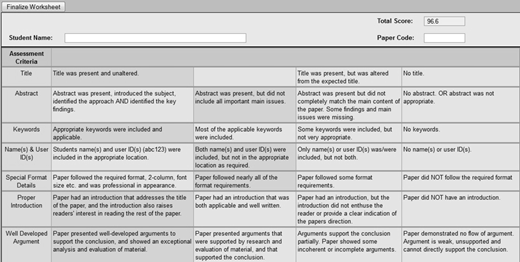
Screenshot of the Rubric Worksheet for Peer Assessment Group
Screenshot of the Rubric Worksheet for Peer Assessment Group
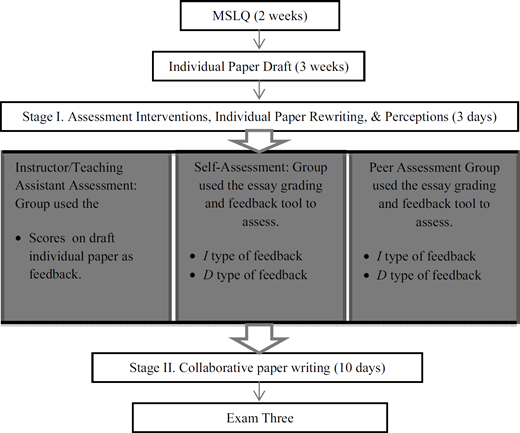
The Course and Materials
The three-credit, semester-based general education course was offered online through ANGEL, a learning management system (LMS), to resident on-campus students. The content was about energy sources and consumption, environmental consequences and challenges, and energy alternatives. During the research process, the learners needed to complete two papers that were required assignments in the course: an individual two-page research paper, and then an enhanced five-page team paper as the result of a collaborative essay writing process. Each learner chose one of the four topics provided by the instructor. The paper topics were entirely based on the course content, which was about energy and the environment. By the course requirement, both the two-page and five-page papers should follow the single spaced, two-column format with Times New Roman font size 10, so the papers were longer than the normal one-col-umn papers. The course usually had a large enrollment of 400 to 500 students every semester with one faculty member. It was virtually impossible for the instructor and the teaching assistants to provide written feedback other than the scores to all the students on papers. This might not be unusual in many large-enrollment online courses in higher education. However, it is obvious that this write-and-submit approach was not the most effective way to help learners achieve the intended learning outcomes from scientific writing.
Essay Assessment Criteria and the Interactive Essay Grading and Feedback Tool
When completing the individual papers, all participants had access to the assessment criteria in the form of a static rubric on the course site. The criteria with detailed descriptions included eighteen criteria under five categories: format; content; citations, quotations, and references; readability; and general quality. One criterion of material integration was added specifically for team paper writing. The criteria were arranged in order of how one reads the paper rather than the importance of the criteria.
The assessment criteria were also presented in the essay grading and feedback tool, which is an interactive essay grading and feedback tool created for this research study. The tool can be customized for any assessment activity that uses a rubric. Figure 1 shows the customized rubric worksheet used in the treatment sessions for assessment. The teaching assistants, the instructor, and the control group participants did not access the tool until after the research process was completed. Participants in the self-assessment and peer assessment treatment groups used the tool, which generated automatic feedback and a total score upon their selection of the assessment criteria in the cells.
The assessors were also able to edit the generic feedback report automatically generated by the tool. The assessment criteria and the essay grading and feedback tool were reviewed and critiqued by multiple faculty members and researchers who were experienced with essay grading, writing assignments, and assessment. Two types of feedback adapted from Chi's (1996) categorization of feedback were embedded in the two different versions of the rubric worksheet respectively: a simple and informational type of feedback (labeled as I type of feedback) consisting of correctional or reinforcing feedback, and a detailed type of feedback (labeled as D type of feedback) consisting of didactic or suggestive feedback. The following are examples for the two types of feedback embedded in the interactive tool on references.
Example of I type of feedback:
The reference section showed original research. The reference section had the appropriate format with very few errors.
Example of D type of feedback:
Some evidence of a research effort. Much more is desirable for a quality product, which also requires quality sources. If you are unsure on how to do research go see a librarian. Double check the example provided on the Team Briefing Page and correct your errors. This submission was mostly easy to read (good readability). Make sure you read over your submission (or have others do so) to catch the occasional hang-up.
Procedure
Using a block randomization approach (Kang, Ragan, & Park, 2008), the researcher assigned participants with higher and lower levels of SRL skills to three groups that used instructor/teaching assistant assessment, self-assessment, and peer assessment, respectively. Within the self- and the peer-assessment groups, the participants were randomly assigned to two subgroups in which they received either the I type or the D type of feedback when using the essay grading and feedback tool. All research activities were completed online through the ANGEL Learning Management System, except the essay assessing and rewriting process, which was conducted in on-campus computer labs and took an average of an hour for the participants to complete. A 1-hour face-to-face training session was held for the graders to ensure good interrater reliability in grading.
The data collection had two stages (see Figure 2). Stage 1 involved individual paper writing, assessment interventions, and learners' perceptions of assessment for learning, and Stage 2 was the collaborative paper writing process. In Stage 1, the control group participants received the scores returned by their teaching assistants as the feedback. They could access the assessment criteria in the form of a static rubric on the course site that everyone had access to when reviewing and rewriting their papers in the lab sessions. The self-assessment group participants used the essay grading and feedback tool to assess their own papers, and they then reviewed and revised their papers according to the feedback as well as the score generated by the interactive tool. The peer-assessment group participants used the essay grading and feedback tool to assess an anonymous paper written by a peer classmate, reviewed the feedback and the score for the assessed paper, and then had the opportunity to review and revise their own papers. Due to the workload for the participants in the peer assessment process, the peer assessment participants had the option of completing the rewriting and the uploading of the rewritten papers to the course site the next day. The teaching assistants assessed the rewritten two-page individual papers without seeing the self-assessment and peer assessment results, and they assigned scores on the two-page papers. The participants completed the perceptions questionnaire before they left the lab session.
In Stage 2, the researcher assigned the participants to teams based on their level of SRL skills within the assessment treatment groups so that members on one team had similar paper assessing and rewriting experience. The participants completed and submitted the five-page team papers within 10 days of starting the collaborative process. The instructor assessed the five-page team papers and assigned grades, which were used for summative purposes. The participants took the content knowledge test one month after the treatment sessions.
Criterion Measures
The MSLQ
The MSLQ (Pintrich et al., 1991) was used to measure learners' SRL skills in this study. The MSLQ instrument has a long history of use with undergraduate college student populations, and it has been used widely in research studies, publications, and practical uses for student advising, learning improvement, or learner development (Duncan & McKeachie, 2005). MSLQ is a self-report instrument with a total of 81 items presented in the format of 7point Likert-type, from 1 (not at all true of me) to 7 (very true of me). The motivation scales have 31 items and the learning strategies scales have 50 items. The reliability of MSLQ based on previously reported coefficient alphas were: alphas range from .62 to .93 for the motivation scales, and from .52 to .80 for learning strategies scales (Duncan & KcKeachie, 2005).
The scale score is the mean score of all the items in that scale. Ratings for the negatively worded items were reversed before calculating the mean score for a scale to keep consistent with all the positively worded items. Thirteen questions were modified in wording to reflect the nature of the online course and participation in this study. For example, Question 73 was changed to “I spend the appropriate amount of time (weekly) in the course” instead of the original “I attend this class regularly.” In addition to Question 73, Questions 33, 42, 46, 47, 50, 53, 63, 67, 68, 69, 79, 81 were also slightly changed in a same manner. The modified instrument ( Appendix A) had similar or even stronger reliability as previously reported in the literature: Cronbach's α range from .61 to .91 for the motivation scales, and .66 to .81 for learning strategies scales.
Learners' Perceptions of Assessment Questionnaire
The self-report questionnaire included questions about participant background information and perceptions of assessment for learning. The perception statements ( Appendix B) were adapted from Maclellan's (2001) questionnaire investigating students' general perceptions of assessment and Falchikov's (1986) questions about self- and peer-assessment. Question clusters from the original instruments were used, for example, the purpose of assessment, value of feedback, and marking from Maclellan's questionnaire. The first 12 statements were about general perceptions of assessment and the other 10 statements were about perceptions of self- and peer-assessment, respectively. The control group participants only had the general perception statements in their version of the questionnaire. The participants rated their assessment perceptions on a 5-point Likert scale of “strongly disagree,” “disagree,” “undecided,” “agree,” and “strongly agree.” These questions were presented by a design method called “post-then-pre” proposed by Rockwell and Kohn (1989). The “post-then-pre” design intends to help researchers obtain accurate information about the participants by administering the pretest at the end of a study. The participants were able to rate their perceptions of assessment after as well as before experiencing the assessment strategies at the end of the treatment sessions. The perception statements had high reliability: for general perceptions questions, Cronbach's α = .87; and for perceptions questions about self- and peer-assessment, Cronbach's α = .89.
The Content Knowledge Test
Exam Three, a content knowledge test, was a timed online quiz that included 35 multiplechoice questions and 10 short-answer questions, of which students chose three or four to answer. The topics (for example, “meaningful government and state actions to reduce CO2 emission”) covered in both the individual and collaborative team paper writing were part of the content being assessed in the exam.
Results
Results From the Individual Paper Writing Process
Using Pillai's trace, there was no significant effect of either the assessment strategies, F(4, 512) = .503, p = .734, or assessment strategies with different types of feedback, F(8, 504) = 1.227, p = .281, on learning outcomes measured by the scores on the two-page individual papers and Exam Three. There was no significant effect of SRL skills on learning outcomes for either the assessment strategies, F(2, 255) = 2.143, p = .119 or the assessment strategies with types of feedback, F(2, 251) = 2.571, p = .078. No significant interaction was found.
Mixed factorial ANOVA was conducted to examine the effects of assessment strategies and two levels of SRL skills on student perceptions of assessment for learning before and after the use of different assessment strategies in the essay rewriting and assessment process. Table 1 presents the mixed factorial ANOVA results for the participants' general perceptions of assessment for learning.
Repeated Measures Results for General Perceptions of Assessment for Learning
| SS | df | MS | F | |
|---|---|---|---|---|
| Time × assessment strategies with types of feedback (TC, SI, SD, PI, PD) | 23.365 | 4 | 5.841 | .383 |
| Time × MSLQ by higher and lower | 27.246 | 1 | 27.246 | 1.789 |
| Time × assessment strategies with types of feedback × MSLQ | 235.252 | 4 | 58.813 | 3.861* |
| Error (time) | 3777.867 | 248 | 15.233 |
Notes: 1. Time refers to “post” and “pre” in the questionnaire. 2. TC = instructor/teaching assistant assessment, SI = self-assessment with I type of feedback, SD = self-assessment with D type of feedback, PI = peer assessment with I type of feedback, PD = peer assessment with D type of feedback. 3. MSLQ = The Motivated Strategies for Learning Questionnaire. The median score of 4.26 was used to group a total of 341 participants into higher and lower level of self-regulated learning skills. 4. *p < .01.
There was a significant disordinal interaction between time (post and pre), assessment strategies, and MSLQ, F(4, 248) = 3.861, p < .01. A means comparison is plotted in Figure 3, which shows the interaction between time and assessment strategies for lower and higher MSLQ in two plots. The means plots suggest that the participants showed an overall more positive general perception of assessment after the treatment sessions for students with either higher or lower MSLQ. However, the interaction between time and assessment strategies differs for the participants with different level of MSLQ.
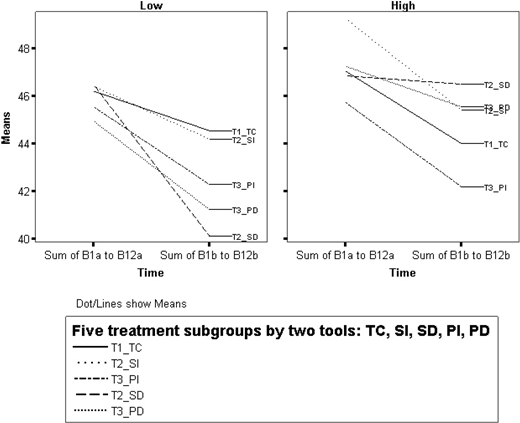
Time × Assessment Strategies with Types of Feedback Interactions for Lower and Higher MSLQ
Time × Assessment Strategies with Types of Feedback Interactions for Lower and Higher MSLQ
No significant interaction effect was found for the participants' perceptions of self- or peer-assessment for learning as a complete scale. There was a significant main effect of time, F(1, 166) = 40.757, p < .01, and a significant main effect of MSLQ, F(1, 166) = 7.841, p < .01. No follow up tests were performed for the two dichotomous factors. Findings from the mixed factorial ANOVA analyses for each perception statement revealed effects on dif ferent aspects of the perceptions of assessment for learning. For statements that do not have significant interaction effects, a significant main effect of time, p < .05, was found except on two statements about self-assessment: self-assessment is enjoyable, F(1, 167) = 3.408, p > .05, and self-assessment is easy, F(1, 167) = 2.992, p > .05. This suggests that the participants did not show significant perception change in terms of self-assessment being enjoyable or easy regardless of their MSLQ level. Table 2 presents the significant interaction effects for seven perception statements.
Repeated Measures Results for Perceptions of Assessment for Learning
| Interaction Effects | SS | df | MS | F | |
|---|---|---|---|---|---|
| Assessment motivates learning. | Time × Assessment Strategies × MSLQ? | 3.854 | 4 | .963 | 2.547* |
| Assessment is used for diagnosing students' learning. | Time × Assessment Strategies × MSLQ | 3.548 | 4 | .887 | 3.037* |
| Feedback prompts discussion with the instructor or the teaching assistant. | Time × Assessment Strategies × MSLQ | 3.273 | 4 | .818 | 2.457* |
| Feedback helps understand assessment. | Time × MSLQ | 1.649 | 1 | 1.649 | 5.472* |
| Feedback improves learning. | Time × Assessment Strategies × MSLQ | 4.541 | 4 | 1.135 | 3.992** |
| Self/peer assessment makes me more independent. | Time × MSLQ | 1.239 | 1 | 1.239 | 4.299* |
| Self/peer assessment helps me develop confidence. | Time × Assessment Strategies × MSLQ | 2.524 | 3 | .841 | 3.400* |
Notes: 1. Time refers to “post” and “pre” in the questionnaire. 2. Assessment strategies: TC = instructor/teaching assistant assessment, SI = self-assessment with I type of feedback, SD = self-assessment with D type of feedback, PI = peer assessment with I type of feedback, PD = peer assessment with D type of feedback. 3. MSLQ = The Motivated Strategies for Learning Questionnaire. The median score of 4.26 was used to group a total of 341 participants into higher and lower level of self-regulated learning skills. 4. *p < .05. **p < .005.
In summary of the additional analysis of individual perception statements, the significant three-way interactions listed in Table 2 suggested that the interactions between time and assessment strategies are different for students with higher MSLQ and those with lower MSLQ. The interaction between time (Post and Pre) and MSLQ suggested that after the treatment sessions, even though in general those with higher MSLQ had more positive perceptions, participants with lower MSLQ showed a significantly greater perception change than those with higher MSLQ in these areas: whether feedback helps them understand assessment, whether feedback improves learning, and whether self or peer assessment makes them more independent (see Figure 4).
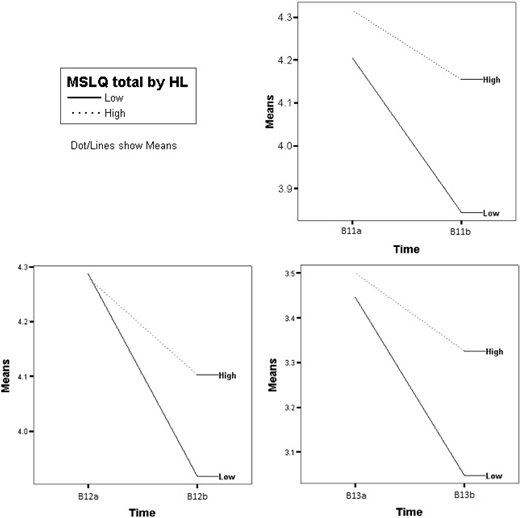
Time × MSLQ Interaction Plotted by Means Comparisons
Time × MSLQ Interaction Plotted by Means Comparisons
Results From the Collaborative Paper-Writing Process
In Stage 2 the collaborative writing process, a total of 68 teams were eligible for the final analysis. Most of the teams were 4-member teams, with about 15 teams of 2 or 3 members and only 1 team of 5 members. A few teams had a smaller number of members than they were originally assigned because some participants dropped out of the teams. Those who dropped out of the teams either completed the five-page paper individually or dropped the course at this stage. These cases were removed from the final analysis. Table 3 reports the descriptive statistics for the five-page team paper scores by assessment strategy and higher or lower MSLQ scores. The teams with lower MSLQ scores show a slightly higher standard deviation than those with higher MSLQ scores in the control and self-assessment groups. Compared with other groups, the peer assessment group has the lowest standard deviation (SD = 5.972), which suggests the lowest variability in the five-page paper scores.
Descriptive Statistics for the Five-Page Paper Scores by Treatment
| Groups by Assessment Strategy | MSLQ Score | M | SD | N |
|---|---|---|---|---|
| TC | Lower | 82.82 | 8.109 | 11 |
| Higher | 79.92 | 7.391 | 12 | |
| Total | 81.30 | 7.707 | 23 | |
| SA | Lower | 85.30 | 8.433 | 10 |
| Higher | 86.50 | 7.868 | 12 | |
| Total | 85.95 | 7.955 | 22 | |
| PA* | Lower | 86.30 | 5.519 | 10 |
| Higher | 89.54 | 6.132 | 13 | |
| Total | 88.13 | 5.972 | 23 | |
| Total | Lower | 84.74 | 7.394 | 31 |
| Higher | 85.43 | 8.047 | 37 | |
| Total | 85.12 | 7.706 | 68 |
Notes: 1. Scores could range from low (0) to high (100). 2. Assessment strategies: TC = instructor/teaching assistant assessment, SA = self-assessment, PA = peer assessment. 3. *p < .01.
Two-way ANOVA results generated a significant main effect for assessment strategies on the 5-page collaborative paper score, F(2, 62) = 4.814, p = .011. The ANOVA results did not find a significant main effect of MSLQ, F(1, 62) = .083, p = .774, nor a significant interaction, F(2, 62) = 1.045, p = .358. between assessment strategies and MSLQ. Scheffé post hoc test results indicated that the teams in the peer assessment group scored significantly higher than those in the instructor or teaching assistant group on their five-page team paper (mean difference = 6.83, p < .01). This is also supported by the 95% confidence interval, which indicates that it is within the lower and upper bounds.
Discussion
Assessment Experience
The results from the individual paper writing, assessing, and rewriting process revealed no statistically significant difference in the immediate skill-based, such as scores on individual papers, and cognitive learning outcomes among learners with higher and lower levels of SRL skills. However, in the subsequent collaborative writing process, peer assessment teams scored significantly higher on the five-page team paper than the teams that only received a score from the teaching assistants as the feedback to improve their two-page individual paper.
First, the findings indicate that self- and peer-assessments with either informational or detailed feedback alone may not improve online learners' performance immediately. However, the peer assessment experience may have triggered active reflection on the feedback and an active application of that information in their team paper process. Also, peers in collaborative authorship may have further strengthened the feedback dialogue as described by Nicol (2010), so the peer assessment experience and collaborative authorship could be the main factors that helped the peer assessment teams score significantly higher than the teaching assistant assessment teams in collaborative writing. The findings also indicate that active assessment experience may be more helpful than the actual feedback students passively receive from others, and this may be especially true when students do not act upon the feedback delivered to them, not created by themselves. Sadler (2010) suggested that feedback as telling is a passive, transmission model of teaching and learning, and as an alternative, peer assessment should be used as an instructional strategy and not just as assessment in order to create effective learning environments. The findings from this study provided evidence for Sadler's suggestion about feedback and peer assessment.
The findings about peer assessment experience also align with one important dimension of the assessment literacy concept theorized by Smith, Worsfold, Davies, Fisher, and McPhail (2011), which is the opportunity for students to practice judging examples of actual student work. Furthermore, the findings support what Vickerman (2009) stated about peer assessment, which is that it “can help self-assessment by judging the work of other students and gaining insight into their own performances” (p. 222). Self-assessment is considered as a key component of self-regulation (Nicol, 2009), so it may be meaningful to investigate in future research how self-assessment that stems from peer assessment is different from standalone self-assessment in terms of improved assessment literacy, reflection, self-regulation, or other long-term benefits.
Second, besides peer assessment experience and collaborative authorship, one important question to consider is which would be more meaningful: immediate learning outcomes, such as essay scores, or long-term outcomes, such as reflection and self-regulation. In this study, assessment strategies have no significant effect on learners' immediate learning outcomes, such as scores on individual papers. The findings indicate that involving students in assessment may help students develop long-term competencies and skills resulting from their assessment experience, although it is not clear how the experience of self-assessment differs from that of peer assessment. Many studies about self- or peer-assessment focus on assessment processes, such as criteria, transferable skills, or grading reliability, rather than learning outcomes. Some researchers proposed that it is helpful to focus on processes instead of outcomes (Orsmond, Merry, & Reiling, 2000; Rust, Price, & O'Donovan, 2003), or on learningoriented assessment that fosters students' future learning rather than only their immediate outcomes (Boud & Falchikov, 2006). However, in practice, there seems to be a mismatch in the expectations between assessment practices guided by a transmission model and assessment strategies considered as active, social practices. Due to this mismatch, the focus on long-term outcomes is likely to be ignored when implementing assessment strategies that involve students. To improve what Smith et al. (2011) theorized as assessment literacy, specifically the ability of judging peers' or one's own work, assessment processes should be planned with a focus on enhancing students' experience as assessors, especially as peer assessors.
Perceptions of Assessment for Learning
The study investigated online learners' perceptions of assessment for learning in two aspects: (1) general perceptions of assessment and (2) perceptions of self- and peer-assessment. The significant interaction effect found in the analysis of the general perceptions indicated a significant difference in the participants' general perceptions of assessment before and after the treatment sessions when considering the participants' different levels of SRL skills. Findings from the mixed factorial ANOVA analyses for each perception statement indicated that students had significant changes in their perceptions after the treatment sessions except in two statements: self-assessment is enjoyable, and self-assessment is easy. These findings are consistent with other findings in the literature in terms of the difficulties in conducting self-assessment. These also lead to a future research recommendation in this paper about the difference between standalone self-assessment and that stems from peer assessment. The significant interaction effects presented in Table 2 emphasize the role of SRL in examining assessment strategies and students' perceptions. Even though in general those with higher MSLQ had more positive perceptions, participants with lower MSLQ significantly improved their perceptions after the treatments in these areas: whether feedback helps them understand assessment, whether feedback improves learning, and whether self or peer assessment makes them more independent. These findings provide evidence for the ultimate goal of successfully implementing formative assessments that involve students: assessment-focused online learning activities could function as instructional strategies to help students with low SRL skills to improve self-regulation and learning.
Many studies investigating students' perceptions of innovative assessment find that students show very positive attitudes toward alternative assessment, while some find mixed responses (Sluijsmans, Dochy, & Moerkerke, 1998). Findings in the literature suggest that the common reasons for mixed responses mostly result from students' lack of confidence in conducting assessment activities, especially when they believe that assessment is traditionally the teachers' responsibility (Lin, Liu, & Yuan, 2001; Sluijsmans, Moerkerke, Dochy, & van Merrienboer, 2001). The significant interaction effects regarding learners' perceptions reinforce the value of utilizing assessment techniques involving students to improve learners' perceptions and SRL, as well as the need of further research. Therefore, when introducing innovative assessment approaches, it may be important to provide students with opportunities to understand their active role in the new assessment approaches, to contribute to the assessment process, and to practice their judging abilities. A few research reports (e.g., Brown, 2011; Smith et al., 2011) have already highlighted the importance of understanding students' conceptions of assessment and the need to increase the tacit knowledge needed for assessment. Improving assessment literacy and changing perceptions of assessment may be the first necessary steps toward an effective online formative assessment culture.
Implications
First, the results showed no significant differences in the individual paper scores but peer assessment group had significant increase in scores on team papers. This implies that learning activities involving students in assessment could be at least as effective as those assessed or monitored only by the instructors in terms of immediate learning outcomes such as essay scores. As higher education is faced with challenging resource constraints that may impact student experience, effective practices, especially assessment feedback, are becoming critical (Price, Handley, Millar, & O'Donovan, 2010). Instructors may help online learners achieve active learning without creating extra grading tasks. For large-sized online courses, this may help reduce faculty workload while enhancing online learners' reflection and active participation in the feedback process. However, course designers and instructor should consider learners' prior assessment experiences and providing necessary training modules in online courses.
Second, the significant interactions between perceptions of assessment and SRL and the theoretical connection between assessment and SRL skills imply that when designed and implemented well, assessment-focused learning activities may help improve learners' perceptions, learning, and performance. This may be especially important in online learning environments where all students are expected to be self-regulated learners; however, not every student has good SRL skills inherently. Ultimately, it is the course developer's responsibility to recognize the importance of instructional design that considers involving students in assessment, instead of adhering to the traditional view of the passive role of students in assessment and believing that assessment is only the instructor's responsibility.
Limitations and Future Research
When generalizing the findings, it is necessary to recognize several limitations of this study. The assessment task for this study was scientific essay writing. Therefore, a generalization of the results is limited because essay writing in science and the humanities may differ in terms of the expectations, the writing itself, criteria, generating and utilizing feedback, and therefore, the assessment process as well. Research studies (Higgins, Hartley, & Skelton, 2001; Keys, Hand, Prain, & Collins, 1999; Krause, 2001; Lea & Street, 1998) suggest that collaboration and communication may be an important feature of scientific essay writing and assessment. However, the research design did not include elements to reflect this feature due to the lack of training for the students in using the assessment tool, the limitation of using a convenience sample, and the limited number and time of the treatment sessions.
Learners' SRL skills were only investigated by higher and lower levels differentiated by a median of the total scores. Therefore, there is a limited understanding of the relation between assessment and the concepts within the SRL framework, such as goal orientation, self-effi-cacy, metacognitive self-regulation, critical thinking, effort regulation, peer learning, and time and study environment management. Future research can use a different method of dividing MSLQ into higher and lower levels or use the subcategories of the self-regulation concept (for example, strategy use, metacognitive self-regulation, or motivation) to further investigate the role of SRL skills in the context of assessment learning activities.
Conclusion
New paradigms are arising in the culture of assessment involving students, and these include: students' assessment experience versus teachers' transmission of feedback, process versus outcomes, and long-term versus immediate benefits. In line with the objective measurement culture, teachers' transmission of feedback leads to more immediate outcomes and benefits, while the active learning from students' assessment experience aligns with constructivist, process focused, and long-term benefits such as self-regulation. Educators should not be deterred from integrating assessment-focused learning activities into their teaching only because they see no immediate effects, such as increased essay scores. With the advancement of learning technologies used for assessment, effective pedagogical strategies should be adopted to expand learners' exposure to and involvement in online formative assessment activities so that they can achieve the intended long-term learning benefits such as critical reflection and self-regulated learning.
Appendix A The Revised MSLQ
Part A: Motivation
In a class like this, I prefer course material that really challenges me so I can learn new things.
If I study in appropriate ways, then I will be able to learn the material in this course.
When I take a test I think about how poorly I am doing compared with other students.
I think I will be able to use what I learn in this course in other courses.
I believe I will receive an excellent grade in this class.
I'm certain I can understand the most difficult material presented in the readings for this course.
Getting a good grade in this class is the most satisfying thing for me right now.
When I take a test I think about items on other parts of the test I can't answer.
It is my own fault if I don't learn the material in this course.
It is important for me to learn the course material in this class.
The most important thing for me right now is improving my overall grade point average, so my main concern in this class is getting a good grade.
I'm confident I can learn the basic concepts taught in this course.
If I can, I want to get better grades in this class than most of the other students.
When I take tests I think of the consequences of failing.
I'm confident I can understand the most complex material presented by the instructor in this course.
In a class like this, I prefer course material that arouses my curiosity, even if it is difficult to learn.
I am very interested in the content area of this course.
If I try hard enough, then I will understand the course material.
I have an uneasy, upset feeling when I take an exam.
I'm confident I can do an excellent job on the assignments and tests in this course.
I expect to do well in this class.
The most satisfying thing for me in this course is trying to understand the content as thoroughly as possible.
I think the course material in this class is useful for me to learn.
When I have the opportunity in this class, I choose course assignments that I can learn from even if they don't guarantee a good grade.
If I don't understand the course material, it is because I didn't try hard enough.
I like the subject matter of this course.
Understanding the subject matter of this course is very important to me.
I feel my heart beating fast when I take an exam.
I'm certain I can master the skills being taught in this class.
I want to do well in this class because it is important to show my ability to my family, friends, employer, or others.
Considering the difficulty of this course, the teacher, and my skills, I think I will do well in this class.
Part B: Learning Strategies
When I study the readings for this course, I outline the material to help me organize my thoughts.
While working on this course, I often miss important points because I'm thinking of other things.
When studying for this course, I often try to explain the material to a classmate or friend.
I usually study in a place where I can concentrate on my course work.
When reading for this course, I make up questions to help focus my reading.
I often feel so lazy or bored when I study for this class that I quit before I finish what I planned to do.
I often find myself questioning things I hear or read in this course to decide if I find them convincing.
When I study for this class, I practice saying the material to myself over and over.
Even if I have trouble learning the material in this class, I try to do the work on my own, without help from anyone.
When I become confused about something I'm reading for this class, I go back and try to figure it out.
When I study for this course, I go through the readings and my notes and try to find the most important ideas.
I make good use of my study time for this course.
If course readings are difficult to understand, I change the way I read the material.
I try to work with other students from this class to complete the course assignments.
When studying for this course, I read my notes and the course readings over and over again.
When a theory, interpretation, or conclusion is presented in the course site or in the readings, I try to decide if there is good supporting evidence.
I work hard to do well in this class even if I don't like what we are doing.
I make simple charts, diagrams, or tables to help me organize course material.
When studying for this course, I often set aside time to discuss course material with a group of students from the class by e-mail, Instant Messenger, or face-to-face meetings.
I treat the course material as a starting point and try to develop my own ideas about it.
I find it hard to stick to a study schedule.
When I study for this class, I pull together information from different sources, such as lectures posted online, information from other classes, and general knowledge.
Before I study new course material thoroughly, I often skim it to see how it is organized.
I ask myself questions to make sure I understand the material I have been studying in this class.
I try to change the way I study in order to fit the course requirements and the instructor's teaching style.
I often find that I have been reading for this class but don't know what it was all about.
I ask the instructor to clarify concepts I don't understand well.
I memorize key words to remind me of important concepts in this class.
When course work is difficult, I either give up or only study the easy parts.
I try to think through a topic and decide what I am supposed to learn from it rather than just reading it over when studying for this course.
I try to relate ideas in this subject to those in other courses whenever possible.
When I study for this course, I go over my notes and make an outline of important concepts.
When reading for this class, I try to relate the material to what I already know.
I have a regular place set aside for studying.
I try to play around with ideas of my own related to what I am learning in this course.
When I study for this course, I write brief summaries of the main ideas from the readings and my notes.
When I can't understand the material in this course, I email another student in this class for help.
I try to understand the material in this class by making connections between subjects and concepts.
I make sure that I keep up with the weekly readings and assignments for this course.
Whenever I read or hear an assertion or conclusion in this class, I think about possible alternatives.
I make lists of important items for this course and memorize the lists.
I spend the appropriate amount of time (weekly) in this course.
Even when course materials are dull and uninteresting, I manage to keep working until I finish.
I try to identify students in this class whom I can ask for help if necessary.
When studying for this course I try to determine which concepts I don't understand well.
I often find that I don't spend very much time on this course because of other activities.
When I study for this class, I set goals for myself in order to direct my activities in each study period.
If I get confused by the material, I make sure I sort it out afterwards.
I rarely find time to review my notes or readings before an exam.
I try to apply ideas from course readings in other class activities such as assignments and team work.
Appendix B Perception Statements for Self-Assessment Groups
Assessment motivates learning.
Assessment is used to grade/rank.
Assessment is used for diagnosing students' learning.
Assessment is used to evaluate teaching.
Uses implicit criteria to assess.
Uses explicit criteria to assess.
Marking strengthens knowledge.
Marking develops thinking.
Detailed feedback is helpful.
Feedback prompts discussion with the instructor or the teaching assistant.
Feedback helps understand assessment.
Feedback improves learning.
Self-assessment makes me more independent.
Self-assessment makes me think more.
Self-assessment makes me learn more.
Self-assessment helps me develop confidence.
Self-assessment makes me more critical.
Self-assessment makes me work in a more structured way.
Self-assessment is time saving.
Self-assessment is enjoyable.
Self-assessment is easy.
Self-assessment is helpful/beneficial.

