


Introduction
The current economic challenge for students seeking to compete on a global scale with an advanced education has contributed to a continual rise in online enrollments (Allen & Seaman, 2010; Stern, 2009). However, Allen and Seaman (2012) reported that a persistent state of less than excellent online courses threatens to undermine the value of the educational opportunities afforded by the Internet. In spite of ongoing advances in instructional technologies, web-based higher academic pedagogies continued to demonstrate a lack of quality well into the new millennium (Means, Toyama, Murphy, Bakia, & Jones, 2009). The Means et al. (2009) study reported a perception of lower academic standards, a perception that was underscored with reports of an ongoing distrust in online courses by a majority of U.S. educators (Allen & Seaman, 2012). From an international perspective, Daniel (2007) referred to online pedagogies in India as “mostly rubbish” (Affordability section, para. 15), while Uysal and Kuzu (2009) reported a problem in Turkey of there being no online standards in existence. With due recognition of those making significant progress in improving the quality of online courses, there remains a question of whether enough is being done to meet growing learner demands.
Given the perceptions of lower quality pedagogies, the practice of designing products for online learning has been called into question in terms of the competencies and leadership of instructional designers needed to improve the situation (Beaudoin, 2007; Kowch, 2009; Naidu, 2007; Reeves, Herrington, & Oliver, 2004; Sims & Koszalka, 2008). This notion aligns with the business and trade industries where improvement of products has been inextricably linked to leadership. For example, after an earlier departure, Steve Jobs returned to Apple in 1997 and led an industry in reenvisioning ways of communicating information (Isaacson, 2011). Who can deny that his leadership resulted in exemplary products? From these observations, it was proposed that instructional design (ID) may likewise improve the quality of its products with applied leadership skills and attributes. To explore the assumption, a study was undertaken that would look for a potential connection between the quality of ID products and an instructional designer's leadership competencies as perceived by those in practice.
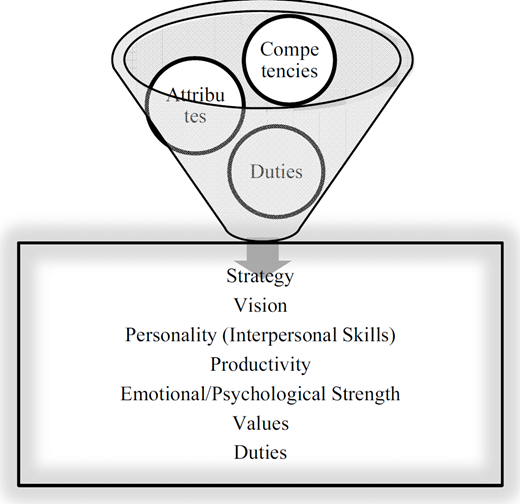
Often meaningful perceptions and insight will come through discourse, therefore, this was the method selected for exploring the issue of leadership's impact on quality. The in-depth interviews conducted with an international panel of expert practitioners resulted in themes that conveyed perceptions of practice from lived experiences. In the form of expressions from the participants, the findings extended the standards usually understood for ID and listed by groups such as the Association of Educational Communications and Technology, the International Board of Standards for Performance, Training, and Instruction, and others (Association of Educational Communications and Technology, 2012; International Board of Standards for Performance, Training, and Instruction, 2000; Larson & Lockee, 2009). Specifically, the participants identified competencies for designing online pedagogies with the added dimension of applied personal leadership characteristics deemed critical to high quality designs—competencies, attributes, and duties. In addition, specific instructional strategy components known to predict engagement (National Survey of Student Engagement, 2008) and learner satisfaction (Sims & Stork, 2007) framed a model for leading the online design process forward—strategy, vision, personality (interpersonal skills), productivity, emotional/psychological strength, values, and duties (mentoring). As a result of these findings, the goal of the study was satisfied: to determine that leadership from instructional designers has the potential for significant impact on the quality of online higher educational products.
Background and Context
Although standard ID competencies are well established for best practices, leadership competencies, per se, were nearly absent from the most common taxonomies (Association of Educational Communications and Technology, 2012; International Board of Standards for Performance, Training, and Instruction, 2000). While reviewing the cross-disciplinary literature, the topic of leadership as a characteristic of instructional designers was found to be just as scarce. There were, however, suggestions from a few that instructional designers may lead in the online educational transformation currently taking place by changing inappropriate or misapplied practices (Beaudoin, 2007; Kowch, 2009; Naidu, 2007; Reeves et al., 2004; Sims, 2006). Reports included ineffective and irrelevant design practices such as text-based lectures loaded into a course room, practice components, multiple choice quizzes and tests, a deck of slides for learning enhancement, a term paper—and not much more (Naidu, 2007). The notion of a misalignment of ID theory and online course designs resonated with Smith (in Fullan & Scott, 2009) who declared a quiet crisis in higher education from dependence on a model that “flies in the face of what we know about how people learn, the opportunities that technology presents to transform the educational enterprise and our historic record of failure with a rapidly diversifying population” (p. 20). In addition, Fullan and Scott (2009) observed a lack of leadership competency and experience in those expected to be change agents in education.
Questioning the design approach of adapting traditional course designs to the online environment was important because studies were beginning to show that people actually learn differently interacting with a computer than with a human interface (Dede, Dieterle, Clarke, Jass-Ketelhut, & Nelson, 2007; Spiro & DeSchryver, 2009). On-screen text and slideshows may not have been engaging the learner, yet various other multimedia affordances were showing promise to capture and hold attention (Thompson et al., 2011). Dede et al.'s (2007) study found positive learning outcomes from students connecting and learning in new ways—with computers, essentially a new mode of learning (Beaudoin, 2007). Later, Dede's (2011) explorations took him into mobile learning and the potential of engaging in learning in new ways with cell phones. The challenge for educators and producers of pedagogical materials is how to progress along the same continuum as the new paradigm of digital learning affordances and deliveries.
To explore the problem of quality in online course designs further, the small yet compelling study presented in this paper purposed to identify the critical ID competencies needed to produce effective designs for modern learning. Acting on the assumption that there may be a connection between leadership competencies—or characteristics in general—and an approach to the design process, a Delphi-style inquiry method of studying expert instructional design professionals in the context of practice was proposed and undertaken. Guiding the study were underlying questions: What is needed to improve quality in online courses? What characteristics of ID are lacking to meet global socio-educational demands? What competencies may be critical for designing effective pedagogies for a changing student body with diverse needs?
Theoretical Framework
A literature review was conducted for purposes of grounding the phenomenological study in an identifiable theoretical framework. The review and analysis of a comprehensive body of scholarly work revealed that leadership theory encompasses copious philosophies, competencies, traits, attributes, attitudes, positions, and roles, which have been applied to a multitude of professions (Zenger & Folkman, 2009). With this complexity in mind, it seemed good to narrow the focus of the study to leadership competencies and attributes. Competency theory provided a relevant lens of exploration in that it was defined as behavioral demonstrations of knowledge, skill, and ability (Dooley et al., 2007). The definition was significant to the study as ID practice similarly demands multiple competencies (Larson & Lockee, 2009). Complicating the explication of these concepts, it was discovered during the literature analysis that both leadership and competency were described with an array of terms often used interchangeably. For example, competencies were also referred to as skills, abilities, or capabilities. Likewise, the term attributes included character, traits, emotions, temperament, or values. To mitigate obfuscation, and to gain a consensus of meaning for each term that would inform the study, the review resourced from a multi-disciplinary body of literary work. The cross-disciplinary approach was necessary, as the ID literature revealed a paucity of conceptualizations or theories of leadership in personal practice or of its impact on the field and its products (Kowch, 2009; Spillane, Halverson, & Diamond, 2004). Thus, a synthesis of theories framed the study being presented with multivariate characteristics of leadership categorized under competencies and attributes.
Leadership Competencies
A major predictor of work performance is competency, which enables the accomplishment of a desired or prescribed task (Dooley et al., 2007). Through this lens, competency may be characterized as a category of leadership with multiple components, of which strategy, vision, personality (interpersonal skills), and productivity are defined below.
Strategy
It was widely reported that leaders are competent in developing a strategy that will include plans for the future (Scott, Coates, & Anderson, 2008). In other words, leaders are proactive in that they reflect on methods to prevent problems rather than wait for difficulties to happen. The Scott et al. (2008) study revealed that participants perceived leaders as engaging others in the process. In addition, leaders were said to collaborate for best possible solutions to not only current but unforeseen challenges. Others found that leaders know where to go for the answers or for the knowledge to create answers; they make the right connections in a network of colleagues and technology (Siemens, 2004; Sims, 2006).
Vision
A leader is commonly known to possess vision and, as such, is recognized as a visionary (Howard & Wellins, 2008). A leader also serves as a “steward of the vision” according to Sackney and Mergel (2007, p. 94). This person not only sees the vision, lives the vision through decisions, conveys the vision to others, enlivens others to the vision, promotes the vision but, at the same time, encourages others to share in the vision (Kouzes & Posner, 2007). As visionaries, leaders are expected to recognize innovation, forward-thinking, uniqueness, and “respond creatively to world conditions and the current state of their own society” (Greenleaf, 1977, p. 321). Scott et al. (2008) regarded this characteristic as having a capacity to see the big picture and to “read and respond to a continuously and rapidly changing external environment” (p. 11), a notion that may also be interpreted as possessing global competency (Reimers, 2009).
Personality
It was clear that leaders convey personality within the dynamics of human interaction. The notion resonated with a pervasive claim in literature that communication is the linchpin of all successful leadership (Sergiovanni & Corbally, 1984). Additionally, Sergiovanni and Corbally (1984) defined interpersonal competence as an essential force of leadership. Moreover, demonstrations of genuineness stem from active communication. Kouzes and Posner (2007) described leaders as being caring, confident, and respectful to others. In contrast, Howard and Wellins (2008) cited the primary cause of failure by a large percentage of organizational leaders as the lack of interpersonal skills in their mentors. In other words, the essentials of being a leader were not being conveyed.
Productivity
Last, competency is evident in a leader's productivity; they understand how to work hard to achieve results. In fact, a study of leadership roles in virtual teams showed that learners preferred a producer (Chen, Wu, Yang, & Tsou, 2008), a leader who gets things done, over a visionary. In this capacity, leaders are expected to do what they say (Argyris & Schön, 1992) by converting words to action. In brief, results are produced by skillful leaders who have been trained in specific capacities, and work until the job is done.
Leadership Attributes
Emotional/Psychological
The category of attributes of leadership included emotional/psychological strength, which is interpreted, in one, as having confidence and displaying strength in diverse ways (Kirkpatrick & Locke, 1991). Through another lens, leaders are logical, make good choices, and, according to Kepner and Tregoe (1997), think rationally. Thus, the various ways of conveying emotional strength and psychological depth may be measured in how one thinks through and responds to challenges (Scott et al., 2008).
Values
Finally, an array of values described leadership, including one who operates from conscience (Walumbwa, Avolio, Gardner, Wernsing, & Peterson, 2008) and personal convictions, and is grounded in moral and ethical principles (Covey, 1989; Senge, 2006). With significance to one of this study's key assumptions, that leadership is a predictor of quality course designs, Walumbwa et al. (2008) put forth the notion that moral leadership is a predictor of “relevant organization outcomes” (p. 91).
When considered together, the leadership competencies listed above also describe the work of a designer or an ID team, and, consequently, provide a glimpse of how leadership may link to ID practice. Therefore, enhanced leadership competencies are proposed herein as factors in activating and maintaining quality, globally-accessed learning designs.
Methodology
Research Design
For exploration into the problem of quality in online pedagogical course designs, a phenomenological study engaged expert instructional designers—who shared a common interest in resolving a mutual problem within a defined social setting (Gelo, Braakman, & Benetka, 2008; Wenger, 1998)—to participate in a Delphi-style, narrative inquiry study. Drucker (1981) said, “It is the practitioner rather than the scholar who develops the discipline, who synthesizes experience into testable concepts, that is into theory, who codifies, who finds and tests new knowledge, and who teaches and sets the example” (p. 1). Thus, an idiographic strategy proffered a means of representing practitioner reality through retrospective inquiry. The approach aided in extracting deep or hidden meanings underlying a social phenomenon—as in how instructional designers perceived the pedagogical influence of leadership attributes in practice. In the end, consensus was sought from the panel members on an emerging model of leadership.
Understanding that experience impacts decision making in practice (Ertmer et al., 2008), experts were sought out for the study in order to discover what drives the critical decisions that impact pedagogical quality of online outputs. Following purposive selection from 610 Association of Educational Communications and Technology members solicited through e-mail, 7 respondents met the qualifications of at least 7 years' experience in ID, with 3 of those in online design (those selected actually averaged over 16 years' experience). Of the 7 who qualified, 6 completed the study. In addition, the group included both males and females from U.S. and Canadian universities. Sources of data included interview transcripts from research conversations, e-mails, personal documents, and institution-generated student evaluations. For analysis of findings, constant comparison analysis (Glaser & Strauss, 1977) was used to examine data until congruency was found in the units of meaning, or themes, identified. Subsequently, the interview data was corroborated for accuracy and relevance to personal documents—online course designs created by the participants.
Data Instrumentation and Collection
As the researcher and main instrument of collection (Seidman, 2006), I asked a series of questions that were each an expansion on the general question of which leadership competencies were deemed critical to effective online ID course development. To establish credibility, as well as to guide the study, a research protocol was first developed to organize the data collection procedure. The protocol called for three rounds of in-depth interviews during which the participants were asked the same 15 semistructured, open-ended questions. However, certain questions inspired important digressive thoughts; consequently, probing questions were added for eliciting clarification and deeper meaning.
Throughout the study, ID voices were captured in the context of daily practice in their respective institutions; therefore, all data and citations used in the following analysis are confined to these settings. It is hoped that the ideas recorded may resonate with others in similar situated contexts. In this way, the participating designers were asked to inform the study from a social constructivist perspective toward construction of meaning for a shared practice (Wenger, 1998). Experts often voice common experiences which, when made known, become triggers of change in a community of practice (Campbell et al., 2009). The methodology was indicative of a Sharma-Bryer and Fox (2008) study that described the typology as an exploration into the “ultimate essence of the experience” (p. 322) from interpreted narratives, which translates into an authentic documentation of participants' voices.
Additionally included in the research protocol were several tests of reliability. Because of the intimate nature of narrative research, and to minimize influence on the participant's responses, the research was conducted while practicing bracketing—a setting aside of one's personal beliefs and ideas (Moustakas, 1994). This is not always an easy task when involved in dialog, as a researcher will naturally insert her personality, interest, and investment in the topic into the interview dynamics (Onwuegbuzie, Leech, & Collins 2008). To the extent possible, though, bracketing was accomplished through active listening and by recording copious research notes in several journals, which later provided data for reflexivity (Kaplan, 2004). For example, one journal recorded perceptions of participants' emotional states, attitudes, and responsiveness to the questions or to the interviewer. Another journal recorded the research process, researcher emotions and attitudes, and the challenges of doing research.
Indicative of a Delphi study approach, group consensus on the competencies and characteristics named was attempted and achieved. In this way, reliability and accuracy of data were established by comparing participants' answers, then feeding those back to each participant for critical comments. In addition, inter-rater reliability was provided at the conclusion of the study by an external qualitative design expert, Laurie Bedford of Walden University, who corroborated all methodologies, tests, and findings. Although the study was small in terms of number of participants, the rich data from a group of experts in ID was, at the least, a great conversation re-starter of what has been before and is still considered an important characteristic for designers of online products—leadership.
Analysis of Findings
For developing themes and theories from the data, a post hoc analysis of transcripts from over 14 hours of recorded narrative relied on NVivo9 software for a constant comparative analysis technique (Gelo et al., 2008). Phrases (units of meaning) from the transcribed data were labeled with descriptors found in the business, organizational, and educational literature. Initially, numerous phrases were coded using the general categories of leadership characteristics: competencies, attributes, and duties. However, further distillation generated the themes: strategy, vision, personality (interpersonal skills), productivity, emotional strength, values, and a duty to mentor or to pass on knowledge. The iterative process resulted in some phrases being reallocated; although, at times, the technique generated additional themes which, together, built the theories produced in the study. A list of themes, along with sample excerpts extracted from the data (abbreviated in most cases), are displayed in Table 1 to illustrate how phrases were organized into themes.
Example of Coded Phrases and Development from In-Depth Interviews
| Theme | Excerpt phrase | Participant |
|---|---|---|
| Strategy | Meet goals set by client: learning objectives, strategies, and personalized | P4 |
| Allow customer to be part of decisions | P5 | |
| Collaborative team-building | P1 | |
| Interactivity for digital learner | P1 | |
| Offer client informed options | P2 | |
| Synthesize best learning and ID theories; include real-world tasks in design | P3 | |
| Vision | Stay current | P5 |
| Backup designs with research | P1 | |
| Partners with other educators to accept new approach | P3 | |
| Productivity | Quality control by team testing each element | P1 |
| Manage time, resources; meet deadlines, prioritize, produce good product | P6 | |
| Personality (interpersonal skills) | Satisfy customer through communication and provide solutions | P5 |
| They (the team) have fun | P1 | |
| Provide expectations, build others up | P6 | |
| Emotional/psychological strength | Accept other's ideas and go with, work with ideas of others (letting go of positional privilege) | P2 |
| Values | Respect is foundation of leadership in design process | P2 |
| Accept consequences of decisions, self-leadership, self-regulation, selfmanagement, self-discipline | P6 | |
| Duties (mentor) | Model collaboration (to faculty, team) | P6 |
Since the context and focus of the study centered in the participants' daily experiences, an effort was made during the analysis phase to link the perceptions to practice. Various conceptions and perceptions comprise one's daily reality in terms of meanings and interpretations attached to the world in which one operates (Pratt, cited in Konings et al., 2005), as well as govern decisions in the work environment (Stein, Shephard, & Harris, 2011). To associate the leadership competencies and characteristics named as critical to quality course designs, participants' sample docu ments (online course designs) were evaluated using a modified Quality Matters rubric (Maryland Online, 2010) displayed in Table 2. Quality of the documents was determined from the positive ratings for course structures, including relevant and effective instructional strategies and components.
Ranking of Course Designs by a Modified Quality Matters Rubric of Standards
| Categories/Standards | Percent of Points Possible |
|---|---|
| Learner Objectives | |
| 2.3. The learning objectives are stated clearly and written from the students' perspective. | 100 |
| 2.4. Instructions to students on how to meet the learning objectives are adequate and stated clearly. | 90 |
| 2.5. The learning objectives address content mastery, critical thinking skills, and core learning skills. | 90 |
| 2.1. The course learning objectives describe outcomes that are measurable. | 80 |
| Assessments and Measurements | |
| 3.2. The course grading policy is stated clearly. | 100 |
| 3.5. “Self-check” or practice assignments are provided, with timely feedback to students. | 100 |
| 3.4. The assessment instruments selected are sequenced, varied, and appropriate to the content being assessed. | 90 |
| 3.1. The types of assessments selected measure the stated learning objectives and are consistent with course activities and resources. | 80 |
| 3.3. Specific and descriptive criteria are provided for the evaluation of students' work and participation. | 73 |
| Learner Engagement | |
| 5.2. Learning activities foster instructor-student, content-student, and if appropriate to the course, student-student interaction. | 93 |
| 5.4. The requirements for student interaction are clearly articulated. | 90 |
| 5.1. The learning activities promote the achievement of the stated learning objectives. | 87 |
| 5.3. Clear standards are set for instructor responsiveness and availability (turn-around time for e-mail, grade posting, etc.) | 70 |
A second analysis looked for an alignment between measurable objectives, relevant assessments, instructional strategies, and authentic activities, a construct considered essential to quality academic designs (Bernard et al., 2009; Sims, 2011). Finally, a summary of ratings from student evaluations of completed courses, which accompanied the participant artifacts, found three major quality determinants present: opportunities for engagement (NSSE, 2008), activities with learner-centeredness at the core (Sims & Stork, 2007), and overall student satisfaction with the courses.
Together, the results of the analyses not only identified aspects of practice deemed to be critical to its practitioners, they also suggested a relationship of leadership to higher quality pedagogies. As accuracy was considered paramount, general first impressions by the researcher of the participants' narratives, along with results of initial data analyses, were reported back to the participants in both verbal and written form for comments and elaboration. The corroborative step was completed before the third and final round of interviews and lent additional reliability to the study, as a more complete context of the research study's findings was illuminated by each individual participant's situational perspective (Seidman, 2006). To capture the essence of their unique contributions to the study, a profile of each participant was developed and is located in Appendix A.
A Model of Leadership for Id
Overall, the findings showed that a leadership mindset is positively associated with high quality work products when certain characteristics are in operation. When synthesized, the results formed a model of leadership for ID. The major categories of the model—competencies, attributes, and duties—as well as the themes listed in Table 1, are synthesized and displayed in graphic form in Figure 1. Subsequently, the model is more fully explicated in this section.
Model of Leadership for Instructional Design
Model of Leadership for Instructional Design
Strategy
When the study's participants discussed various aspects of strategy, two distinct subthemes were identified: overall design process strategy and instructional strategy for the design relevant to digital environments. It was articulated that it takes a leadership mindset to make (a) strategic decisions during the design process for the team to research best options for providing strict alignment of objectives to assessments, content, and activities; and (b) strategic decisions for the design structure to afford engagement with context-relevant learning flexible enough to adapt quickly to advancing technologies.
Design Process Strategy
The importance of the leadership competency of strategy for the design process resonated with Scott et al. (2008), who implied that leaders are competent in developing strategic, proactive plans for the future. In other words, leaders are adept at engaging others in the process to collaborate for best possible solutions to current and unforeseen problems and challenges. Dooley et al. (2007) concluded that this type of competency is evident during the creation and implementation of courses and in the critical decisions underpin high quality, effective, and relevant designs. In this capacity, leadership is essential to the building and functioning of the team for an efficacious design and development effort. Participant 6 stated this position on decision-making,
Leadership really deals more with the types of decision that one has to make and the way that one makes and executes these decisions … decision-making skill is definitely one of those leadership competencies … as well as willingness to accept the consequences of your decisions … you take responsibility for that and you don't shift it to someone else.
Another aspect of strategy is connectedness. The views of participants in this study were consistent with those (Siemens, 2004; Sims, 2006) who posited that leaders make the right connections in a network of colleagues and technology for expertly accomplishing the task at hand or anticipated. Likewise, Scott et al. (2008) posited that leaders know where to go for the answers or knowledge to create the answers to questions of design.
Collaboration with others in the field, as well as with those from other disciplines, adds a dimension of connectedness to practice from which springs inspiration for creating innovative and quality courses. Sims (2009) described a proactive mindset of collaboration and connectedness with each design stakeholder to ensure quality learning products as outcomes to ID efforts. Participant 1 stated,
I think it's the leaders who can create and will create collaborative teams made up of people with diverse perspectives and talents, skills, and expertise … the ones who will be developing the engaging, motivating, interactive, and effective learning environments for today's learners.
The study also found that a critical factor in producing quality courses is staying current with research in technologies and emerging learning theories. Connectedness and collaboration are not dissociative. One participant gave an illustration of an online research writing course he had written that resulted in a reported satisfying outcome for the learners. It required tailoring the course to the research he had done on current best practices for online learning and from collaborating with others who had already envisioned and/or designed a course like this. He also relied on media experts for the latest methods of presenting the course content; these were strategic leadership actions that resulted in an effective course. Summarizing this aspect of the strategy theme, Participant 3 expressed,
you have to have a knowledge of the latest learning theories and the latest instructional design theories in order to be a leader. You also have to be able to implement those theories, individually and in concert with each other, to achieve best practice, instructional strategies, or instructional strategy design.
At the same time, online delivery requires letting go of outdated practices for effective learning. Participant 1 recognized this need,
We've known ADDIE forever, we've known this model forever; but, the online models are different because it's a different delivery modality. So just get the most current research and information you can on what is best practices.
Design Structure Strategy
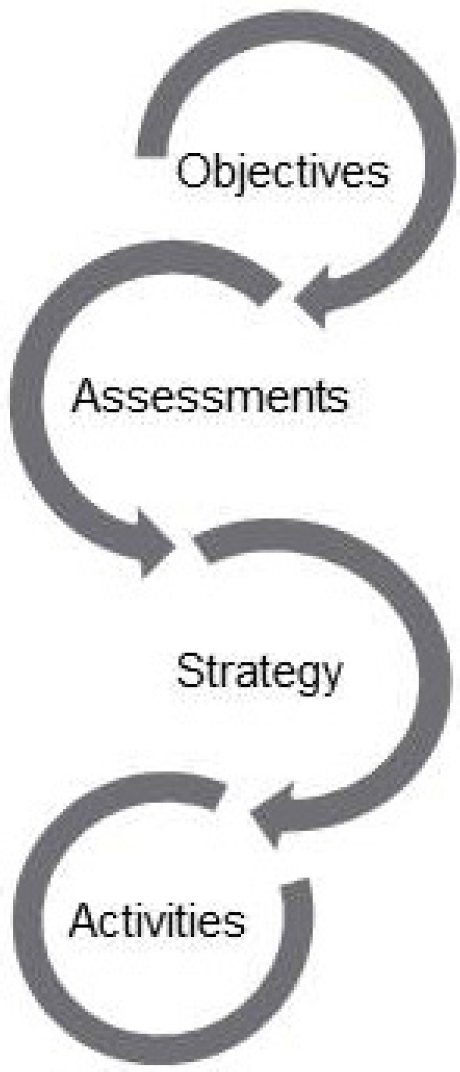
The second type of strategy linked to leadership competency was described as the ability to specify appropriate—research-based and contextual—instructional strategies with relevant learning components—to the student and to the environment, and having those align with the intended learning outcome. A depiction of this concept is conveyed in Figure 2 and articulated by Participant 6,
Components of a Well-Designed Online Course Structure
Components of a Well-Designed Online Course Structure
We would tend to focus on, as far as basic axioms of instructional design, the one that objectives are measurable and that the objectives are aligned with the assessments, and the objectives and the assessments are aligned with the content … allowing you to meet the objectives.
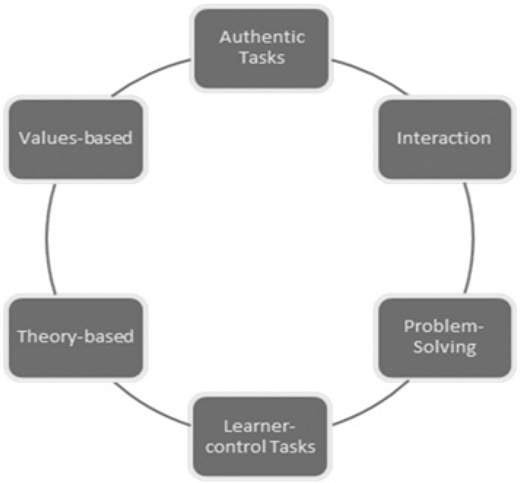
A related issue is the composition of the instructional strategy proposed for the design. Figure 3 is a compilation of the components identified by the study group as paramount to a quality online course: authentic tasks, interaction, learner-controlled tasks, problem solving, theory-based instruction, and values-based instruction. Together, the components provide a foundation of engagement and learner satisfaction through a contextualized and personalized learning approach posited by Sims and Stork (2007) as essential for effective online learning.
Components of a Well-Designed Online Course Instructional Strategy
Components of a Well-Designed Online Course Instructional Strategy
Extending the identification of strategic components in general, the expert designers' experiences paralleled examples of innovative approaches in the literature, such as social networking and mobile technologies (Velletsianos & Miller, 2008). Their perceptions underscored Reimer's (2009) conclusions that instructional designers demonstrate competence—distributive, collaborative, and participatory leadership—by specifying nontraditional resources where appropriate for, in his study, an international student body. For example, The University of the People (www.universityopeople.org) requires its designers to select open source (free) textbooks, applications, and journals to expand access and affordability for their free online program. Participant 2 expressed her strategy as having the flexibility to see a future outcome through a unique point of view and to expand her own knowledge of design components and their potential as having, as she stated,
(Velletsianos & Miller, 2008). Their perceptions underscored Reimer's (2009) conclusions that instructional designers demonstrate competence—distributive, collaborative, and participatory leadership—by specifying nontraditional resources where appropriate for, in his study, an international student body. For example, The University of the People (www.universityopeople.org) requires its designers to select open source (free) textbooks, applications, and journals to expand access and affordability for their free online program. Participant 2 expressed her strategy as having the flexibility to see a future outcome through a unique point of view and to expand her own knowledge of design components and their potential as having, as she stated,
the ability to recognize and work within the concepts of different and better. (Emphases added)
It is this kind of innovative and global thinking that demonstrates strategic leadership on the part of the instructional designers with an eye on the future.
Vision
Zenger and Folkman (2009) studied the effectiveness of leaders from a cross section of organizations and identified the characteristic of strategy in operation, which was summarized as, “to translate organizations [sic] vision and objectives into challenging and meaningful goals for others” (p. 70). The assumption is that business—and educational—institutions first develop a vision before a strategy. Likewise, instructional designers translate the vision and objectives of a client for an educational goal into a course design. From this perspective Participant 6 remarked, “I take information and I translate it into an environment that facilitates learning.” During such pursuit, the instructional designer infuses a measure of his or her own vision for what may be the appropriate structure, strategy, affordance, and learning components for a high quality learning experience. Participant 6 interpreted this competency as, “the ability to see the big picture.” With a similar perspective, Participant 1 likened the visionary role of an instructional designer to leading a sports team,
it's having this quarterbacking skill, being able to read and see things two or three tasks ahead so that you … can foresee possible issues or challenges that are going to come up and try to get those taken care of before your team is at that level.
Second, a vision for the field and for education in general was viewed by one panel member as being aware of “contemporary” and “emerging technologies.” Going beyond awareness to action, Participant 2 stated vision is,
the ability to lead in the design … implementation … development of the new things that come along.
Instructional designers may envision and design for future trends in delivering education afforded by social networking technologies (Ashbaugh, in press). The findings in this present study confirmed that instructional designers demonstrate vision by specifying nontraditional resources, such as wikis (Baggio, 2008). However, having a vision for new pedagogies carries a responsibility to investigate its potential. One participant shared a story of experimentation with a wiki before she had gained a thorough understanding of how one works. Her embarrassment over not having learned enough about the technology was obvious as she told her story of “a disaster” in front of a classroom full of students. The lesson learned was that, while freely exploring innovation, designers need to resist prescribing new technologies before doing diligent research.
Personality (Interpersonal Skills)
For the design team, communication and meaningful dynamics are essential to a quality outcome and emanate from a leader's personality. Larson and Lockee (2009) considered interpersonal communication within diverse settings as vital although how to approach others in the intimate settings instructional designers often operate within requires the characteristics of personal leadership. The study participants related that instructional designers listen carefully to arguments by the team or clients and articulate decisions from a practical, firm position. Interpersonal skills afford designers of online pedagogies an opportunity to exhibit leadership by offering academic and relevant arguments for the design, strategic, and team decisions while taking responsibility for the final outcomes. This view of leadership in action was expressed by Participant 1 as being,
able to communicate technological possibilities, letting people know what is possible with technology … being able to be quite frank with them.
Participant 6 shared his experience with leading in creating positive team dynamics,
I need to provide an atmosphere, a working atmosphere, that is not intimidating and that helps them feel that they can be creative, and that they can inject their ideas and criticisms in areas that they see needs improvement, so that they can participate with this.
Another participant stressed the need for patience and partnership by working with clients to help them see a better way, through the lens of a professional, while acknowledging the clients' and the advising subject matter experts' unique contributions.
From a synthesis of the participants' perceptions on personality, it was apparent that the typical view of communication considered essential to leadership (Howard & Wellins, 2008)—ability to articulate—may not provide a broad enough understanding. Communication assumes various forms that stem from personality—interpersonal skills and attitude, ability to convey ideas and to practice reciprocity, and respect and honesty. Clearly, in this study it was shown that an instructional designer brings a unique personality to a design with a potential for leading in its quality outcome through each dynamic of interpersonal encounters.
Productivity
The study group named most of the known competencies of productivity associated with a good ID process such as: “meet deliverables,” “lead in implementation,” “time management,” “know strengths of team,” as well as motivating skillset improvement and keeping costs down. Often, the range of tasks involved in developing academic courses within client time and budget constraints (Moore & Kearsley, 2005) demands leading in hard work as well as finishing the job, in spite of limitations by institutions bent on following what Campbell et al. (2005) deemed cost-recovery models. In the context of preferring cost over quality, Participant 4 personally witnessed a less expensive approach to practice of relying on template-based design strategies. Considered an unproductive practice, she remarked,
I understand why they were doing what they were doing … but they could never reach real high quality doing what they were doing.
Ostensibly, there is an inherent quality of leadership that emanates from an inner desire for meeting goals, for getting the job done, and for completion without sacrificing relationships. Participant 6 viewed the motivational aspect of leadership as “set[ting] the course” while another Participant 1 summarized,
[it's] using your inner relational skills to build positive, collaborative, cohesive teams to meet your deliverables … plus you have to know how to motivate them if you're going to get all this done … and helping them honor and respect each other's skills and expertise.
From an end results perspective, Participant 1 added,
The lead instructional designer sets the tone for the team. If he or she is proficient, the end product will reflect that.
Emotional/Psychological Strength
A leader possesses or gains a measure of emotional or psychological strength, which is often displayed in intentional decisions made from self-confidence and strength of purpose, although this is not always an easy task when confronting inflexible institutions and faculty with entrenched epistemological ideas (Campbell et al., 2009). Conversely, participants in this study described experiences in which an inner strength was activated to lay aside personal preference in lieu of honoring a colleague or client's theories. This attribute was seen in the previous theme of strategy when a participant recognized an outdated practice and used a better approach. Maxwell (2007) considered leaders psychologically strong when they operate on the offensive and not the defensive, with openness to other ideas, opinions, and criticisms. On the other hand, Campbell et al. (2009) found instructional designers in moral conflict with client epistemologies and often without a sense of power to make changes. To this end, the study participants cited having “a lot of patience” and “being able to work with it [emphasis added].” Clearly, instructional designers are called upon to make complex, emotional decisions within a shifting learning environment while maintaining a rational approach (Kepner & Tregoe, 2007); and this study suggests they will need leadership strengths to succeed.
Values
One area of concern for instructional designers observed was operating from a set of personal values—for the entire spectrum of stakeholders, although, particularly for the learner. One particular participant in this study stressed his lived out values and perceived personal leadership in this way:
I think that, for a leader, it really involves who you are even more than what you do … in the field of instructional design, I guess I'm looking at more character traits than competencies … I would probably still hold honesty as the most important … it's about honesty and integrity.
The personal perspective of leaders with values and the significant influence on design practice is echoed repeatedly in the literature and has been conceptualized as an individual having an inherent moral purpose (Fullan, 2001). Moreover, the Campbell et al. (2009) study revealed deeply held values in instructional designers who considered their practice a moral one with important social responsibility and influence, who “prefer[ed] to practice within a zone of moral coherence” (p. 660). For example, care is given to provide for the vulnerable, the disabled, and a multicultural learning community.
Duties
The theme of ID duties was discussed by participants mainly in the context of mentorship. With a sense of obligation to pass on knowledge gained through experience, instructional designers interpret the value of course designs to the client and to others through verbal and nonverbal interactions. In the process, there is a natural tendency to act as a mentor or instructor in the more complex nuances of design. As one participant stated about her experience with clients,
You are educating at the same time that you are doing the design … you have to double check on that all the time, that people actually understand what it is you're doing.
Adding a layered view to the mentoring process, Participant 2 articulated the need for acting in multiple capacities in her role as an instructional designer with faculty oversight,
So, mentoring the junior people just in the basics of instructional design and how it works, sometimes on an individual level, sometimes they're working in the context of the larger project, so in the project of the team … and sometimes I have teams of instructional designers, so it may be your journeyman instructional designer who is actually him or herself mentoring these juniors … to help them mentor the juniors.
A perception of diminished status by instructional designers in a Rogers, Graham, and Mayes (2007) study implicated a field tasked with educating the world from a powerless position. Campbell et al. (2009) described study subjects' views on the designer's status as a “technician that primarily implements techniques and principles” (p. 661). The study participants (Campbell et al., 2009) described feelings of low respect and held perceptions of negative impact on their professional status and influence. It was argued in the study that instructional designers suffered from an historical view of leadership as one of a positional role. However, it is increasingly evident that individuals in any role benefit from a leadership perspective (Gressick & Derry, 2010; Kowch, 2009). Beaudoin (2007) supported the notion of distributed and multiple leadership roles as important to the future of instructional technology (p. 520). More than this, the ID demands regard for the earned role of leader (DeBlois, 2005). Similar to Campbell et al.'s studies (Campbell et al., 2005, 2009), DeBlois (2005) found that a majority of faculty and practicing instructional designers shared a perspective that includes a change agent and visionary role for leading the academy on what and how to prepare for a fluid educational world. Most significant to the conclusions offered in this paper, the participants in DeBlois' study linked success with embracing the leadership attributes needed for advancing the field. Therefore, instructional designers of higher academic online pedagogies are challenged to embrace the leadership competencies and approaches that underpin exemplary practice.
Discussion
This study has shown that multiple competencies and leadership characteristics combine to create a quality product. Zenger and Folkman (2009) coded thousands of responses to their longitudinal survey study and arranged the findings into a model of five expressions of exemplary leadership—character, leading organizational change, focus on results, personal capability, and interpersonal skills. With close resemblance to their work, that which was critical for leading in quality design practice was summarized by Participant 1,
Leadership competencies are, again, having a process, having a process that works; pulling together people, making sure that the interrelationship skills are there and working; knowing who to contact for help; again, using clear communication skills to convey the purpose and timelines, keeping them on the timelines; and, trying to build a collaborative team who have buy-in and ownership of this course.
In contrast to the Participant 1's more global perspective, Participant 3 stressed his view of technical skills as critical to quality. He stated,
Unless you can implement best practice in instructional strategies, the online instruction, basically, remains back in the dark ages of instruction.… Looking at online course quality is figuring out which factors matter the most. And so when everything is said and done, leadership is about finding those factors.
Finally, Participant 2 summarized the study's findings with thoughts that underscore the significance and focus of the study: learners of the world and their futures,
I do think that the leadership qualities are integral to the course design, to the student learning, to the outcomes that you're going to get, to future transfer … not only in the subject matter content that you are doing, but also transfer in the instructional design principles and the educational precepts that are really important in higher education everywhere.
The evidence gathered in this study suggests that practicing instructional designers are capable of adopting and operationalizing leadership skills, abilities, and attitudes critical for improving course designs that equip future world citizens and leaders. As one participant expressed, “it's having a mindset.” That mindset is broad and demands a new way of thinking. A new way of thinking or a new approach is often linked to those who lead, and just as often to the development of new or better products. As online education progresses, the burden of research is continuing to show that course structures and materials written for one type of learning situation need to be different than when learning in another—and since most instructional designers in practice today were trained for traditional requirements, they may need to be re-tooled for creating relevant and quality online products. In other words, instructional designers need a reorientation in thinking about designing for an evolutionary change in educational deliveries. This is because the literature increasingly called for a response to the demands of a new paradigm of learners for an instructional design vision that will encourage global collaboration among institutions (Durdu, Yalabik, & Cagiltay, 2009) and cultures (Reimers, 2009), through best-fit models and relevant curricula for quality online learning.
Conclusion and Future Research
Arguably, leadership is a controversial concept for the typical designer who has been trained for a supportive role (Campbell et al., 2009) with very little potential for leading on a personal or positional level (Gressick & Derry, 2010), let alone lead in a new way of learning. However, the seldom discussed notion of leadership for daily ID practice (Kowch, 2009) posited in this paper was intended to be an extension of a conversation started by leaders in the field during the last decade (Beaudoin, 2007; Naidu, 2007; and others) who called for leadership recognition for an effective ID practice. The experts whose voices are heard in this paper augmented the concerns of their predecessors by adding a compelling response: to identify and understand what will enhance the quality of learning events for students from any culture who are, or hope to be, engaged in e-learning.
It is hoped that this study creates a sense of urgency for developing new research streams; for infusing leadership competency training into advanced degree programs; for furthering inquiry into practitioners' perceptions of leadership's place in daily practice, and for broadening the research variables such as gender, ethnic, and geographic effects. There is a need for continued research into the underpinning factors of creating quality academic course designs. The critical nature of improving the structures for learning outcomes was highlighted by Participant 3, who warned that if quality does not become the focus of attention and dissemination in the field of online instructional design, “the majority of the instruction is going to remain inferior.” One remedy to this indictment was suggested earlier by Hannum (2009) who admonished researchers to rigorously explore “variables that directly influence outcomes” (p. 173) of the online environment. Still others shared the need for continuing domain-specific research on strategies required in a modern learning environment (Bollettino & Bruderlein, 2008; Hong & Sullivan, 2009). Finally, Reimers (2009) promoted emergence of grassroots efforts to organize, define, and promote global competency throughout curricula—an ongoing challenge for leaders in instructional design.
To further this discussion, course designers and others are urged to pay attention to the powerful voices of experts in the field guiding this study for how increased leadership characteristics in practice will move the online education agenda forward toward more excellent products. It is further hoped that the conversation begun by instructional designers in the previous decades will gain renewed attention to the more critical elements of leadership and its role in the quality of online learning events.
Appendix A Profiles of Study Participants
Participant 1 (P1)
A full-time professor who instructs at a U.S. university with significant online course offerings, P1 leads a teacher training department from both an instructional technology and educational leadership background. While bringing 12 years of experience to the study, P1's extensive knowledge in issues of quality course designs added credibility to the findings of this study. While filtering leadership through a lens of team leader, this participant emphasized interpersonal skills and knowledge of team skills in that role and focused on a leader's need for personal knowledge, skills, expertise, and proficiency. Design leadership competencies perceived by her included knowledge of current research on best practices and team-building. P1 was concerned with increasing student learning by aligning course strategies and activities with course and program outcomes. In addition, P1 expressed a belief that leadership decisions influence designs through knowledgeable choices for affordances such as appropriate technology and texts, as well as reliance on student feedback for improvement. Moreover, the experienced practitioner attributed a team-building, collaborative process to a successful practice of quality online course design.
Participant 2 (P2)
P2 is a full-time professor with teaching, training, and research duties for a Canadian university's educational technology department with 22 years of experience in the field. While filtering leadership through a lens of a team leader role, P2 emphasized leadership as a means to an end: creating effective learning (happy clients) through team collaboration and growth. She focused on a leader's ability to lead projects, giving clients informed options, and creating innovative, team-based designs. Design leadership competencies perceived by P2 included recognizing what is “different and better” as well as respectfully conveying the validity of instructional design principles underlying the recommendations offered to clients. Additionally, P2 was concerned with increasing student learning by advocating activity theory, mediation with tools, constructivist strategies, and authentic activities for metacognitive learning. With conviction, P2 acknowledged a leader's decisions influence designs through reliance on student involvement, students as “co-builders” of contextual, situational course topics and assessments. She believes that, ultimately, leaders impact student satisfaction in these ways.
Participant 3 (P3)
With over 7 years of experience practicing in the instructional design field, P3 added knowledge to this study from multiple perspectives and background in the e-learning industry. While completing a PhD in instructional technology (at a U.S. university), P3's extensive research in assessing quality of course designs lent valuable input. While filtering leadership through a lens of expertise in and application of instructional design theories, P3 emphasized influencing others toward improving quality of online instruction. He focused on a leader's ability to implement latest instructional design strategies for best practice. Design leadership competencies perceived by P3 included knowledge of current research, partnership with developers and instructors, and influence on many from a position of expertise and from evidence-based knowledge of best practices and approaches. Furthermore, P3 was concerned with increasing student learning by affording better and current technology-based strategies, and inclusion of real-world tasks in design affordances.
Participant 4 (P4)
P4 reported a semiretired status as an expert instructional designer with 20 years of experience in the field. As an adjunct online professor with a technical university, she instructed doctoral students, and was a frequent presenter at educational technology conferences worldwide. Although withdrawing from the study after two interviews, her valuable contributions to the study were included in the findings.
While filtering leadership through a lens of modelling behavior through patience in collaborating with the stakeholders, P4 emphasized understanding and aligning with institutional and students' educational goals to improve quality of online instruction. She strives for a course design that meets the needs of all learners, no matter their learning style or mode. Design leadership competencies perceived by P4 included knowledge of current research, as well as conference attendance and presentations as ways of being a “life-long learner” in the field. P4 was concerned with increasing student learning by affording good student interaction strategies in the course room.
Participant 5 (P5)
A director of a U.S. university learning center providing faculty development in instructional technology, P5 was working to improve his practice by seeking a PhD in the field. Quality of instructional design was the focus of his work, making him a particularly qualified candidate for this study. Although study participation was limited to the first interview due to scheduling conflicts, P5's important insights were included in the findings for RQ1.
Participant 6 (P6)
As dean of online studies and distinguished lecturer of graduate studies for a U.S. university, P6 contributed significantly from his 20 years of experience in the field of educational technology and design. The scholar presented compelling and passion-filled views on the study topic. While filtering leadership through a lens of both technical and foundational skills in instructional design systems, P6 emphasized honesty, interpersonal skills, and self-regulation as critical to improving quality of online instruction. He focused on a leader's ability to stay current in the latest instructional design strategies for effectively promoting student learning. Design leadership competencies perceived by P6 include setting objectives and relevant, measurable assessments grounded in the learner's context or situation, thus, a view toward “what the learner gets out of it.” Moreover, P6 was concerned with increasing student learning by affording analysis and problem-solving strategies and activities through interaction and inclusion of real-world tasks in the design affordances.

