


Prelicensure nursing students have a final capstone, practicum, or clinical course as they transition to the professional nurse role. Generally, the student role requires increased independent practice and this can be a challenge. To maximize learning in this clinical experience, an online module was designed. This article will describe course content in the module, interactive strategies, and student comments on experience.
Background
Prelicensure nursing students’ final clinical course is generally designed to facilitate their transition to professional practice (Bourbonnais & Kerr, 2007). The senior practicum or transitions practicum is designed for the stu¬dent to partner with a practicing nurse preceptor to learn both nursing role and skills. Learning during the senior practicum is important, as the student will recognize the development of their own intellectual knowledge, psychomotor skills, and affective attitudes as they transition from nursing student to nurse graduate (Hsu, Hsieh, Chiu, &Chen,2014). Nurse preceptors are generally selected by partnering healthcare facilities. Preceptors have the experience to provide supervision, guidance, teaching, support, and mentorship to nursing students (Omansky, 2010; Yonge, Fer-guson, Myrick, &Haase, 2003). Preceptors use an array of techniques to help students develop knowledge, skills, and confidence to safely transition to professional nursing practice (Hsu et al., 2014). Clinical faculty supports the student and preceptor in this process. In order to maximize clinical learning, preparation of student, nursepreceptor, and clinical faculty is necessary. To assure that all parties appreciate course expectations and objectives,an online module was developed. This module isdesigned for the prelicensure student, preceptor, and faculty using a multifaceted approach to integrate concepts of communication and professionalism to the clinical experience.
The online methodology was selected to assure access to content at times convenient to students, preceptors, and clinical faculty. The approach also ensures that student, preceptor and faculty appreciate each role.
Description Of Online Module
The online module, “Transition to Professional Nursing Practice,” is designed to distinguish the role of the nursing student, preceptor, and faculty mentor; examine potential challenges in meeting learning objectives; and explore tools for maximizing student learning from preceptors and faculty mentors. The module is informedby Yonge’s discussion of the triad relationship for student, preceptor, and faculty (Yonge et al., 2003) and Benner’s (1984) novice to expert theory. Yonge et al. (2003) describe the three-way relationship between faculty mentor, clinical preceptor, and student. Application of this framework assists students in recognizing the significance of the relation-ship among student, preceptor, and faculty. How each individual contributes to student learning is discussed. The framework also considers the challenges that often occur in building communication among faculty, preceptor, and student. The triad describes the relationship and Benner informs the process. Benner’s novice to expert theory provides guidance regarding roles, expectations, communication, and tools for student maximizing learning during a senior practicum experience.
Patricia Benner’s novice to expert theory describes five levels of proficiency for nurses (Benner, 1984). The five levels of proficiency are novice, advanced beginner, competent, proficient, and expert. Concepts from Benner’s theory are applied as a model to empower and enhance student learning with preceptors in the clinicalenvironment. The student is expected to be a novice or advanced beginner at the end of this clinical. The application of Benner’s theory provides a framework for students understand the process of knowledge transfer during the transition process after graduation since they will be a novice or advanced beginner.
Upon completion of the module, the stu-dent, clinical preceptor and faculty mentor will:
distinguish role of the nursing student, preceptor, and faculty mentor;
examine potential challenges in meeting learning objectives during clinical practicum; and
explore tools for maximizing student learning from preceptors and faculty mentors.
The module describes three stages of transi- tion into nursing practice, nursing student, nurse graduate, and professional nurse. Defin- ing these stages of professional growth for the final nursing school clinical module provides a road map for students in anticipation of entry into professional nursing practice. The module defines roles of the student, nurse preceptor, and faculty mentor during the final clinical course. The student role is to use this clinical experience to develop organizational skills, clinical competence, and self-confidence necessary to effectively transition from student nurse to nurse graduate. The preceptor’s role is defined as a one-to-one teaching and learning relationship between a staff nurse and nursing student (Hsu et al., 2014; Yonge, Ferguson, & Lughana, 2005). A preceptor facilitates learning by fostering a consistent, safe environment and a positive learning environment. A preceptor contributes to student professional growth by promoting self-confidence, organizational skills, and clinical competence (Bourbonnais & Kerr, 2007). Preceptors can apply concepts of clinical reasoning, effective communication, and evaluation to foster a successful learning experience for students (Bourbonnais & Kerr, 2007; Yonge et al., 2005). The role of faculty mentor or clinical faculty in a practicum is to develop and maintain partnerships with the institution. This partnership includes a close working relationship among nurse managers, nurse educators, and charge nurses to manage schedules, conflicts, and preceptor availability. Faculty mentors are urged to review institutional policies and procedures of selected clinical sites to assure students remain in compliance with all rules and regulations. Documenting student learning and events help faculty mentors provide constructive feedback and formative and summative evaluation (Yonge et al., 2003). Faculty mentors are encouraged by schools of nursing to maintain consistent communication preceptors and students and plan visits to validate the learning process (Yonge et al., 2003)
The module emphasizes the importance of establishing the triad relationship by maintaining an open line of communication between the student, nurse preceptor, and faculty mentor. Students are encouraged to use effective communication to develop positive relationships with both faculty and nurse preceptors. The triad relationship is used to help the learner identify strategies for building relationships and address potential gaps in communication with both clinical preceptor and faculty mentor to foster a positive learning experience.
Interactive Strategies
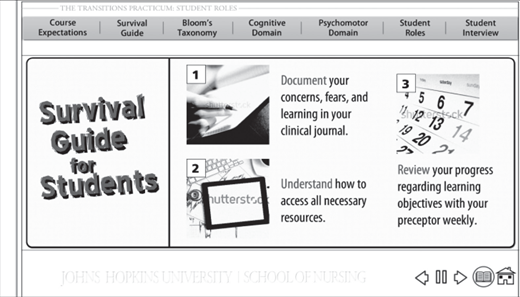
An asynchronous interactive-online module was created. Online learning offers an efficient, cost-effective, and convenient alternative to traditional classroom education. The online module was delivered using an interactive Web 2.0 teaching tool, a web-based program that integrates scenario-based learning and pedagogic interactivity to promote learning (Sessoms, 2008). The objective of this learnercentered approach is to develop critical thinking by reading content, applying to knowledgeto scenarios, and participating in learning activities. The interactive learning tool includes visual and auditory teaching methods featuring a voice-over narration,and a slide show using pictures and text with guided prompts for navigating through the module. Vimeo interviews with students, preceptors, and faculty also support content. The module has four components: a pretest, module content, a posttest, and evaluation. The pre-/posttest consists of multiplechoice questions randomly drawnfrom a test pool. The posttest can be taken until a grade of 80% is achieved. The module content is divided into three submodules, each exploring the role of student, preceptor, and clinical faculty. The learner is encouraged to complete all sections of the module to appreciate each role. The content for each submodule follows a similar format, consisting of objectives, instructional content, testimonial videos, and a “survival guide” for students, preceptor, and faculty at the end of each submodule (Figure 1). The descriptive student, preceptor, and clinical faculty “survival guides” highlight key strategies for building successful triad relationships and clinical experience.
Student Survival Guide
Conclusion
Seven senior practicum students completed the module and provided qualitative feedback, summarizing key “take-away” points, and personal learning objectives, based on meeting objectives for the senior practicum. Students reported being prepared for the senior practicum after learning the differences between faculty and preceptor roles. Students acknowledged the importance of understanding the expectations of the three roles, how communication cultivates those relationships, and how the student will perform in the last clinical. Other comments included student recognition that their learning during the practicum is greatly influenced by their relationship with the faculty and preceptor. By the end of the module, students identified common challenges that occur during the senior practicum experience, distinguish between roles of student, preceptor, and faculty, and demonstrate the ability to formulate learning objectives for their own senior practicum experience.
Online learning is an approach to assure that consistent content is delivered to the target audience. For this program, it is essential for nursing students to fully comprehend preceptor and clinical faculty roles and responsibilities in student learning as they prepare to transition from nursing student to nurse graduate. The module explores concepts of communication, professional accountability, and strategies for maximizing student learning during their final practicum. Faculty rely on nurse preceptors to provide education, guidance and mentoring to students in the final semester (Yonge et al., 2003). The module receives positive evaluations fromstudents, preceptors, and clinical faculty. Due to the success of this module, it is now required for clinical faculty. Preceptors are encouraged to complete module.
Acknowledgments
The authors thank Nathan Poole at the Johns Hopkins university School of Nursing for serving as instructional designer for the development of the interactive online module. The authors express gratitude for his leadership and creative ideas for innovative instructional methods. Funding was provided in part by Nurse Support Program ii 12-109, Maryland Higher Education Commission, Baltimore, MD.

