


The purpose of this mixed methods study was to determine what characteristics of affinity spaces are found in distance higher education. Affinity spaces have been established as successful learning environments, but as of yet, have not been established in distance higher education. Faculty and students from 3 cohorts of a distance educational studies doctoral program at a teaching-intensive university were surveyed. Data found that 83% of affinity space characteristics were encompassed in the learning space. Exploration of the space specific to contributions, diversity, and engagement are presented and discussed. Finally, the participants in the space are presented as a significant component in distance higher education affinity spaces.
Introduction
With 5.5 million students enrolled in distance education courses (U.S. Department of Education, 2014), there comes a responsibility by educators and educational institutions to deliver a quality experience for participants (Somenarain, Akkaraju, & Gharbaran, 2010). Creating an effective educational environment conducive to online student learning is imperative; however, research focused on creating an effective distance environment has been lacking in higher education. Available research highlights that affinity spaces can lead to a successful learning environment and experience (Beemt, Akkerman, & Simons, 2011; Brass, & Mecoli, 2011; Curwood, 2013; Fields, 2009; Gee, 2013).
James Paul Gee is known for establishing affinity spaces in literacy, gaming, and education literature (Gee, 2005, 2007, 2013). Affinity spaces are physical or virtual places where individuals with a shared interest gather to facilitate learning, gain collective intelligence, and produce artifacts related to a joint enterprise (Gee, 2005). Although Gee’s (2005) research of affinity spaces stems from gaming, he stated that these social configurations have considerable implications for the future of schools and schooling. Gee (2013) acknowledged that “schools and colleges could have been and should be in the future a network of well-designed interacting affinity spaces devoted to synchronized intelligence” (p. 177). The notion that affinity spaces have implications in education is shared by experts in the field (Beemt et al., 2011; Gee, 2005). Beemt et al. (2011) argued that:
Social and cultural spaces are increasingly defined around affinities … affinity spaces should not be set aside as something students deal with outside school hours. Instead … an exploration of how education can connect to the affinity spaces that students engage in is necessary. (p. 63)
By connecting affinity spaces to education, students’ academic careers are more aligned with their lives outside of academia, rather than expectations in these two areas being completely isolated (Gee, 2007).
In spite of the acknowledged connections between education and affinity spaces (Beemt et al., 2011; Gee, 2005, 2007) and the plethora of literature on affinity spaces in relation to gaming and digital literacy, research pertaining to the association of affinity spaces and education is lacking; research relating affinity spaces with the distance higher education setting is not specifically identified. With a focus on the learning space, affinity spaces align with distance education and its emphasis on the virtual learning space that is available anytime, anywhere. If a space incorporates numerous, but not all, of the features of an affinity space, it is essentially an affinity space (Gee, 2005). This research aimed to bridge the gap in literature connecting affinity spaces as successful learning environments to distance higher education as well as generating new knowledge regarding creating effective online learning environments and strove to reveal further necessary research arenas.
This article describes part of a larger mixed methods study focused on examining distance higher education learning spaces through the lens of affinity spaces. The scope of research presented here explored if distance higher education learning spaces are affinity spaces and if affinity spaces do, in fact, have implications in distance higher education. Online learning spaces were examined to establish if affinity spaces could be applied in distance higher education. The researcher agrees with Gee and others’ declarations prioritizing the interactions of individuals in a learning space and the formation of affinity spaces in education (Beemt et al., 2011; Gee, 2007); however, prior to commencing the study, the researcher questioned whether a greater emphasis needed to be placed on the participants in the space when equating affinity spaces with distance higher education learning spaces.
Research Questions
The study sought to answer three research questions:
What characteristics of affinity spaces, as defined by Gee, are exhibited in distance higher education learning spaces?
Who contributes to the learning space in a distance higher education program?
How do graduate higher education learners utilize virtual spaces in distance education?
Theoretical Framework
Affinity spaces guide the research and are understood to be places for learning where individuals gather “to share resources and values and flexibly form and re-form in different groups” (Gee, 2013, p. 174). Affinity spaces place an emphasis on the space where participants interact around a common enterprise (Gee, 2005). Participants may be diverse, but have a mutual interest in common and can engage in the space as deeply as wanted to gain as much expertise on the subject as they desire. Despite the presence of social interactions in the affinity space, Gee’s (2005, 2013) research does not place an emphasis on participants of the space. Yet, the social phenomenon of learning is imperative to education (Rovai, Ponton, & Baker, 2008) and a focus of this study. Wenger’s (1998) communities of practice place an emphasis on the members within the learning community and, thus, was used as a lens through which to view the participants in the affinity space, a necessity when exploring the distance higher education learning space.
Adult learners are a unique student population. The Flannery and Apps (1987) study of adult learners indicated that these students are balancing a variety of roles: student, family member, and employee, to name a few. They are required to balance a number of differing responsibilities, making student not their primary appointment (Flannery & Apps, 1987). Yet, participation by adults in formal higher education continues to escalate due to the potential for career advancement (Ginsberg & Wlodkowski, 2010). This division of responsibility leads adults to distance education. Adults are the most prevalent population in online learning (Ginsberg & Wlodkowski, 2010). The social learning theories of affinity space and communities of practice in combination with adult learning theory provided a complete framework for the study of learning spaces within a distance higher education program.
Literature Review
Both communities of practice and affinity spaces are created around a common enterprise. Participants may be diverse, but have some mutual interest in common. Also, both Wenger’s (1998) communities of practice and Gee’s (2005) affinity spaces can be real, virtual, or a hybrid. However, the fundamental components of the two vary slightly and the emphases of the two are distinctively unique.
Affinity Spaces
Gee (2005) addressed affinity spaces and communities of practice and presented affinity spaces as an alternative to communities of practice. Affinity spaces “focus on the idea of a space in which people interact, rather than on membership in a community” (Gee, 2013, p. 214). With membership, learning communities are more focused on the individuals that make up the community, rather than on the space or place being “occupied.” In affinity spaces, the emphasis is on the space (physical, virtual, or geographical) where individuals relate (Gee, 2013). This space is comprised of portals (access to the space) and generators (content). The focus should, therefore, be on the space and how it is utilized by different individuals (Henderson & Hirst, 2007). “These physical, virtual or blended spaces are often spread across many sites, such as face-to-face meetings, message boards, blogs and web pages” (Lammers, Curwood, & Magnifico, 2012).
Affinity spaces are “places where people can go to share resources and values and flexibly form and re-form in different groups” (Gee, 2013, p. 174). These spaces can be face-to-face, online, at a distance, or any combination of these. In affinity spaces, individuals gather around a shared passion (Gee, 2013). Participants in the space have the opportunity to become as involved as they want and to become an expert to the degree they desire. Affinity spaces provide a place where individuals congregate to be creative and generate a collective intelligence, created through contributions by all individuals, that is greater than the sum of its parts (Gee, 2013).
A review of affinity spaces established 18 characteristics (Gee, 2013). The presence of a majority of these characteristics indicates a learning space is essentially an affinity space.
Learning Spaces Human Element
Communities of practice focus on the social aspect of learning. Wenger (1998) acknowledged that these “communities” have been around for centuries and that he is simply implementing an innovative approach to theories of learning. He dictated that learning is in fact a social phenomenon, a “process of being active participants in the practices of social communities and constructing identities in relation to these communities” (Wenger, 1998, p. 4). The individuals that make up a community of practice are at the core of this learning theory. Communities of practice are “groups of people informally bound together by shared expertise and passion” (Wenger & Snyder, 2000, p. 139). The “space” is not an imperative element in communities of practice, rather who makes up the population is significant. The individuals in the community energize the community and “organize themselves … and establish their own leadership” (Wenger & Snyder, 2000, p. 142).
Mixed Method Study
With an interest in fully exploring the distance education learning space, it was evident that a mixed method approach combining both quantitative and qualitative approaches most accurately supported the inquiry. For this research, the term mixed methods indicates Smith’s (2009) definition, referring to “studies or projects that employ at least one quantitative and one qualitative method to produce knowledge claims” (p. 458). The purpose of the mixed method design used for this research was complementary. Employing both types of data seeks “elaboration, enhancement, illustration, [and] clarification of the results from one method with the results from the other method” (Greene, Caracelli, & Graham, 1989).
Both quantitative and qualitative data collected explored the distance higher education classroom. The quantitative data solely focused on the elements attributed to affinity spaces. The qualitative data consisted of open-ended questions relating to the learning space in distance higher education.
Participants and Setting
Participants were recruited from a single program at a university in the Rocky Mountain Region. The sample was a convenience sample of 45, comprised of 6 faculty and 39 doctoral students and had a response rate of 56% (3 faculty and 22 students). The program was a distance educational studies doctoral program that has initiated three cohorts since its inception. The 39 students who were contacted were students from all three cohorts, in varying phases of the program (first year in the program, middle of the program, and completed the program). Participants in the study were located throughout the United States and internationally and ranged in age from 27–60.
The university was a midsize teaching intensive university in the Rocky Mountain Region with a graduate enrollment of 2,542 (University of Northern Colorado, 2015). According to the fall 2015 census, 40% of these students were enrolled in at least one online course; 57.8% of the graduate students were in The College of Education and Behavioral Sciences, which houses the Educational Studies EdD Program (University of Northern Colorado, 2015).
Data Collection
Participants in the study were sent online surveys through their university e-mail. Surveys contained 4-point Likert scale questions and open-ended questions requesting brief explanations. The Likert scale questions corresponded to the characteristics identified by Gee (2013) as necessary elements in an affinity space. This approach was utilized to provide a more comprehensive understanding (Creswell, 2014).
Data Analysis
A reflective journal was utilized for rudimentary analysis, a technique “to keep track of your thoughts, musings, speculations, and hunches as you engage in analysis. This kind of information might be interwoven with your raw data, or it may be separate files or memos” (Merriam, 1998, p. 165). The questionnaire was analyzed with both quantitative and qualitative approaches. SPSS was used for statistical analysis of the data collected from the Likert scale questions. A principal components analysis was completed on the 27 Likert scale questions linked to Gee’s (2013) 18 characteristics of affinity spaces.
Responses to the open-ended questions in the questionnaire were coded for a systematic interpretation of the data (Remler & Van Ryzin, 2011). The primary intention of coding the data was for qualitative analysis. Coding is an iterative process through which themes in the data emerge (Creswell, 2014). Following coding of the responses and emergence of themes, the larger meaning, or interpretation, of the qualitative data is conceptualized (Creswell, 2013).
Validity and Reliability
Although quantitative methods were utilized in some of the analysis of data, the research was exploratory. An emphasis was placed on meticulous documentation of the analysis process, including steps taken and the motivations and logic behind the process. The use of triangulation, in particular through multiple forms of data collection and analysis, improves both internal validity and reliability in the research (Merriam, 1998). Data were collected from multiple perspectives and in a variety of modes. Also, multiple questions measure the same elements to ensure consistency in the data collected throughout the survey (Creswell, 2014).
Findings And Discussion
For the purposes of this study, a learning space was defined as places individuals with a shared affinity assemble, face to face, online, or at a distance to: share resources and values, generate collective intelligence, and create collaborative artifacts. Gee (2005) indicated that if a space includes many of the characteristics of affinity spaces, then it is essentially an affinity space.
Affinity Space Characteristics
Current and former students of an educational studies distance program were asked to what degree on a 4-point Likert scale they agreed on 27 questions. The scale included: strongly agree (1), agree (2), disagree (3), and strongly disagree (4). The questions aligned with Gee’s (2013) characteristics of affinity spaces. Table 1 depicts participants’ responses on how affinity space characteristics aligned with their learning space.
Descriptive Statistics
| Statement | Mean | SD | Analysis N |
|---|---|---|---|
| You are in the educational studies learning space by choice. | 1.11 | .315 | 19 |
| You have a shared interest with the other students in your educational studies cohort. | 1.11 | .315 | 19 |
| The educational studies cohort is comprised of individuals with diverse backgrounds. | 1.37 | .496 | 19 |
| The educational studies cohort is comprised of individuals of varying ages. | 1.32 | .582 | 19 |
| Individuals in the cohort range from amateurs to experts in educational studies. | 1.89 | .658 | 19 |
| The individuals in the cohort have a variety of interests surrounding education. | 1.32 | .478 | 19 |
| High standards for excellence within the learning space are set by individuals with mastery of the content. | 1.58 | .607 | 19 |
| The learning space is dedicated to production not just the gathering of knowledge. | 1.63 | .597 | 19 |
| All members of the learning space have the opportunity to contribute to the degree they are interested. | 1.63 | .496 | 19 |
| All contributions to the learning space have potential for significance. | 1.58 | .507 | 19 |
| All contributions to the learning space are welcome. | 1.58 | .692 | 19 |
| Diversity within the learning space is valued. | 1.58 | .607 | 19 |
| Status within the learning space is amenable and fluid. | 1.63 | .496 | 19 |
| Leadership within the learning space is amenable and fluid. | 1.79 | .631 | 19 |
| Status in the cohort is based on an individual’s engagement and accomplishments within the learning space, not what has been attained outside of the space. | 2.00 | .745 | 19 |
| Resources within the learning space are plentiful. (e.g. peers, experts, outside materials, content links….) | 1.89 | .937 | 19 |
| Resources within the learning space are fluid and amendable by the participants rather than static resources. | 1.79 | .631 | 19 |
| Participants in learning space may have a specific focus, but must also collaborate with others. | 1.53 | .513 | 19 |
| The learning space has established a unique culture. | 1.26 | .452 | 19 |
| The learning space is open to new ideas and recognizes outside knowledge to ensure growth and diversity. | 1.37 | .496 | 19 |
| All individuals in the learning space are expected to facilitate learning for themselves and other participants. | 1.63 | .684 | 19 |
| Participants’ motivations in the learning space vary. | 1.58 | .607 | 19 |
| Participants’ tenure in the learning space varies. | 2.11 | .737 | 19 |
| Because participants in the cohort have a shared interest there is no delineation between mandatory participation and intrinsic enrichment within the learning space. | 2.37 | .761 | 19 |
| Socialization within the learning space is secondary only to the objective of the learning space. | 2.21 | .855 | 19 |
| Socialization within the learning space is achieved through a variety of mediums. | 1.79 | .631 | 19 |
| The learning space is based on tangible production not assertions or philosophies. | 2.05 | .705 | 19 |
It should be noted that, when the mean scores were combined to equate with their corresponding affinity space characteristics, there were only three characteristics of affinity spaces that student participants did not feel were evidenced in their learning space: participants’ tenure in the space varied; because affinity spaces are created around an interest, there is no delineation between work and play within the space; and affinity spaces are based on empirical evidence, not assertions or philosophies. The remaining 15 characteristics of affinity spaces all received mean scores in the agree to strongly agree range (1–2).
Distance Higher Education Affinity Spaces
Gee (2005) stated that although there is potential for transforming education to more closely parallel affinity spaces, current students, teachers, and classrooms rarely align with many of the features he presented. However, the elements specific to online and higher education students can be effectively associated with an affinity space. The typical class segregates students by age (Gee, 2005), but in the educational studies distance higher education program, students ages varied from 27– 60, and they were geographically dispersed. Unlike in a K–12 classroom, higher education learners vary greatly. Participants in the space either agreed or strongly agreed with a mean score of 1.37 that the cohort was comprised of individuals with diverse backgrounds. Adults come to education environments with diverse and disproportionate prior experience (Long, 2004). Agreement with this was reflected in the data from participants in this study who agreed that individuals in the cohort range from amateurs to experts in educational studies. This diversity in age, background, and level of expertise was consistent with participant characteristics in Gee’s (2013) affinity spaces. All participants, with the exception of one, agreed that diversity within the learning space is valued. Students in the online higher education course strongly agreed that they were brought together over a common interest, but their reasons for returning to school often varied greatly. Entry in an affinity space is for different reasons; it is simply the common endeavor that brings the individuals together (Gee, 2013). Of student participants, 95% agreed or strongly agreed that their motivations in the space varied greatly, and a mean score of 1.31 indicated that they had a variety of interest surrounding education.
In traditional teacher-centered learning, the teacher is entirely in control, dictating what students will learn, how the students will learn, and if the students have learned (Weimer, 2013). This control and delineation between students and teachers is contradictory to affinity spaces.
In an affinity space, leadership and status are flexible. People sometimes lead and mentor; sometimes they follow and are mentored. There are no fixed bosses and teachers, though people acknowledge different paths to mastery and know where people are on them. (Gee, 2013, p. 176)
However, in adult education, the professor is encouraged to be a facilitator (Merriam, Caffarella, & Baumgartner, 2007). The idea of facilitating learning more closely aligns with Gee’s (2005) affinity spaces. In this study, 89% of the students in the educational studies program either strongly agreed or agreed that all individuals in the learning space were expected to facilitate learning for themselves and others. An educator of adults has “many roles within the teaching and learning interaction including role model, mentor, counselor, content resource person, learning guide, instructional developer, and institutional representative” (Galbraith, 2004, p. 5). This relationship is more give and take and, therefore, more representative of an affinity space. In formal online adult education, the students are often encouraged to “take charge” and assist in the instruction. Ninety-five percent of responses in this study indicated that status in the learning space is amenable and fluid, and 85% believed that leadership is also amenable and fluid. Learning in distance education is no longer a passive activity. A mean score of 1.58 was received, indicating that all contributions to the learning space are welcome and have potential for significance.
The distance classroom setting focuses on the education space, similar to affinity spaces that are often positioned in multiple locations (Lammers et al., 2012). Online classrooms are often launched on a learning management system containing discussion boards, chat rooms, group hangouts, and assignment and content resources. The survey statement that resources within the learning space are plentiful garnered a mean score of 1.89, indicating the participants agreed. Ninety percent of responses specified that the resources within the learning space are fluid and amendable by the participants, rather than static resources. Additional portals (Gee, 2005) are often created for collaboration between participants. Of participants in the educational studies learning space, 95% agreed or strongly agreed that they were required to collaborate with others. Learners often connect on social media, Google documents, wikis, and so forth, a list that continues to grow as technology advances. Similar to education classroom spaces that expand to external resources, affinity spaces link to other related spaces so that knowledge from the outside can transform the space (Gee, 2013). A mean score of 1.37 in this study indicated that the learning space was open to new ideas and recognized outside knowledge. Gee’s (2013) focus on space creates the potential for a formal learning space to be considered an affinity space (Bommarito, 2014).
Variable Reduction
The variable reduction technique known as principal components analysis was used to analyze questions on the survey related to the 18 characteristics of affinity spaces. Due to the smaller size of this study and the number of questions analyzed, this technique was more advantageous than other variable reduction techniques (Dunteman, 1989; Field, 2005). Although due to the limited participant sample, all outcomes were supported by qualitative data. In addition, this procedure was utilized because it was believed that the variables in the characteristics were highly correlated. By completing a principal components analysis, these highly correlated variables can be reduced down to a small set of uncorrelated principal components by measuring the underlying constructs within the questions (Dunteman, 1989). A principal components analysis was run in SPSS to discover these underlying similarities in the 27 Likert scale questions that were included in the survey. These 27 questions related to the 18 items identified by Gee (2013) as characteristics of an affinity space. When the analysis was originally run, eight principal components were extracted from the data and accounted for 85.10% of the variance. The first principal component accounted for 33.46% of the variance within the variables. This original analysis of the data can be found in Table 2.
Total Variance Explained
| Initial Eigenvalues | Extraction Sums of Squared Loadings | |||||
|---|---|---|---|---|---|---|
| Component | Total | % of Variance | Cumulative % | Total | % of Variance | Cumulative % |
| 1 | 9.034 | 33.458 | 33.458 | 9.034 | 33.458 | 33.458 |
| 2 | 3.673 | 13.605 | 47.063 | 3.673 | 13.605 | 47.063 |
| 3 | 2.802 | 10.379 | 57.442 | 2.802 | 10.379 | 57.442 |
| 4 | 2.375 | 8.795 | 66.237 | 2.375 | 8.795 | 66.237 |
| 5 | 1.470 | 5.443 | 71.680 | 1.470 | 5.443 | 71.680 |
| 6 | 1.321 | 4.894 | 76.574 | 1.321 | 4.894 | 76.574 |
| 7 | 1.256 | 4.654 | 81.228 | 1.256 | 4.654 | 81.228 |
| 8 | 1.047 | 3.876 | 85.104 | 1.047 | 3.876 | 85.104 |
| 9 | .829 | 3.071 | 88.175 | |||
The output from SPSS was examined to determine what strategies would be most useful to further study the data. Dunteman (1989) acknowledged that there are several methods for determining how many components to retain, and these include the use of a scree plot and accounting for a desired percent of variance. This study was exploratory in nature, so a variety of variations to the analysis were attempted. Based on the scree plot, it was determined that it would be beneficial to extract four to five components as this was where the “elbow” of the plot was located (Field, 2005). The components settled within the steep portion of the line connecting components are preserved (Dunteman, 1989). The scree plot illustrated in Figure 1 represents this graphically.
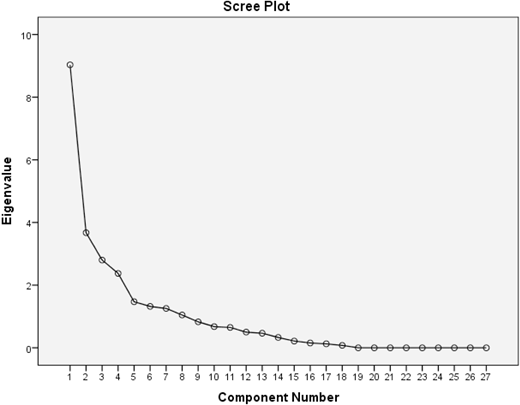
Although the scree plot indicated that four to five principal components may be ideal, further investigation and analyses within SPSS ultimately led to the extraction of three principal components. Modifications including: the use of promax versus varimax, which indicates the items to extract if they were sufficiently similar, and the number of optimal components were all investigated. Table 3 displays the optimal principal component analysis with rotation method varimax with Kaiser normalization.
Rotated Component Matrix
| Component | |||
|---|---|---|---|
| Item | 1 | 2 | 3 |
| All members of the learning space have the opportunity to contribute to the degree they are interested. | .887 | ||
| All contributions to the learning space have potential for significance. | .867 | ||
| Status within the learning space is amenable and fluid. | .858 | ||
| Leadership within the learning space is amenable and fluid. | .837 | ||
| High standards for excellence within the learning space are set by individuals with mastery of the content. | .761 | ||
| Diversity within the learning space is valued. | .753 | ||
| The learning space is open to new ideas and recognizes outside knowledge to ensure growth and diversity. | .752 | .421 | |
| All contributions to the learning space are welcome. | .752 | ||
| Status in the cohort is based on an individual’s engagement and accomplishments within the learning space, not what has been attained outside of the space. | .687 | ||
| Individuals in the cohort range from amateurs to experts in educational studies. | .677 | .344 | |
| The learning space is dedicated to production not just the gathering of knowledge. | .659 | .302 | |
| Resources within the learning space are fluid and amendable by the participants rather than static resources. | .612 | .554 | |
| All individuals in the learning space are expected to facilitate learning for themselves and other participants. | .536 | .400 | –.309 |
| The learning space has established a unique culture. | .481 | .381 | |
| Socialization within the learning space is secondary only to the objective of the learning space. | .761 | ||
| Because participants in the cohort have a shared interest there is no delineation between mandatory participation and intrinsic enrichment within the learning space. | –324 | .686 | |
| The Educational Studies cohort is comprised of individuals with diverse backgrounds. | .648 | ||
| Resources within the learning space are plentiful (e.g., peers, experts, outside materials, content links). | .385 | .647 | –.327 |
| Participants in learning space may have a specific focus, but must also collaborate with others. | .616 | .388 | |
| The Educational Studies cohort is comprised of individuals of varying ages. | .578 | ||
| Participants’ tenure in the learning space varies. | –.349 | .492 | |
| You have a shared interest with the other students in your Educational Studies cohort. | –.319 | ||
| Participants’ motivations in the learning space vary. | .776 | ||
| Socialization within the learning space is achieved through a variety of mediums. | .652 | ||
| You are in the Educational Studies learning space by choice. | –.303 | –.628 | |
| The learning space is based on tangible production not assertions or philosophies. | .574 | .608 | |
| The individuals in the cohort have a variety of interests surrounding education. | .301 | .496 | |
Components
A thorough examination of the questions contained within each of the components was completed to determine the themes for each component. The three principal components include: (a) contributions to the space; (b) diversity within the space; and (c) engagement in the space. Table 4 was created to align affinity space characteristic, survey questions, and principal components. Column 1 lists each of the 18 characteristics Gee (2013) recognized as features of affinity spaces. Column 2 indicates which survey questions support each of Gee’s characteristics. And finally, column 3 displays the component that each question was associated with based on the principal components analysis.
Affinity Space Component Alignment
| Characteristic | Question | Components |
|---|---|---|
|
|
|
|
|
|
|
|
|
|
|
|
|
|
|
|
|
|
|
|
|
|
|
|
|
|
|
|
|
|
|
|
|
|
|
|
|
|
|
|
|
|
|
|
|
|
|
|
|
|
|
|
|
|
Diversity within the space was included in the discussion above concerning participants (instructors and students) in affinity spaces and the affinity space classroom. The components or themes of contributions to the space and engagement in the space were further explored through open-ended questions asked of both faculty and students. Both faculty and students of the learning space contributed to the space. This was achieved through the collaborative creation of the space and collective creation of the content within the space. One response indicated, “We all create the learning space. The instructor has a strong input in this design, but the students contribute and create the space through each course and provide a thread that weaves through all the courses through our shared work and group projects.” The learning space is comprised of a multitude of portals. One faculty member described this as a web. Portals are how the space is accessed (Gee, 2005). In the case of the distance doctoral program, these portals included Blackboard, wikis, Facebook pages, Skype, and so forth. Contributions to the space in the form of content or generators (Gee, 2005) are, again, created by all involved in the space. As noted in the characteristics of affinity spaces, sometimes this is completed collectively, and sometimes these are individual contributions. It should also be noted that responses often indicated that some of the spaces within the Distance Educational Studies Affinity Space were accessible only to students, not faculty. In addition to contributing to the “physical” aspects of the space, participants also created the culture and environment of the space, explaining it was “social, supportive, welcoming, fun, safe, [and] collaborative.”
One participant articulated a sentiment that was pervasive throughout the research regarding the learning space, saying they “are created to facilitate collaboration, socialization, and production of educational ideas and materials.” Or, “the learning space is characterized by motivated like-minded people seeking an advancement in their educational careers.” These descriptions aligned with the characteristics and definition of affinity spaces as places where individuals with a shared interest gather to facilitate learning, gain collective intelligence, and produce artifacts related to a joint enterprise (Gee, 2005). Participants in this study noted several reasons they engaged in the space: social interactions/communications, collaboration, sharing resources, questions/ clarification, academic and emotional support, and for assignments. With the exception of engaging in the space for assignments, the focus was on connections between the participants in the space. This was not surprising as research supports the notion that in online education, there is a greater need for interaction and communication in order for students to succeed (Rovai et al., 2008). When students were asked to what degree they agreed with the following statement, “Socialization within the space is secondary only to the objective of the learning space,” the mean score of 2.21 disagreed with the statement. However, one student’s comment perfectly articulated this characteristic, “learning is at the core of the learning space, but the ability to socialize and interact is a key contributor to the effectiveness of the learning space.” Another participant described the learning space as “social, constant connections with peers.”
Learning Space Participants
Throughout this research studying the learning space, participants’ emphasis was on the other individuals in the space including their interactions, connections, collaborations, support etc. The space was used to “share and ask for educational resources, and vent frustrations as well as announce accomplishments [and] we push each others’ thinking by reflecting on our homework assignment readings, our own personal experiences … prior knowledge.” Kasl and Yorks (2016) discussed learning, stating that “by presenting ideas to others and encountering others’ points of view, learners clarify, expand, and attune their thinking” (p. 4). One participant in the space even told the story of how they would often utilize Skype all day with another individual in the program, regardless of whether or not they were working together. It was left on even when they might temporarily leave or take a nap; the intent was simply for the connection with someone else from the learning space. Of the three cohorts to go through the program, one cohort graduated almost 2 years earlier and, yet, they still continued relationships and connections, collaborated, and maintained various portals in their affinity space. One student from this cohort described their learning space as “sustainable, even today we still have learning spaces in place long after we all have graduated.” Without the participants and their engagement in the learning space, it would cease to exist.
Implications And Future Research
This study indicated that distance higher education learning spaces are, in fact, a series of interacting affinity spaces leading to effective education. However, this potential for optimal learning is only present when the space accentuates the participants. The participants in the space must contribute to the space and be actively engaged in the space, and there must be diversity within the space. Previous literature differentiated affinity spaces from communities of practice by focusing on the space, rather than the members in the space (Gee, 2005). But, in the educational studies distance higher education program, the participants in the space were an integral element of the affinity space. They were repeatedly described as the ultimate stakeholders within the space.
Due to the limited sample utilized in this study, future research on a variety of distance higher education programs could further investigate the participants in the space and their necessity in distance higher education affinity spaces. In addition, extended exploration of higher education learning spaces could ensure that the characteristics necessary for affinity spaces are present to ensure effective learning. In gaming, there may not be a need to emphasize the participants in an affinity space, but based on this research of distance higher education, one would be remiss to not accentuate the members in the space.

