


In this paper, we examine some of the limitations of online course delivery and management systems in terms of the range of pedagogies they support. Online courses are often criticized for their emphasis on reproductive learning. We argue that learning outcomes are limited by the lack of pedagogical affordances in the popular course delivery and management systems. Because popular online course delivery and management systems do not support the use of alternative forms of knowledge representation by learners, authentic forms of assessment, and the use of distributed tools to scaffold different forms of reasoning, the range of student learning outcomes is restricted to reproductive learning. Attempts to work around these limitations over-rely on student self-regulation, resulting in student frustrations and negative student perceptions of the learning experience.
Introduction
Distance education delivered through online courses and programs are the focus of intensive media scrutiny. For example, the Chronicle of Higher Education has a dedicated distance learning section in both its print and online forms. Popular newspapers such as The New York Times and The Wall Street Journal regularly examine distance education topics. The academic community has analyzed online learning in numerous ways (Cleary, 2001; Guernsey, 2001; Larson, 2000; Williams, 2000; Thomas, 2000). In all of these forums, attention has focused on policy issues, such as curricular ownership, teaching loads, accreditation, revenue streams, and participation rates, as well as effectiveness of online courses (Hackbarth, 1997; Kahn, 1997). Although these topics are essential for examining the viability of online learning, this paper addresses another aspect of online distance learning—the lack of affordances in online courses for meaningful learning. Learning effectiveness, we believe, should be the primary focus of concern about online learning.
The National Center for Educational Statistics reports that in 1997-98, 58 percent of all post-secondary institutions offered Internet-based courses. Further, 82 percent reported that they had plans to increase their Internet-based offerings over the next three years (NCES, 1999). Given existing commitments and the growing trend toward distributed learning environments, it is clear that online courses and curricula have become an institutionalized part of higher education. As members of a field committed to technology and learning as its central foci, we are obliged to examine the learning outcomes of online learning.
This examination should be conducted within the context of current theories of learning. Learning theory has moved definitively in a constructivist direction (Jonassen & Land, 2000). Constructivist learning environments support learning by embedding authentic tasks into rich contexts to enable learners to represent their own understanding by producing artifacts. The most meaningful forms of learning outcomes include modeling, designing, and decision-making related to problem solving (Jonassen, 2000). However, very few online learning environments that we have examined throughout higher education engage learners in solving problems. Rather, most online learning that we have examined replicates in structure and function traditional classroom instruction. Very little online learning employs constructivist, problem-oriented approaches to learning in any significant way. Why? Is it because all online educators believe exclusively in objectivist epistemologies? That is doubtful. Does the focus on efficient information delivery preclude constructivist pedagogies? Perhaps, but neither of these reasons, we believe, is sufficient to explain the dearth of constructivist pedagogies in online learning. In this paper, we argue that a major reason that constructive learning is not commonly adopted in online learning contexts is that the affordances of online course development, delivery, and management systems do not support constructive learning. Based on literature reviews and our experiences with online learning, we claim that three major limitations of these systems create significant barriers to implementing constructivist learning principles in online courses.
The ability to efficiently and effectively accommodate multiple, alternative forms of student knowledge representation. Meaningful, constructive learning must be assessed in multiple ways (Jonassen & Carr, 2000), however online course systems support only quizzes, online discussions (with no evaluative support), and the submission of word-processing documents.
The ability to provide and support authentic assessment (either with tools for the instructor or tools to help communicate these assessment data to students). The most commonly used assessment in online environments is the quiz. The over-reliance on single forms of assessment (especially quizzes) precludes the assessment of meaningful learning.
The ability to support distributed tools for meaning making. Constructivist learning environments should provide cognitive tools to scaffold the cognitive requirements of functioning in the environment (Jonassen, 1999, 2001). While face-to-face courses easily provide access to cognitive tools via laboratory instruction, online course developers who require this functionality to support learning find it difficult to provide access to tools and to support the learning of the tools.
In this paper, we examine the effects of a distance learning pedagogy that emphasizes alternative forms of knowledge representation, authentic forms of assessment, and the use of distributed tools on student outcomes and student perceptions of the learning experience. We begin by examining the relevant literature regarding the affordances of online delivery systems and online learning outcomes. We then support our claims with data from a case study of an online course that we recently designed and taught. These data include student performances and self-report data from this course. Finally we discuss implications and recommendations for engaging more constructive learning outcomes in online courses.
Online Learning
The literature related to online learning has focused on numerous issues, including case studies, methods, research on effectiveness, philosophical discussions of course ownership, the effects of online courses on traditional universities, faculty, academic freedom, revenue implications of online courses and degrees (Black, 1997; Jones, 1999; Schutte, 1997; Smith & Dillon 1999). Our concern in this article is otherwise focused on the attributes of online courses and how they support various learning outcomes. Therefore, we will begin by analyzing online course delivery/manage- ment packages and how they support alternative forms of knowledge representation with particular emphasis on supporting technology-based projects, software distribution, and online assessment.
Online Delivery Packages
The functionality of online course delivery packages is central to the questions we address, because we argue that the features of the packages themselves have a significant impact on what designers of Web-based instruction can implement using sound instructional design practices—such as ensuring that assessment matches the learning task. The proliferation of course packages such as Blackboard (CourseInfo), E-College, WebCT, Symposium, Virtual-U, and many others, is a recent occurrence (Firdyiwek, 1999). Several reviews of these packages are available online (Center for Curriculum Transfer and Technology, 2000; Marshall University Center for Instructional Technology, 2000). The Center for Curriculum, Transfer & Technology (CCTT) reviewed 46 software packages for online course delivery (Center for Curriculum Transfer and Technology, 2000) in terms of a set of more than 60 features. These features are categorized into the following sets: web browsing, asynchronous and synchronous sharing, student tools, resource, lesson, course, data, administration, help desk, and technical information. We assumed that by studying these courseware package reviews that we could learn something about the priorities of online course delivery systems by examining the features they promote and the language they use to promote them.
In both review sites, the focus of the tool descriptions is on the technology and the technologies supported. Phrases such as “provides integrated audio/video … simultaneous text and whiteboard sessions … document sharing … rich in media such as audio, video-graphics, animation, and simulation” that emphasized the technology features were frequently used. Testing is also a popular topic. The majority of the packages reviewed in the CCTT site addressed testing in some form. With few exceptions each package stressed its ability to support the following types of features:
Organizes online course material and test students via interactive quizzes with instantaneous problem correction and grading;
Supports multiple choice, long- and short-answer, true/false, matching and ordering items;
Can automate test and quiz generation via an item pool;
Supports non-graded survey items; and
Immediately grades true/false and multiple choice tests, placing the results in the grade book.
These forms of assessment cannot provide evidence of meaningful learning.
Additionally, a significant number of packages in use in online courses, such as Test Pilot, Test Engine, Quiz Maker and Exam Builder, are strictly assessment tools and do not provide any other online delivery features. These tools are focused only on quiz and survey implementation. We infer that the limited assessment capabilities available in online delivery systems can be attributed to the fact that many consumers of such reviews are technical coordinators and others who are most interested in technical features. We believe that more individuals reviewing online courseware packages should be interested in learning and the system affordances that support learning. Unfortunately, learning is not emphasized in the features described in the two sites.
Comparative reviews of online course package features and the effect of those features on learning outcomes do not exist. Most articles address the features of one delivery package in the context of describing a particular course implementation (see for example, Chen, 1997; Mende, 1999; or Maslowski, Visscher, Collis and Bloemen, 2000). Firdyi-wek’s review also focused on issues of learning and online courseware packages. He reviewed three popular online courseware systems (Web Course In A Box, WebCT, TopClass) specifically for their pedagogical bases (Firdyiwek, 1999). He found that they all demonstrated an ability to support development of cognitive skills through access to information and provided assessment tools that allowed for creation of multiple choice, true/false and matching tests and scoring for such tests. He concluded that all three have extensive capabilities for supporting “competency-based teaching of discrete information and processes” (p. 33) and that the tools included represent a behaviorist/empiricist model of pedagogy quite well. These systems however could not support more flexible, open-ended, or qualitative pedagogies.
Finally, Benyon, Stone and Woodroffe (1997) reflect on the limitations of the tools provided for creating effective online learning experiences. In spite of the phenomenal growth in courseware systems in the past few years, their observations concerning link types, the difficulty of creating well-designed multimedia experiences, and the barrage of inconsistent interfaces users must deal with are still pertinent. We support Firdyiwek’s conclusion that the tools for online course development do not necessarily support the pedagogies that designers and instructors wish to incorporate into their online learning experiences.
Technology/Tool Learning Outcomes
Other researchers have been concerned about the learning affordances in online learning systems. Although one of the most commonly promoted affordances is the ability to conduct collaborative learning in online courses, learners consistently report frustrations related to collaboration. Kitchen reports that learners who needed to make quick decisions within their collaborative groups were not satisfied with how the online courseware supported this process. These students indicated that, in the time it took for all group members to respond to an issue posted online, coordinate or negotiate requirements online, “we could have done this F2F in an hour and half with a lot more laughs” (Kitchen & McDougall, 1998-99, p. 252)
Another concern of online effectiveness is for those outcomes that are substantially dependent upon technology and other types of tools (Carr, 2000; Young, 2000). For instance The Chronicle of Higher Education reports that science instructors are struggling with how to create “online laboratories” that don’t compromise course outcomes (Carr, 2000). A major problem they confront is how to make the necessary equipment and tools available to their students. One instructor ended up mailing a package of materials to all students so they could conduct their own basic science experiments at home for an introductory course for non-majors. The instructor accepts however “that some lab skills cannot be taught from a distance” (p. A62). The instructor differentiated the desired outcomes for these non-major students from skills that science majors would have to develop. “My justification (for teaching this course online) is that none of these students will ever be in a room with a microscope, and they are never going to need to know how to cut open a cat,” he says. Another instructor expresses the concern “that online lab teaching will develop at the expense of hands-on activities,” citing administrative pressure as a cause for this potential phenomenon. Finally, another instructor clearly states that he wouldn’t teach an advanced physics lab online as it requires too much sophisticated equipment and couldn’t effectively be accomplished (Carr, 2000).
Several researchers examining online courses in nursing education that required students learn new technology skills found that face-to-face instruction was best for teaching the actual technology and software skills. They indicated that face-to-face methods not only more effectively addressed the intellectual skill-building for using the technologies but also attitudinal outcomes such as confidence to use technology (Zhang, 1998). Wheeler also describes the debate between conducting courses in a “hybrid mix” of face-to-face and online versus a totally online format, arguing that such decisions should, at least in part, be made via an analysis of the learner population (Wheeler, 2000).
These concerns about learning outcomes have led some organizations to question accreditation of online programs (Crow, 1999), and others to recommend against online degrees. For instance, the American Federation of Teachers passed, without objection, a resolution that an undergraduate degree earned entirely at a distance is not of the same quality as a degree that was earned in a classroom (Carnevale, 2000). These are serious objections and statements against a form of learning that is being used with increasing frequency (Westbrook, 1999). In line with this position, Moore and Kearsley (1996) indicated that more research is needed to determine the most effective technology for different kinds of students and different kinds of learning outcomes (p. 77). That is what this paper is about. In the case study that is described next, we substantiate our concerns.
Method
Recall that our question for this paper is to examine online learning pedagogies for their ability to accommodate alternative forms of knowledge representation, more authentic forms of assessment, and the use of distributed tools on student learning outcomes and student perceptions of the learning experience. To address this question we describe a completely online course that we taught during the summer, 2000, “Using Technology to Enhance Learning.” The goal of the course was to prepare new teachers to meaningfully integrate technology into their classroom teaching experiences. The course was taught during an eight-week summer session and delivered via CourseInfo, the course management software currently adopted and supported by the college. One of the authors had created several online courses prior to this experience, including designing and implementing a course with similar characteristics (e.g. project-based using a variety of software technologies). This was the first online course for the other author.
Participants
Participants were first-year teachers enrolled in a graduate education course. The course enrolled a total of forty-eight students, forty-seven women and one man, evenly and randomly distributed between two course sections of identical content. All participants were in their first semester of graduate course work and were participating in a special master’s program for students who had just completed their bachelor’s degree in K-12 education. The entry requirements for the master’s program were stringent—including a 3.0 or higher undergraduate GPA, acceptable scores on the GRE or MAT and strong recommendations from student teaching supervisors and others. We reasonably concluded that these were hard-working, high achieving students.
Materials
Student data were gathered throughout the course from performance on course assignments and also from a feedback portion of the final exam where we asked students to reflect on their experiences of taking a completely online course. The course proposed and applied a constructivist framework for using technology to enhance learning, and all course projects reflected this orientation. The course required students to actually use technologies in meaningful ways rather than simply learning “about” how technologies can be used to support learning. Students were required to use technologies to support learning in disciplines relevant to their classroom teaching assignments. Table 1 summarizes the projects that students were required to complete. All assignments demonstrated and modeled constructivist uses of technology that these future teachers could in turn use with their future students. For each project, students were required to use the technology in question to represent their interpretations of the knowledge they expected their students to construct.
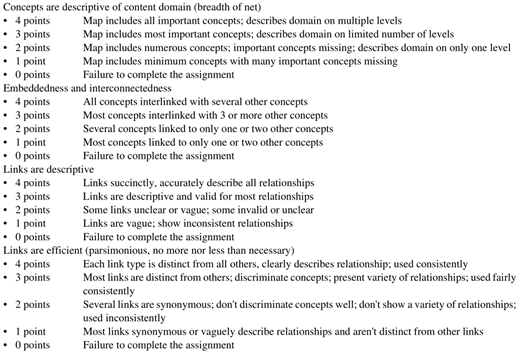
For example, with the concept mapping assignment, students created concept maps in their discipline areas. For every assignment, we provided a rubric (see Figure 1 for an example) that was available for their examination along with the assignment description, several diverse examples, and a procedural guide. In this way, students were informed on how their work would be assessed. The course did not include tests, quizzes and other sorts of close-ended, single response activities, as these assessment methods were not congruent with the course’s learning outcomes.
In a course such as this, where students are required to use many new technologies, they undoubtedly require extra support beyond the thorough written descriptions, examples, and online tutorials provided. Despite the lack of online affordances, we made additional support available in several forms including prompt turn-around of email queries to instructors, and online discussion boards where they could post queries to the instructor and their peers. These are typical forms of support. In addition, all students had electronic and telephone access to a special college team of help desk personnel who specialize in supporting online learning. These personnel were able to answer questions and troubleshoot all manner of inquiries regarding the use of CourseInfo, Internet access, downloading files and plug-ins, and the use of the specific software packages required for the students’ assignments. However, this additional support comes at a significant cost.
Projects for “Using Technology to Enhance Learning” Course
| Assignment | Description |
|---|---|
| Semantic Networking | In this assignment, you will learn about what semantic networks are, how they support knowledge construction, and then develop your own complex and complete semantic network in a discipline area of your choice. |
| Learning Communities | In this assignment, we will focus on how learning communities are established. This assignment will consist of six web forums on different topics related to learning with technology. |
| Information Search Project | The Internet can either be an information landfill or a window of discovery, depending on how skilled learners are with searching and evaluating its contents. This assignment focuses on those skills. |
| Flexibility Hypertext | In this project, you will construct a hypermedia learning environment in html for your students to learn with. The learning environment will be designed based on cognitive flexibility theory. It will present 2 or more cases or problems for students to solve that can be explored from multiple perspectives in order to help students to articulate their own understanding. |
| Technology Integration Plan | In this project, you will develop a plan to use technology in integrated and constructivist ways for a unit of study that you plan on teaching. |
| Assessment Plan | In this final assignment, you will develop assessment rubrics for the technology assignments that you described in your technology integration plans. |
Result
Results for our case study were taken from three sources: student performance on assignments, students’ reflective responses on the final exam, and the instructors’ reflections and observations while teaching the course. The results are presented in terms of the three course characteristics in question. Of the 48 students, 41 completed the final exam (a self-report instrument requiring reflection on action at the conclusion of the course). Seventy-one percent (29) of the students on the final reported they had never participated in a completely online course before. Nine percent (4) had taken an online course before and 20 percent (8) had taken either a correspondence course that was not online or had participated in at least one web-assisted course where an online courseware package such as Courseinfo was used to distribute documents, collect assignments, etc.
Alternative forms of Knowledge Representation
In this course students were required to represent ideas and knowledge via concept maps, web pages, integration and lesson plans. We insisted that students use multiple representations of their knowledge (Jonassen & Carr, 2000). Concept maps, semantic networks, multi-media presentations, audio and video, lesson plans, and three-dimensional design prototypes are all valid representation formalisms required in this course. In this course we challenged students to use technologies as knowledge representation formalisms that are typically not supported by courseware packages. We assumed that it is more important for students to produce instructional products (web sites, storyboards, graphics, video, hypermedia, multi-media, etc.) than studying already-completed products.
The course delivery system was able to present these alternative forms. However, supporting student construction using these formalisms was very problematic. Because of this difficulty, learners’ efforts focused almost exclusively on learning the mechanics of software use, so they missed the more significant outcomes (e.g. in general, how do I use technology in constructivist ways to support learning).
Students addressed this concern in their responses to the question “what was difficult for you about self-regulated learning?” There were a variety of responses including having to pace their own learning activities, and feeling isolated physically from their class peers, but the one consistent response concerned difficulties learning to use the technologies required of this course via the online format. Of the 41 respondents, 25 (61%) mentioned the difficulty of learning to use new technology tools in an online format. Several students commented about needing more guidance because of their lack of confidence, prior knowledge of and experience level with computers, despite the online modeling of software use that was provided in the course. The following two students both remarked in particular about the difficulty of learning these types of outcomes in an online format.
It was also difficult because we had no prior knowledge of how to use these tools so you can’t really learn how to use them over the Internet without an instructor showing you.
I feel that this class was considerably difficult because of the topics at hand. Technology I think is a difficult class to implement over the Internet and without one on one contact.
Several other students echoed these students’ comments about their lack of confidence and how it affected their learning.
I think the fact that I was not very familiar with a lot of the technological tools and a little afraid to use them made it most difficult.
Several students suggested that the lack of explicit modeling of how these tools operated was a problem. The following student’s assertion that it wasn’t “bad” indicates her level of commitment to the situation in spite of the difficulties.
It was also difficult not having any modeling of the process I was expected to perform. It was just a totally new experience, which can sometimes be uncomfortable. Not bad, just a little uncomfortable at times.
Increased frustration levels because of the lack of face-to-face tutoring opportunities and less than instantaneous responses to their email queries was another common theme as illustrated by this student’s quote.
It was frustrating until you got the hang of the new programs. When you weren’t sure what you were doing, you made a lot of mistakes.
Extensive prior experience teaching the same concepts and required technology tools in a face-to-face mode has shown us that instructors can easily have all students successfully operating the technologies within a standard fifty-minute class session. Once the procedures are mastered, students can focus on the more important outcome of applying the technology in specific ways.
Finally, and perhaps most significantly, several students observed that having to learn the technologies in an online fashion actually interfered with their desire to learn more about using these technologies effectively to support learning—which they realized was the course’s goal, and theirs too. This student expresses very simply that learning the technology was a big effort before the real work of the assignment itself could begin: “I had to learn a lot about the programs before I could even get started with the work.” Although this student attributes the problem to her lack of prior knowledge, she clearly states that learning the mechanics of the programs interfered with her deeper learning goals.
I was not knowledgeable enough to be very successful with this course. I was so concerned on how to use the program and getting the assignment done that I really didn’t have time to learn as much as I wanted. I had to get help with every little thing I did which became annoying, time consuming, and took the place of learning.
We further observed that the students who did not mention this as a problem were consistently the highest performers in the class. These were the students who turned in work that was exemplary and often went beyond the assignment requirements. These two students expressed in their finals that their prior knowledge of computers and in some cases creating HTML pages enabled their success in this course.
I was familiar with the programs and building web pages so I didn’t have difficulties with the tasks.
I am pretty comfortable with computers, so I never really freaked out and always seemed to figure out the problem and turn in the assignment.
Initial concerns about these issues were articulated as we designed the course. We first encountered the form-of-representation issue as we wrestled with whether to require students to use specific software packages for producing word processing, HTML, or concept mapping documents. Our inclination and original policy was to allow students to use whatever package they felt most comfortable with. This was congruent with our course objectives. We wanted students to see that these technologies can be used as tools to support and improve learning activities (Jonassen, 2000). Since we wanted learners to concentrate on the knowledge amplification that these tools can allow, then choosing a tool that the learner is already familiar with and still has the necessary functionality is preferable to one that he or she would have to learn anew. This would allow them to focus on the constructivist benefits rather than having to spend cognitive effort on learning the tool.
We encountered problems with this philosophy. First, we found that we as instructors could not be fluent enough in all of these software packages to coach students and answer their understandably very specific questions. Questions such as “how do you save a file as Rich Text using Hyperstudio?” or “how do you create a link to a URL using Page Mill?” were sometimes answerable by a student peer, the help desk, or us, but many times no answers were available, further contributing to anxiety and frustration.
More significant and less easily addressed were submission problems associated with file corruption, the inability to effectively handle multiple file assignments, and problems with up- or downloading large assignment files. In the case of corrupted files, we began our troubleshooting by asking students to re-submit, suspecting some error on their part. This was not the case and we eventually discovered that CourseInfo’s drop box corrupted the students’ concept mapping files. For other types of files, we sometimes found we could open the file but we found it was missing functionality that the student indicated she had completed. In some cases we resorted to having students do screen dumps and fax or mail them to us for assessment.
We ultimately ended up having to abandon our less structured philosophy for a more structured one. For instance, after our first assignment that required HTML production, we standardized on Netscape Composer. We didn’t choose Netscape Composer because it offered the most pedagogically sound interface and feature set. Rather, we chose it because it is was already available for most of our students and freely downloadable for the rest. It also included an online “wizard” that helped novice users create HTML files, and it created files that were consistently readable even after being zipped, submitted via the drop box or as email attachments. Thus our choices were dictated not by pedagogy, but by the limitations of the online delivery.
Effective Assessments
Given the course’s objectives it would not have been appropriate or instructionally sound to use the built-in quiz and examination features of CourseInfo. The learning outcomes that we sought from the course could not be adequately represented or assessed by any form of quiz afforded by the course delivery system. All the projects for this course required the learners to produce examples of knowledge bases and reflect on how they could be used in classrooms. For each project, we supplied rubrics for assessing them. Course delivery systems do not readily support these forms of assessment.
Therefore the only CourseInfo assessment feature that students experienced was the individual grade book. This simply allows students to access a record of their total points on each assignment and their cumulative course points as a percentage of the total available at that time. It is strictly a quantitative representation and provides no constructive or developmental feedback to students about their performance. Instructor-created rubrics for each project (see Figure 1 for an example) were the primary course assessment tool. We discuss these in terms of conducting effective online assessment under “instructor observations.”
CourseInfo is no exception to the general trend in assessment tools for online course delivery packages. Similar to the packages reviewed, it offers quiz/test and survey creation and management. Quizzes and tests can include fill in the blank, ordering, matching, multiple choice, true/false or short answer or essay type questions. Our goals for the course were for students to have a hands-on experience using various technologies to enhance learning, and to demonstrate their ability to effectively integrate and assess these activities by creating lesson plans and assessment tools. Testing students using the previously mentioned item types would not have supported these goals. On the contrary, students needed feedback-rich rubrics to provide qualitative and generative comments on the pertinent characteristics of their projects. CourseInfo does not provide rubric creation, publication and management capabilities. To use rubrics, we created them as HTML documents and published them with our assignment descriptions.
Although this was not overly burdensome, the task of completing and distributing the rubrics for each student on each assignment was somewhat cumbersome. Certainly the very act of providing the more detailed feedback that a good rubric entails is time consuming in and of itself. The authors acknowledge this and do not expect any online course delivery package to alleviate or reduce this effort. We do think it reasonable, however, that the packages at least facilitate the ability to provide such feedback in an online course. When completing this task for face-to-face classes, instructors can work from a printed copy of the rubric and simply complete the rubric during the marking process, total the score and return this completed document along with the project to the student. For this online course, we completed an electronic rubric template for each student and saved this in a file. This process requires no extra effort over the face-to-face method. However, in order to get these completed rubrics to students, we sent each student an email with the rubric attached. Additionally, because of the different capabilities of each student’s machine, we were forced to use text files that eliminated the nicely formatted tables we had started with, thus reducing the legibility and usefulness of the feedback.
If course delivery packages effectively supported alternative assessment forms such as rubrics, this process could be much easier. For instance, a rubric creation feature would automatically set up a rubric as a template and allow an instructor to simply create, complete and store that completed rubric for each student in a “private” area only readable by that student and the instructor. Once a student’s grade was posted in the grade book, she would not only be able to see her total score but also access the completed rubric by selecting the score for that assignment. This would then pull up her rubric for that assignment with more information on why she earned that score and individual comments clarifying the grade earned. This would not only be easier for the instructor but would also present a seamless assessment picture to students, and additionally, underscore the idea that assessment is not just a numerical score but also includes qualitative and constructive comments on performance.
Distributed Tools
The course required the use of software that students did not have access to in a standard personal computer environment. The distributed-tools issue became particularly clear in the design phase. At this point, we noticed how the features and functions of CourseInfo and the overall circumstances of having students spread over a broad geographical area affected our choices as to what we could require of students in their assignments. For instance, instructional video is a potentially powerful tool for enhancing constructive learning (Jonassen, Peck, & Wilson, 1999). Yet how could we require video production when such an activity requires that all participants have access to a video recording device and an editing facility? Further, if we expected students to turn in their work via CourseInfo, they needed software to translate their analog video to digital. Similar problems existed for other assignments such as multimedia production. The software and hardware capabilities required to create these products are not available to most online students, so we were required to assume the least common digital denominator when planning our assignments.
Additionally, while the course was in progress, it became clear from student comments and questions that they were exerting significant time and effort on learning to use the software at the expense of applying themselves to using the software in constructivist ways to support learning. Too often, as instructors, we conclude that the students just “missed the point.” We found that in some cases they weren’t even getting to “the point” because they were so absorbed in learning the procedures for making a concept map using Inspiration or creating a simple web page using Netscape Composer.
Students’ comments in their final exams indicated that, at least to some extent, their struggles with learning the technologies interfered with their ability to concentrate on the constructivist aspects of the course. Their performance on course projects triangulates this finding. For example, in the concept map assignment, most students produced maps that only minimally met the assignment requirements. For instance in spite of numerous examples and explicit instructions as to how to complete the assignment, approximately 50 percent of the students did not label the links, which is the most important part of the learning task. The whole point of the course was for students to understand how to apply technologies in teaching. We did not just want them to learn how to use software for its own sake.
Discussion
In this case description, we focused on alternative forms of knowledge representation, more authentic forms of assessment, and the use of distributed tools on student learning outcomes and student perceptions of the learning experience in an online course. Our experience was that the technology affordances drive what we do in our online courses. Course delivery and management packages, such as CourseInfo, readily afford the delivery and testing of content knowledge. Online course developers see themselves as offering a basic set of tools that are pedagogy-free, or they see themselves as only technology providers and do not consider any explicit or implied pedagogy the tools may support (Firdyiwek, 1999). However, each form of pedagogy makes explicit assumptions about what knowledge is and how learners come to possess it. There is no such thing as pedagogy-free tools. Many readers will no doubt be able to suggest fixes for the problems that we encountered. Our point is that if fixes are necessary, they will rarely be accomplished. Course designers and teachers are, not surprisingly, motivated by what is easiest to develop and support rather than what is needed. What is easiest to develop are the forms of instruction that are afforded by the delivery and management platform. The difficulties of requiring alternative forms of knowledge representation and more authentic forms of assessment using distributed tools compromised our goals and will likely cause serious circumspection about trying to engage learners in these authentic activities online.
The interrelationship between tools and pedagogy is a chicken-and-egg problem—software supports reproductive learning tasks because they are easy to support and develop. We, as instructors, use these types of test/quiz activities because they are easily supported in the courseware packages we are provided by administrators. The capabilities of the software that do not easily support qualitative activities or means of assessment shape what instructors choose to do in their online courses. Must pedagogy recapitulate technology?
There are alternatives. Motivated faculty can work around the limitations of the software, but there are many barriers that make that untenable and impractical. These include the amount of faculty time required to patch the course together, the frequent lack of faculty technical competence, administrative pressures to use a particular course delivery package because of licensing agreements and technical support, not to mention the compromises in course effectiveness and communication problems resulting from these patches.
Faculty and, more importantly, students, experience the difficulties in implementing a completely online course for teaching future K-12 teachers technologies to enhance learning including over-reliance on students’ self-regulation skills and monumental communication problems. Our students were competent, and highly motivated. The problems experienced by them occurred even with high levels of support, which clearly compromised the learning effectiveness in the course.
What Choices do Faculty and Designers Have?
Given the dilemma of efficiencies and effectiveness mandated by online course management systems, what choices do innovative and committed faculty and designers have?
Compromise your pedagogical values and deliver information using a tell-and-test ontology, sacrificing the activities and skill development that your students require.
Teach face-to-face and miss a whole set of students who could not be accessed otherwise, and realistically miss out on a revenue stream that many programs are tapping into.
Compromise and do the best you can, if you are willing to commit the effort. We are not suggesting that it cannot be done, just that it cannot be done cheaply and easily. We can structure a lesson to foster any kind of objective—but what does the tool do to facilitate the learning strategies that one would use in a face-to-face lesson? We provide a few recommendations for course patches to support the goals of alternative representation forms and authentic assessment using distributed tools.
Try brief segments of compressed video to demonstrate and model certain key aspects of learning to use the technologies (despite the memory requirements, streaming capabilities, and cost), but this does not provide for the same level of interactivity and troubleshooting as does a live instructor who can respond to learners’ specific questions. This also assumes that the course delivery tools make it easy?
Provide a list of FAQ’s to help learners find answers to the problems and queries that we as instructors or designers know they most frequently encounter. Once again, this is not as effective as a face-to-face encounter where the instructor can respond to not-so-typical questions, and learners can learn from one another. It also requires learners to scroll through lists of questions to find the one that matches their query. It further assumes that students are able to articulate their questions clearly enough to find a matching question.
Despite the need to move assessment techniques away from testing to projects, assignments and case studies, use case scenarios where students discuss and project what they would do. These prescriptions can be included in traditional assessment forms.
Try synchronous online sessions for coaching on how to use technology tools—but only after students have tried to learn on their own. We didn’t do this so we can’t say how well it would work, but it would allow for students to get questions answered quickly. In such sessions, make sure to include many references to the online materials students have for supporting learning as this may help students to help themselves more in the future.
Very carefully consider whether your course, given the learning outcomes you have planned, should be one hundred percent online. Perhaps some mix of online and face-to-face would provide students with a better learning environment and you more opportunities to get students to concentrate on the most significant learning outcomes for the course, rather than the lower level procedural outcomes.
Use software reviews and recommendations to pick a package that has the features you need for your learning outcomes. Our hope and belief is that online courseware packages will begin to support alternative pedagogies. We are working on online templates for supporting problem-oriented learning.
If at all possible, teach your students new software applications in a face-to-face or perhaps videoconference mode. The sort of interactions you can support in a synchronous mode where all can easily see examples and benefit from one another’s questions is invaluable—and we aren’t the only ones to conclude this (Billings, 2000).
Require pre-requisite skill development of students (basic computing skills such as download, ftp, file compression, basic and simple web page design using Netscape composer).
At a curricular level, figure out what you can reasonably accomplish for your learners via web courses. Make decisions accordingly. Maybe the whole degree program cannot be online.
Online learning (e-learning) is exploding. Our fervent hope is that educators will perceive this explosion as an opportunity to reconceptualize the ways that we teach. Rather than recapitulating the worst aspects of face-to-face instruction, let us reconceptualize online systems to afford innovative forms of instruction that support more meaningful learning. That represents a significant challenge for the field.

