


Blending learning environments are being adopted by an increasing number of educational institutions in order to offer flexibility to students. Although, blended synchronous learning environments have been around since early 2000s, there has been little research conducted on students’ experiences in these environments, specifically in terms of instructor-student and student-student interactions. This research describes a case study designed to examine graduate students’ perceptions of interactions with their peers and instructors. Observations, interviews, and an open-ended survey were used to collect data. Findings indicated that students preferred to interact with the instructor over their peers. Further, students were able to form relationships with their peers in similar environments. Suggestions for instructors and designer/course developers regarding the design and implementation of class activities are provided.
Introduction
Blending learning environments are growing in popularity and have been adopted by an increasing number of educational institutions in order to offer flexibility to students (Christensen & Evamy, 2011; Mestan, 2019; Pelliccione & Broadley, 2010; Szeto & Cheng, 2014). Osguthorpe and Graham (2003) analyzed the learning activities, students, and instructors to develop three models of blended learning that can occur: (1) blending of online and face-to-face activities, (2) the blending of online and face-to-face students in one environment, and (3) the blending of multiple instructors either face to face or from a distance. One type of blended learning environment is one in which online and face-to-face students take the same course at a certain time within the same educational space (virtual and face to face). These blended learning environments, often called blended synchronous learning environment (BSLE; Hastie, Hung, Chen, & Kinshuk, 2010), combine the face-to-face environment with synchronous technologies or virtual classrooms where students can participate in one class together.
Critical to BSLE is equitable access for students to both instructor and peers (Szeto, 2015). Although, BSLEs have been around since the early 2000s, there has been little research conducted on students’ experiences in these environments, specifically in terms of instructor-student and student-student interaction in the face-to-face environment and those at a distance (Bower, Dalgarno, Kennedy, Lee, & Kenney, 2015; Szeto, 2015; Szeto & Cheng, 2014). Some researchers have analyzed the patterns of interactions within the BSLE to determine how these interactions affect the students’ and instructors’ experiences (Rasmussen,2003; Szeto, 2015; Szeto & Cheng, 2014). As useful as this initial research has been, many of these studies focused only on the frequency not the quality of interactions and student perceptions to access. Although these studies provide insight into BSLEs, research on how interactions shape both the students’ and instructors’ experiences is lacking. Thus, the purpose of this study was to investigate students’ perceptions of interactions between the instructor and students in a BSLE environment. The researcher applied the blended synchronous design framework to evaluate the designed interactions within the virtual classroom. The following research questions guided this study:
How are students-instructor interactions within the live BSLE?
How are student-student interactions within the live BSLE?
Literature Review
Overview of BSLE
Many terms have been associated with the blending of face-to-face and online students in one environment. Oyarzun and Martin (2013) dubbed this environment multimodal course delivery. This is the combination of face-to-face and simultaneous synchronous online delivery. Bower, Cram, and Groom (2010) defined the combination of the physical and virtual environment as blended reality. This combination included participants in both the physical and virtual space simultaneously. BSLEs, a term coined by Hastie et al. (2010), are created using an array of technologies such as room-based video-conferencing systems, desktop web-conferencing platforms such as Skype (Cunningham, 2014), web-based conferencing platforms such as Cisco WebEx (Oyarzun & Martin, 2013), or chat rooms with video feeds. The BSLE must be equipped to allow interactions between face-to-face and online students and their instructor (Oyarzun & Martin, 2013).
Research has identified many challenges associated with the blended synchronous learning environment such as technology (Szeto 2014; Szeto & Cheng, 2014), interaction between the face-to-face and online students (Stewart, Harlow, & DeBacco, 2011), and the ability of the instructor to give equal attention to both the online and face-to-face students (Cunningham, 2014, Szeto, 2015; Szeto & Cheng, 2014). Therefore, it is necessary to understand how to organize and manage a class in the BSLE to facilitate student learning and interaction (Bower et al., 2015). Organization and design of effective interactions are imperative to the success of creating a cohesive class among the face-to-face and online students and lessening instructor cognitive and affective load during teaching (Teng, Chen, & Leo, 2012). During the implementation of the lesson, instructors need to engage students to keep them involved with the course content and each other (Bower et al., 2015; Szeto & Cheng, 2014), and balance the contributions of the students between the face-to-face group and the online students (Bower et al, 2015; Szeto, 2015; Szeto & Cheng, 2014). For this reason, the design of lessons and planning on the interactions between students from the same and different environments and with the instructor is essential.
Technology is an important aspect of the blended synchronous learning environment, and professional development on how to use this technology is vital for the instructor and students (Szeto, 2015). Both online and face-to-face students should become familiar with the technology used in the blended synchronous learning environment as it is the platform for communication between the two groups of students and the instructor. Face-to-face students can be resentful when technology fails and the instructor takes class time to assist online students (Cunningham, 2014). Other researchers have noted that audio lags can be detrimental to group cohesion due to the interference it can cause for group activities (Bower et al., 2015; Szeto & Cheng, 2014). Both face-to-face students and the instructor also need to be aware of the camera and microphones in the room to ensure the online students are able to view and hear the class discussion (Cunningham, 2014). With this in mind, it is important for the instructor to consider the type of technologies utilized as well as incorporating student training into the design of the course to ensure better communication and interactions among participants.
BSLE Challenges
Some research has focused on how instructors and students interact in the blended synchronous environment (Cunningham, 2104; Szeto, 2015; Szeto & Cheng, 2014). Instructors and students can interact in many ways through audio, text, and visual cues in BSLEs. Though, an instructor has to be aware of both groups of students (i.e., the face-to-face and online students) and ensure equal attention is given. For instance, Szeto (2015) found the face-to-face students felt neglected due to the instructor focusing on the online students for skill demonstration. Some students reported that it is difficult to hold an audio conversation with the online students due to the audio delay which resulted in interruptions (Stewart et al., 2011). In order to incorporate both online and face-to-face students and reduce cognitive load for both instructor and students, instructors can employ various instructional strategies. For instance, instructors can direct communication to one mode (e.g. audio, text). For example, when the instructor asks a question, they can direct the students to type their answer in via chat. Another strategy to reduce cognitive load is to employ a face-to-face student to monitor the chat and ensure questions are answered, or comments are made aware to the whole class (Bower et al., 2015). Overall, the instructor must be aware of any potential audio lags and ensure equal attention is given to both the online and face-to-face students.
Blended Synchronous Learning Design Framework
In order to overcome challenges of the BSLE, Bower et al. (2015) developed the blended synchronous learning design framework which offers pedagogical, technological and logistical recommendations. The framework is designed around three constructs: presage (design), process (implementation), and product (outcomes). During the presage or design stage, the instructor determines the learning outcomes for the class and designs activities for each class. At this stage, among other things, the instructor decides how he or she plans to use student groups in class (e.g., group students according to location, mix face-to-face students with online students). The instructor also identifies the appropriate technology for each class activity and tests any technology needed before class starts. Students need to be informed of any technical requirements (e.g., webcam or microphone) and provided any supplementary materials as needed before class begins. Bower et al. (2015) argued that with proper preparation by the students and instructor, the class will be able to focus on course concepts and collaborative activities rather than navigating the technology (Bower et al., 2015).
During the process of implementation of the class, instructors need to continually monitor students while being aware of any potential technology issues. Some pedagogical recommendations offered include distributing attention among the face-to-face and online students, encourage regular contributions from students, and to be flexible and adaptive. Some students may have technology difficulties during class; therefore, the instructor needs to have knowledge of troubleshooting techniques. Finally, start class 10 minutes early to ensure the technology works for all students (Bower et al., 2015).
The recommendations for pedagogy, technology, and logistics set forth by Bower et al. (2015), postulates the following outcomes: active learning for both face-to-face and online students while at the same time enhancing equitable access among learners and to the instructor and creating more flexible access to learning. Overall, this will lead to student satisfaction and achievement of learning outcomes (Garrison, Anderson, & Archer, 2000; Gunawardena, 1995). The blended synchronous learning design framework was developed based on previous literature and a comprehensive research case study project and was used to guide the qualitative analysis in this study.
Methodology
An embedded, single case study approach was utilized for this research. A single case embedded approach is justified since this case is limited to classes within the BSLE. This common case was the academic programs using the BSLE and the subunits are the individual classes within the programs (Yin, 2014). The BSLE was utilized by two programs during the fall 2016 semester, a masters and doctorate program. The introductory course from each program was identified for the embedded unit within the case.
Participants and Context
Purposive sampling was used to identify participants for the study. Purposeful sampling allowed the researcher to select the courses/ participants that would provide rich information regarding the phenomenon and lead to an in-depth understanding of the case (Creswell, 2012; Patton, 2002). This study took place during fall 2016 at a midsized southern university. There were seven master courses in instructional technology and 10 doctorate courses in educational leadership being offered in fall 2016 that utilized a BSLE. The embedded units of this study consisted of two classes: one in the master’s program and one in the doctorate program. Both courses were the prerequisite courses for the core courses for the master’s and doctorate programs. These courses were chosen since both courses were the introduction core class for their respective programs, most of the students would have minimal exposure to this type of environment, and to prevent having the same students in two different classes from participating in the study. The master’s course met every week, while the doctorate course met every 2 to 3 weeks. Overall, 27 students and two instructors participated in the study. The master’s program course had five female students and three males. The doctorate program course had twelve females and seven males (see Table 1). Students who live within the vicinity of the university campus have the choice of attending either face to face, online, or a combination throughout the duration of the semester.
| Master’s Course | Doctorate Course | |||
|---|---|---|---|---|
| Gender | Face-to-Face Students | Distance Education Students | Face-to-Face Students | Distance Education Students |
| Male | 2 | 1 | 3 | 4 |
| Female | 1 | 4 | 4 | 8 |
These BSLE’s used a Cisco Telepresence system along with WebEx. The Cisco Telepresence system provided high definition video of the classroom and quality audio feeds to allow the face-to-face and online students to feel as if they are in the same room. The classroom was equipped with an instructor station computer that can be projected onto a screen (see Figure 1). Cisco telepresence was integrated into the distance education room and includes the instructor station, cameras, and microphones. The instructor used the webbased software of WebEx on the instructor’s station computer to connect peer to peer with the online students. The peer-to-peer connection allowed the students to access the instructor from any location as long as they have a computer and Internet access. The Cisco telepresence then allowed face-to-face students to see and communicate with the online students through the microphones and projector screen.
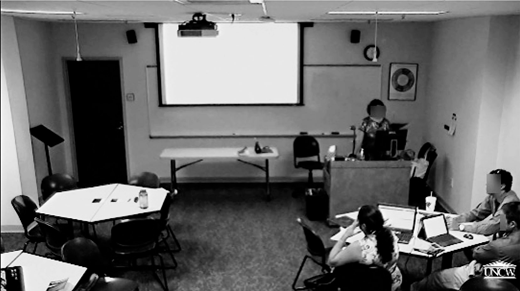
A Cisco telepresence room an instructor’s station, classroom cameras, microphones (located on each table), and projection screen. WebEx is used on the instructor’s station computer and projected on the screen so the face-to-face students can see the online students.
A Cisco telepresence room an instructor’s station, classroom cameras, microphones (located on each table), and projection screen. WebEx is used on the instructor’s station computer and projected on the screen so the face-to-face students can see the online students.
Each course consisted of two sections. Students who lived locally and could attend campus classes as well as use campus resources registered for the on-campus section. Students who lived at a distance (e.g., outside of Wilmington) registered for the distance education section. Although students may live outside of the Wilmington area and registered for the distance section, if they chose to, the student may drive to campus to attend class face to face. The on-campus students could also choose whether they attend on-campus or online. The designation of distance education student means that those students do not have the opportunity to use the on-campus resources and thus have reduced tuition. None of the distance education students opted to attend the face-to-face sessions during the observation period. In the master’s course, three of the face-to-face students decided to attend class online starting in week three (Table 2). Two students moved to the online environment in the doctorate course for the third class. The motivations for students to attend online ranged from medical reasons, moving overseas, and overall preference for attendance.
| Face to Face | Online | |||
|---|---|---|---|---|
| Class Observation (CO) | Male | Female | Male | Female |
| Masters CO 1 | 2 | 2 | 1 | 3 |
| Masters CO 2 | 2 | 2 | 1 | 3 |
| Masters CO 3 | 0 | 1 | 3 | 4 |
| Masters CO 4 | 0 | 1 | 3 | 4 |
| Masters CO 5 | 1 | 1 | 2 | 4 |
| Masters CO 6 | 0 | 2 | 3 | 3 |
| Masters CO 7 | 0 | 1 | 3 | 4 |
| Doctorate CO 1 | 4 | 6 | 3 | 6 |
| Doctorate CO 2 | 3 | 4 | 4 | 8 |
| Doctorate CO 3 | 3 | 2 | 4 | 9 |
Data Collection and Analysis
Data collection for this study included an open-ended survey, observations, text chat transcripts, and semistructured interviews. The data collection was divided into three overlapping phases: observations, survey, and interviews. During the observation phase, the researcher took analytical annotations of interactions that occurred during the class sessions and student reactions. During the second phase, students were asked to volunteer to complete an open-ended survey. Finally, during the third phase, students and instructors were asked to volunteer for a one-on-one interview. The interview questions were semistructured with additional questions added based on the observations and survey results.
In order to investigate the interactions between the students and the instructor within the BSLE (Research Question 1), data were collected through observations, faculty interviews, and students’ interviews. During the observations, frequencies were also collected on the interactions between students and the instructor. These were coded under four categories: administrative, social, content, and technical. The frequencies were collected to validate student experiences, instructor perceptions as well as the researcher’s analytic observations. To answer research question #2, data were collected through observations, students’ interviews, and an open-ended student survey. During the observations, frequencies were also collected on the interactions within and between groups of students. The frequencies were collected to validate student experiences and the analytic observations.
The data collection and data analysis occurred concurrently throughout the research process (Miles & Huberman, 1994). Multiple forms of data analysis were employed to analyze the data such as structural coding, memoing, frequency analysis, and pattern coding. Structural coding was used as a first-round coding process as a categorization technique. Structural coding allowed the researcher to apply a content based or conceptual phrase that represented a topic to a segment of data that related to specific research questions (Saldaña, 2015). Analytic memoing was also used throughout the first-round coding process. An operational diagram was used as a transition to the second-round coding process in order to organize the themes from structural coding. Pattern coding was used to develop categories to interpret the data from the observations, interviews, and surveys. Analytic memos were recorded throughout the process on emerging patterns or themes throughout the data collection and analysis after each observation and interview (Miles & Huberman, 1994). These data were compared to the surveys and interviews to determine consistency.
Findings
Student-Instructor Interactions Within a Live BSLE
A major finding emerged from the analysis of the instructor and student interviews which was distributing attention equally among the online and face-to-face students is an important concept that requires deliberate and conscious effort. According to the students from both classes, the instructors distributed their attention between the two groups, online and face to face, equally. One student stated, “I think they specifically did a really good job of making sure [equal attention]. Several face-to-face students stated they also tried to show respect by allowing the online students to answer some of the questions and were aware of the audio lag that can occur. The face-to-face students stated they held back from answering questions, so the online students had an opportunity to interact with the instructor. One face-to-face student stated, “I can be kind of outspoken, so I know that myself, I try to be quiet. Sometimes, I make sure that I’m letting online have the same. It’s equitable, and not monopolizing time in the class.” Another face-to-face student said,
I have to be careful that I don’t just shout out my answers because a lot of times people will use the little raise your hand thing and beep in.... I have to remind myself, no, you don’t have to answer every question.
One student stated that by distributing equal attention among the face-to-face and online students, the instructor made “it felt as if there’s not two different environments.”
From the observations, the researcher noted that the instructors routinely asked whole class questions. The master’s course instructor would then call on students by their name to answer the question. Each time the instructor asked a question, she would call on different students to ensure all students, both face-to-face and online, had the opportunity to answer. In the doctorate course class, the instructor would ask a whole class question, and either look at the face-to-face students to answer or call on the “online folks.” Using this method, typically the same online people answered the question.
According to the frequency results (see Table 3), face-to-face students accounted for a majority of the interactions with the instructor although they made up 37%of the class. The online students composed 63%of the class yet only interacted with the instructor 25.7%of the time. The frequency data contradicted students’ perceptions that the instructors divided their time equally. Students’ perceptions suggested the instructors equally split their time between the face-to-face and online students by making it a priority to call on the online students individually or as a group. One student stated he moved to the online environment to have more freedom to explore related topics while class is going on. “Sometimes we may be covering something that I know well or am not particularly interested in so when I attend online I can direct my attention to other class related work.” Another student stated, “the only thing that I prefer about the online environment is really more like a personal thing, for me to be able to collect my thoughts, rather than maybe how we’re collaborating in class.” From these statements, it could be inferred that some online students preferred to listen to interactions between other students and the instructor rather than actively participate in class discussions. Despite the numbers in Table 3, the doctorate instructor reported that she felt as though she gave more of her attention to the online students. She stated the following:
| Type of Interaction | Admin | Social | Content | Technical | Total | Percentage of Interaction | Percent of Students in Online or Face to Face |
|---|---|---|---|---|---|---|---|
| Instructor, whole class | 19 (24%) | 10 (12.8%) | 48 (61.5%) | 1 (1%) | 78 | 20.4% | |
| Instructor, online | 32 (32.6%) | 5 (5%) | 59 (60%) | 2 (2%) | 98 | 25.7% | 63% |
| Instructor, face to face | 69 (33.6%) | 7 (3.4%) | 120 (58.5%) | 9 (4.3%) | 205 | 53.8% | 37% |
| Total | 120 | 22 | 227 | 12 | 381 |
I may have erred on the side of paying so much attention to the 12 of them online that we might have actually slacked off a little bit with the discussion in the face to face. It’s really hard to find that balance of how to make sure everybody’s feeling connected and part of the conversations and participating.
The instructor also stated, “I don’t necessarily feel the challenge of my attention so much as I’m almost constantly hyper aware of “Have I heard from the online students recently? Is anybody checking in? Have I missed something? Are they feeling connected?” Despite the perception of the instructor, the actual frequencies demonstrated the instructor focused more on the face-to-face students. Yet the impressions and perceptions of the students also echoed the instructor’s perceptions of equal attention.
Table 4 illustrates the interactions from the master’s course. The instructor in the master’s course class asked each student at the beginning and end of class to explain their knowledge gained or questions regarding the content, therefore, the interactions are more representative of the distribution of the students. On average, 75%of the students attended online and 25% attended face to face. Since the instructor engaged students individually, the frequencies of interactions are more equitable based on the data collected. The instructor stated:
| Type of Interaction | Admin | Social | Content | Technical | Total | Percentage of Interaction | Percent of Students in Online or Face to Face |
|---|---|---|---|---|---|---|---|
| Instructor, whole class | 12 (13.6%) | 0 (0%) | 76 (86.3%) | 0 (0%) | 88 | 33.5% | |
| Instructor, online | 34 (25.9%) | 0 (0%) | 97 (74%) | 0 (0%) | 131 | 50% | 75% |
| Instructor, face to face | 18 (41.8%) | 0 (0%) | 25 (58%) | 1 (2%) | 43 | 16.4% | 25% |
| Total | 64 | 0 | 198 | 1 | 262 |
Then, all the time assess them, because they know that I’m not going to miss them if they’re not listening. I grab them right immediately. If I know that somebody is disappearing, I’ll ask them kind of questions so that they know that it’s like you are right here. You [students] have to be very attentive and as much as possible.
Both instructors engaged all students in discussion and frequently directed questions to the class as a whole. Many students enjoyed hearing the viewpoints of their peers and therefore were partial to the whole class discussion. During the whole class discussion, the interaction was primarily between the instructor and the student answering the question and rarely between students. The instructor took the stance of a facilitator of knowledge and solicited student responses. The primary reason for students’ fondness for whole class discussion was the ability to hear other’s viewpoints and the ability to received immediate feedback on class concepts from the instructor. Students implied that it is important to get clarification from the instructor. One student stated,
So I think that’s important to have some instructor led conversations, because if we were just left up to our own devices I don’t think we’d ever know if we were on the right page. I did like how we had our chance to discuss together afterwards, but I think just student led discussion together all the time would be ... I wouldn’t really be sure if I was on the right path to learning.
The students from both classes sought immediate feedback from the instructor on content related questions and answers. This was validated through the one-on-one interviews. One student stated that she enjoyed the group work but felt she would not be on the right path to learning if the class focused on student-led discussions. When asked about clarifying questions, one student stated she would defer to the instructor instead of her peers. “If I ask a classmate, I don’t think they are going to know half the time.” Through observations, the researcher noticed when answering questions, students nonverbally engaged with the instructor making eye contact when answering the whole class. The students did not scan the class making eye contact with their peers. This indicated that the students only engaged with the instructor seeking validation for their thoughts or clarification.
Student-Student Interactions Within a Live BSLE
Two major findings emerged from student’s interview, the open-ended survey, the class observations and chat transcripts analysis: students did not engage with each other frequently, and student to student interaction was found primarily among the face-to-face students. During observations, students frequently engaged one another during the discussion portion of the class. Students did interact with one another during group activities, but when there was a general discussion, students did not answer each other’s questions nor did they answer questions that arose via text chat. For example, one student was having difficulty finding the document the instructor was referring to in class on the learning management system and asked a question in the text chat on where to find it. None of the students answered the question, and all waited for the instructor to answer the question. According to the frequencies of interaction in Table 5, interactions among the face-to-face students is much higher than that of face to face to online and online to online, yet face-to-face interactions are still low. Frequencies were gathered only during whole class discussion not during collaborative activities. In an interview, one face-to-face student stated she already knew two of the people in the class, therefore, it was much easier to ask them questions as well as the fact that these students all were in close proximity. Another face-to-face student stated, “I usually interact mostly with the students that are in the same room.” A third student stated, “I am definitely more conversational in my [face-to-face] classes and do find a disconnect between [online] and class participation.”
| Type | Total | Percentage |
|---|---|---|
| Face to face—face to face | 31 | 67 |
| Online—Online | 2 | 4 |
| Face to face—online | 6 | 13 |
| Online—whole class | 2 | 4 |
| Face to face—whole class | 5 | 11 |
| Total | 46 |
Students’ interactions were low in both classes. This is likely because the students preferred to interact with the instructor more than their fellow students. When students did engage with one another, they were more likely to engage with those in the same environment. One face-to-face student stated that he was able to get more out of a face-to-face conversation. In fact, he stated that “it’s a little awkward interacting with people online.” Another face-to-face student wrote, “I feel an emotional connection to my peers in the face-to-face class. I do not feel the emotional connection to online peers because it is difficult to build relationships with them through a computerscreen.” A third online student stated,
Sometimes I feel like I am able to develop a sense of collaboration with my peers in an online environment. Often I feel as if the online collaboration is forced and ineffective. I think collaboration is little bit easier in a face to face environment because you are able to be truly present and quickly interact with one another.
Many online students had a different view of collaborating with their peers. Although they did not engage in conversation with their face-to-face peers during whole class discussion, the online students felt they collaborated well with others including the face-to-face peers. The online students referenced the sharing of ideas when describing their interaction with their peers. This type of interaction indicated the online students felt this was a form of collaboration. One online student stated,
Just the sharing of ideas ... someone has an idea and I’m like, oh I didn’t think of it that way, which would help me out in say answering a question or providing input or giving another outlook and experience that I’ve had.
Another face-to-face student stated,
I usually feel I am able to develop a sense of collaboration with my peers.... My partner in this case is online, but I don’t believe it’s really necessary that my partner is in the same environment as me.
Another online student stated,
I detect no difference in my sense of collaboration between those in the same environment or alternate. I recall an in-class activity in which three of the four group members were in class and the other was online, and we made sure to include the online students, asking for input and listening to her suggestions.
Although the online students did not engage in direct discussion with one another or the face-to-face peers, they perceived the whole class discussion as student interaction. Some students reference asynchronous forums.
Introductions and initial conversations create the foundations of these relationships, while the forums allow us to really build and converse around the content. W then reconnect in the synchronous environment to discuss with those same peers.
Yet one face-to-face student did not see the benefit of the asynchronous forums. “I am able to develop a sense of collaboration with my face-to-face peers.... With the delay in an online discussion, it is difficult to have a meaningful discussion.”
Students were also asked if they chatted in class without instructor knowledge (backchanneling). The masters face-to-face students were required to login to the WebEx system to connect with the online peers while the doctorate face-to-face students were not required to log into the WebEx system. Of the 14 students who responded to the survey, 12 stated they backchannel during the synchronous session. Nine of the students were online students while three were face to face (see Table 6).
| Course | Online | Face to Face |
|---|---|---|
| Master | 4 | 1 |
| Doctorate | 5 | 2 |
Interestingly, many of the students chatted with other students in a similar environment. One online masters student stated:
We get a giggle out of our backchannel chats. We note any unintentional double enterdres. We get clarification on classroom information or throw in our own experiences along the lines of the trainer’s discussion. Or sometimes we can just be totally silly and we’re only having fun. The chat is MUCH more open and informative and fun when the teacher engages with our chats, usually by reading the interesting chat message to all. By calling out our chat message this way, it really makes class much more fun, multilayered, informative, and engaging.
Another face-to-face student said, “I do not normally backchannel with online peers. I do, however, do it with face-to-face peers.” Most students did engage in backchanneling for assignment or concept clarification, “typically in an effort to better understand directions or instructions.” Finally, another student reference trying to backchannel but the efforts were not acknowledged. “I noticed that my peers and the instructor tend to ignore the chat box so I think most of us do not use it unless necessary.”
During the observation, there were minimal chats the researcher was able to observe. Most of the time it was online students who were contributing to the discussion but very minimally. Of the eight observation sessions for the master’s students, there were only three class periods the students used the WebEx chat. Students in the doctorate course used the chat for all three observations but again, the responses were not conversational in nature but a response to the instructor’s question to the entire class.
Implications
Student-Instructor Interactions Within a BSLE
The primary interaction that occurred in the BSLE was between the instructor and the students. This was due to students wanting interaction with the instructor to guide clarifying conceptual questions. Although there was unequal attention in the doctorate course, the perception from both the student and the instructor was of equal attention. This could be due to the instructor ensuring the online students were addressed throughout the class time. The fact the instructor ensured the online students were addressed could be a reason the face-to-face students felt a need to ensure the online students had equal opportunity to engage with the instructor.
Both Szeto (2015) and Rasmussen (2003) found an unequal distribution of attention from the instructor to either the online group or the face-to-face group similar to this case study. Unlike this case study, the students in Szeto and Cheng (2014) and Rasmussen’s (2003) studies felt there was an unequal distribution of attention from the instructor. In Szeto and Cheng (2014), the instructor overcompensated his attention toward the online students. The face-to-face students felt the instructor spent too much time focused on additional explanations specifically for the online students. Rasmussen (2003) found the opposite where the instructor focused his attention toward the face-to-face students. In this case study, although the frequency of interactions between the instructor and face-to-face students was higher, overall, the students perceived the attention of the instructor was distributed equally. One instructor used a systematic practice of calling on students by name. The other instructor typically called on students by group: online or face to face. The face-to-face students were more apt to answer the instructors’ questions and then continued to engage in the discussion. Whereas one or two online students would answer the question without continuing to engage the instructor in the dialog. This could be one possible reason for the imbalance of interactions. As long as the instructors identified both groups for each question, the students perceived they were being acknowledged.
Student-Student Interactions Within a Live BSLE
Students described interactions with their peers through a broad variety of collaborations although a majority of the students felt most comfortable collaborating with those in the same environment. Similar to Ramussen (2003) and Szeto and Cheng (2014), there were a low number of interactions between the online and face-to-face students. Face-to-face students preferred to interact with those in their immediate vicinity whereas online students who had questions chose to engage with the instructor rather than fellow classmates. This suggests that students perceived each other in two separate educational environments rather than in one class. It also suggests that students attend class with preconceived notions of education. For example, some of the face-to-face students had referenced the inability to form bonds online or with online students. Yet the online students were able to form bonds and collaborate particularly through backchanneling. The face-to-face students enrolled in the doctorate class were not required to log into the virtual environment with their online peers. A majority of face-to-face students, primarily doctorate course students, stated they had difficulty connecting with their online peers. If the face-to-face students were prompted to be logged into the virtual environment and encouraged to interact with the online students, would the perception of the students change? Despite the environment where the face-to-face students can see physical attributes of the online students including nonverbal facial expressions, it cannot be assumed that students in the two environments will interact. The lack of connection could be attributed to the fact that many of the face-to-face students were not required to log into the virtual environment with their online peers. Since the face-to-face students were not in the virtual environment, they did not have the opportunity to interact with the online students via text chat. Although in Ramussen’s (2003) and Szeto and Cheng’s (2014) studies, the online and face-to-face students were connected in the virtual environment, they still had low interactions. This would suggest the instructor would need to create meaningful interaction between the online and face-to-face students as well as providing scaffolding on interacting across environments.
The blended synchronous framework recommends that all students have access to the virtual environment as well as carefully designing active learning activities (Bower et al., 2015). For instance, Bower et al. (2015) recommend pairing an online student with a face-to-face student so the face-to-face student could articulate any concerns or issues the online student was facing. This strategy could also assist with facilitating communication between the two groups and allow for a relationship to develop among the pairs of students. It was also suggested that online students need preparation in terms of technological setup, technology skills, and expectations. From the current case study, it is suggested that all students including the face-to-face students participate in the virtual environment to level the playing field and create access for comingling among students in the two environments.
Future Research
The BSLE is a unique environment since it incorporates both face-to-face and online students simultaneously. The purpose of this qualitative case study was to explore students’ perceptions of peer and instructor interactions. The findings of this study contribute to the work of previous researchers in the area of BSLEs including the blended synchronous design framework, particularly the process stage. The results suggest that although there may be unequal interaction between the instructor and students, mindfulness of both groups of students is imperative to student satisfaction.
Although the results of this study corroborate Szeto and Cheng (2014) and Ramussen (2003) studies with low student-to-student interaction, students in this study were still able to form emotional connections with other students. Although most connections were within the same environment, the master’s students were able to connect more easily to one another. This may be due to the requirement that all students whether online or face to face be logged into the virtual classroom. Szeto and Cheng (2014) recommended instructors cultivate quality interactions to enhance student interactions among groups. One method would be to ensure all students attend class through the virtual classroom. Future research should continue to examine each class as a case to corroborate instructional and technological strategies set forth by the blended synchronous design framework and continue to expand upon the framework to serve as a guide for those teaching within the BSLE in the future.
Limitations
This study as with most studies is subject to limitations. First, as with all qualitative research, the product is a result of the reflection of the researcher. The researcher is alumni of the MIT program and was more aware of the instructor’s teaching strategies. The research also had some bias toward the BSLE. This study began its inception as a potential study when I was a participant in a workshop with a facilitator who was an instructor in the BSLE. During this workshop, the facilitator dismissed the online participants during the introductions by allowing the face-to-face participants to introduce themselves and then generally introduced the online participants generally. After the online participants were informally introduced, there was no effort on the part of the instructor to engage the online participants, and we were treated more like observers than participants. My concern at that point was that students taking classes may have the same experience. This concern was reaffirmed during the pilot study when one student commented that the feeling was when a student chose to attend online, that student was choosing to be an observer and not a participant.
To prevent bias interpretations of subjective information, multiple sources of data was obtained particularly in the form of multiple interviews from students with diverse backgrounds. Second, a cross-case analysis of this study could be completed to pinpoint the differences in student perceptions based on instructional style. Both instructors had teaching experience within the BSLE yet their instructional and preparation styles differed. These instructional styles could be analyzed further to ascertain in the differences among the specific classes and analyze each class as a case. This was not done as the researcher wanted to gain a holistic view of the BSLE and overall student perceptions. Third, the current study was limited by its context, and there was a small number of students participating in the study. The researcher recruited volunteers for the interviews through email. Therefore, the majority of students who volunteered may have had similar outlooks on the BSLE. The findings of this study may be suggestive for similar groups yet may not be generalizable to other groups such as undergraduate programs or other institutions. Particularly since students in these programs had the option to attend online or face-to-face and they took advantage of this freedom. This mobility of the students may have led to their positive experiences.

