


“When you are trapped in the den of a tiger, you will survive if you keep your spirit alive” is an old proverb in Korea. During the chaos of the COVID-19 outbreak, we have all observed many unexpected events. Being an international PhD student in another country has left me with only one choice—keeping my spirit alive to survive. This was made possible with the support of the communities within my university. We are all new to this pandemic, and we are all learning together. In this essay, I would like to share my experiences in being a PhD student in the state of Oklahoma.
Introduction
My university is located in a small, midwestern town in Oklahoma. It has been a peaceful and quiet place since my arrival in 2017. Unfortunately, in 2020, COVID-19 changed that. During this pandemic, I have experienced unique and funny stories. One story was not being able to find toilet paper for a few weeks (at Walmart); but I was still able to buy them in other stores, so no big drama has really happened surrounding me in this area. Many people in this small city are affiliated with our state university and have a “cowboy spirit.” Most of my experiences in this town come from my program, university, students’ associations for a graduate school, and a community with a campus ministry group and a local church group. My life could have been much more stressful while facing COVID-19 if I did not feel care or support. Fortunately, I felt that my basic needs (food, shelter, security) were met and that I was cared for by my local organization. I received many informative emails and inquiries about my thoughts, opinions, and physical and mental well-being, and I was glad to share them with my university.
What has been happening with this pandemic near me
I believe nobody expected this much impact from the pandemic. However, gradually I was able to observe changes and impacts due to this pandemic. In the beginning of COVID-19, people asked me about my family staying in South Korea as it spread from the other side of the country. They looked concerned about my family, but nobody—including me—seemed to think we would have been affected in this small town too. For example, in January, my colleagues and I were excited about going to one of the biggest conferences in education, and we all started booking flights by starting face-to-face courses. In February, the courses went smoothly. In order to conduct observations for my research, I was even able to freely attend a private Christian school for the entire day. The fieldwork was fun and I enjoyed using a portable gadget to take notes and photos. The school faculty told me they would be happy to have me anytime.
However, in March, I was not able to visit the school again for my second observation. I had to communicate with the principal of the school via email or text. I could clearly start to see some changes. The biggest change was when every face-to-face course moved fully online after spring break. Before switching into the online courses, my experience with instructional technology was minimal. Things were quite traditional in that we would have face-to-face meetings and discussions for classes. Casually I would see a professor using visual aids in class like PowerPoint or sometimes Zoom was used for the students who could not attend a class. Just before spring break, via school emails, the university encouraged students to make good choices during their spring break for their safety. Unfortunately, after spring break, the university emailed us about their decision to move online (like the library, the graduate school, and summer study). The most commonly used tools became Zoom and Canvas. People who were not comfortable with certain “technologies” were forced into a challenging situation once most activities were transferred to an online setting. Suddenly, we had to learn how to teach and learn online without seeing each other and without any prior preparation or training.
Nevertheless, others were able to successfully adapt, lead, and utilize new opportunities presented. For example, one faculty member who serves as a superintendent continued to teach well (and passionately) through synchronous online meetings. He shared stories about how teachers helped their students by delivering printed activity worksheets and lunch boxes to student houses via school buses. The students’ basic needs of food and access to educational resources were able to be met, and the front stories were actively delivered to us during the online meetings. We all shared what is going on with each location since most of the participants are educators, being there and sharing the weeks were very meaningful by seeing each other’s face through a computer screen.
In April, the decision of the university was made clear—all summer courses would go online, spring graduation ceremony would be moved to winter, and the school building closure would be extended. All courses went through Zoom or Canvas according to the course plan even though sometimes flexible deadlines were given. A lot of online resources have been shared through the universities and the courses. I was grateful that open resources were available anytime, but at the same time, I missed real physical interactions with classmates, faculty, or coworkers at the universities.
During this time, one of the most observable changes was the number of participants of the online professional platform called TeleEd or TeleSped. Most of the participants are educational leaders in the state of Oklahoma, and the number of them was dramatically expanded. The newest information regarding educational policies was discussed, and each leader of the school shared their stories and resources and helped each other to go through this unexpected situation by addressing many questions and concerns associated with this pandemic (Harris et al., 2020). The regular number of participant attendance at each ECHO Education line (TeleED, TeleSPED, and TeleEDGE) used to be 20 participants per session; however, during COVID-19 over 500 participants came to the session (Harris et al., 2020). In the meantime, the president of the university constantly updated what has been going on in this local area, and one of the school teams prototyped and manufactured protective masks with 3D printing technology.
The graph (Figure 1) shows the overall cases of COVID-19 since April.
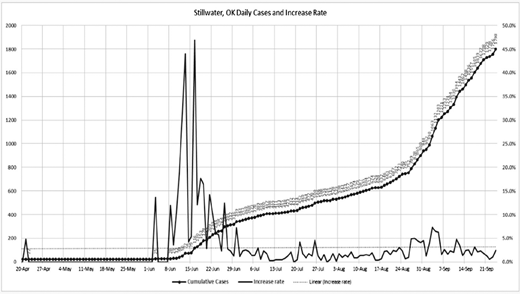
Daily Cases of COVID-19
Daily Cases of COVID-19
In May, the semester was completed with some grading policies where students had an option in their grading system between the pass/no-pass or the alphabetic grade containing A–W. The organization still ran summer courses with online fee waiver along with textbook buybacks, Cowboy Cares Emergency Grant, several online surveys asking the situations and opinions regarding the pandemic, sharing free food or masks, and virtual celebration of our graduates.
What about now?
In fall 2020, some courses went fully online while others gave the option for face-to-face classes. During the semester, one day my neighbor who is an instructor at the university sometimes shared his story about losing the video lecture that he spent several hours for recordings, and it got deleted due to some systems errors or unknown reasons. It sounded very frustrating, but he put his patience for recording the same lecture several times again and finally he was successful. We all were frustrated sometimes but tried to do what we could do with the given situation.
One of the benefits of the pandemic is that most students and professors were able to figure out how to use instructional technology as it needed to be used for learning and teaching. I became more active to learn or teach by opening a blog, searching for and creating online interactive games by utilizing new tools such as Match-up, Canva, Padlet, Educaplay, and Simplebooklet. It is impressive to learn how many fun online tools are available for supporting learning and teaching.
Among many tools, the usage of Zoom dramatically increased while using some other tools such as Google, Microsoft, or Whatsapp. The upgraded version of Zoom has been purchased for conducting projects, meetings, and courses. Sometimes, we have fun through learning some fun features to interact with each other. Thankfully, any technology needed to be used was available at work. Additionally, many other things were provided like mental supports, educational resources, and basic physical supports like food, masks, and tests.
Overall, I was able to feel grateful being in this area with people together. I saw many people saying it is okay because we all face this pandemic for the first time, so we are just all learning together. One of the professors said that currently educators are like people who are riding a bike and fixing it at the same time. While riding a bike, we are learning how to fix it by helping each other. With this pandemic situation, the impact could be very different to each person—a single mom is thankful for working from home while spending time with the kids; some people are stressed getting used to online classes for designing and taking courses. A lot of educators including students surrounding me seemed to learn how to deal with teaching and learning during this pandemic. We miss seeing each other so much in the classrooms or at meetings, but still we are trying to do what we can in the best way we know how: by supporting one another.

