


The academic library has always provided electronic access to the majority of its available services to its patrons. Reference, research, instruction, and some library materials have been available online for more than a decade, but face-to-face interactions with faculty and students still defined the services and communication strategies of the academic library. After campus closure in March 2020 due to COVID-19, academic libraries were forced into a complete remote environment. Library personnel worked together to expand and improve upon online services. Departments using paper-based processes and local digital storage learned to use cloudbased computing. All personnel became accustomed to communication through multiple, layered channels. Eventually, through the creative collaboration of library departments, we managed to design processes to provide most services to patrons so that research and course work were minimally interrupted.
Introduction
Organization/System
The university library system provides study space, educational support, and research materials for students, faculty, and staff at the institution.
The campus library is one element in a larger academic system. The library responds to needs ranging from national, regional, state, and local accreditation requirements, to administrative expectations for compliance, to academic program instructional and access expectations, to professors’ assignments, to individual student expectations for educational resources and spaces, to technology support.
With the outbreak of COVID-19 in March 2020, the educational landscape of the university shifted from one based on face-to-face connection to one driven solely by remote connectivity. Unprecedented expectations for library operations driven by the system demand during the pandemic needed to be met with mental dexterity and agile responsiveness. We needed to design the plan while living and working it. As such, the library pivoted toward operations to continue its mission in a remote world. In this article we present a description of the pandemic-driven changed system needs and the libraries’ use of technology to respond to those needs.
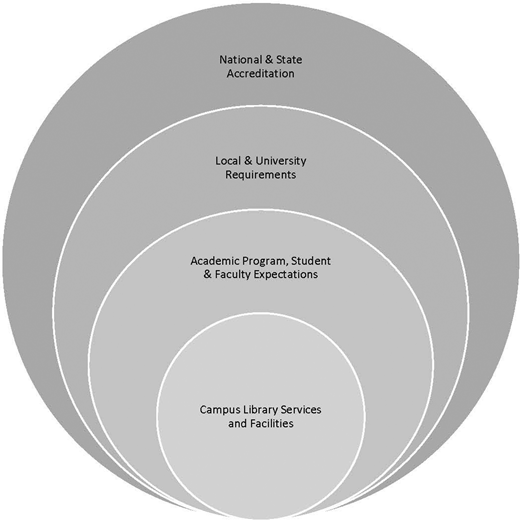
Depiction of the Library’s Central Position as a Campus Service
Depiction of the Library’s Central Position as a Campus Service
Description of the System
Our library is the main academic library on the campus at a mid-sized university in the Southeastern United States. Library faculty collaborate with library staff in multiple library departments and the library dean to guide policies and procedures to achieve defined outcomes. Library methodologies also operate collaterally with faculty, student, campus information technology, and higher administration expectations. Additionally, library operations rely on services of outside agents who provide online and physical items, such as educational materials, vendors, and print materials. It was within this traditional, well-designed system that pandemic operations were developed, with little to no disruption of services to students and faculty. In this narrative report, the public services functions of the library are considered to be a central component of the system.
It became the responsibility of library administration to ensure that library services continued to the best of our ability while working remotely. Considering the vast planning and decisionmaking sessions in which we engaged, we needed to collaborate daily to identify resources and strategies for continuing our work. We needed to operate as an Informed System: a system that “recognizes an organization as a knowledge ecosystem consisting of complex interactions among people, process, technology, and content” (Somerville et al., 2019, p. 1).
Continued operation as an informed system was needed to keep employees in touch with one another, especially for situations that, under normal circumstances, could be solved by a drop-in office visit. Use of educational and communication technologies was varied and complex within library departments. A clear division of use emerged between mobile/ cloud-based service users and those who relied on hardware storage and desktop computing.
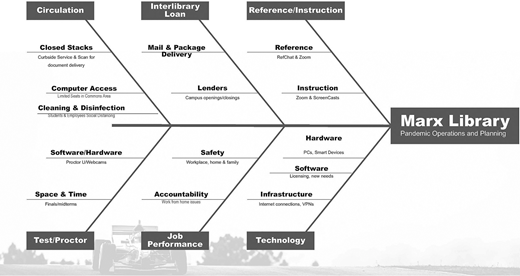
Fishbone Diagram Used for Planning Pandemic Operations
Fishbone Diagram Used for Planning Pandemic Operations
While some librarians and staff were more familiar using cloud-based technologies to support instruction, others used desktop computers and local hard drives for backup and shared storage. Cataloging, purchasing, and processing materials tend to be individual activities guided by specific library protocols. At the onset of work from home operations, these differences in communication and workflow habits made it difficult to collaborate on pandemic policy development between departments. For those accustomed to using Google docs to share project development, trying to use MS Word to email multiple versions of an edited document led to frustration and breakdowns in communication.
In addition to a new reliance on cloud-based computing technologies, library faculty began to more heavily rely on technology that allowed for alternative delivery of instruction and research assistance in order to meet the needs of the discipline and course level. Liaison Librarians are embedded in Canvas modules and provide instruction and just-in-time support for students. LibGuides are online research guides developed by librarians to direct users to relevant research materials, texts, and streaming media, as well as provide traditional information literacy instruction such as tutorials on accessing library resources, avoiding plagiarism, citation guidelines, and bibliographic management. Librarians use Camtasia, Panopto, Screencast-o-matic, and YouTube to create asynchronous instructional materials. A small number of librarians use Zoom to provide synchronous online library instruction.
Finally, proprietary chat software is used to support online reference. It became clear that a single kind of technology or communication strategy was not enough to communicate with or meet the needs of library employees or patrons; we needed to employ a layered approach using multiple tools. Communication technologies routinely used by all library employees include email, text messaging, and Google chat, although Google chat is only used by a select few.
Monthly Summaries
March and April
Equipping and forming phase: In this phase, we were focused on determining hardware, software, and infrastructure needs for staff and professional librarians to continue serving the campus population remotely. As previously noted, we needed to shift many of our traditional face-to-face services to remote. Additionally, many “back of the house” services such as interlibrary loan and acquisitions were only available on computers in the physical library building. While professional librarians did have access to the internet, home computers, smart devices and phones, a surprising number of library staff did not.
Our first steps were to equip staff with software, hardware, and infrastructure. Available laptops and webcams were issued, and VPN requests were initiated. The campus computer center was inundated with VPN requests so our requests were delayed. We prioritized laptop and webcam assignments to those with an immediate need to provide online services such as reference and instruction. Those employees using locally stored network drives had to wait for VPN approvals and set up before they could access some documents. For those using it, Google Drive facilitated a smooth and seamless move to online work. A small number of employees live in rural areas with slow or spotty internet. The library purchased and issued personal wireless devices to assist with this problem. After hardware, software, and infrastructure issues were solved, we began the work of sustaining our network of operations. At this time, other agents in the system, such as university administration, faculty, and students, began to make demands for services.
May/June/July
We had moved past triage and most employees were harnessing the same tools in new ways to establish new services. A growing demand for access to the physical collection prompted collaboration to come up with ideas to solve this problem. Interlibrary loan clients, on site robust scanners, and Google forms provided a solution. Using these technologies and with onsite staff, we were able to provide contactless curbside service to our patrons. Fall reopening planning began, and we regularly used scheduled Zoom meetings, Google chat, and email. More employees were using Google Drive to store, create, and collaborate on projects.
August
As the fall semester began, we deployed plans for extended services and continued to evaluate their efficacy. At this time, instruction librarians began to harness new technologies and ways of providing instruction due to the continued need for remote instruction. As librarians, faculty, and students began to experience Zoom fatigue, many librarians began to rely on technologies that allowed them to create asynchronous instruction strategies and deploy them using the university’s learning management system.
September/October
Explored ways to safely open additional spaces inside the library and still maintain adherence to university COVID policy. Relied on technology such as Google Forms to coordinate head counts inside the library and to manage movement of patrons in the spaces.
Summary
With the closure of campus in March 2020, the academic library was forced to quickly adapt many of its traditionally face-to-face services to a completely remote environment. While we experienced issues, many rooted in hardware and software access to staff unfamiliarity with current technologies, our library was able to move its services online with very little interruption to our patrons and university community. Working as an informed system, and due to increased exposure to multiple communication channels, we were able to discover new ways of delivering instruction and materials.

