


There are seminal moments in the life of an institution when it is highly susceptible to disruptive historical forces. COVID-19 has presented an unprecedented singularity for higher education institutions and K–12 schools throughout the world. Private not-for-profit universities in the United States provide a unique perspective from which to view the impact of the ongoing pandemic posed by COVID-19. U.S. tertiary institutions have been in a state of tension; some would argue a largely existential threat (Christensen & Eyring, 2011). One of the main causes of this threat is the explosion of online and distance-based course and program offerings (Christensen & Eyring, 2011). Additionally, lowering student enrollments, a tightening market for higher education degrees, competition from for-profit distance-based institutions, and a social perception that student debt is a challenge to student’s social mobility have all contributed to this context. This sobering reality has been described as “peak higher education”—a situation where the U.S. higher education market (student demand) has reached the highest level that U.S. institutions can support (Alexander, 2013; Harris, 2018).
Webster University is classified as a large masters granting private not-for-profit university (Carnegie Classifications, n.d.; National Center for Education Statistics; 2017). The institution has a home or central hub campus in the Midwestern United States and enrolls approximately 9,700 students (National Center for Education Statistics, 2017). The university exists on four continents with actual campus locations as well as affiliated partner campuses. Students attend classes online or at one of the 60 military or metropolitan campuses across the United States. Students also pursue Webster’s programs from more than eight international campuses in Europe, Asia, or Africa as well as affiliate campuses. More than 6,000 students (71%) are graduate students (National Center for Education Statistics 2017). There are, however, substantive undergraduate populations on the central hub campus as well as in other global campus locations (U.S. News, 2020).
Statement of Purpose
In this conceptual paper, I examine the pathways through which Webster University, an innovative Midwestern university, deals with the continuing challenges posed by COVID-19 during March to September 2020. With a unique mix of distributed regional U.S. locations and international campuses, Webster University offers a distinctive case study of distance education and distributed communication in the global education context. Distinctively, Webster University has deepened distance learning to protect the core programs and student service offerings of the institution. Distributed communication has been rapidly standardized and organized to meet institutional responsiveness to global stakeholders. And the net effect of these two approaches has been an ongoing transformation of instructional delivery, operations management, and communication across the institution.
The purpose of this case study is to analyze the multiple points of impact caused to the academic mission of the institution caused by COVID-19. By applying a systems approach to the operations and communications engagements prior to and during COVID-19, the case study reveals rapid and ongoing change. The focus of my analysis are personal journal notes, excerpts from select institutional communications, analyses of rapid response surveys and other content analysis. The data was collected from March to September of 2020 during the ongoing COVID-19 global pandemic. The case study is further informed by the scholar’s perspective. “A view from the middle” that of a faculty member and department head at one campus location.
Prominent themes in this study include tensions around institutional learning and knowledge management that has been applied to stabilize educational service offerings. Deepening distance learning modalities to meet student learning needs also figure prominently. Attempts to foster institutional resilience through operational shifts toward remote work is also a prominent theme. The rapid engagement of focused communication across a distributed network in order manage institutional shifts also figure prominently. Finally, a reliance on an elastic team-based deliberative process for decisionmaking and institution listening also emerge as important to institutional viability.
Theoretical Framework
In this analysis a systems approach is helpful to understand the way in which COVID-19 has affected the operational aspects of the institution. As a distributed entity, a systems approach allows for an investigation of one part of the institution or the whole institution.
Crisis management theorists argue that a crisis response network is “necessarily a learning system” because it depends upon the ability of its participants to generate valid information, facilitate informed choice, and foster timely commitment to action (Comfort, 1988). As argued by Moynihan a basic objective of crisis management is “to accumulate wisdom by learning together from the event in order to prevent, lessen the severity of, or improve upon responses to future crises (Moynihan, 2008; Ndlela 2012). (Chaparro, 2012)
A second lens is to apply a transactional theory of distance learning to explore the instructional arrangements within and across the institution, as well as from the engagement of the faculty, support staff, administrative systems, and the students.
The Institution
As an educational entity, the institution functions in multiple subsystems. These interacting systems are first defined by the geographically distributed regional U.S. campuses. Such campuses include locations in Missouri, Washington DC, South Carolina, California, Texas, Arkansas, Florida and other locations. These are complemented by campuses at military locations across the United States. The international campus network extends from North America to Africa, Asia, and Europe.
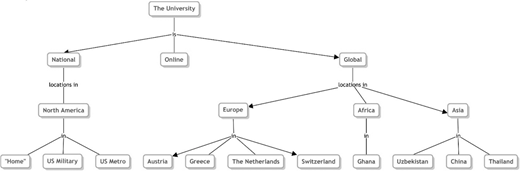
The distinctive geographic reach of Webster University extends to a population of online students across the world who take courses exclusively through distance-based instructional systems. Yet many retain some connection to nearby local or regional campuses. The compelling challenge of COVID-19 at Webster University is that even with these structures already in place, there was a great deal of logistical, curricular, and behavioral shifts that the institution needed to make.
Webster University has taken steps to identify more clearly as a global institution. Since the mid-2000s. its leaders created a new strategic framework that was built around a shared global vision (Webster University Strategic Framework) across its distributed campuses and student populations. Faculty was encouraged to leverage the global network to create shared programs across the institution, a mainstay being the undergraduate general education core called the “global citizenship” program. Similarly, faculty and staff travel across the campuses through a distinctive global leadership academy. In addition, there were several transnational programs like the global MA and the global MBA. The institution has been leveraging the international network to stimulate study abroad programs and a distinct system of international exchange programs through its Windows Internet Name Service network.
This articulated focus on mission and commitment to adaptability (Tamashiro, 2011) in some ways prepared Webster University to attend to the challenges of COVID-19. It has been working to redefine its concept of classroom space around which a university functions. As a result of the globally distributed campus network and the international student reach, classroom spaces for certain segments of Webster University were already virtual and fluid.
Discussion
Technology for Administration and Instruction Pre-COVID
One of the challenges posed by COVID-19 is the extent to which other parts of the institution could leverage the global identity to continue the core functions of the institutions across multiple jurisdictions and borders. Webster University has had a long period of entrenchment of technology for teaching and instructional development. This is a fact of the current geographic DNA of the program as well as the longstanding online programming.
The institution has long made a commitment to distance learning. It is one of the early adopters of online learning programming in the United States (Tamashiro, 2011). Its approach to distance learning has primarily been asynchronous program delivery via the internet. Since the mid-1990s, the primary delivery platforms for instruction at Webster University have been a learning management system (LMS). Currently the primary instructional LMS is Instructure Canvas. Prior to COVID, the university had been investing to a lesser degree in a synchronous model branded as WebNet+. In this model, video conferencing systems were used to deliver more asynchronous courses and programs.
There were also many on-ground class sessions delivered at regional and global campuses. When the pandemic struck, the university had already been offering courses in a hybrid format using video conferencing. These offerings allowed the university to bridge small groups of students across multiple campuses into a single viable class that was taught via synchronous video conference from anyone (or more) of the campus sites.
From an instructional systems perspective, different subsystems within the institution were in different states of instructional technology adoption and penetration prior to COVID-19. For the purposes of our analysis, we will examine two main categories: administrative and instructional. Other important areas would be management and communication. However, these more functional areas of management of communication are embedded in the administrative and the instructional process. See Table 1.
Monthly Summaries
| Pre-COVID | Since COVID | |
|---|---|---|
| Administrative |
|
|
| Instruction |
|
|
However, aspects of the administrative system were not as heavily deepened in terms of technology. Webster University was only in an early to midlevel adoption stage in terms of providing effective remote institutional supports prior to COVID. In part because of the enrollment shocks of over the last 10 years, the University had built out several arms and adopted technologies to strengthen its administrative supports. The three main arms of this engagement are (1) its online support center, (2) a collaborative task-force system for crisis management that (3) communicated via the LMS.
It would be appropriate to examine these interactions in the sense of geography. We could also look, for example, at the global “institutional” system, The midlevel “academic” unit, the departmental unit. to some extent, that is taken into account in our analysis. However, the dataset emerges from an analysis from the middle. So, the researcher’s perspective is shaped by this position. In that case this is a limit of this study.
Conclusions (Final Summary)
Organizations as distributed and diffused as ours rarely change quickly. However, Webster University has been able to centralize communications and rapidly develop more centralized tendencies. A herculean (but laudable feat) considering the circumstance.
Although often criticized as slow and resilient to change, Webster University’s case demonstrates that faculty can shift relatively quickly toward effective remote teaching flows and adopt digitization.
In some sense faculty agility demonstrates a more rapid and wider shift around instruction when compared to administrative changes around management and operations.
Engaged leadership is the core of all crisis management and institutional transformation.
Diffused and democratic systems can lead change and transformations from the middle and below.
Similarly, diffused and distributed systems can see leadership shifts from the periphery (global campus network) lead to deeper leadership changes at the core.
As a learning system Webster University has been able to move swiftly and with agility. We are still cautious about how these moves have affected institutional stability.

