


In this article, the authors discuss virtual teaching and how it affects teacher candidates and education program providers. This is significant not only because of the opportunistic nature of virtual teaching experiences, but also because the 21st century requires media-literate educators. The article puts forth helpful insights into virtual preservice teaching of interest to various constituent groups; whether they are in high school, in college, teachers, or have any interest in the state of education as it relates to today’s technology-engrossed classroom.
BACKGROUND
A lack of adequate quality placements for preservice teachers is an issue that is seen nationwide. Accrediting bodies, and sound educational practice, prescribe experiences that teacher candidates need before they have their own classroom. A progression of experiences from observation, to small tasks, then all of the way through full class responsibilities is the norm over the course of their preparation. When schools in less densely populated areas are training large numbers of teachers, this becomes a challenge for education program providers.
The study described below took place in a southern state university of approximately 20,000 students on the main campus and another 3,000 on satellite campuses. The school of education at this university graduates over 300 students each year in teacher education programs. The university is located such that there are only two high schools, five elementary schools, an intermediate school, a middle school and a junior high school. With approximately 700 juniors and seniors looking for field placements, along with graduate students, those ten schools cannot handle the number of placements needed. Additionally other universities around the state and across state borders look for placements in this area. This university has had to branch out to placements up to an hour away from the campus to attempt to find necessary experiences for the students. Placements that far away add burdens on teacher candidates; while the public transportation system in/around the university is efficient enough for teacher candidates without their own vehicles to get to their placement schools, many teacher candidates placed outside the city limits struggle with gas affordability, lack of reliable transportation, and time commitments to driving.
Virtual Teaching Experience
Eight years ago, at this institution, in an attempt to address the shortage of placements, an opportunity for teaching via a virtual classroom experience was initiated to supplement, and even replace, some of the field placement hours. Teacher candidates had the opportunity to teach lessons to five avatars who each have their own backstory and personality, and who were controlled by a human interactor in real time. Three years ago, the institution took control of the performance of the virtual experiences from the parent company as a licensed provider. At that time, the school of education hired a half-time coordinator of the virtual classroom and a number of student workers to serve as the actors behind the virtual classroom avatars. This augmented the part-time retired principal that was already in place to help facilitate the operations of the experience.
Students enrolled in the first required teacher education course, taken fall of their junior year, performed a 10-12 minute lesson. Candidates scheduled these lessons in one hour blocks with two other students, then received some feedback from the aforementioned retired principal that facilitated the lessons. Once the principal completed a long rubric and this feedback was given to the candidate to share with their instructor of the course, who was not present for the lesson, the teacher candidates could reflect on their experience. However, the instructors struggled with how to effectively use this instrument in the course, and the virtual teaching was largely thought of as separate from the other learnings of the semester as it did not fully align with the selected materials for the course.
This virtual teaching experience replaced hours out in the overloaded schools. The thinking behind this was that it was better to get an initial experience, and to perhaps make mistakes, in front of avatars rather than impacting real children in the schools. There was a weaning out of candidates after this course; many of the students lost were because of their inability to pass the state licensing exam requirements (which were required to move on to the next phase of the program). Anecdotally, the principal in the room found that a small number of the students selfselected out of their degree program based on the experience because of discomfort in teaching the virtual lesson, or in their reaction to the feedback they received.
A year into their taking over the operations of the virtual classroom, the school of education collected data regarding the students’ feelings towards the experience after their first virtual teaching session. That data collection was followed up a year later with a subsequent data collection for those experiencing the virtual classroom for a second time in their program. Below are the results of those data collections and how these data were used to inform education program providers practice and improve the experience for the students.
DATA COLLECTION
Initial Data Collection
The initial data collection described above consisted of 117 teacher candidates completing an anonymous electronic survey regarding their experience in the virtual classroom. The instrument consisted of several Likert scale questions and some open-ended questions. Students were encouraged, but not required, to complete the survey.
The majority (89.8%) reported that they strongly agreed or somewhat agreed that their experience in the virtual classroom felt like a real classroom (see Figure 1). These data were reinforced by conversations around the school of education in which the teacher candidates were talking about the virtual students as if they were real. Things like, “Ava took out her cell phone when I turned my back" (Ava is the name of one of the avatar students) were heard as candidates discussed their experiences. Other students even joked that some of the avatars were too capable of distraction and attitude, and that they wished to do more sessions before entering a classroom with real students. One of the avatars even made a virtual cameo in the dean’s graduation speech one year to the delight of the graduates and their families in attendance.
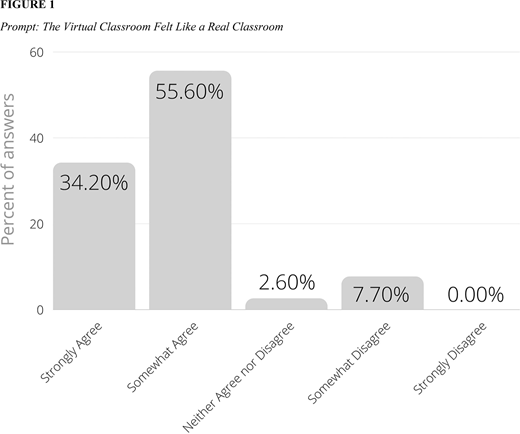
Prompt: The Virtual Classroom Felt Like a Real Classroom
Prompt: The Virtual Classroom Felt Like a Real Classroom
The majority (87.8%) reported that they strongly or somewhat agreed to feeling more confident to step into a real classroom after the virtual teaching experience (see Figure 2). This was something that the school of education felt validated the timing of this first experience as a prelude to them being inducted into a real classroom the following semester. This fact, too, excited students and professors alike; students felt more inclined to try new protocols or “attention grabbers" to the avatars, prior to interacting with real students in their placements.
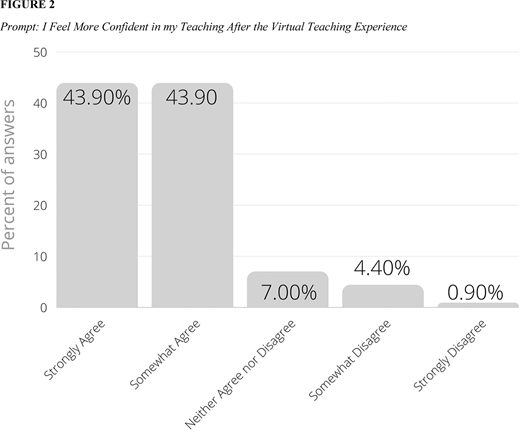
Prompt: The Virtual Classroom Felt Like a Real Classroom
Prompt: The Virtual Classroom Felt Like a Real Classroom
The majority (87.7%) strongly or somewhat agreed to feeling more confident with the management of a classroom after having the virtual experience (see Figure 3). Since this first session was focused on the realities of different behaviors within a classroom and management of those behaviors, this was important information. For the first session, the lessons were provided by the department thus removing a foundational piece of the responsibilities of the teacher candidate. This allowed the candidate to focus on delivery of the lesson and managing of behaviors, and not the variable of how well-prepared the lesson plan was for implementation. The school of education team worked hard to have structures in place to simulate some of the more common off-task behaviors one would see in a classroom, including a range of off-task behaviors like spacing out, talking to a classmate, taking out a cell phone, and even falling asleep. The actors controlling the avatars were trained to evoke these off-task behaviors when certain teacher behaviors existed. For instance, if a teacher candidate was only talking to one side of the classroom a student on the other side of the classroom would fall asleep.
Prompt: I Feel More Confident in Handling Behavior Management Issues After the Virtual Teaching Experience
Prompt: I Feel More Confident in Handling Behavior Management Issues After the Virtual Teaching Experience
Qualitative data were also collected from this instrument. Some telling comments were made, in reaction to these open-endedquestions, that informed conversations with the teacher candidates:
To teach real students, you must be a fast thinker. You must be able to react professionally to any situation.
Kids take longer to answer questions than me. I need to slow down.
It showed me how every lesson will not go smoothly and that I have to know how to react and respond to certain situations that may occur or interrupt.
It reminded me to continue to keep all students engaged at all times.
We cannot be prepared for every situation in the classroom but with the behavioral aspect, I feel confident going into the classroom after the experience.
Conversations around wait time, adaptability, engagement and preparation were now seen by students in a more concrete light. Instead of hypothetical scenarios described by instructors, the teacher candidates saw these topics come to life in their own lessons in the virtual classroom, as well as the ones they observed with their classmates sharing the same hour block.
The department felt that this data reinforced the resources and efforts that were poured into the virtual classroom as a part of the field experience preparation for the teacher candidates. The practice, for the first few years, was to have the students do another session during the spring semester of their junior year. The experience, as first modeled, was exactly the same as in the fall. They did the same lessons to the same virtual students and, although the interactors are trained to not give duplicative experiences, the teacher candidates may have received very similar experiences based on their professional growth in behavior management. The following spring another similar data collection was performed to seek information about the experience a second time through.
Second Data Collection
It is important to make clear that the data presented here in the second data collection is a different cohort of students than those that were the sample for the first data collection. Hence, this research is not to be compared with the earlier data in a way that analyzes changing attitudes of a particular group of students. Rather, this data was analyzed to assess the second experience in the virtual classroom, as it was completed in the spring semester, along with actual field experience in K-12 schools. This collection yielded 130 candidates that completed the survey. The results this time were not as positive as in the first data collection.
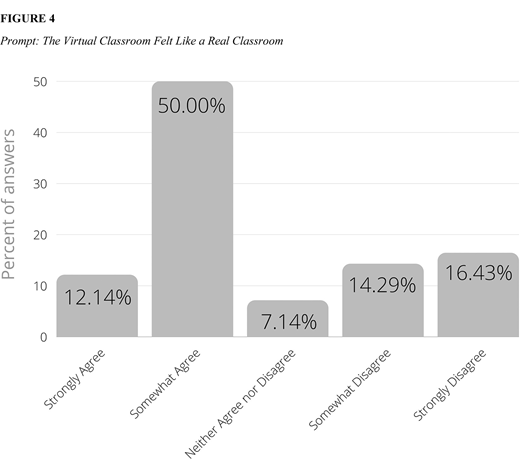
In this data collection only 62.14% of the respondents strongly or somewhat agreed that the virtual teaching experience felt real (see Figure 4). This could be for a couple of possible reasons. It could be that after having a first experience where data indicated it felt realistic, a second experience was less so. Perhaps, more likely to be the case, is that these students have now also performed field experience hours in an actual K-12 classroom. When comparing the virtual experience with the actual experience, these candidates may have seen the difference.
Prompt: The Virtual Classroom Felt Like a Real Classroom
Prompt: The Virtual Classroom Felt Like a Real Classroom
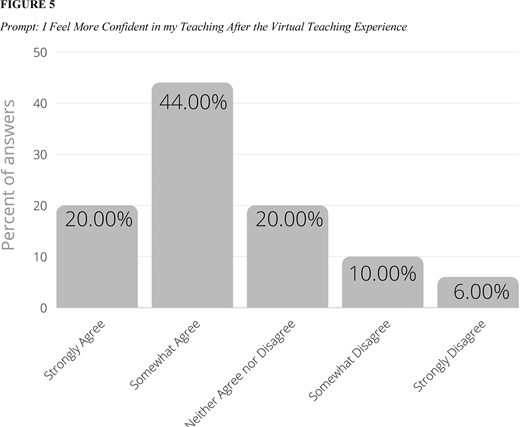
When asked if they are more confident after a second virtual teaching experience only 63.85% indicated that they strongly or somewhat agreed that they were more confident in their teaching in general (see Figure 5). While still a substantial percentage, it appears that a second experience is less impactful than the first-time experience.
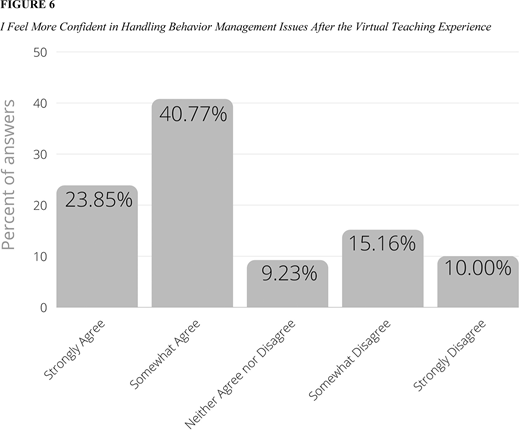
Sixty-four point sixty-two percent of the students in this data collection reported thatthey strongly or somewhat agreed that they felt more confident in their classroom management abilities after a second virtual teaching lesson (see Figure 6). It is understandable that the second time through the same experience would have less of an impact than the first. The duplicity of the experience was troubling to the researchers, and this was investigated further.
Along with the Likert scale data, qualitative data were also compiled. Some powerful statements that came out of these open-ended questions are listed below:
Along with the Likert scale data, qualitative data were also compiled. Some powerful statements that came out of these open-ended questions are listed below:
This was my second time so I’m a little more confident than I was before.
We already have a tremendous amount of work to do. Adding more mandatory assignments will only escalate the stress level.
I would like to practice lessons that could be used in my classroom that I am student teaching in.
From these and other similar responses it was evident that in order to optimize the experience for the second time, thorough adaptations needed to be made. Simply replicating the same exact experience wasn’t as helpful as it could be. Narrowing in on the last comment listed above, students felt the desire to create lessons that were relevant to them and their future students. With this data, and many conversations with students and instructors, some key elements emerged.
Students were ready to make and try out their own lessons.
Instructors wanted to be able to be a part of the feedback loop.
The rubric that was being used was cumbersome.
The level of difficulty needed to be enhanced for the off task behaviors.
In order to address these areas in need of improvement it was clear that better communication was necessary. It was important to get the instructors on board with the value of the experience. This required some work to be done in soliciting feedback and visiting classrooms to have conversations with all parties involved. From these conversations several important changes were made.
MODIFICATIONS
The first change was to modify the format of the second experience. Instead of duplicating the same lesson that was furnished for the candidates, they each created their own lesson. This second virtual lesson was now a place to try out their own lesson plan that they could eventually be delivering to actual students in the K-12 classroom. Instead of simply an exercise, this was now an opportunity to practice before a high stakes lesson. This required some changes in protocol to help the facilitator and the actors prepare. The actors now had to be familiar with 300 different lessons rather than seven stock lesson plans that they saw repeatedly and knew well. To ensure the actors were prepared, a layer-of-submission for the lesson plans (a week ahead of the scheduled lesson) was added. It was challenging when candidates did not adhere to this, and protocols had to be instituted with a heightened level of scrutiny on the lesson plans and the professional responsibility of submitting them.
Because the target of the experience changed so greatly in scope, a better rubric was needed. The old, cumbersome rubric was abandoned and replaced by a scaled down version of the instrument that is used in the K-12 classrooms to evaluate teachers of record. That instrument was simplified to include only items about planning, delivery and management of the lesson. The new rubric had fewer items, which allowed for more focused feedback in the room by the facilitator and retired principal. This took training for the facilitator and the instructors to become comfortable with the new instrument and how to optimize its use.
Another large undertaking was to implement a recording of the lesson. The video recording process came in phases. At the beginning of this implementation there were restrictions about showing anything proprietary to the company that built the software; they were understandably concerned with someone stealing their work and creating their own. Initially, recording only the teacher candidate was allowed, so a small GoPro camera was focused away from the screen where the avatars were and only on the teacher candidate. This allowed for a good starting point to work out the details of the recording of lessons. After a couple of iterations and upgrades to capabilities and permissions, the lessons are now recorded via a screen capture that allows a split screen video with the avatars on one side of the screen synched up with the teacher candidate performing the teaching of their lesson on the other.
RAMIFICATIONS
Ramifications on Teacher Candidates
The recordings of the lessons are now used for the candidate to self-reflect on their own teaching and for their instructors, who are not
able to be in the room for all of their students, to be able to give feedback. They are being used in various ways depending on the instructor, but the high usage instructors are meeting with students and watching the lessons together. This is a very powerful experience for the teacher candidate. They also can use this video as an artifact of evidence for their completion portfolios and to show potential employers their teaching ability.
Overall, the feedback received from the teacher candidates speaks to the powerful impact virtual teaching can have on classroom management skills, lesson planning, and professional growth. The avatars’ displays of off- task behaviors are a testament to how important mastering effective classroom management is to preservice teachers. Lesson planning for the virtual teaching experience provides the teacher candidates with a couple of opportunities; first, the ability to teach lessons that were not designed by them. Second, the ability to practice writing and implementing age-appropriate lessons. Lastly, and perhaps the most lasting impact the virtual classroom demands, is professional growth from the teacher candidates. Aside from the obvious teaching of the students, the teacher candidates also collaborate with their peers, professors, technology, and must challenge themselves as educators to get the full scope of the experience. This kind of collaboration and growth are critical in the formation of effective teachers who know how to communicate with students, parents, colleagues, and administrators.
Ramifications on Education Program Providers
This tool is impacting how our university, and those for whom we provide this service, approach field experiences for teacher candidates. Two important ways that this is so, is in the practice for teacher candidates before getting in front of real children and in the targeting of missing experiences available in placements.
While only a simulation, the use of the virtual classroom experience before going out to the brick and mortar schools allows for some common mistakes to be made, and addressed, in front of the virtual students rather than real students. Not only does this have the benefit of not adversely impacting real children, but it also maintains strong relationships with K-12 partner schools where such mistakes could damage these relationships.
Depending upon how densely populated the area that an education program providers serves is, availability of certain experiences can be problematic. For instance, it is challenging for some universities to provide experiences with English Language Learners, or students with a particular learning disability that teacher candidates are expected to get experience with prior to becoming a licensed teacher. The virtual classroom scenarios and avatars can be adapted to fit the specific needs of the universities and teacher candidates.

