


Leverage AI tools
According to Schmelzer (2019), approximately 47% of learning management tools will be enabled with artificial intelligence (AI) capabilities by 2024. For seasoned educators, it is their first experience using AI technologies in an online learning environment, and they may not have adequate knowledge and skills to manipulate these AI applications (Guerrero-Roldán, Rodríguez-González, Bañeres, Elasri-Ejjaberi, & Cortadas 2021). Likewise, newly minted educators may not be digitally ready to use AI-driven educational applications for teaching and learning purposes (e.g. Ally, 2019; Seo, Tang, Roll, Fels, & Yoon, 2021). In other words, not all educators have the technological background and experience to operate different AI-driven equipment and systems (Ng, Leung, Su, Ng, & Chu, 2023). In fact, online faculty may lack technological experience to conduct data analysis, or to set rules to automatically generate assignments and feedback for students via AI-driven tools (Seo et al., 2021). Nevertheless, there needs to be a conversation about leveraging AI tools to align them with online faculty's instructional methodologies, educational philosophies and pedagogical competencies. First, when online faculty incorporates various instructional methodologies into their course content, they should ensure that the integration of AI tools (1) builds knowledge and solves problems together in collaboration with other learners; (2) focuses on shaping a comprehensive learning community; (3) uses different virtual lectures and digital classrooms (4) involves interactive, independent and accessible learning (Laksana, 2020). Next, from an online faculty's perspective, the use of AI tools should strengthen their level of confidence, creativeness and competence. As it relates to educational philosophies, online faculty should continue to bring their educational worldviews and instrumental values to the learning environment because it will enable them to cultivate a more authentic learning experience. Meaning, online faculty should continue to provide authentic, real-world activities that encourage students to think innovatively, instinctively and intuitively. Lastly, as online faculty demonstrate various pedagogical competencies, their knowledge of pedagogy and curriculum design can enable them to foster active learning through problem-based alternative assignments and performance-based assessments (Archambault, Leary, & Rice, 2022). Therefore, when leveraging AI tools, it provides an opportunity for online teachers to explore the following: (1) Does the AI tool adopt a framework that ensures academic integrity? (2) Does the AI tool enhance existing assessment viability? (3) Does the AI tool monitor course content for credibility?
Model academic integrity
Modeling academic integrity will strengthen accountability for online faculty, reinforce credibility for students and create more transparency for the institution. Strengthening accountability is essential for online faculty to incorporate an academic integrity-based framework within their course curriculum and course content. Meaning, online faculty should revisit their institution's academic integrity policies and acceptable use policies to ensure best teaching practices. The reason online faculty should model an AI-based framework is that it will reduce problematic concerns and cyber security issues. In fact, modeling an AI-based framework is important because it ensures academic integrity, enhances cyber security and improves application tool validity.
Specifically, establishing an AI model reduces potential risks and conflicts such as privacy concerns, changes in power structures and excessive miscommunications between students and teachers due to misunderstanding or misleadingness (Seo et al., 2021). In fact, Seo et al. (2021) warned that AI could give unreliable recommendations, which may negatively impact students' performance, especially when teachers solely rely on AI-driven technologies to predict and assess students' learning outcomes. Next, AI-driven platforms can misunderstand users and offer misleading suggestions for learners (Seo et al., 2021). For various users, the sacrifice of using such technologies, whether in terms of accuracy and reliability, privacy, misconduct, fee risks or other metrics, is a significant consideration (Al-Abdullatif and Alsubaie, 2024). In other words, the degree to which users perceive these risks may influence their understanding and knowledge of AI – a concept we refer to as AI literacy. For this reason, online faculty should ensure that the AI tool exemplifies best practices as well as fosters academic integrity and academic excellence.
Measure AI-driven tool validity
According to recent research, AI-driven tools have become more teacher-focused and help teachers identify effective pedagogies based on students' learning data, automate operational tasks, generate assessments, automate grading and feedback, which save teachers' time and enhance efficiencies (Chaudhry & Kazim, 2022). Meaning, AI-driven systems can develop custom learning profiles for each student and customize their learning journeys and materials based on their needs, ability, preferred mode of learning and experience (Fu, Gu, & Yang, 2020). Particularly, AI-driven technologies bring opportunities for enhancing students' learning experience through intelligent tutoring, individualized learning and recommendation systems (e.g. Hwang, Tu, & Tang, 2022; Zawacki-Richter, Marín, Bond, & Gouverneur, 2019). In fact, when integrating AI technologies with assessment practices, teachers need to consider how AI enhances existing assessment strategies. Also, in AI-driven learning environments, teachers need to manipulate different AI-enhanced systems to design assessments and examine students' performance using their historical and current data as well as using the adaptive learning system (Guerrero-Roldán et al., 2021). Likewise, teachers who are more capable of using AI-driven technologies tend to adapt more towards the digital transformation and facilitate their teaching and administrative work (Huang, 2021).
When measuring AI-driven tools validity, it is important for teachers to be aware of the ethical concerns behind AI systems such as the potential risks and ethical and safety concerns when using AI technologies for teaching, learning and assessment (Ng et al., 2023). Likewise, since online faculty measures a multiplicity of AI application tools based on their teaching style, teaching strategy and teaching methodology, they should (1) engage in professional development workshops; (2) explore the cyber security implications and problematic ramifications associated with incorporating AI tools and (3) examine application tools associated with AI. First, online faculty should attend AI professional development workshops and/or training to utilize AI tools and resources for data protection and security awareness. Next, online faculty should explore cyber security implications associated with AI tools for risk factors that may include but are not limited to algorithm vulnerabilities, application dysfunctionalities and internal and/or external intricacies. Finally, online faculty should examine the AI application tools to evaluate and authenticate the generative data for academic integrity, cyber security and content credibility. Therefore, teachers should learn how to utilize diverse types of AI technologies to monitor learner progress, facilitate the provision of feedback and allow themselves to assess and adapt their teaching strategies (Ng et al., 2023).
Monitor content credibility
According to Ng et al. (2023), online teachers use AI to assist in designing instructional content that suits students' needs to personalize students' learning through task automation. For example, AI-driven writing assistants can evaluate and grade students' written work automatically and identify features such as word usage, grammar and sentence structures to grade and provide feedback (Ramesh & Sanampudi, 2021). In fact, teachers who understand the functions and attributes of AI technologies can adopt suitable AI applications in their classrooms to promote students' motivation, engagement or learning achievement (Chen, Xie, & Hwang, 2020a; Hwang et al., 2022). Particularly, teachers should actively introduce new concepts of smart learning based on AI and learn how to use its technology to help do frequent repetitive tasks and mechanical work (Klopov et al., 2023). Meaning, online faculty can increase student participation by incorporating test versions of AI plagiarism detectors to check written papers such as reports, theses and dissertations. Specifically, online faculty can ensure that online students submit original work with the use of the following AI plagiarism checkers: AI-Turnitin, iThenticate, Copyscape, PlagScan, CopyLeaks, GPTZero and GLTR.
AI-Turnitin is one of the most well-known plagiarism checkers used by educators and students around the world. Specifically, educational institutions utilize AI-Turnitin to ensure that the work of students is original. Equally important, AI-Turnitin's advanced algorithms compare submissions against an extensive database of academic papers, web pages and publications to detect similarities and potential plagiarism. Next, iThenticate is a product produced by the same company that created AI-Turnitin. It is a professional plagiarism detection and prevention technology designed primarily for researchers. It specializes in comparing academic papers against a massive database of over 60 billion web pages and 155 million content items, including leading journals, publications and research articles. Overall, iThenticate is known for its accuracy, ease of use and comprehensive reporting, making it a trusted tool in academic and professional communities for maintaining the integrity of their work.
Another effortless way to check for plagiarized content is through Copyscape. Particularly, Copyscape is professional plagiarism detection and prevention technology designed primarily for website and blog owners who use the tool to avoid penalization for duplicate content. In the same manner, PlagScan is an advanced plagiarism detection tool created by the same company as Turnitin and iThenticate. Even though it serves as a great alternative to Turnitin, it is not free; instead, it charges its users by word count. Also, it offers detailed reports that outline not only instances of plagiarism but also potential sources, making it easier to address issues. Afterward, CopyLeaks is accurate AI detection software with additional plagiarism-prevention features that uses sophisticated AI and machine learning algorithms to scan and compare documents against a vast database of online sources, academic papers and proprietary content. Unlike the other AI detection software, Copyleaks does not offer users an effortless way to explore its software, as it requires payment to see the results. Finally, GPTZero is an AI-detector tool that offers accurate AI detection to humanize the content. While GPTZero does not offer conventional plagiarism checks, its general AI detection is available for free and without sign-up. Lastly, GLTR is a research preview and stands for Giant Language (Model) Test Room. Specifically, the GLTR tool has direct access to ChatGPT-2 data, and as such, it works great for content generated with older versions of ChatGPT (2019). Thus, monitoring content through multiple AI-generated detectors will strengthen content credibility, enhance content sustainability and improve content validity.
Conclusion
To meet the 21st-century demands, online faculty should explore the gaps and deficiencies of AI tools, model an AI-based framework that exemplifies academic integrity, measure AI application tools to ensure that they are value-based, character-based and authentic-based and monitor AI-generated content for credibility, sustainability and reliability (see Appendix). First, exploring the gaps and deficiencies of leveraging AI tools requires further research. Secondly, modeling academic integrity requires that online faculty establish an AI-based framework to strengthen academic integrity, enhance cyber security and encourage accountability. One way to strengthen academic integrity is to incorporate AI policies and integrate AI privacy guidelines into the course curriculum. Another way to strengthen academic integrity is to remain palatable to technological advancements, pliable to educational pedagogies and practical to AI functionalities. Likewise, to enhance cyber security, online faculty should attend workshops, webinars and seminars to discuss potential risks, ethical concerns and security concerns. In the same manner, to encourage accountability, online faculty should proofread AI-generated content for accuracy to ensure the integrity of the assessment. Thirdly, measuring AI application tool validity requires online faculty attend professional development workshops, address AI-generated applications limitations and adopt strategies that will strengthen application reliability, enhance application viability and improve application credibility. Lastly, monitoring content credibility requires online faculty to design instructional content that engages active learning, elevates critical thinking and enhances decision-making skills. Therefore, to remain relevant with 21st-century technologies, online faculty should cultivate a learning environment that empowers students to think innovatively, instinctively and intensively.
About the authors

Appendix AI-based framework
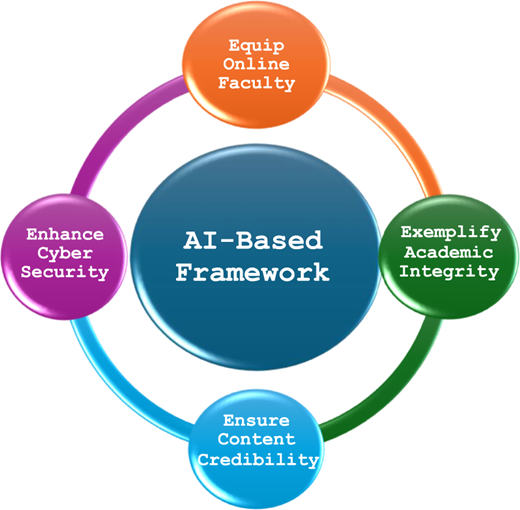
Source: Created by author

